


jeudi, 01 mars 2012
Poutine sera réélu par le peuple russe pour le Bien de la Russie et de l’Europe !
Poutine sera réélu par le peuple russe pour le Bien de la Russie et de l’Europe !
Par Marc Rousset
Ex: http://infonatio.unblog.com/
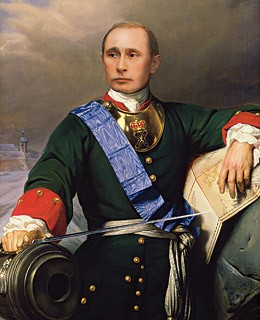 Monsieur André Glucksmann, obsédé par Vladimir Poutine, le contre-modèle exemplaire de ses rêves politiquement corrects et droit de l’hommistes, n’hésite pas à écrire dans une chronique du Figaro du Vendredi 24 Février 2012 : « Poutine réussira-t-il la falsification administrative des élections présidentielles ? Devra-t-il fomenter une épidémie d’attentats attribués à d’imaginaires ennemis pour mieux réprimer les contestataires ensuite ? Ou pourquoi pas, lancera-t-il une expédition militaire, genre deuxième guerre de Géorgie, afin de s’imposer comme l’homme fort et insubmersible de la Russie ? »
A noter que Monsieur Glucksmann n’est pas à une contre-vérité près car les faits et les enquêtes impartiales de l’Union Européenne démontrent que c’est bel et bien la Géorgie du jeune, inconscient et fougueux Président Mikhaïl Saakachvili qui a commencé en Aout 2008 les hostilités militaires en Ossétie du Sud et les a terminées dans une totale déroute.
Or, le jeudi 23 Février 2012, devant une foule réunie dans le stade moscovite de Loujkini et évaluée par les autorités à 130 000 personnes, Poutine a montré au monde que les mouvements d’opposition peinent à trouver leur second souffle. « Désormais, il n’y aura plus lieu de parler de la révolution orange car la rue nous appartient » a pu déclarer Vladimir Bourmatov, un député de Russie unie (1). Il est probable que Poutine sera réélu avec plus de 50% des voix et non plus des scores de 71% des voix comme en 2004, mais quoi d’anormal ? Les peuples européens de l’Ouest ont-ils été reconnaissants par leurs votes à Winston Churchill, à Clemenceau, à De Gaulle ?
Poutine, l’obsession des Etats-Unis et des Occidentaux
L’Amérique veut déstabiliser et faire sauter le verrou Poutine pour plusieurs raisons. La Russie est devenue une superpuissance pétrolière respectée, à défaut d’être crainte. Poutine a brisé les rêves de Mikhaïl Khodorkovski , patron de Youkos, et ceux des Etats-Unis qui voulaient mettre la main sur les ressources énergétiques de la Russie.
Poutine veut également réarmer la Russie, immense pays richissime ouvert aux quatre vents et deux fois plus grand que les Etats-Unis avec au grand maximum 130 millions de Russes en 2050 ! Poutine veut dépenser 590 milliards d’euros d’ici à dix ans pour se protéger de la menace militaire de l’OTAN et des États-Unis. Selon le quotidien Rossiskaya Gazeta, le plan de modernisation militaire lancé il y a un an par Poutine comprendrait : construction de 400 missiles balistiques d’ici à 2022, 8 croiseurs sous-marins lance-missiles stratégiques, 20 sous-marins polyvalents, 50 navires de surface, 600 chasseurs de cinquième génération, mille hélicoptères, 2300 chars modernes, 2000 canons automoteurs, 28 régiments de systèmes de missile sol-air S400. Tout spécialiste des problèmes militaires sait en effet parfaitement que le système américain de bouclier antimissile est dirigé contre la Russie, l’Iran n’étant qu’un prétexte !
Poutine n’a pas digéré non plus l’erreur de Dimitri Medvedev qui n’a pas mis son véto au Conseil de Sécurité de l’ONU , d’où la brèche éhontée dans laquelle s’est engouffrée l’Occident en bombardant la Libye et en intervenant avec des troupes au sol dans un conflit tribal interne, en lieu et place d’une zone d’exclusion aérienne, ce qui n’est pas sans rappeler la mauvaise foi de l’expansion de l’OTAN à l’Est, contrairement aux promesses qui avaient été faites lors de la chute du Mur de Berlin à Gorbatchev et plus tard à Boris Eltsine !
Poutine s’oppose à l’intervention militaire occidentale en Syrie pour protéger les exportations russes d’armement ainsi que la seule et unique base maritime pour la flotte russe en Méditerranée !
Poutine peut enfin se prévaloir d’un succès sur le plan économique à faire pâlir d’envie les Occidentaux. La croissance du PIB devrait frôler les 4,5% en 2011 et en 2012.Le taux de chômage est descendu à 6,3% ; la dette du pays est faible, inférieure à 10%du PIB. Les réserves de change sont d’environ 500 milliards de dollars. L’inflation est à la baisse, estimée à 6,5% , soit son plus faible niveau depuis 20ans.La Russie est déjà aujourd’hui la 10ème économie du monde en PIB nominal et la 6ème en termes de parité de pouvoir d’achat. La Russie devrait être la 4èmeéconomie de la planète en 2020.
Poutine propose un contre-modèle à l’Europe décadente
Poutine a dores et déjà sauvé la Russie, mais il est d’autant plus dangereux qu’il propose à l’Europe occidentale un autre modèle que le droit de l’hommisme et l’incite à se libérer du protectorat militaire américain. Poutine a compris que le redressement, le rétablissement de la Russie passait par les valeurs traditionnelles, le patriotisme, l’Eglise orthodoxe, le sens de l’effort et du dépassement, constituant un magnifique contre-exemple pour les démocraties européennes décadentes et aveugles. Alors que les droits de l’hommistes souhaitent que la Russie s’adapte au modèle occidental, c’est bien au contraire, selon Vladimir Poutine, aux Européens de l’Ouest de retrouver leurs valeurs traditionnelles, de ne plus pratiquer la repentance. En ce sens, Poutine est le sauveur potentiel de l’Europe de l’Ouest !
Poutine est enfin dangereux car il est natif de Saint Petersburg , la ville symbole du rapprochement européen fondée par Pierre Le Grand ; il parle allemand , il a travaillé pour le KGB à Dresde et a une vision continentale européenne historique que n’ont pas nos dirigeants atlantistes actuels !
C’est ainsi que devant le Bundestag, il a pu dire :
« Si à une certaine époque, la réconciliation historique de la France et de l’Allemagne fut l’une des conditions de base de l’intégration ouest-européenne, aujourd’hui, c’est le partenariat entre la Russie, l’Allemagne et la France qui constitue le facteur positif majeur de la vie internationale et du dialogue européen.
Je suis profondément convaincu que la Grande Europe unie de l’Atlantique à l’Oural, et de fait jusqu’à l’ Océan Pacifique, dont l’existence repose sur les principes démocratiques universels, représente une chance exceptionnelle pour tous les peuples du continent, pour le peuple russe notamment…..Le peuple russe a toujours eu le sentiment de faire partie de la grande famille européenne, à laquelle le rattachent les mêmes valeurs culturelles, morales, spirituelles. »
Vladimir Poutine, Président de la Fédération de Russie
Marc Rousset, économiste, écrivain, auteur de « La Nouvelle Europe-Paris-Berlin-Moscou », pour Novopress France. http://fr.novopress.info
(1) Le Figaro du Vendredi 24 Février –« Poutine poursuit “la bataille pour la Russie” »
00:05 Publié dans Actualité, Affaires européennes | Lien permanent | Commentaires (0) | Tags : russie, europe, affaires européennes, politique internationale, actualité |  |
|  del.icio.us |
  |
|  Digg |
  Facebook
«Konservative Revolution»
«Konservative Revolution»
Publicado por edicionesnuevarepublica
 NOVEDAD
AA. VV.
Prólogo de Jordi Garriga
1ª edición, Barcelona, 2012
21×15 cms., 262 págs.
Cubierta a todo color, con solapas y plastificada brillo
PVP: 20 euros
Orientaciones:
La llamada Revolución Conservadora (Konservative Revolution) fue un fenómeno particularmente radicado en Alemania, ya que desde el final de la I Guerra mundial, hasta el advenimiento del nacionalsocialismo al poder, estuvieron activos intelectuales, círculos y grupos críticos con la República de Weimar y con su trasfondo ideológico y político, y contra la idea moderna de democracia en general.
Algunos de estos grupos y personas, procedían del neorromanticismo anterior a la guerra, principalmente los Völkischen, pero casi todos eran de nuevo cuño, e intentaban ordenar conceptos e ideas para crear un nuevo Estado, al que algunos como Stefan George o Moeller Van den Bruck llamaron “III Reich”. La experiencia de la guerra les había marcado mucho, y se vieron en la tesitura de empezar de nuevo, mentalmente hablando.
Se profesaban ideas conservadoras, aunque no hacían referencias al pasado reciente. Eran en conjunto hostiles a las ideas progresistas e igualitaristas. Pero curiosamente su activismo era de impronta moderna, eran revolucionarios porque se enfrentaban al sistema en el poder.
Era un conjunto de ideas conservadoras que planteaba una subversión contra el mundo democrático, moderno. Una aparente contradicción, pero con una lógica interna.
El término “revolución conservadora” fue por vez primera pronunciado por el escritor y poeta Hugo von Hoffmannsthal en el aula magna de la Universidad de Munich, el 10 de febrero de 1927…
[del prólogo de Jordi Garriga]
Índice:
Prólogo. Revolución Conservadora alemana, ¿simple reacción o nueva revolución?
Jordi Garriga
Prólogo al libro “Konservative Revolution”
Carlos Caballero
La Konservative Revolution en Alemania, 1918-1923
Robert Steuckers
La Konservative Revolution en Alemania, 1918-1932
Giorgio Locchi
La Revolución Conservadora rusa
Alexander Duguin
Hitlerismo y Revolución Conservadora
Louis Dupeux
Fundamentos del pensamiento bündisch
Luc Nannens
Los trotskistas del nacional-socialismo
Francois Duprat
Movimientos juveniles e ideología nacional-revolucionaria en la República de Weimar
Thierry Mudry
Las cuatro fases de la historia del Movimiento de Juventud alemán
Michel Froissard
Los Nerother, anarcas del movimiento de juventud
Bertrand Eeckhoudt
Nietzsche, Langbehn, Stefan George: las raíces intelectuales
Michel Froissard
Wolffheim y Laufenberg: los nacionalbolcheviques
Alvaro Bolaños
Wolffheim: algunas ideas
Alvaro Bolaños
Friedrich-Georg Jünger (1898-1977). La perfección de la técnica
Robert Steuckers
Moeller van den Bruck, ¿un “precursor” póstumo?
Denis Goedel
Ernst Niekisch o el nacional-bolchevismo
Clemente Simoes
El itinerario de Otto Strasser
Thierry Mudry
Arnolt Bronnen: entre el comunismo y el nacional-socialismo
Werner Olles
Lukanga Mukara: una sátira de la Alemania guillermina
Serge Herremans
Tusk: creador de un movimiento de juventud radicalmente antiburgés
Bertrand Eeckhoudt
La Konservative Revolution y sus editores
Michel Froissard
Los autores de la Konservative Revolution
Giorgio Locchi (comp.)
Pedidos:
enrpedidos@yahoo.es
Tlf: 682 65 33 56
00:05 Publié dans Livre, Révolution conservatrice | Lien permanent | Commentaires (0) | Tags : allemagne, livre, révolution conservatrice | | del.icio.us | | Digg | Facebook
Why Conservatives Always Lose
In our modern Western societies, liberals do all the laughing, and conservatives do all the crying. Liberals may find this an extraordinary assertion, given that over the past century their preferred political parties have spent more time out of power than their conservative rivals, and, indeed, no radical Left party has ever held a parliamentary or congressional majority. Yet, this view is only possible if one regards a Labour or a Democratic party as ‘the Left’, and a Conservative or a Republican party as ‘the Right’—that is, if one considers politics to be limited to liberal politics, and regards the negation of liberalism as a negation of politics. The reality is that in modern Western societies, both ‘the Left’ and ‘the Right’ consist of liberals, only they come in two flavours: radical and less radical. And whether one is called liberal or conservative is simply a matter of degree, not of having a fundamentally different worldview. The result has been that the dominant political outlook in the West has drifted ever ‘Leftwards’. It has been only the speed of the drift that has changed from time to time.
This is not to deny the existence of conservatism. Conservatism is real. This is to say that conservatism, even in its most extreme forms, operates against, and is inevitably dragged along by, this Leftward-drifting background. And this is crucial if we are to have a true understanding of modern conservatism and why conservatives are always losing, even when electoral victories create the illusion that conservatives are frequently winning.
It would be wrong, however, to attribute the endless defeat of conservatism entirely to the Leftward drift of the modern political cosmos. That would an abrogation of conservatives’ responsibility for their own defeats. Conservatives are responsible for their own defeats. The causes stem less from liberalism’s dominance, than from the very premise of conservatism. Triumphant liberalism is made possible by conservatism, while triumphant conservatism leads eventually to liberalism. Anyone dreaming of ‘taking back his country’ by supporting the conservative movement, and baffled by its inability to stop the march of liberalism, has yet to understand the nature of his cause. The brutal truth: he is wasting his time.
Defeating liberalism requires acceptance of two fundamental statements.
- Traditionalism is not conservatism.
- Liberal defeat implies conservative defeat.
Much of our ongoing conversation about the future of Western society has focused on the deconstruction of liberalism. Not much of it has focused on a deconstruction of conservatism. Most deconstructions of conservatism have come from the Left, and, as we will see, there is good reason for this. It is time conservatism be deconstructed from outside the Left (and therefore also the Right). I say ‘also’ because neither conservatism nor traditionalism I class as ‘the Right’. Neither do I accept that ‘Right wing’ is the opposite of ‘Left wing’; ‘the Right’ is predicated on ‘the Left’, and is therefore not independent of ‘the Left’. Consequently, any use of the terms ‘Left’ and ‘Right’ coming from this camp is and has always been expedient; I expect such terms to disappear from current usage once the political paradigm has fundamentally changed.
Below I describe eight salient traits that define conservatism, explain the long-term pattern of conservative defeats, and show how liberalism and conservatism are complementary and mutually reinforcing partners, rather than contrasting enemies.
Anatomy of Conservatism
Fear
Proponents of the radical Left like to describe the politics of the Right as ‘the politics of fear’. Leftist propaganda may be full of invidious characterisations, false dichotomies, and outright lies, but this is one observation that, when applied to conservatism, is entirely correct. The reason conservatives conserve and are suspicious of youth and innovation is that they fear change. Conservatives prefer order, fixity, stability, and predictable outcomes. One of their favourite refrains is ‘if it ain’t broke, don’t fix it’. There is some wisdom in that, and there are, indeed, advantages to this view, since it requires less effort, permits forward planning, and reduces the likelihood of stressful situations. Once a successful business or living formula is found, one can settle quite comfortably into a reassuring routine in a slow world of certainties, which at best allows for gradual and tightly controlled evolution. Change ends the routine, breaks the formula, disrupts plans, and lead to stressful situations that demand effort and speed, cause stress and uncertainty, and may have unpredictable outcomes. Conserving is therefore an avoidance strategy by risk-averse individuals who do not enjoy the challenge of thinking creatively and adapting to new situations. For conservatives change is an evil to be feared.
No answers
We can deduce then that the reason conservatives fear change is that they are not very creative. Creativity, after all, involves breaking the mould, startling associations, unpredictability. Conservatives are disturbed by change because they generally know not how to respond. This is the primary reason why, when change does occur, as it inevitably does, their response tends to be slow and to focus on managing symptoms rather than addressing causes. This is also the primary reason why they either plan well ahead against every imaginable contingency or remain in a state of denial until faced with immediate unavoidable danger. Conservatives are first motivated by fear and then paralysed by it.
Defensive
Unfortunately for conservatives, the world is ever changing, the universe runs in cycles, and anything alive is always subject to unpredictable changes in state. Because they generally have no answers, this puts conservatives always on the defensive. The only time conservatives take aggressive action is when planning against possible disruptions to their placid life. They are the last to show initiative in anything else because being a pioneer is risky, fraught with stress and uncertainties. Thus, conservatism is always a resistance movement, a movement permanently on the back foot, fighting a tide that keeps on coming. The conservatives’ main preoccupation is holding on to their positions, and ensuring that, when retreat becomes inevitable, their new position is as close as possible to their old one. Once settled into a new position, any lull in the tide becomes an opportunity to recover the previous position. However, because lulls do not last long enough and recovering lost positions is difficult, the recovery is at best partial, never wholly successful. Conservatives are consequently always seen as failures and sell-outs, since eventually they are always forced to compromise.
Necrophiles
Their lack of creativity leads conservatives to look for answers in the past. This goes beyond learning the lessons from history. Averse to risk, they mistrust novelty, which makes their present merely a continuation of the past. In this they contrast against both liberals and traditionalists: for the former the present is a delay of the future, for the latter it is a moment between what was and will be. At the same time, conservatives resemble the liberals, and contrast against traditionalists more than they think. One reason is that they confuse tradition with conservation, overlooking that tradition involves cyclical renewal rather than museological restoration. Museological restoration is what conservatives are about. Their domain is the domain of the dead, embalmed or kept alive artificially with systems of life support. Another reason is that both liberals and conservatives are obsessed with the past: because they love it much, conservatives complain that things of the past are dying out; because they hate it much, liberals complain that things of the past are not dying out soon enough! One is necrophile, the other a murderer. Both are about death. In contrast, traditionalism is about life, for life is a cycle of birth, growth, maturity, death, and renewal.
Boring
Fear, resistance to change, lack of creativity, and an infatuation with dead things makes conservatives boring. Dead things can be interesting, of course, and in our modern throwaway society, dead things can have the appeal of the exotic, particularly since they belong to a time when the emphasis was on quality rather than quantity. Quality, understood both as high quality and possessing qualities, is linked to rarity or uniqueness, excitement or surprise, and, therefore, creativity or unpredictability. Conservatives, however, conserve because they long for a world of certainties—slow, secure, comfortable, and with predictable outcomes. Granted: such an existence can be pleasant given optimal conditions, and it may indeed be recommended in a variety of situations, but it is not exciting. Excitement involves precisely the conditions and altered states that conservatives fear and seek to avoid. It thus becomes difficult to get excited about anything conservative.
Old
There are good reasons why conservatism is associated with old age. As a person grows old he loses his taste for excitement; his constitution is less robust, he has less energy, he has fewer reserves, he has rigidified in mind and body, and he is less capable of the rapid, flexible responses demanded by intense situations and sudden shocks. It makes sense for a person to become more conservative as he grows old, but this is hardly a process relished by anyone. Once old enough to be taken seriously, the desire is always to remain young and delay the signs of old age. Expressing boredom by saying that something ‘got old’ implies a periodic need for change. Conservatives oppose change, so they get old very fast.
Irrelevant
Preoccupation with the past, resistance to change, and mistrust of novelty eventually makes conservatives irrelevant. This is particularly the case in a world predicated on the desirability of progress and constant innovation. Conservatives end up becoming political antiquarians, rather than effective powerbrokers: they operate not as leaders of men, but as curators in a museum.
Losers
Sooner of later, through their refusal to adapt until they become irrelevant, conservatives are constantly left behind, waving a fist at the world with angry incomprehension. Because eventually survival necessitates periodic surrenders and regroupings at positions further to the Left, conservatives come to be seen as spineless, as people always in retreat, as, in short, losers. The effective function of a conservative in present-day society is to organise surrender, to ensure retreats are orderly, to keep up vain hopes or a restoration, so that there is never risk of a revolutionary uprising.
Liberalism’s Best Ally
With the above in mind, it is hard not to see conservatism as liberalism’s own controlled opposition: it may not be that way, but the effect is certainly the same. Conservatism provides periodic respite after a bout of liberalism, allowing citizens to adapt and grow accustomed to its effects before the next wave of liberalisation. Worse still, conservative causes, because they eventually always become irrelevant, provide a rationale for liberalism, supplying proof for the Left of why it is and should remain the only game in town. Liberals love conservatives.
Conservatism and Tradition
Conservatism does not have to be liberalism’s best ally: conservatism can be the best ally of any anti-establishment movement, since it always comes to represent the boring alternative. Conservatives defend the familiar, but familiarity breeds contempt, so over time people lose respect for what is and grow willing to experience some turbulence—results may be unpredictable and may indeed turn out to be negative, but at least the turbulence makes people feel alive, like there is something they can be actively involved in. In the age of liberalism, conservatism is fundamentally liberal: it does not defend tradition, since liberalism has caused it to be forgotten for the most part, but an earlier version of liberalism. In an age of tradition, conservatism could well be the best ally of a rival tradition, since conservatism always stagnates what is, thus increasing receptivity over time to any kind of change. Thus conservatism sets the conditions for destructive forms of change.
By contrast, tradition is evolution, and so long as it avoids the trap of conservatism (stagnation), those within the tradition remain engaged with it. This is not to say that traditions are immune from self-destructive events and should never be abandoned: hypertely, maladaption, or pathological evolution, for example, can destroy a tradition from within. However, that is outside our scope here.
Confusion of Tradition and Conservation
In the age of liberalism, because it has forgotten tradition, tradition is confused with conservation. Thus some conservatives describe themselves as traditionalists, even though they are just archaic liberals. Some self-described traditionalists may erroneously adopt conservative traits, perhaps out of a confused desire to reject liberalism’s notions of progress. Tradition and conservation are distinct and separate processes. Liberalism may contain its own traditions. Liberalism may also become conservative in its rejection of tradition. Likewise for conservatism, except that it rejects liberalism and does so only ostensibly, not in practice.
End of Liberalism
Ending liberalism requires an end to conservatism. We should never call ourselves conservatives. The distinction between tradition and conservation must always be made, for transcending the present ‘Left’-‘Right’ paradigm of modern democratic politics in the West demands a great sorting of what is traditional from what is conservative, so that the former can be rediscovered, and the latter discarded as part of the liberal apparatus.
In doing so we must be alert to the trap of reaction. Reactionaries are defined by their enemies, and thus become trapped in their enemies’ constructions, false dichotomies, and unspoken assumptions. Rather than rejection, the key word is transcendence. The end of liberalism is achieved through its transcendence, its relegation into irrelevance.
Given the confusion of our times, it must be stressed that tradition is not about returning to an imagined past, or about reviving a practice that was forgotten so that it may be continued exactly as it was when it was abandoned. There may have been a valid reason for abandoning a particular practice, and the institution of a new practice may have been required in order for the tradition successfully to continue. A tradition, once rediscovered, must be carried forward. Continuation is not endless replication.
After Liberalism
The measure of our success in this enterprise will be seen in the language.
We know liberalism has been successful because many of us ended up defining ourselves as a negation of everything that defined liberalism. Many of the words used to describe our political positions are prefixed with ‘anti-‘. This represented an adoption by ‘anti-liberals’ of negative identities manufactured by liberals for purposes of affirming themselves in ways that suited their convenience and flattered their vanity.
Ending liberalism implies, therefore, the development of a terminology that transcends liberalism’s constructions. Only when they begin describing themselves as a negation of what we are will we know we have been successful, for their lack of an affirmative, positive vocabulary will be indicative that their identity has been fully deconstructed and is then socially, morally, and philosophically beyond the pale.
Developing such a vocabulary, however, is a function of our determining once again who we are and what we are about. Without a metaphysics to define the tradition and drive it forward, any attempt at a cultural revolution will fail. A people need a metaphysics if they are to tell their story. If the story of who we are and where we are going cannot be told for lack of a defining metaphysic, any attempt at a cultural revolution will need to rely on former stories, will therefore lapse into conservatism, and thus into tedium and irrelevance.
After Conservatism
One cannot be for Western culture if one is not for the things that define Western culture. A metaphysics, and therefore ‘our story’, is defined through art. Art, in the broadest possible sense, gives expression to values, ideals, and sentiments that a people share and feel in the core of their beings, but which often cannot be articulated in words. Therefore, the battle for Western identity is waged at this level, not in the political field, even if identity is a political matter. Similarly, any attempt to use art for political purposes fails, because politics, being merely the art of the possible, is defined by culture, not the other way around.
In the search for ‘our story’, we must not confuse art with craft. Craftmanship may be defined by tradition, and a tradition may find expression in crafts, making them ‘traditional’, but the two are not synonymous. Similarly, craftsmanship may improve art, but craft is not art anymore than art is craft. Art explores and defines. Craft reproduces and perpetuates. Thus, art is to tradition what craft is to conservatism. This is why contemporary art, being an extreme expression of liberal ideals, is without craftsmanship, and why art with craftsmanship is considered conservative, illustration, or ‘outsider’.
Those concerned with the continuity of the West often treat reading strictly non-fiction and classics as proof of their seriousness and dedication, but ironically it will be when they start reading fiction and making new fiction that they will be at their most serious and dedicated. If tradition implies continuity and not simple replication, then it also implies ongoing creation and not simple preservation.
After Tradition
No tradition has eternal life. Ours will some day end. Liberalism sees its fulfilment as the end of history, but that is their cosmology, not ours. Therefore, liberalism does not—and should never—indicate to us that we have reached the end of the line. The degeneration of the West is tied to the degeneration of liberalism. The West will be renewed when the liberals come crashing down. They will be reduced to an obsolete and irrelevant subculture living off memories and preoccupied with conserving whatever they have left. Once regenerated, the West will continue until its tradition self-destructs or is replaced by another. Whatever tradition replaces ours may be autochthonous, but it could well be the tradition of another race. If that proves so, that will be the end of our race. Thus, so long as our race remains vibrant, able to give birth to new metaphysics when old ones die, we may live on, and be masters of our destiny.
00:05 Publié dans Philosophie | Lien permanent | Commentaires (0) | Tags : philosophie, réflexions personnelles, conservatisme, droite | | del.icio.us | | Digg | Facebook