


mercredi, 01 mai 2013
SEMINAR: 11., 12. 05. 2013, Klagenfurt: " BLEIBURŠKA, VIKTRINŠKA TRAGEDIJA"
SEMINAR: 11., 12. 05. 2013, Klagenfurt: " BLEIBURŠKA, VIKTRINŠKA TRAGEDIJA" ( predavači )
Slati dalje! Weiterleiten bitte!
Im Stift Viktring (Gymnasium) - Barocksaal
Stift-Viktring-Straße 25, A-9073 Viktring-Klagenfurt- Österreich
Subota (Samstag), den 11. Mai 2013
15:00 - 15:45 Uhr
Begrüßung und Einleitung: Mag. Dr. Florian Thomas Rulitz (Österreich/Leiter des Bildungsprojektes und Symposiums Zeitgeschichte in Kärnten)
Univ. Doz. Dr. Tamara Griesser-Pečar (Slowenien / SCNR-Institut)
Univ. Prof. Dr. sc. Josip Jurčević (Kroatien / Institut Ivo Pilar)
Grußworte:
Christian Scheider (Bürgermeister der Stadt Klagenfurt)
Dr. Valentin Inzko (Hoher Repräsentant und EU Sonderbeauftragter für Bosnien und Herzegowina)
Msgr. Dr. Josef Marketz (Bischofsvikar der Diözese Gurk für das katholische Bildungshaus Sodalitas | Dom prosvete v Tinjah)
Grüße von Vertretern der Opferverbände, der Bundesrepublik Österreich, des Landes Kärnten, Stadt Klagenfurt, der Republik Slowenien sowie der Republik Kroatien.
15:45 bis 19:00 Uhr
Univ.-Prof. i.R. Dr. Heinz Dieter Pohl: Gedanken zur gleichberechtigtenAufarbeitung von nationalsozialistischen und kommunistischen Verbrechenim Alpen-Adria Raum
Ivan Ott (Zeitzeuge und Buchautor): Mein Weg vom Viktringer Feldüber Bleiburg in das jugoslawische Konzentrationslager Teharje/Tüchern im Mai 1945
Mag. Dr. Florian Thomas Rulitz: Die Massaker vom Viktringer Feldbis zum Bleiburger Feld im Mai 1945. Verleugnete Verbrechen gegen dieMenschlichkeit auf österreichischem Staatsgebiet.
Mag. Christian Wehrschütz: Die jugoslawischen Nachfolgestaaten und ihre Aufarbeitungsdefizite von kommunistischen Verbrechen
Moderation: Mag. Christian Wehrschütz (ORF-Balkan-Korrespondent in Belgrad und ein ausgewiesener Experte und Kenner des Balkans)
Sonntag 12.05.2013
08:30 - 11:30 Uhr
Univ. Prof. Dr. sc. Josip Jurčević: Die "Massaker von Bleiburg" als diegrößten Massentötungen in der Geschichte der Kroaten
Jože Dežman: Die Viktringer Tragödie im Mai 1945 - Verbrechen gegen dieMenschlichkeit in Slowenien nach dem Zweiten Weltkrieg
Univ. Doz. Dr. Tamara Griesser-Pečar: "Ein britisch-jugoslawischerKuhhandel in Klagenfurt?" - der Vertrag von Jalta und die Auslie- ferung derFlüchtlinge im Mai 1945 nach Jugoslawien
Univ. Doz. Dr. sc. Zlatko Hasanbegović: Die moslemischen Opfer der Massaker von Bleiburg
Dr. Damjan Hančič: Die Massengrabstätten im Raum Kamnik (Stein)und in der Gorenjska (Oberkrain)
11:30 - 13:00 Uhr
Mittagspause mit Buffet, danach katholische Gedenkmesse in der Stiftskirche Viktring
13: 00- 18:00 Uhr
Roman Leljak: Die Opfer der Massaker von Bleiburg und Viktring in derslowenischen Štajerska/Untersteiermark
Dipl. Ing. Zvonko Springer (Zeitzeuge): Der Todesmarsch (križni put) quer durch Jugoslawien
Bože Vukušić: Der UDBA-Terror gegen kroatische Emigranten in Österreich und Deutschland nach dem Zweiten Weltkrieg
Mijo Jurić: Mijo Jurić: OZNA und UDBA die Terrorhand des kommunistischen Regimes- Überwachung und Verfolgung durch jugoslawische Geheimdienst Spitzel in Österreich
Dr. Malte Olschewski: Tito zwischen Massenmorden und Mätressen -Psychologische Aspekte der Person Josip Broz Tito und die österreichischen Opfer der Titogewalt im Mai 1945 Ivan Ott berichtet als Zeitzeuge nach 68 Jahren am ehe-maligen Internierungsort über seine Erlebnisse imFlüchtlingslager Viktring und als Überlebender derMassaker von Bleiburg sowie des Tito- KZ-Teharje/Tüchern
Während des Symposions wird die zweisprachige (slowenisch-deutsche)Ausstellung Vroče sledi hladne vojne / Heiße Spuren des Kalten Kriegesgezeigt. Mag. Hanzi Filipič präsentiert die slowenischsprachige erweiterte Auflage Vetrinjska in" bleibusrka" tragedija von Dr. Florian Rulitz.
Organisation und Mitveranstalter:
Florian Thomas Rulitz, Mag. Hanzi Filipič (Österreich), Tamara Griesser-Peča
00:08 Publié dans Affaires européennes, Evénement | Lien permanent | Commentaires (0) | Tags : politique internationale, yougoslavie, balkans, europe, affaires européennes, histoire, deuxième guerre mondiale, seconde guerre mondiale |  |
|  del.icio.us |
  |
|  Digg |
  Facebook
Le terrorisme c’est toujours et partout le spectacle d’imposture étatique
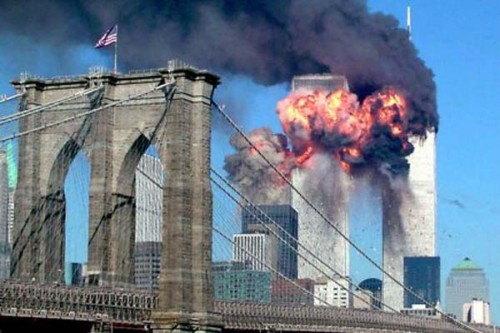
De l’attentat de la gare de Bologne à celui du Marathon de Boston en passant par tous les 11 septembre petits, grands ou moyens, le terrorisme c’est toujours et partout le spectacle d’imposture étatique de la crise mondiale du chaos de la marchandise !
par Gustave LEFRANÇAIS
« Les bombes-fusées qui tombaient chaque jour sur Londres étaient probablement lancées par
le gouvernement de l’Océania lui-même,
“ juste pour maintenir les gens dans la peur ” »
George Orwell, 1984
Les opérations sous fausse bannière ou « sous faux-pavillon », parfois désignées sous l’anglicisme de false flag sont des actions de perfidie et d’artifice stratégiques menées avec utilisation de marques de reconnaissance fabriquées, contrefaites, postiches, fourbes ou empruntées, dans le cadre d’opérations clandestines destinées à désigner un responsable inexact, imaginaire et trafiqué qui portera ainsi le chapeau illusoire mais pourtant bien tangible d’une action commise par tout autre que lui mais qui permettra de la sorte que tous les bénéfices en reviennent à celui qui justement l’aura cependant perpétré.
Au tout début du mois d’août 1964, deux destroyers américains qui s’étaient engagés dans les eaux territoriales du Nord-Viêtnam, essuyèrent soi-disant des tirs de la part de batteries nord- vietnamiennes. Il est établi aujourd’hui par la documentation déclassifiée que ces Incidents du Golfe du Tonkin ont constitué une manœuvre délibérée de feinte, de provocation et de simulation pour prétexter une escalade de l’intervention américaine dans le conflit indochinois. Les Papiers du Pentagone ont de la sorte révélé que le texte de la position rédigée par l’administration Johnson l’avait été en fait plusieurs mois avant la date desdits « incidents ». Le manège légendaire de cet accrochage arrangé a donc fourni au président Johnson la couverture tant attendue pour faire voter le texte de la Résolution qui lui donna les moyens de déclarer la guerre sans avoir à demander au préalable l’autorisation du Congrès.
Même si cette péripétie fut en réalité le contraire de ce que le spectacle officiel en a dit puisqu’elle n’a jamais existé réellement qu’en stricte contradiction avec la logorrhée des experts étatico-médiatiques du faux omniprésent qui l’ont évidemment narrée de manière retournée, cela a bien entendu suffi à convaincre la conscience hallucinée et obéissante des Américains de l’utilité d’une riposte. Johnson a donc pu paisiblement autoriser alors les raids aériens de terreur sur le Viêtnam par ce casus belli entièrement forgé par les officines et les ateliers de l’ombre. Sur cette lancée de simulacres, de fourberie, de sang et de larmes, les Bush, Clinton et Obama n’ont cessé en Irak, en Yougoslavie en Afghanistan et ailleurs, de démontrer que partout où règne le spectacle capitaliste de la terreur démocratique, les seules forces autorisées sont celles qui reproduisent la terreur capitaliste du spectacle démocratique.
Durant ces dernières années, les premiers grands attentats étatiques sous fausse bannière eurent spectaculairement lieu en Italie lors des années de plomb lorsque la modernisation de l’esclavage citoyenniste rendit nécessaire que le gouvernement fit de l’attentat aveugle le mode opératoire le plus approprié à la psychologie de masse de la soumission, de l’in-conscience et de la cécité. Ainsi, le 2 août 1980, à 10 h 25, à la gare de Bologne, une bombe posée dans la salle d’attente explosait. Elle tuait 85 personnes et en blessait plus de 200, arrivant ou partant de la gare pour cette période de fort trafic estival.
Dans son arrêt du 23 novembre 1995, la Cour de cassation du tripatouillage officiel italien, malgré mille et une occultations savantes ou grossières, fut néanmoins obligée de reconnaître que derrière cet attentat, il y avait bien l’existence d’une vaste organisation criminelle gouvernementale où l’on retrouvait la maffia, la loge maçonnique P2 et les services spéciaux les plus secrets de l’appareil d’État… Bien entendu, les commanditaires profonds du massacre n’ont jamais été découverts puisque cachés derrière les comparses secondaires de l’organisation Gladio, ceux-ci se trouvaient au cœur central et insaisissable de l’état-major de la stratégie de la tension élaborée par les États-Unis via l’O.T.A.N. et ses divers magasins et affidés, ceci tant pour neutraliser les velléités dommageables de non-alignement de certains courants politiciens italiens que pour briser la radicalité ouvrière des grèves sauvages qui débordait alors dangereusement les chiens de gardes politiques et syndicaux.
Le mardi 16 avril 2013, une double bombe de fabrication prétendument artisanale, emplie de divers fragments métalliques, a tué trois personnes et en a blessé plus d’une centaine d’autres lors du marathon de Boston. À la faveur de l’étrange découverte propice d’un sac à dos contenant le couvercle d’une cocotte-minute et grâce aux vidéos des caméras de surveillance opportunément disposés, les autorités du spectacle du boniment et de la fabulation étatiques eurent rapidement les moyens, de diffuser les photographies de deux suspects : les frères Tsarnaev qui avaient eu, eux, la grande amabilité de longuement flâner juste face aux appareils d’observation et d’enregistrement qui purent par conséquent abondamment et minutieusement les filmer. Selon la version officielle, les deux frères échappèrent à un policier qu’ils tuèrent sur un campus universitaire. Ensuite, après avoir détourné une automobile, ils furent atteints par la police. Plus de 200 coups de feu furent échangés durant la nuit, les deux hommes furent blessés. Le premier décéda rapidement à l’hôpital pendant que son frère, s’échappait à pied avant d’être rattrapé par la police pour finalement être enfin mis en état de ne plus jamais pouvoir dire autre chose que ce pourquoi il serait autorisé à parler.
Toute cette affaire des deux islamistes hollywoodiens de la filière tchétchène de la C.I.A. a évidemment mobilisé les chaînes de télévision de toutes les fictions imaginables du spectacle mondial de la misère marchande. Depuis le Daghestan, les parents des suspects ont, eux, proclamé qu’ils avaient été manipulés. Leur mère, a même souligné qu’ils étaient sous surveillance étroite du F.B.I. et ne pouvaient donc monter aucune opération sans que ce dernier en ait évidemment immédiatement eu connaissance.
À Boston, les services spéciaux du chaos gouvernementaliste ont donc parfaitement rempli leur mission dans le cadre d’une opération de camouflage et d’intoxication qui permet en un temps de crise économique approfondie et de crise sociale ravageuse de faire utile diversion massive en ce moment d’ébranlement ou d’ailleurs plusieurs États entendaient comme le Texas demander à retirer leur or de la Réserve fédérale…
La crise du spectacle démocratique de la dictature marchande est désormais à son point culminant et le chaos étatiquement programmé y est alors amené à produire partout et sans cesse son mythique ennemi inventé, le terrorisme qui est en fait sa seule vraie défense en ce temps de décomposition universelle où la liberté despotique de l’argent et ses conséquences véritables ne peuvent être encore acceptées qu’au regard d’antagonismes factices et d’attaques insidieuses sous faux drapeaux constamment mis en scène par le biais d’orchestrations machiniques de vaste ampleur.
L’histoire du terrorisme est désormais l’une des forces productives majeures du spectacle étatique mondialiste; elle définit donc le cœur stratégique du dressage social puisque les spectateurs doivent retenir de la pédagogie de l’attentat, que, en comparaison au terrorisme, toute la pourriture quotidienne de la vie fausse devra leur demeurer préférable et préférée.
« U.S.A., U.S.A. », ont ainsi scandé naïvement des Bostoniens descendus dans la rue et de la sorte bien domptés par le jeu des images fantastiques du renversement concret du réel. Certains arborant même frénétiquement un drapeau américain. Des célébrations totémiques de l’aliénation qui traduisaient le soulagement d’une population traumatisée par le plus grave attentat étatiquement télécommandé aux États-Unis depuis la mystification du 11-Septembre. L’union sacrée de la servitude volontaire n’a bien évidemment qu’un temps mais le confusianisme mystérieux des bombes barbouzardes conserve toujours là un intérêt évident bien que sa durée soit éminemment toujours et de plus en plus rétrécie…
Dans le monde du spectacle de la marchandise où les intérêts agissants de la dictature démocratique des Mafia de l’argent sont à la fois si bien et si mal obscurcis, il convient toujours pour saisir les mystères du terrorisme d’aller au-delà des rumeurs médiatiques policières puisque la sauvegarde des secrets de la domination opère continûment par attaques fardées et véridiques artifices.
Le leurre commande le monde du fétichisme de la marchandise et aujourd’hui d’abord en tant que leurre d’une domination qui ne parvient plus à vraiment s’imposer au moment où l’économie historique de la crise manifeste explosivement la crise historique de l’économie elle-même.
Du meurtre d’Aldo Moro par les brigades rouges étatiques aux attentats pentagonistes du 11-Septembre et en passant évidemment par la disparition violemment paramétrée de John Fitzgerald Kennedy sans oublier les tueries hautement calculées du télépiloté Merah, la société du spectacle de l’indistinction marchande ne cesse de s’éminemment montrer comme le monde de l’inversion universelle où le vrai est toujours réécrit comme un simple moment nécessaire de la célébration du faux. Derrière les figurants, les obscurs tirages de ficelles et les drapeaux mal bricolés, les vrais commanditaires sont adroitement camouflés puisqu’ils résident invariablement dans ces lieux impénétrables et énigmatiques, inaccessibles à tout regard, mais qui du même coup les désignent par cette ruse de la raison qui rend précisément percevable ce qui se voulait justement in-soupçonnable.
Le masquage généralisé se tient derrière le spectacle qui donne ainsi à infiniment contempler quelque chose en tant que complément décisif et stratégique de ce qu’il doit empêcher simultanément que l’on voit et, si l’on va au fond des choses, c’est bien là son opération la plus importante; obliger à sans cesse observer ceci pour surtout ne point laisser appréhender cela.
Par delà chaque tueur fou opportunément manipulé dans les eaux troubles du djihadisme téléguidé ou, de l’extrémisme supervisé existe, en premier lieu, l’incontournable réalité du gouvernement du spectacle de la marchandise lequel dorénavant possède tous les moyens techniques et tous les pouvoirs gestionnaires d’altérer et de contre-faire l’ensemble de la production sociale de toute la perception humaine mise sous contrôle. Despote absolu des écritures du passé et tyran sans limite de toutes les combinaisons qui arrangent le futur, Big Brother pose et impose seul et partout les jugements sommaires de l’absolutisme démocratique des nécessités du marché de l’inhumain.
On commet une très lourde erreur lorsque l’on s’exerce à vouloir expliquer quelque attentat en opposant la terreur à l’État puisqu’ils ne sont jamais en rivalité. Bien au contraire, la théorie critique vérifie avec aisance ce que toutes les rumeurs de la vie pratique avaient si facilement rapporté lors des très enténébrées disparitions de Jean de Broglie, Robert Boulin, Joseph Fontanet, Pierre Berégovoy et François de Grossouvre. L’assassinat n’est pas étranger au monde policé des hommes cultivés de l’État de droit car cette technique de mise en scène y est parfaitement chez elle en tant qu’elle en est désormais l’articulation de l’un des plus grands quartiers d’affaires de la civilisation moderne.
Au moment arrivé de la tyrannie spectaculaire de la crise du capitalisme drogué, le crime règne en fait comme le paradigme le plus parfait de toutes les entreprises commerciales et industrielles dont l’État est le centre étant donné qu’il se confirme là finalement comme le sommet des bas-fonds et le grand argentier des trafics illégaux, des disparitions obscures et des protections cabalistiques.
Plus que jamais, en ce moment très spécifiquement crisique où en France, reprenant le témoin d’une droite complètement épuisée, la gauche du Capital bien vite superbement exténuée est en charge des affaires d’un marché en pleine décomposition, l’exutoire terroriste risque de devenir de plus en plus tentant pour détourner la colère qui monte, il est temps d’en finir avec toutes les mystifications et tous les malheurs historiques de l’aliénation gouvernementaliste afin de commencer à pressentir la possibilité de situations humaines authentiques. Hors de l’économie politique de la non-vie, il convient exclusivement d’organiser le retour aux sources à une communauté d’existence enfin débarrassée de toute exploitation et de toute domination.
Pour L’Internationale, Gustave Lefrançais
Fin avril 2013
Article printed from Europe Maxima: http://www.europemaxima.com
URL to article: http://www.europemaxima.com/?p=3094
00:05 Publié dans Actualité | Lien permanent | Commentaires (0) | Tags : politique internationale, actualité, terrorisme, spectacle, georges orwell, manipulations médiatiques, attentats | | del.icio.us | | Digg | Facebook
The Third Political Theory
The Third Political Theory
By Michael O'Meara
Ex: http://www.counter-currents.com/
“We will march to fight for Holy Russia/
And spill as one our blood for her.”
—White Army song
The “Third Political Theory” (3PT) is what Alexander Dugin, in The Fourth Political Theory [2]
According to Dugin, National Socialist Germany and Fascist Italy were not just militarily, but ideologically defeated in the Second European Civil War (1939–45)—victims of “‘homicide’, or perhaps ‘suicide’.” Thereafter, these two national anti-liberal ideologies allegedly “overcome by history” ceased to address the great challenges facing European man. Then, with Communism’s fall in 1989/91, the second major anti-liberal “theory” opposing the Judeo-financial forces of Anglo-American liberalism collapsed. Today’s anti-liberal struggle, Dugin concludes, requires an ideology that has not “been destroyed and disappeared off the face of the earth.”
There is nothing in The Fourth Political Theory likely to please the Correctorate—which is, perhaps, reason for reading it. Nevertheless, Dugin’s effort to develop a compelling new “theory” appropriate to the global anti-system resistance must be judged (I’ll not be the first to say) a “failure”—an interesting failure, admittedly, but one also constituting a possible snare for the anti-system opposition, especially in its misleading treatment of 3PT and its implications for the anti-system resistance.
***
In early 1992, not long after the Soviet collapse, Alain de Benoist, the Paris-based leader of the French “New Right” (who was then just discovering le facteur Russie), was invited by Alexander Dugin to meet in Moscow. Though elements within the Correctorate immediately raised the specter of a “red-brown alliance”[2] (which apparently caused Benoist to keep his distance) and though petty differences continued to divide them, Dugin was eventually accepted as a kindred, anti-liberal spirit, sharing, as he does, the New Right’s Traditionalism (Evola), political theology (Schmitt), Heideggerian ontology, anti-Americanism, and tellurocratic geopolitics (Haushofer). In recent years, their differences seem to have succumbed to all that link their closely related projects.
Dugin has since become a prominent fixture in the NR constellation, sharing the heavens with Benoist. This prominence is entirely deserved, for the gifted Dugin (something of a one-man think tank) is conversant in all the major European languages, erudite in the anti-liberal and esoteric heritage the NR rescued from the postwar Memory Hole, and, above all, an uncompromising, metapolitically-prolific opponent of the United States, “the citadel of world liberalism” and thus the principal source of evil in our time.
The exact nature of Dugin’s project (embracing various elements shared by Europe’s anti-system opposition) has, though, never been entirely clear when viewed from afar. This seems due less to the many bad English translations of his early articles or the numerous conflicting interpretations that can be found of his work—than to a remarkable political itinerary (possible only in the last sovereign white nation on earth) that took him from the political fringes to the heights of power: an itinerary that began with his membership in the ultra-nationalist and anti-Semitic Pamyet Party in the late 1980s, followed by the post-Soviet Communist Party of Gennady Zyuganov, next the National Bolshevik Party and certain other Eurasianist formations, then the Orthodox-monarchist Rodina bloc, and, for the last decade, after achieving national prominence as a “public intellectual,” an occasional adviser to Vladimir Putin and the Russian Duma.
These formations and capacities, each respectable, together raise certain obvious questions about the nature of a political project that spans such a wide spectrum of belief and blends such an eclectic mix of seemingly incompatible ideas (Evolean Traditionalism, NR thought [already a pot-pourri des idées divergentes], Eurasianism, inter alia) into a worldview suitable to the post-Soviet Russian state.
Arktos’ nicely translated and edited publication is such a publishing event precisely because it gives the Anglophone world its first book-length exposure to Dugin’s thought and thus a clearer view of his NR project.
***
Though still difficult to pigeonhole, I’ve become increasingly critical of Dugin over the years, mainly on account of his Eurasianism—which is not a National Bolshevism in the German sense (of allying Russia and Europe and hence overcoming the narcissistic differences dividing the Greco-Slavic East from the Romano-Germanic West), but rather something of a prospective state ideology inclusive of the Jews, Muslims, and Turks occupying Russian lands—more concerned thus with geopolitical than ethno-civilizational (state power rather than Russian) hegemony—and hence something potentially anti-cultural. This threat is underscored by Dugin’s formal allegiance to the ethnopluralist, multiculturalist, and communitarian principles (spin-offs of the Western universalism he formally opposes) that are key components of Benoist’s culturally-relativist “pluriversum.”[3]
Though unintended, these principles shared by Dugin and Benoist cannot but endanger Europeans, for they legitimize Islam’s colonization of their historic lands, just as they risk turning European Russians into a Turkic-Slavic or Asian people, and thus away from the destiny they share with other Europeans (the “Boreans”: the white or Indo-European peoples of the North).
In his talk at Identitär Idé IV, Dugin the ethnopluralist even toyed with the Left-wing fiction that “race” (as a scientific or zoological concept) is a “social construct” (in spite of his Evolean Tradionalism, which acknowledges the significance of “race” in both its physical and spiritual sense).[4] His position here, though it wavers at times, is like Benoist’s in slighting the racial fundament of what Saint-Loup called the patrie charnelle—the genetic and territorial heritage without which Europeans cease to be who they are.[5]
Dugin, of course, is correct in dismissing “race” as a key social determinant. The white man’s impending demise is spiritual, not biological, in origin. (This, incidentally, is why an American White Nationalism that appeals mainly to race is already a failed project.) Spirit is always primary and the materialist or biological basis of human existence is simply a vehicle of the spirit.
But however “insignificant” as a determinant, race is nevertheless indispensable—in the sense that man’s world is impossible without it. For man is a living, blood-infused being: change his blood (race) and you change his spirit. As it is with being and Being, there is no spirit without blood—the blood distinct to man’s “being-t/here” (Dasein). This doesn’t mean that blood explains or determines anything (at least directly), only that the genetic heritage cannot be dispensed with, without dispensing with the very condition (the “thrownness and facticity”) of human being. Not to see that race, stock, and kinship is an inextricable facet of being is not to see the necessarily embodied nature of Dasein. In fact, Dugin’s is not Heidegger’s Dasein, but an “idealism” (like his Traditionalism).
Dugin’s concessions via Benoist to the miscegenating principles of globalist cosmopolitanism, along with his Turko- and Islamophilia, are evident not just in a Eurasianism that mixes white and yellow, Christian and Islamic peoples in a single polity (instead of promoting the cultural homogeneity characteristic of the West European lands of the High Culture), but also in his stance on the former Faye-Benoist debate on ethnonationalism and communitarianism.
Guillaume Faye is no Vestal Virgin[6], admittedly, but on the decisive issues—race, culture, immigration, Islam—he has stood against the system’s ethnocidal forces for the sake of European Europe, while Dugin, again like Benoist (who in 2000 publicly denounced Faye as a “racist,” just as the French state had launched a judicial assault on him for inciting “racial hatred”), has repeatedly sought an accommodation with the anti-white forces (which probably accounts for a certain Third-World/Islamic interest in 4PT).
In The Fourth Political Theory, Dugin depicts Benoist as a fellow toiler in 4PT and explicitly identifies him with his project. This follows Benoist’s similar public affiliation with 4PT in Moscow in 2009.[7] In spite of their lingering differences, this collaboration between the Paris and Moscow New Rights in recent years seems aimed at giving their related brands of NR discourse (rechristened 4PT) a larger, more consequential audience. (But here I speculate, given that I no longer read their publications.)
Cui bono? For the “political soldier” (who, Dugin believes, is obsolete), for the white ethnonationalist, and, I suspect, for the Russian nationalist, Dugin’s affinity with Benoist, along with his anti-racist opposition to Faye, must set off alarms, signaling, as it does, Dugin’s allegiance to the most communitarian and ethnopluralist—i.e., the most politically correct and demographically compromising—of the NR tendencies.
***
The Fourth Political Theory is full of insightful discussions of 1PT (liberalism) and 2PT (Communism), which is another reason for reading it, but, strangely, there is almost no discussion, except in passim, of 3PT (Fascism/National Socialism)—perhaps because this “theory” was itself a negation of theory—and thus a negation, among other things, of the “modernism” Dugin rather simplistically attributes to it.

Just as questionably, he treats National Socialism and Fascism, though obviously different, as closely related tendencies, while at the same time ignoring their common roots in an earlier history of anti-liberal resistance. He similarly neglects the post-1945 extensions of this supposedly moribund “theory,” refusing to accept that 3PT did not die after the war and, more important, that the historical forces which once made it a power in the world (the destruction of meaning and the social-economic dislocations that come with excessive liberalization: think today’s “globalization”) are presently creating conditions conducive to another mass, “fascist”-style, anti-liberal insurgence.[8]
For Dugin, 3PT—let’s call it “fascism” (lower case)—is understood in a way not unlike that of the Communist International following its Popular Front turn (1934). In endeavoring then to rally the democratic plutocracies to a collective-security alliance with the Soviet Union against insurgent Germany, the Comintern used “fascism” as a generic term to describe a multitude of movements, allegedly in cahoots with the most reactionary and militaristic factions of Big Capital, but having little else in common other than their anti-liberal or anti-Communist defense of the nation or the nation’s tradition.
Not just Italian Fascists and German National Socialists, but the KKK and Republicans in the US, Franquistas and Falangists in Spain, the “leagues” and others in France, Catholic Rexists in Belgium, Orthodox Iron Guardists in Romania, and virtually every tendency of the interwar period opposing the nihilistic devastations of “democratic capitalism,” Soviet Communism, or Jewish chicanery ended up tagged as “fascist.” Conceptually, this “fascism” was so vacuously defined that “cognitive control over entry criteria into the class was all-but-lost,” as the term evolved into a form of liberal or Left-wing exclusion—like the term “racism.”
After 1945, both the Left and the Academy continued to follow the Comintern line, using the term “fascism” to describe everything or everyone who might oppose 1PT or 2PT in the name of some tradition or rooted identity (what Dugin calls “Dasein”). There’s nothing “scientific” (i.e., rigorous) here, for the term is expressly used to demonize whomever or whatever opposes the forces of capitalist or Communist subversion—usually because the arguments and claims justifying their practices cannot withstand rational scrutiny, even in their own courts. That Dugin uses the term in the same way suggests something about his own assessment of European anti-liberalism.
***
The second major problem with Dugin’s treatment of 3PT (specifically Fascism and National Socialism) is that he fails to acknowledge that these “ideologies” originated not ex nihilo in the 1920s and ’30s, but from a half-century long movement that had emerged in opposition to similar modernizing forces propelled by Jewish and speculative interests profiting from liberalism’s ongoing economization of European life. Not seeing or stressing the social-historical crucible out of which 3PT emerged causes him to miss the larger counter-modernist intent of its “Third Way.”
3PT struggles against liberal modernity, already beyond Left and Right, first stepped onto the historical stage in the late 19th century, as elements from the revolutionary anti-liberal wing of the labor movement joined elements from the revolutionary anti-liberal wing of the nationalist movement to resist liberalism’s Hebraic (i.e., usurious) model of state and society—a model which turns the nation into a market, caters to cosmopolitans, and denies it a history and destiny.[10]
In this sense, German National Socialism and Italian Fascism represented continuations of these earlier socialist and nationalist expressions of anti-liberalism, being sui generis mainly in embodying the specific spirit and tenure of their age.
Like our court historians, Dugin cannot define “fascism,” except vacuously. Indeed, it can only be defined vacuously given that “fascism” was an ideological deception, for there was only one Fascism and numerous distinct and particularistic forms of 3PT: anti-liberalism, anti-capitalism, anti-Communism, anti-modernization, anti-Semitism, ultranationalism, etc.—sometimes overlapping with one another, sometimes not—but, in most cases, defending their collective Dasein in terms of a specific land and people.
In a similar stroke, Dugin ignores the historical circumstances that brought Italian Fascism and German National Socialism to power: the profound material and psychological dislocations of the 1914–18 war and the devastating economic crisis that followed in the ’30s. If more attention were paid to this aspect of his subject, he might have noticed that since the crisis of 2008, economic stagnation, predatory confiscations by the Robber Barons, and the hollowing out of European institutions, preeminently the state, have created conditions in which another mass form of 3PT may arise to challenge the ethnocidal forces in command of state and society.
If this should occur, the Third Political Theory (the “anti-liberal” and hence anti-system “ideology”), which arose in rebellion against liberal modernity and corporate capitalism in the 1890s, and was called “fascism” in the 1920s and ’30s, is likely to assume what earlier were the unforeseeable forms of identitarianism, goldendawnism, casapoundism, and whatever other revolutionary nationalist tendency that presently fights the liberal devastation of European life in the name not necessarily of “race,” “state,” or theory (as Dugin has it), but in that of the traditions defining Europeans as a people (i.e., as Dasein and Mitsein—concepts, via Martin Heidgegger, native to 3PT).[10]
Not coincidentally, the tendencies that today represent 3PT are as distinct and different as the “fascisms” of the interwar period, though each belongs to the same epochal rebellion against liberal modernization that was defeated in 1945 and is only now, and still hesitantly, beginning to reassert something of its former oppositional significance.
Anti-liberals are nevertheless indebted to Dugin for giving them the term “3PT”—because they can now refrain (when being forthright) from describing or thinking of themselves as “fascists” (who, to repeat, were part of something born of an earlier European struggle against the rising forces of Jewish modernity)[11] and therefore ought, more accurately, to be seen as expressions of this larger historical movement (3PT), which has had many different manifestations, most of which converged in resisting the ethnocidal forces associated with capitalism, Communism, or the Jews. Beyond that, there was little ideological similarity (“theory”).
However 3PT is characterized—as “fascist” or as a larger anti-liberal movement—it continues to speak to the present world situation, for unlike the timid imputations of 4PT and the apoliteia lingering in its antecedents, it has an indisputable record of fighting the dark legions of the Antichrist—not for the sake of a theory, but for certain primordial identities rooted in blood and spirit, kin and countrymen. Indeed, if Europeans are to survive the 21st century, it seems likely that they will have to fight for something of greater “mythic” significance than the self-effacing, bloodless, theoretical tenets of 4PT.
As it was with Fascism and National Socialism in their time, 3PT in our time is also likely to reject the established political arenas and manifest itself “extra-institutionally”—against the Troika (IMF-ECB-EC) and its Masonic Parliaments, Money Changers, and Judeo-Americanists—as it resists liberalism’s nation-destroying effects and, more generally, the usurious system the US imposed on defeated Europe in 1945.
In the new political arenas it will create (analogous to 2PT’s Soviets), 3PT’s appeal will not be to a party, a theory, or a metaphysical abstraction (Dasein), but to the “sovereign people” (diminished as his term may be in the “society of the spectacle”)—as it (3PT) rallies the opposition against an unreformable system threatening Europeans with extinction.
And like its earlier manifestations, today’s 3PT struggle will create a counter-hegemony anticipating a future in which Europeans are again free to pursue the destiny born of their Gothic “kings and emperors.” It will not promote an “affirmative action” program for international relations or seek to ensure the communitarian integrity of the alien populations occupying their lands.
***
The third and most significant problem in Dugin’s treatment of 3PT lies in ignoring its postwar extensions and thus in failing to recognize those aspects of postwar “fascist” thought relevant to the current situation, especially now that it has shed its earlier petty-state nationalism, bourgeois (“vertical”) racism, and anti-Slavism.
Dugin and Benoist are both extraordinarily creative forces, from whom much can be learned, but ideologically the project of these “free-floating intellectuals” are closer in spirit to Britain’s “Traditionalist” Prince Charles than to such postwar 3PT figures as the American Vabanquespieler, Francis Parker Yockey, whose so-called “postwar fascism” took the theory and practice of 3PT to a point not yet attained by 4PT or NR thought.
Yockey would know nothing of Dugin’s postmodernity, but by the early 1950s, based on European aesthetic (i.e., Spenglerian) rather than scientific objective criteria and thus with a sort of postmodernism avant la lettre, he had worked out a prescient understanding of what lay ahead, offering both an analysis and a means of fighting whatever postmodern form Satan’s Synagogue might assume.[12] It’s hardly coincidentally that the postwar anti-liberal resistance starts—and culminates—with him.
 A revolutionary imperial struggle against the Atlanticist Leviathan (aka the NWO)—the struggle to which Yockey gave his life—revolves around the formation of a Euro-Russian federation to fight the thalassocratic powers: les Anglos-Saxons incarnating the Protestant ethic and the spirit of capitalism—England and America—whose hedonist dictatorship of “creative destruction” was not the invention of maniacal Jews, but entirely homegrown, given that it was born at Runnymede; came of age with Henry VIII’s sacrileges, which turned Christianity into a religion of capitalism (Protestantism); and triumphed with the Whig Oligarchy that has dominated the Western world since 1789, when its Continental ideologues overthrew the French monarchy, representing a “Catholic” and regalian modernity.[13]
By 1952, Yockey understood that both the liberation and destiny of Europe were henceforth linked to Russia—the sole world power capable of resisting the satanic counter-civilization geopolitically aligned along the Washington-London-Tel Aviv axis.[14]
Resisting the Leviathan, the movement stretching from Yockey, Saint-Loup, René Binet, and others in the 1940s and 50s, to Jean Mabire, François Duprat, and Jean Thiriart in the ’60s and early ’70s, and to the current generation of revolutionary nationalist, identitarian, and other “Third Way” or anti-system tendencies awakened by the golden dawn[15]—attests (I would think) to the continuing vitality of this allegedly moribund “theory,” especially compared to the deedless metapolitics of NR or 4PT discourse.
In contrast to 4PT, there beats at the heart of 3PT the spirit not of theory but of practice. The great 3PT tribunes all followed Pisacane in their conviction that “ideas spring from deeds and not the other way around.” What always is (and has been) most lacking is not ideas, but men to realize them. There are, as such, no metapolitics without politics.
Privileging Evola’s royal way to Guénon’s sacerdotal, the 3PT resistance distinguishes itself today by fighting for socialism against the Left, for nationalism against the Right, and for Europe’s “difference” against the multi-racialist ideologues of 4PT.
***
After 1945, 3PT’s POWs were exiled to the margins of European society. It is from there, accordingly, that the final assault on the liberal center is being prepared. For the propagandists of the deed—intent on ridding Europe of her usurers and alien interlopers, and thus of resuming her destiny—Dugin’s theory is a detour from the Euro-Russian Imperium offering the one possibility of creating not the utopia of 4PT multipolarity or replicating the vileness of US unipolarity, but of establishing a peaceful world order based on Borean principles.
Notes
1. Alexander Dugin, The Fourth Political Theory, trans. M. Sleboda and M. Millerman (London: Arktos, 2012).
2. Thierry Wolton, Rouge-Brun: Le mal du siècle (Paris: Lattès, 1999).
3. Michael O’Meara, “Benoist’s Pluriversum: An Ethnonationalist Critique,” The Occidental Quarterly 5: 3 (Fall 2005); http://toqonline.com/archives/v5n3/53-mo-pluriversum.pdf [3]. Also Michael O’Meara,”Community of Destiny or Community of Tribes?,” Ab Aeterno n. 2 (March 2010); http://www.counter-currents.com/2010/08/community-of-destiny-or-community-of-tribes/ [4].
4. Dugin’s Identitär Idé IV talk is at http://www.youtube.com/watch?v=7X-o_ndhSVA [5]. On race and Traditionalism, see Julius Evola, Éléments pour une éducation raciale, trans. G. Boulanger (Puiseaux: Pardès, 1984 [1941]); also Frithjof Schuon, Castes and Races, trans. M. Pallis and M. Matheson (Bedfont, UK: 1982 [1959]).
5. Saint-Loup, “Une Europe des patries charnelles,” Défense de l’Occident, n. 136 (March 1976).
6. Michael O’Meara, Guillaume Faye and the Battle of Europe (London: Arktos, 2013).
7. http://www.evrazia.tv/content/alien-die-bienua-o-chietviertoi-politichieskoi-tieorii [6].
8. George Friedman, “Europe, Unemployment and Instability” (March 5, 2013), http://www.stratfor.com/weekly/europe-unemployment-and-instability [7].
9. Karlheinz Weissmann, Der Nationale Sozialismus: Ideologie und Bewegung 1890–1933 (Munich: Herbig, 1998); Zeev Sternhell, La Droite révolutionnaire 1885–1914: Les origines françaises de fascisme (Paris: Seuil, 1978); Arnaud Imatz, Par-delà droite et gauche: Histoire de la grande peur récurrente des bien-pensants (Paris: Godefroy de Bouillon, 2002).
10. Pace Dugin, Martin Heidegger remained a proponent of 3PT, evident in his National Socialist critique of Hitler’s regime; see his “second magnum opus,” Contributions to Philosophy (From Enowning), trans. P. Emad and K. Maly (Bloomington: Indiana University Press, 1999 [1936-38/1989]).
11. On the essentially “Jewish” character of “modernity,” see Yuri Slezkine, The Jewish Century (Princeton: Princeton University Press, 2004).
12. Francis Parker Yockey, The Proclamation of London (Shamley Green, UK: The Palingenesis Project, 2012 [1949]); Francis Parker Yockey, “The Prague Treason Trial: What Is Behind the Hanging of Eleven Jews in Prague” (1952), http://www.counter-currents.com/tag/the-prague-treason-trial/ [8].
13. E. Michael Jones, The Jewish Revolutionary Spirit and Its Impact on World History (South Bend, Ind.: Fidelity Press, 2008); Steve Pincus, 1688: The First Modern Revolution (New Haven & London: Yale University Press, 2009).
14. Desmond Fennell, Uncertain Dawn: Hiroshima and the Beginning of Post-Western Civilisation (Dublin: Sanas, 1996).
15. Nicolas Lebourg, Le Monde vu de la plus extrême droite: Du fascisme au nationalisme-révolutionnaire (Perpignan: Presses Universitaires de Perpignan, 2010).
Article printed from Counter-Currents Publishing: http://www.counter-currents.com
URL to article: http://www.counter-currents.com/2013/04/the-third-political-theory/
URLs in this post:
[1] Image: http://www.counter-currents.com/wp-content/uploads/2013/04/roots.jpg
[2] The Fourth Political Theory: http://www.amazon.com/gp/product/1907166564/ref=as_li_ss_tl?ie=UTF8&camp=1789&creative=390957&creativeASIN=1907166564&linkCode=as2&tag=countercurren-20
[3] http://toqonline.com/archives/v5n3/53-mo-pluriversum.pdf: http://toqonline.com/archives/v5n3/53-mo-pluriversum.pdf
[4] http://www.counter-currents.com/2010/08/community-of-destiny-or-community-of-tribes/: http://www.counter-currents.com/2010/08/community-of-destiny-or-community-of-tribes/
[5] http://www.youtube.com/watch?v=7X-o_ndhSVA: http://www.youtube.com/watch?v=7X-o_ndhSVA
[6] http://www.evrazia.tv/content/alien-die-bienua-o-chietviertoi-politichieskoi-tieorii: http://www.evrazia.tv/content/alien-die-bienua-o-chietviertoi-politichieskoi-tieorii
[7] http://www.stratfor.com/weekly/europe-unemployment-and-instability: http://www.stratfor.com/weekly/europe-unemployment-and-instability
[8] http://www.counter-currents.com/tag/the-prague-treason-trial/: http://www.counter-currents.com/tag/the-prague-treason-trial/
00:05 Publié dans Théorie politique | Lien permanent | Commentaires (1) | Tags : troisième voie, théorie politique, politique, philosophie politique, politologie, histoire, sciences politiques | | del.icio.us | | Digg | Facebook
Le "Goulag" américain
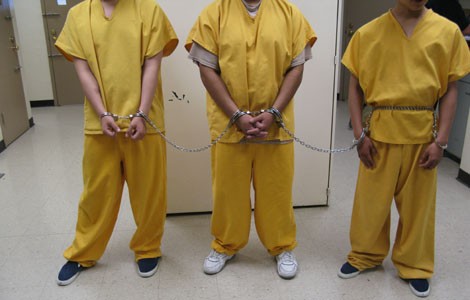
Une affaire qui marche :
le Goulag US
L’ensemble pénitentiaire US s’est lentement transformé, depuis le début des années 1970, en un Prison Industrial Complex (PIC) qui s’avère être une des plus étonnantes trouvailles du Système dans la recherche d’une activité à la fois industrielle et génocidaire, – faisant passer au second plan les problématiques de la justice et de la délinquance qui, d’ordinaire, définissent la question des prisons. L’établissement du PIC est en général daté de 1973, avec une loi de l’Etat de New York passée par le gouverneur Nelson Rockefeller, rendant passible de prison tout détenteur et utilisateur de drogue. Depuis, les peines pour ces délits, jusqu'aux plus ridiculement mineurs, n'ont cessé de s'alourdir, mettant en évidence la participation active à l'entreprise du système législatif et du système judiciaire US.
L’analyste politique et photographe Nile Bowie, collaborateur de Russia Today, publie ce 23 avril 2013 un article sur «[A] Moral monstruosity : America’s for profit Gulag system» Il y décrit les conditions de développement, de fonctionnement et d’existence du PIC, dont la population a augmenté de 772% entre 1970 et 2009, et dont la part du privé a été multipliée par 17 durant les deux dernières décades. Le PIC est effectivement devenu une part intégrante du Système, notamment dans sa division économique, comme un effet presque naturel et évident de la doctrine capitaliste développée dans les conditions du Système. Actuellement, la population carcérale aux USA approche les 25% de la population carcérale mondiale, alors que la population US se situe entre 4% et 5% de la population mondiale. (D’une façon qu’on devrait juger assez significative de l’implication du système capitaliste, et dans tous les cas certainement symbolique, ce rapport 4%/5% versus “près de 25%” est également celui du pourcentage de la population US par rapport au pourcentage d’émission de CO2 pour l’activité industrielle par les USA.)
L’emploi du terme Goulag (ou GOULAG, puisqu’il s’agit d’un acronyme russe) pour qualifier le système pénitentiaire US apparaît en général assez délicat. Pourtant, la description du PIC tel qu’il est aujourd’hui écarte les dernières réticences : il s’agit bien d’un système de Goulag, puisque son opérationnalité permet l’usage d’une main d’œuvre à si bon marché qu’on peut la considérer comme quasiment gratuite, tandis qu’elle neutralise et élimine des catégories très précises d’individus dont le Système se méfie.
Durant ces ces quelques décennies depuis l'institution du PIC, la population carcérale a été de plus en plus alimentée par trois grands courants sociaux et ethniques : la population dépendante de la drogue sous tous ses aspects, jusqu’aux cas les plus mineurs ; la population des immigrants clandestins capturés essentiellement à la frontière entre les USA et le Mexique ; la population des minorités ethniques, essentiellement les Africains Américains. (Bien entendu, les diverses catégories de “déviants” du Système, comme les “prisonniers politiques” sous la forme de contestataires divers, sont inclus dans ces courants.) L’auteur compare le système actuel des prisons au système de prisons, également privé, qui fut mis en place aux USA après l’abolition de l’esclavage, de la Guerre de Sécession jusqu’au début du XXème siècle, et d’ailleurs nullement cantonné à une seule région du pays, pour regrouper des populations fournissant de la main d’œuvre à bon marché, sinon à coût quasiment nul, pour le travail traditionnel de la cueillette de coton, mais aussi pour les travaux d’infrastructure de modernisation (routes, chemins de fer, etc.). Ce système est ainsi reproduit aujourd’hui, avec la privatisation maximale, les “travailleurs-esclaves” recevant des sommes ridicules sinon symboliques et les entreprises privées gérant les prisons (il y en a trois principalement, CCA, GEO Group, Cornell) sous-traitant des travaux divers pour l’extérieur. Ce système rassemble tous les attributs habituels du capitalisme américaniste, notamment une organisation de corruption maximale du monde politique avec une organisation très puissante de lobbying, pour obtenir certaines lois favorisant les activités rentables du complexe, aussi bien que des lois qui favorisent directement (sévérité des peines) et indirectement le “recrutement” des populations carcérales. Dans ce dernier cas, par exemple, les lobbies du complexe luttent avec acharnement contre la dépénalisation de la marijuana, la consommation de cette drogue mineure fournissant un nombre appréciable de “travailleurs-esclaves”.
Dans tous les cas envisagés, les peines sont extrêmement lourdes, de façon à obtenir une stabilité de “la main d’œuvre”. Les prisonniers vivent dans des conditions de plus en plus dégradées, parfois dans des conditions stupéfiantes de promiscuité dans des immenses hangars organisés en dortoir, puisque les entreprises privées ne cessent de restreindre les budgets d’entretien et que les quelques interventions publiques sont restreintes à cause de la crise. Bien entendu, tout cela se passe dans un climat de contrainte et de violence internes constant, qui favorise indirectement la soumission des prisonniers. Lorsqu’ils sont libérés, puisque la chose arrive, les prisonniers sont le plus souvent privés de leurs droits civiques et d’accès aux services sociaux et au marché du travail, ce qui fait que le complexe espère les récupérer rapidement sous la forme de l’un ou l’autre délit de survie aussitôt transformé en une peine de prison maximale (récidive). Ainsi le système est-il complet, avec comme premier incitatif le profit. Enfin, toutes ces conditions excluent toute vie sociale et familiale des détenus ; elles suscitent une dégradation rapide de leur état de santé au sens le plus large avec des soins médicaux réduits au minimum, si bien qu’on peut considérer qu’il s’agit également d’une entreprise d’élimination “douce” (!) de type génocidaire, portant sur des populations dont le Système en général ne veut pas. Le circuit est ainsi bouclé et la capitalisme, parvenant à son essence la plus intime, rejoint complètement les caractères généraux du Goulag stalinien.
Voici un extrait important du texte de Nile Bowie, de ce 23 avril 2013, dont l’intérêt est de développer la description des conditions de l’action du complexe pour assurer sa position de puissance au sein du Système, notamment dans le monde politique US.
«The number of people imprisoned under state and federal custody increased 772% percent between 1970 and 2009, largely due to the incredible influence that private corrections corporations wield against the American legal system. The argument is that by subjecting correctional services to market pressures, efficiencies will be increased and prison facilities can be run at a lower cost due to market competition. What these privatizations produce in turn is a system that destroys families by incentivizing the mass long-term detention of non-violent criminals, a system that is increasingly difficult to deconstruct and reform due to millions paid out to state and federal policymakers. According to reports issued by advocacy group Public Campaign, the three major corrections firms –Corrections Corporation of America (CCA), the GEO Group, and Cornell, have spent over $22 million lobbying Congress since 2001.
»As a means of influencing policymaking at the federal level, at least $3.3 million have been given to political parties, candidates, and their political action committees, while more than $7.3 million has been given to state candidates and political parties since 2001, including $1.9 million in 2010, the highest amount in the past decade. Senators like Lindsay Graham and John McCain have received significant sums from the private prison corporations while Chuck Schumer, Chair of the Rules Committee on Immigration and Border Enforcement, received at least $64,000 from lobbyists. The prison lobby thrives off of laws that criminalize migrants and submit them to mandatory detention prior to being deported, sometimes up to 10 months or more; private firms have consistently pushed for the classification of immigration violations as felonies to justify throwing more and more immigrants behind bars. The number of illegal immigrants being incarcerated inside the United States has risen exponentially under Immigration and Customs Enforcement, an agency responsible for annually overseeing the imprisonment of 400,000 foreign nationals at the cost of over $1.9 billion on custody-related operations.
»The private prison industry has become increasingly dependent on immigration-detention contracts, and the huge contributions of the prison lobby towards drafting Arizona’s controversial immigration law SB 1070 are all but unexpected. Arizona's SB 1070 requires police to determine the immigration status of someone arrested or detained when there is “reasonable suspicion” that they’ve illegally entered the US, which many view as an invitation for rampant racial profiling against non-whites. While the administration of Arizona’s Governor Jan Brewer is lined with former private prison lobbyists, its Department of Corrections budget has been raised by $10 million in 2012, while all other Arizona state agencies were subject to budget cuts during that fiscal year. The concept of privatizing prisons to reduce expenses comes at great cost to the inmates detained, who are subjected to living in increasingly squalid conditions in jail cells across America. In 2007, the Texas Youth Commission (TYC), a state agency that overseas juvenile corrections facilities, was sent to a West Texas juvenile prison run by GEO Group for the purpose of monitoring its quality standards.
»The monitors sent by the TYC were subsequently fired for failing to report the sordid conditions they witnessed in the facility while they awarded the GEO Group with an overall compliance score of nearly 100% - it was later discovered that the TYC monitors were employed by the GEO Group. Independent auditors later visited the facility and discovered that inmates were forced to urinate or defecate in small containers due to a lack of toilets in some of the cells. The independent commission also noted in their list of reported findings that the facility racially segregated prisoners and denied inmates access to lawyers and medical treatment. The ACLU and Southern Poverty Law Center have also highlighted several cases where GEO Group facility administrators turned a blind eye to brutal cases of rape and torture within their facilities, in addition to cases of its staff engaging in violence against inmates. According to the Justice Department data, nearly 210,000 prisoners are abused annually (prison personnel are found responsible half the time), while 4.5 percent of all inmates reported sexual assaults and rape.
»It’s not possible to conceive how such institutionalized repression can be rolled back when the Obama administration shows only complicity with the status quo – a staggering $18 billion was spent by his administration on immigration enforcement, including detention, more than all other federal law enforcement agencies combined. Under Obama’s watch, today’s private prison population is over 17 times larger than the figure two decades earlier. Accordingly, Obama’s drug czar, Gil Kerlikowske, has condemned the recently passed state laws in Colorado and Washington that legalize the possession of marijuana in small amounts. The Obama administration is bent on keeping in place the current federal legislation, where a first-time offender caught with marijuana can be thrown in prison for a year. It’s easy to see why common-sense decriminalization is stifled - an annual report released by the CCA in 2010 reiterates the importance of keeping in place harsh sentencing standards, “The demand for our facilities and services could be adversely affected by the relaxation of enforcement efforts, leniency in conviction or parole standards and sentencing practices or through the decriminalization of certain activities that are currently proscribed by our criminal laws. For instance, any changes with respect to drugs and controlled substances or illegal immigration could affect the number of persons arrested, convicted, and sentenced, thereby potentially reducing demand for correctional facilities to house them.”
»Such is the nature of a perverted brand of capitalism, and today’s model bares little difference to the first private prisons introduced following the abolishment of slavery in the late 1800s, where expansive prison farms replaced slave plantations where predominately African-American inmates were made to pick cotton and construct railroads in states such as Alabama, Georgia and Mississippi. Today, African-Americans make up 40% of the prison population and are incarcerated seven times more often than whites, despite the fact that African-Americans make up only 12% of the population. Inmates are barred from voting in elections after their release and are denied educational and job opportunities. The disproportionate levels of black people in prisons is undeniably linked to law enforcement’s targeting of intercity black communities through anti-drug stipulations that command maximum sentencing for possession of minute amounts of rock cocaine, a substance that floods poor black neighborhoods.
»Perhaps these social ills are byproducts of a system that places predatory profits before human dignity. Compounding the illogic is that state spending on prisons has risen at six times the rate of spending on higher education over the past two decades. Mumia Abu-Jamal, America’s most famous political prisoner, has spent over three decades on death row; he was convicted in 1981 for the murder of a white police officer, while forensic experts say critical evidence vindicating Jamal was withheld from the trial. In an interview with RT, Jamal relates his youth activism with the Black Panthers party against political imprisonment in contrast to the present day situation, “We could not perceive back then of what it would become… you can literally talk about millions of people incarcerated by the prisoner-industrial complex today: men, women and children. And that level of mass incarceration, really mass repression, has to have an immense impact in effect on the other communities, not just among families, but in a social and communal consciousness way, and in inculcation of fear among generations.” The fear and immortality the system perpetuates shows no sign of abating. Being one of the few growth industries the United States has left, one can only imagine how many people will be living in cages in the decades to come.»
Ce qui est remarquable dans cette description du complexe, c’est la façon structurelle décrite d’une organisation systématique, très rentabilisée, très bien contrôlée, qui dépasse très largement en efficacité et en rentabilité le système stalinien (Goulag). On rejoint alors des considérations beaucoup plus larges, qui doivent alimenter la réflexion sur la nature profonde d’un Système qui génère, presque naturellement, presque de lui-même, de tels ensembles dont les moyens de fonctionnement sont l’esclavagisme (dans des conditions pires que l’esclavage originel), la déshumanisation et la destruction psychologique, l’extermination organisée, “collectivisée” d’une façon rampante et indirecte. Grâce aux conditions de communication du Système, ces ensembles ont la caractéristique d’être présentées et perçues (supériorité indiscutable sur les dictatures d’extermination) comme de bien public et de participation efficace à la protection normale de la loi et de l’ordre démocratiques. L’effet de ces phénomènes rejoint la production naturelle du Système comme élément représentant le “pire de tous les maux”, ou le Mal parvenu à un état de fonctionnement maximal et exclusif ; il s’agit de la production maximale de déstructuration, de dissolution et d’entropisation, dans ce cas de la société et de populations diverses.
Il faut noter que certains auteurs ont également rapproché le fonctionnement du système nazi gérant, organisant et développant le système d’extermination (Holocauste), de la référence du capitalisme américaniste (pour nous, produit du Système), avec sa branche bureaucratique et sa branche de productivité et de rentabilité. Ainsi en ont-ils fait un produit direct de la modernité, ce qui correspond assez justement au jugement naturel qui nous vient sous la plume. Le 7 décembre 2005, parlant alors du seul système de prisonniers de la CIA dans la Guerre contre la Terreur, nous écrivions ceci, qui citait un de ces principaux auteurs, le professeur Richard L. Rubenstein :
«Pour ce qui concerne le système nazi, qui présente un autre cas, il faut lire La perfidie de l’Histoire, de Richard L. Rubenstein (né en 1924, professeur d’histoire et de philosophie des religions à l’université de Bridgeport, dans le Connecticut). Ce livre, publié en 2005 (éditions Le Cerf), comprend le texte original de Rubenstein, datant de 1975 (avec un ajout de circonstances, datant de 2004, traitant du terrorisme islamique). L’originalité de l’approche de Rubenstein est qu’il fait porter l’essentiel de la responsabilité de l’Holocauste dans son ampleur et dans la réalisation de son aspect systématique non sur l’idéologie, qui est l’élément déclencheur, mais sur la bureaucratisation et les méthodes industrielles modernes de gestion et de production. C’est introduire comme principal accusé de l’ampleur et de la substance du crime les méthodes et les contraintes modernistes au travers de l’expansion et de la gestion industrielles, et de la bureaucratisation systémique.
»La caractéristique finale est un montage systémique s’apparentant moins à un complot qu’à l’évolution “naturelle” (c’est-à-dire logique dans ce cas, de la logique interne du système) d’un système de conception moderniste à la fois de cloisonnement et de dilution de la perception des responsabilités. L’effet mécanique du montage est de cacher l’ampleur et le motif du crime aux exécutants, et d’assurer son efficacité complète sans prendre le risque de l’illégalité qui constitue une transgression des lois difficilement supportable pour un esprit conformiste (la bureaucratie implique un complet conformisme de l’esprit ; — il faut donc ménager leur conformisme). Rubenstein observe qu’à cause de diverses dispositions et situations, l’Holocauste ne peut être tenu pour “illégal” selon les lois allemandes en vigueur à l’époque. Rubenstein laisse clairement voir qu’il considère la bureaucratisation de la puissance américaine comme une évolution de même substance que les structures qui permirent l’Holocauste...»
00:05 Publié dans Actualité | Lien permanent | Commentaires (0) | Tags : répression, totalitarisme, prisons, goulag, états-unis, système pénitentiaire | | del.icio.us | | Digg | Facebook