Ok

En poursuivant votre navigation sur ce site, vous acceptez l'utilisation de cookies. Ces derniers assurent le bon fonctionnement de nos services. En savoir plus.

vendredi, 29 octobre 2010

Salvate la vita a Tareq Aziz !

Salvate la vita a Tareq Aziz

di Felicity Arbuthnot e Tony Benn

Fonte: Come Don Chisciotte [scheda fonte]


Tante altre notizie su www.ariannaeditrice.it

LETTERA A SUA SANTITA' PAPA BENEDETTO XVI

"E' STATO VERSATO COSI' TANTO SANGUE". SALVATE LA VITA A TAREQ AZIZ


"...Saddam, Tariq, tutti loro avrebbero potuto darsi alla fuga, ce n'erano di paesi che li avrebbero accolti. Sono rimasti perchè era inimmaginabile per loro non stare dovevano stava la loro gente. E nemmeno avrebbero potuto immaginare che democratici liberatori di una superiore civiltà potessero a tal punto strafottersi del diritto, della giustizia, dell'umanità. Non c'è stato nessun Vittorio Emanuele. Sono rimasti perchè erano e sono iracheni. Che il corpo di Tariq Aziz possa restare ai vostri piedi e farvi inciampare per il resto della vostra vita nel mattatoio che chiamate civiltà."
Fulvio Grimaldi


Lettera aperta :

A sua Santità Papa Benedetto XVI,

A Sua Grazia l’Arcivescovo di Canterbury,
A Sua Grazia l’Arcivescovo di Westminster,

Al Primo Ministro On. David Cameron,
Al Vice Primo Ministro On. Nick Clegg,
Al Ministro degli Esteri, On. William Hague.

Sua Santità, Vostre Grazie, Primo Ministro, Vice Primo Ministro, Ministro degli Esteri,

Mi scuso per questa missiva a destinatari multipli , ma è questione assoluta di tempo. È stato versato così tanto sangue nell’invasione illegale dell’Iraq, che è difficile da comprendere, con una cifra superiore dei caduti dal 2003 stimata a 1,4 milioni di persone. Quasi cinque milioni (4,7) di persone sono profughi, internamente ed esternamente, secondo l’UNHCR, sono stati creati un milione di vedove e cinque milioni di orfani, secondo le agenzie delle Nazioni Unite.


Adesso, dopo il disgustoso linciaggio del legittimo presidente del paese, e dei suoi stretti colleghi, un paese la cui: “sovranità ed integrità territoriale”, era garantita dall’ONU, è stato oggi annunciato che il suo sostituto, Tareq Aziz, un cristiano caldeo, sta per essere giustiziato. Questo in aggiunta al sangue versato per l’invasione, su scala biblica – e alla luce delle terribili rivelazioni delle realtà della “liberazione”, nei giorni scorsi, su Wikileaks.

Certo Wikileaks ha anche rivelato che il terrorismo si riversava sul popolo dell’Iraq per mano delle forze governative imposte di “Vichy”, “ guidate” dalle truppe USA e Britanniche.

L’accusa contro l’ex Vice Primo Ministro nonché Ministro degli Affari Esteri dell’Iraq, è una discriminazione religiosa. Ironicamente, mezzo milione di Cristiani iracheni, sono fuggiti, a causa della persecuzione, dal momento dell’invasione. Innumerevoli sono stati assassinati. Avevano vissuto fianco a fianco della maggioranza musulmana a quanto pare dall’anno 33 D.C., quando si crede che San Tommaso abbia fondato la Cristianità in Mesopotamia.

L’accusa si riferisce ad un tentato assassinio contro Aziz e Saddam Hussein a Dujail, in Iraq, nel 1982 da parte di affiliati del partito Dawa appoggiato dall’Iran. Lo stesso partito Dawa a cui aderisce Nuri al Maliki. (Non ho detto il “Primo Ministro”, poiché non lo è più, in un Iraq senza direzione). La vendetta a Dujail è stata certamente deplorevole, ma è stata una decisione presa dal Presidente. E comunque vista nel contesto, pare lieve in confronto al massacro riservato alla popolazione di Fallujah nel 2004 dalle forze americane, per vendicarsi dell’uccisione di quattro mercenari, e della reazione contro gli USA, le truppe che avevano ucciso inspiegabilmente uomini, donne e bambini dal momento dell’invasione.

Il massacro in Iraq è stato per mano di tutti i cittadini degli Stati Uniti e del Regno Unito.

Ci dobbiamo convivere ovunque viaggiamo, con la vergogna e il vituperio delle azioni dei loro governi. Inoltre, non c’ è stata l’immunità presidenziale per il governo illegalmente rovesciato dell’Iraq, una consueta norma legale, e tuttavia le forze dell’occupazione avrebbero potuto interrompere i loro massacri. Come forza occupante dominante e rimanente, l’America adesso è responsabile di ogni violazione dei diritti umani.

Aziz è stato parte di un governo che lungi dal discriminare religiosamente, sosteneva annualmente, proporzionatamente, equamente tutte le religioni per la manutenzione dei loro luoghi culto e dei loro uffici affiliati. Le punizioni sono state date non sulla base della religione, ma per i crimini commessi. Senza discussione sono state dure, ma ci fa vergognare riflettere come siano lievi, al confronto con quello che è accaduto, e continua ad accadere, sotto i poteri occupanti, dal giorno dell’invasione.

Tariq Aziz si è consegnato alle autorità degli Stati Uniti, in buona fede.

Tale buona fede non era fondata ed è stata sfruttata. È un uomo anziano ed era in cattive condizioni di salute molto prima dell’invasione.

I suoi giorni comunque, sono sicuramente contati. Vi scongiuro di prendere almeno questa chance di salvare anche solo una vita. Aziz è un nazionalista, come tutto il suo governo, avrebbero potuto fuggire. Hanno scelto di rimanere in Iraq perché si sentono profondamente iracheni - contrariamente all’attuale governo, con le sue fedeltà e i suoi passaporti stranieri, in gran parte.

Tareq Aziz si è recato in Vaticano, prima dell’invasione, per incontrare il Capo della Chiesa in cui aveva riposto tutta la sua fede, tutta la sua vita, per implorare che venisse bloccata la distruzione del suo popolo e della terra dell’ Ur della Caldea, menzionata certo tre volte nel libro della Genesi: 11:28, 11:31, 15:7. La sua preghiera non è stata ascoltata.

Vostra Santità, Vostre Grazie, Primo Ministro, Ministro degli Esteri, vi prego non deludetelo ancora una volta. La Gran Bretagna e l’America non potranno mai, comunque, lavare il sangue dalle loro mani. “Salvare una vita, è come salvare l’intera umanità” è un convincimento comune a tutte le fedi.

Vi prego di agire subito.

Sta per finire il tempo. Se così dovesse essere e non aveste fatto nulla, nonostante la vostra influenza e i vostri contatti collettivi, il suo corpo giacerà ai vostri piedi, per tutta la vostra vita. Per lo più il non agire, che porta ad un altro linciaggio, imporrà quell’orrore a ogni cittadino con una coscienza, dato che siamo, così ci viene detto, una democrazia. Vi imploriamo di agire.

Oggi siamo stati avvisati circa un reale pericolo di un attentato terroristico; abbiamo già commesso innumerevoli atti di terrorismo – per favore non fatecene essere parte di un altro, che volendolo, è del tutto prevenibile.

Distinti saluti.

FELICITY ARBUTHNOT (giornalista, corrispondente per i diritti umani, Global Research) E TONY BENN ( veterano di guerra, ex parlamentare britannico, autore, fondatore del CND)

Fonte: www.globalresearch.ca
Link: http://www.globalresearch.ca/index.php?context=va&aid=21628


Traduzione per www.comedonchisciotte,org a cura di MICAELA MARRI


16:12 Publié dans Actualité | Lien permanent | Commentaires (2) | Tags : pétition, tarek aziz, irak, peine de mort | |  del.icio.us | | Digg! Digg |  Facebook

An Ambiguous Victory for Wilders

An Ambiguous Victory for Wilders

by Srdja Trifkovic

Ex: http://www.chroniclesmagazine.org/

Srdja_Trifkovic.jpgThe news just in that Dutch prosecutors have changed their mind about prosecuting Geert Wilders for the Orwellian crime of “discriminating against Muslims” and “inciting hatred” is prima facie a victory for free speech and all that. In fact it is not nearly as good as it may seem.

The establishment is scared of continuing to hound the leader of the third-largest political party in the land. The fact that their legal minions are forced to eat humble pie is gratifying, but the trouble is that they are dropping this particular case while keeping all the pernicious laws used against him. They have come up with the ridiculous argument that the politician’s comments about banning the Kuran can be discriminatory, but because Wilders wants to pursue a ban “on democratic lines,” there is no incitement to discrimination “as laid down in law.” As for his comparison of the Kuran with Mein Kampf, the prosecutors now say that the metaphor was “crude, but that did not make it punishable.” While some of his comments could incite hatred against Muslims if taken out of context, they concluded, on the whole Wilders seems to be opposed to the growing influence of Islam and not hostile to Muslims as such.

A clear victory would have been for the Dutch state to declare that it was mistaken in pursuing a case of any kind against Wilders; but that would have meant the end of the Dutch state as we have known it for the past forty years.

In the event the oppressive laws are there to stay. Ordinary Dutch citizens, less visible than Wilders, can be maliciously prosecuted – and convicted – for saying the same things he has said, but with far less fuss. In the same manner some well known East European dissidents were relatively protected from the Comrades’ fury in the 1970s, but arbitrary and oppressive laws were then applied with an even greater ferocity against the anonymous multitudes.

For as long as Holland’s and other European countries’ ridiculous “hate” laws remain on the statute books, the threat of prosecution hangs above everyone’s head – and no conviction is required to make people think twice about expressing themselves frankly and meaningfully about “prophet” Muhammad’s ideology of war and hatred.

I suspect that Wilders himself would have preferred a highly publicized trial and conviction, followed by an appeal that would test the constitutionality of the laws used against him. That is the kind of battle that requires courage, money, and media attention. He is the ideal man to give it one more try.

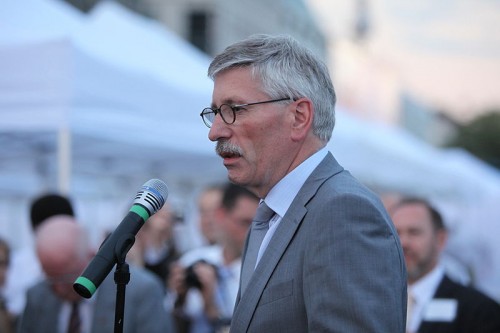
Der Sarrazin-Impuls

Thilo_Sarrazin.jpg

Der Sarrazin-Impuls

Von Andreas Mölzer

Ex: http://www.zurzeit.at/

Es war gewiß nicht in erster Linie Thilo Sarrazins Buch „Deutschland schafft sich ab“, das nunmehr dafür verantwortlich ist, wenn in Deutschland eine Ausländer- und Integrationsdebatte hochkocht. Nein, es sind einfach die Probleme, die diese Debatte geradezu erzwingen. Diese waren einerseits der Anlaß für das Sarrazin-Buch und sind andererseits nunmehr die Ursache für den politischen Disput, der die Bundesrepublik in diesen Tagen erschüttert. Es war ja nur die Politik der etablierten Parteien, welche die Augen vor den Problemen verschlossen hat. Die Bürger selbst waren längst damit konfrontiert, daß Deutschland in den letzten Jahren und Jahrzehnten Ziel einer Massenzuwanderung, insbesondere von Türken, geworden war. Und die Bürger waren natürlich auch damit konfrontiert, daß aus den Parallelgesellschaften das Konfliktpotential der einst so hochgelobten multikulturellen Gesellschaft geradezu explosiv über die gesamte deutsche Gesellschaft hereingebrochen ist. Wie hat Angela Merkel dieser Tage so schön gesagt: „Der Multi-Kulti-Ansatz ist absolut gescheitert“. Wie wahr.

Dennoch muß man anerkennen, daß seit dem Streit um die Person Thilo Sarrazins und um sein Buch auch die Strategen der etablierten bundesdeutschen Parteien aufgewacht sind. Das ist Sarrazins Verdienst. Wenn nunmehr CSU-Boß Horst Seehofer vorprescht und einen Zuwanderungsstopp für Türken und Muslime fordert, glaubt er begriffen zu haben, wo der Hase im Pfeffer liegt. Zwar haben radikale Imame vorläufig noch kein Alkoholverbot für das Münchner Oktoberfest gefordert, der Ober-Bayer weiß aber, wie er politisch bei den Menschen – wohl nicht nur in Bayern – punktet. Und Kanzlerin Merkel muß nolens volens nachziehen. Auch wenn ihr Parteifreund, der nunmehrige Bundespräsident Wulff, erst jüngst fromm erklärt hatte: „Der Islam gehört auch zu Deutschland“.

Gutmenschen und Schön-Redner wie Herr Wulff sind es indessen, die an der Explosivität des Zuwanderungs- und Islamisierungsproblems mit schuld tragen. Sie haben mit ihrer Schönfärberei dafür gesorgt, daß es nicht rechtzeitig zu entsprechenden Bremsvorgängen im Bereich der Zuwanderung kam, daß man die deutsche Leitkultur nicht entsprechend schützte und das Vordringen des immer offensiver werdenden Islams duldete. Diesen Gutmenschen stehen die simplen Populisten à la Seehofer gegenüber, deren Protest wahrscheinlich auch zu spät kommt. Und daß just Ministerin Ursula von der Leyen nun im Gegensatz zu Angela Merkel demonstrativ die weitere Zuwanderung von Facharbeitern fordert, weil deren Mangel das Wirtschaftswachstum bremse, ist mehr als bedenklich. Die Mutter eines halben Dutzends Kinder sollte es besser wissen. Facharbeiter kann man in drei Jahren mittels entsprechender Lehre ausbilden. Akademisches Fachpersonal bedarf zwar eines längeren Studiums, aber auch das kann man bei entsprechender Förderung in Deutschland selbst heranziehen.

Die Forderung, solche Fachkräfte aus dem Ausland zu importieren – so nach dem Motto „Inder statt Kinder“ – ist schlicht einfältig. Sie zeitigt zwar Zuwanderung, aber nicht jene des gewünschten Fachpotentials, sondern weiter die eines ungebildeten Subproletariats. Dieses wandert nur ins deutsche Sozialsystem ein und nicht in den Arbeitsmarkt.

Eins zu eins vergleichbar mit der bundesdeutschen Lage ist jene bei uns in Österreich. Auch hier fordern Lobbyisten der Industrie den Zuzug von Fachkräften und meinen doch in Wahrheit weitere billige Arbeitskräfte, die der Gewinnmaximierung dienlich sein sollen. Auch hier verkrampft sich das politische Establishment in einer Integrationsdebatte und zeigt dabei nur das eigene Unvermögen, die eigene Hilflosigkeit. Brutalo-Abschiebungen von Kindern auf der einen Seite, auf der anderen Seite kein Mut, um die wirkliche Massenzuwanderung und die Islamisierung zu stoppen. Offiziell haben in Österreich von 8,4 Millionen Einwohnern 1,7 Millionen Menschen einen sogenannten Migrationshintergrund. In Wahrheit werden es wohl über zwei Millionen Menschen sein, wenn man die Illegalen und die schöngeredeten Bereiche mitzählt. Nahezu ein Viertel der Wohnbevölkerung also entstammt nicht der autochthonen Bevölkerung. Das darf man getrost „Überfremdung“ oder auch „Umvolkung“ nennen. Jene, die sich über derartige angeblich ach so böse Begriffe politisch korrekt erregen, sind mit schuld an den Problemen, die damit bezeichnet werden.

Allerdings gibt es diese Probleme längst nicht nur in Deutschland und Österreich, sie sind indessen zu einem gesamteuropäischen Phänomen geworden. Nicht zufällig schwelt die Debatte um Zuwanderung, Islamisierung, Integration oder Assimilation auch quer durch Europa. In Frankreich gibt es den Streit um die von Sarkozy abgeschobenen Roma, in Holland will Wilders die Zuwanderung von Muslimen verhindern, in Italien punktet die Lega Nord mit ihrem Kampf gegen die Islamisierung und selbst im diesbezüglich bislang allzu liberalen Spanien diskutiert man nunmehr über das Problem der Integration.

Und überall zeigt sich so wie gegenwärtig in Deutschland, daß die etablierte Politik den Problemen nur hinterher hechelt, sie zwar mitverursacht, aber kaum Lösungskompetenz aufweist.

Serbia Surrenders Kosovo to the EU

Serbia Surrenders Kosovo to the EU

Ex: http://www.slobodanjovanocvic.org/

Probably, the Tadic government had expected something better, and had planned to follow up a favorable ICJ opinion with an appeal to the General Assembly to endorse renewed negotiations over the status of Kosovo, perhaps enabling Serbia to recover at least the northern part of Kosovo whose population is solidly Serb. 

Diana Johnstone: In its dealings with the Western powers, recent Serbian diplomacy has displayed all the perspicacity of a rabbit cornered by a rattlesnake. After some helpless spasms of movement, the poor creature lets itself be eaten.

(September 20, Paris, Sri Lanka Guardian) On September 10, at the UN General Assembly, Serbia abruptly surrendered its claim to the breakaway province of Kosovo to the European Union. Serbian leaders described this surrender as a “compromise”. But for Serbia, it was all give and no take.

In its dealings with the Western powers, recent Serbian diplomacy has displayed all the perspicacity of a rabbit cornered by a rattlesnake. After some helpless spasms of movement, the poor creature lets itself be eaten.

The surrender has been implicit all along in President Boris Tadic’s two proclaimed foreign policy goals: deny Kosovo’s independence and join the European Union. These two were always mutually incompatible. Recognition of Kosovo’s independence is clearly one of the many conditions – and the most crucial – set by the Euroclub for Serbia to be considered for membership. Sacrificing Kosovo for “Europe” has always been the obvious outcome of this contradictory policy.

However, his government, and notably his foreign minister Vuk Jeremic, have tried to conceal this reality from the Serbian public by gestures meant to make it seem that they were doing everything possible to retain Kosovo.

Thus in October 2008, six months after U.S.-backed Kosovo leaders unilaterally declared that the province was an independent State, Serbia persuaded the UN General Assembly to submit the following question to the International Court of Justice for an (unbinding) advisory opinion: “Is the unilateral declaration of independence by the Provisional Institutions of Self-Government of Kosovo in accordance with international law?’”

The surrender has been implicit all along in President Boris Tadic’s two proclaimed foreign policy goals: deny Kosovo’s independence and join the European Union.

This was risky at best, because Serbia had more to lose by an unfavorable opinion than it had to gain by a favorable one. After all, most of the UN member states were already refusing to recognize Kosovo’s independence, for perfectly solid reasons of legality and self-interest. At best, a favorable ICJ opinion would merely confirm this, but would not in itself lead to any positive action. Serbia could only hope to use such a favorable opinion to ask to open genuine negotiations on the status of the province, but the Kosovo Albanian separatists and their United States backers could not be forced to do so.

One must stop here to point out that there are two major issues involved in all this: one is the status and future of Kosovo, and the other is the larger issue of national sovereignty and self-determination within the context of international law. If so many UN member states supported Serbia, it was certainly not because of Kosovo itself but because of the larger implications. Nobody objected to the splitting of Czechoslovakia, because the Czechs and the Slovaks negotiated the terms of separation. The issue is the method. There are literally hundreds, perhaps thousands, of potential ethnic secessionist movements within existing countries around the world. Kosovo sets an ominous precedent. An armed separatist movement, with heavy support from the United States, where an ethnic Albanian lobby had secured important political backing, notably from former Senator and Republican Presidential candidate Bob Dole, carried out a campaign of assassinations in 1998 in order to trigger a repression which it could then describe as “ethnic cleansing” and “genocide” as a pretext for NATO intervention.

This worked, because US leaders saw “saving the Kosovars” as the easy way to save NATO from obsolescence by transforming it into a “humanitarian” global intervention force.

Bombing Serbia for two and a half months to “stop genocide” was a spectacle for public opinion.

The only people killed were Yugoslav citizens out of sight on the ground.

It was the lovely little war designed to rehabilitate military aggression as the proper way to settle conflicts.

This worked, because US leaders saw “saving the Kosovars” as the easy way to save NATO from obsolescence by transforming it into a “humanitarian” global intervention force. Bombing Serbia for two and a half months to “stop genocide” was a spectacle for public opinion. The only people killed were Yugoslav citizens out of sight on the ground. It was the lovely little war designed to rehabilitate military aggression as the proper way to settle conflicts.

The reality of this cynical manipulation has been assiduously hidden from Americans and most Europeans, but elsewhere, and in certain European countries such as Spain, Greece, Cyprus and Slovakia, the point has not been missed. Separatist movements are dangerous, and whenever the United States wants to subvert an unfriendly government, it has only to incite mass media to portray the internal problems of the targeted government as potential “genocide” and all hell may break loose.

So Serbia did not really have to work very hard to convince other countries to support its position on Kosovo. They had their own motivations – which were perhaps stronger than those of the Serbian government itself.

What did Serb leaders want?

The question put to the ICJ did not spell out what Serb leaders wanted. But it had implications. If the Kosovo declaration of independence was illegal, what was challenged was not so much independence itself as the procedure, the unilateral declaration. And indeed, there is no reason to suppose that Serb leaders thought they could reintegrate the whole of Kosovo into Serbia. It is even unlikely that they wanted to do so.

What did Serb leaders want?

The question put to the ICJ did not spell out what Serb leaders wanted. But it had implications. If the Kosovo declaration of independence was illegal, what was challenged was not so much independence itself as the procedure, the unilateral declaration. And indeed, there is no reason to suppose that Serb leaders thought they could reintegrate the whole of Kosovo into Serbia. It is even unlikely that they wanted to do so.

There are very mixed feelings about Kosovo within the Serb population. It is hard to know how widespread is the sense of concern, or guilt, regarding the beleaguered Serb population still living there, vulnerable to attacks from racist Albanians eager to drive them out. The sentimental attachment to “the cradle of the Serb nation” is very strong, but few Serbs would choose to go live there, even if the province were returned to them. In former Yugoslavia, the province was a black hole that absorbed huge sums of development aid, and would certainly be a heavy economic burden to impoverished Serbia today. Economically, Serbia is probably better off without Kosovo. Nearly twenty years ago, the leading Serb author and patriot Dobrica Cosic was arguing in favor of dividing Kosovo along ethnic and historic lines with Albania. Otherwise, he foresaw that the attempt to live with a hostile Albanian population would destroy Serbia itself.

Few would admit this, but the proposals of Cosic, echoed by some others, at least suggest that in a world with benevolent mediators, a compromise might have been worked out acceptable to most of the people directly involved. But what made such a compromise impossible was precisely the US and NATO intervention on behalf of armed Albanian rebels. Once the Albanian nationalists knew they had such support, they had no reason to agree to any compromise. And for the Serbs, the brutal method by which Kosovo was stolen by NATO was adding insult to injury – a humiliation that could not be accepted.

By taking the question to the UN General Assembly and the ICJ, Serbia sought endorsement of a reopening of negotiations that could lead to the sort of compromise that might have settled the issue had it been taken up in a world with benevolent mediators.

International Court of No Justice

On July 22, the ICJ issued its advisory opinion, concluding that Kosovo’s “declaration of independence was not illegal”. In some 21,600 words it evaded the main issues, refusing to state that the declaration meant that Kosovo was in fact properly independent. The gist was simply that, well, anybody can declare anything, can’t they?

On July 22, the ICJ issued its advisory opinion, concluding that Kosovo’s “declaration of independence was not illegal”. In some 21,600 words it evaded the main issues, refusing to state that the declaration meant that Kosovo was in fact properly independent. The gist was simply that, well, anybody can declare anything, can’t they?

Of course, this was widely interpreted by Western governments and media, and most of all by the Kosovo Albanians, as endorsement of Kosovo’s independence, which it was not.

Nevertheless, it was a shameful cop-out on the part of the ICJ, which marked further deterioration of the post-World War II efforts to establish some sort of international legal order. Perhaps the most flagrant bit of sophistry in the lengthy opinion was the argument (in paragraphs 80 and 81) that the declaration was not a violation of the “territorial integrity” of Serbia, because “the illegality attached to [certain past] declarations of independence … stemmed not from the unilateral character of these declarations as such, but from the fact that they were, or would have been, connected with the unlawful use of force or other egregious violations of norms of general international law…”

In short, the ICJ pretended to believe that there has been no illegal international military force used to detach Kosovo from Serbia, although this is precisely what happened as a result of the totally illegal NATO bombing campaign against Serbia. Since then, the province has been occupied by foreign military forces, under NATO command, which both violated the international agreement under which they entered Kosovo and looked the other way as Albanian fanatics terrorized and drove out Serbs and Roma, occasionally murdering rival Albanians.

The ICJ judges who endorsed this scandalous opinion came from Japan, Jordan, the United States, Germany, France, New Zealand, Mexico, Brazil, Somalia and the United Kingdom. The dissenters came from Slovakia, Sierra Leone, Morocco and Russia. The lineup shows that the cards were stacked against Serbia from the start, unless one actually believes that the judges leave behind their national mind-set when they join the international court.

Digging Itself Deeper Into a Hole

Probably, the Tadic government had expected something better, and had planned to follow up a favorable ICJ opinion with an appeal to the General Assembly to endorse renewed negotiations over the status of Kosovo, perhaps enabling Serbia to recover at least the northern part of Kosovo whose population is solidly Serb.

Oddly, despite the bad omen of the ICJ opinion, the Tadic government went right ahead with plans to introduce a resolution before the UN General Assembly. The draft resolution asked the General Assembly to state the following:

Aware that an agreement has not been reached between the sides on the consequences of the unilaterally proclaimed independence of Kosovo from Serbia,

Taking into account the fact that one-sided secession cannot be an accepted way for resolving territorial issues,

1. Acknowledges the Advisory opinion of the ICJ passed on 22 July 2010 on whether the unilaterally proclaimed independence of Kosovo is in line with international law,

2. Calls on the sides to find a mutually acceptable solution for all disputed issues through peaceful dialogue, with the aim of achieving peace, security and cooperation in the region.

3. Decides to include in the interim agenda of the 66th session an item namely: “Further activities following the passing of the advisory opinion of the ICJ on whether the unilaterally proclaimed independence of Kosovo is in line with international law.”

The resolution dictated by the EU made no mention of Kosovo other than to “take note” of the ICJ advisory opinion, and concluded by welcoming “the readiness of the EU to facilitate the process of dialogue between the parties.”

According to this text of the resolution, which UN General Assembly adopted by consensus; “The process of dialogue by itself would be a factor of peace, security and stability in the region. This dialogue would be aimed to promote cooperation, make progress on the path towards the EU and improve people’s lives.”

By accepting this text, the Serbian government abandoned all effort to gain international support from the many nations hostile to unilateral secession, and threw itself on the mercy of the European Union.

The key statement here was “the fact that one-sided secession cannot be an accepted way for resolving territorial issues”. This was the point on which the greatest agreement could be attained. The United States made it known that it was totally unacceptable for the General Assembly to hold a debate on such a resolution. The main Belgrade daily Politika published an interview with Ted Carpenter of the Cato Institute in Washington saying that the Serbian draft resolution on Kosovo was “irritating America and the EU’s leading countries”. American diplomats were “working overtime” to thwart the resolution, he said. Carpenter said that the Serbian resolution was seen in Washington as an unfriendly act that would lead to a further deterioration in relations, and that as a result of its Kosovo policy, Serbia’s EU ambition could suffer setbacks that would have negative consequences for the Serbian government “and the Serb people”.

Carpenter conceded that this time around, the country would not be threatened militarily, but noted that the United States was influential enough to “make life very difficult” for any country that stood up against its policies. He concluded that Serbia would “have to accept the reality of an independent Kosovo”, and that Washington would thereupon leave it to Brussels to deal with the remaining problems.

The American stick was accompanied by a dangling EU carrot. Carpenter expressed his hope that the EU would consider various measures, “including adjustment of borders, regarding Kosovo, and the rest of Serbia”, but also, he noted, Bosnia-Herzegovina, suggesting that Serbs could be satisfied if a loss of Kosovo were compensated by a unification with Bosnia’s Serb entity, the Republika Srpska. Giving his own opinion, Carpenter said such a solution would at least be much better than the current U.S. and EU policy, “which seems to be that everyone in the region of the former Yugoslavia, except Serbs, has a right to secede”.

Carpenter, who was a sharp critic of the 1999 NATO bombing of Serbia, and who warned that secessionist movements around the world could use the Kosovo precedent for their own purposes, said that such a solution was possible “in the coming decades”… a fairly distant prospect.

The decisive arm twisting was perhaps administered by German foreign minister Guido Westerwelle on a visit to Belgrade. Whatever threats or promises he made were not disclosed, but on the eve of the scheduled UN General Assembly debate, the Tadic government caved in entirely and allowed the EU to rewrite the resolution.

The resolution dictated by the EU made no mention of Kosovo other than to “take note” of the ICJ advisory opinion, and concluded by welcoming “the readiness of the EU to facilitate the process of dialogue between the parties.”

According to this text of the resolution, which UN General Assembly adopted by consensus; “The process of dialogue by itself would be a factor of peace, security and stability in the region. This dialogue would be aimed to promote cooperation, make progress on the path towards the EU and improve people’s lives.”

By accepting this text, the Serbian government abandoned all effort to gain international support from the many nations hostile to unilateral secession, and threw itself on the mercy of the European Union.

Still More to Lose

In a TV interview, I was asked by Russia Today, “What does Serbia stand to gain?” My immediate answer was, “nothing”. Serbia implicitly abandoned its claim to Kosovo in return for nothing but vague suggestions of “dialogue”.

In a TV interview, I was asked by Russia Today, “What does Serbia stand to gain?” My immediate answer was, “nothing”. Serbia implicitly abandoned its claim to Kosovo in return for nothing but vague suggestions of “dialogue”.

A usual aim of all policy is to keep options open, but Serbia has now put all its eggs in the EU basket, in effect rebuffing all the member states of the UN General Assembly which were ready to support Belgrade as a matter of principle on the issue of unnegotiated unilateral secession.

Rather than gain anything, the Tadic government has apparently chosen to try to avoid losing still more than it has lost already. After the violent breakup of Yugoslavia along ethnic lines, Serbia remains the most multiethnic state in the region, which means that it includes minorities which can be incited to demand further secessions. There is a secession movement in the ethnically very mixed northern province of Voivodina, which could be more or less covertly encouraged by neighboring Hungary, an increasingly nationalist EU member attentive to the Hungarian minority in Voivodina. There is another, more rabid separatist movement in the southwestern region of Raska/Sanjak led by Muslims with links to Bosnian Islamists. Surrounded by NATO members and wide open to NATO agents, Serbia risks being destabilized by the rise of such secession movements, which Western media, firmly attached to the stereotypes established in the 1990s, could easily present as persecuted victims of potential Serb genocide.

Moreover, no matter how the Serbs vote, the US and UK embassies dictate the policies. This has been demonstrated several times. Little Serbia is actually in a position very like the Pétain government in 1940 to 1942, when it governed a part of France not yet occupied but totally surrounded by the conquering Nazis.

Moreover, no matter how the Serbs vote, the US and UK embassies dictate the policies. This has been demonstrated several times. Little Serbia is actually in a position very like the Pétain government in 1940 to 1942, when it governed a part of France not yet occupied but totally surrounded by the conquering Nazis.

It would take political genius to steer little Serbia through this geopolitical swamp, infested with snakes and crocodiles, and political genius is rare these days, in Serbia as elsewhere.

EU to the rescue?

Under these grim circumstances, the Tadic government has in effect abandoned all attempt at independence and entrusted the future of Serbia to the European Union.

Under these grim circumstances, the Tadic government has in effect abandoned all attempt at independence and entrusted the future of Serbia to the European Union. Serb patriots quite naturally decry this as a sell-out. Indeed it is, but Russia and China are far away, and could not be counted on to do anything for Serbia that would seriously annoy Washington. The fact is that much of the younger generation of Serbs is alienated from the past and dreams only of being in the EU, which means being treated as “normal”.

How will the EU reward these expectations?

Up to now, the EU has responded to each new Serb concession by asking for more and giving very little in return. At a time when many in the core EU countries feel that accepting Rumania and Bulgaria has brought more trouble than it was worth, enlargement to include Serbia, with its unfairly bad reputation, looks remote indeed.

In reality, the most Belgrade can hope for from the EU is that it will muster the courage to take its own policy line on the Balkans, separate from that of the United States.

Given the subservience of current EU leaders to Washington, this is a long shot. But it has a certain basis in reality.

United States policy toward the region has been heavily influenced by ethnic lobbies that have pledged allegiance to Washington in return for unconditional support of their nationalist aims. This is particularly the case of the rag-tag Albanian lobby in the United States, an odd mixture of dull-witted politicians and gun-running pizza parlor owners who flattered the Clinton administration into promising them their own statelet carved out of historic Serbia. The result has been “independent” Kosovo, in reality occupied by a major US military base, Camp Bondsteel, NATO-commanded pacifiers and an EU mission theoretically trying to introduce a modicum of legal order into what amounts to a failing state run by clans and living off various criminal activities. Since Camp Bondsteel is untouchable, and the grateful hoodlums have erected a giant statue to their hero, Bill Clinton, in their capital, Pristina, Washington is content with this situation.

But many in Europe are not. It is Europe, not the United States, that has to deal with violent Kosovo gangsters peddling dope and women in its cities. It is Europe, not the United States, that has this mess on its doorstep.

The media continue to peddle the 1999 fairy tale in which heroic NATO rescued the defenseless “Kosovars” from a hypothetical “genocide” (which never took place and never would have taken place), but European governments are in a position to know better.

As evidence of this is a letter written to German Chancellor Angela Merkel on October 26, 2007 by Dietmar Hartwig, who had been head of the EU (then EC) mission in Kosovo just prior to the NATO bombing in March 1999, when the mission was withdrawn. In describing the situation in Kosovo at a time when the NATO aggression was being prepared on the pretext of “saving the Kosovars”, Hartwig wrote:

“Not a single report submitted in the period from late November 1998 up to the evacuation on the eve of the war mentioned that Serbs had committed any major or systematic crimes against Albanians, nor there was a single case referring to genocide or genocide-like incidents or crimes. Quite the opposite, in my reports I have repeatedly informed that, considering the increasingly more frequent KLA attacks against the Serbian executive, their law enforcement demonstrated remarkable restraint and discipline. The clear and often cited goal of the Serbian administration was to observe the Milosevic-Holbrooke Agreement to the letter so not to provide any excuse to the international community to intervene. … There were huge ‘discrepancies in perception’ between what the missions in Kosovo have been reporting to their respective governments and capitals, and what the latter thereafter released to the media and the public. This discrepancy can only be viewed as input to long-term preparation for war against Yugoslavia. Until the time I left Kosovo, there never happened what the media and, with no less intensity the politicians, were relentlessly claiming. Accordingly, until 20 March 1999 there was no reason for military intervention, which renders illegitimate measures undertaken thereafter by the international community. The collective behavior of EU Member States prior to, and after the war broke out, gives rise to serious concerns, because the truth was killed, and the EU lost reliability.”

EU governments lied then, for the sake of NATO solidarity, and have been lying ever since.

Other official European observers said the same at the time, and in 2000, retired German general Heinz Loquai wrote a whole book, based especially on OSCE documents, showing that accusations against Serbia were false propaganda. While the public was fooled, government leaders have access to the truth.

In short, EU governments lied then, for the sake of NATO solidarity, and have been lying ever since.

Now as then, there are insiders who complain that the situation in reality is very different from the official version. Voices are raised pointing out that Republika Srpska is the only part of Bosnia that is succeeding, while the Muslim leadership in Sarajevo continues to count on largesse due to its proclaimed victim status. There seems to be a growing feeling in some leadership circles that in demonizing the Serbs, the EU has bet on the wrong horse. But that does not mean they will have the courage to confront the United States. In Kosovo itself, the most radical Albanian nationalists are ready to oppose the EU presence, by arms if necessary, while feeling confident of eternal support from their U.S. sponsors.

The Betrayal of Serbia

Pro-Western politicians in Belgrade labored under the illusion that throwing Milosevic to the ICTY wolves would be enough to ensure the good graces of the “International Community”. But in reality, the prosecution of Milosevic was used to publicize the trumped up “joint criminal enterprise” theory which blamed every aspect of the breakup of Yugoslavia on an imaginary Serbian conspiracy.

If the latest self-defeat at the UN General Assembly can be denounced as a betrayal, the betrayal began nearly ten years ago. On October 5, 2000, the regular presidential election process in Yugoslavia was boisterously interrupted by what the West described as a “democratic revolution” against the “dictator”, president Slobodan Milosevic. In reality, the “dictator” was about to enter the run-off round of the Yugoslav presidential election in which he seemed likely to lose to the main opposition candidate, Vojislav Kostunica. But the United States trained and incited the athletically inclined youth organization, Otpor (“resistance”), to take to the streets and set fire to the parliament in front of international television, to give the impression of a popular uprising. Probably, the scenarists modeled this show on the equally stage-managed overthrow of the Ceaucescu couple in Rumania at Christmas 1989, which ended in their murder following one of the shortest kangaroo court trials in history. For the generally ignorant world at large, being overthrown would be proof that Milosevic was really a “dictator” like Ceaucescu, whereas being defeated in an election would have tended to prove the opposite.

Proclaimed president, Kostunica intervened to save Milosevic, but not having been allowed to actually win the election, his position was undermined from the start, and all power was given to the Serbian prime minister, Zoran Djindjic, a favorite of the West who was too unpopular to have won an election in Serbia. Shortly thereafter, Djindjic violated the Serbian constitution by turning Milosevic over to the International Criminal Tribunal for Former Yugoslavia (ICTY) in The Hague – for one of the longest kangaroo court trials in history.

Having abandoned all attempt to assert its moral advantage, Serbia is counting solely on the kindness of strangers.

Pro-Western politicians in Belgrade labored under the illusion that throwing Milosevic to the ICTY wolves would be enough to ensure the good graces of the “International Community”. But in reality, the prosecution of Milosevic was used to publicize the trumped up “joint criminal enterprise” theory which blamed every aspect of the breakup of Yugoslavia on an imaginary Serbian conspiracy. The scapegoat turned out to be not just Milosevic, but Serbia itself. Serbia’s guilt for everything that went wrong in the Balkans was the essential propaganda line used to justify the 1999 NATO aggression, and by going along with it, the “democratic” Serbian leaders undermined their own moral claim to Kosovo.

In June 1999, Milosevic gave in and allowed NATO to occupy Kosovo under threat of carpet bombing that would destroy Serbia entirely. His successors fled from a less perilous battle – the battle to inform world public opinion of the complex truth of the Balkans. Having abandoned all attempt to assert its moral advantage, Serbia is counting solely on the kindness of strangers.


Diana Johnstone is author of Fools’ Crusade: Yugoslavia, NATO and Western Delusions (Monthly Review Press). She can be reached at diana.josto@yahoo.fr

www.srilankaguardian.org

Diana Johnstone, 22.09.2010.

Europees masochisme

alg_jessicaalbaad.jpg

Mia DOORNAERT:
Europees masochisme

'Wij lijken alleen nog vreemde geloven en culturen als onze naasten te
beschouwen'

Ban Ki-moon vond het vorige week nodig de landen van de Europese Unie te
kapittelen wegens onverdraagzaamheid jegens immigranten, in het bijzonder
moslims. De secretaris-generaal van de Verenigde Naties deed dit dinsdag in
een toespraak tot het Europees parlement. Bij het lezen van zijn woorden
vraag je je af hoe het komt dat miljoenen moslims hun paradijzen ontvlucht
zijn naar ons ongastvrij continent. Bij mijn weten is Ban Ki-moon nooit de
Organisatie van de Islamitische Conferentie, met haar 57 aangesloten
moslimlanden, de les gaan spellen, dus zou je denken dat het daar allemaal
veel beter is.

Nochtans is de wijze waarop immigranten in een aantal moslimslanden
behandeld worden berucht. De gastarbeiders die in de luxeparadijzen aan de
Perzische Golf de schitterende nieuwe gebouwen optrekken, worden genadeloos
uitgebuit. Veel geïmporteerd huispersoneel in Saudi-Arabië en andere
olielanden leeft in een toestand die neerkomt op lijfeigenschap en seksuele
slavernij. Godsdienst en gewetensvrijheid bestaan niet in de overgrote deel
van de OIC-landen. Niet-moslims worden institutioneel gediscrimineerd. De
media staan bol van hate speech tegen de 'kruisvaarders'
(westerlingen/christenen), en de antisemitische haatpropaganda in een aantal
moslimlanden herinnert aan die van de nazi's.

Het verschil is dat Ban Ki-moon onmiddellijk de wraak van het grote
moslimblok in de VN zou voelen als hij op de balk in hun oog zou wijzen.
Terwijl Europa niets liever doet dan zichzelf kastijden en laten kastijden.
Natuurlijk is de vaststelling dat het elders veel slechter is geen argument
om blind te zijn voor de eigen tekortkomingen. Maar evenmin gaat het op
juist een continent waar immigranten uit de moslimwereld jaarlijks en masse
naartoe komen, op de vingers te komen tikken. Niet alleen is Ban Ki-moon
eenzijdig in zijn vermaningen, hij is ook slecht op de hoogte van Europese
toestanden.

Het zijn niet de Europeanen, het is de moslimwereld, het zijn de
moslimimmigranten die van religie een zo dominerend thema van identiteit
maken, die de andersgelovige als de Andere zien. Het is onder die
mosliminvloed dat er hier nu een enorme druk ligt op de vrije meningsuiting,
in de naam van 'respect' voor de religies - lees voor de islam, want het
christendom kan niet genoeg bekritiseerd en bespot worden. Geert Wilders is
een zeldzame uitzondering, niet de regel. Er is een enorme censuur en
zelfcensuur aan de gang, op alle niveaus, juist om moslims niet voor het
hoofd te stoten - of uit schrik voor moslimgeweld, waar Ban Ki-moon ook niet
over sprak.

De Nederlandse liberale voorman Frits Bolkestein wijdde daar eind vorig jaar
in de Volkskrant een opmerkelijk artikel aan. Hij gaf onder meer het
voorbeeld van het Europees waarnemingscentrum tegen racisme en
vreemdelingenhaat 'dat in 2003 een onderzoek naar antisemitisme geheim hield
omdat daaruit bleek dat het antisemitisme in Europa voornamelijk werd gevoed
door moslims en pro-Palestijnse groeperingen'. De vaststelling van dat
onderzoek klopt vandaag de dag nog altijd, maar blijft een even groot taboe.

De intellectuele goegemeente vindt pittige kritiek op de islam niet kunnen,
ook al is die gegrond, want dat werkt 'polariserend'. Alsof niet elk debat
dat is, getuige onze aanslepende preformatie. In die context wordt het
spannend te zien welk onthaal de indrukwekkende bundel De islam. Kritische
essays over een politieke religie (ASP), van Vlaamse en Nederlandse auteurs,
straks op de boekenbeurs te wachten staat.

In hetzelfde artikel stelde Bolkestein vast dat het Westen niet meer voor de
eigen cultuur durft op te komen. 'In confrontatie met de islamitische
cultuur die zichzelf verabsoluteert en uitsluitend kritiek heeft op anderen,
neemt dit soms zelfdestructieve vormen aan', schreef hij over een Europa dat
niet eens zijn eigen erfgoed in zijn grondwet durfde benoemen. Het gevolg is
dat 'wij niet opkomen voor de onzen en alleen vreemde geloven en culturen
als onze naasten lijken te beschouwen'.

Dat masochisme levert Europa alvast weinig respect op, getuige onder meer de
selectieve verontwaardiging van Ban Ki-moon ten aanzien van een Europese
Unie die nota bene 40 procent betaalt van het budget van de VN. Zijn
toespraak was veelzeggend over het gewicht in de VN van het moslimblok, dat
zelf geen godsdienstvrijheid erkent (ook in het zogenaamd seculiere Turkije
zijn godsdiensten niet gelijkwaardig) maar onze democratische landen
constant aanvalt op hun zogenaamde islamofobie.

Mia Doornaert is onafhankelijk adviseur van de premier. Haar column
verschijnt tweewekelijks op maandag.
© 2010 Corelio
Publicatie:     De Standaard /
Publicatiedatum:     25 oktober 2010
Auteur:     avl;
Pagina:     23
Aantal woorden:     731

Interview with Guillaume Faye

Interview with Guillaume Faye

Guillaume FAYE

Ex: http://www.counter-currents.com/

archeo_fu_fa.gifQuestion: We will begin by quoting you. In the review Études et recherches, fifteen years ago, you wrote that one can arrive at the point where “a world civilization desirous to stabilize history opposes its conservative will to the forces which it had itself released.” According to you, are we there? The Occident, longtime passive witness of the ethnic invasion, America longtime imprudent accomplice of the Islamists — do they still have the moral strength “to stop the course of history” when the clash of civilizations has passed from the stage of the “cold war” to that of the “hot war”?

Guillaume Faye: One epoch terminates, another commences. One cannot foresee what will occur: what we know is that we are at a crossroads; we live the end of an age of European civilization. This civilization has known three great epochs: the ancient, the medieval, then the modern which commenced about the 1850s. Currently we live at the end of this last epoch because Europe is invaded by the very ones it had conquered when it is in full demographic decline. On the moral, mental, psychological level, all European values have reached their conclusion, diluted in humanism and total egalitarianism. The Hegelian “enough” thesis that I defend is that this situation is provoking a world catastrophe which can in the end regenerate us. One does not regenerate oneself cold: one can metamorphose oneself only hot. The central question that one can pose in a dialectical manner is to know if this ethnic, ecological, ethical, etc., catastrophe that European civilization caused by its own decline will be the occasion of a regeneration or a disappearance.

Currently we are colonized, and this invasion is coupled with an incredible masochism on the part of Europeans themselves. Thus, only a terrifying crisis –­ that I welcome, in this respect -­- can change collective mentalities, awake Europeans. In my new book, Avant-Guerre [Before the War], I develop my thesis of “the Colonization of Europe,” while going beyond, by transcending the European context. Because for me, now that we have come right to the clash of civilizations, we go towards the third world war!

Question: The shock of September 2001 seemed to awaken the capacity of analysis of certain media. Then, quite quickly, Bush specified that he did not make war on Islam, and the big media — Le Monde or Télérama in France, Repubblica in Italy — devoted all their energy to make Islam known to us, this religion of tolerance and culture, so near and so remote. Has censorship already returned?

Guillaume Faye: This awakening was a shuddering, a flapping of wings. When Bush and Blair say that they do not make war on Islam, it is risible. Maybe we do not make war on Islam, but Islam makes war on us! It is not you who designate the enemy; it is the enemy who designates you! They knew very well that they declared the war on Islam, which besides is designated in Arabic by the same word as “Islamism”: islamiya. There was thus a small awakening, but it is not very important. The war which Islam makes on us did not begin on September 11, 2001, but in the ’60s. What is positive, it’s that the Islamists went too far, too fast: it’s the Arab mentality which wants that. They passed too quickly from the time of peace to the time of war, whereas they were underway to invade consciousness. If they had been less impatient, nobody would have seen anything. No doubt, so that the eyes really open, there a giant attack will be necessary: but I do not believe that this will take place immediately; it is not in their interest to realize too much of it in the immediate future.

It is possible that there will be a period of calm. We are faced with a terrorism which does not depend on a true terrorist organization, but deploys itself according to the logic of a transnational war, in networks, and which goes beyond the sole capacities of a group like Al-Qaeda: Islam is multinational; the war is not territorialized, nor reducible to the misdeeds of a single organization! The end of bin Laden will not solve anything at all because this last, simple sponsor of the jihad in spite of his posture of Prophet, had only applauded some acts that he undoubtedly had followed and financed, but certainly not organized directly himself!

Question: Which strategy do you recommend for citizens who would like to prepare for the future conflicts? Some have said that you want to found your own political party.

Guillaume Faye: It’s idiotic! That would limit my audience. That goes completely against my current analysis, because I recommend creating and working through a network. It is certainly necessary that there be parties to make agitprop. But the important thing is the network, on a European scale, without a guru or bigwig! To found one more petty sect is completely counterproductive. My “party” is my secretariat and the many friends with whom I collaborate in all Europe. I do not want a label!

Question: In the review Réfléchir et Agir, you recommended a “withdrawal” from associative action, following the example of that which the extreme-Left made. Could you develop this point?

Guillaume Faye: It is not a “withdrawal,” but a general-purpose strategy. One needs parties, publishers, associations, trade unions. It is necessary that our ideas be present in civil society. But all the forms of action are necessary: we should not oppose metapolitics to politics. All action, political, cultural, should be connected by the same vision of the world. It is not a strategy of withdrawal, but of spreading out, comparable that of the Trotskyists — who are today at the head of the State and of the Catholic Church! –­ from the ’60s. The French national Right is undermined by the culture of defeat, petty bosses, gossip: the different groups of Muslims and Leftists can detest one other, but they have each and all the same enemies against whom they unite. Whereas for many people of our ideas, the enemy is at first his own political friend, for simple reasons of jealousy!

I am stunned to see that associative action has so little been used. There is no association which defends Europeans! Well, there is AGRIF, but they do few things, and they belong too openly to the National Front, which undermines their credibility: S.O.S Racism knew to more or less camouflage  its connection to the Socialist Party!

At least, the Left moves: look at Act against Unemployment, ATTAC or Right to Housing, which represent 5,000 people in France! People in our circles are for order, but they are disorganized and inactive, whereas the Trotskyists, in spite of their ideology, are organized people. It is necessary to move! I am struck by the poverty of the associative activity in our camp. I repeat it, there is anti-European racism and no association really stirs itself to get it talked about!

Question: What do you think of this pro-Islamist drift that one observes in the French national Right, a drift often aroused by an anti-Americanism fed on ill-digested antisemitism?

Guillaume Faye: This drift is recognized. They confound the enemy and the adversary: the adversary is that which weakens us, that is to say the United States, the enemy is that which invades us concretely: Islam and the Third World. The funniest thing is that it is I, among others, who, in the ’70s, convinced this circle that one did not have to be deeply pro-American. All the obsessional anti-Americans of today were then pro-Americans! Giorgio Locchi and I, notably with my book Le Système à tuer les peuples [The System Against the Peoples], made Alain de Benoist topple over into anti-Americanism, who was an Americanophile before; to realize it, it is enough to re-read the numbers from before 1975 of the review Nouvelle École! Some suffer from an obsessional antisemitism, coupled with a kind of Stockholm Syndrome which makes them love the true enemy. The Muslims will not hold any liking of them for it: the French “identitarians” who perhaps admired the actions attributed to bin Laden will have their throats cut like the others! Islam is a religion of force which leads certain nationalist militants to prostrate in front of the conquering religion with the fascination of a colonized people. But even if they convert, which is already the case for some, they are always, as Occidentals, only second-class Muslims. Pro-Islamism in the nationalist Right is common enough. Plus these people are “nazis” in the most primary sense of the word, anti-Americans in the most idiotic sense of the term, and plus they are pro-Muslims, without knowing either America or Islam besides. They are fascinated by the neo-romantic illusions which they have of Islam. In circles which claim to be radical, there is an infantile reaction: these people are perhaps extremists, but not radical, because the radicals are those who go to the root of things. It is easy to tag “US go home” or “Long live bin Laden” in the subway; they risk less than if they were going to write “Islam out” in the projects.

Question: As a journalist, which judgment do you give to the sociology of the current media? Does the “politically correct” find its roots in the Third-Worldism of the ’50s and ’60s, in communist engagement, or rather in May ‘68 and the years which followed?

Guillaume Faye: It is a sequence; but I believe that it is the post-’68 period which weighed the most. Those who hold the media are people 50 years old, of my generation, who grew up in a neo-Marxist atmosphere. But one needs to know that there reigns among journalists a true Stalinist single thought: Marxism has ceded in this respect its place to Third-Worldism, then to immigrationism. To succeed socially, it is necessary to have a position which goes in the direction of the anti-[White] racist, immigrationist, and egalitarian software-ideology (as at the time of the USSR, where it was necessary to be pro-Soviet). Knowing that even people disapproving of it participate in this vulgar affair.

Everyone sees the truth in the street, everyone except the current elites, who play ostrich. Some great journalists, totally [in spite] of my ideas, signed the petitions for the “undocumented:” they explained to me that if they had refused, their career was screwed. It does not suffice not to speak of it: one must claim to be anti-[White] racist, as it was necessary to be Stalinophile in the ’50s. Charlie-Hebdo attacked Gérard Depardieu because he refused to sign! That did him no harm, because he is at the top. But a young actor would have seen his career cut short. One must know that many do not speak by conviction, but from fear: they want to be on the side of the whip hand. One must proclaim oneself anti-[white] racist, for immigration, etc. as in the nineteenth century one must go to Mass every Sunday! That means Charlie-Hebdo, directed by “old schmucks,” is the classic example of the “Stalinist rag and informer,” a “media of thought-police and collaborators,” the “freezing point of journalism.” For Europeans to have a true awakening from the conformism and ethno-masochistic blindness of our self-styled “opinion leaders,” we have need of a terrible crisis, which alone can give us the energy to defend ourselves.

From the Guillaume Faye Archive, interviewer and translator not credited.