Ok

En poursuivant votre navigation sur ce site, vous acceptez l'utilisation de cookies. Ces derniers assurent le bon fonctionnement de nos services. En savoir plus.

mercredi, 14 mai 2014

Ukraine, du flot de l'histoire et de ses terribles engrenages

Ukraine, du flot de l'histoire et de ses terribles engrenages

Comment sauver l'Europe ?

Michel Lhomme
Ex: http://metamag.fr

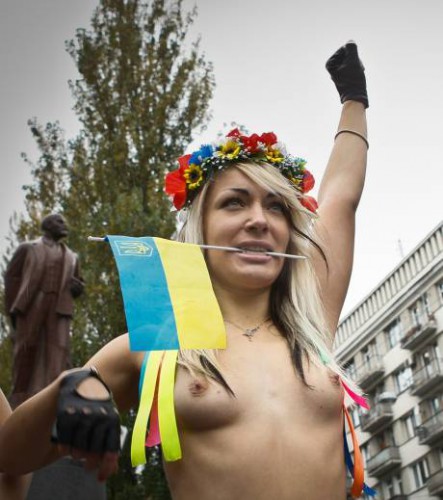
femenukrs60.jpgQue nous arrive-t-il ? Tout d'un coup, nous comprenons. Non pas que nous n'avions pas compris mais il subsistait toujours un peu le doute, une interrogation. Qu'aurions-nous fait ? Dans quel camp aurions-nous été ? Que nous réserverait un jour l'histoire ? Nous avions tant lu sur la génération des années 30 de Maulnier à Aragon, de Cocteau à Malraux, de Drieu à Maurras, de Rebatet à Breton, de Bernanos à Sartre que nous sentions bien que leurs positionnements suivaient les aléas de l'Histoire, des familles, des générations politiques, de la clairvoyance intellectuelle, des idées prolétariennes ou bourgeoises voire même de l'avenir de la poésie. Cela nous fascinait.

Mais aujourd'hui, en suivant leur scénario, en assimilant honteusement, comme ils le font sur les médias officiels, la Crimée aux Sudètes et Poutine à un moustachu, de surcroit blanc et viril, nous nous retrouvons de facto dans le mauvais camp. Ainsi, s'il y avait une « troisième guerre mondiale » officielle, avec mobilisation générale, serions-nous tentés de partir pour Moscou. Derechef, nous serions alors rangés, à notre retour, du côté des collabos ou fusillés à Bad Reichenhall. Comme tout cela va très vite, vous êtes ainsi balancés du mauvais côté de l'histoire, au mépris de la vérité et de l'analyse juste puisque dans l'affaire qui nous préoccupe, ce sont bien les alliés de l'Europe, les gens de Praya Sektor qui font le salut romain en début de réunion. Voulez-vous les photos ? On voit ainsi devant nos yeux cette lâcheté des « trous du cul » dénoncés en son temps par Céline, souhaiter la victoire de l’OTAN et de l’Union Européenne, partager l'acharnement de Washington contre la Russie exactement comme hier Laval souhaitait la victoire de l’Allemagne ou Aragon encensait Staline. Face au drame de dizaines de morts, et au risque de guerre civile généralisée et de partition de l'Ukraine, on voit et l'on entend ainsi des Français exciter les tensions en Ukraine en prenant parti, sur la base d’un vocabulaire politique tissé de manipulation idéologique et de provocation, ignorant totalement les réalités culturelles, géopolitiques, économiques et stratégiques. Réalités  culturelles : la profonde division nationale, entre Russes, Ukrainiens et Ruthéno-Galiciens, Historiques, dans un pays qui fut martyrisé par l’Union soviétique : l'holodomor ou génocide par la faim de 1933 ; l'extermination des armées de libération nationale en 1954  et entre temps, la parenthèse nazie. Economiques, un pays très riche, la plaine à blé de l'Europe tant par ses sols agricoles (tchernoziom) que par ses mines et ses industries lourdes. Stratégiques, les bases navales russes sur la Mer Noire et le lieu de passage des oléoducs ou gazoducs orientaux vers les débouchés occidentaux.


Dans ces conditions, quelle est l'aberration ? Où est, en effet, l'irrationalité politique ? N'était-elle pas cette proposition de l’Union européenne, instiguée par une lointaine puissance maritime d’offrir de façon provocante à l’Ukraine un rapprochement politique et économique, voire militaire? La Russie, limitrophe sur près des 2/3 des frontières ukrainiennes, ne pouvait l’accepter. Ukrajnia ne signifie-t-il pas « frontière » en russe ?


Ainsi, soit, les « stratèges » de la Commission européenne sont des ignares historiques soit, ils sont totalement inféodés à l’OTAN dans la perspective d'une stratégie globale de chaos sur le terrain européen. Alors, tout serait prêt pour le drame de l'effondrement européen qui infuse depuis Gorbatchev car si l’Ukraine explose en deux, puis, peut être trois parties, il y aura forcément une dislocation régionale et des répliques dans d’autres pays des Carpates, des Balkans, des Tatras ou du Caucase. Face à cette tragédie, le premier devoir des dirigeants européens – et plus encore de la France- aurait été de prendre des distances c'est-à-dire d’abord de comprendre la crise. Or, on entendit dénommer les émeutiers aux saluts romains de  « pro- européens » ! 


L'Ordre nouveau approche et la destruction de la zone euro n’est plus pour certains qu’une question de temps ! La mise en scène de la troisième guerre mondiale, version XXIème siècle, c'est-à-dire sans mobilisation générale est en place. Ce sera la dissémination du chaos (Irak, Afghanistan, Libye, Syrie). Elle commence à prendre forme sur le sol européen même. Les évènements s’accélèrent à différentes échelles depuis le début de l'année : monétaire avec des dettes souveraines impossibles à rembourser, des banques aux actifs de plus en plus toxiques; stratégiques avec l’émergence de blocs continentaux ou de pays dissidents en vue d’une confrontation planétaire. En Afrique : Rwanda, République démocratique du Congo, République Centrafricaine, Tchad, Somalie, Nigeria. En Asie: Chine contre Vietnam et Japon. L'Europe est invertébrée, pusillanime, divisée, incapable en 60 ans d'existence de créer une défense commune. Dans les états-majors, à cause de l'Ukraine, on recommence à entendre parler de « pare-feu », d' « échelles d’escalade », de « dissuasion élargie », terme pourtant créés pendant la Guerre Froide pour établir les différents scénarii possibles de la guerre en Europe. Nous aimerions entendre parler d'autre chose, par exemple de « puissance allemande ». Décidément serions-nous irrécupérables ? Nous commencions par être pro-russe et vouloir rejoindre Moscou et nous finissons en optant pour une Allemagne réveillée et décomplexée, une Allemagne comme leader politique de l'Europe puissance ! Qu'il est donc difficile de sauver l'Europe !

The US Tactics of Withdrawal and its Regional Implications

withdraw24_n_s.jpg

Author: Salman Rafi Sheikh

Ex: http://journal-neo.org

The US Tactics of Withdrawal and its Regional Implications

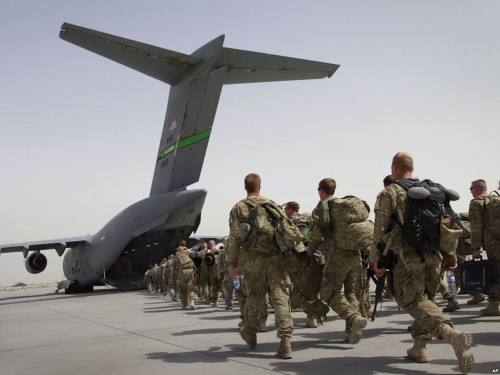
Keeping in mind the critical objectives the US wanted to achieve through politico-military domination of Afghanistan—-which crucially included control over flow of energy from Central Asia and Caspian Sea region to the outer world as well as gravitating its influence in the region —-one does have every reason to apprehend the spillover effects of the consequences of the situation evolving in Afghanistan with the manifold increased possibility of civil war following the withdrawal of the US/NATO forces from Afghanistan. Since the US has not been able to achieve its objectives, by any means, therefore, she is least expected to leave (or leave at all?) this region in a politically stable condition. The form of the withdrawal that the US has been trying to accomplish through signing the (hitherto unsigned) Bi-lateral Security Agreement, and the consequent refusal by the Karzai government to accept some of the crucial elements of this agreement, has created such conditions whereby a situation of ‘controlled instability’ in Afghanistan—to be used as an excuse for maintaining military presence as well as gravitating its influence and creating further disruption in the region surrounding Afghanistan—-emerges as a viable tactical option for the US for the post-2014 period.

A politically bifurcated and disrupted Afghanistan can thus be more advantageous for the US than the one dominated by Taliban or any political system not sensitive to protecting the US’ interests. It is therefore naïve to think of the US as ‘struggling’ to establish ‘peace’ through political means, as is often officially projected by the US and its allies. Her, by any definition of real politick, is a struggle for sustaining geo-political edge in the region. As such, the current set back to the US in Ukraine has further made it necessary for her to stay in the region to counter Russian resurgence. Therefore, it is of utmost significance for the regional states, especially of the CAS and Pakistan, to revisit their policies in the light of these emerging scenarios in Afghanistan, because the ethnic linkages of these states make them very much vulnerable to threats emanating from possible civil war in Afghanistan.

Interestingly, and probably due to the failure on ground, the emphasis of occupying forces has continuously been shifted from one set of objectives to another. Sometimes it is focusing on stemming down the resistance and some other times on the rehabilitation and strengthening of the political structure and democratic institutions in Afghanistan and more recently on the development and training of armed and security forces. This situation raises another important and even more serious question: whether the US invaded Afghanistan for achieving the stated objectives only. Many experts believe it was an attempt to assert American dominance in the regions surrounded by energy-rich areas and that the American ruling elite is determined to consolidate Afghanistan as a neo-colonial US protectorate and a staging post for further intrigues in Central and South Asia and the Middle East.

As such, in order to achieve these objectives, the US has been changing its strategy from time to time as well. Now that the time for withdrawal has arrived, it does not, by any means, imply the end of war in Afghanistan. The war will continue; however, the primary actors would change. The US/NATO combat forces, after their withdrawal, are most likely to be replaced by the private militias that the US has erected and been funding through, along with other means, the CIA and US army sponsored poppy cultivation. As a matter of fact, the US has been paying tens of millions of dollars to these private militias annually for escorting their convoys. Theses private militias extort money from common people and levy agricultural tax on farmers. They have been found involved in burglary, kidnapping and other unscrupulous activities; and, all these are overlooked by the foreign forces as the militias support them in their fight against the so-called ‘terrorism.’

The private militias are led by local warlords, many of whom are also planning to contest up-coming Presidential elections, and are least expected not to use force or stop poppy cultivation; rather, they tend to use political platform to implement their agendas and those of their political mentors’ as well in the hope of keeping Taliban ousted from power. For example, Abdul Rasoul Sayyaf, a candidate for Presidential election, is a veteran warlord and is known to have massacred tens of thousands of Hazaras, a community who are mostly Shias. Warlords like Sayyaf with a violent past have been playing a significant role in influencing Afghan politics since the US-led coalition helped oust the Taliban in 2001. But they are now emerging to play an overt political role in next month`s presidential elections as President Hamid Karzai leaves the scene. Some, like Sayyaf, are running for elections, while others are being courted by the candidates because many of the warlords command strong followings, particularly along ethnic lines. With warlords and notorious powerbrokers now gearing up to exert direct and indirect influence on Afghanistan’s politics, ethnic and sectarian rivalry is most likely to get sharpened, leading to a fully fledged civil war in Afghanistan.

However, it has to be kept in mind that the only major stakeholder that can get maximum benefit out of this scenario is the US; for, infighting would keep Taliban out of power and will provide the US with an ‘excuse’ to keep the number of residual forces high in Afghanistan. In this behalf, the often repeated Western assertion that civil war will follow the US’ withdrawal is just another way of actually predicting what is factually going to happen, once the US backed new government gets established; for, the US is now planning to finalize the BSP with this new government and pave the way for a long-term stay of its military in Afghanistan. As a matter of fact, all of the 11 candidates for president elections in Afghanistan have already signaled that they would sign the security agreement, and allow the western troops to stay in Afghanistan past 2014. It also factually means that the US will also fully drag the Afghan National Force, as a substitute to its own war machine, into the war with Taliban and keep its own military in Afghanistan in the name of training the ANF for counter-terrorism operations. Needless to say, it is for this very purpose the ANF was created in the first place. This would also help the US in giving this war technically a “civil” colour, whereas in actual terms it would remain the US’ own war—hence, minimum public pressure on the US government. The US, as such, is all set for a longer stay and is now looking well beyond Hamid Karzai.

In this scenario coming up, there is hardly any room to doubt that war in Afghanistan would come to an end in the near future, or political stability would follow elections. However, there is another related fact that has to be kept in mind. If civil war breaks out in Afghanistan, it is not the people of Afghanistan alone who are likely to be affected; regional states will also become extremely vulnerable to such fallout. Let’s have a look at regional implications of civil war in Afghanistan.

In the first scenario, prolonged infighting in Afghanistan would push more refugees into Pakistan. Already around 1.7 million Afghans are still living in Pakistan, who are currently registered with United Nations’ High Commission for Refugees (UNHCR) and it is estimated that a large number is also unregistered, and the total figure is around three to four million. This influx of population in Pakistan has already been causing conflicts between local Pashtun people as well as between the refuges and other ethnic groups such as Baluchistan where people of Baluch origin are gradually being reduced to minority because of this demographic shift, with grave consequences in the shape of terrorism and insurgency in Pakistan. Apart from this refugee influx, it is almost self evident that an unstable Afghanistan necessarily implies a highly unstable North-Western region of Pakistan, since porous border allows fighting groups to infiltrate in Pakistan and assist local groups in fighting against the state of Pakistan and vice versa. As a matter of fact, the current leader of Pakistani Taliban was based in Afghanistan before he infiltrated into Pakistan in 2013.

In addition to this problem, Pakistan and almost all the regional states are going to be affected by the highly increased production and outflow of poppy from Afghanistan. Considering the link between warlords, poppy cultivators and the US, it is not difficult to understand why the production of poppy has markedly increased since 2001. It has swelled from 1,570 tons in 1990 to 6,000 tons in 2006 and 8,200 tons in 2007. Since 2001, the land used for poppy cultivation has increased from 8,000 hectares to 193,000 hectares. Where this increase is deeply linked with the US intelligence services, which increasingly constitutes a powerful actor in the spheres of finance and banking and which tacitly allows this production in Afghanistan to enable the warlords to indirectly finance the “civil war”, there it also affects population of near and remote areas of the region alike. According to a 2012 report of UNO, the illicit trade of opiates runs along the Northern route from northern Afghanistan to Central Asia up to the borders of the Russian Federation. Similarly, opium is also smuggled into Pakistan and Iran where a large number of people have already become addicted. It is not a coincidence that 11 percent of the total population of Pakistan’s North-Western province, which also borders Afghanistan, is drug addicted, and 6.7 million of Pakistan’s total population is drug addicted. Although it cannot be said that opium produced in Afghanistan in the only reason for this high rate of drug addiction, however, it is a very significant factor which can be further strengthened by looking at the increase of drug addiction in Pakistan in the 1980s when Afghan refugees in Pakistan indulged in its trade.

Another implication of eruption of civil war in Afghanistan is the threat of its spillover to the Central Asian States as well as Pakistan. Needless to say, the deep ethnic linkages among some major ethnic communities of Afghanistan, Pakistan and the CA States make the latter two regions vulnerable to the physical and ideological infiltration of the fighting groups into these states, which in turn can cause huge disruption in these states as well.

The analysis shows that the hope of “peace” being established following withdrawal of the US/NATO forces will vanish soon after elections, which are most likely to be followed by an intense wave of infighting. As a matter of fact, in a recent statement issued, Taliban have already warned of attacks on election polls, agents and Afghan National Army. In this scenario, with the above mentioned regional implications of a new era of warfare in Afghanistan, it is of utmost importance that the regional states draw up policies to insulate themselves against these direct threats emanating from Afghanistan. It is very significant since the US does want to stay in the region for as long as possible, and it is obvious that peace would remain only a dream as long as she is here; for, establishment of peace is diametrically opposite to the attainment of the above mentioned geo-political objectives that the US wants to achieve.

Salman Rafi Sheikh, research-analyst of International Relations and Pakistan’s foreign and domestic affairs, exclusively for the online magazine “New Eastern Outlook”.
Alemania y China edifican la nueva ruta de la seda a través de Rusia: ¿la troika del siglo XXI?

por Alfredo Jalife-Rahme

Ex: http://paginatransversal.wordpress.com

A diferencia de Alemania y Rusia, la prensa china ha otorgado mucho vuelo a la “nueva ruta de la seda”: un proyecto geoeconómico de primer orden de Pekín que lo conecta geoeconómicamente con Berlín y Moscú, pero que, a mi juicio, tiene un transcendental trasfondo geopolítico (emsnews, 30/3/14). Durante su visita al emblemático puerto alemán de Duisburgo –el mayor puerto interno del mundo en la región siderúrgica y comercial del Ruhr, además de ser la encrucijada de transporte y logística de Europa–, el mandarín chino Xi Jinping exhortó a construir el cinturón económico de la ruta de seda.

Mientras Estados Unidos (EEUU) realiza cuentas alegres con los dos brazos de sus ominosas tenazas geopolíticas/geoeconómicas –tanto de la Asociación Transpacífico (ATP) como de la Asociación Trasatlántica de Comercio e Inversión (TTIP, por sus siglas en inglés), los cuales supuestamente captarían las dos terceras partes del comercio global–, las tres grandes geoeconomías de la proyectada “nueva ruta de la seda” conectarían a la hoy segunda geoeconomía global, China –a punto de desbancar a EEUU–, Alemania (primera en Europa y la cuarta a escala global) y Rusia (octava economía global).

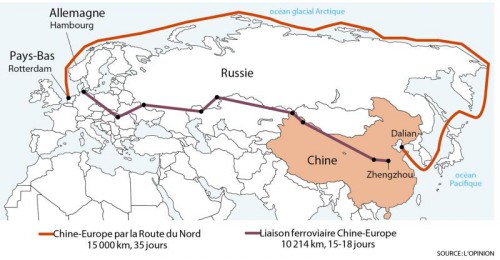
La osadía geoeconómica/geopolítica del mandarín chino puede acelerar los planes de guerra de EEUU y Gran Bretaña, ya que ha sido un axioma inmutable de la geopolítica anglosajona desde sir Halford Mackinder (creador conceptual de la OTAN), en el intermezzo de las dos guerras mundiales a inicios del siglo XX: impedir a cualquier precio una alianza entre Alemania y Rusia en Europa. Hoy China y Alemania están conectadas por la red ferroviaria internacional Chongqing/Xinjiang/Europa.

Según Xinhua (28 y 30/3/14), la red ferroviaria “Yu Nueva Europa”, bautizada como la “nueva ruta de la seda”, se ha convertido en la “más importante ruta de comercio del mundo (¡supersic!) al conectar la relevante metrópoli sur-occidental de Chongqing (China) con Duisburgo”, que entró en operación en 2011 y recorta cinco semanas de transporte marítimo a sólo dos –lo cual fue seguido en 2013 por la conexión ferroviaria de cargo de Chengdu (capital de Sechuan y santuario de los legendarios Pandas)/Lodz (Polonia) que atraviesa Kazajistán, Rusia y Bielorrusia: mercados emergentes donde pasa la ruta de carga, que toma 12 días de transportación (http://www.alfredojalife.com/?p=1075 ).

Se vaticina que China se convertiría en el mayor socio comercial de Alemania en los próximos cinco años, cuando los principales socios de Berlín, tanto Francia como EU, “carecen de un poderoso potencial de crecimiento”.

En medio de las sanciones de Oc­cidente a Rusia, la prensa iraní destaca el acercamiento de China con Alemania, publica una entrevista con el investigador estadunidense-alemán William Engdahl, muy versado en geopolítica de los energéticos, las finanzas y los alimentos, además de ser catedrático de universidades en China y Alemania (http://www.presstv.ir/detail/2014/04/06/ 357386/china-uses-economy-to-avert-cold-war/). A juicio del entrevistador iraní, el presidente chino, Xi Jingping, dio un golpe maestro de “diplomacia económica” para contrarrestar el “esfuerzo de la facción neoconservadora de Washington para propiciar una nueva confrontación entre la OTAN y Rusia”.

Para Engdahl, la proclama de Xi en Duisburgo comporta “implicaciones asombrosas de crecimiento económico en Eurasia”. Resulta y resalta que Alemania y China representan “dos locomotoras económicas” a cada lado de la ruta de la seda y rememora que el término de “ruta de la seda” describe “la antigua ruta comercial y cultural entre China, Asia Central y el Sur de Asia, Europa y Medio Oriente, que fue creada durante la dinastía Han, 200 años aC”.

Tanto la “ruta de la seda económica” como la “ruta de la separada seda marítima (sic)” fueron mencionadas por Xi durante la tercera sesión plenaria del Partido Comunista chino. Para Xi la ruta euroasiática representa una “prioridad estratégica”, ya que “China necesita encontrar nuevos mercados de exportación y preservar los existentes, así como disminuir las brechas de desarrollo entre las áreas costeras bien desarrolladas como Shanghai y la parte menos desarrollada al interior del país”, lo cual servirá para “preservar la estabilidad al interior de China y en su vecindad”.

La provincia efervescente de Xinjiang (China) se encuentra a lo largo de la ruta de la seda, donde prevalecen los islámicos uigures: centroasiáticos de origen mongol.

Engdahl destaca que “el camino del corredor de la nueva infraestructura pasa por Rusia (¡supersic!)”, por lo que “no existe alternativa económica” y hace inevitable la profundización de la cooperación entre Alemania y Rusia y, por ende, de China con los dos. A Engdahl no se le pasa por alto que una semana antes de su periplo por varios países de Europa, Xi recibió en Pekín al príncipe heredero de Arabia Saudita, Bin Abdulaziz Al Saud, a quien invitó unirse en la construcción del cinturón económico tanto de la ruta eurosiática de la seda y como de la “ruta marítima de la seda” del siglo XXI que promuevan la “conectividad del transporte y la cultural”.

Llama la atención que Xi siempre acompañe la cuestión cultural en sus intercambios comerciales, como dejó entrever en su histórica visita a Yucatán: el “espíritu de Chichen Itzá”. El mandarín chino no deja nada al azar y, al unísono de su primer ministro, ha realizado visitas a varios países centroasiáticos a lo largo de la ruta de la seda: Turkmenistán, Kazajistán, Uzbekistán y Kirguizistán.

La elusiva estabilidad en Asia Central será fundamental para el éxito de la nueva ruta de la seda que comporta una propuesta visionaria y muy ambiciosa de cinco puntos del Xi: 1) la cooperación económica conjunta (¡supersic!); 2) el fortalecimiento de las conexiones de ruta para construir un gran corredor de transporte del Pacífico al mar Báltico y de Asia central al océano Índico (¡supersic!); 3) la facilitación comercial mediante la eliminación de barreras comerciales; 4) el fortalecimiento de la cooperación monetaria (¡supersic!), lo cual, a mi juicio, desplazaría gradualmente al dólar e impulsaría al renminbi chino, la rupia de India y al euro “alemán”, y 5) el estrechamiento de las relaciones de sus poblaciones: 30 mil (¡supersic!) miembros del Consejo de Cooperación de Shanghai estudiarán en las universidades chinas en los próximos 10 años.

Detrás de la decisión de China de enfocarse en dirección de su “occidente”, se encuentra un componente mayúsculo de seguridad, a juicio de Engdahl, cuando China es “muy vulnerable a la interrupción del estrecho de Malaca, donde pasa 85 por ciento de sus importaciones que incluyen 80 por ciento de sus necesidades energéticas”.

Con la mirífica “nueva ruta de la seda”, en sus componentes terrestre y marítimo, China intenta dar la vuelta al virtual bloqueo del estrecho de Malaca.

¿Dejará la dupla anglosajona, muy versada en balcanizaciones y desestabilizaciones, prosperar el eje euroasiático tripartita Berlín-Moscú-Pekín, que puede definir el nuevo orden multipolar?

www.alfredojalife.com

Twitter: @AlfredoJalife

Facebook: AlfredoJalife

Ukraine, après Farage, Schröder: L'erreur fondamentale vient de la politique de l'UE

gerhard-pk-BM-Bayern-Oslo.jpg

Ukraine, après Farage, Schröder: L'erreur fondamentale vient de la politique de l'UE

Auteur : AFP 
Ex: http://www.zejournal.mobi

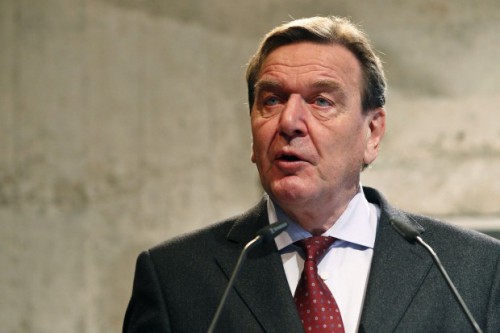
L'ancien chancelier allemand Gerhard Schröder estime que l'Union Européenne est la principale responsable de la crise ukrainienne, en ayant obligé Kiev à choisir entre un avenir avec l'UE ou avec la Russie, dans le journal Welt am Sonntag, dimanche.

"L'erreur fondamentale vient de la politique de l'UE en faveur d'un traité d'association" que Bruxelles voulait signer avec l'Ukraine, a jugé M. Schröder, ami de longue date du président russe Vladimir Poutine.

"L'UE a ignoré le fait que l'Ukraine est un pays profondément divisé culturellement. Depuis toujours, les gens du sud et de l'est du pays sont plutôt tournés vers la Russie et ceux de l'ouest plutôt vers l'UE", a-t-il rappelé.

"On pouvait parler d'un traité d'association, mais il aurait fallu le faire avec la Russie dans le même temps. L'erreur de départ a été de dire ce sera ou un traité d'association avec l'UE ou une union douanière avec la Russie", a-t-il poursuivi.

Tout en assurant par ailleurs que "des erreurs ont été commises de toutes parts", M. Schröder ne condamne pas le rattachement de la Crimée à la Russie, à la suite d'un référendum jugé illégal par la communauté international.

"Le rattachement de la Crimée est contesté sur le plan du droit international, mais c'est maintenant une réalité. La Crimée a décidé par référendum qu'elle voulait être une région russe. Et cela a été appliqué", a-t-il relevé.

M. Schröder a également relativisé l'influence de Moscou sur les séparatistes pro-russes ukrainiens.

"L'idée qu'il suffirait que le président russe ou le chef du gouvernement ou qui que ce soit d'autre n'aurait qu'à dire +basta+ pour que tout rentre dans l'ordre n'est certainement pas réaliste", a-t-il commenté.

Dimanche se tiennent en Ukraine deux référendums dans l'est du pays.

Plus de sept millions d'Ukrainiens de l'Est sont appelés à se prononcer sur l'"indépendance" des "républiques populaires" autoproclamées de Donetsk et de Lougansk, deux régions frontalières de la Russie, où les insurgés contrôlent les principales villes.

Dans l'interview, M. Schröder est également revenu sur la fête organisée pour ses 70 ans à Saint-Petersbourg, et à laquelle a participé le président russe, ce qui lui avait valu de vives critiques en Allemagne.

L'accolade chaleureuse entre les deux hommes à l'arrivée du président russe avait été particulièrement commentée en Allemagne.

Depuis que je connais Vladimir Poutine, depuis plus de 14 ans, on se salue ainsi. Je ne vais pas changer cela, pas même dans les périodes difficiles, a rétorqué M. Schröder.

M. Schröder a aussi rejeté les critiques de ceux qui le jugent de parti pris parce qu'il préside le groupe d'actionnaires de Nord Stream. Ce groupe, fondé pour la construction d'un gazoduc transportant du gaz russe vers l'Europe via la Baltique et donc en évitant l'Ukraine, est détenu à 51% par Gazprom, contrôlé par l'État russe.

Nord Stream est une entreprise européenne, dont le siège est en Suisse et dont sont également actionnaire les groupes allemands Eon et BASF, ainsi que Gaz de France, a rappelé M. Schröder.

 - Source : AFP