


samedi, 27 juin 2009
Citation de Chantal Delsol

Citation de Chantal Delsol:
Trouvé sur: http://forumsoral.com/
Comme je suis anti-républicain, et donc plutôt fédéraliste, au même titre que Robert Steuckers ou l'Action Française fidèle à Charles Maurras, je vous laisse un morceau qui résume bien ce que j'ai envie de dire à Soral et de la république :
Chantal Delsol écrit : « La république n'accepte donc le débat démocratique qu'à l'intérieur des présupposés qui sont les siens. Et parce que ces présupposés sont assez précis et dessinent une figure du bien commun clairement déterminée, le champ du débat demeure toujours limité, voire exigu, en tout cas par rapport aux démocraties occidentales voisines. Dans la république française, la démocratie ne peut fonctionner seulement tant que les différents courants de pensée acceptent les présupposés républicains, et par là elle ne fonctionne jamais que sous une forme atténuée, puisque l'éventail des figures permises du bien commun est restreint. Si, pour des raisons diverses, un nombre significatif de citoyens récusent certains présupposés républicains et veulent exprimer cette récusation au nom de la démocratie, alors la république se trouve déstabilisée et sommée de donner une réponse à cette contradiction. Soit il lui faudra remettre en cause ses propres principes au nom de la démocratie, ce qui lui paraît impensable parce que ses valeurs sont sacralisées ; soit elle cherchera les moyens d'empêcher ces courants de s'exprimer, au nom de ses principes. La difficulté, dans ce deuxième cas, est qu'elle ne peut pas condamner ouvertement la démocratie pluraliste, faute de se voir rejetée dans le camp des ennemis de la liberté. La réponse à ce dilemme s'annonce tortueuse ».
http://www.polemia.com/article.php?id=109
_________________
Ne serait-ce pas l'instinct de la crainte qui nous incite à connaître ? La jubilation de celui qui acquiert une connaissance ne serait-elle pas la jubilation même du sentiment de sentiment recouvré ? Friedrich Wilhelm Nietzsche
00:20 Publié dans Théorie politique | Lien permanent | Commentaires (0) | Tags : politologie, philosophie, sciences politiques, fédéralisme, france |  |
|  del.icio.us |
  |
|  Digg |
  Facebook
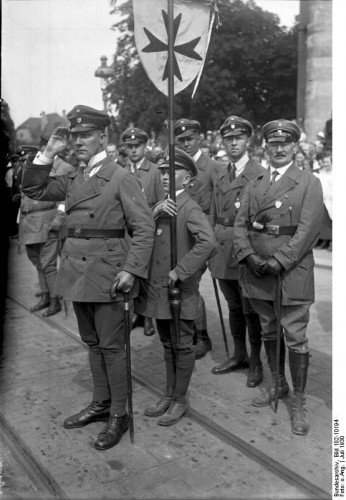
Heroischer Realismus im Kerker - Nationalrevolutionäre der Weimarer Republik
| |||||||||||
 Im agitatorischen Stil kommt der unter Herausgeberschaft von Hartmut Plaas’ 1928 erschienene Sammelband: „Wir klagen an! Nationalisten in den Kerkern der Bourgeoisie“ daher. Als einen der ersten Faksimiles druckte der Uwe-Berg-Verlag die Schrift in seiner Reihe „Quellentexte zur Konservativen Revolution“ unter der Kategorie „Die Nationalrevolutionäre“ ab. Was der Einband nicht verrät: der Herausgeber wurde 1944 im Zuge des Stauffenberg-Attentats hingerichtet.
 mit ihr! Ihr führet Krieg und heulet derweil um Frieden! Wir klagen euch an.“ Die Zeilen lesen sich oftmals als prägende Leidensgeschichten aus den Gefängnissen der Weimarer Republik. Aber auch eine gewisse Zynik spricht aus vielen Zeilen. So etwa hier bei Roderich Zoeller: „Und ich verließ nach sechsmonatigem Nachdenken hinter Gitterfenstern das Gefängnis natürlich als sittlich gebesserter Mensch.“
00:15 Publié dans Révolution conservatrice | Lien permanent | Commentaires (0) | Tags : weimar, allemagne, politique, révolution conservatrice, nationalisme révolutionnaire | | del.icio.us | | Digg | Facebook
Petite bibliographie sur la Révolution Conservatrice allemande
GENERALITES
-Armin MOHLER : La Révolution Conservatrice allemande (1918-1932), Pardès, Puiseaux, 1993 (Première édition 1950).
-Dominique VENNER : Histoire d’un fascisme allemand, les corps-francs du Baltikum et la Révolution Conservatrice, Pygmalion/Gerard Watelet,Paris, 1996.
-Stefan BREUER : Anatomie de la Révolution conservatrice, Editions de la Maison des Sciences de l’Homme, Paris, 1996.
-Louis DUPEUX : Aspects du fondamentalisme national en Allemagne de 1890 à 1945 et essais complémentaires, Presses Universitaires de Strasbourg, 2001.
-Louis DUPEUX (sous la direction de) : La « Révolution Conservatrice » dans l’Allemagne de Weimar, Editions Kime, Paris, 1992.
-Barbara KOEHN (sous la direction de) : La Révolution conservatrice et ses élites intellectuelles, Presse Universitaires de Rennes, 2003.
-Paul LACOSTE : La Révolution Conservatrice allemande (1918-1932), Imperium, Epinay sur Orge, 1997.
-Edmond VERMEIL : Doctrinaires de la Révolution allemande 1918-1938, Nouvelles Editions Latines, Paris, 1948.
-Robert STEUCKERS (éditeur) : in Vouloir n°8 nouvelle série, Révolution Conservatrice, automne 1996.
-Robert STEUCKERS : La « Révolution Conservatrice » en Allemagne, 1918-1932 in Vouloir ancienne série n°59/60, novembre-décembre 1989, p : 11-16.
-Luc PAUWELS : Armin MOHLER et la « Révolution Conservatrice » in Vouloir ancienne série n°63/64, Printemps 1990, p : 13-19.
-Alain de BENOIST (entretien avec) : in Eléments n°70, printemps 1991, p : 24-37.
-Giorgio LOCCHI : Die Konservative Revolution in Deutschland 1918-1932 in Nouvelle Ecole n°23, automne 1973, p : 94-107.
-Erwin BUCHEL : Armin MOHLER, l’historien de la « Révolution Conservatrice » in Nouvelle Revue d’histoire n°8, septembre-octobre 2003, p : 22-23.
LES JEUNES CONSERVATEURS
-Oswald SPENGLER : Le déclin de l’Occident, 2 volumes, Gallimard, Paris, 1948.
-Oswald SPENGLER : Prussianisme et socialisme, Actes Sud/ Hubert Nyssen, Arles, 1986.
-Oswald SPENGLER : L’homme et la technique, Idées, Gallimard, Paris, 1969.
-Oswald SPENGLER : Années décisives, Copernic, Paris, 1980.
-Oswald SPENGLER : Écrits et pensées, Copernic, Paris, 1980.
-Robert STEUCKERS (éditeur) : Dossier Spengler in Orientations n°1, janvier 1982, p : 14-25.
-Thomas MANN : Considérations d’un apolitique, Grasset, Paris, 1975 (réédition 2002).
-Denis MAGNE : Thomas MANN ou la domination des contraires in Nouvelle Ecole n°41, Automne 1984, p : 11-44.
-Laurent SCHANG : La jeunesse « apolitique » de Thomas Mann in Nouvelles de Synergies Européennes n°33, mars-avril 1998, p : 21-22.
-Carl SCHMITT : La notion de politique/ théorie du partisan, Champs/Flammarion, Paris, 1992.
-Carl SCHMITT : Terre et mer. Un point de vue sur l’histoire mondiale, Labyrinthe, Paris, 1985.
-Carl SCHMITT : Du politique, « légalité et légitimité » et autres essais, Pardès, Puiseaux, 1990.
-Carl SCHMITT : Machiavel-Clausewitz, droit et politique face aux défis de l’histoire, Krisis, Paris, 2007.
-Carl SCHMITT : La dictature, Seuil, Paris, 2000.
-Carl SCHMITT : Théologie politique, Gallimard, Paris, 1988.
-Alain de BENOIST : Carl Schmitt actuel-« Guerre juste, terrorisme, état de guerre, Nomos de la terre », Krisis, Paris, 2007.
-Arthur MOELLER VAN DEN BRUCK : Le troisième Reich, Fernand Sorlot, Paris, 1981.
Arthur MOELLER VAN DEN BRUCK : La révolution des peuples jeunes, Pardès, Puiseaux, 1993.
-Alain DE BENOIST : Arthur MOELLER VAN DEN BRUCK, une « question à la destinée allemande » in Nouvelle Ecole n°35, Hiver 1979-1980, p : 40-73.
-Giselher WIRSING : L’âge d’Icare, de la loi et des frontières de notre temps, PanEuropa, Paris, 2003 (édition originale 1944).
LES NATIONAUX-REVOLUTIONNAIRES/NEO-NATIONALISTES
-Ernst JUNGER : Orages d’acier, Livre de poche, Paris, 1989.
-Ernst JUNGER : Le boqueteau 125, Christian Bourgois (nouvelle traduction), Paris, 1995
-Ernst JUNGER : La guerre comme expérience intérieure, Christian Bourgois, Paris, 1997 (nouvelle traduction de La guerre, notre mère).
-Ernst JUNGER : Feu et sang, Christian Bourgois, Paris, 1998.
-Ernst JUNGER : Lieutenant Sturm, Viviane Hamy, Paris, 1991.
-Ernst JUNGER : Le travailleur, Christian Bourgois, Paris, 1989.
-Ernst JUNGER : Sur les falaises de marbre, Gallimard, Paris, 1979.
-Alain de BENOIST : La figure du travailleur entre dieux et titans in Nouvelle Ecole, n°40, automne 1983, p :11-61.
-Alain de BENOIST (Editeur) : in Nouvelle Ecole, n°48, année 1996, Ernst JUNGER.
-Robert STEUCKERS (Editeur) : in Vouloir n°4 nouvelle série, printemps 1995, Ernst JUNGER 100 ans.
Robert STEUCKERS (Editeur) : in Nouvelles de Synergies Européennes, Hommage à Ernst JUNGER, n°33, mars-avril 1998, p : 2-10
-Isabelle GRAZIOLI-ROZET : JUNGER, Qui suis-je ?, Pardès, Grez-Sur-Loing, 2007.
-Isabelle GRAZIOLI-ROZET : Hommage à Ernst JUNGER in Eléments n°92, Juillet 1998, p : 4-8.
-Philippe BARTHELET (Sous la direction de) : Ernst JUNGER, Les Dossiers H, L’Âge d’Homme, Paris/ Lausanne, 2000.
-Ernst VON SALOMON : Les cadets, UGE/10-18, Paris, 1986.
-Ernst VON SALOMON : Les réprouvés, Christian Bartillat, Paris, 2007.
-Ernst VON SALOMON : Histoire proche, essai sur l’esprit corps-franc, Porte Glaive, Paris, 1987.
-Ernst VON SALOMON : Le questionnaire, Gallimard, Paris, 1982.
-Ernst NIEKISCH : « Hitler, une fatalité allemande » et autres écrits nationaux-bolcheviks, Pardès, Puiseaux, 1991.
-Thierry MUDRY : L’itinéraire d’Ernst NIEKISCH in Orientations n°7, septembre-octobre 1986, p : 34-37.
-Paul BAHN : L’itinéraire de Friedrich HIELSCHER, 1902-1990 in Nouvelle Ecole n°53-54 (Le Fascisme), année 2003, p : 170-182.
-Robert STEUCKERS : Friedrich-Georg JUNGER (1898-1977), la perfection de la technique, Synergies Européennes, Bruxelles, 1996.
-Robert STEUCKERS : L’itinéraire philosophique et poétique de Friedrich-Georg JUNGER in Vouloir n° 45/46 ancienne série, janvier-mars 1988, p : 10-12.
LES VOLKISCHEN/ FOLCISTES
-Ludwig FERDINAND CLAUSS : L’âme des races, L’homme Libre, Paris, 2001.
-Ludwig FERDINAND CLAUSS : David et Goliath in Etudes et Recherches nouvelle série, n°2, quatrième trimestre 1983, p :17-23.
-Hans F. K. GUNTHER : Platon, eugéniste et vitaliste, Pardès, Puiseaux, 1987.
-Hans F. K. GUNTHER Religiosité indo-européenne, Pardès, Puiseaux, 1987.
-Hans F. K. GUNTHER Mon témoignage sur Adolf Hitler, Pardès, Puiseaux, 1990.
-Hans F. K. GUNTHER Les peuples de l’Europe, Editions du Lore, 2006.
-Hans F. K. GUNTHER La race nordique chez les Indo-Européens d’Asie, L’Homme Libre, Paris, 2006.
-Otto RAHN : La cour de Lucifer, Pardès, Puiseaux, 1994.
-Robert STEUCKERS : L’œuvre de Hermann Wirth (1885-1981) in Vouloir n°101/102/103/104 ancienne série, avril-juin 1993, p : 53-55.
-Nicholas GOODRICK-CLARKE : Les racines occultistes du nazisme. Les Aryosophistes en Autriche et en Allemagne, 1890-1935, Pardès, Puiseaux, 1989.
LES BUNDISCHEN
-Karl HOFFKES : Wandervogel révolte contre l’esprit bourgeois, ACE, Saint-Etienne, 2001 (nouvelle édition augmentée).
-Alain THIEME : La jeunesse « Bundisch » en Allemagne au travers de Die Kommenden (janvier 1930-juillet 1931), ACE, Saint-Etienne, 2003.
-Walter FLEX : Le pèlerin entre deux mondes, Porte Glaive, Paris, 1996.
-Hans BLUHER : Wandervogel, histoire d’un mouvement de jeunesse, tome 1, Les Dioscures, Paris, 1994.
-Luc SAINT-ETIENNE : La sexologie politique de Hans BLUHER, GRECE, Paris, 1994.
LE LANDVOLKBEWEGUNG/ MOUVEMENT PAYSAN
-Ernst VON SALOMON : La ville, Gallimard, Paris, 1986.
-Michelle LE BARS : Le mouvement paysan dans le Schleswig Holstein 1928-1932, Peter Lang, Berne, 1986.
DIVERS
-Robert STEUCKERS : Conception de l’homme et Révolution Conservatrice, Heidegger et son temps in Nouvelle Ecole n°37, Printemps 1982, p : 55-75.
-Robert STEUCKERS : Le mouvement métapolitique d’Engelbert PERNERSTORFER à Vienne à la fin du XIXème siècle, précurseur de la « Révolution Conservatrice » in Nouvelles de Synergies Européennes n°55/56, avril-juillet 2002, p : 21-35.
-Stefan GEORGE : Dichtungen/Poèmes, édition bilingue, Aubier/Flammarion, Paris, 1969.
-Stefan GEORGE : L’étoile de l’alliance, Editions de la Différence, Paris, 2005.
-Jean-François THULL : Claus SCHENK Graf von Stauffenberg, un aristocrate dans la tourmente in Le Baucent, n° 19, mai-juin 2000, p : 25-30.
-Henri COURIVAUD : L’Allemagne secrète de Claus von Stauffenberg in Revue Catholica n°97, Automne 2007, p : 111-126.
-H.T. HANSEN : Julius EVOLA et la « Révolution Conservatrice » allemande, association les Deux Etendarts, Montreuil-sous-Bois, 2002.
-Werner SOMBART : Le bourgeois, Petite Bibliothèque Payot, Paris, 1966.
-Werner SOMBART : Le socialisme allemand, Pardès, Puiseaux, 1990.
-Alain de BENOIST : Le paradigme de la culture humaine in Les idées à l’endroit, Editions Libres/Hallier, Paris, 1979, p : 215-249.
-Ferdinand TONNIES : Communauté et société, Retz, Paris, 1977.
-Armin MOHLER : Le « style » fasciste in Nouvelle Ecole n° 42, Eté 1985, p : 59-86.
-Martin KIESSIG : Ludwig KLAGES et son temps in Vouloir ancienne série n°59/60, novembre-décembre 1989, p : 17-19.
-Thierry MUDRY : Le « socialisme allemand », analyse du télescopage entre nationalisme et socialisme de 1900 à 1933 en Allemagne in Orientations n°7, septembre-octobre 1986, p : 21-30.
-Thierry MUDRY : La figure du partisan, approche historique in Le Partisan Européen, n°7-8, Vendémiaire-Brumaire 1986, p :10-22.
-Thierry MUDRY : Le « socialisme allemand » de Werner Sombart in Orientations n°12, été 1990-hiver 1990-91, p : 22-27.
-Julien Freund : La décadence, Sirey, Paris, 1984.
Bibliographie réalisée par Pascal Lassalle Pour Novopress France
00:10 Publié dans Révolution conservatrice | Lien permanent | Commentaires (2) | Tags : révolution conservattice, conservatisme, droite, weimar, allemagne, nouvelle droite, histoire, années 20, années 30, nationalisme révolutionaire | | del.icio.us | | Digg | Facebook
A review of "La convergence des catastrophes" by Guillaume Corvus

A review of "La convergence des catastrophes" by Guillaume Corvus
"La convergence des catastrophes by Guillaume Corvus, Paris: Diffusion International, 2004, 221 pages
by Michael O'Meara
Part I
NEARLY THREE HUNDRED YEARS ago, the early scientistic stirrings of liberal modernity introduced the notion that life is like a clock: measurable, mechanical, and amenable to rationalist manipulation. This modernist notion sought to supplant the traditional one, which for millennia held that life is organic, cyclical, and subject to forces eluding ma"thematical or quantifiable expression. In this earlier view, human life was understood in terms of other life forms, being thus an endless succession of seasons, as birth, growth, decay, and death followed one another in an order conditioned by nature. That history is cyclical, that civilizations rise and fall, that the present system will be no exception to this rule -- these notions too are of ancient lineage and, though recognized by none in power, their pertinence seems to grow with each new regression of the European biosphere. With Corvus' Convergence des catastrophes, they assume again something of their former authority.
"For the first time in its history," Corvus writes, "humanity is threatened by a convergence of catastrophes." This is his way of saying that the 18th-century myth of progress -- in dismissing every tradition and value distinct to Europe -- is about to be overtaken by more primordial truths, as it becomes irrefutably evident that continued economic development creates ecological havoc; that a world system premised on short-term speculation and financial manipulation is a recipe for disaster; that beliefs in equality, individualism, and universalism are fit only for a social jungle; that multiculturalism and Third World immigration vitiate rather than re-vitalize the European homelands; that the extension of so-called republican and democratic principles suppress rather than supplant the popular will, etc. In a word, Corvus argues that the West, led by the United States, is preparing its own irreversible demise.
II
Though Convergence des catastrophes takes its inspiration from the distant reaches of the European heritage, its actual theoretical formulation is of recent origin. With reference to the work of French mathematician René Thom, it first appeared in Guillaume Faye's L'archéofuturisme (Paris: L'aencre, 1998), arguably the most important work of the "new European nationalism." Indeed, those familiar his style and sentiments are likely to suspect that "Corvus" is Faye himself.
Anticipating today's "chaos theory," Thom's "catastrophe theory" endeavored to map those situations in which gradually changing circumstances culminate in abrupt systemic failure. Among its non-scientific uses, the theory aimed at explaining why relatively smooth changes in stock markets often lead to sudden crashes, why minor disturbances among quiescent populations unexpectedly explode into major social upheavals, or why the Soviet Union, which seemed to be surpassing the United States in the 1970s, fell apart in the 1980s. Implicit in Thom's catastrophe theory is the assumption that all systems -- biological, mechanical, human -- are "fragile," with the potential for collapse. Thus, while a system might prove capable of enormous expansion and growth, even when sustaining internal crises for extended periods, it can, as Thom explains, suddenly unravel if it fails to adapt to changing circumstances, loses its equilibrium, or develops "negative feedback loops" that compound existing strains.
For Corvus -- or Faye -- the liberal collapse, "the tipping point," looks as if it will occur sometime between 2010 and 2020, when the confluence of several gradually mounting internal failures culminate in something more apocalyptic. Though the actual details and date of the impending collapse are, of course, unpredictable, this, he argues, makes it no less certain. And though its effects will be terrible, resulting in perhaps billions of dead, the chaos and violence it promises will nevertheless prepare the way for a return to more enduring truths.
III
What is this system threatening collapse and what are the forces provoking it? Simply put, it is the technoeconomic system born of 18th-century liberalism -- whose principal exemplar has been the United States and Europe, but whose global impetus now holds most of the world in its grip.
Faye's work does not, however, focus on the system per se. There is already a large literature devoted to it and, in several earlier works, he has examined it at length. The emphasis in Convergence des catastrophes is on delineating the principal fault lines along which collapse is likely to occur. For the globalization of liberal socioeconomic forms, he argues, now locks all the world's peoples into a single complex planetary system whose fragility increases as it becomes increasingly interdependent. Though it is difficult to isolate the catastrophes threatening it (for they overlap with and feed off one another), he believes they will take the following forms:
1. The cancerization of the social fabric that comes when an aging European population is deprived of its virile, self-confident traditions; when drug use, permissiveness, and family decline become the norm; when a dysfunctional education system no longer transmits the European heritage; when the Culture Industry fosters mass cretinization; when the Third World consolidates its invasion of the European homelands; and, finally, when the enfeebling effects of these tendencies take their toll on all the other realms of European life.
2. The worsening social conditions accompanying these tendencies, he predicts, will be exacerbated by an economic crisis (or crises) born of massive indebtedness, speculation, non-regulation, corruption, interdependence, and financial malpractices whose global ramifications promise a "correction" more extreme than that of the 1930s.
3. These social and economic upheavals are likely to be compounded by ecological devastation and radical climatic shifts that accelerate deforestation and desiccation, disrupt food supplies, spread famine and disease, deplete natural resources (oil, along with land and water), and highlight the unsustainability of the world's present overpopulation.
4. The scarcity and disorders these man-made disasters bring will not only provoke violent conflicts, but cause the already discredited state to experience increased paralysis, thus enhancing the prospect of global chaos, especially as it takes the form of strife between a cosmopolitan North and an Islamic South.
These catastrophes, Faye argues, are rooted in practices native to liberal modernity. For the globalization of Western civilizational forms, particularly American-style consumerism, has created a latently chaotic situation, given that its hyper-technological, interconnected world system, dependent on international trade, driven by speculators, and indifferent to virtually every non-economic consideration, is vulnerable to a diverse range of malfunctions. Its pathological effects have indeed already begun to reach their physical limit. For once the billion-plus populations of India and China, already well embarked on the industrializing process, start mass-producing cars, the system will simply become unfit for human habitation. The resource depletion and environmental degradation that will follow are, though, only one of the system's tipping points.
No less seriously, the globalizing process creates a situation in which minor, local disputes assume planetary significance, as conflicts in remote parts of the world are imposed on the more advanced parts, and vice versa. ("The 9/11 killers were over here," Pat Buchanan writes, "because we were over there.") In effect, America's "Empire of Disorder" is no longer restricted to the periphery, but now threatens the metropolis. Indeed, each new advance in globalization tends to diminish the frontier between external and internal wars, just as American-sponsored globalization provokes the terrorism it ostensibly resists. The cascading implication of these developments have, in fact, become strikingly evident. For instance, if one of the hijacked Boeings of 9/11 had not been shot down over Pennsylvania and instead reached Three Mile Island, the entire Washington-New York area would have been turned into a mega-Chernobyl -- destroying the U.S. economy, as well as the global order dependent on it. A miniature nuke smuggled into an East Coast port by any of the ethnic gangs specializing in illegal shipments would have a similar effect. Revealingly, speculation on such doomsday scenarios is now seen as fully plausible.
But even barring a dramatic act of violence, catastrophe looms in all the system's domains, for it is as much threatened by its own entropy (in the form of social-racial disorder, economic crisis, and ecological degradation), as it is by more frontal assaults. This is especially the case with the global economy, whose short-term casino mentality refuses the slightest accountability. Accordingly, its movers and shakers think nothing of casting their fate to fickle stock markets, running up bankrupting debts, issuing fiat credit, fostering a materialistic culture of unbridled consumption, undermining industrial values, encouraging outsourcing, de-industrialization, and wage cutting, just as they remain impervious to the ethnocidal effects of international labor markets and the growing criminality of corporate practices.
IV
Such irresponsible behaviors are, in fact, simply another symptom of the impending crisis, for the system's thinkers and leaders are no longer able to distinguish between reality and their virtualist representation of it, let alone acknowledge the folly of their practices. Obsessed with promoting the power and privileges sustaining their crassly materialist way of life and the progressive, egalitarian, and multicultural principles undergirding the global market, they see the world only in ways they are programmed to see it. The ensuing "reality gap" deprives them, then, of the capacity both to adapt to changing circumstances or address the problems threatening the system's operability. (The way the Bush White House gathers and interprets "intelligence," accepting only that which accords with its ideological needs, is perhaps the best example of this). In this spirit, the system's leaders tirelessly assure us that everything is getting better, that new techniques will overcome the problems generated by technology, that unbridled materialism and self-gratification have no costs, that cultural nihilism is a form of liberation, that the problems caused by climatic changes, environmental degradation, overpopulation, and shrinking energy reserves will be solved by extending and augmenting the practices responsible for them. These dysfunctional practices are indeed pursued as if they are crucial to the system's self-legitimacy. Thus, at the very moment when the system's self-corrective mechanisms have been marginalized and the downhill slide has become increasingly immune to correction, the charlatans, schemers, and careerists in charge persist in propagating the belief that everything is "hunky-dory."
Karl Marx spilt a great deal of ink lambasting ideologues who thought capitalism arose from natural principles, that all hitherto existing societies had preordained the market's triumph, or that a social order subordinate to economic imperatives represented the highest stage of human achievement. Today, the "new global bourgeoisie" gives its euronationalist critics even greater cause for ridicule. Paralyzed by an ideology that bathes itself in optimistic bromides, the system's rulers "see nothing and understand nothing," assuming that the existing order, in guaranteeing their careers, is a paragon of civilizational achievement, that the 20,000 automobiles firebombed every year in France by Muslim gangs is not sign of impending race war, that the non-White hordes ethnically cleansing European neighborhoods will eventually be turned into peaceful, productive citizens, that the Middle East will democratize, that the spread of human rights, free-markets, and new technologies will culminate in a consumer paradise, that limitless consumption is possible and desirable, that everyone, in effect, can have it all.
Nothing, Faye argues, can halt the system's advance toward the abyss. The point of no return has, indeed, already been passed. Fifteen years of above average temperatures, growing greenhouse gases, melting ice caps, conspicuous biological deterioration, and the imminent peaking of oil reserves, combined with an uncontrolled Third World demographic boom, massive First World indebtedness, social policies undermining the state's monopoly on our loyalties, and a dangerous geopolitical realignment -- each of these potentially catastrophic developments is preparing the basis of the impending collapse. Those who think a last minute international agreement will somehow save the day simply whistle pass the graveyard. Washington's attitude (even more pig-headed than Beijing's) to the modest Kyoto Accords -- which would have slowed down, not halted greenhouse emissions -- is just one of the many signs that the infernal machine cannot be halted. The existing states and international organizations are, in any case, powerless to do anything, especially the sclerotic "democracies" of Europe and United States, for their corrupt, short-sighted leaders have not the slightest understanding of what is happening under their very noses, let alone the will to take decisive action against it. Besides, they would rather subsidize bilingual education and Gay Pride parades (or, on the conservative side, ban Darwin) than carry out structural reforms that might address some of their more glaring failures. For such a system, the sole solution, Faye insists, is catastrophe.
V
The ecological, economic, demographic, social, civilizational, and geopolitical cataclysms now in the process of converging will bring about the collapse of liberalism's technoeconomic civilization. In one of the most striking parts of his book, Faye juxtaposes two very different TV images to illustrate the nature of the present predicament: one is of a troubled President Bush, whose Forest Gump antics left him noticeably perplexed on 9/11; the other is of the traditionally-dressed, but Kalachinokov-bearing Bin Laden, posing as a new Mohammed, calmly and confidently proclaiming the inevitable victory of his rag-tag jihadists. These two images -- symbolizing the archaic violence that promises to disturb the narcoticized sleep of a sickened modernity -- sum up for Faye the kind of world in which we live, especially in suggesting that the future belongs to militant traditionalists rooted in their ancestral heritage, rather than high-tech, neo-liberal "wimps" like Bush, who are alienated from the most elementary expressions of Europe's incomparable legacy.
Though rejecting liberalism's monstrous perversion of European life, Faye does so not as a New Age Luddite or a left-wing environmentalist. He argues that a technoeconomic civilization based on universalist and egalitarian principles is a loathsome abnormality -- destructive of future generations and past accomplishments. But while rejecting its technological, bureaucratic, cosmopolitan, and anti-White practices, he fully accepts modern science. He simply states the obvious: that the great technological and economic accomplishments of Europe cannot be extended to the world's six billion people -- let alone tomorrow's ten billion -- without fatal consequence. For this reason, he predicts that science and industry in a post-catastrophe world will have no choice but to change, becoming the province of a small elite, not the liberal farce that attempts to transform all the world's peoples into American-style consumers. Similarly, Faye does not propose a restoration of lost forms, but rather the revitalization of those ancient spirits which might enable our children to engage the future with the confidence and daring of their ancestors. Thus, as befits a work of prophecy, Faye's survey of the impending tempests aims at preparing us for what is to come, when the high flood waters and hurricane winds clear away the system's ethnocidal illusions and create the occasion for another resurgence of European being. It aims, in a word, at helping Europeans to resume the epic course of their history.
[Michael O'Meara, Ph.D., studied social theory at the Ecole des Hautes Etudes in Sciences Sociales and modern European history at the University of California. He is the author of New Culture, New Right: Anti-Liberalism in Postmodern Europe (2004)]
Source: http://foster.20megsfree.com/index_en.htm
00:05 Publié dans Livre | Lien permanent | Commentaires (0) | Tags : philosophie, nouvelle droite, convergence des catastrophes | | del.icio.us | | Digg | Facebook