


dimanche, 05 février 2012
Le rapport secret de l’Otan sur le double jeu pakistanais
Le rapport secret de l’Otan sur le double jeu pakistanais ou les talibans prêts à (re)prendre le contrôle de l’Afghanistan
Ce document décrit dans le détail la collusion entre les services secrets pakistanais et les talibans afghans.

La nature incestueuse des liens qui unissent les services de renseignements pakistanais (ISI) aux talibans afghans était connue depuis de longues années par les capitales occidentales. Mais le rapport secret compilé par des officiers américains en Afghanistan, basé sur 27.000 interrogatoires de plus de 4000 détenus talibans ou membres d’al-Qaida et transmis aux commandants de l’Otan le mois dernier, est une véritable bombe.
Le document, intitulé «l’état des talibans», repris mercredi par le Times et la BBC, décrit pour la première fois en détail les relations intimes et la collusion existant entre le gouvernement et les services pakistanais d’un côté, les talibans afghans de l’autre. L’État pakistanais aurait ainsi mis en place un réseau complexe d’espions et d’intermédiaires chargés de donner des conseils stratégiques aux talibans combattant la coalition.
Un soutien concret aux insurgés
«Le gouvernement du Pakistan reste intimement engagé auprès des talibans», notent les auteurs. Y compris dans l’assistance fournie aux insurgés, selon le rapport, pour organiser leurs attaques contre les forces de la coalition et le gouvernement Karzaï en Afghanistan. Les services secrets pakistanais, écrivent les auteurs, offrent un soutien concret aux insurgés via des groupes militants basés au Waziristan et au Baloutchistan, à la frontière de l’Afghanistan. Les officiers de l’ISI «soutiennent la nécessité de poursuivre le djihad et l’expulsion des envahisseurs étrangers d’Afghanistan».
Les services pakistanais, poursuit le rapport, sont au fait de toutes les activités des talibans afghans et de leurs chefs, qu’ils reçoivent régulièrement et à qui ils fournissent profusion de conseils. «Le Pakistan sait tout. Les Pakistanais contrôlent tout», affirme un commandant d’al-Qaida interrogé par les Américains.
Le rapport affirme également que le gouvernement pakistanais et l’ISI connaissent parfaitement les lieux de résidence des plus hauts dirigeants talibans. La capture de Ben Laden, tué par les forces spéciales américaines au nord d’Islamabad en mai 2011, dans une maison qui jouxtait une grande académie militaire, avait déjà jeté un froid entre Washington et Islamabad. Mais si l’on en croit les détenus interrogés, le chef taliban Haqqani habiterait juste à côté de l’ISI, dans la capitale pakistanaise. Quand au mollah Omar, le commandant suprême des talibans, il pourrait s’être réfugié dans la région de Quetta, au sud-est du Pakistan.
«Profondeur stratégique»
Entre les deux pays, les frontières, qui s’étendent sur 2.500 kilomètres, ont toujours été poreuses et pachtounes. Depuis l’intervention des forces internationales en Afghanistan après le 11 septembre 2001, les talibans se sont réfugiés dans des bases, au sein des Zones tribales frontalières.
Le Pakistan et ses services de renseignements, qui ont besoin de la «profondeur stratégique» de leur voisin du Nord, notamment face à l’ennemi indien héréditaire, ont toujours joué un double jeu dans la région, faisant croire aux Américains qu’ils participaient à la guerre contre le terrorisme tout en encourageant les extrémistes en Afghanistan. Mais le rapport des officiers américains va encore plus loin en suggérant que les chefs talibans sont directement manipulés par le Pakistan.
Eclairage :
Soutenus par leurs alliés pakistanais, les talibans s’apprêtent à reprendre le pouvoir après le retrait des forces de l’Otan prévu en 2014. Serait-ce un échec majeur de la politique occidentale menée en Afghanistan depuis dix ans et dont l’un des buts avait été de chasser du pouvoir les talibans alliés à al-Qaida, puis d’empêcher leur retour? C’est en substance ce que suggère le contenu du rapport secret américain transmis à l’Otan le mois dernier.
Ses conclusions, en tout cas, sont en contradiction totale avec les déclarations des chefs militaires et politiques occidentaux, qui assurent au contraire que les insurgés afghans ont reculé, affaiblis par la nouvelle politique de contre-insurrection (surge). Et que les forces de sécurité afghanes, police et armée, seront bientôt assez fortes pour assurer la sécurité du pays et résister à la pression des talibans.

Changement de stratégie
«La force, la motivation, le financement et les succès tactiques des talibans sont demeurés intacts», précise le rapport. Les insurgés sont même davantage «confiants» dans leur victoire, que beaucoup jugent aujourd’hui «inévitable».
Après avoir été chassés du pouvoir fin 2001, les talibans ont commencé à regagner du terrain à partir de 2005, lorsque les forces américaines et britanniques étaient polarisées sur le conflit irakien. Aujourd’hui, la guérilla est active dans les deux tiers du pays. Elle mène régulièrement des actions jusqu’au cœur de la capitale.
Depuis un an, affirment les détenus interrogés dans le rapport, les talibans ont changé de stratégie. Ils privilégient désormais les efforts destinés à capitaliser sur l’impopularité du gouvernement corrompu d’Hamid Karzaï plutôt que les opérations militaires.
Afin de ne pas retarder le transfert de responsabilités aux forces afghanes, le mollah Omar aurait signé une directive demandant aux insurgés de ne pas attaquer les troupes étrangères quand elles se retirent. Et pour encourager les forces de l’Otan à quitter l’Afghanistan plus vite, les talibans auraient volontairement cessé leurs attaques dans certaines régions. Ils ont aussi, affirment les détenus interrogés par les Américains, multiplié leurs efforts pour convaincre les responsables gouvernementaux au niveau local et les soldats enrôlés dans les forces afghanes de les rejoindre. C’est la première fois qu’est ainsi décrite la coopération entre les insurgés talibans et les militaires de l’ANA, formés par les troupes de l’Otan.
Gouvernement de l’ombre
«Que ce soit ou non officiel, les talibans, dans tout l’Afghanistan, travaillent déjà avec le gouvernement au niveau local», affirme le rapport. Certains membres du cabinet de Kaboul auraient même repris contact avec les insurgés, anticipant leur victoire. «De nombreux Afghans se préparent à un éventuel retour des talibans», écrivent encore les auteurs.
L’émergence progressive d’un gouvernement taliban de l’ombre et l’influence grandissante des insurgés dans les zones où les forces de l’Otan se sont retirées, posent aujourd’hui des questions sur la capacité du gouvernement et des forces afghanes à contrôler le pays après 2014. Les forces de sécurité afghanes, qui formaient pourtant l’ossature de la nouvelle stratégie occidentale, seront-elles capables de résister longtemps aux talibans après le départ des troupes de combat? Rien n’est moins sûr, même si, avant de pouvoir reprendre Kaboul, les insurgés devront encore affronter les forces spéciales des pays occidentaux, qui n’ont pas prévu de se retirer en même temps que les troupes de combat, en 2014.
00:10 Publié dans Actualité | Lien permanent | Commentaires (0) | Tags : politique internationale, otan, pakistan, afghanistan, talibans, islam, islamisme, moyen orient, asie, affaires asiatiques, actualité |  |
|  del.icio.us |
  |
|  Digg |
  Facebook
Rex Fairburn
Rex Fairburn
By Kerry Bolton
Ex: http://www.counter-currents.com/

Editor’s Note:
A. R. D. Fairburn was born on February 2, 1904. Fairburn was a poet, painter, critic, essayist, and advocate of Social Credit, New Zealand Nationalism, and organic farming. In commemoration,we are publishing the following expanded version of Kerry Bolton’s essay on Fairburn. To read Fairburn’s magnificent poem “Dominion,” click here [2].
A. R. D. “Rex” Fairburn, 1904–1957, is not usually identified with the “Right.” As a central figure in the development of a New Zealand national literature, much of the contemporary self-appointed literary establishment would no doubt wish to identify Fairburn with Marxism or liberalism, as were other leading literary friends of Fairburn’s such as the Communist R. A. K. Mason.
However, the primary influences on Fairburn were distinctly non-Left, and include D. H. Lawrence, Nietzsche, Oswald Spengler, and of course Social Credit’s Major C. H. Douglas.
While Fairburn described himself at times as an “anarchist,”[1] it was of a most unorthodox type, being neither Left-wing nor Libertarian. For Fairburn outspokenly rejected all the baggage dear to the Left, including feminism and internationalism. His “anarchism” was the type of individualism of the Right that called for a return to decentralized communities comprised of self-reliant craftsmen and farmers. His creed was distinctly nationalistic and based on the spiritual and the biological components of history and culture, both concepts being antithetical to any form of Leftism.
We feel more than justified then in identifying Fairburn as an “Artist of the Right.”
Rejection of Rationalism
Fairburn was born in modest though middle class circumstances. He was proud of being a fourth generation New Zealander related to the missionary Colenso.
Although critical of the Church hierarchy and briefly involved with the Rationalist Association, Fairburn was for most of his life a spiritual person, believing that the individual becomes most profoundly who he is by striving towards God. He believed in a basic Christian ethic minus any moralism. Fairburn soon realized that rationalism by itself answers nothing and that it rejects the dream world that is the source of creativity. He was in agreement here with other poets of the Right such as Yeats, and often stated throughout his life his rejection of materialism.
While he concurred with his friend Geoffrey Potocki de Montalk, who called poets a “spiritual aristocracy,” Fairburn at first thought socialism was the answer to “free artists of economic, worldly shackles,” and even made sporadic favorable references to Communism.[2] However, in particular he looked to the non-doctrinaire socialism not of a political theorist but of another artistic luminary, Oscar Wilde, whose essay on the subject[3] he enthusiastically recommended to Potocki, Wilde advocating the elimination of the “burden” of private property to free the creative spirit from economic drudgery.[4]
Potocki would have no belief in socialism of any type other than “national socialism,” and Fairburn would find the answer to the economic question he was looking for in Social Credit. Nonetheless, the early socialist interests were part of Fairburn’s quest for a more humane system.
Fairburn throughout his life rejected any form of “materialism” and rationalism, and it seems likely that in his youth he had not realized that these are the predicates of communism and most forms of socialism, having rather a romantic ideal of “socialism” and even of “communism.” The counting-house mentality came to be seen by Fairburn as intrinsic to rationalism and it repelled his sense of the spiritual.
This,
having rejected Jonah and Genesis,
contrived to erect
a towering edifice of belief
on the assumption that God
is an abridgement of the calculus
and lived happily
ever after.
What is adequate suffices.[5]
England
Potocki had left New Zealand in disgust at the cultural climate and persuaded Fairburn to join him in London, since New Zealand prevented them from doing what they were born for, “to make and to mould a New Zealand civilization,” as Potocki stated it.
Fairburn arrived in London in 1930. Like Potocki, he was not impressed with bohemian society and the Bloomsbury intellectuals who were riddled with homosexuality, for which both Potocki and Fairburn had an abiding dislike.[6] He was reading and identifying with Roy Campbell’s biting satire and ridicule of Bloomsbury,[7] and there was much of the “wild colonial boy” in both personalities.
However, away from the bohemianism, intellectualism, and pretentiousness of the city, Fairburn came to appreciate the ancestral attachment with England that was still relevant to New Zealanders through a continuing, persistent “earth-memory.”[8]
In London he felt the decay and decadence of the city. Like Knut Hamsun and Henry Williamson, Fairburn conceived of a future “tilling the soil.” He now stated: “I’m going to be a peasant, if necessary, to keep in touch with life,” and he and his future wife lived for a year at a thatch-roofed cottage in Wiltshire.
Regarding a land and culture in metaphysical terms gave Fairburn a deeper spirituality than he could find in modern religion, while early eschewing rationalism and godlessness, and the land became fundamental to his world-view. His reading of Spengler would have made him acutely aware of the land and the farmer/peasant as the foundations of a healthy culture, and of the symptoms of cultural decay and of the predominance of money-values in the “Winter” cycle of a civilization, when the land becomes denuded of people, debt-ridden, with foreclosures and urban drift.
The barn is bare of hoof and horn,
the yard is empty of its herds;
the thatch is grey with age and torn,
and spattered with the dung of birds.
The well is full of newts, the chain
long broken, and the spindle cracked,
and deep in nettles stands the wain
three-wheeled, with rotten hay half-stacked.
Where are the farmer and his bride
who came from their honeymoon in spring
filled full with gaudy hope and pride,
and made the farm a good paying thing? . . .[9]
Social Credit
In 1931 Fairburn was introduced to A. R. Orage,[10] who had published New Zealander Katherine Mansfield, and who was editing the New English Weekly which was bringing forth a new generation of talents to English literature, including Ezra Pound and T. S. Eliot. Orage was a “guild socialist,” advocating a return to the medieval guilds which had upheld craftsmanship and represented interests according to one’s calling rather than one’s political party. Orage met C. H. Douglas in 1918 and had himself become a seminal influence on Social Credit. Orage probably introduced Fairburn to Douglas around 1931.[11]
Fairburn had read Spengler’s Decline of the West at least as early as 1930. He saw that New Zealand as a cultural outpost of Europe was just as much subject to Spengler’s cyclical laws of decline as the Occident.[12] It would have been with the fatalist eyes of a Spenglerian that Fairburn observed London and bohemian society and recognized in them the symptoms of decadence of which Spengler wrote, retreating to rural England where cultural health could still be found.
However, Fairburn felt that the vitality of individuals could be the answer to a reinvigorated culture, and break the cycle of decay, rather than the rise of a Caesar that Spengler stated was a kind of “last hurrah” of a Civilization before its eclipse,[13] despite Fairburn’s earlier belief that Social Credit could only be “ushered in by a dictatorship.”[14] This anti-statist, individualist belief reflects two major influences on Fairburn, that of Nietzsche and of D. H. Lawrence,[15] who espoused “heroic vitalism” as the basis of history.[16]
Spengler however, also had much to say on the role of money and plutocracy in the final or “Winter” epoch of a civilization, and of the last cultural resurgence that saw the overthrow of money by “blood,” or what we might call the instinctual.[17] It is not too speculative to believe that Fairburn saw “Social Credit” as the practical means by which the money-power could be overthrown through economic reform rather than through an authoritarian “Caesar” figure. Fairburn returned to a Spenglerian theme in 1932 when writing to his communist friend, the poet R. A. K. Mason: “A civilization founded on Materialism can’t last any time historically speaking of course. But it may be necessary to go through the logical end of our present trend of development before we can return to the right way of life.”[18]
While Fairburn agreed with Marx that capitalism causes dehumanization, he rejected the Marxist interpretation of history as based on class war and economics. Materialistic interpretations of history were at odds with Fairburn’s belief that it is the Infinite that touches man. Art is a manifestation of the eternal, of pre-existing forms. It is therefore the calling of the artist to see what is always here and bring it forth.[19]
Fairburn met the Soviet press attaché in England but concluded that the USSR had turned to the 19th century Western ideal of the machine. He did not want a Marxist industrial substitute for the capitalist one. Hence Fairburn’s answer amidst a decaying civilization was the vital individual: not the alienated “individual” thrown up by capitalism, but the individual as part of the family and the soil, possessing an organic rootedness above the artificiality of both Marxism and capitalism. Culture was part of this sense of identity as a manifestation of the spiritual.[20]
Not surprisingly, Fairburn was increasingly distanced from his communist friends. He was repelled by communist art based on the masses and on the fetish for science, which he called “false.” He writes: “Communism kills the Self—cuts out religion and art, that is today. But religion and art ARE the only realities.”[21]
Fairburn also repudiated a universal ideal, for man lived in the particular. New Zealand had to discover its own identity rather than copying foreign ideas. Another communist friend, the photographer Clifton Firth, wrote that the “New Zealand penis was yet to be erect.” To this Fairburn replied: “True, but as a born New Zealander, why don’t you try to hoist it up, instead of tossing off Russia? Why steal Slav gods? Why not get some mud out of a creek and make your own?”[22]
The artist and poet William Blake appealed to Fairburn’s spiritual, anti-materialist sentiments, as a means of bringing English culture out of decadence, Blake being for Fairburn “the rock on which English culture will be built in the future, when Christianity dies of an inward rot,”[23] Blake’s metaphysic holding forth against the tide of industrialization and materialism.[24] Fairburn also saw in D. H. Lawrence “a better rallying point than Lenin.”[25] He was similarly impressed with Yeats.[26] In 1931 he wrote to Guy Mountain that “Lawrence is the big man of the century as far as we are concerned.” To Clifton Firth he wrote of a lineage of prophets against the materialist age: William Blake, Nietzsche, and Lawrence.[27]
To Mason, he wrote: “our real life is PURELY spiritual. Man is not a machine.”[28]
While social reform was required, it was the inner being that resisted the onrush of materialism, and Blake “was a great old boy” for what he had offered to those who fought against the material: “Social reform by all means: but the structures of the imagination are the only ones which, fortified by the spirit, can resist all the assaults of a kaleidoscopic world of matter.”[29]
In 1932 Fairburn wrote an article for the New English Weekly attacking materialism. He feared that the prosperity that would be generated by Social Credit monetary reform would cause rampant materialism devoid of a spiritual basis. He saw the aim of monetary reform as being not simply one of increasing the amount of material possessions, but as a means of achieving a higher level of culture.
Fairburn wished for a post-industrial, craft and agricultural society. The policy of Social Credit would achieve greater production and increase leisure hours. This would create the climate in which culture could flourish. Because culture requires sufficient leisure time beyond the daily economic grind, not simply for more production and consumption, as the declining cultural level of our own day shows, despite the increasing quantity of consumer goods available. It was the problem that Fairburn had seen admirably but impractically addressed by Oscar Wilde, but the practical solution of which could now be sought in Social Credit, which moreover did not aim to abolish private property but to ensure its wider distribution as a means of freedom rather than servitude.
In June 1932 Fairburn wrote to Mason that if the Labour Party rejected Social Credit economics,[30] he would on returning to New Zealand start his own movement:
If I were in NZ I should try to induce Holland[31] and the Labour Party to adopt the Social Credit scheme. Then, if they turned it down, I should start a racket among the young men off my own bat. A Nationalist, anti-Communist movement, with strong curbs on the rich; anti-big-business: with the ultimate object of cutting NZ away from the Empire and making her self-supporting. That party will come in England hence, later in NZ. I should try and anticipate it a little, and prepare the ground. Objects: to cut out international trade as far as possible (hence, cut out war); to get out of the clutches of the League of Nations; to assert NZ’s Nationalism, and make her as far as possible a conscious and self-contained nation on her own account. I should try, for the time being, to give the thing a strong military flavor. No pacifism, “idealism,” passive resistance, or other such useless sentimentalities. Then, when the time came, a Fascist coup might be possible.
But Social Credit and Nationalism would be the main planks and the basis of the whole movement. Very reactionary, you will say. But I am quite realistic now about these things. No League of Nations, Brotherhood of Man stuff. “Man is neither a beast nor an angel”: but try to make him into an angel, and you will turn him into a beast, idealism is done with—over—passé—gone phut.
Behind the labels, of course, all this would be a cunning attempt to get what we are actually all after: decent living conditions, minimum of economic tyranny, goods for all, and the least possible risk of war. Our Masters, the Bankers, would find it harder to oppose such a movement than to oppose communism. And it would be more likely to obtain support.[32]
Murray in commenting on this stated of Social Credit that it drew from both the Left and the Right, T. S. Eliot and Ezra Pound being Social Credit adherents from the Right, while New Zealand author Robin Hyde, a Leftist, also embraced Social Credit. As for Fairburn, Murray describes him as “probably one of the most notable campaigners for Douglas’s ideas in New Zealand [who had] flirted with at least the theories of fascism early in the decade.”[33]
On his return to New Zealand Fairburn, instead of launching his own movement, wholeheartedly campaigned for Social Credit, mainly through his position as assistant secretary of the Auckland Farmers’ Union, which had a social credit policy, and as editor of its paper Farming First, a post he held until being drafted into the army in 1943. As Trussell says of New Zealand during the early 1930s, “Everywhere now Douglas Credit was in its heyday,” and in 1932 the Social Credit association was formed, followed that year by the adoption of Social Credit policy by the Auckland Farmers’ Union. “Rex Quickly slipped into the routine of a campaigner,” speaking at Social Credit meetings, and engaging in public debates.[34]
As Trussell accurately observes, although the Social Credit association did not field candidates,[35] the victorious Labour Party incorporated some of Social Credit’s “more useful concepts.”[36]
National Culture, Organic Society
Around the closing years of the war, Fairburn began to paint in earnest and made some money as a fabric designer, necessitated by the need to provide for a wife and four children.
He spurned abstract art, and particularly Picasso, as falsifying life. Abstraction, like rationalism, was a form of intellectualism that took life apart. Fairburn believed in the total individual. In art this meant synthesis, building up images, not breaking them down: “If art does anything it synthesizes, not analyses, or it is dead art. Creative imagination is the thing, all faculties of man working together towards a synthesis of personal experience resulting in fresh creation.”[37]
While Fairburn believed in innovation in the arts and had earlier adhered to the Vorticist movement founded in England by Ezra Pound, Wyndham Lewis, et al., he also believed that art should maintain its traditional foundations, which was a feature of Vorticism: its classicism was quite unique among the new forms of art arising at the time Art is a product of an organic community, not simply the egotistical product of the artist.
Fairburn, however, saw many artists as not only separate from the community but also as destructive, calling Picasso for instance, “a bearer of still-born children,” and referred to the “falseness of abstract art” and its “nihilism.”[38] By way of example, Fairburn pointed to the contemporary French and Italian artists, writing of the “French Exhibition” that few of those who either scoff or praise see the art for what it is: “the great monument to industrialist and materialist civilisation.”
It is the finest expression of that civilisation that has emerged yet. But as I happen not to be a materialist, I can’t accept any of the modern French painters as of any permanent importance. I’m all for Turner and the English landscape school, and for the Dutch. The Italians and the French can go and stuff themselves for all I care![39]
Fourteen years later Fairburn elaborated in a radio talk:
Art is not the private property of artists. It belongs to the living tradition of society as a whole. And it can’t exist without its public. Conversely, I think it can be said that no society can live for long in a state of civilization without a fairly widespread appreciation of the arts, that is to say, without well-organized aesthetic sensibility.[40]
Hence there was a reciprocal interaction between the artist and the public. Both possessed a shared sense of values and origins, in former times, whether peasant or noble, in comparison to the formlessness of the present day cosmopolitanism. “The artist has brought contempt upon himself by letting himself be used for ends that he knows to be destructive. By doing so he has brought art and his own type close to extinction.”[41]
“Form” in art, geometrically, is fundamental. It is the primary responsibility of art schools to teach “traditional techniques” then allow those who have genuine talent to flow from there.[42]
Fairburn lectured in art history at the Elam School, Auckland University, the most influential of New Zealand’s art schools which produced Colin McCahon et al. McCahon, New Zealand’s most esteemed artist whose splatters fetch millions on the market and whose influence upon new generations of artists endures, was vehemently opposed by Fairburn, who considered his works devoid of form, “contrived,” and “pretentious humbug, masquerading as homespun simplicity.” “In design, in colour, in quality of line, in every normal attribute of good painting, they are completely lacking.”[43]
He also considered modern music sensationalist, without content, form, or order, reflecting the chaos of the current cycle of Western civilization.[44]
Fairburn, in accordance with his nationalism, advocated a New Zealand national culture arising from the New Zealand landscape. He believed that one’s connection with one’s place of birth is of a permanent quality, not just a question of which place in the world one find’s most pleasant as a place to live.
Conversely to this rootedness of Being, Fairburn had early come to regard Jews as a rootless people who consequently serve as agents for the disruption of traditional society,[45] juxtaposing old England with that of the new in his 1932 poem “Landscape with Figures,” where:
In mortgaged precincts epicene Sir Giles,
cold remnant of a fiery race, consorts
with pale fox-hunting Jews with glossy smiles,
and plays at Walton Heath, and drives a sports[46]
Writing to Mason in June 1932, Fairburn had stated that the criterion of “fortune-hunting” in choosing where one lives cannot satisfy “anybody who is un-Semitic like myself.”[47] Fairburn explained to Mason that the art which is manufactured for the market by those who have no attachment to any specific place, is Jewish in nature:
The Jews are a non-territorial race, so their genius is turned to dust and ashes. Their works of art have no integrity—have had none since they left Palestine. Compare Mendelsohn and Humbert Wolfe with the Old Testament writers. When I came to England, I acted the Jew. I have no roots in this soil. In the end every man goes back where he belongs, if he is honest. . . . Men are not free. They are bound to fate by certain things, and lose their souls in escaping—if it is a permanent escape. . . . Cosmopolitanism—Semitism—are false, have no bottom to them. Internationalism is their child—and an abortion.[48]
Fairburn condemned the notion that a culture can be chosen and attached to “like a leech” without regard to one’s origins. He further identifies the impact of Jewish influence on Western culture: a contrived art that does not arise spontaneously from the unconscious mind of the artist in touch with his origins.
Jewish standards have infected most Western art. It is possible to look on even the “self-conscious art” of Poe, Baudelaire, Mallarmé, Pater—Coleridge even—as being “Jewish” in the sense I am meaning. The orgasm is self-induced, rather than spontaneous. It has no inevitability. The effect is calculated. The ratio between the individual artist and his readers is nicely worked out prior to creation. It does not arise as an inevitable result of the artist’s mental processes. William Blake, who was not Jewish, had perfect faith in his own intuitions—so his work could not fail to have universal truth—to have integrity. But the truth was not calculated . . . [49]
This cosmopolitan influence expressed an “international” or “world standard” for the arts which debased culture. He wrote: “Is poetry shortly to be graded like export mutton?”[50]
The “racket of modern art” was related to economic motives:
. . . the infection of the market place . . . the sooty hand of commerce. The “modern art racket” has the aim of “rapid turnover, a rate of change that induces a sort of vertigo, and the exploitation of novelty as a fetish—the encouragement of the exotic and the unusual.
Fairburn’s biographer Denys Trussell comments: “Rex feared that internationalism in cultural matters would reduce all depiction of human experience to a characterless gruel, relating to no real time or place because it attempted to relate to all times and places.[51] In contrast, great art arises from the traditional masculine values of a culture: “honor, chivalry, and disinterested justice.”
Writing to the NZ Listener, Fairburn decried the development of a “one world” cosmopolitan state, which would also mean a standardized world culture that would be reduced to an international commodity:
The aspiration towards “one world” may have something to be said for it in a political sense (even here, with massive qualifications), but in the wider field of human affairs it is likely to prove ruinous. In every country today we see either a drive (as in Russia and the USA) or a drift (as in the British Commonwealth) towards the establishment of mass culture, and the imposition of herd standards. This applies not only in industry, but also in the literature and the arts generally. In the ant-hill community towards which we are moving, art and literature will be sponsored by the State, and produced by a highly specialized race of neuters. We have already gone some distance along this road. Literature tends more and more to be regarded as an internationally standardized commodity, like soap or benzine—something that has no particular social or geographical context. In the fully established international suburbia of the future it will be delivered by the grocer—or, more splendidly, be handled by a world-wide chain store Literary Trust . . . [52]
The situation today has proved Fairburn correct, with the transnational corporations defining culture in terms of international marketing, breaking down national cultures in favor of a global consumer standard. This mass global consumer culture is most readily definable with the term “American.”[53]
Fairburn opposed State patronage of the arts, however, believing that this cut the artist off from the cycle of life, of family and work, making art contrived and forced instead. He also opposed the prostitution of the nation and culture to tourism, more than ever the great economic panacea for New Zealand,along with world trade. In a letter to the NZ Herald he laments the manner by which the Minister of Tourism wished to promote Maori culture as a tourist sales pitch to foreigners:
May I suggest that there is no surer way in the long run to destroy Maori culture than to take the more colorful aspects of it and turn them into a “tourist attraction.” If the elements of Maori culture are genuine and have any place outside of a museum, they will be kept alive by the Maori people themselves for their own cultural (not commercial) needs. The use of Maori songs and dances to tickle the pockets of passing strangers, and the encouragement of this sort of cheapjackery by the pakeha are degrading to both races. . . . And the official encouragement of Maori songs, dances, and crafts as side-shows to amuse tourists is both vulgar and harmful. [54]
This situation has since become endemic in New Zealand, but where once in Fairburn’s time there was the spectacle of the plastic Maori tiki made in Japan and sold in tourism shops, Maori culture has now been imposed as the “New Zealand culture” per se, as a selling point not just for tourism, but for world trade. Conversely, opening New Zealand up to the word economically has a concomitant opening up to cosmopolitanism, which usually means what is defined as “American,” and the younger generations of Maori, uprooted from the rural life of Fairburn’s time, have succumbed to alien pseudo-culture as conveyed by Hollywood and MTV. It is part of the “one world,” “internationalized commodity standard” Fairburn saw unfolding.
In discussing the question as to whether there is any such thing as “standard English” Fairburn nonetheless alluded to his opposition to cultural standardization, including that between those of the same nationality, in favor of “personalism” and “regionalism,” distinguished from “individualism,” which in our own time we have seen in the form of a pervasive selfishness raised up as social, political and economic doctrines. Fairburn wrote:
There is, first of all, the question whether it is a desirable thing for all English-speaking people to conform to a common standard in their style of speech. My own instinct leads me to resist standardisation of human behaviour in all possible contexts. I believe in ‘personalism’ (which is not quite the same thing as individualism), in regionalism, and in organic growth rather than mechanical order. With Kipling, I ‘thank God for the diversity of His creatures’.[55]
A “mechanical order” pushing cultural standardization across the world is the present phase of capitalism, now called “globalization,” of which Fairburn was warning immediately after World War II.
The Dominion of Usury
In 1935 Fairburn completed Dominion, his epic poem about New Zealand.[56] Much of it is an attack upon greed and usury, and is reminiscent of Ezra Pound’s Canto XLV: “With Usura.”[57]
The assumption to Government of the Labour Party gave Fairburn little cause for optimism. Trussell writes that Fairburn’s view was that the Labour Government might introduce “a new dimension in social welfare, but apart from that he felt it to be conformist.”[58]
Dominion begins by identifying the usurer as the lord of all:
The house or the governors, guarded by eunuchs,
and over the arch of the gate
these words enraged:
He who impugns the usurers Imperils
the State.[59]
Those who serve the governors are picked from the enslaved, well paid for their services to “keep the records of decay” with “cold hands . . . computing our ruin on scented cuffs.” For the rest of the people there is the “treadmill . . . of the grindstone god, and people look in desperation to the “shadow of a red mass” of communism”’[60] Like Pound in “With Usura,”[61] Fairburn saw the parasitic factor of usury as the corruptor of creativity and work, where labor becomes a necessary burden rather than a craft with a wider social function than that of profit.
For the enslaved, the treadmill;
the office and adoration
of the grindstone god;
the apotheosis of the means,
the defiling of the end;
the debasement of the host
of the living; the celebration
of the black mass that casts
the shadow of a red mass.[62]
And . . .
In this air the idea dies;
or spreads like plague; emotion runs
undamned, its limits vague,
its flush disastrous as the rolling floods,
the swollen river’s rush; or dries
to a thin trickle, lies
in flat pools where swarms of flies
clouding the stagnant brim
breed from thick water, clustered slime.[63]
The unemployed and those on relief work, as Fairburn had been when he returned to New Zealand, were “witnesses to the constriction of life” which was necessary to maintain the financial system. Nor did the countryside escape the ravages of the system. The farms are “mortgaged in bitterness . . .” to the banks. “A load of debt for the foetus” dramatizes how the debt system of usury compounds generation after generation, with each being placed further into serfdom to the banks, while the banker is lauded as an upstanding businessman, the new aristocrat of the age of decline that Spengler states emerges in the “Winter” cycle of Civilization. The city is:
a paper city built on the rock of debt,
held fast against all winds by the paperweight of debt.
The living saddled with debt.
A load of debt for the foetus . . .
And all over the hand of the usurer,
Bland angel of darkness,
Mild and triumphant and much looked up to.[64]
Colonization had bought here the ills of the Mother Country, and debt underscored the lot:
They divided the land,
Some for their need,
And some for sinless, customary greed
. . .
Fairburn’s answer is a return to the land.
Fair earth, we have broken our idols:
and after the days of fire we shall come to you for the stones of a new temple.[65]
The destruction of the usurers’ economic system would result in the creation of a new order: the land freed of debt would yield the foundation for “a new temple” other than that of the usurer. Fairburn’s belief in the soil as a key ingredient to cultural renewal and freedom brought him also to the cause of farmers, then allied to Social Credit.
Organic Farming
In 1940 Fairburn extended his advocacy to include organic farming, and he became editor of Compost, the magazine of the New Zealand Humic Compost Club. He considered that the abuse of the land led to the destruction of civilization. The type of civilization that arises depends on its type of farming, he said. Food remains the basis of civilization, but industrial farming is spiritually barren.
The type of community Fairburn sought is based on farming, not industry that gives rise to fractured, contending economic classes. Industry reduces life to a matter of economics.
In a lecture to the Auckland Fabian Society in 1944 Fairburn stated:
It is natural for men to be in close contact with the earth; and it is natural for them to satisfy their creative instincts by using their hands and brains. Husbandry, “the mother of all crafts,” satisfies these two needs, and for that reason should be the basic activity in our social life—the one that gives color and character to all the rest.[66]
In the same lecture he spells out his ideal society:
The decentralization of the towns, the establishment of rural communities with a balanced economic life, the co-operative organization of marketing, of transport and of necessary drudgery, the controlled use of manufacturing processes . . .
In 1946 Fairburn elaborated again on his ideal of decentralization, regarding the corporation as soulless and the State as the biggest of corporations:
The best status for men is that of independence. The small farmer, the small tradesman, the individual craftsman working on his own—these have been the mainstay of every stable civilization in history. The tendency for large numbers of men to forsake, or to have taken from them, their independent status, and to become hangers-on of the state, has invariably been the prelude to decay.[67]
“The broad aspect of soil politics engaged Rex’s imagination: the consciousness that the fate of civilization and the shape of its culture depended ultimately on its style of farming,” writes Trussell.
He hankered after a community that was itself “organic” rather than broken into a meaningless series of economic functions, and as far as he could see, the community that was founded on industrialized farming was spiritually barren even though, in the sort term, it could produce huge surpluses of food.[68]
The influence of Spengler obviously remained, as did William Blake, and the aim was clearly to return through agriculture and the defeat of “Money” via Social Credit, to the “Spring” epoch of Western Civilization; an era prior to industrialization, the “City” as a Spenglerian metaphor for intellectualism and its ruler, Money, and all the other symptoms of decay analyzed by Spengler.
However utopian, Fairburn’s vision was still vaguely possible in the New Zealand of his day. Today, the vision is inconceivable considering not only the rate of debt at every level of society, but due to a steady elimination of the independent farmer in favor of the corporation. If Fairburn were alive today he might well return to his original belief that such a revitalized society could only be implemented after a period of crisis and via a dictatorship, as he had written in The New English Weekly in regard to Social Credit.
New Barbarism—America and the USSR
Fairburn feared that the victors of World War II, America and the USSR, would usher in a new age of barbarism. In 1946 he wrote in an unpublished article to the NZ Herald:
The next decade or two we shall see American economic power and American commercial culture extended over the whole of the non-Russian world. The earth will then be nicely partitioned between two barbarisms. . . . In my more gloomy moments I find it hard to form an opinion as to which is the greater enemy to Western civilization—Russian materialism, the open enemy, or American materialism with its more insidious influence. The trouble is that we are bound to stick by America when it comes to the point, however we may dislike certain aspects of American life. For somewhere under that Mae West exterior there is a heart that is sound and a conscience that is capable of accepting guilt.[69]
Experience has shown that Fairburn’s “more gloomy moments” were the most realistic, for America triumphed and stands as the ultimate barbarian threatening to engulf all cultures with its materialism, hedonism, and commercialism. The Russian military threat was largely bogus, a convenient way of herding sundry nations into the American orbit. The USSR is no more, while Imperium Americana stands supreme throughout the world, from the great cities to the dirt road towns of the Third World, where all are being remolded into the universal citizen in the manner of American tastes, habits, speech, fashions, and even humor.
Fairburn’s attitude towards “Victory in Europe” seems to have been less than enthusiastic, seeing post-war Europe as a destitute, ruined, famished heap, yet one that might arise from the ashes in the spirit of Charlemagne and Jeanne d’Arc.
. . . Ten flattened centuries are heaped with rubble,
ten thousand vultures wheel above the plain;
honour is lost and hope is like a bubble;
life is defeated, thought itself is pain.
But the bones of Charlemagne will rise and dance,
and the spark unquenched will kindle into flame.
And the voices heard by the small maid of France
will speak yet again, and give this void a Name. [70]
Biological Imperatives
Fairburn regarded feminism as another product of cultural regression. In The Woman Problem[71] he calls feminism an “insidious hysterical protest” contrary to biological and social imperatives. He saw the biological urge for children as central to women.
Fairburn also considered biological factors to be more important than the sociological and economic, therefore putting him well outside the orbit of any Left-wing doctrine, which reduces history and culture into a complex of economic motives.
Our public policies are for the most part anti-biological. Social security legislation concerns itself with the care of the aged long before it looks to the health and vitality of young mothers and their children. We spend vast sums of money on hospitals and little or nothing on gymnasia. We discourage our children from marrying at the right age, when desire is urgent, and the pelvic structure of the female has not begun to ossify; we applaud them when they spend the first ten years of their adult lives establishing a profitable cosmetic business or a legal practice devoted to the defense of safe breakers. The feminists must feel a sense of elation when they see an attractive young woman clinging to some pitiful job or other, and drifting toward spinsterhood, an emotion that would no doubt be shared by the geo-political experts of Asia, if they were on the spot.[72]
Indeed, what has feminism shown itself to be, despite its pretensions as being “progressive,” other than a means of fully integrating women into the market and into production, while abortion rates soar?
It is interesting also that Fairburn makes a passing reference to the burgeoning population of Asia in comparison to New Zealand, in relation to geopolitics, the implication being that he foresaw a danger of New Zealand succumbing to Asia, which in the past few decades has indeed been the case, and which proceeds with rapidity.
Fairburn saw Marxism, feminism, and Freudianism as denying the “organic nature” of man. Urbanization means the continuing devitalization of the male physically and ethically as he is pushed further into the demands of industrial and economic life. The “masculine will” requires reassertion in association with the decentralization of the cities and, “the forming of a closer link with agriculture and the more stable life of the countryside.”
The influence of Spengler’s philosophy can be seen in Fairburn’s criticism of urbanization as leading to the disintegration of culture: “Whether this will anticipate and prevent or follow in desperation upon the breakdown of Western society is a matter that is yet to be decided.”
Fairburn, with others, especially the poets, such as Dennis Glover, Mason, Curnow, and Potocki, represented the great blossoming of an embryonic New Zealand culture that was starting to come into its own from out of the cultural hegemony of British colonialism. It was the type of nation-forming process that was being forcefully advocated by Fairburn’s contemporary “across the ditch” in Australia, Percy Stephensen.
World War II cut short what Fairburn and others had hoped to achieve; the creation of a nativist New Zealand culture. Maori culture became, as Fairburn wrote, a tourist curiosity, and the arts became as subject to international “market forces” as any commodity. Fairburn exposed, like none other of the New Zealand cultural milieu from out of that Golden Age, the forces that were bending and shaping the arts, and his polemics were a reflection of what he saw as his calling to help create a “New Zealand civilization.”
Fairburn died of cancer in 1957. He continues to be recognized as a founder of a New Zealand national literature; albeit one that in this writer’s opinion was an abortive process that waits fallow for refertilization.
Notes
[1] Fairburn to R. A. K. Mason, December 28, 1931, cited by Denys Trussell, Fairburn (Auckland: Auckland University Press, 1984), p. 116.
[2] Fairburn to Geoffrey Potocki de Montalk, August 6, 1926, in Lauris Edmond, ed., The Letters of A. R. D. Fairburn (Auckland: Oxford Univesrity Press, 1981), p. 6.
[3] Oscar Wilde, Soul of Man Under Socialism, 1891. http://wilde.thefreelibrary.com/Soul-of-Man-under-Socialism
[4] Trussell, p. 49.
[5] Fairburn, “The Rationalist,” Collected Poems (Christchurch: Pegasus, 1966), p. 95.
[6] Trussell, p. 91. Throughout his life Fairburn maintained that homosexuality was not merely a personal preference, but an actual subversion, and referred to a “Green International,” an informal conspiracy of homosexuals who were distorting the arts to their own temperament. He came to regard the “dominance” of “pansies” in the arts as largely responsible for “the decadence of contemporary English and American writing.” Fairburn to Eric McCormick, ca. 1951 or 1952 (Trussell, Fairburn, p. 249).
[7] Trussell, pp. 105–106.
[8] Fairburn, “A New Zealander at Home. Our Two Countries,” Star, August 3, 1931, magazine section, p. 1 (Trussell, p. 91).
[9] Fairburn, “Deserted Farmyard,” Collected Poems, p. 89.
[10] Trussell, p. 109.
[11] Trussell, p. 114.
[12] Trussell, pp. 109–110.
[13] Oswald Spengler, The Decline of the West, 2 vols. (London: Allen and Unwin, 1971), Vol. II, p. 506.
[14] Fairburn, New English Weekly, July 14, 1932, p. 314.
[15] Trussell, p. 113.
[16] Eric Bentley, The Cult of the Superman (London: Robert Hale, 1947).
[17] Spengler, The Decline of The West, Vol. II, pp. 506–507.
[18] Fairburn to Mason, January 29, 1932 (Trussell, p. 116).
[19] Fairburn to Guy Mountain, July 23, 1930 (Trussell, p. 112).
[20] Trussell, p. 111.
[21] Fairburn to Clifton Firth, December 23, 1931 (The Letters of A. R. D. Fairburn, p. 60).
[22] Fairburn to Clifton Firth (The Letters of A. R. D. Fairburn, p. 60).
[23] Fairburn to Clifton Firth (The Letters of A. R. D. Fairburn, p. 60).
[24] Trussell, p. 113.
[25] Trussell, p. 113.
[26] Trussell, p. 114.
[27] Stuart Murray, Never a Soul at Home: New Zealand Literary Nationalism in the 1930’s (Wellington: Victoria University Press, 1998), p. 117.
[28] Fairburn to Mason, December 28, 1931 (Trussell, p. 116).
[29] Fairburn to Mason, August 1931 (Murray, Never a Soul at Home, p. 120).
[30] The Labour Party, mainly through the persistence of the popular John A, Lee, a one-armed ex-serviceman, was campaigning for election on a platform of nationalizing the Reserve Bank and issuing “state credit.” Although this was not the same as Douglas’ Social Credit, the Douglas tour of New Zealand had provided an influential impetus for financial reform. Again at Lee’s insistence, the Labour Government did issue 1% state credit to finance the iconic sate housing project, which reduced unemployment by 75%, but the Government was too hide-bound by orthodox finance, and Lee split from Labour amidst much bitterness. See: Erik Olssen, John A. Lee (Dunedin: Otago University Press, 1977). Also: Cedric Firth, State Housing in New Zealand (Wellington: Ministry of Works, 1949) “Reserve Bank Credit,” p. 7.
[31] Harry Holland, Labour Party leader.
[32] Fairburn to Mason, June 16, 1932 (The Letters of A. R. D. Fairburn, p. 77).
[33] Stuart Murray, Never a Soul at Home, pp. 36–37.
[34] Trussell, pp. 132–33.
[35] Orthodox “Douglas Social Crediters” do not believe in party politics, and it was therefore a contentious move when the majority of Social Crediters gradually moved into becoming a full fledged political party, now known as the “Democrats for Social Credit,” a very dim shadow of what Social Credit was in Fairburn’s time.
[36] Trussell, p. 135.
[37] Fairburn to R. A. K. Mason, December 22, 1931 (The Letters of A. R. D. Fairburn, p. 58).
[38] Fairburn to Firth, December 23, 1931 (The Letters of A. R. D. Fairburn, p. 61).
[39] Fairburn to Guy Mountain, February 4, 1932 (The Letters of A. R. D. Fairburn, p. 65).
[40] Fairburn, “The Arts are Acquired Tastes,” radio talk; New Zealand Listener, July 5, 1946, pp. 21–22.
[41] Fairburn, “Notes in the Margin,” Action, New Zealand, 1947.
[42] Fairburn, “The Auckland School of Art,” Art in New Zealand, December-January 1944–1945, pp. 21–22.
[43] Fairburn, “Art in Canterbury,” Landfall, March 1948, pp. 49–50.
[44] Fairburn, “Art in Canterbury,” Landfall, pp. 49–50.
[45] Stalin came to similar conclusions from another direction, launching a campaign in 1949 against “rootless cosmopolitanism” in Soviet culture.
[46] Fairburn, “Landscape of Figures (Memories of England, 1930),” Collected Poems (Christchurch: Pegasus Press, 1966), p. 88.
[47] Fairburn to R. A. K. Mason, June 24, 1932 (The Letters of A. R. D. Fairburn, p. 80).
[48] Fairburn to R. A. K. Mason, June 24, 1932 (The Letters of A. R. D. Fairburn, p. 80).
[49] Fairburn to R. A. K. Mason, June 24, 1932 (The Letters of A. R. D. Fairburn, pp. 80–81).
[50] Fairburn to New Zealand Listener, September 11, 1953 (Trussell, p. 263).
[51] Trussell, p. 263.
[52] Fairburn to the Editor, New Zealand Listener, June 18, 1955 (The Letters of A. R. D. Fairburn, p. 228).
[53] See for example: G Pascal Zachary, The Global Me (New South Wales: Allen and Unwin, 2000). Zachary, a senior business correspondent, celebrates the way by which globalization is making interchangeable cogs of humanity, not bound to place or culture, to enable a more efficient utilization of talent under capitalism. The world situation seems to be precisely what Fairburn feared would develop several decades previously.
[54] Fairburn to the New Zealand Herald, February 4, 1955 (The Letters of A. R. D. Fairburn, pp. 225–26).
[55] Fairburn, The Woman Problem and Other Prose (Auckland: Blackwood and Janet Paul, 1967), “Spoken English,” p. 93.
[56] Fairburn, “Dominion,” http://www.nzepc.auckland.ac.nz/authors/fairburn/dominionfull.asp
[57] Ezra Pound, “Canto XLV, With Usura,”Ezra Pound Selected Poems 1908–1959 (London: Faber and Faber, 1975), pp. 147–48.
[58] Trussell, p. 176.
[59] Fairburn, Dominion, “Utopia”, I.
[60] Fairburn, Dominion, “Utopia”, I.
[61]
With usura, sin against nature,
is thy bread ever more of stale rags . . .
with no mountain of wheat, no strong flour . . .
WITH USURA
Wool, comes not to the market
Sheep bringeth no grain with usura . . .
And stoppeth the spinner’s cunning . . .
[62] Fairburn, Dominion, “Utopia,” I.
[63] Fairburn, Dominion, “Utopia,” IV.
[64] Fairburn, Dominion, “Utopia,” IX.
[65] Fairburn, Dominion, “Elements,” IV.
[66] Fairburn, “The Land of Our Life,” unpublished essay, p. 5 (Trussell, p. 199).
[67] Fairburn, “A Nation of Officials,” in The Woman Problem and other Prose, p. 47.
[68] Trussell, pp. 198–99.
[69] Fairburn to NZ Herald, August 28, 1946. Trussell, p. 198.
[70] Fairburn, “Europe 1945,” Collected Poems, p. 97.
[71] Fairburn, The Woman Problem and other Prose.
[72] Fairburn, “The Woman Problem,” in The Woman Problem and other Prose.
Article printed from Counter-Currents Publishing: http://www.counter-currents.com
URL to article: http://www.counter-currents.com/2012/02/rex-fairburn-2/
00:05 Publié dans Philosophie, Théorie politique | Lien permanent | Commentaires (0) | Tags : nouvelle-zélande, philosophie, théorie politique, idéologie, rex fairburn | | del.icio.us | | Digg | Facebook
Les budgets de défense européens s’effondrent en 2011
Les budgets de défense européens s’effondrent en 2011. Et 2012 ne sera pas mieux
La baisse continue des budgets de défense en Europe depuis les années 2000 devrait encore s’accélérer en 2011. Selon les premières prévisions, effectuées par B2 avec les différentes données disponibles, le budget total pour l’UE-26 (*) s’établirait autour de 180 milliards d’euros. Un chiffre à comparer au montant de 194 milliards € constatés pour 2010 par l’Agence européenne de Défense de 194 milliards. Soit une baisse de 6-7% en moyenne. Des chiffres qu’on ne peut cependant pas confirmer à l’Agence européenne de défense, les résultats annuels étant communiqués plus tard.
Mais, selon les premiers indices, cette tendance n’est pas prête de s’inverser en 2012. Tout au plus peut-on espérer la stabiliser à l’horizon 2014. Tous les pays européens ont entamé, en effet, soit des réformes de structure ou de format (Royaume-Uni, Pays-Bas, Allemagne, Finlande, Pologne…) qui s’étalent sur plusieurs années ; soit contribuent à l’effort budgétaire général (Grèce, Italie, Espagne, Portugal, Irlande, France, …) ; soit les deux (Bulgarie, Roumanie, Slovaquie…).
Pour 2012, les premiers chiffres laissent illustrer d’autres coupes. L’Italie prévoit ainsi de supprimer 1,45 milliard € pour 2012, et envisage des coupes identiques pour 2013 et 2014. La Grèce a baissé son budget en 2011 à moins de 5 milliards €, et prévoit un budget aux alentours de 4 milliards € pour 2012. Ce qui n’est pas suffisant selon la troïka européenne qui réclame des efforts supplémentaires notamment dans le budget de défense.
On pourrait croire que ces coupes n’affectent que les pays en difficulté, endettés. Que nenni. Au nord de l’Europe, les pays moins affectés par la crise de la dette et la crise économique ne sont pas épargnés par cet effort de « rationalisation budgétaire » La Finlande a ainsi prévu un budget en baisse pour 2012 de 90 millions €. Etc. Les Pays-Bas comptent économiser plus d’un demi-milliard : 400 millions par application de l’accord de coalition auxquels s’ajoutent 173 millions de réorganisation interne ; au programme diminution du nombre d’unités.
Seule, en fait, la Suède a décidé d’augmenter son budget pour les années à venir.
Un suicide collectif
Dans un espace de moins de dix ans (2006-2014), l’Europe pourrait donc avoir réalisé une réduction plus drastique de l’ordre d’un tiers de ses budgets de défense, selon nos estimations corroborées par celles d’experts du dossier. Soit un effort proportionnel supérieur à celui engagé aux États-Unis (même si les montants ne sont pas les mêmes). Mais dans le désordre, sans concertation, ni planification, ni organisation… Un vrai suicide collectif en quelque sorte. Puisque cette décroissance est non seulement quantitative et qualitative.
(*) 26 États membres sont membres de l’agence européenne de Défense (les « 27″), sauf le Danemark.
00:05 Publié dans Actualité, Affaires européennes, Défense | Lien permanent | Commentaires (0) | Tags : politique internationale, europe, défense, affaires europénnes, crise européennes, crise économique | | del.icio.us | | Digg | Facebook
Presencia de Gaston Bouthoul en la Argentina
|
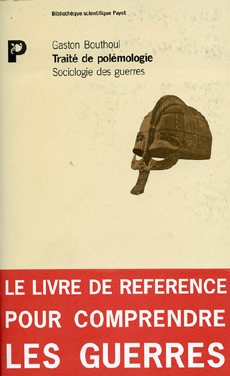 En su prólogo a la edición española del Tratado de Polemología de Gaston Bouthoul1 Enrique Jarnés Bergua, señala que esta obra no tenía una primera edición en 1951. “Entonces tenía otro título: Las Guerras y un subtítulo Elementos dePolemología. Este libro fue traducido al español. El que ahora consideramos es una nueva edición de aquél, puesta al día, publicada por Payot en 1970, cuando Bouthoul había podido apreciar ya un crecimiento y una proliferación de su semilla.” 2
00:05 Publié dans Théorie politique | Lien permanent | Commentaires (0) | Tags : argentine, gaston bouthoul, polémologie, guerres, théorie de la guerre, politologie, sciences politiques, théorie politique | | del.icio.us | | Digg | Facebook