

dimanche, 01 septembre 2013
Las potencias occidentales… ¡a favor de Al-Qaida!
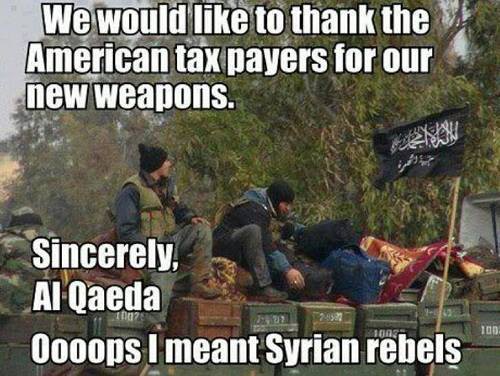
¡a favor de Al-Qaida y contra Siria!
¡Ya estamos!
Obama, Cameron, Hollande y sus compinches, que son integristas cristianos, se empecinan en aupar el integrismo musulmán -los rebeldes sirios son, mayormente, partisanos de Al-Qaida-.
FERNANDO SÁNCHEZ DRAGÓ
Ex: http://www.elmanifiesto.com
00:05 Publié dans Actualité | Lien permanent | Commentaires (0) | Tags : politique internationale, al qaeda, occident, crise syrienne |  |
|  del.icio.us |
  |
|  Digg |
  Facebook
Robert Stark Interviews Manuel Ochsenreiter About Syrian Civil War
00:05 Publié dans Actualité, Entretiens | Lien permanent | Commentaires (0) | Tags : politique internationale, manuel ochsenreiter, syrie, grèce | | del.icio.us | | Digg | Facebook
Entretien avec Tracy Chamoun
Tracy Chamoun: “L'extrémisme islamiste existe aussi chez vous, dans les pays occidentaux"
 Interview. Héritière d’une grande famille politique maronite brisée par la guerre civile, Tracy Chamoun déplore l’aveuglement euro-américain. Rencontre sur fond de crise syrienne. Son grand-père, Camille Chamoun, fut président de la République libanaise de 1952 à 1958.
Lire aussi:
> Syrie : des experts de l’ONU attaqués
> Quand la chimie fait la guerre
> La vérité sur les armes chimiques en Syrie
> Syrie: les options du Pentagone
Son père, Dany, fut assassiné, en octobre 1990, avec sa femme et deux de ses jeunes enfants, par d’autres chrétiens. Alors âgée de 30 ans, résidant à l’étranger, Tracy échappa au massacre. Elle en tira un premier livre passionné et déchirant, Au nom du père (JCLattès, 1992). Son nouvel ouvrage, le Sang de la paix, se veut plus serein, porteur de valeurs pour l’avenir du Liban, tout en rappelant les responsabilités libanaises ou étrangères dans le sort de son pays. Elle est particulièrement sévère pour le chrétien Samir Geagea, le chef des Forces libanaises, et pour le clan sunnite Hariri. On peut ne pas partager toutes ses colères, on peut réfuter telle ou telle de ses analyses, mais ses épreuves, son courage et sa force de conviction font de Tracy Chamoun, 53 ans, une voix qui porte. Il faut savoir l’écouter.
Que représente votre engagement ?
J’ai un héritage politique à assumer, pour sauvegarder la démocratie et la liberté au Liban. Mes valeurs sont celles de la tradition libérale de ma famille : le non-confessionnalisme, l’égalité, la diversité, la défense de cette passerelle unique que représente le Liban entre l’Orient et l’Occident.
Que signifie être libéral-démocrate au Liban ?
Aujourd’hui, pas grand-chose. On nous vole nos droits démocratiques en nous privant d’élections législatives sous de faux prétextes. On nous prive d’une loi électorale qui favoriserait la représentation des différentes communautés. Ils amendent la Constitution comme bon leur semble pour proroger les mandats de nos hauts fonctionnaires d’une façon inconstitutionnelle.
Pourquoi le camp chrétien est-il encore si divisé ?
Il a été délibérément divisé. Faire sortir Samir Geagea de prison, en 2005, fut un choix politique. Il avait été arrêté en 1994, condamné à mort puis à la prison à vie pour avoir commis des crimes contre sa propre communauté, ce qui divisa et affaiblit les chrétiens, en vue de contrer le général Aoun.
Pouvez-vous pardonner aux chrétiens qui vous ont fait tant de mal ?
Les chrétiens ne m’ont fait aucun mal. Certains chefs chrétiens, oui, en particulier Samir Geagea, lorsqu’il commandita l’assassinat de ma famille.
Comprenez-vous l’alliance entre le général Aoun et le Hezbollah chiite ?
L’alliance entre chrétiens et chiites date de l’époque de mon grand-père. Il en fut même l’instigateur. Elle devait préserver ces communautés. L’étiquette terroriste est une qualification occidentale qui sert des intérêts politiques régionaux, mais le Hezbollah est un parti politique qui représente un très grand nombre de chiites.
Le Liban peut-il s’apaiser avec ce parti qui conserve sa milice armée ?
La résistance est une composante essentielle de la défense du pays contre les agressions successives d’Israël. Tant que nous n’avons pas une armée forte, on ne pourra pas se passer de la résistance armée du Hezbollah. Son désarmement devra se faire dans un contexte plus large de dialogue national, sous l’autorité de l’État libanais.
Comment évaluez-vous la crise en Syrie ?
Les intérêts de la communauté chrétienne du Liban sont intimement liés à la survie du régime de Bachar al-Assad. Il représente la seule option laïque face à la poussée de l’extrémisme islamiste et djihadiste. Nous avons combattu les Syriens lorsqu’ils occupaient notre pays, mais ils sont partis. Nous savons que la survie de notre communauté dépend de nos alliances avec toutes les minorités dans la région.
Pourquoi dites-vous que l’avenir de l’Occident se joue au Liban ?
Parce que la formule de coexistence au Liban est aussi une référence de base pour la survie des communautés occidentales. L’extrémisme islamiste qui émerge du conflit syrien existe aussi chez vous, dans les pays occidentaux, dont la France, qui alimentent ce conflit en hommes. Le risque est de voir cet extrémisme revenir chez vous, dans vos pays.
Que dire aux amis du Liban qui désespèrent du pays du Cèdre ?
Réveillez-vous !
Le Sang de la paix, de Tracy Chamoun, JCLattès, 200 pages, 19 €.
00:05 Publié dans Actualité, Entretiens | Lien permanent | Commentaires (0) | Tags : liban, méditerranée, proche orient, levant, syrie, tracy chamoun, entretien, politique internationale | | del.icio.us | | Digg | Facebook
The Social “Big Bang” of the 21st Century Turkey: from Atlantic to Eurasia
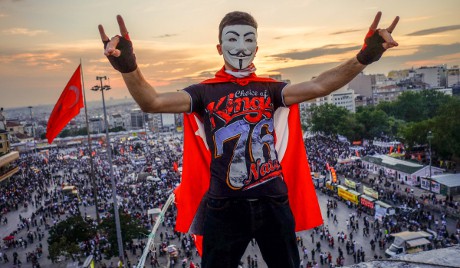
The Social “Big Bang” of the 21st Century Turkey: from Atlantic to Eurasia
There are two important aspects of the nation-wide uprising in Turkey centered at the Taksim Square in İstanbul that deserve emphasis. First and foremost, it is an unprecetented social “big bang” of the 21st century Turkey. Secondly, the extreme hostility of the stance of the Erdoğan regime against this protest movement is equally unseen.
The Taksim Square represents the uprising of the Turkish Nation against the Erdoğan Administration, who arrogantly attempted to trample on the Turkish Nation and the values of the Atatürk Republic. The main symbol that unites millions of people who have been filling the squares all over Turkey for about three weeks now and facing police violence everywhere is the Turkish flag. The nation-wide common slogan these masses are chanting everywhere is “Tayyip resign! Government resign! Dictator resign!”. If this movement is to be connected to something in the past, its roots clearly lie in the Kemalist Revolution.
How it began?
Protests were started by a small group of activists as a reaction to the demolition of the Gezi Park in Taksim, to rebuild the “historic” Taksim Military Barracks, which was also planned to house a shopping mall. The construction company had started to demolish the wall of Gezi Park and cut down the trees, when the protestors stood up to prevent any further demolition. Then the police intervened with tear gas. More people joined the activists to start a sit-in act and a night watch in the Gezi Park. The police attacked once more and more violently with tear gas and water cannons to drive the protestors out of the Park. The outcome of this sequence of “more protestors-more police violence” was that the resistance grew very quickly and spread over the whole country covering millions of people in hundreds of protest rallies. All the demonstrations were met with police violence, tear gas, water cannons, plastic bullets. The target of the demonstrators went far beyond stopping the project of the government concerning the Gezi Park. They started to unanimously demand the resignation of Erdogan and the government. By now, there are four people killed, thousands injured, including many who are heavily injured by tear gas shells and plastic bullets.
Before analyzing the background and reasons that led to the mobilization of masses to such an unseen extent, it might be telling to shortly look into the reasons of Erdoğan's insistence on the project concerning the Gezi Park. This project is two-legged. One leg is concerned with the history of the Military Barracks that are to be rebuilt. After the 1908 Revolution led to the establishment of the Constitutional Monarchy in the Ottoman State, a reactionary rising was staged on the 31st of March in 1909 in Istanbul demanding to go back to an absolutist regime based on religious principles again. The rising was started in the Taksim Barracks, which was then turned into the headquarters of this reactionary rebellion. The rising was suppressed by the Movement Army which came from Thessaloniki to İstanbul and whose staff officer was Mustafa Kemal (Atatürk). It is thus only natural that those who desparately wish to take the revenge of the Kemalist Revolution today insist on rebuilding these Barracks as a symbol of their own stance.
The second leg of the project is that the rebuilt Barracks are planned to house a shopping mall. I think it will be no exaggeration to regard “shopping malls” as symbols of a lifestyle imposed by the global capitalist system to the entire world. Thus the project itself is nothing but a synthesis of Ottomanism and global capitalism, reflecting the current alliance between the imperialistic system and the medieval forces in Turkey.
The background of the Taksim Resistance
If the question is whether the social outburst in Turkey triggered by the resistance against Erdoğan's Gezi Park project was something expected or not, the answer is both yes and no. The first thing to be noted in that regard is that, for the last decade, the political and social tensions in Turkey have been growing since Erdoğan came into power, along with this process being especially accelerated within the last few years. Prior to the Taksim Resistance, the potential energy accumulated within the society had already started to turn into kinetic energy in the form of big mass demonstrations within the last one year. Large numbers of demonstrators became familiar with tear gas, water cannons and police violence during these struggles. It was this militant rise of the people's movement, which paved the way to the current resistance. That is what underlies the answer “yes”. Due to the stochastic nature of social phenomena, however, it usually is not possible to precisely forecast the time, place and scale of social outbursts, as was also the case with the Taksim Resistance.
The bans and limitations introduced by the Erdoğan government last year concerning the celebration of national holidays was met with big anger among the citizens. The Youth Union of Turkey (Türkiye Gençlik Birliği) made a call for a demonstration in İstanbul on May 19, 2012, in which more than 200 thousand citizens took part. The 19th of May is the date when Mustafa Kemal landed in Samsun in 1919 to start the National Liberation Movement and is celebrated as a national holiday dedicated to the youth in Turkey. 19 May 2012 witnessed the first big mass demonstration in Turkey in the aftermath of the Republic Meetings in 2007, which had been held in Ankara, İstanbul, İzmir and several other cities with the participation of millions of citizens. On 29 October 2012 - the Anniversary of the Foundation of the Turkish Republic – hundreds of thousands of people gathered in Ulus (Ankara) in front of the First Turkish Grand National Assembly Building under the leadership of Workers' Party (Turkey) (İşçi Partisi – Türkiye) and the Youth Union of Turkey. The police tried to prevent the gathering by attacking the crowd with tear gas and water cannons and by setting up barricades between groups that were coming to the square from different directions. Neither the police raids nor the barricades could prevent the people from gathering at the Ulus Square, from where they marched several kilometers to reach Atatürk's Mausoleum. 19 May 2012 acted as the sparkler, and 29 October 2012 was the turning point in the rising wave of the people's movement in Turkey.
Hatay is one of the Southern provinces of Turkey bordering with Syria, where several “refugee camps” are located. As most of these are acting as “mercenary camps” from where terror is being “exported” to Syria under the patronage of the Erdoğan administration, several big mass demonstrations were held in Hatay starting as of September 2012, demanding the shutdown of these terror camps and calling for solidarity and friendship with the Syrian people. It seems also worthwhile to emphasize that these demands united people of different ethnic origins and religious beliefs in Hatay and neigboring provinces along the border with Syria.
The trials of the so-called Ergenekon Case are being held in a prison compound near Silivri. The very fact that Silivri is a town about 100 km distant from İstanbul , while the natural location of the court in charge of this case is in Beşiktaş – a central district of İstanbul –, may give everyone some idea about how “open” these trials are to the public. The summary accusation is that the suspects of this trial (including leaders of political parties, former rectors and several academicians, journalists, retired generals and officers) have formed a secret organization called Ergenekon to overthrow the government, although many of them got to know each other well only in prison. Dr. Doğu Perinçek who is still the chairman of Workers' Party (Turkey) is among the suspects and has now been under arrest for more than five years. The common feature that unites almost all the suspects is that they are all patriotic figures who have struggled against the US plans concerning Turkey and the Middle East and have defended the Kemalist Revolution. The “Ergenekon Case” itself is a US plot implemented by the Erdogan Administration not only against the suspects, but against Turkey as a whole. Thus, it comprises along with other similar “cases” one of the most important sources of political and social tension underlying the current social outburst. There have been two big mass demonstrations (along with several other smaller ones) in Silivri in front of the court within the last year, one on December 13, 2012, and the other on April 8, 2013, both including about 100 000 participants, who had to face barricades, tear gas and water cannons. The citizens, however, insisted on staying in front of the court until the trial was over, thereby also defending the principle of the “openness of the trials to the public”.
These are just some chosen incidences to exemplify the background of the current nation-wide resistance. It should thus be no wonder any more to anyone who sees this picture how come these young people of all ages, these women and men of Turkey have been struggling day and night all over the country for so long.
Having gone through the source of human energy of the Taksim uprising, let us turn to the architecture of the political and social tensions in Turkey and the factors behind them. This is quite important as the people's movement in Turkey will continue to rise in waves with outcomes that will not stay confined only to Turkey itself, but will have an impact upon the entire region.
Erdoğan's foreign policy is tightly bound to the US and NATO
It might be best to start with the foreign policy that the Erdoğan Administration has been following since it came into power in 2002 with a focus on the Syrian issue.
Tayyip Erdoğan – the Prime Minister of Turkey- is known to have himself publicly declared more than 30 times that he is acting as one of the Co-Chairs of the Great Middle East Project of the USA. Abdullah Gül – the President of Turkey- is known to have admitted himself that he signed a secret “two-page, nine-item” agreement with Colin Powell in 2003, when he was the Foreign Minister of Turkey. Ahmet Davutoğlu – the present Foreign Minister of Turkey – is known to have written a book entitled “Strategic Depth” whose main message can be summarized as “Align your policies with those of big powers, if you wish to become a regional leader.” This provides a clear picture of the framework that has been shaping the foreign policy of the Erdoğan Administration.
Erdoğan is known to be the world champion of hostility against Bashar Assad in Syria. He is supporting the so-called “Syrian Free Army” and other terror groups against Esad logistically by all means, which include the provision of safe bases behind the front to these mercenaries in Turkey under the guise of “refugee camps”. As a consequence of this policy, the control of Turkish security forces on the border with Syria was practically lifted so that the mercenaries could cross the border freely in either direction. The displeasure aroused thereby among the inhabitants in cities and towns near the border was made visible by mass demonstrations in Hatay and other places as mentioned above.
The terror that was exported to Syria under the patronage of the Erdoğan regime struck back Turkey itself violently. On 11 February 2013, a car bomb exploded at Cilvegözü Bordergate killing 13 people including both Syrians and Turks. The second and more tragic incidence of terror took place on 11 May 2013 in Reyhanlı, a town in Turkey very near to Cilvegözü Bordergate, when two car bombs exploded in the town center killing more than 50 people and injuring hundreds of them. Erdoğan could go to Reyhanlı only one week after the incidence and made a speech to a crowd supposedly collected together from other regions because he was afraid of the fury of the people from Reyhanlı. These two tragic events only added to the great fury of the Turkish people who demand peace with the neighbor and peace at neighbor's home.
The Taksim Resistance in Turkey and the opposition of the Turkish people to Erdoğan's hostile stance against Syria combined with the inevitable tightening of the control on the Syrian border by Turkish security forces after the Reyhanlı bombs seem to have recently contributed to the Syrian Administarion headed by Beshar Esad in combatting terror at home.
The relationship between Obama's and Erdoğan's stances concerning the Syrian issue might look puzzling at first glance, as Erdoğan seems to be the one who is ready to do everything to overthrow Esad, while Obama looks as if he were dragging his feet in this regard. It is, however, doubtless that the patent of Erdoğan's policy concerning Syria belongs to the US. Initially, he was driven against Beshar Esad by the US in an unbridled way in expectation of an easy and quick victory. When this plan failed, however, Erdoğan found himself in the midst of a mined ground, while Obama still could use the relative maneuvre space he had secured for himself by having let someone else jump to the mined ground on his behalf. It should be noted here that the “good times” between Erdoğan and Assad, the climax of which was reached by holding joint government meetings very shortly before Erdoğan's sharp turn from “extreme friendship” to “extreme hostility”, were not a product of Turkey either.
After Obama came into office in the US, Davutoğlu became the Foreign Minister in Turkey.
In the first term (2002-2007) of AKP (Adalet ve Kalkınma Partisi - Justice and Development Party), “membership to the European Union” had been the major keyword of Turkish foreign policy. The rationale behind this policy, whose patent again belongs to the US, was to keep Turkey bound to the door of the EU in order to prevent it from seeking other alternatives and forming closer ties with Eurasia. In AKP's second term (2007-2011), however, the keyword “EU” entirely disappeared from the scene, and Davutoğlu replaced it first by “zero-problem-with-the neighbors” and then by “New Ottomanism”.
In order to understand the rationale behind this change, let us remember the main components of the Obama doctrine, which can be summarized as (i) making more effective use of diplomatic, political and cultural channels, (ii) letting the “allies” share the burden by getting them do some of the jobs on behalf of the US rather than the US itself directly, and (iii) shifting the center of weight from regular warfare to special warfare in reshaping the world. It is the implementation of the second and third items that we presently witness in Syria.
As for the first item, the USA was lacking direct diplomatic, political and cultural channels with the Islamic World whose effective use would help the creation of political and social footholds
that would internalize the US plans and thus be useful in implementing them. So, the need was for a country which owned such channels and was ready to use them on behalf of the US. This country was not only to look socially and culturally Islamic, but also should introduce a reinterpretation of Islam that would get rid of all obstacles in Islam to integration with the global capitalistic market. Finally, for such a country to be influential in the Islamic World, it should not act like a proxy of the US. All this is actually nothing but what is meant by “Moderate Islam”, represented by the AKP Administration in Turkey.
Davutoğlu's formula of “zero-problem-with-the neighbors” as well as Erdoğan's “one-minute-show” in Davos against Israel followed by his stance in the Mavi Marmara Incidence are to be evaluated within this framework. The “golden times” with Syria were not an indication of a shift of axis of the Erdoğan Administration from the West to the East, but were part of a scenario aiming at softening and weakening Syria from inside. But the difficulty that USA and the West have been facing in producing an effective opposition to Bashar Assad in the Syrian issue now nclearly shows that the task of creating an effective political and social foothold on behalf of the US was not succeeded.
The firm resistance of Syria under Esad's leadership against the dirty war initiated by the US using the Erdoğan Administration as an instrument gained the sound support of a “Eurasian hinterland”. Assad's resistance, the international support it gained and the strong opposition of the Turkish people to Erdoğan's stance concerning Syria left Erdoğan in a cumbersome position. When the inability of the US and the West due to the big difficulties they are going through because of the global economic crisis was added to that, the claim to regional leadership or equivalently “New Ottomanism” collapsed before it even started. We can hardly deny the importance of the role this collapse played in the rise of the people's movement in Turkey and thus in the Taksim Uprising. Conversely, the strength of the nation's opposition now renders Erdoğan more inable than ever concerning Syria as well as in other major issues.
The Second Israel = “Free Kurdistan” is an invariant of the Great Middle East Project
One of the invariants of the US policy concerning the Middle East is to turn Northern Iraq into a permanent base of its own, or equivalently into a second Israel. This target can be reached by founding a “Free Kurdistan”. The territory of the Kurdistan Regional Government is by itself not adequate for the sustainability of such a state. Sustainability requires expansion of the territory to the North into Turkey and an opening to the Mediterranean via a “Kurdish Corridor” in Northern Syria. A possible expansion to the East into Iran is also desirable. The competence and accumulation needed for founding and running such a state is owned by the PKK. This collection of statements depicts the framework within which the USA considers the “Kurdish factor” in the Middle East.
Turkey is now going through a so-called “peace process” with the PKK, the roadmap of which has been drawn by the US. The US authorities had been advocating for quite some time that the PKK should be taken as a negotiation partner by the Turkish Government. To cope with circumstances under which the acceptance of the PKK as a formal negotiation partner would be politically untenable for a government, the advice was that the parliamentary deputies of the BDP (Barış ve Demokrasi Partisi – Peace and Democracy Party) serve as interlocutor in negotiations. The Erdoğan Administration has followed this advice to such an extent that the current position of Öcalan and the PKK is factually far beyond that of a negotiation partner. A description that would fit the present situation best is to refer to them as “coalition partners” of the Erdoğan Administration. The process was carried out under the pretense that this was the only feasible way of liquidating the PKK. The consequence was, however, the legitimization of the PKK, rendering this separatist force stronger than ever.
“Peace at home” is naturally the common demand of all Turkish citizens irrespective of their ethnic origins. As now the continuation of “cease fire” is made dependent upon the well-treatment of the PKK so that it continues to comply with cease fire, the social engineering behind the “peace process” is the utilization of this common demand of the people for peace by blackmailing them with the PKK terror. The success of this blackmail naturally requires a strong PKK, rather than one that has entered a liquidation process.
The next stop of the roadmap is the change of the Constitution accordingly, the essence of which can be summarized as to remove the “Turkish Nation” along with all values of the Atatürk Republic from the Constitution. The estimation that has been rendered vacuous by the uprising of the nation was that the same blackmailing by the PKK would be useful in making these changes acceptable to the nation and carrying it to the brink of fragmentation.
Having noted that a “Free Kurdistan” lies at the core of the Great Middle East Project and the PKK is indispensable for the US in that regard, it would be an illusion to even think that the USA would allow the Erdoğan Administration to liquidate the PKK. The US plan is, in fact, to let the PKK and the Turkish Army to fight together in Syria and Iraq against the territorial integrities of these two countries when the time ripens for that
Turkey is drowning in the Atlantic System: Back to the route of the Kemalist Revolution in Eurasia
The conquest of the state apparatus by the counter-revolutionary forces was mainly completed in 2007, when Abdullah Gül became the President. It was then that they started the operation against the members of the Turkish Army and the leaders of the patriotic forces in Turkey, who had been opposing Turkey getting turned into an instrument of the USA, under the guise of legal cases as Ergenekon, Balyoz and several others. In the meantime, they also were able to tighten their control on the judiciary. The next item on their agenda was to start the liquidation of the Kemalist Revolution from within the social life.
The Kemalist Revolution had replaced “religion” by “nation” as the source of power. What naturally accompanied that process was the substitution of “reason and science” for “dogma”. In an attempt tor reverse this process, the AKP Administration is now trying to replace “nation” by “religion” again and substitute “dogma” for “reason and science”. This revival of the medieval approach is in compliance with the attempt of the imperialistic system to dissolve the national states of the Oppressed and Developing World.
The reversal attempted by the Erdoğan Regime, however, required on its part to intervene more and more not only into social life, but also into individual lives. It is precisely this increasing intervention what is now especially being met with fury by broad masses. Thus, it is no wonder that the youth and women formed the overwhelming majority in the Taksim Uprising so far.
There is another very important process going on in Turkey, in parallel with the rise of the people's movement, one of whose main slogans is “we will win by uniting”. Namely, it is the construction of a united national front with the Workers' Party (Turkey) in its center, with the aim of carrying a national government to power. To indicate how successful this movement is proceeding, it might suffice to quote Erdoğan who said about a month ago that “the Chair of Workers' Party (Dr. Doğu Perinçek) is giving direction from prison to CHP (Cumhuriyet Halk Partisi - Republican People's Party) with his left finger and to MHP (Milliyetçi Hareket Partisi – Nationalist Movement Party) with his right finger”.
The summary conclusion that from now on everyone has to take into account is that the rising movement of the nation has invalidated all equations concerning Turkey that do not contain the nation itself as the biggest source of power.
Everything said in this article points at the fact that Turkey is drowning in the Atlantic System. The unique framework that will allow Turkey to live and develop embracing all its people as equal citizens irrespective of their etnic origins or religious beliefs is the Atatürk Republic. The only geography in which Turkey can set itself back to the route of the Kemalist Revolution and complete it in order to go beyond is nothing but Eurasia.
Published in Journal of Eurasian Affairs No.1, Vol. 1, 2013
00:05 Publié dans Actualité, Eurasisme, Géopolitique | Lien permanent | Commentaires (0) | Tags : eurasisme, turquie, géopolitique, proche orient, méditerranée, asie mineure, kémalisme | | del.icio.us | | Digg | Facebook
L’HUMANISME EUROPEEN EST VIDE DE SON SENS

L’HUMANISME EUROPEEN EST VIDE DE SON SENS
SA LEGITIMITE EST MENACEE
Une refondation est-elle possible ?
Pierre Le Vigan
Ex: http://metamag.fr
Rémy Brague

 , qui l’aurait chassé du centre de l’Univers, puis Darwin, qui l’aurait détrôné du sommet des vivants, puis la psychanalyse, qui aurait chassé de sa propre âme la conscience. » Ainsi, la « mort de l’homme » ne désigne en fait rien d’autre que le constat (banal) que la conscience de l’homme ne résume pas le tout de l’homme, que le sujet n’est jamais totalement conscient et transparent à lui-même. On en conviendra bien volontiers.
00:05 Publié dans Philosophie | Lien permanent | Commentaires (0) | Tags : philosophie, humanisme, europe, affaires européennes, rémy brague | | del.icio.us | | Digg | Facebook