


samedi, 07 janvier 2012
Turkey preparing for an attack against Greece?

Turkey preparing for an attack against Greece?
Although the Turkish political leadership is trying to convince Greece of its benevolent intentions, its acts ultimately betray the reality of its true visions. So after the start of deliveries of the first 52 offensive amphibious bridges Samur FNSS which can erase from the map in a few minutes the obstacle called Evros River and the acquisition of dozens of armored demining vehicles type Keiler, the Turkish Armed Forces completed receiving a few days ago 40 heavy HGMS (Heavy Ground Mobility Systems).
Thanks to these HGMS the Turkish engineering corps can prepare the ground for the transportation of tanks or other heavy vehicles on the opposite bank of the river Evros, while of similar importance is the use of these system for landing operations for which the Turkish Army gets constantly trained opposite the Greek island of Chios.
These heavy HGMS were ordered to the British company FAUN MV Ltd. and Iveco in 2008 costing 21.5 million.
They were delivered only, and we emphasize that, to the engineering units of the 1st Army in Eastern Thrace. The HGMS of the British company can withstand vehicles with weight exceeding 70 tonnes, even on soft ground (eg, river bank or shore) and they are carried on the truck Trakker 8 × 8 of the Italian company Iveco. They are easy to use thanks to the simple laying system that these trucks have.
The walkways are made of high strength aluminum alloy 54.7 meters long and 4.5 meters wide, and their total area reaches 228 square meters.
It is worth noting that this acquisition is the second of the Turkish army, since a few years ago had acquired another ten of such systems. The continued insistence of Turkey to acquire offensive systems for crossing barriers and removing obstacles as well as systems that facilitate the handling of heavy armored vehicles have a single purpose to prepare the Turkish Armed Forces to carry out offensive operations.
While the Greek political and economic elites praise Erdogan’s government, the leadership of the Turkish Armed Forces with these armament programs is methodically preparing for the implementation of invasion plans or at least for the intimidation of the Greek government.
Hopefully, after the explanations requested by the Greek government from Turkey regarding the statements of the former Turkish Prime Minister Mesut Yilmaz on the arsoning of Greek forests by agents of MIT will also seek new explanations by the Erdogan government why Turkey during the recent years is systematically buying military equipment for overcoming water obstacles.
00:06 Publié dans Actualité, Affaires européennes, Géopolitique | Lien permanent | Commentaires (0) | Tags : grèce, turquie, méditerranée, affaires européennes, europe |  |
|  del.icio.us |
  |
|  Digg |
  Facebook
The End of Globalization

The End of Globalization
By Greg Johnson
Ex: http://www.counter-currents.com/
The market is an inherently global institution. The market is non-racist, non-nationalist, and non-religious, for as long as decisions are made solely in monetary terms, the race, nationality, and religion of buyers and sellers simply do not matter. Often, they are completely unknown.
I know the ethnic identity of the owners of the Armenian rug shop and the Chinese restaurant down the street. But what is the race, ethnicity, or nationality of the Coca-Cola Corporation? Its stockholders, employees, and customers have every identity in the world. But the corporation has none. It is global, cosmopolitan. As its famous jingle tells us, it wants to teach the world to sing in perfect harmony, meaning that it wants a pacified planet where people have relinquished all boundaries and identities that might impede the sale of Coke.
Globalization is the process of making the inherently global, cosmopolitan potential of the marketplace actual by breaking down racial, national, religious, and cultural barriers to the market, such as protectionist laws, religious prohibitions on usury, ancient enmities between peoples, sentimental attachments to one’s community, tribe, homeland, etc.
For consumers in the First World, globalization starts out as a good thing. They can take their First World wages and buy lots of cheaper goods manufactured in the Third World. For capitalists based in the First World, it is an even better thing, for they can make enormous profits by selling Third World goods at only slightly lower prices than goods manufactured at far greater expense in the First World—and pocket the difference.
For example, to use arbitrary numbers, when shoes were made in America, a pair of shoes retailing for $100 might be manufactured by a worker being paid $10/hour, 40 hours/ week + overtime pay, plus benefits, plus vacation time, in a factory regulated for health, safety, and environmental impact. Sure, it sounds like a lot of bother. But it never prevented American shoe manufacturers from becoming millionaires.
And when such a manufacturer left his factory at the end of the day, his luxury car would share the road with the modest cars of his own employees. He would pass through a bustling downtown where the wives of his employees shopped; he would pass the school attended by the children of his employees; he might even attend the local high school football game and cheer the sons of his workers; he would drive through neighborhoods with neatly painted houses and manicured lawns, where his employees lived. And when he arrived at his columned mansion, he would simply pull off the road into his driveway. There would be no security gates and guards to protect him.
With globalization, however, a similar pair of shoes retailing for $95 might be manufactured in Indonesia by a half-starved wretch making a fraction of the wages, with no overtime, no vacation, and no benefits, in a factory with no regulations for health, safety, or environmental impact. And the shoe manufacturer pockets the difference.
Even if the American owner of an American-founded, American-based, American-staffed shoe manufacturer had a sentimental attachment to his nation and his employees, he could not compete with rivals who had no such ties. In the end, he would have to close his factory: either to ship his jobs to the Third World or simply due to bankruptcy. Thus the globalization process selects for and rewards rootless cosmopolitanism and anti-national, anti-patriotic, anti-communitarian sentiments.
In the long run, globalization means one thing: the equalization of wages and living standards over the whole globe. That means that First World living standards will fall a great deal, and Third World living standards will rise a little bit, until parity is achieved. In other words, globalization means the destruction of the American working and middle classes, a reduction of their standard of living to those of Third World coolies. Globalization means the reversal of the progress in living standards since the industrial revolution.
Specifically, globalization means the reversal of the genuine progress made by the left: the higher pay, shorter work days, and benefits won by the labor movement; the health-care, safety, welfare, and old age programs created by liberals and social democrats (programs that do not exist in the Third World); and the environmental protections won by ecologists (which are only imposed on the Third World by the First World, which will no longer have that luxury).
Globalization also affects the rich. First of all, those who have grown rich by selling things to the working and middle classes of the First World will disappear along with their customers. There will no longer be a market for riding lawnmowers or camper trailers. The rich who remain will produce either for the global super-rich or the global proletariat. And the lives of the rich will be dramatically transformed as well. Some people will grow very rich indeed by dismantling the First World. But they will end up living like the rich of the Third World.
They will commute from fortified factories or offices to fortified mansions in armored limousines with armed guards past teeming slums and shantytowns. They will socialize at exclusive clubs and vacation at exclusive resorts under the watchful eyes of security guards. Like Marie Antoinette, who liked to play milkmaid in the gardens of Versailles, they might even pretend to be bohemians in million-dollar flats in Haight Ashbury, or cowboys on twenty-million dollar ranches in Wyoming, or New England villagers in million-dollar cottages on Martha’s Vineyard—having ridden to the top of a system that has exterminated the people who created these ways of life.
The consequences of globalization are not secret. They are not random and unpredictable. They are not even arcane or controversial. They are predicted in every introductory economics textbook. They are apparent in the stagnation of American working and middle class living standards beginning in the 1970s and the steep declines of the last decade, when 50,000 American manufacturing facilities closed their doors, many to ship their jobs overseas—while millions of immigrants, legal and illegal, came to compete with Americans for the jobs that remain, depress wages, and consume public services for which they cannot pay.
Yet the American middle and working classes were never allowed a choice about globalization, for the obvious reason that they would never have approved of their pauperization. The labor movement, the political parties, the churches, and all other forces that are capable of resisting globalization have been coopted.
Sincere progressives recognize the destructive effects of globalization, but most of them think that the only alternative to global capitalism is global socialism, which is no solution, even if it could be attained.
But if we reject globalization, what is the natural economic unit? This is where White Nationalists are able to address the genuine concerns of the Occupy movement and other progressive critics of globalization. For the boundary where globalization ends is the nation. The United States and every other European nation entered modernity and made most of their economic and social progress by practicing nationalistic economic policies, including protectionism. Prosperity and social justice will return when globalization is replaced by economic nationalism.
Libertarians decry protectionism as benefiting one group at the expense of another (as if globalization did not do the same thing). But this is the wrong way to look at it. Every individual wears different hats and plays different roles: producer, consumer, family member, citizen, etc. Free trade makes us good consumers, but it also makes us bad citizens by undermining social justice and national sovereignty. Protectionism limits our acquisitiveness as consumers, but it strengthens us as citizens. Free trade empowers some businessmen at the expense of the common good, making them bad citizens. Protectionism and other regulations make all businessmen good citizens by making it impossible to profit at the expense of the common good—which leaves no shortage of opportunities to generate wealth in a socially responsible fashion.
But wouldn’t the completion of globalization, whether socialist or capitalist, be worth it, if it really could lead to a world without nations, borders, boundaries, and wars? It is this utopian hope that sustains the allegiance of many globalists despite the spreading desolation of the Earth. It is the same hope that sustained Communists despite the oceans of blood they spilled.
There are two basic replies to this. One is to argue that it is not worth it, which the die-hard utopian would never accept. The other is to argue that a world without nations will never be achieved, and the people who are pushing it, moreover, are not even serious about the notion. Globalization is not the overcoming of nationalism, but merely the way that market dominant nations break down barriers to expanding their own economic power. Today’s color-coded, Twitter and Facebook powered insurrections in Eastern Europe and the Muslim world are merely the modern version of the empire-building and gunboat diplomacy of centuries past. George Soros is just the Cecil Rhodes of today.
Jews like Soros, of course, are the primary preachers of universalist schemes such as global trade, open borders, racial miscegenation, multiculturalism, and other forms of identity erasure. But they show no signs of practicing these same policies among themselves. What is theirs they keep; what is ours is negotiable. The implication is obvious: their goal is to destroy all national boundaries and racial and cultural identities that serve as impediments to expanding Jewish power. Globalization is not a path to universal freedom. It is the creation of one neck to bear a Jewish yoke for eternity.
It is easy to see why Jews think that the devastation caused by globalization is worth it to them, but it is hard to understand why anybody else wishes to go along with it, except for the alienated, deracinated products of cultural decline. And even these people have to be asking themselves if this is the world they really want.
Universalism, after all, is not really universal. Only whites seem susceptible to it in large enough numbers to matter. But if universalism is merely a racially and culturally European belief system, then globalization will only work by exterminating Jews and other ancient, ethnocentric people like the Chinese, Koreans, Japanese, Armenians, etc., who refuse to jump into the global melting pot. This means that globalization is not the path to a liberal utopia, but merely a genocidal extension of European imperialism. But given the massive investment in Holocaust propaganda, even the most fanatical globalists don’t have the heart for that solution, so in the end, they would have to allow ethnocentric peoples to opt out.
And if Jews and others get to opt out of globalization, then why can’t the rest of us? Especially since unreciprocated free trade is regressive, dissolving national sovereignty, undermining social justice, and delivering the destinies of European peoples into the hands of aliens.
The conclusion is clear: Progressive advocates of globalization are either ignorant or they are dishonest shills for a process that will pauperize and enslave the people they pretend to defend. There is a vast constituency in America for a racially-conscious, nationalistic, anti-globalist, protectionist, progressive political party. They are only waiting for leadership.
Article printed from Counter-Currents Publishing: http://www.counter-currents.com
URL to article: http://www.counter-currents.com/2011/12/the-end-of-globalization/
00:05 Publié dans Actualité, Economie | Lien permanent | Commentaires (0) | Tags : actualité, globalisation, mondialisation | | del.icio.us | | Digg | Facebook
Dystopia is Now!

Dystopia is Now!
By Jef Costello
Ex: http://www.counter-currents.com/
Whatever happened to the Age of Anxiety? In the post-war years, intellectuals left and right were constantly telling us — left and right — that we were living in an age of breakdown and decay. The pre-war gee-whiz futurists (who’d taken a few too many trips to the World’s Fair) had told us that in just a few years we’d be commuting to work in flying cars. The Cassandras didn’t really doubt that, but they foresaw that the people flying those cars would have no souls. We’d be men at the End of History, they told us; Last Men devoted only to the pursuit of pleasure — and quite possibly under the thumb of some totalitarian Nanny State that wanted to keep us that way. Where the futurists had seen utopia, the anti-futurists saw only dystopia. And they wrote novels, lots of them, and made films — and even one television show (The Prisoner).
But those days are over now. The market for dystopias has diminished considerably. The sense that something is very, very wrong, and getting worse – (something felt forty, fifty years ago even by ordinary people) has been replaced with a kind of bland, flat affect complacency. Why? Is it because the anxiety went away? Is it because things got better? Of course not. It’s because all those dire predictions came true. (Well, most of them anyway).
Dystopia is now, my friends! The future is where we are going to spend the rest of our lives. The Cassandras were right, after all. I am aware that you probably already think this. Why else would you be reading this website? But I’ll bet there’s a tiny part of you that resists what I’m saying — a tiny part that wants to say “Well, it’s not quite as bad as what they predicated. Not yet, anyway. We’ve got a few years to go before . . . uh . . . Maybe not in my lifetime . . .”
Here is the reason you think this: you believe that if it all really had come true and we really were living in dystopia, voices would be raised proclaiming this. The “intellectuals” who saw it coming decades ago would be shouting about it. If the worlds of Brave New World [2]


Well, I hate to disappoint you. Unfortunately, there’s this little thing called “human nature” that makes your expectations a tad unrealistic. When I was very young I discovered that there are two kinds of people. You see, I used to (and still do) spend a lot of time decrying “the way people are,” or “how people are today.” If I was talking to someone simpatico they would grin and nod in recognition of the truth I was uttering. Those are the people who (like me) didn’t think that “people” referred to them. But to my utterly naïve horror I discovered that plenty of people took umbrage at my disparaging remarks about “people.” They thought that “people” meant them. And, as it turns out, they were right. They were self-selecting sheep. In fact, this turned out to be my way of telling whether or not I was dealing with somebody “in the Matrix.”
Shockingly, people in the Matrix take a lot of pride in being in the Matrix. They don’t like negative remarks about “how things are today,” “today’s society,” or “America.” They are fully invested in “how things are”; fully identified with it. And they actually do (trust me on this) believe that how things are now is better than they’ve ever been. (Who do you think writes Mad Men?)
And that’s why nobody cares that they’re living in the Village. That’s why nobody cares that dystopia is now. Most of those old guys warning about the “age of anxiety” are dead. Their children and grandchildren were born and raised in dystopia, and it’s all that they know.
In the following remarks I will revisit some classic dystopian novels, and invite you to consider that we are now living in them.
1. Brave New World by Aldous Huxley (1932)
 This is, hands down, the best dystopian novel of all. It is set in a future age, after a great cataclysmic war between East and West, when Communism and assembly-line capitalism have fused into one holistic system. Characters are named “Marx” and “Lenina,” but they all revere “Our Ford.” Here we have Huxley anticipating Heidegger’s famous thesis of the “metaphysical identity” of capitalism and communism: both, in fact, are utterly materialistic; both have a “leveling effect.”
When people discuss Brave New World, they tend to emphasize the “technological” aspects to the story: human beings hatched in test tubes, pre-sorted into “castes”; soma, Huxley’s answer to Zoloft and ecstasy all rolled into one; brainwashing people in their sleep through “hypnopedia”; visits to “the feelies” instead of the movies, where you “feel” everything happening on the screen, etc.
These things get emphasized for two reasons. First, some of them enable us to distance ourselves from the novel. I mean, after all, we can’t hatch people in test tubes (yet). We are not biologically designed to fit caste roles (yet). We don’t have “feelies” (virtual reality isn’t quite there – yet). So, we’re not living in Brave New World. Right? On the other hand, since we really have almost developed these things (and since we really do have soma), these facets of the novel can also allow us to admire Huxley’s prescience, and marvel a tad at how far we’ve come. The fantasies of yesteryear made reality! (Some sick souls feel rather proud of themselves when they read Brave New World.) But these responses are both defense mechanisms; strategies to evade the ways in which the novel really comes close to home. Without further ado, here they are:
The suppression of thumos: Thumos is “spiritedness.” According to Plato (in The Republic) it’s that aspect of us that responds to a challenge against our values. Thumos is what makes us want to beat up those TSA screeners who pat us down and put us through that machine that allows them to view our naughty bits. It’s an affront to our dignity, and makes us want to fight. Anyone who does not feel affronted in this situation is not really a human being. This is because it is really thumos that makes us human; that separates us from the beasts. (It’s not just that we’re smarter than them; our possession of thumos makes us different in kind from other animals.) Thumos is the thing in us that responds to ideals: it motivates us to fight for principles, and to strive to be more than we are. In Brave New World, all expressions of thumos have been ruthlessly suppressed. The world has been completely pacified. Healthy male expressions of spiritedness are considered pathological (boy, was Huxley a prophet!). (For more information on thumos read Francis Fukuyama’s The End of History and the Last Man – a much-misunderstood book, chiefly because most readers never get to its fifth and final part.)
Denigration of “transcendence.” “Transcendence” is my convenient term for what many would call the “religious impulse” in us. This part of the soul is a close cousin to thumos, as my readers will no doubt realize. In Brave New World, the desire for transcendence is considered pathological and addressed through the application of heavy doses of soma. Anyone feeling a bit religious simply pops a few pills and goes on a “trip.” (Sort of like the “trips” Huxley himself took – only without the Vedanta that allowed him to contextualize and interpret them.) In the novel, a white boy named John is rescued from one of the “Savage Reservations,” where the primitives are kept, and brought to “civilization.” His values and virtues are Traditional and he is horrified by the modern world. In one particularly memorable scene, he is placed in a classroom with other young people where they watch a film about penitents crawling on their knees to church and flagellating themselves. To John’s horror, the other kids all begin laughing hysterically. Religion is for losers, you see. How could anyone’s concerns rise above shopping? Which brings me to . . .
Consumerism. The citizens of Brave New World are inundated with consumer goods and encouraged to acquire as many as possible. Hypnopedia teaches them various slogans that are supposed to guide them through life, amongst which is “ending is better than mending.” In other words, if something breaks or tears, don’t fix it – just go out and buy a new one! (Sound familiar?) Happiness and contentment are linked to acquisition, and to . . .
Distractions: Drugs, Sex, Sports, Media. These people’s lives are so empty they have to be constantly distracted lest they actually reflect on this fact and become blue. Soma comes in very handy here. So does sex. Brave New World was a controversial book in its time, and was actually banned in some countries, because of its treatment of sex. In Huxley’s world of the future, promiscuity is encouraged. And it begins very early in life — very early (this was probably what shocked readers the most). Between orgasms, citizens are also encouraged to avail themselves of any number of popular sports, whether as participants or as spectators. (Huxley tantalizes us with references to such mysterious activities as “obstacle golf,” which he never really describes.) Evenings (prior to copulation) can be spent going to the aforementioned “feelies.”
The desacralization of sex and the denigration of the family. As implied by the above, in Brave New World sex is stripped of any sense of sacredness (and transcendence) and treated as meaningless recreation. Feelings of love and the desire for monogamy are considered perversions. Families have been abolished and words such as “mother” are considered obscene. Now, before you optimists point out that we haven’t “abolished” the family, consider what the vector is of all the left-wing attacks on it (it takes a village, comrades). And consider the fact that in the West the family has all but abolished itself. Marriage is now consciously seen by many as a temporary arrangement (even as a convenient merging of bank accounts), and so few couples are having children that, as Pat Buchanan will tell you, we are ceasing to exist. Why? Because children require too much sacrifice; too much time spent away from careering, boinking, tripping, and playing obstacle golf.
The cult of youth. Apparently, much of the inspiration for Brave New World came from a trip Huxley took to the United States, where aging is essentially regarded as a disease. In Brave New World, everyone is kept artificially young – pumped full of hormones and nipped and tucked periodically. When they reach about 60 their systems just can’t take it anymore and they collapse and die. Whereas John is treated as a celebrity, his mother is hidden from public view simply because she has grown old on the savage reservation, without the benefit of the artificial interventions the “moderns” undergo. Having never seen a naturally old person before, the citizens of Brave New World regard her with horror. But I’m guessing she probably didn’t look any worse than Brigitte Bardot does today. (Miss Bardot has never had plastic surgery).
The novel’s climax is a marvelous dialogue between John and the “World Controller.” The latter defends the world he has helped create, by arguing that it is free of war, competition, and disease. John argues that as bad as these things often are, they also bring out the best in people. Virtue and greatness are only produced through struggle.
As a piece of writing, Brave New World is not that impressive. But as a prophecy of things to come, it is utterly uncanny – and disturbingly on target. So much so that it had to be, in effect, suppressed by over-praising our next novel . . .
2. Nineteen Eighty-Four by George Orwell (1948)
 This is the most famous of all dystopian novels, and also the one that is least prescient. Like Brave New World, its literary qualities are not very impressive. It is chiefly remembered for its horrifying and bizarrely over-the-top portrayal of a future totalitarian society.
As just about everyone knows, in Nineteen Eighty-Four every aspect of society is controlled by “Big Brother” and his minions. All homes feature “telescreens” which cannot be shut off, and which contain cameras that observe one’s every move. The Ministry of Peace concerns itself with war, the Ministry of Love with terror, etc. Orwell includes slogans meant to parody Hegelian-Marxist dialectics: “war is peace,” “freedom is slavery,” ignorance is strength.” The language has been deliberately debased by “Newspeak,” dumbed-down and made politically correct. Those who commit “thoughtcrime” are taken to Room 101, where, in the end, they wind up loving Big Brother. And whatever you do, don’t do it to Julia, because the Women’s Anti-Sex League may get you. In short, things are double-plus bad. And downright Orwellian.
Let’s start with what Orwell got right. Yes, Newspeak reminds me of political correctness. (And Orwell’s analysis of how controlling language is a means to control thought is wonderfully insightful.) Then there is “doublethink,” which Orwell describes in the following way:
To know and not to know, to be conscious of complete truthfulness while telling carefully constructed lies, to hold simultaneously two opinions which cancelled out, knowing them to be contradictory and believing in both of them, to use logic against logic, to repudiate morality while laying claim to it, to believe that democracy was impossible and that the Party was the guardian of democracy, to forget, whatever it was necessary to forget, then to draw it back into memory again at the moment when it was needed, and then promptly to forget it again, and above all, to apply the same process to the process itself — that was the ultimate subtlety; consciously to induce unconsciousness, and then, once again, to become unconscious of the act of hypnosis you had just performed.
This, of course, reminds me of the state of mind most people are in today when it comes to such matters as race, “diversity,” and sex differences.
 The Women’s Anti-Sex League reminds me – you guessed it – of feminism. Then there is “thoughtcrime,” which is now a reality in Europe and Canada, and will soon be coming to America. (Speaking of Brigitte Bardot, did you know that she has been convicted five times of “inciting racial hatred,” simply for objecting to the Islamic invasion of France?) And yes, when I get searched at the airport, when I see all those security cameras on the streets, when I think of the Patriot Act and of “indefinite detention,” I do think of Orwell.
But, for my money, Orwell was more wrong than right. Oceania was more or less a parody of Stalin’s U.S.S.R. (Come to think of it, North Korea is sort of a parody of Stalin’s U.S.S.R., isn’t it? It’s as if Kim Il-Sung read Nineteen Eight-Four and thought “You know, this could work . . .”) But Orwell would never have believed it if you’d told him that the U.S.S.R. would be history a mere four decades or so after his book was published. Soft totalitarianism, not hard, was the wave of the future. Rapacious, unbridled capitalism was the future, not central planning. Mindless self-indulgence and phony “individualism” were our destiny, not party discipline and self-sacrifice. The future, it turned out, was dressed in Prada, not Carhartt. And this is really why Brave New World is so superior to Nineteen Eighty-Four. We are controlled primarily through our vices, not through terror.
The best description I have encountered of the differences between the two novels comes from Neil Postman’s book Amusing Ourselves to Death:
What Orwell feared were those who would ban books. What Huxley feared was that there would be no reason to ban a book, for there would be no one who wanted to read one. Orwell feared those who would deprive us of information. Huxley feared those who would give us so much that we would be reduced to passivity and egotism. Orwell feared that the truth would be concealed from us. Huxley feared the truth would be drowned in a sea of irrelevance. Orwell feared we would become a captive culture. Huxley feared we would become a trivial culture, preoccupied with some equivalent of the feelies, the orgy porgy, and the centrifugal bumblepuppy. As Huxley remarked in Brave New World Revisited, the civil libertarians and rationalists who are ever on the alert to oppose tyranny “failed to take into account man’s almost infinite appetite for distractions.” In 1984, Orwell added, people are controlled by inflicting pain. In Brave New World, they are controlled by inflicting pleasure. In short, Orwell feared that what we fear will ruin us. Huxley feared that our desire will ruin us.
And here is Christopher Hitchens (in his essay “Why Americans are not Taught History”) on the differences between the two novels:
We dwell in a present-tense culture that somehow, significantly, decided to employ the telling expression “You’re history” as a choice reprobation or insult, and thus elected to speak forgotten volumes about itself. By that standard, the forbidding dystopia of George Orwell’s Nineteen Eighty-Four already belongs, both as a text and as a date, with Ur and Mycenae, while the hedonist nihilism of Huxley still beckons toward a painless, amusement-sodden, and stress-free consensus. Orwell’s was a house of horrors. He seemed to strain credulity because he posited a regime that would go to any lengths to own and possess history, to rewrite and construct it, and to inculcate it by means of coercion. Whereas Huxley . . . rightly foresaw that any such regime could break but could not bend. In 1988, four years after 1984, the Soviet Union scrapped its official history curriculum and announced that a newly authorized version was somewhere in the works. This was the precise moment when the regime conceded its own extinction. For true blissed-out and vacant servitude, though, you need an otherwise sophisticated society where no serious history is taught.
I believe this just about says it all.
3. Fahrenheit 451 by Ray Bradbury (1953)
 This one is much simpler. A future society in which books have been banned. Now that all the houses are fireproof, firemen go around ferreting out contraband books from backward “book people” and burning them. So, what do the majority of the people do with themselves if they aren’t allowed to read? Why, exactly what they do today. They watch television. A lot of television.
I read Fahrenheit 451 after seeing the film version by Francois Truffaut. I have to admit that after seeing the film I was a bit disappointed by the book. (This would be regarded as heresy by Bradbury fans, who all see the film as far inferior.) I only dimly recall the book, as the film manages to be more immediately relevant to current pathologies than the book does (perhaps because the film was made fourteen years later, in 1967).
I vividly remember the scene in the film in which Linda, Montag the fireman’s wife, asks for a second “wallscreen” (obviously an Orwell influence). “They say that when you get your second wallscreen it’s like having your family grow out around you,” she gushes. Then there’s the scene where a neighbor explains to Montag why his new friend Clarisse (actually, one of the “book people”) is so different. “Look there,” the neighbor says, pointing to the television antenna on top of one of the houses. “And there . . . and there,” she says, pointing out other antennae. Then she indicates Clarisse’s house, where there is no antenna (she and her uncle don’t watch TV). “But look there . . . there’s . . . nothing,” says the neighbor, with a blank, bovine quality.
Equally memorable was a scene on board a monorail (accompanied by haunting music from Bernard Herrmann). Montag watches as the passengers touch themselves gently, as if exploring their own sensations for the very first time, while staring off into space with a kind of melancholy absence in their eyes. Truffaut goes Bradbury one better, by portraying this future as one in which people are numb; insensitive not just to emotions but even to physical sensations. In an even more striking scene, Montag reduces one of Linda’s friends to tears, simply by reading aloud an emotionally powerful passage from David Copperfield. The response from her concerned friends? “Novels are sick. All those idiotic words. Evil words that hurt people. Why disturb people with that sort of filth? Poor Doris.”
What Bradbury didn’t forsee was a future where there would be no need for the government to ban books, because people would just voluntarily stop reading them. Again, Huxley was more prescient. Lightly paraphrasing Neil Postman (from the earlier quotation), “What Bradbury feared were those who would ban books. What Huxley feared was that there would be no reason to ban a book, for there would be no one who wanted to read one.” Still, you’ve got to hand it to Bradbury. Although books still exist and nobody (at least not in America) is banning them, otherwise the world of today is pretty much the world of Fahrenheit 451.
No one reads books anymore. Many of our college graduates can barely read, even if they wanted to. Everywhere bookstores are closing up. Explore the few that still exist and you’ll see that the garbage they sell hardly passes as literature. (Today’s bestsellers are so badly written it’s astonishing.) It’s always been the case in America that most people didn’t read a lot, and only read good books when forced to. But it used to be that people felt just a little bit ashamed of that. Things are very different today. A kind of militant proletarian philistinism reigns. The booboisie now openly flaunt their ignorance and vulgarity as if these were virtues. It used to be that average Americans paid lip service to the importance of high culture, but secretly thought it a waste of time. Now they openly proclaim this, and regard those with cultivated tastes as a rather curious species of useless loser.
Nobody needs to ban books. We’ve made ourselves too stupid to deserve them.
4. Atlas Shrugged by Ayn Rand (1957)
 Atlas Shrugged changed my life.
You’ve heard that before, right? But it’s true. I read this novel when I was twenty years old, and it was a revelation to me. I’ve since moved far away from Rand’s philosophy, but there’s a part of me that still loves and admires this book, and its author. And now I’ll commit an even worse heresy than saying I liked the film of Fahrenheit 451 more than the book: I think that, purely as a piece of prose fiction, Atlas Shrugged is the best of the four novels I’m considering here. I don’t mean that it’s more prescient or philosophically richer. I just mean that it’s a better piece of writing. True, it’s not as good a book as The Fountainhead, and it’s deformed by excesses of all kinds (including a speech by one character that lasts for . . . gulp . . . sixty pages). Nevertheless, Rand could be a truly great writer, when she wasn’t surrounded by sycophants who burbled affirmatively over every phrase she jotted (even when it was something like “hamburger sandwich” or “Brothers, you asked for it!”).
Atlas Shrugged depicts an America in the not-so-distant future. Collectivism has run rampant, and government regulation is driving the economy into the ground. The recent godawful film version of the first third of the novel (do yourself a big favor and don’t see it) emphasizes this issue of government regulation at the expense of Rand’s other, more important messages. (Rand was not simply a female Milton Friedman.) Rand’s analysis of the roots of socialism is fundamentally Nietzschean, though she would not admit this. It is “hatred of the good for being the good” that drives people in the world of Atlas Shrugged to redistribute wealth, nationalize industries, and subsidize lavish homes for subnormal children. And at the root of this slave morality (which Rand somewhat superficially dubs “altruism”) is a kind of primal, life-denying irrationalism. Rand’s solution? A morality of reason, where recognition that A is A, that facts are facts, is the primary commandment. This morality is preached by Rand’s prophet, John Galt, who is the leader of a secret band of producers and innovators who have “gone on strike,” refusing to let the world’s parasites feed off of them.
Despite all her errors (too many to mention here) there’s actually a great deal of truth in Rand’s analysis of what’s wrong with the world. Simply put, Rand was right because Nietzsche was right. And yes, we are living in the world of Atlas Shrugged. But the real key to seeing why this novel is relevant to today lies in a single concept that is never explored in Atlas Shrugged or in any of the other novels discussed here: race.
[12]Virtually everything Rand warned about in Atlas Shrugged has come to pass, but it’s even worse than she thought it was going to be. For our purveyors of slave morality are not just out to pillage the productive people, they’re out to destroy the entire white race and western culture as such. Rand was an opponent of “racism,” which she attacked in an essay as “barnyard collectivism.” Like the leftists, she apparently saw human beings as interchangeable units, each with infinite potential. Yes, she was a great elitist – but she believed that people became moochers and looters and parasites because they had “bad premises,” and had made bad choices. Whatever character flaws they might have were changeable, she thought. Rand was adamantly opposed to any form of biological determinism.
Miss Rand (born Alyssa Rosenbaum) failed to see that all the qualities she admired in the productive “men of the mind” – their Apollonian reason, their spirit of adventure, their benevolent sense of life, their chiseled Gary Cooperish features – were all qualities chiefly of white Europeans. There simply are no black or Chinese or Hispanic John Galts. The real way to “stop the motor of the world” is to dispossess all the white people, and this is exactly what the real-life Ellsworth Tooheys and Bertram Scudders are up to today.
Atlas Shrugged, Brave New World, Nineteen Eighty-Four, and Fahrenheit 451 all depict white, racially homogeneous societies. Non-whites simply do not figure at all. Okay, yes, there might be a reference somewhere in Atlas Shrugged to a “Negro porter,” and perhaps something similar in the other books. But none of the characters in these novels is non-white, and non-whites are so far in the background they may as well not exist for these authors. Huxley thought that if we wanted epsilon semi-morons to do our dirty work the government would have to hatch them in test tubes. Obviously, he had just never visited Detroit or Atlanta. Epsilon semi-morons are reproducing themselves every day, and at a rate that far outstrips that of the alphas.
These authors foresaw much of today’s dystopian world: its spiritual and moral emptiness, its culture of consumerism, its flat-souled Last Manishness, its debasement of language, its doublethink, its illiteracy, and its bovine tolerance of authoritarian indignities. But they did not foresee the most serious and catastrophic of today’s problems: the eminent destruction of whites, and western culture.
None of them thought to deal with race at all. Why is this? Probably for the simple reason that it never occurred to any of them that whites might take slave morality so far as to actually will their own destruction. As always, the truth is stranger than fiction.
The dystopian novel most relevant to our situation is also – surprise! – the one that practically no one has heard of: Jean Raspail’s The Camp of the Saints [13]. But that is a subject (perhaps) for another essay . . .
Article printed from Counter-Currents Publishing: http://www.counter-currents.com
URL to article: http://www.counter-currents.com/2012/01/dystopia-is-now/
00:05 Publié dans Littérature, Philosophie | Lien permanent | Commentaires (0) | Tags : contre-utopie, dystopie, littérature, lettres, philosophie, lettres anglaises, lettres américaines, littérature anglaise, littérature américaine, orwell, huslay, ray bradbury, ayn rand | | del.icio.us | | Digg | Facebook
La mémoire manuscrite de l'Egypte en fumée
|

00:05 Publié dans Actualité | Lien permanent | Commentaires (0) | Tags : arabellion, printemps arabe, egypte, mémoire historique, égyptologie, monde arabe, monde arabo-musulman | | del.icio.us | | Digg | Facebook
Le Printemps arabe redessine la carte politique du Proche-Orient !
|
Le Printemps arabe redessine la carte politique du Proche-Orient ! par Léon Camus
Ex: http://www.toutsaufsarkozy.com/ |
 |

Palach, Havel, Bouazizi, même combat !
Il y a quarante ans un événement de même nature - et tout aussi fondateur -allait s’inscrire dans un cycle similaire de révoltes ayant changé la face du monde. Le 19 janvier 1969, Jan Palach s’immolait de la même façon à Prague, entendant ainsi protester contre l’invasion de la Tchécoslovaquie par les forces du Pacte de Varsovie venues mettre fin au Printemps de Prague, ainsi baptisé en référence au Printemps des Peuples de 1848 1.
Ce faisant Palach reprenait à son compte le mode spectaculaire de lutte non-violente auquel quelques moines bouddhistes recoururent lors de la Guerre du Vietnam, une pratique en vérité ancienne datant d’au moins un siècle ou plus. Observons ici que le Printemps arabe présente de nombreuses analogie avec la Révolution planétaire de 1968 caractérisée par une révolte de la jeunesse, celle-ci ayant éclaté au sortir des années de reconstruction et de croissance de l’après-guerre. Jeunesse cependant déjà étreinte à la fin des années 60 – au sein du monde libre mais aussi à la périphérie de l’empire soviétique - par l’entrée de nos sociétés modernes dans le cycle de ces crises multiformes dont nous vivons aujourd’hui l’acmé. Les révoltes arabes sont à ce titre, tout pareillement à celles de 68, celles de jeunesses sans horizon, confrontées le plus souvent à une modernité inaccessible autrement que par le truchement des mirages virtuels diffusées à profusion par les chefs d’orchestres et les commerçants avisés promoteurs de la World culture anonyme et décérébrante.
En janvier 1989, vingt après le sacrifice de Jan Palach, celui-ci provoquera - à l’occasion de l’anniversaire de sa mort - d’impressionnantes et inédites manifestations de rue contre le régime communiste dont la fin s’approche. Le 16 février 1989, l’écrivain Václav Havel, l’un des premiers signataires de la Charte 77 2, est arrêté lorsqu’il s’apprête à déposer une gerbe de fleurs sur la sépulture de Jan Palach et condamné pour ce fait, le 29 février, à neuf mois d’emprisonnement. Seulement quelques semaines plus tard, la dictature s’effondre sous le choc de la Révolution dite de Velours. Or, Havel vient aujourd’hui de disparaître et, par une étonnante et symbolique coïncidence, ce 18 décembre 2011, l’exact lendemain du premier anniversaire du geste désespéré de Mohamed Tarek Bouazizi. Notons que l’accélération de l’histoire étant ce qu’elle est – autrement dit, l’actuelle chute dans le temps d’un monde sénescent - il aura fallu deux décennies pour que les conséquences de la mort de Palach se fassent sentir, et en Tunisie, à peine un mois : le 14 janvier 2011 le président Ben Ali se démettait de ses fonctions après 23 ans de règne et s’enfuyait en Arabie saoudite. Le 23 octobre 2011, les Tunisiens ont élu une Assemblée constituante, celle-ci largement dominée par les islamistes d’Ennahda.
Le feu de la révolte s’étend à l’ensemble du Maghreb et du Machrek.
À son tour L’Égypte s’embrase le 25 janvier 2011 et le 11 février suivant, le président Hosni Moubarak à la tête de l’État depuis 30 ans, remet les clefs de l’État à une junte militaire. Actuellement le pays se trouve engagé dans un processus d’élections législatives qui doit durer plusieurs mois et dont la première étape, au Caire, à Louxor et à Alexandrie, s’est soldée par une écrasante majorité pour la Confrérie des Frères musulmans.
En Libye, à la mi-février 2011, des troubles éclatent à l’Est du pays. La contestation se propage et se transforme en guerre civile appuyée, à partir du mois de mars, par Washington, Paris et Londres. Une guerre déguisée des Atlantistes mais impitoyable, conduite sous couvert de l’Otan et sous mandat des Nations Unies, au prétexte d’assistance à populations en danger et qui, au final, aura fait de 25 à 150 000 morts… ce dernier chiffre étant celui avancé par le Conseil National de Transition, qui, de la sorte, a effectivement noyé la Libye dans ce bain de sang qu’était supposé perpétrer les loyalistes ! La capitale Tripoli tombe aux mains des rebelles en août et le guide de la Jamahiriya libyenne, Mouammar Kadhafi est - Démocratie oblige - sauvagement massacré le 20 octobre dans la ville de Syrte. Un gouvernement de transition est formé en novembre qui accorde une large place aux islamistes radicaux autrement appelés Salafistes. Les mêmes contraignent au Yémen, après des mois d’émeutes et de répression, le président Saleh à accepter un transfert du pouvoir alors que les combattants se revendiquant d’Al Qaïda – nébuleuse terroriste largement créée et instrumentée par les services anglo-américains - sont aux portes de la capitale Sanaa.
À l’heure présente, la République arabe syrienne est, elle aussi, au bord d’une guerre civile qui servira - si elle ne s’arrête pas maintenant - de prétexte à une nouvelle intervention des puissances occidentales, au premier rang desquelles la France, l’Allemagne et le Royaume-Uni. Un conflit qui comme en Lybie, prendra la forme d’une intervention humanitaire et se développera avec l’aide active du Qatar, mais ici par le truchement spécifique de la Turquie qui y voit l’occasion inespérée de pousser ses pions dans la Péninsule arabique et sur le pourtour méditerranéen…Les Islamistes de Tunis n’ont-il pas reçu – avant les élections - l’adoubement du Premier ministre turc Erdogan ? De toute évidence, Ankara hier encore dans le camp de ces nouveaux non-alignés que sont les puissances émergentes [Inde, Russie, Chine, Brésil, Afrique du Sud] s’est opportunément rappelée qu’elle est avant tout la clef de voûte orientale de l’Organisation du Traité de l’Atlantique Nord et qu’à ce titre, elle se trouve étroitement liée par ses alliances – et ici pense-t-elle, pour le meilleur ! - aux États-Unis et à son 51e état, Israël.
De la révolte des masses à la guerre civile.
Ainsi, un an exactement après le sacrifice d’un anonyme vendeur d’agrumes tunisien, alors que le tsunami de révoltes continue à balayer le monde arabe, les partis islamistes, seules forces d’opposition organisées au Maghreb et au Machrek, apparaissent d’ores et déjà comme les grands vainqueurs d’événements qui ont fait tache d’huile à travers la planète… Les mouvements du type « Occupy Wall Street », non seulement à New-York - mais également à Londres, Francfort, Rome et Tel-Aviv, sans parler des émeutes d’Athènes - montrent que la planète traverse de grands bouleversements en réaction notamment à une crise systémique globale, laquelle frappe - certes plus ou moins durement, mais indifféremment - les peuples du Sud comme ceux du Nord.
Dans cette perspective, le « Printemps arabe », avec l’arrivée au pouvoir tout azimut des partis islamistes semble assurément augurer de la formation d’un bloc islamique, anime les élites turques, celui de faire revivre le Califat aboli en mars 1924 à la chute de l’Empire ottoman… Reste qu’à présent, cette résurrection se ferait en pleine convergence et avec le plein accord des États-Unis en tant qu’élément déterminant de leur géopolitique arabe et africaine. Politique qui depuis 1991 et l’effondrement du régime soviétique, vise en priorité à la déconstruction des États-nations du monde arabe détenteurs des grands réservoirs d’hydrocarbure, en les morcelant en entités ethno-confessionnelles, ainsi que nous pouvons le constater à propos de l’Irak de facto divisé entre trois entités, sunnite, chiite et kurdes.
Pour les stratèges de Washington il s’agit, autant que faire se peut, d’utiliser à leur profit la dynamique du « Printemps arabe » - fût-il islamique - afin de balkaniser la région pour mieux ensuite réunir les communautés religieuses ou ethniques au sein d’une vaste zone régionale de libre-échange, elle-même intégrée à un marché mondial en voie accélérée d’unification sous la houlette des centres financiers de Londres, Manhattan et Chicago !
Reste que pour atteindre ce vaste objectif encore faut-il détruire la Syrie laïque comme cela a déjà été fait pour l’Irak baasiste, avant de régler son compte à la théocratie parlementaire iranienne… À ceci près que, dans un monde redevenu peu ou prou multipolaire, les ambitions de Washington se heurtent de plein fouet au veto de la Russie et de la Chine et à la résistance de plus en plus manifeste des nouvelles grandes puissances économiques. Ce pourquoi, nous voyions actuellement resurgir, entre l’Est et l’Ouest, les fantômes de la Guerre Froide. Ceux-ci se manifestent à cette heure entre autres par un net un regain de tensions diplomatiques sur fond d’ingérences indirectes… comme par exemple lors des élections législatives russes ou à propos du bouclier antimissiles que le Pentagone entend installer en Europe orientale !
Tout n’est cependant pas joué. Dans le monde arabe, les luttes entre laïcs et religieux seront très certainement la source de dures luttes intestines, voire de guerres civiles sous-tendues ou alimentées par d’immémoriales rivalités tribales, claniques et familiales… et au-delà par l’irréductible fossé religieux existant entre les Wahhabisme, l’Islam radical saoudien, et le Chiisme. Autant de facteurs qui opposeront des masses frustrées dans leurs attentes de changements pour plus de liberté et de dignité, à des pouvoirs de transitions plus ou moins dépendants, ou soutenus en sous-mains, par la diplomatie armée des É-U. Déjà au Caire l’on assiste à une véritable Intifada - un soulèvement populaire irrépressible sous forme de guerre des pierres - dirigées contre la junte au pouvoir 3 . Prémices de tempêtes telluriques de toute autre magnitude ?
_______
Notes
(1) Le printemps de Prague, entendait, entre autres choses, instaurer un « socialisme à visage humain ». En 1848, l’Europe entre en ébullition, ce que l’histoire nommera le « Printemps des peuples » ou le « Printemps des révolutions ». La plupart seront durement réprimées mais les faits resteront et l’histoire changera quelque peu de visage.
(2) En 1976, un groupe de « dissidents » tchécoslovaques rédigent un texte collectif afin de rappeler au gouvernement communiste les engagements - relatifs au respect des Droits de l’Homme – pris à la Conférence d’Helsinki en 1975 et publiés au Journal Officiel, Sbírka Zákonů, en octobre 1976.
(3) Combien de temps faudra-t-il aux historiens pour se souvenir que si l’histoire se répète, c’est parce que la nature de l’homme change fort peu au fil des âges et que de tout temps, la multitude a toujours servi, tout comme l’infâme khalouf [cochon en langue vernaculaire], à déterrer les truffes, en l’occurrence celles du pouvoir, et qu’après cela, il est immanquablement renvoyé à sa bauge d’un coup de pied au cul.
__________
*
http://www.geopolintel.fr/
00:05 Publié dans Actualité, Géopolitique | Lien permanent | Commentaires (0) | Tags : actualité, géopolitique, politique internationale, printemps arabe, arabellion, monde arabe, monde arabo-musulman | | del.icio.us | | Digg | Facebook
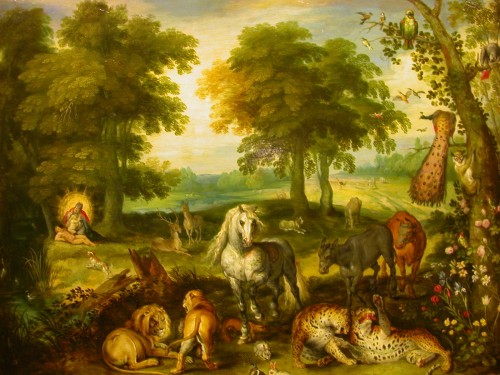
Heimwee naar het paradijs
Heimwee naar het paradijs
Mircea Eliade
Een tekst van M. Eliade zoals verschenen in het blad Bres (nr. 65 - juli-aug. 1977)
De ontdekking en de kolonisatie van de Nieuwe Wereld dragen het stempel van de eschatologie·- de leer van het einde der dagen. Ik zou ten bewijze hiervan de denkbeelden van het einde der tijden en het verloren paradijs, gekoesterd door de pioniers die Noord-Amerika koloniseerden, naar voren willen brengen. Eveneens de verandering van het "Amerikaanse paradijs" die de mythe van de voortdurende vooruitgang deed ontstaan, in een karakteristiek Amerikaans optimisme en een aanbidding van de jeugd en van alles dat nieuw is.
Christoffel Columbus was er zeker van bij de poorten van het Paradijs te zijn aangekomen. Hij geloofde dat de beken met kristalhelder water afkomstig waren van de vier rivieren uit de Hof van Eden. Het zoeken naar het aards Paradijs was voor hem geen hersenschim meer. De grote zeevaarder kende aan deze geografische ontdekking een eschatologische betekenis toe.
De Nieuwe Wereld vertegenwoordigde meer dan een nieuw continent dat gekerstend moest worden. In feite was Columbus ervan overtuigd dat de voorspelling van de verspreiding van het Evangelie in de gehele wereld plaats moest vinden vóór het einde van de wereld, dat overigens niet ver verwijderd was.
In zijn "Boek der Voorspellingen" bevestigde Columbus dat deze gebeurtenis, d.w.z. het einde der wereld, zou worden voorafgegaan door de verovering van het nieuwe continent, de bekering van de heidenen en de vernietiging van de Anti-Christ. En hij zelf speelde in dit grandioze drama een hoofdrol, zowel historisch als kosmisch. Zich tot de vorst Johannes richtend, verklaarde hij: "God heeft mij tot boodschapper benoemd van de nieuwe hemel en de nieuwe aarde, waarover Hij spreekt in de Apocalypse van Johannes en waarover Hij reeds gesproken heeft door de mond van Jesaja; en Hij heeft mij de plaats getoond waar ik deze kon vinden". Het was in deze messiaanse en apocalyptische sfeer dat de ontdekkingen en overzeese expedities plaats vonden die West-Europa schokten en totaal veranderden. In heel Europa geloofden de mensen aan een op handen zijnde hernieuwing van de wereld, hoewel om velerlei en vaak met elkaar strijdige redenen.
De kolonisatie van de beide Amerika's begon in een eschatologisch teken: de mensen geloofden dat de tijd gekomen was om de christelijke wereld te vernieuwen en dat de werkelijke vernieuwing de terugkeer tot het aards paradijs inhield, of op zijn minst, het opnieuw beginnen van de Heilige Geschiedenis, de herhaling van de wonderbaarlijke gebeurtenissen waarover de Bijbel verhaalt.
Daarom wemelt de literatuur uit die tijd, zoals de preken, de memoires en de briefwisselingen, van zinspelingen op de eindtijd en het paradijs. In de ogen van de Engelsen bijvoorbeeld betekent de kolonisatie van Amerika niet anders dan een vervolg en voltooiing van een Heilige Geschiedenis die begon met de Reformatie. In feite was de trek van de pioniers naar het Westen het voortzetten van de triomfale opmars van de wijsheid en het ware geloof van het Oosten naar het Westen. Reeds enige tijd hadden de protestante theologen de neiging het Westen te identificeren met geestelijke en morele vooruitgang. Sommige theologen hadden de Ark des Verbonds van Abraham naar de Engelsen overgebracht. De anglicaanse theoloog William Crashaw schrijft:
"De God van Israel is... de God van Engeland".
De eerste Engelse kolonisten in Amerika beschouwden zich zelf als door de Voorzienigheid uitverkoren om "Een stad op een Berg" te bouwen die als model zou dienen voor de ware hervorming voor heel Europa. Zij hadden de weg van de zon naar het verre Westen gevolgd, de traditionele opmars van de godsdienst, de beschaving van het Oosten naar het Westen op een wonderbaarlijke wijze voortzettend en uitbreidend. Zij zagen er een teken van de goddelijke Voorzienigheid in dat Amerika aan de Europeanen onbekend was gebleven tot aan de periode van de Reformatie. De eerste pioniers twijfelden er niet aan dat het uiteindelijke drama van de zedelijke wedergeboorte en de universele verlossing met hen begon, want zij waren de eersten om de loop van de Zon te volgen naar de paradijselijke tuinen van het Westen. Zoals de anglicaanse dichter George Herbert schreef in zijn "Strijdende Kerk": "In ons land maakt de religie, op haar tenen staand, zich op om over te gaan naar de Amerikaanse oever''.
Meer dan enige andere moderne natie werden de Verenigde Staten het product van de protestante Reformatie, op zoek naar een aards Paradijs waar de hervorming van de Kerk ten goede geleid moest worden. De samenhang tussen de Reformatie en het herstel van het aards Paradijs is door een zeer groot aantal auteurs opgemerkt, van Heinrich Bullinger tot Charles Dumoulin. Volgens deze theologen heeft de Reformatie de komst van het tijdperk van de paradijselijke zaligheid versneld.
Wij merken op dat vlak voor de kolonisatie van Amerika en de revolutie van Cromwell de millenaristische beweging zijn grootste toeloop gekend heeft. Het is daarom De triomfale opmars van het ware geloof naar de paradijselijke tuinen van het Westen niet verwonderlijk dat het meest verspreide dogma in de kolonieën inhield dat Amerika onder alle landen van de Aarde uitverkoren was om de tweede komst van Christus te begroeten en dat de aanvang van het duizendjarig rijk, hoewel in wezen geestelijk, vergezeld zou gaan van een verandering van de Aarde in een Paradijs, ten teken van een innerlijke volmaaktheid. De eminente puritein Increase Mather, president van de Harvard universiteit van 1685 - 1701: "Wanneer dit Koninkrijk van Christus de gehele Aarde gevuld zal hebben, zal deze Aarde zijn toestand van Paradijs weer hervinden''.
Later kwam echter een andere idee naar boven: het Nieuwe Jeruzalem zou voor een deel het product van menselijke arbeid worden. Jonathan Edwards (1703-1758) dacht dat door de arbeid het Nieuwe Engeland getransformeerd zou worden tot "een Paradijs op aarde". Wij zien aldus hoe de toekomstverwachting van de pioniers langzamerhand uitmondt in de idee van de vooruitgang. De eerste etappe bestond uit het op elkaar afstemmen van het paradijs en de aardse hulpbronnen van de
Nieuwe Wereld.
In de volgende etappe werd de eschatologische spanning verminderd door het ontbreken van de periode van decadentie en ellende die verondersteld werd vooraf te gaan aan "de laatste dagen" en op deze wijze kwam men tenslotte op de idee van een voortschrijdende en nimmer onderbroken verbetering. Maar voordat de Amerikaanse idee van vooruitgang vaste vorm aannam had het millenarisme van de pioniers andere gedaanteverwisselingen ondergaan. De eerste belangrijke crisis van deze puriteinse eschatologie werd uitgelokt door de worsteling tussen de Europese machten om het koloniale imperium. Rome en de katholieke landen werden vereenzelvigd met de antichrist en van hun vernietiging hing de totstandkoming van het toekomstig koninkrijk af.
In een bepaalde periode leed de koloniale Engelse literatuur bepaald aan een obsessie: de inval in Amerika van de antichrist die alle hoop op een triomferende wederkomst van Christus dreigde te doen vervliegen. Voor de advocaat en goeverneur John Winthrop was de eerste plicht van het Nieuwe Engeland een muur op te richten tegen het koninkrijk van de antichrist dat de Jezuïeten op het punt stonden in deze gebieden te vestigen. Andere auteurs bevestigden dat de Nieuwe Wereld een waar paradijs was vóór de komst van de katholieken. Zeker, de rivaliteit tussen de Europese machten om de overheersing van de Amerikaanse imperiums was in de eerste plaats van economische aard, maàr zij werd verergerd door een bijna manicheïstische eschatologie: alles scheen teruggebracht te kunnen worden tot een conflict tussen Goed en Kwaad.
De koloniale schrijvers spraken over de dreiging die de Fransen en de Spanjaarden op hen uitoefenden als over een "nieuwe Babylonische gevangenschap" of van een "Egyptische slavernij". Fransen en Spanjaarden waren tirannen, in dienst van de antichrist. Het katholieke Europa werd afgeschilderd als een gevallen wereld, een Hel, tegenover het paradijs van de Nieuwe Wereld. In plaats van over "hemel of hel" sprak men over "hemel of Europa". De beproevingen van de pioniers in de Amerikaanse woestijn hadden tot hoofddoel het uitwissen van de zonden des vlezes van de mens van de oude heidense wereld.
Terwijl het conflict tussen het Goed en het Kwaad in de ogen van de kolonisten geconcretiseerd werd in de worsteling tussen het protestantisme en het katholicisme, bleef Engeland buiten schot.
Maar na 1640 ontstond er een zekere spanning tussen de kolonisten en het moederland. De Engelse Reformatie was in de ogen van de perfectionisten onder de kolonisten onvolmaakt. Erger nog, de religieuze praktijken in Engeland werden beschouwd als het werk van de antichrist. In het apocalyptische koloniale beeldenspel werd Engeland de vervanger van Rome. Deze vervanging had een directe consequentie: de kolonisten - als uitverkoren volk - begonnen te geloven dat hun opdracht in de woestijn niet alleen de voortzetting van een religieuze traditionele activiteit was, maar ook iets geheel nieuws.
In de hoop op een wedergeboorte ver van de Europese hel dachten zij dat het hun taak was de eerste stap te doen voor de laatste etappe van de Geschiedenis. In 1647 verkondigde de apostel der Indianen, John Eliot, de "dageraad van het Evangelie... in Nieuw-Engeland". Dit soort uitspraken toont aan hoe diep de breuk was met het Europese verleden. En vooral opmerkelijk is het feit dat deze breuk plaats gevonden heeft lang voor de Revolutie en de Amerikaanse Onafhankelijkheid.
In 1646 beschouwde Nieuw-Engeland zich als een vrije staat en niet als een " kolonie of compagnie van Engeland". Dit bewustzijn van autonomie berustte in de eerste plaats op religieuze motieven. Cotton Mather verwachtte in Nieuw-Engeland de terugkeer tot de eerste eeuwen van het christendom. Hij schreef: " Tenslotte was de eerste eeuw de Gouden Eeuw; om daartoe terug te keren, zal de mens opnieuw protestant worden en, ik zal er aan toevoegen, puritein". Deze terugkeer tot de Gouden Eeuw van het christendom moest samengaan met een verandering van de Aarde. Zoals Increase Mather verklaarde, zou "het herstel van de primitieve Kerk de Aarde in een Paradijs herscheppen".
De breuk met Engeland en het Europese verleden werd bovendien nog gekenmerkt door de vermaningen van de pioniers, terug te keren tot de deugden van de primitieve Kerk om zich voor te bereiden op het duizendjarig rijk. Voor de puriteinen was de eerste christelijke deugd de eenvoud. De intelligentie, de cultuur, de kennis, de goede manieren en de luxe waren slechts het werk van de duivel. John Cotton schreef: "Hoe intelligenter en beschaafder u bent, des te meer bent u voorbereid om voor Satan te werken". Reeds begonnen de pioniers en zendelingen een meerderwaardigheidscomplex te ontwikkelen. Deze terugkeer tot het primitieve christendom, die geacht werd het paradijs op aarde te herstellen, hield een zekere verachting in voor de eruditie van de Jezuïeten alsmede een kritiek op de Engelse aristocratie die beschaafd en elegant was, geraffineerd, gewend aan macht en gezag. Overdaad en luxe in de kleding werden de "hoofdzonde" van de "gentleman".
Nathanael Ward stelde in zijn boek "Simple Cobbler of Aggawam" (1647) het eenvoudige leven en de morele superioriteit van de kolonisten tegenover de verdorven zeden van de Engelsen en concludeerde uit deze vergelijking het bewijs voor de reeds geboekte vooruitgang in de richting van de paradijselijke staat van de primitieve Kerk.
Hoewel zij hun achterlijkheid ten aanzien van kleding en beschaving erkenden, gingen de kolonisten prat op hun hogere morele standaard vergeleken bij de Engelsen. Volgens Charles L. Sanford moet de kiem van het Amerikaanse superioriteitscomplex - zo duidelijk tot uitdrukking komend in de buitenlandse politiek en in de geestdriftige pogingen de "American Way of Life'' te verspreiden over de gehele aarde - gezocht worden in de activiteit van de zendelingen onder de voortrekkers. Er ontwikkelde zich in het gehele door de pioniers van het Westen ontwikkelde gebied een religieus symbolisme dat de eschatologiegedachte van de pioniers in stand hield tot ver in de 19e eeuw.
De immensiteit van de wouden, de eenzaamheid van de onmetelijke vlakten, de zegen van het landelijk leven werden vergeleken met de zonden en ondeugden van de stad.
Een nieuw denkbeeld kwam toen op: het Amerikaanse paradijs was besmet met duivelse krachten, afkomstig van het verstedelijkte Europa. In de plaats van de kritiek op de aristocratie, de luxe en de beschaving kwam nu de kritiek op de steden en het stadsleven. De grote bewegingen voor een religieuze herleving ontstonden allemaal onder de pioniers van het verre Westen en bereikten de steden pas veel later. Sterker nog, in de steden zelf was deze herleving veel meer verspreid onder de armen dan onder rijken en de beschaafde kringen. De kerngedachte was dat het verval van de godsdienst uitgelokt was door de ondeugden in de grote steden en in het bijzonder door de dronkenschap en de luxe, zo gewoon bij de uit Europa afkomstige aristocratie. Want, late niemand daaraan twijfelen, de Hel was - en bleef nog heel lang - de kenmerkende hoedanigheid van Europa.
Zoals wij reeds benadrukt hebben, de eschatologische verwachting van het duizendjarig rijk en van het aards Paradijs werden uiteindelijk onderworpen aan een radicale verwereldlijking. De mythe van de vooruitgang en de aanbidding van alles dat nieuw en jong is zijn de meest karakteristieke gevolgen daarvan. Niettemin vindt men onder de schijn van strenge secularisatie het religieuze enthousiasme en de eschatologische hoop terug waardoor de eerste pioniers bewogen werden. Want, kort gezegd, zowel de eerste kolonisten als de latere Europese immigranten uit onze tijd gingen scheep naar Amerika als naar het land waar zij herboren konden worden, d.w.z. een nieuw leven beginnen. Dit "nieuwe" dat ook de Amerikanen van vandaag nog fascineert, is een verlangen doortrokken met religieuze bijkomstigheden. In het "nieuwe" is er hoop voor "wedergeboorte", het spoor naar een nieuw leven.
Nieuw-Engeland, New York, New Haven - al deze namen drukken niet alleen het heimwee naar het geboorteland uit dat men achter zich gelaten heeft, maar vooral de hoop dat op deze nieuwe grond en in deze nieuwe steden het leven nieuwe dimensies zal bieden.
De hoop in een nieuw leven herboren te worden - en de verwachting van niet alleen een betere maar een paradijselijke toekomst - weerspiegelt zich ook in de Amerikaanse cultus van de jeugd.
Sinds het industriële tijdperk hebben de Amerikanen volgens Charles L. Sanford getracht hun verloren onschuld steeds meer in hun kinderen terug te vinden. Deze auteur gelooft ook dat de opwinding bij alles dat nieuw is en de tocht van de pioniers naar het verre Westen vergezelt, het individualisme ten opzichte van het gezag heeft versterkt, maar ook heeft bijgedragen aan gebrek aan eerbied bij de Amerikanen voor historie en traditie. Men zou deze analyse kunnen vervolgen met aan te tonen dat het langdurig verzet van de Amerikaanse elite tegen de industrialisatie van het land en hun overdrijving van de deugden van het boerenbedrijf verklaard kunnen worden uit datzelfde heimwee naar het aards Paradijs. Zelfs na de overweldigende triomf van het urbanisme en de industrialisatie riepen de beelden en denkbeelden die de pioniers zo dierbaar waren, nog steeds eerbied op. Tenslotte was het met de bedoeling te bewijzen dat verstedelijking en industrialisatie niet noodzakelijk zoals in Europa gepaard behoefden te gaan met ondeugd, armoede en corruptie, dat de fabriekseigenaren hun filantropische activiteiten sterk opvoerden met het bouwen van kerken, scholen en ziekenhuizen. Men wilde met alle geweld aantonen dat de technologie en de industrie in plaats van de geestelijke en religieuze waarden aan te tasten, bijdroegen aan versterking daarvan.
In 1842 verscheen een boek met de titel "Het Paradijs binnen bereik van alle mensen, dankzij de natuur en de machines". En deze heimwee naar het Paradijs, dit verlangen de "natuur" van hun voorouders terug te vinden, vormen voor een deel de verklaring voor de hedendaagse neiging de steden te verlaten om onderdak te zoeken in de voorsteden - welvarende rustige wijken, die met de grootste zorg in paradijs-achtige landschappen herschapen zijn.
Het geloof in een eschatologische opdracht en vooral in de mogelijkheid de volmaaktheid van het primitieve christendom te hervinden en het paradijs op aarde te herstellen, loopt niet het gevaar gemakkelijk in vergetelheid te raken. Er is een grote kans dat zowel de houding van de gemiddelde Amerikaan van vandaag, als de politieke en culturele ideologie van de Verenigde Staten, de neerslag zullen gaan weerspiegelen van de zekerheid van de puriteinen uitverkoren te zijn om het aards paradijs te herstellen.
00:05 | Lien permanent | Commentaires (0) | | del.icio.us | | Digg | Facebook