


dimanche, 27 janvier 2013
À L’ASSAUT DE LA MODERNITÉ
À L’ASSAUT DE LA MODERNITÉ
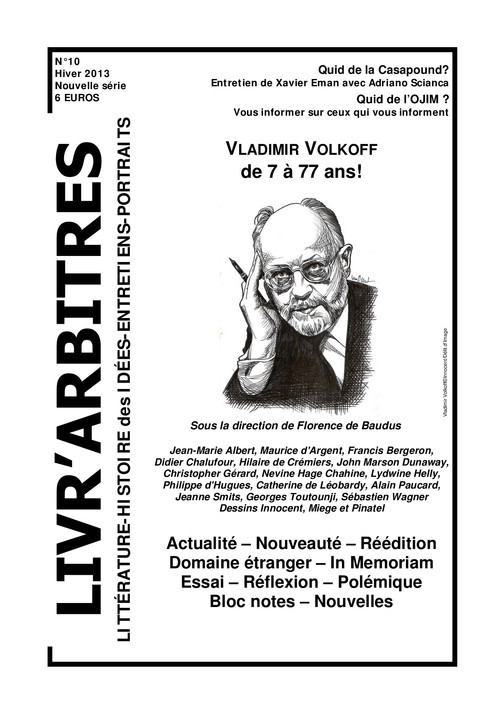
par Xavier EMAN
(In « Livr’arbitres » numéro 10, www.livr-arbitres.com )
Depuis plusieurs années, le mouvement de droite radicale et sociale italienne « Casapound » suscite intérêt et interrogations au sein de l’ensemble de la mouvance identitaire et patriote européenne.
Si c’est sans doute avant tout l’esthétique de ce mouvement — offensive, novatrice, insolente et avant-gardiste — et ces méthodes d’action — audacieuses et inventives — qui ont intrigués puis passionnés des observateurs sans cesse plus nombreux, Casapound Italia ne peut bien évidemment se résumer à cela.
Car Casapound, qui se veut le rassemblement des « fascistes du troisième millénaire », n’est pas qu’un groupe activiste, c’est un mouvement politique révolutionnaire qui s’appuie sur un corpus idéologique complet et propose à ses membres une véritable « vision du monde » alternative.
C’est cette vision qu’Adriano Scianca, responsable de la culture de CP et journaliste diplômé en philosophie, expose et explicite dans son ouvrage dont la version française est titrée : Casapound, une terrible beauté est née (Éditions du Rubicon, 21 rue Fécamp, 75012 Paris. hhtp://www.leseditionsdurubicon.com).
À travers quarante concepts fondamentaux (Action, Fascisme, Femme, Nature, Usure, Identité, Histoire, etc.), l’auteur propose une plongée intellectuelle et doctrinale dans l’univers archéo-futuriste et explosif du mouvement à la tortue. Ainsi, on croisera dans ces pages aussi bien Heidegger, Nietzsche, Junger et Drieu que le capitaine Harlock (« Albator » en France), Metallica et, bien sûr, Zetazeroalfa, le groupe rock dont Gianlucca Iannone, le charismatique président de CP, est le chanteur.
Adriano Scianca dessine ainsi une mosaïque plurielle, bouillonnante et multicolore dont se dégagent peu à peu une cohérence interne et une ligne directrice forte.
D’une lecture parfois ardue (du fait de la profondeur des sujets et concepts abordés) mais toujours passionnante, « Casapound, une terrible beauté est née ! » représente un ouvrage fondamental pour qui veut sérieusement connaître et comprendre la pensée et l’action des « fils de la Tortue » ainsi que la portée de la révolution organique qu’ils incarnent.
Un livre qui ne laissera personne indifférent, pour preuve les polémiques qu’il suscite depuis sa sortie, notamment au sein d’une « extrême-droite » qui n’en finit plus de rancir et qui semble avoir bien du mal à supporter les expériences faisant sortir les idéaux patriotes et sociaux des placards plein de naphtaline où ils sont remisés depuis plus de soixante ans.
TROIS QUESTIONS À ADRIANO SCIANCA
-
La traduction française de votre ouvrage dont le titre original est Riprendersi tutto (Tout reprendre) vient de sortir, publié par les Éditions Rubicon. Pouvez-vous nous dire quelle est la nature de ce livre : est-ce un essai de sciences politiques, le programme politique de Casapound, une histoire de ce mouvement ?
Je crois que Riprendersi tutto est la structuration d’un lexique politique en premier lieu pour les militants mais également pour tous ceux qui, pour une raison ou une autre, sont curieux de découvrir CasaPound. Le livre est né d’une insatisfaction vis-à-vis des descriptions que l’on pouvait donner de notre mouvement. On en parlait souvent en termes de « déjà vu » alors que notre mouvement est véritablement un phénomène nouveau dans le panorama politique italien et probablement européen.
-
Votre mouvement politique s’est placé sous les auspices du grand écrivain et poète américain Ezra Pound. Pourquoi ce choix et signifie-t-il que la littérature joue un rôle important au sein de votre formation politique ?
Ezra Pound — auteur sur lequel portera mon prochain livre — fut une figure intellectuelle très importante de son époque et je pense que nous devons tous encore aujourd’hui en apprécier la portée. Casapound s’est surtout inspiré de ses théories sociales, en particulier sur le thème du logement. Ce qui est sûr, c’est que la littérature joue un rôle important à CasaPound. Notre première occupation se nommait CasaMontag comme le personnage de Fahrenheit 451 de Ray Bradbury.
Nous avons aussi récemment organisé des conférences autour de Bukowski ou de Kérouac. Nous n’oublions pas non plus Robert Brasillach et les grands auteurs de notre « milieu ». À l’entrée de CasaPound, on peut trouver sur les murs une galerie de noms peints, outre les auteurs que je vous ai cité, on y retrouve : Pirandello, Eliot, Orwell, Ballard, Tolkien, Saint-Exupéry, Fante, Mishima, Pessoa, Majakovskij, Marinetti, D’Annunzio, Jünger, Yeats, Dante, Hölderlin, Omero, Céline. Ceux-là, et bien d’autres encore, sont les anges gardiens de notre action quotidienne.
-
L’édition française de votre ouvrage répond notamment à un intérêt croissant des milieux patriotes et identitaires européens pour le « phénomène » Casapound. Comment expliquez-vous cet engouement et pensez-vous que le « modèle » Casapound soit exportable à l’étranger ?
L’intérêt pour le phénomène CasaPound vient des résultats obtenus par ce mouvement au cours des dernières années et de son approche innovante. Le modèle CasaPound est-il exportable ? Dans la forme, non mais dans l’esprit, certainement.
Très souvent des camarades étrangers qui viennent à notre rencontre veulent eux aussi faire des « Occupations Non Conformes » de retour chez eux. Cela nous fait plaisir mais nous pensons surtout que pour obtenir ce résultat, il faut d’abord des bases solides. Cpi est né d’un petit groupe de personnes mais qui représentait avant tout une communauté de destin très unie et qui a obtenu des résultats incroyables grâce à des efforts inimaginables. C’est par ça qu’il faut commencer : communauté, unité, hiérarchie, esprit de sacrifice, idées claires. Ceux qui viennent à notre rencontre et qui nous demandent la « recette de la révolution » sont dans l’erreur car elle n’existe pas. L’unique recette qui existe consiste dans un travail quotidien et la foi dans ses idées. C’est ça l’esprit de Cpi qui doit être exporté, les résultats viendront d’eux-mêmes.
00:05 Publié dans Actualité | Lien permanent | Commentaires (0) | Tags : acutalité, casa pound |  |
|  del.icio.us |
  |
|  Digg |
  Facebook
World War III Has Begun
|
– It`s the First Asymmetric War Long Awaited by Pentagon Think Tanks |
|
Wayne MADSEN The Pentagon has already declared World War III and President Barack Obama and the Congress never even carried out their constitutional duties to approve the use of American military power for war. One might reasonably conclude that the United States has outsourced war. Presently, World War III is being conducted on two continents – Asia and Africa – with two others – Europe and South America – looming on the horizon. Today, wars are crafted by the upper one percent of wealthy elitists who, using non-governmental organizations, television networks, non — profit “think tanks,” and public relations firms, can declare war on nations without a whimper from elected public officials. Symmetric warfare is no longer an option for the global elites. World Wars I and II severely affected the investments of many of the global elite families as a result of the destruction of cities, factories, railways, seaports, and other infrastructures. The Korean, Vietnam, the Arab-Israeli, and Iraq wars were messy affairs that also adversely affected markets and destroyed valuable infrastructures. The Cold War never developed into a hot nuclear war because of the doctrine of Mutually Assured Destruction (MAD), which ensured that a nuclear first strike by either the West or the East would result in total annihilation of both sides, along with the rest of the world. Even a western military attack on China would have had disastrous results for the attackers, especially since China could retaliate with a nuclear counter-attack and wipe out the U.S. Seventh Fleet and its East Asian naval bases, including Okinawa and Guam. A new type of warfare was required by the elites: asymmetric warfare – the use of unconventional warfare tactics, including information warfare, by proxies, non-state actors, agents provocateur, and fifth columns. Largely financed by hedge fund mega-tycoon George Soros and his Central Intelligence Agency interlocutors, our present asymmetric World War III was field tested just like any new product. The “themed” revolutions were market-tested first in Serbia, and then in Ukraine, Georgia, and Kyrgyzstan, to oust problematic governments that did not want to get on board with the dictates of the unelected and unaccountable real controllers of the financial and political destiny of the world. Pro-western and pro-European Union governments, comprised of a number of individuals who were funded by Soros and other non-state operations established by the global elites, for example, the Council on Foreign Relations, the Bilderberg Group, the Trilateral Commission, Freedom House, U.S. Institute of Peace, and others funded and supported by the Houses of Rothschild, Rockefeller, Mellon, and others saw to it that new governments took root in Belgrade, Kiev, Tbilisi, and Bishkek. These new governments were not elected but took power as a result of themed street rebellions, a new manifestation of unconventional warfare. No longer did armies, navies, and air forces have to face each other across battlefields and battle zones and theaters of warfare. One merely had to embed fifth columnists and provocateurs inside a targeted nation's capital city, media, political party apparatus, and "civil society" infrastructure to bring about the defeat of the government outside the normal political process and replace it with a new government beholden to the desires of the central banks and global oligarchs. The beginnings of the asymmetric world war began in Belgrade, Serbia when Otpor – a Serbian resistance movement dedicated to overthrowing the Slobodon Milosevic regime – launched the first “themed revolution.” Otpor’s symbol was a clenched fist, an emblem that would reappear in the future in other capital cities from Kiev to Cairo. Otpor received massive funding from a network of western contrivances, including George Soros’s Open Society Institute, the neo-conservative-infiltrated U.S. National Endowment for Democracy, and various European Union-funded NGOs that were intimately linked to Soros’s “democracy engineering” operations. The playbook used for Otpor in Serbia and by similar organizations in toppling the governments of Georgia in the Rose Revolution, Ukraine in the Orange Revolution, and Kyrgyzstan in the Tulip Revolution, was developed by University of Massachusetts professor Gene Sharp, the founder of the Boston-based NGO, the Albert Einstein Institute, which helped train Otpor activists in civil disobedience and popular resistance campaigns designed to overthrow governments, those democratically-elected and those not. Albert Einstein Institute-trained provocateurs launched popular resistance campaigns around the world aimed at replacing governments unwilling to acquiesce to the dictates of Western elites. Internal opposition forces, all acolytes of Sharp, for instance Kmara, which helped install the pro-Western and pro-Israeli Mikheil Saakashvili in Georgia; Pora in Ukraine that propelled pro-NATO Viktor Yushchenko into the presidency; and KelKel in Kyrgyzstan that replaced Askar Akayev with the corrupt Kurmanbek Bakiyev. The domino effect of the themed revolutions saw Serbs helping to overthrow the Georgian government, then Serbs and Georgians flocking to Kiev to oust the Ukrainian government, and Georgians and Ukrainians being directly involved in the insurrection in Bishkek. The neo-conservatives and Sharp had borrowed a page from the Communists and the international proletarian movement that saw Communist cadres fight against capitalists and fascists in foreign civil wars, for example, the Spanish Civil War and conflicts in Africa and Southeast Asia. Sharp was an alumnus of Harvard University’s CIA-linked Center for International Affairs, also abbreviated “CIA,” which is not coincidental. Harvard and the CIA of Langley, Virginia have long maintained a close relationship. In fact, Sharp was never interested in ensuring the will of the people to map out their own future but was putting into practice the theory of asymmetric warfare – the vanquishing of enemies through the use of proxy internal forces without the requirement for invading foreign armies and the massive death and destruction associated with such action. Many of Sharp’s tactics have been seen in practice in many asymmetric warfare targets. These include the creation of a perception of a successful movement, even if there is not one. The use of western-controlled news networks like Fox News that showed a video clip of anti-austerity Greek rioters in Athens falsely depicted as anti-government protesters in Moscow and Al Jazeera’s use of a video erroneously showing a U.S.- and Saudi-backed bloody crackdown of pro-democracy protesters by Bahrain’s security forces as the bloody repression of protesters by Syria’s government are examples of Sharp’s propaganda and disinformation tactics. Cultivating foreign support is another key element of Sharp’s asymmetric warfare tactics. The virtual control exercised by Soros over Human Rights Watch after the multi-billionaire hedge fund kingpin donated $100 million to the group is a case in point. The human rights NGO was at the forefront of hyping “atrocities” committed by the Qaddafi regime in Libya but remained largely silent on Libyan rebel atrocities committed against Libyan and African blacks, as well as Qaddafi loyalists. In so doing, Human Rights Watch had a powerful accomplice in the International Criminal Court, which tended to look the other way when CIA- and Saudi- and Qatari’ supported Libyan rebels were committing the massacres. Another Sharp tactic is to seek change outside the electoral system. This tactic was evident in the 2004 Orange Revolution in Ukraine, where election results were rejected, and in the recent Russian parliamentary election, where Soros- and U.S. neocon-financed election monitoring groups like Golos rejected the outcome of the election and used shills like former Soviet President Mikhail Gorbachev to call for the nullification of the election. Interference following the Sharp and Soros methodology can also be seen in the presidential candidacies of Russian oligarch and New Jersey Nets basketball owner Mikhail Prokhorov and the backing by western propaganda outlets like the Christian Science Monitor (now derided as the “Christian Zionist Monitor” after its takeover by interests who favor a neo-imperialist U.S. foreign policy) of Moscow street protest veteran Alexei Navalny. Sharp and Soros are on the same page in calling for the internal opposition forces’ use of the Internet, fax, and social networks like Facebook and Twitter to advance their agendas. In the next phases of World War III, the asymmetric warriors of the Pentagon and their adjunct non-state actors will continue to turn up the heat in the Arab World, with the revolutions in Libya, Syria, Tunisia, Yemen, and Egypt, after a somewhat shaky start that saw the advancement of Islamist groups, being brought under more western and NATO control. Russia’s presidential election and a turndown in the Chinese economy, with growing village-based dissent among China’s growing middle class, will present further opportunities for the promoters of World War III. The sudden death of North Korea’s leader Kim Jong Il has also resulted in a call for an expansion of social networking operations, most notably by the CIA- and Soros-infested Washington Post, inside Asia’s hermit kingdom. Myanmar, China’s restive provinces of Tibet and East Turkestan, Lebanon, Iran, Algeria, Sudan, Zimbabwe, Venezuela, Nepal, Belarus, Ecuador, Bolivia, Pakistan, Laos, and the two Congos also present opportunities for the World War III architects. Those who seek to extend American and global elitist control over the entire planet will not rest until every acre of land comes under the firm control of the oligarchs of Wall Street, the spymasters of the CIA, and the globalist business cartels and families. |
Republishing is welcomed with reference to Strategic Culture Foundation on-line journal www.strategic-culture.org. |
00:05 Publié dans Actualité, Géopolitique, Militaria | Lien permanent | Commentaires (0) | Tags : guerre, guerre asymétrique, politique internationale, géopolitique, militaria | | del.icio.us | | Digg | Facebook
Bij Paul van Ostaijen in de leer
Bij Paul van Ostaijen in de leer

Zowel de vroege als de late epigonen van Paul van Ostaijen zullen het U wellicht heel anders trachten diets te maken, daar elkeen bij zijn leermeester slechts datgene wenst te leren wat het meest naar zijn zin is en het best met zijn eigen geestesaanleg overeenstemt.
De speelse geesten, die slechts van woordgeknutsel houden of de poëzie “experimenteren” zoals men een nieuwe fiets of een nieuwe flirt aanpakt, zullen U weten te vertellen dat Paul van Ostaijen de aartsmodernist bij uitstek was die hele tot dan toe zo ouderwetse Vlaamse poëzie op stelten heeft gezet, om de ene poëtische waaghalzerij na de andere aan te durven en het over boord te werpen. Ze staven zich blind op toch zo modernistische “Boere-charleston” of op dat even leuk “Alpejagerslied”, met die twee heren die een open hoed dragen en die hem voor elkaar afnemen vlak vóór de winkel van Hinderickx en Winderickx… Leuk zijn ze, inderdaad, die gedichten en misschien zelfs baanbrekend, doch vindt U ze niet eveneens een tikje “prozaïsch” en potsierlijk, met heel die goedkope tingeltengel van “bolle wangen ballen bekkens / bugel en basson”?
We weten gelukkig genoeg, dat het voor Paul van Ostaijen met die en dergelijke andere gedichten slechts om het “Eerste Boek van Schmoll” ging, U weet dat eerste piano-oefenboek, waarin de kinderen de allereerste beginselen van de moeilijke klavierkunst aanleren. Na dit boek komen de andere, meer ingewikkelde oefenboeken en slechts na jaren oefenen komt men er eindelijk toe min of meer voldoende bekwaam te zijn een fuga van Bach of een nocturnen van Chopin te vertolken. Met Paul van Ostaijen was het net eender en na die eerder schrale en al te gemakkelijke probeerselen moesten meer ernstige dichtoefeningen komen. Trouwens, dit “Eerste Boek van Schmoll” behelst het niet reeds enkele zeer gave gedichten, zoals die wondermooie en ietwat romantische “Loreley”? Helaas, Paul van Ostaijen is te jong de dood ingegaan, om ons de volle maat van zijn dichterlijke gaven te hebben kunnen tonen. De gedichten die we van hem bezitten zijn nog te onvolkomen, te onvolmaakt om ons de volle, overdadige potentie van zijn waar dichterlijk vermogen te kunnen onthullen.
In zijn critische proza moeten wij de dichter Paul van Ostaijen leren zoeken en, hoe paradoxaal! het is in een van de weinige Franstalige geschriften van deze Vlaamse dichter dat wij zijn ars poetica vinden. Dit Franstalig geschrift heet “Un Débat Littéraire”. Het behelst de tekst van een lezing door Paul van Ostaijen in 1925, te Brussel, gehouden voor het publiek van het studentengenootschap “La Lanterne Sourde”. Als nog zeer jonge dichter, hadden wij het voorrecht deze lezing te mogen horen, er ja zelfs een beetje een van de mede-inrichters van te zijn. De lezing van Paul van Ostaijen maakte de grootste indruk op zijn Brussels publiek en voor onszelf werd ze een werkelijk richtinggevende poëtische boodschap, die wij achteraf nog dikwijls met Paul van Ostaijen mochten bespreken.
De poëtische boodschap van Paul van Ostaijen viel bij ons in een wellicht reeds goed voorbereide aarde, want toen reeds dweepten wij èn met Hadewijch èn met Novalis. Hoe het ook zij, de heel wat oudere Paul van Ostaijen vond in ons, vertegenwoordiger van een jongere generatie, een gewillige discipel, toen hij verkondigde dat Sint Jan van ‘t Kruis de hoeksteen van de hele Spaanse literatuur was, terwijl Mechtild van Maagdeburg, Meister Ekhardt, Jacob Böhme, Tauler en Angelus Silesius als de hechtste vertegenwoordigers van de Duitse letterkunde dienden beschouwd te worden.
Paul van Ostaijen had, inderdaad, de poëtische boodschap van die wonderbare woordkunstenaars begrepen; hij had van hen geleerd dat het woord heel wat meer is dan een teken, dat de woorden meer dan loutere begrippen dekken, dat ze het leven zelf zijn, of eerder dat ze de transcendentie van al hetgeen in het leven besloten weten te reveleren. Hij had van hen geleerd dat het woord in de woordkunst heel wat meer is dan een klank, een klankassociatie met of zonder geestelijke of intellectuele resonans-bodem. Weliswaar is de poëzie eerst en vooral, zoals alle kunsten trouwens, gensensibiliseerde materie, die materie hier het woord zijnde met al de mogelijkheden van zijn verhouding tot het onbewuste. De metafysische bekommernis van de dichter, leerde ons Paul van Ostayen (want volgens hem diende de dichter metafysische bekommernissen te hebben), zou er de dichter toe leiden in de woorden heel wat meer te zien dan het beeld van de uiterlijke wereld, om er de onbewuste som uit te puren van al hetgeen uit hun aard in hem weerklank, diepte en verte heeft gevonden. En op zijn beurt moet de dichter, niet de geest, maar het onbewust van zijn lezer of luisteraar weten te beroeren.
Ten slotte bestaat de kunst van de dichter er vooral in een bewuste en bestendige beroering van het onbewuste te verwekken. Doch van Ostaijen wist onmiddellijk de onbewust geïnspireerde poëzie van de bewust opgebouwde te onderscheiden, met dit voorbehoud echter dat de ene vaak in de andere verglijdt. Geen enkel dichter, geen enkel bewust woordkunstenaar geraakt echter ten volle in de sfeer van de louter onbewust geïnspireerde poëzie; slechts de zuivere mystici, de profeten en… de geesteszieken kunnen het spreekbord van de onbewuste, van de “goddelijke” of andere niet gewone ingeving worden. Aan de dichters behoort het de bewust opgebouwde poëzie te puren uit de gehele bewerking van de onbewuste grondstof die hun wordt geboden ter beoefening van hun dichtkunst. Van Ostaijen stond hier dan van meetaf afwijzend tegenover het blind vertrouwen van de surrealisten in hetgeen deze het woordautomatisme noemen. Voor hem kwam het er in eerste instantie op aan de Wahlverwantschaften van de woorden op te sporen en hierbij zijn hun klank en de metafysische en gevoelsverhoudingen tussen die klank en de zin van de woorden wellicht de beste gidsen.
Paul van Ostaijen stelde zich daarbij de vraag of men een bewuste mystieke literatuur kon scheppen. Hij antwoordde er onmiddellijk negatief op. Hij meende echter dat men heel wat aan de mystieke literatuur kon ontlenen, om haar uitingsmiddelen bewust in de poëzie om te werken. Kantiaans aangelegd, sprak hij dan van een “mystiek in de verschijningsvormen” die de mystiek in God zou kunnen vervangen. Maar die “mystiek in de verschijningsvormen”, is ze ten slotte niet als een vorm van het eeuwige pantheïsme te beschouwen? In die zin hebben we althans de les van van Ostaijen verstaan en, de extase van de mystici “bewust” ervarend, hebben we de “verwondering”, de “begeestering”, samen met al de “nachtzijden” van het leven, als doel an sich van de poëzie weten te ontginnen. (*)
Paul van Ostaijen zegt nog dat het er op aankomt door het woord heen “rationeel”tot het surreële op te gaan. Wij hebben zijn raad gevolgd en zijn aldus logischerwijze in het surrealisme beland om achteraf tot een loutere metafysische poëzie te komen. Doch hijzelf, heeft hij zijn ars poëtica heel en gans in de praktijk van zijn poëzie weten om te zetten? Wij geloven van niet, want daarvoor was zijn kunst nog te gebonden aan zekere aspecten van het expressionisme, ja zelfs van het dadaïsme. Wel heeft hij de grondslagen gelegd van een loutere thematische poëzie, doch zijn thematiek was nog te verslaafd aan de al te goedkope feeërie van de music-hall, aan “dressuurnummers” en grotesken. In enkele van zijn mooiste gedichten heeft hij de poëzie van het “kind in ons” weten op te roepen, doch de poëzie van “plant in ons”, van het “dier in ons” en het verder van al hetgeen de “subcorticale” wereld van ons diepste wezen toebehoort heeft hij nooit of slechts sporadisch weten te benaderen.
De poëzie van Paul van Ostaijen is voor ons een vertrekpunt geweest, een “overwonnen standpunt”, om een uitdrukking aan zijn eigen terminologie te ontlenen. In de poëzie van de jongste jaren hebben wij, helaas, slechts een terugkeer tot die “overwonnen standpunten” dus een poëtische “Weg zurück” menen te zien. Wij weten het wel, men zal ons antwoorden dat men verder gegaan is dan van Ostaijen zelf. Misschien wel, doch dan voorzeker slechts op de meest gemakkelijke onder de vele wegen die vanaf het “kruispunt” van Ostaijen openstonden. Wij, in tegendeel, hebben de moeilijkste verkozen, die waar de poëzie de ijlste toppen van het sacrale in de mens besloten tracht te benaderen en te omschrijven. Doch leidt deze weg ten slotte niet tot de “eeuwige poëzie”, die boven alle bekommernis van rijm, metrum of andere min of meer gebonden of ongebonden prozodie, de poëzie weet bloot te leggen van al hetgeen ons in het werelds aanzijn weet te beroeren?
MARC. EEMANS
(*) Paul Rodenko, in zijn boek “Tussen de Regels”, aarzelt niet Paul van Ostaijen een “mysticus” te noemen. Hij voegt er aan toe dat alleen van daaruit de poëtische ontwikkeling van de dichter te begrijpen is, en hij citeert daarbij, ter staving, een louter metafysisch gedicht van de dichter, waarin het gaat over de bevrijding van de “gevangen éénheid” van doen en denken, lichaam en ziel.
Marc. Eemans, Bij Paul van Ostaijen in de leer, in De Periscoop, 7e jg., nr. 1, november 1956, blz. 1-2.
00:05 Publié dans art, Littérature | Lien permanent | Commentaires (0) | Tags : art, avant-gardes, paul van ostaijen, lettres, lettres néerlandaises, lettres flamandes, flandre, littérature, littérature flamande, littérature néerlandaise, marc eemans | | del.icio.us | | Digg | Facebook