

vendredi, 25 octobre 2013
Eurasian Union: Substance and the Subtext
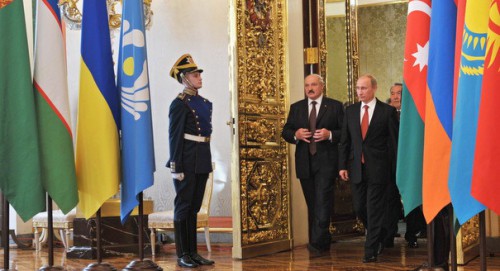
Eurasian Union: Substance and the Subtext
The Eurasian Union has come to the present stage in its evolution within a remarkably compressed time-frame. Although the idea was first mooted by the Kazakh president Nursultan Nazarbaev in 1994, it hibernated for long years.[1] It was only in late 2011 that Vladimir Putin revived the idea; visualised it as one of the major centres of economic power alongside the EU, the US, China and APEC; and initiated the process of its implementation. In November 2011, the presidents of Russia, Kazakhstan and Belarus signed an agreement to establish the Eurasian Economic Space (EES) that would graduate towards the Eurasian Union. The EES came into existence on 1 January 2012. The paper proposes to examine the origin of the idea and assess its implementation todate with an analysis of the substance and subtext of the organization.
Eurasian Union: The Origins
On 3 October 2011, Vladimir Putin published a signed article in the daily newspaper Izvestia titled “New Integration Project in Eurasia: Making the Future Today.” Putin was the Russian Prime Minister at that time and set to take over the Russian Presidency. The article can thus be interpreted as the assignment he set for himself in his second tenure. On the ground, the “Treaty on the Creation of a Union State of Russia and Belarus” already existed. The Treaty envisaged a federation between the two countries with a common constitution, flag, national anthem, citizenship, currency, president, parliament and army. On 26 January 2000, the Treaty came into effect after the due ratifications by the Russian Duma and the Belarus Assembly. It provided for political union of the two, creating a single political entity. Whether the Treaty laid down a proto Eurasian Union remains to be seen.
The European Union (EU) announcement in 2008 of its Eastern Partnership Programme (EPP) may also have inspired the Russian drive towards reintegration of the Eurasian space. The EPP was initiated to improve political and economic relations between the EU and six "strategic" post-Soviet states -- Armenia, Azerbaijan, Belarus, Georgia, Moldova and Ukraine -- in the core areas of democracy, the rule of law, human rights, the promotion of a market economy, and sustainable development.[2] There was much debate over whether to include Belarus, whose authoritarian dictatorship disqualified it. The eventual invitation to Belarus was the concern over an excessive Russian influence in that country.
The US plan to deploy the NATO missile defence system in Poland and Czech Republic was already a source of concern for the Russians. China was emerging as a serious player in the region through its heavy investments in energy and infrastructure. The Russian determination to keep the post-Soviet states away from the US, the EU and China made the Eurasian project a priority in its foreign policy. The Treaty between Russia and Belarus intended to keep the latter into the Russian fold.[3]
Eurasianism: The Idea
Eurasianism as an idea predates the Soviet Union. The Russian identity has been contested by the Occidentalists, the Slavophils and the Eurasianists. The latter claim Russia as the core of the Eurasian civilization. Today, the former Soviet states accept the Russian centrality but not the core-periphery division bet Russia and the rest.
Within Russia itself, the Eurasianists always considered the Soviet Union to be a Greater Russia. With the collapse of the Soviet Union, the Eurasian political project is to reunite the Russians from the former Soviet territories and ultimately to establish a Russian state for all the Russians. Aleksander Dugin is an ideologue and activist for neo-Eurasianism in Russia. His political activities are directed at restoring the Soviet space and unification of the Russian-speaking people. The South Ossetian President Eduard Kokoity is a sworn Eurasianist himself and eager to make his country a part of Russia.
Organization and Accomplishments
The Eurasian Economic Commission (EEC), the governing body of the EES is set up in Moscow for the time being. Kazakhstan has already staked its claim to host its permanent headquarters. The formula under which the 350-member body would be filled allots Russians 84 percent of staff, the Kazakhs 10 percent and the Belarusians a mere 6 percent. The formula has been worked out on the basis of the population in the three countries. The expenses towards accommodation and infrastructure would be borne by Russia.
The EEC will be eligible to make decisions with regard to customs policies, as also the issues relating to macroeconomics, regulation of economic competition, energy policy, and financial policy. The Commission will also be involved in government procurement and labour migration control.[4] The right of the EEC to sign contracts on behalf of all of them is contested.
The Supreme Eurasian Union Council will be the apex body of the group. The vice- premiers of the three countries would be leading their countries’ delegations in this body. There are differing opinions on the powers of its apex body.
Eurasian Union is an economic grouping. Its objective is to expand markets and rebuild some of the manufacturing chains destroyed by the collapse of the Soviet Union. The Customs Union of Russia, Kazakhstan and Belarus had set the process toward this goal and the Eurasian Union is a continuation of the same process.[5]
The EEC has made some progress, in the meantime. It has simplified the trade rules, eliminated border customs and facilitated free movement of goods, services and capital. It has also encouraged migration of labour among its signatories. The trade among the three is estimated to have gone up by forty percent last year alone. Russia has benefitted from cheaper products and labour force from the rest of the two and several hundred Russian enterprises have re-registered in Kazakhstan to avail cheaper tax rates. Kazakhs and Belarusians have found a large market for their products in Russia.
Major hurdles still remain. A common currency has not been agreed to. The pace of economic integration is yet another point of debate among the three. Belarus would not be comfortable with market integration, which would require economic reforms. Eventually, the economic reforms could lead to political reforms and even changes in political system. Belarus is least prepared for such an eventuality.
Russia, Belarus and Kazakhstan
Within Russia, the Eurasianism still holds an appeal; and not just among the marginal groups. The Eurasian Union is perceived as an expression of Eurasianism that would lead to the state of Russia for all Russians. There are calls to invite countries like Bulgaria, Czech Republic, Hungary, Finland and even China and Mongolia to join the Eurasian Union. At the leadership level, Putin may also prefer ruling over an expanded space encompassing the entire or most of the former Soviet territory.
The Russian raison d’état for the Eurasian Union cannot be traced to such feelings alone. The missionary zeal to reach out to the neighbours involves subsidizing them. As a general rule, economic integration must necessarily involve mutual benefits for all the parties - even when the benefits are not in equal measure. An economic arrangement does not only eliminate tariffs and other restrictive trade barriers among the signatories, it also formulates and implements tariffs and trade barriers against the non-signatories. Facilitating trade among themselves and restricting trade with the outsiders is the dual track of any economic group.
As regional integration proceeds in much of the world (not just through the EU but also via NAFTA, ASEAN and Washington’s proposed Trans-Pacific Partnership, among others), the post-Soviet space remains largely on the sidelines. A lack of horizontal trading links and isolation from global markets contribute to the region’s persistent underdevelopment. By reorienting members’ economies to focus on the post-Soviet space, a Eurasian Union would create new barriers between member states and the outside world.[6] Russia is particularly worried about the Chinese forays into its neighbourhood. And the EU Eastern Partnership Programme threatens to encroach into the space that Moscow considers its own sphere of influence.
A second powerful reason for Russia to reach out to its neighbours is that the neighbours are steadily making Russia their home. The influx of migrants from the former Soviet territories has generated a lot of resentment and will soon become a serious political issue. In the circumstances, helping to improve the economic situation beyond the Russian borders and assimilate the new arrivals in a common citizenship is being considered. The then president Dmitry Medvedev explicitly linked the issue of immigrants to the expansion of the state borders. He spoke of the time when the giant state had to comprise different nationalities that created “Soviet People”. "We should not be shy when bringing back the ideas of ethnic unity. Yes, we are all different but we have common values and a desire to live in a single big state," he said.[7]
Russia is not single-mindedly committed to the Eurasian Union. It has initiated and nurtured several other multi-lateral organizations and become a member of scores of others initiated by others. The Collective Security Treaty Organization (CSTO) consisting of Armenia, Belarus, Kazakhstan, Kyrgyzstan, Russia, Tajikistan and Uzbekistan[8] is one such. So is the Commonwealth of Independent States comprising most of the post-Soviet countries. It is a member of the Shanghai Cooperation Organization that is clearly a China-led group. The Quadrilateral Forum comprising Russia, Tajikistan, Afghanistan and Pakistan is a Russian project.
It has not shied away from making deals with the EU, either. In 2003, it entered into an agreement with the EU to create four common spaces: 1. of freedom, security and justice; 2. cooperation in the field of external security; 3. economy; and 4. research, education and cultural exchange. Since the formalisation of the Customs Union, Putin has insisted that the EU formalise its relations with the Customs Union before a new basic treaty between the EU and Russia could be formalised. At the EU-Russia Summit in June 2012, he also sought the EU support for the Kazakh and Belarusian bids to join the WTO.[9]
Kazakhstan has formulated and pursued a “multivector” foreign policy since independence. It seeks good relations with its two large neighbours as also with the West. Its operational idiom, therefore, is “diversify, diversify and diversify”.
Its relations with the US are centred on counter-terrorism. In Central Asia, it is now the most favoured US partner in the war on terror. It has welcomed the US-sponsored New Silk Road. The Aktau Sea port is expected to emerge as the capital city on this cross-Caspian Road as the central point for transportation, regional educational cooperation and tourism. The Transportation and Logistics Centre is being developed in the city. Aktau hopes to play a role within the New Silk Road that Samarkand played in the Old Silk Road.[10]
Its relations with Europe are as good. Its bilateral cooperation with the EU dates back to 1999, when it entered into the Partnership and Cooperation Agreement with it. The European Commission has agreed to support its application for membership of the WTO. On 1 January 2010, Kazakhstan became the first post-Soviet state to assume the chairmanship of the 56-member Vienna-based Organization for Security and Cooperation in Europe. Its trade with the EU accounts for as much as the trade of all the Central Asian countries put together. France has a trade agreement with it that is worth $2 billion under which France would help build a space station and cooperate on nuclear development.
It is its close ties – in fact, too close ties – with China that explains its active membership of the Eurasian Union. China’s presence in the country is pervasive. In 2005, the Asatu-Alashanku oil pipeline between the two countries went into use. The second stage of the same from Kenkyiak to Kumkol is already in works. A gas pipeline is being discussed. In the same year, China bought Petrokazakhstan that was the former Soviet Union’s largest independent oil company. At $4.18 billion, it was the largest foreign purchase ever by a Chinese company. In 2009, it gained a stake in the MangistauMunaiGas, a subsidiary of the KazMunaiGas, which is the Kazakh national upstream and downstream operator representing the interests of the state in the petroleum sector. Even as economic ties get stronger, there could be a point of friction between the two regarding the Uighur-based East Turkestan Islamic Movement in the Xinjiang province of China. There are 180,000 Kazakhs of Uighur descent, which is a source of discomfort to China.
Belarus is a landlocked country and dependent on Russia for import of raw materials and export to the foreign markets. Its dependence on Russia is aggravated by the fact that the US has passed the “Belarus Democracy Act”, which authorizes funding for pro-democracy Belarusian NGOs and prevents loans to the government. The EU has imposed a visa ban on its president Alexander Lukashenko. Even as the Belarus’s dependence on Russia is overwhelming, their bilateral relations have gone through severe frictions. In 2004, there was a gas dispute as Russia stopped the gas supply for six months before a compromise on the price was worked out.
In 2009, the two fought what has come to be called “milk wars”. Moscow banned import of Belarusian dairy products, claiming that they did not meet Russian packaging standards, a non-tariff measure allowed under the common customs code. The disagreement cost Belarus approximately $1 billion. The real problem was that Belarusian farmers were heavily subsidized, meaning that the cost of milk production in Belarus was substantially lower than that in Russia. As a result, Russian dairy producers were on the verge of bankruptcy and looked to their government for support. In response to Russian action, Belarus introduced a ban on the purchase of Russian agricultural machinery, accusing Russia of not providing leasing for Belarusian tractors (a major source of income for Belarus).[11]
Destination Ukraine?
Ukraine is the raison d’être for the entire Eurasian project, according to many. “Once past the verbal hype, it becomes clear that in fact it [Eurasian Union] has nothing to do with Eurasia and has everything to do with a single country, which, incidentally, is situated in Europe of all places: Ukraine,” according to an analyst.[12] Its key task is to draw Kiev into the integration project.
The primary reason for Russian stake in Ukraine is the Ukraine-Russia-Turkmen gas pipeline. Till the break-up of the Soviet Union, it was a domestic grid. Today, the gas trade between Turkmenistan, Russia and Ukraine is not just a commercial proposition, but an illustration of triangular dependencies of the three countries. The key issues in terms of transit are that all Turkmenistan’s gas exports outside Central Asia pass through Russia, which puts the latter in complete control of around three-quarters of Turkmenistan’s exports. Russia’s position vis-à-vis Ukraine is extremely vulnerable in that more than ninety percent of its gas exports to Europe pass through that country.
Thus, Ukraine is the transit point as well as the choke point of the Turkmen and Russian exports. It has also been a leaking point of the deliveries. In early 1990s, there were serious disruptions as Ukraine pilfered the gas for its own domestic use. Since then the gas deliveries have become an important issue in the political and security relationship between Russia and Ukraine, having featured in the package of agreements which have included issues such as the future of the Black Sea Fleet and Ukrainian nuclear weapons. There was a serious stand-off between the two in 2009, when the Russians cut off natural gas supplies to Ukraine over price dispute. A compromise was reached only after Ukraine agreed to pay more for the gas that was, till then, subsidised.[13]
The second most important Russian stake in Ukraine is that Ukraine’s Crimea peninsula hosts a Russian navy base whose lease term was extended for twenty-five years in 2010 by a special agreement between Presidents Dmitry Medvedev and Viktor Yanukovych, despite an unresolved gas dispute. This facility provides Moscow with strategic military capabilities in an area that Russia once considered crucial for the security of its southwestern borders and its geopolitical influence near the “warm seas.”[14] In return for the extension of the lease, Russia agreed to a thirty percent drop in the price of natural gas it sold to Ukraine.
A third reason for Russian interest in Ukraine could be that the latter represents a promising market of 45 million potential consumers, in the context where Russia seeks to diversify its own economy and export destinations.
Russian diplomacy to retain control over Ukraine and the US diplomacy to extend its control over the same have repeatedly to come to a clash. Till recently, Ukraine was pointedly excluded from both the EU and the NATO expansions[15]; as also from the list of possible invitees. Since the “Orange Revolution”, the situation has radically changed. How the energy pipeline politics plays out in the changed circumstances remains to be seen.
For its part, Ukraine has not closed its options between the EU and the Eurasian Union. Its prime minister Mykola Azarov, speaking at a meeting to discuss “Ukraine at the Crossroads: The EU and/or the Eurasian Union: Benefits and Challenges” said, “Ukraine has never contrasted one economic organization with the other and we cannot do that from many points of view. We are in ‘between’ and we must have friends both here and there.”[16]
Conclusions
There is no Eurasian Union todate. And yet, it has been the subject of intense scholarly scrutiny as also of prescriptive analysis. Its future membership, the direction of its evolution and the gamut of its activities must remain speculative in the meanwhile.
In lieu of the final conclusions, some tentative recapitulation of the above is in order. The Russians aim to retain the former Soviet space within their own sphere of influence, seeking to diminish the US, Chinese and the EU presence out of it to the extent possible. The Kazakhs are keeping all their options open: seeking a central role in the US-sponsored war on terror and the New Silk Road, permitting pervasive Chinese presence in their economy, promoting bilateral and institutional ties with the EU, and becoming a member of the Eurasian Union. “Diversify” is the name of the Kazakh game. Belarus is landlocked and dependent on Russia for its trade exports and imports, and the Belarus president is persona non grata in much of the West. Under the circumstances, the Eurasian Union is a solution to much of its problems.
Ukraine has signed a Memorandum of Understanding on trade cooperation with Eurasian Economic Commission. Much will depend on whether and when Ukraine decides to join the Eurasian Union.
[1] The Kazakh people like to point out that Kazakhstan’s president Nursultan Nazabaev was the first leader to propose the Eurasian Union in 1994. Chinara Esengul, “Regional Cooperation”, March 27, 2012. http://www.asiapathways-adbi.org/2012/03/does-the-eurasian-union-have-a-future/
[2] Kambiz Behi and Daniel Wagner, “Russia’s Growing Economic Influence in Europe and beyond”, 23 July 2012.
http://www.huffingtonpost.com/kambiz-behi/russias-growing-economic-influence_b_1696304.html
[3] On 30 September 2011, Belarus withdrew from the EU initiative citing discrimination and substitution of the founding principles. Three days thereafter, it refuted its decision to withdraw. The EU-Russia competition was obviously at work in quick turnarounds in Belarusian position.
[5] The Customs Union came into existence on 1 January 2010. Removing the customs barriers among them, the countries took the first step towards economic integration.
[6]Jeffrey Mankoff, “What a Eurasian Union Means for Washington”, National Interest http://nationalinterest.org/commentary/what-eurasian-union-means-washington-6821
[7] Gleb Bryanski, “Putin, Medvedev Praise Values of the Soviet Union”, Reuters, 17 November 2011, http://in.reuters.com/article/2011/11/17/idINIndia-60590820111117
[9] http://www.euractiv.com/europes-east/putin-promotes-eurasian-union-eu-news-513123 “Putin Promotes Eurasian Union at the EU Summit”, 5 June 2012
[10] “Kazakhstan: U S Interest in Global Hub on the Caspian”, http://pulitzercenter.org/reporting/kazakhstan-aktau-united-states-caspian-sea-caucasus-trade-afghanistan-silk-road-strategy
[12] Fyodor Lukyanov, gazeta.ru. 17 September 2012. Quoted in http://www.telegraph.co.uk/sponsored/russianow/opinion/9548428/eurasian-union-explanation.html
[13] The Ukrainian prime minister at that time, Yulia Tomashenko, has since been sentenced to seven years in prison for abusing the authority and signing the deal.
[14] Georgiy Voloshin, “Russia’s Eurasian Union: A Bid for Hegemony?”, http://www.geopoliticalmonitor.com/russias-eurasian-union-a-bid-for-hegemony-4730
[15] Putin was reported to have declared at the NATO-Russian Summit in 2008 that if Ukraine were to join the NATO, he would consider annexing the Eastern Ukraine and Crimea in retaliation.
[16] http://www.kyivpost.com/content/politics/azarov-ukraine-never-contrasted-eu-with-eurasian-u-1-127756.html Kyivpost, 17 May 2012.
00:05 Publié dans Actualité, Eurasisme | Lien permanent | Commentaires (0) | Tags : actualité, politique internationale, europe, eurasie, eurasisme, russie, affaires européennes, asie, affaires asiatiques |  |
|  del.icio.us |
  |
|  Digg |
  Facebook
Conseil de l’Europe et circoncision
Conseil de l’Europe et circoncision : l’incroyable affaire
par Guillaume Faye
http://www.gfaye.com
Le Conseil de l’Europe a publié une résolution condamnant la circoncision sur les jeunes enfants mâles – comme mutilation sexuelle. Cette pratique est fondamentale dans la religion juive et constitue même un élément central de son identité. Immédiatement, le Congrès Juif Mondial (World Jewish Congress) épaulé par le CRIF et le Congrès Juif européen ont publié dans les médias des communiqués (1) pour dire qu’ils étaient « profondément choqués par la résolution du Conseil de l’Europe condamnant la pratique de la circoncision sur de jeunes enfants ».
Curieusement, les musulmans ne sont pas (pour l’instant) montés au créneau, eux qui pratiquent aussi la circoncision, mais plus tard. Mais il est vrai que les musulmans pratiquent la stratégie de la ruse.
L’argumentaire du WJC tient en plusieurs points : 1) la circoncision n’est pas médicalement une mutilation mais peut protéger de certaines pathologies. 2) Il n’est pas sérieux d’assimiler circoncision et excision (pour les filles) qui, elle, est une véritable mutilation sexuelle. 3) Beaucoup de chrétiens américains pratiquent la circoncision (2). Enfin, le WJC indique dans son communiqué : « prétendre même que le choix de la religion devrait être fait à la majorité [ à 18 ans] c’est nier le rôle incontournable des parents dans l’éducation des enfants ». Il s’agit donc ici d’un choix traditionnaliste, opposé à la mentalité ”moderne”. Pourtant le WJC. affirme aussi : « le respect de la liberté religieuse de chacun impose que cette résolution ne soit pas mise en œuvre et que chacun se mobilise pour défendre la liberté de conscience que cette résolution met dangereusement en cause ».
Il y a là une évidente contradiction : d’une part, un nouveau-né ne peut pas avoir de ”liberté de conscience”, contrairement à l’argument faible du WJC. D’autre part, on ne peut pas obliger, sérieusement, une religion à attendre l’âge de la majorité pour proposer, rationnellement, à ses adeptes, le suivi de ses rituels. Et là, le Conseil de l’Europe est dans le délire.
**************
Cette polémique est révélatrice de notre époque de confusion complète, où une modernité essoufflée se heurte au retour des traditions archaïques. Le Conseil de l’Europe a-t-il eu conscience que sa résolution (qui n’a aucune chance d’aboutir à quoi ce soit) pouvait être interprétée comme subrepticement antisémite, plus exactement antijuive ? Impossible de répondre à cette question. D’après plusieurs réactions, cette résolution du Conseil de l’Europe, assez incroyable à vrai dire, serait le résultat d’un lobbying antijuif puissant et subtil. Une nouveauté. (3)
Pour protester contre cette résolution anti-circoncision, le WJC termine ainsi dans son communiqué : « au moment où le monde fait face à tant de menaces, tant de guerres civiles, où les morts se comptent par centaines de milliers, le combat initié par le Conseil de l’Europe paraît bien dérisoire ». Effectivement, le Conseil de l’Europe, défenseur des « droits de l’Homme », est bien muet sur les persécutions des chrétiens au Moyen-Orient. Muet aussi sur l’immigration incontrôlée, sur les excisions des filles africaines en Europe, sur la persistance de l’esclavage, sur les ravages de la polygamie, sur l’explosion de la criminalité, etc.
La circoncision des nouveaux-nés juifs : pour quelle mystérieuse raison le Conseil de l’Europe a-t-il perdu son temps (qui coûte cher au contribuable) à se pencher sur ce faux problème qui, pour l’immense majorité des Européens, est dépourvu de la moindre signification ?
NOTES
(1)Cf. « Non à la remise en cause de la circoncision », communiqué en pleine page dans plusieurs quotidiens et journaux européens et sur le Net . Interventions de Roger Cukierman, (président du CRIF), Ronald Lauder (président du WJC) et Moshé Kantor (président du Congrès Juif européen).
(2) Beaucoup d’Américains protestants (pas catholiques) pratiquent la circoncision par tradition biblique, avec des arguments hygiénistes. Ça ne dérange personne.
(3) Une nouveauté d’autant plus étonnante que les attaques contre la circoncision des nouveaux-nés ont toujours été un axe critique de l’antijudaïsme. Les membres du Conseil de l’Europe l’ignoraient-ils ?
00:05 Publié dans Actualité, Affaires européennes | Lien permanent | Commentaires (0) | Tags : europe, affaires européennes, union européenne, circoncision, mutilations sexuelles | | del.icio.us | | Digg | Facebook
Le Grand Marché Transatlantique contre notre liberté
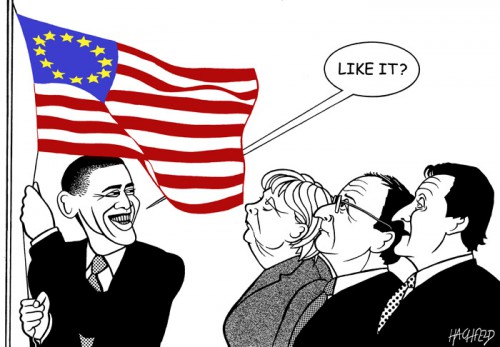
Le Grand Marché Transatlantique contre notre liberté
par Claude BOURRINET
La « crise » précipite les choses, aux deux sens du verbe : accélère leur cours, et les révèle, comme dans un tube à essai où se mélangent divers liquides. Ce qui semblait presque une vue de l’esprit il y a quelques lustres, et augures improbables dignes de Cassandre, devient redoutablement concret. Il fallait le temps que certains nœuds se défassent, que des résistances faiblissent, qu’une génération disparaisse. Les esprits n’étaient pas encore mûrs, expliquent les progressistes. Les temps sont désormais consommés, et la parousie est imminente.
La ruine et le terrorisme, les chantages à la guerre et à la misère, l’invocation de la nécessité du marché, comme jadis on expliquait les hécatombes humaines par les dieux ou le destin, pèsent comme un couvercle sur l’esprit des peuples. Les fieffés coquins nous mènent savent par le bout du nez, les partis 1 et 2, en maestros du mensonge, de la perfidie et du mépris, en tricheurs maniant avec dextérité leurs cartes, embobinent les masses, et les mènent à leur perte.
Après le putsch budgétaire européen de l’an dernier, et le basculement vers le fédéralisme ultralibéral, c’est la fusion des parties occidentales et orientales de l’Atlantique Nord qui est projetée. L’absorption de l’Europe par les États-Unis est proche, elle est pour demain, pour 2014 ou 2015. Les échéances sont fixées : dans deux ans, nous auront achevé notre temps, notre destin, notre existence, et nous n’aurons plus aucun pouvoir sur notre avenir.
Comme toujours, l’Union européenne et les États-Unis ont manigancé leur coup par-dessus les peuples. Sans qu’ils en aient été avisés, et qu’on leur ait donné la parole, on leur annoncera bientôt une libéralisation quasi totale des échanges commerciaux et financiers, et une harmonisation complète des politiques judiciaires et sécuritaires. On agitera comme il faut la presse propagandiste, on ne prendra pas le risque du référendum, les parlements voteront comme un seul traître, et l’affaire sera pliée.
Le coup est pourtant préparé de longue date. Mais en catimini. En 2004, en effet, le P.D.G. d’Unilever, président européen du Transatlantic Business Dialogue (T.A.B.D.) et son homologue américain, P.D.G. d’U.P.S., rencontraient à Dublin les présidents Bush, Prodi et le Premier ministre irlandais dont le pays assumait la présidence tournante de l’Union européenne. Il fut question de lever les « obstacles à l’intégration » dans le domaine du commerce, des investissements et de la réglementation.
Dans un autre domaine, la bonne volonté collaboratrice des bureaucrates de Bruxelles avait été jusqu’à échanger avec les services américains de sécurité les données sur les passagers empruntant les lignes transatlantiques. Sans réciprocité, bien sûr.
Le projet bloquait néanmoins, notamment au niveau des biotechnologies, des problèmes environnementaux et de ceux liés à la consommation, les normes américaines de protection et de qualité étant, comme l’on sait, très laxistes (commerce et lobbies obligent). La pression des associations et des protestataires alternatifs ont sans doute eu quelque effet sur l’opinion. Les résurgences d’une guerre commerciale plus ou moins ouverte avec les U.S.A., notamment au sujet de l’acier, mettaient aussi un frein au projet.
Mais les commissaires mondialistes Erkki Liikanen et Pascal Lamy veillaient, aidés efficacement par Elmar Brok, député européen chrétien démocrate allemand qui présidait la Commission des Affaires étrangères du Parlement. Tout ce beau monde agit par le truchement plus ou moins occulte, mais bien pourvu financièrement, du Réseau politique transatlantique (T.P.N.), un « groupe de réflexion » qui rassemblait en 2004 plus de quatre-vingt parlementaires européens et environ quarante-cinq membres du Congrès ainsi que trente-cinq entreprises géantes dont A.B.B., Daimler Chrysler, B.P., Nestlé, U.P.S., I.B.M., Boeing, Microsoft, Philips et Unilever.
À son tour, le mai 2008, le Parlement européen a prévu pour 2015 la création d’un grand marché transatlantique, avec , de facto, dans la plupart des secteurs, l’application du droit états-unien.
L’objectif est bien sûr économique, et obéit à la pensée unique ultralibérale qui domine actuellement, aux dépens des peuples. Mais il est évident que l’idéologie atlantiste des responsables politiques européens y trouve sa place, l’Union européenne s’étant systématiquement alignée sur la ligne de la diplomatie étrangère américaine, en l’appuyant et en participant, via l’O.T.A.N., à ses aventures guerrières.
L’intégration de la France au commandement intégré de l’Organisation de l’Atlantique Nord a fait sauter tous les obstacles. Le prestige français, animé par l’esprit d’indépendance gaullien, n’est plus qu’un souvenir. Pour paraphraser Tacite, comme le Sénat romain, l’élite de notre pays, comme du reste l’oligarchie de l’Europe occidentale, suivie par la partie abusée du peuple, se rue vers la servitude.
À terme, c’est une plus grande symbiose entre les politiques et les législations américaines et européennes qui va être à l’œuvre. Mais l’on ne voit pas pourquoi et comment l’hyper-puissance yankee n’imposerait pas ses normes et ses usages, dans la « protection » de l’environnement et des consommateurs, dans le domaine de la santé, au sujet du problème très sensible des O.G.M., , de la législation sur les produits chimiques. Tout cela se traduira inévitablement par une régression, à la grande satisfaction de ceux qui tentent, avec une obstination remarquable, de déréguler tous ces secteurs, sans trop de succès jusqu’à maintenant. Il est assuré que le Traité transatlantique va leur donner le sésame pour ouvrir toutes les portes, d’autant plus que ces combinaisons sont ficelées sans contrôle démocratique.
Ce traité achève donc la perte de la souveraineté de l’Europe, qui, pour autant, n’en a eu que dans l’étroite marge que lui laissait la puissance américaine. Celle des vingt-sept nations européennes a pris fin l’an dernier, par le Traité d’équilibre budgétaire européen. Or, les lois qui régissent les relations internationales sont comme celles de la nature, nonobstant l’inévitable hypocrisie inhérente à l’espèce humaine. Le plus fort impose sa volonté, que l’on essaiera d’incarner, par exemple, par l’usage obligatoire de l’anglais comme langue maternelle.
Parallèlement, la création d’un espace commun de contrôle des populations, d’une aire de coopération transatlantique en matière de « liberté de sécurité et de justice » est prévue d’ici 2014, surtout au profit de l’ultra-sécuritaire État américain, obsédé par le terrorisme et encouragé par le Military Commissions Act de 2006, qui permet de poursuivre toute personne quelle qu’elle soit, y compris non américaine, considérée comme ennemi, « combattant illégal ».
L’étape suivante sera la réalisation d’un pouvoir exécutif, qui sera institué dans les dix ans, et qui usera comme il l’entend de la force judiciaire, policière et militaire. Les peuples devront se plier. Et comme le processus de domestication ne s’effectuera pas sans réactions, il est probable que des révoltes auront lieu, sans doute violentes, avec des réponses répressives adéquates. Une ère de dictature s’annonce.
Nous sommes, nous, Français, Européens, à un tournant de notre histoire. Sera-t-il dit que nous ne savions pas, et que, quand il sera trop tard, nous n’ayons d’autre choix qu’entre la servitude et la mort ?
Claude Bourrinet
• D’abord mis en ligne sur Vox N.-R., le 2 février 2013.
Article printed from Europe Maxima: http://www.europemaxima.com
URL to article: http://www.europemaxima.com/?p=3333
00:05 Publié dans Actualité, Affaires européennes | Lien permanent | Commentaires (0) | Tags : politique internationale, atlantisme, marché transatlantique, europe, états-unis, affaires européennes, union européenne | | del.icio.us | | Digg | Facebook
Conversations with History: Robert Fisk
00:05 Publié dans Actualité, Histoire | Lien permanent | Commentaires (0) | Tags : robert fisk, histoire, entretien | | del.icio.us | | Digg | Facebook