Ex: https://atlanticcenturion.wordpress.com
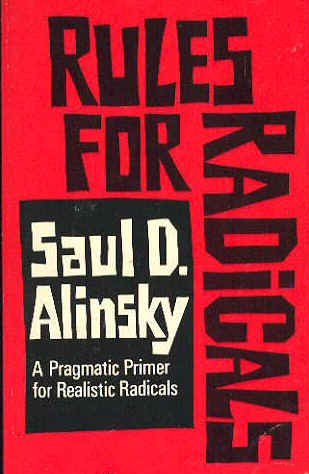 Saul Alinsky
Rules for Radicals: A Practical Primer for Realistic Radicals
New York: Random House, 1971.
Rules for Radicals is [in]famous for its purported influence, and that of author Saul Alinsky, among liberal and left-wing ideologues and politicians in the United States, including Barack Obama and Hillary Clinton. The political bent of this classic but reviled work by a community organizer from Chicago is shown on the very first page of the introduction by referencing “Joe McCarthy’s holocaust.” [It should be noted of course that declassified documents have revealed Senator McCarthy was pretty much always right about who was a bolshevik, but I digress].
The catch though is that the book isn’t particularly ideological, even if the author’s sympathies are blatantly clear and he writes from the assumption that you believe in the same things he does. What Rules for Radicals is much more interested in is how to create the most effective community organizers, and how they should communicate if they want to be effective. Think of it as far-left metapolitics manual. There is thus a heavy focus on semantics, networks, pragmatism, and presentation. Being internally honest about power and self-interest in politics, understanding your audience, and using familiar terms rather than alien highbrow concepts are all considered critical. In (((Alinsky’s))) world of hyper-realism and self-rationalizing, things like principles, morals, qualms about the means used to achieve ends, and consistency are baggage and vices, not politically expedient values.
With that in mind it isn’t hard to see why the cuckservative, muh principles crowd that dominates the Republican party seems to be losing ground in our society at every turn. They cry that liberals don’t fight fair. They have what French New Right author Guillaume Faye calls “mental AIDS,” no immune system against the aggressive ideology of their enemies, whom they grant moral hegemony to. But what they do have, if not organized defense, is what social psychologist (((Jonathan Haidt))) calls the moral foundation of sanctity—they can be disgusted by things on the basis of their violation of core values.
(((Alinsky))) knows what disgusts these people. He advises against trampling on the American flag or burning it, for example, since that drives ordinary people away from radical politics. He instead says the radical should frame the values of that flag as having been perverted by the enemy. This is all too familiar a suggestion to readers in the current year, given leftist appeals to the validity of the Constitution of all things, and the redefinition of American history as having always been a march towards the equality of all people on planet Earth: blacks and Whites, men and women, heterosexuals and deviants, legal immigrants and illegal immigrants, documented persons and undocumented persons, etc. The only thing standing in the way are those evil Republicans, who have perverted everything that Hamilton the musical is about. See how that works? A lot better than saying burn it all down—it creates the impression you’ve been robbed of something that should be yours.
The enemy of the cause must be black-and-white. (((Alinsky))) cites the Founding Fathers, who in their Declaration of Independence had not one good thing to say about the Crown, only listing its transgressions. For if one is to make an inspiring case to the people, who will have to risk everything for the cause, it had better be one that leaves no doubts about its righteousness. You can’t be concerned about how Britain provided soldiers to defend against Indian attacks or kept the sea lanes safe for commerce. Making these kinds of black-and-white arguments in and of itself is totally apolitical; they could be for either side.
One insight in particular felt very familiar to me, echoing a Hillary Clinton speech leaked during the campaign which had been privately given to a multinational bank. The Supreme Catlady spoke about needing to have a public face and a private face as a politician, something ((Alinsky))) would readily endorse. In practice, one sells two different positions to two different audiences, which is in line with the whole ends-outweigh-means thing. Of course I am for free trade and open borders. No I am not for “open borders;” that’s a right-wing smear. On that note, (((Alinsky))) says the radical must always advocate for 100% to the community he wants to organize, but as soon as negotiations begin with the powerful, take anything that moves the needle, even 30%. Say one thing and do another, as long as you are on target. That’s the utility of extremism in politics.
 Thus, (((the long march through the institutions))) has a road-map that will take it up the mountain, while pseudo-reactionary Republican stonewalling of issues—for as long as is politically required by their constituents until leftward change is a done deal—leads to nothing. There is a reason why some of Bill Clinton’s campaign speeches from 1996 sound like Donald Trump’s in 2016, and it’s because the left has succeeded into converting many Goldwater-Reagan era Republicans into 1990s’ Democrats. Homosexual marriage will soon be a conservative issue when faced with transgenderism. And the latter will in time be accepted as well on the Beltway right. (((Alinsky’s))) methods move the Overton window; cuckservatives merely follow Overton movements.
Another important (((Alinsky))) insight is that you need to have something of a “vague” vision of a better, inspiring future. At the same time, don’t become a single-issue organization. While 88-point policy plans may win over wonkish autistes, if you actually want to create a large community organized around common goals and oriented towards a common opponent, you need to go broader and less specific on the details. Consider the mental gymnastics that fiscally conservative Republicans go through to sell trickle-down economics—lower taxes on people and corporate persons who are responsible for providing employment so that they can expand operations and recruit more human capital, owing to their higher net income from reduced taxation of their business. Democrats simply run on a platform of doling out free shit to net tax recipients, including but not limited to a better economy jobs, social programs, and universal pre-kindergarten. Or they just blather about equality for 20 minutes and call it a historic speech. That’s a lot easier than talking about family values, national interest, civic virtue, trade policies, foreign affairs, etc. Just say we all deserve to be equal and my agenda is to make it happen. It’s an easy sell and no one really cares about the particulars other than critics. So, long live the ethnostate. What ethnostate? Doesn’t matter yet.
The long discussion on means versus ends is particularly useful. (((Alinsky))) talks about how people lionize Indian independence leader Mahatma Gandhi as a pacifist, but notes that pacifism was really the only means available in the first place of resisting the British at the time. He jokes that Gandhi must have noticed how Indians seemed to sit around all day in prayer or mediation, and then told them to shout slogans while they were doing it. Probably not the exact chain of events, but that is effectively what happened—multitudes of people engaging in sit-in protests. Which India banned almost immediately after independence—since those who usurp power generally, and correctly, wish to keep it and prevent the next batch of revolutionaries from unseating them in the same way they did in their predecessors. (((Alinsky))) also cites Lenin’s remarks about how the bolsheviks had to say they were for peace—well until they didn’t have to say they were for peace. In other words, the chosen means are just the most effective ways of reaching an end. If they don’t work, you don’t use them. If they stop working, you change them. And if they’ve never worked, you are doing it wrong.
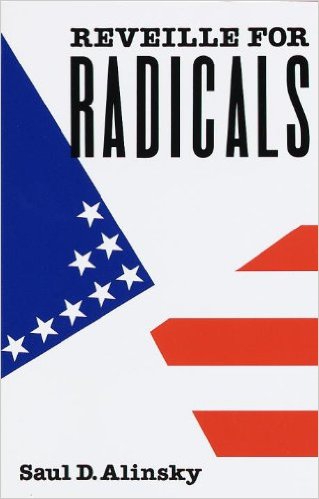 (((Alinsky))) tactics work and continue to work for the left. Whether it’s calling every opponent a racist, or framing the enemy as always being a fascist, or having no attachment to anything that doesn’t effectively further the political power of their faction, the left we are dealing with now is smarter on culture, coalition, and community outreach than movement conservatives have ever been. The left, in true (((Alinsky))) style, sees itself on the side of “angels,” while its enemies are “devils.” The Beltway right only uses the term “crusade” to refer to tax policy adjustments.
The crucial question—Why I am writing about Rules for Radicals? Simply put, the Alt-Right is a radical movement that is interested in community organizing and propaganda. (((Alinsky))) wanted to organize “Have-nots” and “Have a little, want mores” against the “Haves,” and for them to meme effectively to that end. The Alt-Right wants to organize White people against the occupation government (a globalist coalition comprised of Davos men, Hart-Celler Americans, and overseas Israelis), and for them to meme effectively to that end. Reading Rules for Radicals won’t change anything you believe ideologically, since (((Alinsky))) never really makes the case for what he believes in anyway. (Even if he did, if you are reading this you already know he is wrong). But hopefully, young radicals, you will take some lessons from it about how to better approach your task.
Probably the most important section for our purposes is the author’s drill-down of how he believes power works. He gives us 13 rules: I will attempt to give some translation:
- “Power is not only what you have, but what the enemy thinks you have.” – I have read innumerable articles in recent months from the lying press about how the GOP is full of crypto-White nationalists. Sounds good. Big if true.
- “Never go outside the expertise of your people.” – We’re not going to get most people to do things they have no habit of doing. We need to play to the strengths of our existing human resources.
- “Whenever possible, go outside the expertise of the enemy.” – This and the above rule are standard Sun Tzu; know the enemy and know yourself or else you will be defeated. We must always stay abreast of the opposition, always be more informed, and always make them look stupid.
- “Make the enemy live up to its own book of rules.” – There are two key forms of this: concern-trolling and malicious compliance. Doing so will stress them out by increasing their cognitive dissonance load, bleed them of resources, and generally waste their time and energy. You can also bait your opponents into producing specific outcomes if they are inflexible and dogmatic enough.
- “Ridicule is man’s most potent weapon.” – Most of the Alt-Right’s troll ops consist of making a mockery of things. Ditto for our memes and critiques, e.g. cuckservative. It will probably go down as one of the greatest political slurs of all time: implying that your opponent gets off to watching his country be destroyed while his wife’s son votes against him. Cuckservative captures perfectly, and ridiculously, how the target serves every interest but the national.
- “A good tactic is one your people enjoy.” – Trolling. Shitposting. Meme magick. It never gets old because there is always something new to provide a perspective on, or some new journalist to troll, or a comments section to raid, or a viral media campaign to be fought.
- “A tactic that drags on too long becomes a drag.” – I think the only area the Alt-Right sees diminishing returns on is putting out too blackpilled of a message, or being too gloom and doom. People don’t really want to hear that all the time, even when it has to be said. Things getting worse is after all part of the sales pitch as to why the Alt-Right’s solutions are necessary. On the other hand, we have to have a positive and future-oriented message to put out, and that reaches a bigger audience than commiseration.
- “Keep the pressure on. Never let up.” – I tend to think this won’t be much of a problem because there is nothing the regime can offer us that would be satisfying other than its resignation.
- “The threat is usually more terrifying than the thing itself.” – This certainly works in our favor given how (((neurotic))) the people we are engaged in holy memetic warfare with are. Even the implication of our presence somewhere or in something is enough to produce media hysteria and maelstroms of kvetching.
- “The major premise for tactics is the development of operations that will maintain a constant pressure upon the opposition.” – At the moment this is our endless streams of daily content across multiple platforms, something we should continue to scale up and diversify.
- “If you push a negative hard enough, it will push through and become a positive.” – We want to get to a point where being labeled by the establishment as a racist, sexist, or antisemite is a sign of having done something correct, being that bad people are saying it about you.
- “The price of a successful attack is a constructive alternative.” – In other words, to win you actually need an answer to the issue. It can’t just be about opposition. We must be more than reactionary.
- “Pick the target, freeze it, personalize it, and polarize it.” – This is my favorite and I think Alt-Right troll ops have done this quite well. First you get ahold of a luegenpresse journalist’s attention. Then you apply the other above tactics to him or her. Finally you get some sort of overdone reaction from them AND their supporters against you, which helps reinforce your own battle lines by showing that the issue you are up against is supported by x and x-plus, all of whom are against you. Many journalists noted during the 2016 presidential campaign that if one were of a Semitic surname (or known to follow a cult of volcanic demonology) and said something critical of Donald Trump, that he or she would be targeted and harassed on their social media or in the comments section. They began to reach out to one another about this and write about the responses they were getting, many going as far as labeling themselves with the triple parentheses symbol in solidarity. So what had basically happened was that our argument all along that overseas Israelis were uniquely opposed to nationalism in the United States was proven—by getting them to band together and admit that they were, and that they were proud about it too. See, all those people who hate Trump have (((something in common)))!
I think the Alt-Right is already in something of an unholy alliance with (((Alinsky))). That our trademark tactic is trolling while that of our enemies is banning and/or overreacting says something about how much society has been restructured since the 1960s. We’re the ones causing headaches for the regime, we’re the ones doing the culture-jamming, we’re the ones speaking on behalf of a marginalized class, we’re the ones tipping the sacred cows, and we’re the ones calling for revolutionary change. The meme war favors the offense.

 del.icio.us
 Digg
Digg Facebook
![Résonance[s]](https://yt3.ggpht.com/-sbyK2bcvcSg/AAAAAAAAAAI/AAAAAAAAAAA/hhqw5XEAKzg/s88-c-k-no-mo-rj-c0xffffff/photo.jpg)