
S. T. Joshi
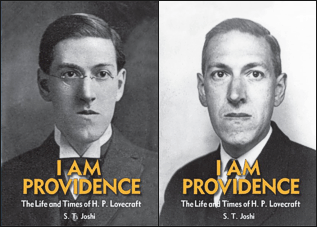
I Am Providence: The Life and Times of H. P. Lovecraft [2]
2 vols.
New York: Hippocampus Press, 2012
When it comes to a truly comprehensive biography of Howard Philip Lovecraft, one cannot do better than S. T. Joshi’s I am Providence, a 2 volume, 1,000-page, 500,000-word mammoth of a book that aims to cover everything there is to know about the American master of the weird tale.
As with Mark Finn, whose biography of Howard I reviewed recently, it would seem that L. Sprague de Camp was what spurred Joshi into action: after reading the latter’s Lovecraft: A Biography upon initial publication in 1975, Joshi dedicated his life thereafter to the study of the author from Providence. His choice of university was dictated by its holding the Lovecraft manuscript collection of the John Hay Library. And when he discovered that At the Mountains of Madness, his favourite Lovecraft story, contained no less than 1,500 textual errors, he devoted the ensuing years to tracking down and examining manuscripts and early publications in order to determine the textual history of the work and make possible a corrected edition of Lovecraft’s collected fiction, “revisions,” and other writings. What we have here, you may confidently conclude, is the product of decades of fanaticism and obsessive investigation.
Lovecraft was born in 1890, into a conservative upper middle class family, in Providence, Rhode Island. His father, Winfield, was a travelling salesman, employed by Gorham & Co., Silversmiths, and his mother, Sarah, could trace her ancestry back to the arrival of George Phillips to Massachusetts in 1630. His parents married in their thirties.
The young Lovecraft was talented, intellectually curious, and precocious, able to recite poetry by age two, and to read by age three. Growing up at a time when school was not compulsory, Lovecraft would not be enrolled in one until he was eight years of age and his attendance would be sporadic, possibly due to a nervous complaint and / or psychosomatic condition. But he was well ahead of his coevals in any event, having been exposed, and thereafter enjoyed ready access, to the best of classical and English literature. From Lovecraft’s perspective, this meant 17th and early 18th century prose and poetry, and, indeed, so steeped was he in the canonical literature from this period that he regarded its style of writing not only the finest ever achieved, but, for him, the norm. In the process, he also absorbed some of the archaic tastes and sensibilities permeating this literature, which would subsequently be reflected in his writing, speech, and attitudes, fundamentally aristocratic and at odds with the 20th century. What is more, Lovecraft was never denied anything he may have needed in the pursuit of his intellectual development, be it a chemistry set, a telescope, or printing equipment, so he became knowledgeable enough on these topics, and particularly his passion, astronomy, to contribute articles to a local publication from an early age. He also regularly produced—while still in infancy—his own amateur scientific journals, many of which still survive and were personally examined by Joshi for this biography. Thus, from early on, Lovecraft, a somewhat lonely boy with a charmed boyhood, was committed to a life entirely of the mind.
With such beginnings, it would appear to a casual observer that Lovecraft was well-equipped to become a success in life. But, instead, in adulthood he experienced ever-worsening poverty, squalor, and, though well known for a period within the specialised milieu of amateur publishing, growing professional obscurity. That his legacy has endured owes—besides to the intrinsic value of his works—perhaps in a not insignificant measure to his having been a prodigous correspondent: it has been estimated that throughout the course of his life Lovecraft may have written as many as 100,000 letters (only about 20,000 of which survive), and these were not hastily penned missives, as can be seen in the many excerpts herein presented, but thoughtful communications, sometimes of up to 30 pages in length, which are works of literatue in themselves.
In examining his overall trajectory, we can identify a number of negative vectors early on. The loss of his father, who, following a psychotic episode and permanent committal to a local hospital, suffering from what Joshi presumes to have been syphilis, meant that, from 1893, Lovecraft passed into the care of his mother, aunts, and his maternal grandfather. Whipple van Buren Phillips, a wealthy businessman, proved a positive influence, but died in 1904, and, his estate being poorly managed, this eventually forced the family to downsize. This badly affected the young Lovecraft, to the point that he briefly contemplated suicide. He was eventually dissuaded by his own intellectual curiosity and love of learning.
In 1908, just prior to his high school graduation, Lovecraft suffered a nervous breakdown. Joshi speculates that failure to master higher mathematics may have been a factor, since Lovecraft’s ambition was to become a professional astronomer. (Failure to master meant not getting straight As, but, among the As, a few A-s and Bs.) Whatever its cause, the breakdown prevented Lovecraft from obtaining his diploma, a fact he would later conceal or minimise. Lovecraft then went into seclusion—hikikomori, as it would be called today—in which condition he remained for five years, mostly reading and writing poetry. Joshi expresses alarm at the sheer volume of reading undertaken by Lovecraft during this period, a large portion of it consisting of magazines.
Lovecraft’s re-emergence owes to his irritation with a pulp author, Fred Jackson, whose stories in Argosy magazine he found maudlin, mediocre, and irritating. His letter was published in the magazine, whereby it detonated an opinionated debate. When Lovecraft’s expressed view led to attacks, he responded in lofty and witty verse, thus instigating a months-long war—in archaic rhyme—in the letters’ page. This got him noticed by the president of the United Amateur Press Association (UAPA), Edward F. Daas, who invited Lovecraft to join. This inaugurated Lovecraft’s amateur career, which led to his return to fiction—something he had dabbled in years before—and, by 1919, to his first commerically published work. During his early years in amateurdom, Lovecraft would also produce his own literary journal, The Conservative, a publication that truly lived up to its name and that has only recently been reprinted by Arktos in unabridged form.
Throughout this period Lovecraft continued to live with his mother, who sustained them both off an ever-shrinking inheritance. Trapped between the expectations of her class and dwindling resources, she grew progressively more neurotic and unstable. She already had an unheathily close, love-hate, relationship with her son, and Joshi records that she considered her son’s visage too ugly for public view. By 1919, suffering from hysteria and clinical depression, she would be committed to hospital, where she would remain for the rest of her days. Mother and son stayed close correspondents, but she was a perennial source of worry. Thus, when Sarah died in 1921, initial grief led to a sense of liberation, and an improvement in Lovecraft’s general health—though he, at this time a tall man of nearly 200 lbs, always regarded himself as ailing.
Yet there were further turns to the worst ahead. In 1921, at a convention for amateur journalists in Boston, Lovecraft met Sonia Green, an assimilated 38-year-old Ukrainian Jew from New York, whom he would marry in 1924. Interestingly, Lovecraft only told his aunt after the fact, writing to her from New York, where he had by then already taken residence at Sonia’s apartment.
Joshi notes that at this time Lovecraft’s prospects appeared to be improving: Sonia earned a good living at a hat shop in Fifth Avenue, and Lovecraft’s professional writing career was taking off. Lovecraft, then in a decadent phase, was also enthralled by the city, where he had a number of amateur friends. However, Sonia lost her job almost immediately when the shop went bankrupt. This forced Lovecraft for the first time to find regular employment, but without qualifications, work experience, nor, apparently, marketable skills, he was unable to find a position. The consequent financial difficulties impacted on Sonia’s health, who entered a sanatorium for a period of recovery. Eventually, she would find a job in Cleveland, leaving Lovecraft to live on his own, in a tiny apartment, in Brooklyn Heights (then Red Hook), back then a seedy neighbourhood. Sonia sent him an allowance, which permitted him to cover his rent and minimal expenses, but otherwise Lovecraft lived in poverty, stretching as far as possible a minuscule fare of unheated beans, bread, and cheese.
This was, however, genteel poverty. When, on one occasion, Lovecraft’s apartment was burglarised, he was left with only the clothes on his back (while he slept, the thieves gained access to his closet and stole all his suits). His reaction says much about Lovecraft: first priority for him was to get four new replacements: light and dark, winter and summer—no easy task, given his slender wallet. A gentleman may be poor, but he must still dress like a gentleman! The ensuing hunt for suitable attire taxed Lovecraft’s ingenuity, and ignited his frustration at the shoddy quality of modern suits (Lovecraft’s original suits had been made in happier times). Eventually, he succeeded, with minimal compromise.
Seething with immigrants of all descriptions, crowded, and filthy, Lovecraft came to despise New York, recognising it as an emblem of modern degeneration (remember: he already thought this in 1925!). This negative opinion does not sit well with Joshi: having immigrated from India at a young age and having been a New York resident for 27 years, Joshi puts Lovecraft through the wringer for failing to appreciate the city’s vibrancy. Here and elsewhere, he attacks Lovecraft for his enamourment with Anglo-Saxondom, his fierce resistance to racial egalitarianism, and his rejection of the multicultural society. In Joshi’s estimation, Lovecraft ought to have considered Franz Boas’ research, which was beginning to transform anthropology at this time; Joshi views this as contrary to Lovecraft’s rigorous scientific outlook—in other words, as Lovecraft having been blinded by prejudice. However, this overlooks the fact that there were different strands of opinion in anthropology at this time: this was the Progressive Era, when the American eugenics movement was at its height, enjoying institutional legitimacy, famous proponents (e.g. John Harvey Kellogg), and backing from the likes of the Rockefeller Foundation, the Carnegie Institution, and the the Harriman estate. Boas’ findings were politically motivated and not universally accepted, and he had by no means proven his case. (Worse still, since then there have been accusations of scientific fraud.) It would, therefore, seem that Lovecraft was entirely consequent with his aristocratic and scientific worldview.
Though Joshi deems it necessary to shoehorn his views on race and racism—zzz . . . —he shows admirable restraint, all things considered—though he has still been criticised by readers. He clearly struggles to reconcile his admiration for Lovecraft with an imagined rejection by him, which is coloured by the absurdities of the modern discourse on these matters. As the author of The Angry Right: Why Conservatives Keep Getting it Wrong (2006), where he invects against liberals like William Buckley and Rush Limbaugh, and where he welcomes the Leftward drift of American values, he can understand Lovecraft’s own merely as a reflection of the times in which he lived. Yet, Joshi has expended an immense amount of time and energy studying and writing about Lovecraft’s thought and worldview, as expressed both in correspondence and in fiction, and thus makes a fair attempt at describing them at length in a temperate fashion.
Lovecraft would eventually return to Providence, thus marking the beginning of the most productive phase of his career. By this time his marriage to Sonia was essentially over; a final attempt was made, but Lovecraft’s aunts rejected the idea of Sonia setting up shop in Providence, regarding her—or rather, the idea of a businesswoman—as somewhat declassé. Joshi again takes Lovecraft to task for not having shown more backbone before his aunts, but he is, nevertheless, of the opinion that Lovecraft was unsuited for marriage—being emotionally distant, stiff-upper lipped, and sexually sluggish—and ought never to have taken a wife. The Lovecrafts would in time agree on an amicable divorce (though, in the end, and to Sonia’s shock later on, he never signed the decree).
Despite his peaking productivity, Lovecraft’s economic prospects continued to decline. His stories became longer and more complex, and it became increasingly difficult to place them. Farnsworth Wright, Weird Tales’ capricious editor, repeatedly rejected them, though sometimes he would accept some after a period, after lobbying or intercession by one of Lovecraft’s correspondents. His seminal essay on horror fiction, Supernatural Horror in Literature [3], completed at this time, appeared haphazardly and incompletely in tiny amateur publications, and would never appear in its final, revised, complete form during his lifetime. Therefore, Lovecraft, now living in semi-squalor with his aunt in cramped accommodation, was increasingly forced to survive through charging for “revisions,” which, given the amount of hands-on editing and re-writing involved, was for the most part tantamount to ghostwriting. Lovecraft was too much of a gentleman, too generous for his own good, and charged very modest fees. We must remember, however, that Lovecraft, in this same modest spirit, saw himself as a hack.
All the same, through extreme frugality and resourcefulness, Lovecraft still managed to travel yearly around New England, mainly as an antiquary. This resulted in extensive travelogues, written in 18th-century prose, replete with archaisms and therefore neither publishable nor intended for publication. Joshi mentions that some have criticised Lovecraft for expending excessive energy on correspondence and unpublishable travelogues, rather than writing fiction, but he argues that this was Lovecraft’s life, not his critics’—who are they to tell him, posthumously, what he ought to have done?
Joshi notes that the Great Depression forced Lovecraft to reconsider some of his earlier positions, and that he—encouragingly in his view—embraced FDR’s New Deal. He also notes, although briefly, that Lovecraft may have misunderstood the nature of the program. All the same, he likes to describe Lovecraft as having become a “moderate socialist,” even if he is later careful to point out that his socialism was radically distinct from the Marxist conception—in fact, Lovecraft instinctively sympathised with fascism and Hitler’s movement, and would remain firmly opposed to Communism. Lovecraft’s conception of socialism was entirely elitist. From his perspective, the culture-bearing stratum of a civilisation should not, in an ideal world, be shackled by the need to waste time and energy on trivial tasks, out of the need to earn a living: the production of high culture is often incompatible with commercial goals, so, in his view, it demands freedom from economic activity. And this implied some sort of patronage, in the manner that kings, popes, or wealthy aristocrats or businessmen provided to artists in the past. In other words, a portion of the nation’s wealth should be channelled into things of lasting value—and, therefore, into seeing to it that the very few individuals capable of producing them are in a position to do so. Lovecraft conceived this as socialism because he saw it as the task of the best to better the rest, and high art and intellection played an important rôle in that endeavour.
By 1936, Lovecraft, already in constant pain, was diagnosed with bowel cancer. He would die a few months later, on 15 March 1937.
As with Finn’s biography of Robert E. Howard, Joshi carries on beyond the grave to trace Lovecraft’s legacy, and the development of Lovecraft scholarship over the past 75 years. Like Finn, he has complaints about L. Sprague de Camp’s biography, which he deems substandard and inaccurate; he describes de Camp as business-minded (a euphemism for opportunist). Joshi also criticises August Derleth, one of Lovecraft’s correspondents, who acted early on and energetically to preserve Lovecraft’s legacy through his publishing company, Arkham House: as de Camp did with Howard, Derleth sought to extend Lovecraft’s mythology with posthumous “collaborations,” wherein he distorted the mythology by infusing it with his own preconceptions. To Joshi this was a disreputable attempt to market his own fiction using Lovecraft’s name, though Derleth would later become a well-regarded author in his own right.
While Joshi’s biography is impressive in its comprehensiveness and level of detail, I found his compulsion to provide a plot summary of every single story that Lovecraft ever wrote rather tedious and beyond requirements. One can see that the biography’s comprehensive logic dictates their inclusion, and they can be useful, but I wonder if the tomes’ objectives could not have been met without this overwhelming prolixity.
Joshi recognises his subject’s superior character in that, though Lovecraft would have been able to prosper economically had he compromised on quality, produced more, and stuck to what was popular, he remained steadfast in his refusal to do so. Whatever he did, he did to the best of his ability, without homage to Mammon. Readers, says Joshi, should be grateful for that, as it was this that has guaranteed the lasting value of Lovecraft’s work as well as his enduring legacy.





 del.icio.us
 Digg
Digg Facebook
 Ces peuplades qui parlent une langue iranienne apparaissent dans le bas-Empire romain sous le nom de Sarmates quand ils sont alliés ou federati et de Scythes quand ils sont ennemis. Envahisseurs, ils sont connus sous le nom d’Alains alliés des Vandales.