Ok

En poursuivant votre navigation sur ce site, vous acceptez l'utilisation de cookies. Ces derniers assurent le bon fonctionnement de nos services. En savoir plus.

jeudi, 08 mai 2014

A US & Filipino Front Vs. China

Author: Ulson Gunnar

A US & Filipino Front Vs. China

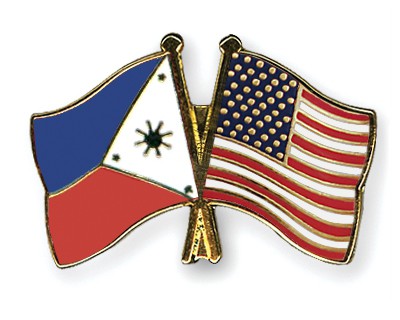
Flag-Pins-Philippines-USA.jpgThe reversal of longstanding policy preventing the US from using Filipino territory for military bases signifies and escalation in tensions between the United States and China, as well as exposes the true nature of the US “pivot” toward Asia. 

The Guardian in its article, “Philippines agrees to 10-year pact allowing US military presence,” states that, “the United States and the Philippines have reached a 10-year pact that would allow a larger US military presence in this south-east Asian nation as it grapples with increasingly tense territorial disputes with China, White House officials said on Sunday.” The article would go on to claim that the move seeks to “deter China’s increasingly assertive stance in disputed territories” but that it could “encourage China to intensify its massive military buildup.”  

For many geopolitical analysts, the move comes as no surprise. The “pivot” toward Asia, while promoted as America’s attempt to reengage in the region diplomatically, was in fact nothing more than an attempt for the US to reassert itself as a hegemonic power against a rising China. The encirclement of China with a bloc of pro-Western Southeast Asian regimes has been the cornerstone of US policy in Asia for decades. 
 
Containing China: America’s Ongoing Project 

As early as 1997, US policy makers were articulating a means of containing China’s rise. One such policy maker, Robert Kagan, stated in his 1997 op-ed, “What China Knows That We Don’t: The Case for a New Strategy of Containment,” that, “the choice we face is not between containment and engagement, but between an ineffective, unconscious, and therefore dangerous containment — which is what we have now — and a conscious and consistent containment that effectively deters and ultimately does change China.”
 
Kagan and other US policy makers’ desire to “change China,” includes the political reordering of the country within through covert subversion and the fueling of violent separate movements along its peripheries, as well as the military encirclement of China abroad. The recent pact between the Philippines and the US, giving American military might a new foothold in the Pacific, represents one of many attempts to encircle China. 
 
To understand this encirclement deeper, one must read through the 2006 US Army War College Strategic Studies Institute’s report titled, “String of Pearls: Meeting the Challenge of China’s Rising Power Across the Asian Littoral.” The 36 page report details the geopolitical and strategic background within which this latest pact between the Philippines and the US was signed.
 

The report states specifically that, “the United States should expect countries like Pakistan, Myanmar, Cambodia, and Vietnam to welcome overtures from China. Even America’s staunchest regional allies—Japan, South Korea, Australia, and the Philippines, for example—increasingly find it in their self-interest to improve ties with China. The United States also should expect occasional expressions of reticence over U.S. military presence throughout the region. This will not necessarily indicate a diminished friendship with America; rather it is a symptom of the perception that a peaceful region does not require U.S. military presence.”  

 
The report continues by stating (emphasis added), “this perception is a fallacy, however, since security is illusory. The United States can accommodate military sensitivities with a less visible presence or reduced footprint, but America cannot afford to abandon its military commitments in Asia. In the event China chose to pursue a more aggressive course, by seeking hegemony along the “String of Pearls,” the challenge to the United States could not be ignored. In the interim, even as nations delicately balance their relationships with United States and China in pursuit of their own self-interest, America needs to keep her alliances in good stead while encouraging China’s further participation in the international system as a responsible stakeholder.”
 
The incremental creep of US military forces back into the Philippines after they withdrew decades ago, signifies America keeping “her alliances in good stead.” Of course, this “international system” or “order,” the report refers to was described by Robert Kagan in his 1997 piece as serving “the needs of the United States and its allies, which constructed it.” In other words, this “system” or “order” within which the US would like China to submit, is a euphemism for US hegemony. 
 
US-Philippines Military Pact is an Empty, Unnecessary Provocation 
 
While the US and the government in Manila will attempt to sell the recent military pact as a means of maintaining peace and stability throughout the region, it is in fact going to do precisely the opposite. It is an adversarial policy aimed at pressuring and provoking Beijing, and in particular to undermine the perceived strength of China both at home and across the region. 
 
While analysts believe China will increase its military budget to counter the move, Beijing will likely only do so to a point. The threat to China and its interests by these new US forces is negligible. The US has neither the resources nor the political will to wage any war, anywhere, let alone with a nuclear-armed China and its billion plus population. Should China expend a disproportionate amount of resources toward its military, it may do so at the expense of domestic socioeconomic development, and give the US an opportunity to sow the seeds of dissent across its population. Subversion, unlike an external military threat, is still a cause for concern in Beijing. 
 
For the Philippines, its population must ask the sitting government what benefit such a pact extends to their nation’s prosperity and future. Allowing the island nation to be used as a proxy belligerent in America’s quest for hegemony is done so at the expense of its political ties and future with an increasingly influential China, its budget that will be surely redirected from domestic develop and toward a military build-up, and all the consequences of hosting American troops that made it necessary to prohibit them years ago in the first place.  

Over the next 10 years, the US will be using the Philippines to provoke and harass Chinese ambitions in the Pacific. Within these 10 years, irrevocable damage may be done between the Philippines and China, between their cultures and economies. As the US has done elsewhere, when it has achieved its goals, it will discard Manila and any responsibility for what it has done. For the sake of slaking intentionally drummed up nationalist fervor across the Philippines today, the Filipino people may end up paying for years well into the future. 

Ulson Gunnar is a New York-based geopolitical analyst and writer especially for the online magazine “New Eastern Outlook

The Philanthropic Superpower

If a single word could sum up the goal of Barack Obama’s Asia tour, it would be “reassurance.”

Obama went to Tokyo to reassure Japan that, should China attempt to seize its Senkaku Islands, America will fight at her side.

He reassured Seoul of our commitment to defend South Korea.

He went to Manila to reassure the Filipinos, who threw our Navy out of Subic Bay at the end of the Cold War, that America will be there in any clash with Beijing in the South China Sea.

Yet, as Clyde Prestowitz writes in the Financial Times, while we are committed to go to war to defend all three countries if attacked, none of them is obligated to go to war if we are attacked.

What Tokyo, Seoul and Manila get out of their alliances with the United States is easy to see — the security of a superpower’s pledge to come and fight their wars for them.

But what do we get out of these commitments, other than an obligation to go to war with a nuclear-armed China or North Korea over shoals, rocks and borders on the other side of the world that have nothing to do with the peace or security of the United States?

Saudis, Turks and Israelis are angry because Obama backed down from his “red line” warning to Bashar Assad, when Syria’s army allegedly used chemical weapons.

They were all counting on the United States to attack their enemy, Syria, and we let them down. Now after the red line fiasco and the U.S. failure to stop Vladimir Putin from annexing Crimea, our allies want reassurances that we will not fail in our obligations again.

But if Assad’s alleged use of sarin or chlorine is a moral outrage, why did his neighbors not punish him themselves?

Why is this America’s duty? Why is Syria America’s war?

Historically, great powers and empires exact tribute, exploit colonies, and demand conscripts of their protectorates.

America is something new in the way of world powers. We not only provide the legions to protect “allies,” but provide the tribute in the form of foreign aid, IMF and World Bank loans, and bailout billions.

Moreover, America has thrown open her home market, largest in the world at $17 trillion, to Europe, Japan, Canada, Mexico, and even China, and invited them to come and capture it from our manufacturers.

In a quarter century, these trade partners have run up $10 trillion in trade surpluses at our expense, eviscerating our industrial base to where Detroit looks like Dresden in 1945.

But while we preach free trade our partners practice protectionism.

The Chinese undervalue their currency to keep imports low and exports high. We are too timid to confront them. The Europeans put value-added taxes on imports from the USA, and rebate the VAT on exports to the USA.

The Japanese, who look on trade as a form of warfare, killed our TV industry and now own huge slices of our auto market.

Last year, Tokyo ran a $60 billion trade surplus at our expense. After our trade deal with South Korea, Seoul’s trade surplus at our expense shot up 25 percent to a record $20 billion. China ran a $318 billion trade surplus with us in 2013, up from $313 billion in 2012.

Our trade deficits finance both the growth of our allies and our adversaries.

For Beijing has used its hoard of dollars from trade surpluses with the U.S. to finance the military buildup that threatens us and our allies, whom Obama pledges to defend against China, with the lives of our soldiers, sailors, airmen and Marines.

Does this make sense?

We pay three-fourths of the cost of defending NATO Europe.

But why is the defense of Europe seemingly more important to us than to the Europeans themselves?

The EU is as rich as America. Why were U.S. F-16s and U.S. troops sent to the Baltics and Poland, and U.S. warships to the Black Sea? Russians occupying buildings in Luhansk and Donetsk are no threat to America.

Where are the French and German troops in Estonia, Latvia, Lithuania and Poland?

Neither China nor Russia nor Iran nor Syria threatens us. Yet, we are constantly goaded by allies to confront them for reasons that have virtually nothing to do with our security and almost everything to do with their agendas.

This role of philanthropic superpower is simply not sustainable.

A Wall Street Journal/NBC Poll reveals that while only 19 percent of Americans want this country more active in world affairs, 47 percent want it to become less active. This confirms a Pew poll where 53 percent of Americans said the United States “should mind its own business internationally.”

As China’s military power grows, and U.S. armed forces shrink, our allies had best prepare for the day, not too distant, when America decides she will no longer play the philanthropic superpower, and gives up the role and goes home.

As all world powers eventually do.

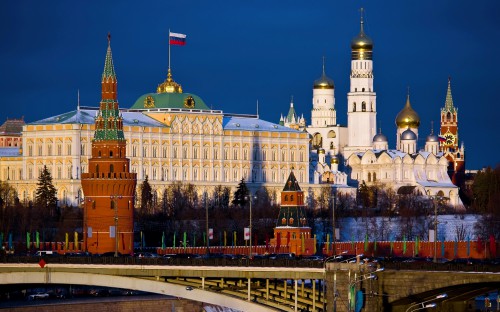
La Russie va instaurer "une politique culturelle d'État" pour se protéger de l'Occident

28372_russia.jpg

La Russie va instaurer "une politique culturelle d'État" pour se protéger de l'Occident

Le HuffPost/AFP

Ex: http://www.huffingtonpost.fr

Les autorités russes travaillent sur une nouvelle politique culturelle fondée sur les valeurs démarquant la Russie de l'Occident, un projet, en pleine crise sur l'Ukraine, que des observateurs dénoncent comme rappelant l'époque soviétique.

Et ce, alors que le président Vladimir Poutine a estimé samedi 19 avril que "rien n'empêchait" la normalisation des relations le pays et le reste de la communauté internationale, qui traversent leur pire crise depuis la Guerre froide en raison de la situation en Ukraine. "Cela ne dépend pas de nous. Ou pas seulement de nous. Cela dépend de nos partenaires".

Cette nouvelle politique, dont la rédaction revient au ministère de la Culture, se base sur la thèse que "la Russie n'est pas l'Europe" et s'appuie sur de nombreuses citations des discours de Vladimir Poutine. Depuis son arrivée au pouvoir en 2000, le président se pose en homme fort du pays et en héraut du patriotisme russe.

Lors de sa séance de questions-réponses télévisées jeudi, il a consacré une longue tirade à "l'homme russe". "Un Russe, ou plutôt une personne appartenant au monde russe, pense d'abord et avant tout qu'un homme a une haute destinée morale. Les valeurs occidentales sont (à l'inverse) que la réussite se mesure à la réussite personnelle", a-t-il dit.

"La Russie sera peut-être le dernier gardien de la culture et des valeurs européennes"

Selon une première version du texte du ministère, révélée dans la presse, la Russie est à la croisée des chemins et doit faire un choix entre l'extinction culturelle et la sauvegarde de ses "fondements moraux et spirituels". La solution, "une politique culturelle d'Etat".

Le document est entre les mains d'un groupe de travail du Kremlin présidé par l'un des plus proches appuis de Vladimir Poutine, son chef de cabinet Sergueï Ivanov, un ancien agent du KGB récemment mis sur liste noire par les Etats-Unis.

Dans une interview au journal Kommersant, le ministre de la Culture, Vladimir Medinski a souligné que la Russie devait "protéger" sa culture des errements, selon, lui, de la culture contemporaine européenne.

"La Russie sera peut-être l'un des derniers gardiens de la culture européenne, des valeurs chrétiennes et de la véritable civilisation européenne", a-t-il affirmé.

L'Occident est le diable

Experts et universitaires dénoncent le projet. "L'idée principale, c'est que nous devons nous défendre de l'Occident, que l'Occident est le diable", résume l'analyste politique Alexeï Makarkine.

"Les événements en Crimée (péninsule ukrainienne rattachée en mars à la Russie, ndlr) ont renforcé la tendance" déjà visible ces dernières années, poursuit-il.

Il cite pour exemple la loi adoptée en 2012 pour obliger les ONG bénéficiant de financements étrangers et ayant une "activité politique" à s'enregistrer comme "agent de l'étranger".

A l'époque stalinienne, le terme était appliqué aux opposants réels ou supposés du régime, qui étaient alors fusillés ou envoyés dans les camps. Il était aussi employé par les autorités soviétiques dans les années 1970 et 1980 à l'égard des dissidents, accusés d'être à la solde de l'Occident.

"Idéologie d'Etat"

"Nous vivions ainsi à l'époque soviétique. C'était apprécié par les conservateurs, ceux qui voulaient un monde confortable, hermétique sans choses irritantes comme l'art abstrait", poursuit l'analyste.

De leur côté, 25 professeurs de l'Académie des Sciences ont rejeté dans une lettre ouverte le concept d'une Russie étrangère à l'Europe. Accusant le texte et son "idéologie d'Etat" de violer la Constitution russe, les professeurs ont regretté que le gouvernement, plutôt que de financer la recherche et favoriser les débats, ne préfère imposer une vision étrangère à l'histoire.

Le ministre de la Culture a tenté mercredi de calmer le jeu lors d'une conférence de presse. La nouvelle politique culturelle sera mise en oeuvre par des experts et des personnalités respectées du monde de la culture, a affirmé Medinski.

Un expert, membre d'un jury d'attribution de bourses d'Etat aux artistes, s'est voulu rassurant, estimant qu'il pourrait prendre ses décisions en ne s'appuyant que sur des critères artistiques. "Nous sommes des personnes indépendantes et réputées, pas une unité militaire", a dit cet expert, Edouard Boïakov.

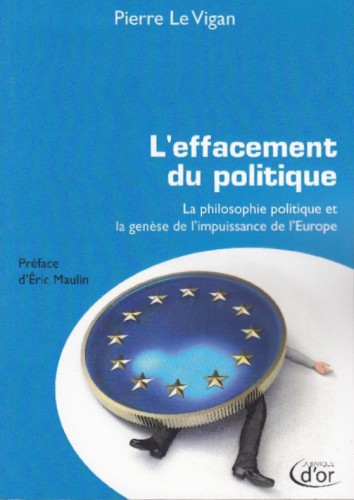
L'effacement du politique...

L'effacement du politique...

Pierre Le Vigan vient de publier aux éditions de La Barque d'or L'effacement du politique - La philosophie politique et la genèse de l'impuissance de l'Europe. Collaborateur des revues Eléments, Krisis et Le Spectacle du monde, Pierre Le Vigan a notamment publié Inventaire de la modernité avant liquidation (Avatar, 2007), Le Front du Cachalot (Dualpha, 2009) La banlieue contre la ville (La Barque d'Or, 2011), Écrire contre la modernité (La Barque d'Or, 2012) et Chronique des temps modernes (La Barque d'Or, 2014).

Le livre peut être commandé à l'adresse suivante, pour la somme de 19 euros, port compris :

Editions La Barque d'Or

12 rue Léon Blum

94600 Choisy le Roi


Effacement du politique.jpg

" « Le politique est une instance, il lui faut une substance.»

« Dans l'Europe actuelle, l'unique a été privilégié sur le commun (ainsi pour la monnaie). Pire, l'unique a tué le commun.»

«Faut-il choisir le retour à nos vieilles nations contre l'Europe ? Cela ne parait pas durablement possible. Qui peut penser que nos nations soient à l'échelle des grands empires du monde : USA, Chine, Inde, Brésil... ? Faut-il alors construire une nation européenne, l'équivalent de nos vielles nations mais à l'échelle de l'Europe ? Interrogeons-nous. Si le volontarisme est nécessaire, est-il toujours suffisant ? Peut-on en quelques décennies refaire le processus de construction des nations qui s'est étalé sur plusieurs siècles ? Il faut sans doute faire une Europe politique mais pas comme une «supernation». Comme autre chose. Et c'est là qu'il faut certainement recourir à l'idée d'Empire. La repenser comme notre nouvelle chose commune. Faire revivre une idée à la fois très ancienne et très neuve ? » "

China’s Presence in Latin America

amlat.jpg

Nil NIKANDROV
Strategic-Culture.org

China’s Presence in Latin America: Strategy of Gradual Squeezing US Out

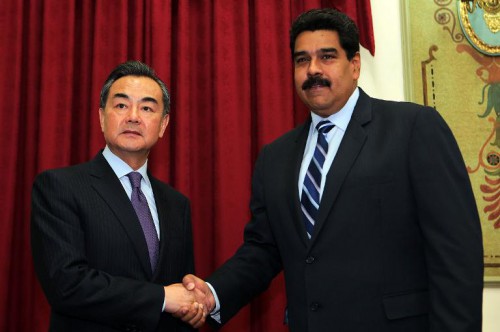
The United States keeps on getting mired in the quagmire of Ukraine’s crisis. Meanwhile China is intensifying diplomatic efforts in Latin America. Chinese Foreign Minister Wang Yi has just wound up his Latin America trip. He has visited Cuba, Venezuela, Argentina and Brazil. China’s top leader Xi Jinping is to tour the region in July.

Beijing boasts the relations of strategic partnership with Havana, Caracas, Buenos Aires and Brasilia. That’s what Wang Yi talked about while meeting Raul Castro, Nicolas Maduro, Cristina Fernandez and Dilma Rousseff. Without any exaggeration he was greeted with outspread arms. In recent years, China has significantly strengthened its presence in the region. Many of the states situated to the south of Rio Grande see dynamic trade and investments coming from China as an important contribution into reduction of dependence on the United States with its annoying incessant rebukes and off-handed interference telling everybody what to do. Latin Americans want close cooperation with the Celestial Empire, the state which boasts rapid progress and looking confidently into the future to become a world leader in the multipolar world. 

According to plans, the Chairman Xi Jinping’s visit to Brazil will coincide with the announcement of establishing the joint ministerial-level forum with the Community of Latin American and Caribbean States (CELAC), a platform for promoting their comprehensive cooperative partnership, which features equality, mutual benefit and common development, so as to better safeguard their common interests and promote world and regional peace, stability and development. The initiative is unanimously approved by CELAC member-states. The idea of close friendship with China is attractive. The state is nearing a super power status and is involved in hundreds of joint energy, infrastructure, communications, agriculture, science and high-tech projects. The leaders of China, Brazil, Cuba, Ecuador, Costa Rica and Saint Vincent and the Grenadines will be present at the ceremony devoted to the Forum’s establishment. By the end of 2014 the first ministerial China-CELAC working meeting is scheduled to take place. 

The Wan Yi’s visit was mainly focused on practical issues. The special development zone in Mariel, a Cuban port, which is being built with financial support from China, was an issue of special importance. That megaproject under construction 45 km west of Havana is to become a pillar of Cuban development due to the geographic location of the port, remodeled to equip the terminal to receive deeper-draft ships. The project will also attract investment in biotechnology, the pharmaceutical industry, renewable energy, agribusiness, tourism and real estate. Attracting foreign investments is an important contribution into the modernization of the whole country. In Venezuela the parties discussed the diversification of oil and gas sector and the expansion of the welfare program aimed at providing social housing. In Brazil the communications protection of the host country and the states of UNASUR (the Union of South America Nations), especially from interference of US NSA and CIA, was added to the agenda. The Brazil-US relationship has greatly deteriorated following the revelations of Edward Snowden. Washington has never clearly said it was sorry for spying on the country’s leadership, including President Dilma Rousseff. The news about the United States activities made many Brazilians see the reality as it is putting an end to fantasies about equal partnership. 

Many media reported that during his trip Wan Yi discussed the agenda of the sixth summit of BRICS countries with his Brazilian counterpart Brazilian Foreign Minister Luiz Alberto Figueiredo Machado. The group leaders’ meeting is to take place in the Brazilian city of Fortaleza on July 15-17. An announcement of launching a joint development bank with authorized capital stock of $50 billion is expected with great hope. But any signs of constructive steps taken by BRICS are an irritant for the United States. President Obama has failed to establish good relations with the group and Washington has no leverage to influence the organization’s activities. 

The recent example is the United Nations General Assembly’s vote on Crimea in March with four out of five BRICS members abstaining. Every BRICS member has its own reasons not to trust the Obama’s administration expecting it to resort to pressure instead of engaging in a dialogue of equals. 

China has never had any illusions on the account of the North American “partners”. The Asia pivot announced by the United States is seen in China as an attempt to cut it off from the world. South Korea, Japan, the Philippines, Malaysia and some other countries are sided with the USA. The recent news from the “anti-China” front is the planned agreement between the United States and the Philippines on US military installations to be deployed in this country for the initial term of 10 years. Of course, China takes appropriate measures in response to boost its defensive potential. 

China believes in the expediency of BRICS expansion to counter the West’s financial dominance implemented with the help of the World Bank and the International Monetary Fund. The group set before itself some strategic goals like gradual distancing for the dollar and creating safe cushions against financial turmoil. China supports the Russia’s approach based on the BRICS “transformation from a dialogue forum into a full-fledged mechanism of strategic interaction.” 

As of December 2013, China was the Latin American third largest trade partner. The trade turnover is on the rise in 2014. China has become the leading consumer of the continent’s minerals causing Washington’s concern. It imports oil, iron, copper, soya and consumer goods. The China’s clout grew significantly as a result of the establishment of the Bolivarian Alliance for the Americas (ALBA) in 2004. The organization is a brainchild of Fidel Castro and Hugo Chavez created to counter the US-led free trade zone concept. 

The US has lost its financial might struggling for world leadership and involved in overseas wars. To large extent China has taken its place… In 2013 the total amount of China’s investments almost reached $17 billion. It has become the leading trade partner of many states in the region, including Brazil. Only in the period of 2005-2011 Latin America received over 75 billion dollars from Chinese banks. Mainly the money was spent on transport, telecommunications, mine industry and energy projects. 

One of the reasons China gives money to Latin American states is to prevent pro-US politicians coming to power. Beijing is interested in preserving social peace in the countries led by left-wing governments. This issue was constantly kept in focus during the Wang Yi’s Latin American tour. Venezuela, Ecuador, Bolivia and some other states are getting more threatened by subversive activities of American special services. The financial support they get from China becomes an important factor of regional stability. 


Republishing is welcomed with reference to Strategic Culture Foundation on-line journal www.strategic-culture.org.