


vendredi, 04 mai 2012
Sarkozy ou la diplomatie de l'éléphant / Interview du journaliste Gilles Delafon par Pascal Boniface

Sarkozy ou la diplomatie de l'éléphant
Interview du journaliste Gilles Delafon par Pascal Boniface
Révélatrice des lacunes des différents prétendants ou d'une appréciation insignifiante de son importance, l'action diplomatique est la dernière roue du carrosse dans cette campagne présidentielle. Le paradoxe est d'autant plus surprenant que notre pays est engagé militairement comme jamais sur les théâtres extérieurs (Afghanistan, Libye, Côte d'Ivoire) et de façon diplomatique mais ostentatoire (n'excluant pas l'action de terrain) dans différentes autres zones chaudes (Liban, Tunisie, Syrie, Iran, Palestine, Mali-Niger). Politique arabe, défense des droits de l'homme, préservation d'intérêts économiques, lutte contre le terrorisme, sauvegarde du fait israélien, suivisme américain sont autant de lièvres qui paraissent poursuivis...


Pascal Boniface et Gilles Delafon
00:05 Publié dans Actualité, Affaires européennes, Entretiens, Politique | Lien permanent | Commentaires (0) | Tags : politique, politique internationale, actualité, europe, affaires européennes, france, sarkozy, entretiens, géopolitique, diplomatie |  |
|  del.icio.us |
  |
|  Digg |
  Facebook
Vanguard, Aesthetics, Revolution
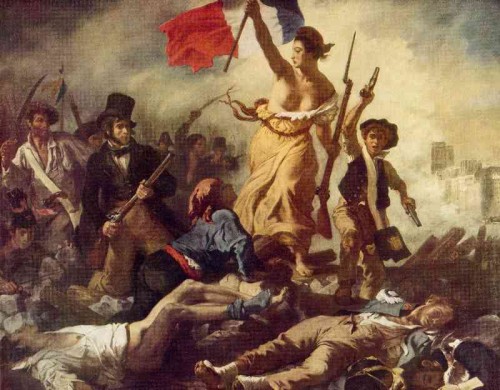
Vanguard, Aesthetics, Revolution
By Alex Kurtagić
Ex: http://www.counter-currents.com/
I have on various occasions criticized the tendency among a subset of racial nationalists to indulge in improbable revolutionary fantasies, where the liberal system collapses, the white masses rise up, and evildoers hang from lampposts in one great Day of the Rope. “Mainstreamers” have, in turn, criticized the tendency among another subset to be bookworm revolutionaries, hermitic, eccentric, and too absorbed in their abstruse intellectual vaporings to be effective harbingers of change in the real world. Both subsets are emblematic of the retreat from reality that results from perceived powerlessness. Both represent vanguardist tendencies. Does that mean that vanguardism is a failed strategy, and that only mainstreamers offer a viable approach?
Far from it.
Vanguardism plays a key role in any movement seeking fundamental change when a system that can no longer be reformed, that has to crumble to make way for a new one, built on different foundations. What is more, it needs not stand in an either-or relationship with mainstreaming: it is possible—indeed it is preferable—to integrate both approaches into a coherent strategy.
Before I begin, I will define the political categories “Right” and “Left” as I intend to use them in this article. By Left I mean those who believe in the ideology of equality and progress; they are associated with liberalism and modernity. By Right I mean those whose outlook is elitist (inegalitarian) and cyclical; they are associated with Traditionalism (in the Evolian sense). By Right I do not mean conservatives, whom I regard as Classical liberals, only with socially conservative attitudes.
From Dystopia to Utopia
Commentators on the Right are prone to spend most of their energy analyzing and critiquing the modern dystopia. But while this is necessary, it is not sufficient: saying that we have arrived at a wrong destination and that we need to be elsewhere without at the same time indicating where that elsewhere is does not imply motion, only the recognition of the need for motion; therefore it is not a movement. For movement to occur, for an idea to gain adepts who then follow each other in a collective act of motion, the destination must be known, a priori, which implies it must be communicable in some way. This destination is the movement’s utopia: the perfect accomplishment of its goals.
Utopias exist only in the imagination. Most of the time they are communicated through fantastic art and literature. At best, they are only ever partially and/or imperfectly implemented. At worse, they are highly unrealistic and impractical—most are to some degree. Yet this does not mean they are not useful: they are in fact necessary, and a pre-condition for movement. Their active ingredient is not their being scientifically accurate, but their capacity to exert an enormous sentimental force on a large enough collective of individuals. And its conception is the charge of the vanguardist, the intellectual outsider, the pioneer, the dreamer, the creator—the individual, or group of individuals, whose task is to break us out of the cognitive cages built by the incumbent system; out of the system-sponsored illusion where anything that is anathema to it seems unthinkable.
Those who adopt mainstreaming approaches often despair at these dreamers because they appear—obviously—impractical, eccentric, and lacking in good sense. The problem is that creative innovators and iconoclasts often are: creative types comprise a peculiar breed, and within that, those who are truly innovative, truly at the vanguard, often shock, worry, and discomfit their less creative peers because they are less fettered by convention. There are undoubtedly good and bad sides to this, but this does not detract from the value of the creative process, even if not all of its byproducts are eventually adopted. The task of the mainstreamer, who abuts the vanguard and the mainstream, is to calculatingly take whatever can be used from the vanguard to stretch the limits of the mainstream, with a view to fundamentally transform the later in the long run.
Dreamer as Pragmatist
Despite having the science, the data, and the logical arguments on its side, the Right has been in retreat for many decades. This alone should be sufficient indication that humans need more than just data, arguments, and truth to be persuaded into a change of allegiance. Yet many who identify with the Right continue operating under the illusion that this is not the case: if people believe in equality it is because they do not know about race differences in IQ; if people believe in multiculturalism it is because they do not know the black on white crime statistics; if people believe in liberalism it is because they have not read Gibbon, or Spengler, or Schmitt; and so on.
The irony is that the best example of why this approach is flawed exists all around us: the consumer society. As a child I was irritated by the unrealistic scenarios, the catchy jingles, and the constant sloganizing of television advertising, and I resented the irrational superficiality implied in this method of selling products. I thought that it would be far more logical to have a man in a suit seated at a table, facing the camera, like in a newsroom, and listing the product specifications to the audience in an unemotional monotone, so that viewers may be able to make a rational choice, based on solid data. Any adult with sense knows, even if he cannot explain exactly why, that this would never work in the real world. The reason is simple: the consumer society is not founded on utilitarian logic or reason, but on Romanticism, daydreaming, status display, and utopias. And it is founded on these principles because that is what has been found to work—vast sums of money has been spent researching human psychology in the effort to maximize consumer mobilization. Colin Campbell and Geoffrey Miller provide theoretical and evolutionary explanations for the human motivational aspects of consumerism this in The Romantic Ethic and the Spirit of Modern Consumerism and Spent respectively.
Therefore it is fair to say that he who daydreams and purposefully induces others to daydream is, in fact, more of a pragmatist than the self-avowed pragmatically-oriented rationalist who seeks to persuade through reason. The former at least understands the irrationality of human nature, and plays (preys?) on it, while the latter fantasizes about abstract humans who act on the basis of rational self-interest.
Truth as a Lifestyle Choice
Far from an asset, a belief in the power of “the truth” is one of the main obstacles for White Nationalists seeking converts to their cause. If they are frustrated by the failure of individuals to support them despite masses of scientific and statistical data showing heritable race differences in IQ and heritable propensities to violent crime, it is because they have failed to realize that humans choose the truth that suits them best, according to whether it makes them feel good about themselves and about the world, and whether it makes those whose opinion they value feel good about them, at any given point in time and space. Humans are more strongly motivated by the innate need for self-esteem and belonging than by abstract reason. Thus, faced with voluminous, conflicting, and virtually indigestible data and arguments emanating from multiple factions, each claiming monopoly of the truth, it is easy to choose the most emotionally and socially convenient of available options. For the majority of people this means the truth sponsored by the cultural establishment, because it means easier social integration and higher rewards. Those who choose a truth anathematized by the cultural establishment become reliant on alternative networks and even unconventional methods to survive within a system that seeks to purge them. Ultimately, and perhaps especially in a materialistic society, truth becomes a lifestyle choice.
Substance & Style
For the above reasons, a strategy purely based on what we tend to regard as substance (i.e., empirical data, logical arguments, reasoned conclusions) is doomed to fail. And in the case of White Nationalism, it has long proven a failure. Also for the above reasons, an effective strategy needs to employ a methodology that taps, like consumerism, into the pre-rational drivers of human behavior. The lesson of consumerism does this through the calculating use of style and aesthetics, which in the consumer society are constantly deployed to induce the desired behavior (consumption).
I am familiar with the calculating use of style and aesthetics through my role in the consumer culture, which I played via my record company. Before the advent of MySpace and the free illegal download, whenever I designed an album cover, a logo, an advertisement, a newsletter, or a website; whenever I crafted an album description; even whenever I described an album verbally, I was acutely conscious of the need to appeal and stimulate interest in my target audience. I did not expect them to make rational decisions (especially since to hear the music they had to first buy the CD), but because I successfully triggered an emotional response strong enough to elicit the needed response: an immediate purchase. (Of course, I did not always get it right, and from time to time I got stuck with unsellable stock, something I blamed as much on bad artwork, ill-judged names and titles, and uninspiring logos as I did on the quality of the music.) Advertisement agencies thrive on the exploitation of style and aesthetics for purposes of mobilizing the public into consuming products, supporting a campaign, or voting for a political candidate.
We all know that as far as the White voters are concerned, Obama got elected purely on the basis of aesthetics: he sounded good, was telegenic, and his “blackness” reassured millions of whites eager to prove (mainly to themselves) that they were not racist. Slogans like “Hope” and “Change” contained zero substance; it was all about the Obamicons; and yet they excited the right sentiment among voters who felt hopeless and wanted change. Televised debates about policy emphasized visual presentation and catchy soundbites; they were more about what the candidates looked and sounded like while discussing—but not really—an ostensibly serious topic than about really discussing a serious topic. Annoying? Certainly. But there is no point fighting this. It works.
Having said this, substance is still important. We all know that a strategy based purely on stylistic flash without it being backed by at least some substance eventually implodes. (In the United States, many duped voters have since realized that Obama is an empty suit; in the United Kingdom, many duped voters eventually realized that Blair was a liar.) Emphasize style over substance in too obvious a manner and your strategy will, in fact, turn against you. (This was a major problem for the Blair government during the late 1990s; heavy “spin-doctoring” got Blair elected, but in time everyone was complaining about it.)
It is obvious, therefore, that the winning strategy is one that has both style and substance—substance that backs the style and style that backs the substance—that, in other words, projects the substance as well as the nature of the substance.
This is nothing new, of course, but it is amazing how many fail to realize the importance of style and aesthetics. Is it because we live in an age that is so obviously about style over substance that there is an instinct to rebel against it?
Weaponizing Aesthetics
In a metapolitical context, we can speak then of weaponizing aesthetics: translating ideology into art, high and low, and using it to push culture and society in a pre-determined direction, to cause culture and society to undergo fundamental change.
In my experience with various forms of underground music and their associated subcultures, an individual’s transformation of consciousness goes through identifiable phases.
First, individuals are exposed to a particular genre of music through their peers; the response, positive or negative, is often immediate, instinctive, the result of a combination of innate biological predisposition, personal history, and sociological factors.
Next, if the individual’s response is positive, there begins a process of researching and collecting albums by bands that play in that genre. And if the individual’s response is extremely positive, the process is intensive, and becomes gradually more so, causing him eventually to become completely immersed in the associated subculture.
Music-centered youth subcultures are easily identifiable because they are highly stylized and stylistically distinctive. They also have their own ideology, which both emanates and reinforces the values coded in the style of music out of which it has grown. Sometimes the ideology is derivative, an extrapolation, or an exaggeration of certain mainstream values. Sometimes the ideology is fundamentally antagonistic to the cultural mainstream. Also, sometimes the ideology is superficial, sometimes it is not. But in all cases, music fans who have become immersed in the associated subculture come to adopt and internalize its ideology to some extent.
Depending on the nature of this ideology, members of a subculture may undergo a radical change in consciousness—even to the point of becoming proud pariahs—which endures even after they have transcended their membership. They may eventually discard the garb and take up conventional salaried employment, but their allegiance to the music will endure, sometimes as a guilty secret, and traces of their fanatical past will remain in their cognitive structures, lifestyle, home decor, vocabulary, and choice of associations. What is more, even decades after, former members will recognize each other and have a common bond.
And all this is achieved aesthetically, through art. It bears iterating: to the extent that values are absorbed, they are so not because they have been presented logically or scientifically, but because they were presented in an attractive and artful or aesthetically pleasing manner—in a manner that exerts a strong sentimental force on its consumers. And anyone with an awareness of popular culture will know that its power to excite extreme emotion, unite psychologically, and mobilize the masses—to cause them to act irrationally, violently, even against their own rational best interests—cannot be underestimated. When the last volume of the Harry Potter series of novels was published, people queued for hours, in the cold, in the rain, in the wee hours of the morning, to be the first to get their hands on the first hardback edition. And this is a very mild example. We have film evidence from the 1960s showing young women absolutely in hysterics at Beatles concerts, and there is little doubt that their personal lives were partly consumed by thoughts and fantasies involving members of the band. Did their record company present an especially logical argument?
Of course, mass mobilization is possible within popular culture when the product or event in question encodes culturally mainstream values. The less mainstream the values, the less the capacity for mobilization. All the same, in the age of mechanical reproduction we have seen that when a synergistic aesthetic and ideological system is deployed using the methods of popular culture, even radical anti-system propositions are capable, under the right conditions, of mobilizing large enough bodies of people and growing until it establishes itself as a new hegemonic order.
The National Socialists, beginning in Weimar Germany, offer perhaps the most iconic example in the West. Like all political movements, however, National Socialism had metapolitical origins, and arguably occult origins in daydreams of Atlantean and Hyperborean civilizations, which the SS later sought to substantiate. It was more a certain set of ideas and daydreams, a certain sentiment, a certain political romanticism, a certain look, before it was actual politics with an actual label.
The same is true of our modern society: between René Descartes, Adam Smith, John Locke, Karl Marx, and Sigmund Freud on the one hand, and political correctness, immigration, outsourcing, and diversity training on the other, lie a mass of popular novels, films, and albums that consciously or semi-consciously encode, aestheticize, and promote the ideas and narratives of global capitalism and the Freudo-Marxist scholasticism, upon whose metapolitical tradition the modern order is founded.
The weaponization of aesthetics is the creation of an interface that facilitates the translation of the metapolitical into the political, of the vanguard into the mainstream.
Credibility
Another reason why I put such emphasis on aesthetics in metapolitical discussions is that a well-formulated and perfectly rendered aesthetic system is the fastest way of projecting credibility, and therefore of making a set of values and ideals appear credible to apolitical observers. (To political observers it may inspire pride or fear, depending on their allegiance.) Do we not judge books by their covers? Do we not judge a person by his or her appearance?
I contend that if our values and ideals lack credibility outside our immediate milieu, it is partly because we have yet to find a way to translate our metapolitics into an professionally rendered aesthetic system that is both acceptable and appealing to a wider audience—that reformulates our archaic ideas in a way that is vibrant, relevant, and forward-looking (because people do need hope and change). Needless to say that there are other very significant factors involved (such as the reality of economic sanctions), but this is certainly one of them: without an optimal aesthetic system, actual politics becomes very difficult. One cannot sell an idea without marketing. And one cannot appeal to an elite audience without the right kind of marketing.
This is why we will benefit when talented artists, musicians, designers, and literary stylists who share our sensibilities find congenial outlets and begin making a name for themselves. It is, therefore, necessary that we provide such outlets and offer viable professional and economic opportunities for creative types, lest we continue losing them to the (censoring but remunerated) alternatives offered by the establishment. Only then will we be able to grow a forceful counter-culture.
Final Thoughts
The age of chaos offers opportunities to those able to “sell” a new dream. Although the present liberal, egalitarian, progressive establishment appears superficially invincible, they do not represent a unified, cohesive, monolithic, totalitarian order: they are, in fact, a rainbow coalition of competing and sometimes contradictory factions that happen to share a set of core beliefs. They are also degenerative and disintegrative, and the logical conclusion of their project is the complete breakdown of society. This has become increasingly apparent since the adoption of multiculturalism as an official government policy, and the adoption of globalism as the modern capitalist paradigm. Worse still, they are contrary to nature, so their continuity results in constant stress and strenuous effort. Division, degeneration, disintegration, stress, and exhaustion grow ever more apparent. And the end of prosperity in the West will make social and cultural upheavals more difficult to contain or diffuse. Thus, in the escalating confusion, even the apolitical, conventionally thinking citizen will in time become receptive to new, exotic, and even quixotic ideas. Once the confusion becomes severe enough, they will be looking for a radical ideology, a harsh religion, an authoritarian strongman, or Caesar. They will be looking for meaningful symbolism, for utopian daydreams, for a new romanticism, for something that projects order and strength, is distinctive amid the chaos, and makes them feel powerful and part of something strong.
This might seem grandiose, but the beginning of it is nearer than one thinks: it, in fact, starts with pen and paper, with brush and canvas, with guitar and plectrum; it is founded on the fantasy and the daydreams that animate these utensils.
If revolutions begin with scribbles, scribbles begin with daydreams. And although this may sound fluffy and nebulous to the hard political pragmatist, it bears remembering that such verities always look so after a long period of material prosperity and political stability, while the system appears strong and credible to a majority. But, as it did in the past, following cataclysmic upheavals, when their origins and causes were catalogued by sociologists in their postmortem reports, said verities are likely to look somewhat less nebulous after the tide of culture turns and those once seemingly improbable daydreams start to take form. How long until then? Who knows? But unless we have set the metapolitical bases for our new order, unless we have a virile counter-culture upon which can build it, we might find that by the time the tide turns, others got in well ahead of us while we waited to see if it ever would.
Article printed from Counter-Currents Publishing: http://www.counter-currents.com
URL to article: http://www.counter-currents.com/2012/05/vanguard-aesthetics-revolution/
00:05 Publié dans Philosophie, Réflexions personnelles | Lien permanent | Commentaires (0) | Tags : réflexions personnelles, philosophie | | del.icio.us | | Digg | Facebook
Le retour du Colonel Peters
Ex: http://mbm.hautetfort.com/
 En juin 2006, le lieutenant-colonel retraité de l’US Army, Ralph Peters, s’était fait connaître par la publication dans l’Armed Force Journal d’une carte de sa main (voir ci-dessous) envisageant une complète refonte des frontières du « Grand Moyen-Orient » où G.W.Bush projetait d’injecter la démocratie parlementaire – et de marché ! – à l’occidentale.
Certes, à l’époque tant l’énormité de ces modifications et le fait qu’apparemment, il ne s’agissait que de la publication d’une carte autorisaient à penser que les propositions du colonel Peters resteraient de simples élucubrations.
Pourtant, une série d’informations récentes pourrait toutefois indiquer que la fameuse carte n’a peut-être pas été reléguée au fond d’un tiroir poussiéreux.
Vers un Grand Azerbaïdjan ?
Mark Perry, auteur de Talking to Terrorists. Why America must engage with its enemies (Basic Books, 2010), révèle dans un article paru en mars et basé sur des fuites de Wikileaks[1] la coopération militaire aussi poussée que mal connue entre l’Azerbaïdjan et Israël et montre que l’usage de bases aériennes azerbaïdjanaises, dont celle de Sitalcay, pourrait permettre aux avions israéliens de bombarder, le cas échéant, plus efficacement l’Iran puisqu’il pourraient s’y poser après leurs raids plutôt que de devoir faire l’aller-retour vers leurs bases de départ. Toutefois, dans le même texte, Perry rappelle qu’en février 2012, un membre du parti au pouvoir à Bakou, capitale de la république dynastique et pétrolière d’Azerbaïdjan, en très bon termes avec l’Occident, a demandé à son gouvernement de rebaptiser le pays en Azerbaïdjan du Nord, appel qui relève d’un irrédentisme souhaitant « réunifier la patrie » en y rattachant les provinces azériphones du Nord-ouest de l’Iran[2], considérées comme l’Azerbaïdjan du Sud. Rappelons que plus de15 millions d’Azéris (selon les chiffres iraniens, apparemment minimisés) vivent dans le nord-est de l’Iran contre 9,1 millions en Azerbaïdjan même. D’où les craintes iraniennes d’un séparatisme azéri, qui s’était déjà manifesté, avec l’appui de l'URSS à la fin de la 2ème Guerre mondiale, par la création d’un Gouvernement populaire d'Azerbaïdjan séparatiste et hostile au Chah[3]. Une appréhension renouvelée à Téhéran suite à la naissance d’un Azerbaïdjan indépendant à la faveur du démantèlement de l’URSS.
Limitons-nous à observer que sur la carte du colonel Peters : le très récalcitrant Iran devrait se voir amputer au Nord-ouest de la région azérie de Tabriz, au Sud-ouest du Khouzistan arabophone et, au Sud-est, de sa province baloutche.
Un « Baloutchistan libre » ?
Tout récemment, le blog Atlas Alternatif titrait : « Des républicains américains veulent faire éclater le Pakistan » et faisait état d’une série d’auditions, le 8 février 2009, de la sous-commission des Affaires étrangères de la Chambre des États-Unis consacrées aux « violations des Droits de l’Homme au Baloutchistan », sous l’égide du député républicain de Californie Dana Rohrabacher. Rencontre qui avait soulevé la colère du gouvernement pakistanais. Étaient en effet conviés à ces auditions, outre des universitaires, des délégués d’Amnesty International et de Human Rights Watch, ce qui n’a rien d’étonnant vu le thème des rencontres, mais aussi le lieutenant-colonel Ralph Peters…
Autre « petite chose » à souligner : l’an dernier, l’ambassadeur US au Pakistan, Cameron MUNTER, a réitéré la demande de son gouvernement d’ouvrir un consulat au Baloutchistan[4].
Or, pour ce qui est du Pakistan, Peters envisageait l’amputation de sa province du Baloutchistan et la réunion de cette dernière avec les régions baloutches du sud-est de l’Iran pour former un État libre du Baloutchistan, doté ipso facto d’une importante façade sur l’océan indien avec, en son milieu, le port de Gwadar. C. à d. une remise en cause de la Ligne Goldschmid (1871) par laquelle Londres avait délimité la frontière entre l’Iran et son Empire des Indes, ligne frontalière reprise en 1947 par le Pakistan.
L’on sait déjà qu’au Baloutchistan – qui forme 42% du territoire du Pakistan, mais dont les 7 millions de Baloutches ne forment que 5% de sa population – opèrent des groupes tribaux armés, ulcérés non seulement de voir leur région négligée par Islamabad, mais faire l’objet d’une politique de peuplement pachtoune et pendjabi. S’ajoute à cela le fait que le sous-sol du Baloutchistan recèlerait d’immenses ressources en gaz et en pétrole.
Casser le « collier » chinois
Par ailleurs, la valeur stratégique du Baloutchistan s’est vue multipliée par la création, financée par la Chine lors de la décennie écoulée, d’un port en eaux profondes à Gwadar qui devrait constituer le terminal d’un gazoduc venant du Turkménistan. Ceci au risque d’aggraver le mécontentement de certains Baloutches, le nouveau port menaçant à leurs yeux d’accroître la fuite des ressources de la région et de créer principalement de nouveaux emplois parmi les « immigrés » du reste du Pakistan. Pour la Chine par contre, le projet de Gwadar comporte plusieurs avantages, ce qui justifie peut-être les accusations pakistanaises d’une aide de l’Inde à la guérilla baloutche. Gwadar désenclave en effet les provinces ouest de la Chine (Xinjiang), offre à sa marine des facilités portuaires situées à l’ouest de l’Inde et proches du « verrou stratégique » du détroit d’Ormuz, et permet à la RPC un approvisionnement, énergétique, à partir de l’Afrique et du Moyen-Orient, plus « terrestre », échappant donc en partie au contrôle américain des routes maritimes du Sud-est asiatique.Un « Baloutchistan libre » parrainé par Washington et Delhi et obtenant la haute main sur Gwadar n’aurait-il pas l’avantage d’ôter l’une des plus belles perles du « collier »[5] stratégique que Pékin tente de constituer à l’ouest de l’Inde et au nord de l’océan Indien ? Et cela alors même que le putsch du 7 février dernier aux Maldives, immédiatement cautionné par les Etats-Unis et la « plus grande démocratie du monde » que serait l’Inde, pourrait bien avoir mis fin aux souhaits chinois d’ajouter, avec une base de sous-marins dans l’atoll maldivien de Marao, une nouvelle pièce à leur parure.
La guerre de l’ombre que livrent des agents américains et israéliens dans plusieurs régions de l’Iran non-persanophones (Azerbaïdjan-occidental, Khouzistan, Sistan-Baloutchistan) n’est plus qu’un secret de polichinelle. Une guerre qui se déroule à l’occasion, avec une collaboration tacite… d’Al-Qaïda, à laquelle serait « affilié » le Jundullah, groupe sunnite du Baloutchistan iranien (le Sistan-Baloutchistan) partisan d’un système fédéral en Iran, qui, depuis 2005, s’est fait remarquer par une tentative d’assassinat de M. Ahmadinejad (septembre 2005), ses enlèvements de soldats iraniens, ses attentats contre des casernes de l’armée ou des Gardiens de la Révolution[6] ou contre des mosquées[7] ou des manifestations religieuses chiites[8], malgré le coup dur qu’a constitué pour l’organisation la capture et l’exécution, en juin 2010, de son leader Abdolmalek Righi.
Un peu plus à l’Ouest : un « réduit » alaouite ?
Par ailleurs, Fabrice Balanche, Maître de conférences à l’Université Lumière-Lyon II [9], écrivait dans la dernière parution d’Alternatives internationales (n°54, mars 2012) qu’en cas de débâcle du régime syrien, « le clan Assad peut tenter de créer grâce à ses moyens militaires un réduit dans la région alaouite, sur la côte, avec l’aide de Moscou et de Téhéran ». Or, ce « réduit alaouite » figure bel et bien sur la carte du colonel Peters, mais… inclus dans un « Greater Lebanon », un « Plus grand Liban », qui ferait main basse sur toute la côte syrienne jusqu’aux frontières turques, privant cette fois la Syrie, de surcroît dûment amputée de ses régions nord-est au profit d’un « Kurdistan libre », de toute façade maritime.
 De même, à la mi-mars, New Lebanon[10]estimait que « la vieille idée du mandat français » revenait à l’ordre du jour, « l’enclave alaouite [pouvant] devenir un État indépendant si Assad perdait tout contrôle sur Damas », et précisant que le clan Assad chercherait dans ce cas à élargir le « réduit alaouite » à la région de l’Idlib pour qu’il s’étende jusqu’à la frontière turque au-delà de laquelle vivent quelque 15 millions d’alévis.
Question : « le rejet régional et international » et « le refus total » de la Turquie d’un tel projet sont-ils aussi assurés que semble le penser New Lebanon ?
Sarkozy, apprenti Pandore
En Libye, la proclamation, le 6 mars dernier, de l’autonomie partielle de la Cyrénaïque, l’est du pays, par le cheikh Ahmed Zoubaïr Al-Senoussi, au demeurant neveu de l’ex-roi Idriss Al-Senoussi et s’exprimant au nom de quelque 3000 chefs de tribus et personnalités, est certes dues à des facteurs locaux – projet de loi électorale sur base démographique, sentiment d’abandon du « cœur de la révolution » en faveur de Tripoli – mais les accusations de projets séparatistes liés à la concentration des richesses pétrolières dans cette même région et bénéficiant d’un soutien occulte de « puissances étrangères » ne sont pas à rejeter sans plus.
Toujours en Libye, mais au Sud, les combats entre Toubous et tribus arabes dans la région de Sebha qui auraient fait quelque 150 morts entre le 26 et le 31 mars, pourraient ranimer les aspirations au séparatisme de ces mêmes Toubous.
À suivre donc…
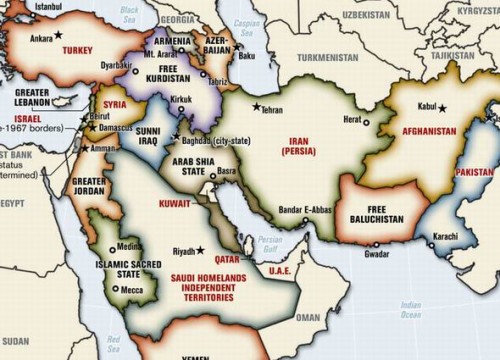
Carte élaborée par le Lieutenant-Colonel américain Ralph PETERS et publiée dans le Armed Forces Journal en juin 2006. Peters est colonel retraité de l'Académie Nationale de Guerre US. (Carte sous Copyright 2006 du Lieutenant-Colonel Ralph Peters) – Source : Mahdi Darius NAZEMROAYA, Le projet d'un « Nouveau Moyen-Orient ». Plans de refonte du Moyen-Orient, in Mondialisation.ca, 11 décembre 2006
1er avril 2012
Paul DELMOTTE
Professeur de Politique internationale à l’IHECS
Source : Investig'Action michelcollon.info
[1] L’Azerbaïdjan, le terrain d’atterrissage secret d’Israël (http://www.slate.fr/story/52415/israel-iran-azerbaidjan-g...)
2] Provinces d’Azerbaïdjan occidental et oriental, d’Ardabil, de Zanjan et, partiellement, celles d’Hamadan et de Qazvin
3] Velléités séparatistes que l’on a cru voir se réveiller avec les manifestations survenues en 2006, e. a. à Nagadesh.
[4] Selon I.SALAMI, in Palestine Chronicle, 28.10.11
[5]L’on appelle poétiquement « stratégie du collier de perles » les efforts de la Chine en vue de s’assurer une série de bases navales pour mieux assurer ses approvisionnements énergétiques moyen-orientaux. À part Gwadar, les autres perles sont Chittagong (Bangla-Desh), Sittwe, Coco, Hiangyi, Khaukpyu, Mergui, Zadetkui Kyun (Myanmar), des bases en Thaïlande et au Cambodge, Hanbatota (Sri-Lanka). Depuis l’an dernier, un accord avec les Seychelles envisage la construction d’installations de réapprovisionnement de la marine chinoise.
[6] Comme en octobre 2009 (42 morts)
[7] Comme à Zahedan, en mai 2009 (25 morts) ou en juillet 2010 (26 morts)
[8] Comme à Chabahar en décembre 2010
[9] Auteur de La région alaouite et le pouvoir syrien (Karthala, 2006) et de l’Atlas du Proche-Orient arabe (PUPS-RFI, 2012), F.Balanche a également collaboré au volumineux et incontournable ouvrage dirigé e. a. par notre compatriote Baudouin Dupret, La Syrie au présent. Reflets d’une société, Sindbad/Actes Sud, 2007
00:05 Publié dans Actualité, Géopolitique | Lien permanent | Commentaires (0) | Tags : politique internationale, géopolitique, etats-unis, ralph peters, moyen orient, proche orient, caucase, azrbaïdjan, iran, syrie, beloutchistan, pakistan, cartes | | del.icio.us | | Digg | Facebook
Armin Mohler: Rechter Blick auf die Bundesrepublik
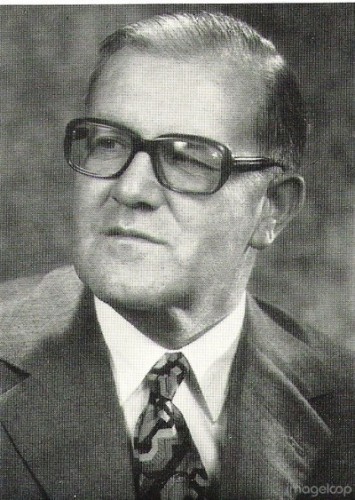 Armin Mohler: Rechter Blick auf die Bundesrepublik
Ansgar Lange
http://www.jungefreiheit.com/
Armin Mohler wurde am 12. April 1920 in Basel geboren. Der Vater war evangelisch-reformiert, die Mutter katholisch. Die religiöse Prägung Mohlers war schwach. Die Mohler-Kinder wurden nach dem Bekenntnis des Vaters erzogen, aber das Christentum blieb rein äußerlich und wurde höchstens in der calvinistisch geprägten Atmosphäre Basels erfahren. Dafür faszinierten den jungen intellektuellen Schweizer andere Ideengebäude, die für seinen illegalen Grenzübertritt nach Deutschland im Jahr 1942 verantwortlich waren: Mohler fühlte sich mit Deutschland schicksalhaft verbunden und bewunderte Ernst Jüngers Essay „Der Arbeiter“.
1949 wurde der Bücher- und Augenmensch Mohler bei Hermann Schmalenbach und Karl Jaspers über „Die Konservative Revolution in Deutschland 1918–1932. Grundriß einer Weltanschauung“ (Buchausgabe 1950) promoviert. Mohler ging von der „Annahme der Unvereinbarkeit von Christentum und ‚Konservativer Revolution aus. Mohlers Sympathie für seinen Gegenstand, also die konservativen Revolutionäre, war unverkennbar. Mit seinem Buch wollte er – für eine Doktorarbeit ungewöhnlich – Hilfestellung für die rechte Intelligenz in Deutschland leisten.
Eine Feder des Strauß
1953 ging Mohler als politischer Auslandsberichterstatter der Zürcher Tat nach Paris, von 1955 bis 1960 war er in gleicher Funktion auch für die Zeit tätig, außerdem für Christ und Welt (1960-61). Von 1959 an schrieb er auch für Die Welt, zu der Hans Zehrer ihn geholt hatte. Im Jahr 1964 gestattete er sich unter dem Pseudonym „Michael Hintermwald“ auch journalistische Ausflüge in die Deutsche Nationalzeitung und Soldatenzeitung, eine nicht nachvollziehbare publizistische Fehlleistung.
Ab den 1970er und 1980er Jahren wehte ein unfreierer Wind in der deutschen Publizistik. Mohler veröffentlichte von 1970 bis 1997 vor allem in der Zeitschrift Criticón, einer Art konservatives Sammelbecken, zusammengehalten von dem Genie und dem Geld Caspar von Schrenck-Notzings. Was die Zeitungen anbelangt, konnte er – mit wenigen Ausnahmen – ab 1967 nur noch im Bayernkurier, gelegentlich in der Welt sowie später in der Jungen Freiheit schreiben.
Bevor Mohler politisch weitestgehend kaltgestellt wurde, war er als eine Art politischer Berater von Franz Josef Strauß tätig. In der Zeit von Strauß als Finanzminister in der Großen Koalition (1966–1969) gab es regelmäßige persönliche Kontakte zwischen den beiden. Mohler verfaßte auch Reden für den bayerischen Politiker.
Opfer einer „katholischen“ Intrige?
Daß Mohler schließlich vom Etablierten zum Verfemten wurde, beruhte laut Karlheinz Weißmann auf „einer Intrige Paul Wilhelm Wengers“, den er „zu den wichtigsten katholisch-konservativen Journalisten der Nachkriegszeit“ zählt. Als der „Adenauer-Preis“ der Deutschland-Stiftung im Jahr 1967 an Mohler vergeben werden sollte, „entschloß sich Wenger zu Störmanövern“, so Weißmann: „Wenger wurde bei Androhung einer Geld- oder Haftstrafe untersagt, weiter zu behaupten, daß Mohler von der Schweizer Armee zur Waffen-SS desertiert sei und in seiner Heimat zur ‚Fünften Kolonne’ des Nationalsozialismus gehört habe“. Kampagnen in der linken Presse (Stern, Spiegel, Zeit etc.) folgten. Auch in bürgerlichen Medien wie Christ und Welt und FAZ und der Zeitschrift Civis sah sich Mohler Anfeindungen ausgesetzt. Rückendeckung konnte der „Verfemte“ nur noch von der Welt erwarten.
Daß Mohler von katholischer Seite Widerstand entgegengebracht wurde, darf indes nicht verwundern. Schließlich wollte er Strauß zu einer Art neuem Führer der CSU machen, die ihre katholisch-konservativen Wurzeln kappen und sich zu einer modernen nationalen Partei wandeln sollte. Dieser „Ausflug“ in die Parteipolitik scheiterte jedoch. So war Mohler der Ansicht, daß CDU und CSU absolute Mehrheiten erringen würden, wenn sie sich gegen den Atomsperrvertrag, die „Vergangenheitsbewältigung“, die Mitbestimmung sowie die Aufweichung der Bundeswehr wenden würden. Wahrscheinlich hätte die Union mit solchen Themenschwerpunkten keinen Blumentopf bei den Wählern gewonnen. Hier irrte der Intellektuelle, der sonst so viel Wert auf die Betrachtung der Wirklichkeit richtete, und entpuppte sich als abgehobener Theoretiker.
Abschied aus der Parteienpolitik
Mohler, der Christentum und Konservatismus für unvereinbar hielt, wollte aus der CSU eine Rechtspartei machen. Das Wort „konservativ“ war ihm zu verwaschen. Dabei sollte sie dann auch gleich ihr Tafelsilber verscherbeln, nämlich das seiner Sicht „überholte C“ aufgeben und sich von vermeintlichen klerikalen Bindungen lösen. Als Name für eine solche rechte Parteigründung aus der etablierten C-Partei heraus schwebte ihm der Name „Nationale Volkspartei“ vor.
In den letzten 20, 30 Jahren seines Lebens hat sich Mohler von der Parteipolitik verabschiedet. Er widmete sich seiner Tätigkeit als Geschäftsführer der Siemens-Stiftung und organisierte viel beachtete Vortragsreihen – ohne Scheu vor politisch Andersdenkenden, insofern sie nur interessant waren. Als Herausgeber von über zehn Bänden zu gesellschaftlichen und zeitpolitischen Themen war er überaus produktiv. Neben politischen Themen verfaßte Mohler auch eine große Zahl an Artikeln über Kunst und Literatur und schrieb zahlreiche Buchrezensionen und Portraits, vor allem für Criticón.

Ansgar Lange, Politikwissenschaftler und Publizist, 1971 in Arnsberg/Westfalen geboren, Studium der Politischen Wissenschaft, Geschichte und Germanistik in Bonn. Mit Extremen vertraut, da er die die eine Hälfte seines bisherigen Lebens im Sauerland und die andere Hälfte im Rheinland verbracht hat. Auch wenn er die Nähe zum Rhein und das Leben in der beschaulichen Bundesstadt Bonn schätzt, bleibt er im Grunde seiner Seele weiterhin Westfale und Pilstrinker. Langjährige Tätigkeit als Journalist, in der Presse- und Öffentlichkeitsarbeit sowie der Politik.
00:05 Publié dans Hommages, Nouvelle Droite, Révolution conservatrice | Lien permanent | Commentaires (0) | Tags : armin mohler, révolution conservatrice, allemagne, nouvelle droite | | del.icio.us | | Digg | Facebook