


mardi, 17 juin 2014
Richard Roudier à Cannes

15:28 Publié dans Actualité, Affaires européennes, Evénement | Lien permanent | Commentaires (0) | Tags : france, midi, ligue du midi, identité, identitaires, cannes, provence, richard roudier, événement |  |
|  del.icio.us |
  |
|  Digg |
  Facebook
Michel Houellebecq’s Sexual Anti-Utopia

“I get my kicks above the waistline, Sunshine”
Michel Houellebecq’s Sexual Anti-Utopia
By James J. O'Meara
Ex: http://www.counter-culture.com
 Michel Houellebecq
The Elementary Particles [2]
Translated from the French by Frank Wynne
New York: Knopf, 2000

“I get my kicks above the waistline, Sunshine.”[1]
“The universe is nothing but a furtive arrangement of elementary particles. . . . And human actions are as free and as stripped of meaning as the unfettered movements of the elementary particles.” — Michel Houellebecq, H. P. Lovecraft: Against the World, Against Life
“Frolicking has never been so depressing.”—MST3k Episode 609: Coleman Francis’ Skydivers.
It really does seem odd that I have until now managed to avoid reading the novels of Michel Houlelebecq. It’s especially odd I didn’t plunge right in after reading his excellent essay on Lovecraft, [2] and even quoting it my very own first essay on Lovecraft, published right here on Counter Currents.[3] Why, we even share the same year of birth![4]
The appeal of Houellebecq to elements of the Right should be obvious; his enemies seem to be our enemies, from American consumer culture to modernity itself, as well as not just the French versions of PC but French culture itself, at least in its postwar state.[5]
His basic notion is that, contrary to the foolish dreams of the ’68ers, and dogmatically enforced today by both academic and consumer establishments, “The ‘decentred self’ remains a selfish unit; the death of hierarchy merely nurtures the cult of the individual and an incoherent, deviant society.”[6]
These fiercely individualized entities are the elementary particles left to spin aimlessly by the smashing of the bonds of traditional society.
It is interesting to note that the “sexual revolution” was sometimes portrayed as a communal utopia, whereas in fact it was simply another stage in the historical rise of individualism. As the lovely word “household” suggests, the couple and the family would be the last bastion of primitive communism in liberal society. The sexual revolution was to destroy these intermediary communities, the last to separate the individual from the market. The destruction continues to this day.
This is pretty consistent with the model explored by Baron Evola in, for example, Ride the Tiger: A Survival Manual for the Aristocrats of the Soul.[7] Liberalism has atomized[8] society by a Nietzschean smashing of all our idols. All members are now “free” to “realize themselves” and “become what they are.” The problem being, Nietzsche intended this to apply to an elite, the potential Supermen — what Evola calls “differentiated [from the social herd] men” — not society at large. Left to his own devices, the Underman resorts to what he knows best: sensation, and thus to shopping and sex.
Houellebecq’s characters are notable for how completely they embrace the consumerist ethos: believing that youth is society’s primary index of value, that sex is the only pleasure and is eminently commodifiable, that disposability is natural, that quality is ultimately reducible to quantity [cf. Guénon], that the quest for novelty is our only genuine tradition, that secular materialism has triumphed once and for all over atavistic spirituality. [9]
So far, he seems to be on our team. Of course, someone who hates as much as Houellebecq is apt to be an uncomfortable ally.
I know that Islam — by far the most stupid, false and obfuscating of all religions – currently seems to be gaining ground, but it’s a transitory and superficial phenomenon . . . [All but Guénon & Co. shout Yah!]
. . . in the long term, Islam is even more doomed than Christianity. [Crickets][10]
And just to be clear on that: “I was talking about the stupidity of all monotheistic religions.”[11]
Alrighty then, moving along . . . Besides being a fountain of opinions either bold and scintillating or mean and stupid, depending on whose ox is being gored,[12] Houellebecq is a damned good, clear — lucid, the French would say, I suppose — writer; here, if anywhere, worthy of the comparisons made to Camus. [13]
But unlike Camus, he’s a funny guy[14] (though perhaps rather like Joe Pesci is “funny” in Goodfellas[15]):
As a teenager, Michel believed that suffering conferred dignity on a person. Now he had to admit that he had been wrong. What conferred dignity on people was television.
Rumor had it that he was homosexual; in reality, in recent years, he was simply a garden-variety alcoholic
The beach at Meschers was crawling with wankers in shorts and bimbos in thongs. It was reassuring.
Whatever, in the showers at the gym I realized I had a really small dick. I measured it when I got home—it was twelve centimeters, maybe thirteen or fourteen if you measured right to the base. I’d found something new to worry about, something I couldn’t do anything about; it was a basic and permanent handicap. It was around then that I started hating blacks.
Not that Old Grumpypuss will let you just have your fun:
Irony won’t save you from anything; humour doesn’t do anything at all. You can look at life ironically for years, maybe decades; there are people who seem to go through most of their lives seeing the funny side, but in the end, life always breaks your heart. Doesn’t matter how brave you are, or how reserved, or how much you’ve developed a sense of humour, you still end up with your heart broken. That’s when you stop laughing. In the end there’s just the cold, the silence and the loneliness. In the end, there’s only death.
And, as in liberal society, until then, when all else fails, there’s also the sex.[16] Perhaps I’ve consumed more than my share of pornography, but it did not seem as overwhelming or perverse as reviewers would have us believe. I suppose it serves the purpose of shocking the shockable, but if you find it off-putting, or just boring, go ahead and skip it, it really adds nothing to the message of the book.
Now, at this point, fifteen years later, there’s little to be gained in adding yet another review; so with the book taken as read, I’d like to take a look at that message and try to place it in relation to some other, rather grander works.
First off, the book has an odd structure that only becomes apparent with the Epilogue. “Despite the essentially elaborate scope of the plot revealed in the novel’s conclusion (i.e. the eventual emergence of cloning as a replacement for the sexual reproduction of the human race) . . .”[17] It’s not entirely mind-shattering, but if, like Ulysses, you’ve been told it’s just a book about sex, you might wonder what the point is. Even the New Yorker reviewer found himself frustrated by what he called “editorials” cropping up throughout the text, which he felt were Houellebecq putting in his two cents.[18]

Actually, they are another feature of, and clue to, the structure and intent of the book. Certainly other odd features, such as the long poem that opens the book, become clearer at this point. What you have here is another one of those “future histories” that I’ve been reviewing here recently; [19] a biography, from the near future (apparently around 2030) of the main protagonist, the geneticist Michel, and the effects of his work in our near future (actually, now right about today).
In particular, though, it reminded me of a far older, and much more substantial one than those. Then it finally hit me: Hermann Hesse’s The Glass Bead Game [4]
Hesse’s novel takes place around 2500 and presents itself as a biography of a recently deceased and rather controversial Game Master, one Joseph Knecht. To orient the reader (both fictional and real) to both the Game and the history out of which it emerged (which is our own, of course) it opens with a long section presenting “A General Introduction” to the Game’s history “For the Layman.”[21] It ends with a supposed selection of poems from Knecht’s student days documenting his struggle to assimilate the game, and to allow himself to be assimilated by it.
The Game, we learn, arose out of the ruins of The Century of Wars, which was, not coincidentally, the “Age of the Feuilleton,” symbol of journalistic and scholarly frivolity.[22] At the last moment, Europe pulled back from the brink, and initiated a movement dedicated to Truth rather than Interest, to Platonically purify and uplift society by purifying the arts and sciences of fraud, triviality, and irrelevance; above all, by demonstrating their unity and interconnection.
Fortunately, the same Zeitgeist was expressing itself by the slow development of The Game; conveniently indescribable, it seems to be a system, akin to music or mathematics,[23] by which the content of any science can be stated, developed, and, most importantly, interwoven with any other, in a kind of scientific or cultural or spiritual counterpoint. The result is a spiritual exercise, akin to meditation but often performed publicly and ceremonially, “an act of mental synthesis through which the spiritual values of all ages are seen as simultaneously present and vitally alive.” The celibate scholars of the province of Castalia are the secular monks of this new quasi-religious order that orders society as Catholicism did mediaeval Europe.
While there is a certain intellectual thrill in contemplating this picture (perhaps a clue as to whether the reader would be a suitable candidate for the Order) the dramatic heart of the work is the Bildungsroman in the center, in which Joseph Knecht is initiated into the game and the Order, rises to the very highest position, only to abdicate and return to the world when he begins to sense that the Game itself has become arrogant, sterile, and alien to human society, which may someday decide they no longer need to support it; and as Marx would say, the same shit would start all over again.
What does this have to do with The Elementary Particles? Houellebecq has essentially inverted Hesse’s novel, both structurally and thematically.
Structurally, he has placed at the beginning an unattributed poem that strikes the same themes as Hesse’s work, resembling one of Knecht’s final poems of contentment with the Game, “Stages.”
We live today under a new world order
The web which weaves together all things envelops our bodies
Bathes our limbs,
In a halo of joy.
A state to which men of old sometimes acceded through music
Greets us each morning as a commonplace.
What men considered a dream, perfect but remote,
We take for granted as the simplest of things.
But we are not contemptuous of these men,
We know how much we owe to their dreaming,
We know that without the web of suffering and joy which was their history, we would be nothing.
Now, rather than Hesse’s long, clear, conveniently labeled Introduction to the Game and our history we have the unexpected and puzzling epilogue, which details Michel’s self-exile to Ireland (land of monks where “most of them around here are Catholics”) and his breakthrough in genetics that results in the replacement of sexual reproduction with perfect, immortal clones. The bulk of the novel shows us the modern, secular society that Michel comes to doubt and reject.
Genetics, of course, easily lends itself to metaphors of weaving, but Michel’s breakthrough, which somehow bases itself on quantum mechanics, seems especially Game-like: “Any genetic code, however complex, could be noted in a standard, structurally stable form, isolated form disturbances and mutation . . . every animal species could be transformed into a similar species . . .”
Moreover, the description of his thought processes and inspirations constantly recur to similar tropes; he takes inspiration from the Book of Kells and writes works like “Meditations on Interveaving” — “Separation is another word for evil; it is also another word for deceit. All that exists is a magnificent interweaving, vast and reciprocal.” — while a his protégé’s article “Michel Djerzinki and the Copenhagen Interpretation” is in fact a “long meditation on a quotation from Parmenides” while another attempts “a curious synthesis of the Vienna Circle and the religious positivism of Comte.”
Meanwhile, the popularizing of Michel’s ideas adds to the popular ferment. We live in “the age of materialism (defined as the centuries between the decline of medieval Christianity and the publication of Djerzinki’s work)” whose “confused and arbitrary” ideas have led to a 20th century “characterized by progressive decline and disintegration.” But now, “There had been an acceptance of the idea that a fundamental shift was indispensable if society was to survive – a shift which would credibly restore a sense of community, of permanence and of the sacred.”
The key to this is “the global ridicule in which the works of Foucault, Lacan, Derrida and Deleuze had suddenly foundered, after decades of inane reverence,” which “heaped contempt on all those intellectuals active in the ‘human sciences.’” Now “they believed only in science; science was to them the arbiter of unique, irrefutable truth.”
What we have, then, is in effect a re-write of Hesse’s novel, but now centered on the (in Hesse’s work, anonymous by choice[24]) inventor of the Game, rather than his later descendant; the celibate monks of Castalia, selected in childhood and separated forever from their mundane families, have now been generalized to the entire population of the Earth: “Having broken the filial chain that linked us to humanity, we live on. We have succeeded in overcoming the forces of egotism, cruelty and anger which they [us!] could not.”[25]
While it’s pretty cool and all, one can’t help but think, especially if one has already read Hesse’s novel, that Houellebecq has simply passed the buck. Remember that whole middle section about Joseph Knecht? Hesse had played around with the idea of a utopian society devoted to intellectual contemplation for years; who hasn’t, from Leibniz all the way back to Plato? And he, like Plato, had seen, living through the Century of Wars himself, that it was the only hope for mankind, or at least for culture.
The problem was, however, less one of how to do it — Step One, invent cloning — than Step Two, how would it work; or rather, how would it be maintained? Houellebecq’s narrator speaks with the same placid self-satisfaction as the narrator of Hesse’s introduction: “Science and art are still a part of our society; but without the stimulus of personal vanity, the pursuit of Truth and Beauty has taken on a less urgent aspect.” Indeed. What Joseph Knecht realizes is that dealing with the “less urgent aspect” (his scholars can, if they choose, while away whole careers freely pursuing research so inane that even our Federally-funded researchers would be embarrassed) may be the key to avoiding sterility (admitted, not a problem perhaps with cloning) and self-defeating social irrelevance.
Simultaneously and synchronistically, while Hesse was writing away in Switzerland Thomas Mann was comfortably ensconced in LA, writing his own very similar book, Doctor Faustus : The Life of the German Composer Adrian Leverkuhn As Told by a Friend [5]
But most significantly, after that last catastrophe, he conceived his ultimate work, before sinking, again like Nietzsche and Bruno, into madness — The Lamentations of Dr. Faustus, an blasphemous atonal work by which he intends “to take back the Ninth.” I think Houellebecq’s novel can be seen as performing a similar function — taking back The Glass Bead Game, or at least its dramatic sections, where the personal and historical conflicts are lived through and at least somewhat resolved; instead settling comfortably in with the rather pompous narrator of the Introduction, refusing to face the task of working out the problems of the interactions of the human particles and simply saying, “Oh, sure, the modern world sure sucks so let’s just let Science clone us and be done with it!”
Notes
[1] “One Night In Bangkok,” from Chess [6] by Tim Rice and Benny Andersson
[2] Michel Houellebecq, H. P. Lovecraft: Against the World, Against Life [7] (McSweeney’s, Believer Books, 2005).
[3] Now republished in the collection The Eldritch Evola … & Others (Counter Currents, 2014).
[4] Although not, like Thomas Ligotti, the same city of birth, college and first job.
[5] His narrator from the future laconically notes that “Foucault, Lacan, Derrida, and Deleuze” have fallen into “global ridicule” and “suddenly foundered, after decades of inane reverence.”
[6] “Confused extremes: Platform, Michel Houellebecq’s follow-up to Atomised [aka The Elementary Particles]” by Anna Lynskey, here [8].
[7] 1961; first English translation (by Joscelyn Godwin and Constance Fontana) published by Inner Traditions in 2003. See especially “Part Two: In the World Where God is Dead.”
[8] The title of the UK edition of the book.
[9] “Death Dreams” by Rob Horning, here [9].
[10] Of course, some on the Right would be fine with that: “Ben Jeffery makes a comment on this, saying: ‘It is not that Houellebecq is a reactionary writer exactly. For example, it is never suggested that religious faith is the solution to his character’s dilemmas; the books are all resolutely atheist.’ But I guess Jeffery has never heard of the likes of Mencius Moldbug [10], neoreactionary atheist….” “Ben Jeffery’s Anti-Matter: Michel Houellebeq and Depressive Realism” by Craig Hickman; May 19, 2013, here [11].
[11] Suzie Mackenzie, Interview with Michel Houellebecq, The Guardian. August 31, 2002.
[12] “I don’t begin by wanting to be provocative exactly, no. But when I realize that what I say is provoking, I don’t change it because of obstinacy. It’s up to me. Nobody asked me to say it again.” — The Guardian. August 31, 2002.
[13] No, really [12].
[14] “Yet Houellebecq possesses one quality in which the Left Bank existentialists of the ’40s and ’50s were notably lacking, namely, humor. Houellebecq’s fiction is horribly funny. Often the joke is achieved by a po-faced conjunction of the grandiloquent and the thumpingly mundane.” – “Futile Attraction: Michel Houellebecq’s Lovecraft” by John Banville, Bookforum (April/May 2005), here [13].
[15] Henry: You’re just funny, y’know, the story. It’s funny. You’re a funny guy.
Tommy: Whattya mean? The way I talk? What?
Henry: It’s just, y’know, it’s just funny, you know the way you tell the story and everything . . .
Tommy: Funny how? I mean, what’s funny about it?
Anthony (Frank Adonis): (worried) Tommy, no, you got it all wrong . . .
Tommy: Whoa, whoa Anthony! He’s a big boy, he knows what he said. What’d you say? Funny how? What?
Henry: Just you know you’re funny.
Tommy: You mean, let me understand this . . . cuz I . . . maybe it’s me, maybe I’m a little fucked up maybe. I’m funny how, I mean funny, like I’m a clown? I amuse you. I make you laugh? I’m here to fuckin’ amuse you? Whattya you mean funny? Funny how? How am I funny?
Henry: I don’t know just . . . you know how you tell the story. What?
Tommy: No, no I don’t know. You said it. How do I know? You said I’m funny. (yelling now) How the fuck am I funny? What the fuck is so funny about me? Tell me. Tell me what’s funny?
[16] “Now the wife and I are going to have the sex.” — MST3k, Experiment #0612 — The Starfighters.
[17] Wikipedia, here [14].
[18] “Paris Journal: Noel Contendere: A political impasse gives way to a literary scandal” by Adam Gopnick; Dec. 28, 1998 & Jan. 4, 1999, p61.
[19] Such as Jeff Frankas’s De-World [15] and Ann Sterzinger’s The Talkative Corpse [16].
[20] Das Glasperlenspiel, 1943; English as Magister Ludi (1949) and The Glass Bead Game (1969).
[21] If you have a kindle, you can download the whole Introduction as a “sample” from Amazon.
[22] Imagine American Idol, although Hesse couldn’t think of anything more degrading than crossword puzzles and popularizing literary biographies.
[23] Music, of course, properly understood, is mathematics. For this, and the Traditional doctrine by which musical systems are methods of creation rather than arbitrary systems of pleasant noise, see the material presented in my essay “Our Wagner, Only Better: Harry Partch, The Wild Boy of American Music” in The Eldritch Evola . . . & Others.
[24] See Guénon’s The Reign of Quantity, Chapter 9, “The Twofold Significance of Anonymity.”
[25] “Our people have forgotten, they have been made to forget. For centuries. But I have learned how it once was. Families. Brothers and sisters. There was happiness . . . there was love.” — Teenagers from Outer Space (1959).
[26] Theodore Ziolkowski explores the remarkable parallels in his “Foreword” to the 1969 translation.
Article printed from Counter-Currents Publishing: http://www.counter-currents.com
URL to article: http://www.counter-currents.com/2014/06/michel-houellebecqs-sexual-anti-utopia/
URLs in this post:
[1] Image: http://www.counter-currents.com/wp-content/uploads/2014/06/ElementaryParticles.jpg
[2] The Elementary Particles: http://www.amazon.com/gp/product/0375727019/ref=as_li_tl?ie=UTF8&camp=1789&creative=390957&creativeASIN=0375727019&linkCode=as2&tag=countecurrenp-20
[3] Image: http://www.counter-currents.com/wp-content/uploads/2014/06/michel_houellebecq.jpg
[4] The Glass Bead Game: http://www.amazon.com/gp/product/0312278497/ref=as_li_tl?ie=UTF8&camp=1789&creative=390957&creativeASIN=0312278497&linkCode=as2&tag=countecurrenp-20
[5] Doctor Faustus : The Life of the German Composer Adrian Leverkuhn As Told by a Friend: http://www.amazon.com/gp/product/0375701168/ref=as_li_tl?ie=UTF8&camp=1789&creative=390957&creativeASIN=0375701168&linkCode=as2&tag=countecurrenp-20
[6] Chess: http://en.wikipedia.org/wiki/Chess_%28musical%29
[7] H. P. Lovecraft: Against the World, Against Life: http://www.amazon.com/gp/product/1932416188?ie=UTF8&tag=countecurrenp-20&linkCode=as2&camp=1789&creative=390957&creativeASIN=1932416188
[8] here: http://www.oxonianreview.org/issues/1-2/1-2-5.htm
[9] here: http://thenewinquiry.com/essays/death-dreams/
[10] Mencius Moldbug: http://unqualified-reservations.blogspot.com/
[11] here: http://darkecologies.com/2013/05/19/ben-jefferys-anti-matter-michel-houellebeq-and-depressive-realism/
[12] really: https://www.google.com/search?q=houllebecq&ie=utf-8&oe=utf-8&aq=t&rls=org.mozilla:en-US:official&client=firefox-a&channel=sb#channel=sb&q=houllebecq+camus&rls=org.mozilla:en-US:official&safe=off
[13] here: http://www.bookforum.com/archive/apr_05/banville.html
[14] here: http://en.wikipedia.org/wiki/Atomised#Plot_summary
[15] Jeff Frankas’s De-World: http://www.counter-currents.com/2014/05/jeff-frankas-de-world/
[16] Ann Sterzinger’s The Talkative Corpse: http://www.counter-currents.com/2014/04/the-talkative-corpse-a-love-letter/
00:10 Publié dans Littérature, Livre, Livre | Lien permanent | Commentaires (0) | Tags : livre, littérature, littérature française, lettres françaises, michel houellebecq | | del.icio.us | | Digg | Facebook
Le document secret qui prouve que le «printemps arabe» a été provoqué par les Etats-Unis
Le document secret qui prouve que le «printemps arabe» a été provoqué par les Etats-Unis

Un document rendu public par un think tank américain révèle que le «printemps arabe» est loin d’être un mouvement spontané de populations avides de changements politiques, mais bel et bien une reconfiguration mûrement réfléchie et orchestrée par l’administration américaine.
L’organisation Middle East Briefing (MEB), qui se base sur un rapport officiel du département d’Etat américain, confirme l’implication de la Maison-Blanche dans les «révolutions» ayant secoué de nombreux pays dans la région du Moyen-Orient et de l’Afrique du Nord. Le document en question, qui date du 22 octobre 2010 et intitulé «Middle East Partnership Initiative : Overview», est confidentiel et le MEB n’a réussi à le consulter que grâce à la loi Freedom of information Act.
Le pays de l’Oncle Sam a concocté dans ses officines de nombreuses stratégies pour défaire les régimes dans les pays ciblés en s’appuyant sur «la société civile» qu’il arrive à contrôler après avoir effectué un travail de fond sur les organisations non gouvernementales (ONG). L’approche américaine consiste à manipuler ces ONG pour qu’elles s’inscrivent en droite ligne de sa politique étrangère et de ses objectifs en matière de sécurité interne, note MEB.
«The Middle East Partnership Initiative (MEPI) est un programme régional qui renforce les citoyens du Moyen-Orient et de l’Afrique du Nord afin de développer des sociétés plurielles, participatives et prospères. Comme le démontrent les chiffres fournis dans cette évaluation, le MEPI a évolué depuis son lancement en 2002 pour devenir un outil flexible dans la région pour un appui direct aux sociétés civiles autochtones, appui qui est intégré dans la diplomatie du gouvernement américain dans la région», peut-on lire dans le rapport du département d’Etat qui use et abuse du langage diplomatique pour masquer la nature hégémonique de cette initiative. Dans la section intitulée «comment le MEPI fonctionne», il y est clairement expliqué que les principaux objectifs du MEPI sont de «constituer des réseaux de réformateurs qui échangeront leurs connaissances et s’entraideront, et de catalyser le changement dans la région ».
La subversion financée par les ambassades américaines
L’administration Obama ne lésine pas sur les moyens pour réussir son ingérence dans les affaires internes des pays en point de mire. Les subventions locales «apportent un soutien direct à des groupes de citoyens autochtones, et représentent désormais plus de la moitié des projets de MEPI», note le rapport.
«Des agents désignés dans les ambassades américaines gèrent le financement et sont en liaison directe avec les différentes ONG et les groupes composant la société civile» qui bénéficient de ces subventions. «Les projets spécifiques aux pays visent à répondre aux besoins locaux en matière de développement tels qu’identifiés par les ambassades, les réformateurs locaux et notre propre analyse du terrain.
Les développements politiques dans un pays peuvent induire de nouvelles opportunités et de nouveaux défis pour la réalisation des objectifs de la politique du gouvernement américain, et le MEPI va transférer les fonds nécessaires pour répondre à ces besoins», souligne-t-on encore.
Il va sans dire que les initiateurs de ce programme zappent les institutions locales et les gouvernements. Il y est en effet indiqué que le MEPI a pour seuls interlocuteurs les acteurs de la société civile à travers les ONG parties prenantes basées aux Etats-Unis et dans la région concernée.
«Le MEPI ne fournit pas des fonds aux gouvernements étrangers et ne négocie pas des accords d’assistance bilatéraux», relève le rapport. Selon MEB, le document énumère une liste de pays ciblés en priorité par les desseins inavoués de l’establishment américain.
Il s’agit du Yémen, l’Arabie Saoudite, la Tunisie, l’Egypte et le Bahreïn. La Libye et la Syrie ont été ajoutées une année après l’élaboration de ce rapport du département d’Etat. Pour ce qui est de l’Egypte, on y apprend que l’administration américaine misait sur le mouvement des Frères musulmans, jugé compatible avec la politique étrangère du gouvernement américain. L’administration d’Obama assure même «le service après-vente» de «ces révolutions» qui participent à remodeler le «Grand Moyen-Orient» selon la vision américaine.
Un bureau de coordonnateur spécial des transitions dans le Moyen-Orient a été créé en septembre 2011. William B. Taylor a été nommé à sa tête. Ce diplomate s’y connaît en révolution, puisqu’il était l’ambassadeur des Etats-Unis en Ukraine durant «la révolution orange», de 2006 à 2009. Selon le rapport du département d’Etat, le bureau du coordonnateur spécial des transitions dans le Moyen-Orient coordonne l’assistance du gouvernement américain «aux démocraties naissantes» dans la région du Moyen-Orient et en Afrique du Nord, dont l’Egypte, la Tunisie et la Libye.
- Source : Sonia Baker
00:05 Publié dans Actualité, Géopolitique | Lien permanent | Commentaires (0) | Tags : subversion, politique internationale, printemps arabes, monde arabe, monde arabo-musulman, états-unis, provocation, géopolitique | | del.icio.us | | Digg | Facebook
Missing Saddam

Missing Saddam
|
Ex: http://www.strategic-culture.org |
|
The neo-conservatives who have driven the foreign policies of Barack Obama and his predecessor, George W. Bush, have seen their plans for total disruption of the Middle East come to fruition. It was the neocons’ insatiable desire to eliminate every Arab populist socialist government that now has a breakaway faction of Al Qaeda, assisted by former members of Saddam Hussein’s Republican Guard, seizing Mosul and Tikrit and is now within marching distance of Baghdad. In January, the Iraqi jihadists seized control of Fallujah, the site of one of the bloodiest battles during the U.S. invasion of Iraq.
President Obama, who withdrew the bulk of U.S. troops from Iraq, leaving a few U.S. military trainers and even more civilian security contractors, stated during a June 12 meeting with Australian Prime Minister Tony Abbott that Iraq will need «more help» from the United States. Observers of the current jihadist-led Sunni offensive in Iraq reason that Obama will deploy armed drones to deal with the insurgency, just as he has done in Yemen, Somalia, Libya, Mali, and Syria… Obama also said, «We have a stake in making sure that these jihadists are not getting a permanent foothold in either Iraq or Syria.» Yet, it was Obama’s provision of military assistance to the Syrian rebels trying to topple President Bashar al Assad from power in Damascus that allowed victories of insurgent forces of the Islamic State in Iraq and the Levant («al Sham») (ISIL or «ISIS») over their erstwhile allies, the Al Nusra Front and its Al Qaeda cadres, to capture Western-supplied weapons from Al Nusra and establish bases of operation inside Syria from which to launch their assault on Iraqi cities. The rise of a Sunni Islamic caliphate between Syria and Iran is the product of the covert «evil alliance» between Israeli right-wing nationalists of Likud and the settlers’ parties and the jihadist-supporting Saudis and Qataris. The covert deals struck between Mossad and the Saudi Mukhabarat General Intelligence, all with a «wink and a nod» from John O. Brennan, the Saudiphile director of the Central Intelligence Agency are no longer clouded in secrecy. It has always been the desire of the regimes in Riyadh, Doha, and Jerusalem to bring about the fall of the Shi’a-led government of Iraq, the pro-Iranian Alawite-led government of Syria, and ultimately the government of Iran. Former U.S. Secretary of State Colin Powell’s «Pottery Barn» rule, which warned the previous administration that if it invaded and occupied Iraq, it would own the country, has come true. However, thanks to the incompetent National Security Adviser products of misguided U.S. racial and gender «affirmative action» programs in the Bush and Obama administrations – namely Drs. Condoleezza Rice and Susan Rice, respectively -- the U.S. not only «owns» Iraq, but also Libya, Yemen, and the mess that now ensues in Syria and may plague Lebanon if the name «Islamic State of Iraq and the Levant» is any indication of the ultimate territorial ambitions of the rising caliphate. The rise of the Muslim Brotherhood in Egypt and an Islamist government in Tunisia was also a result of the neocon-Israeli plan, hatched with the House of Saud, to destabilize every Arab country that had been governed by governments with pan-Arab Socialist or Nasserite roots. There have been enough meetings between Israeli Mossad chief Tamir Pardo and Princes Muqrin and Bandar, the two former heads of Saudi intelligence, to prove that when it comes to destabilization of Arab countries, Israel has no better friends in the Middle East than the House of Saud. The new head of Saudi intelligence, General Youssef al Idrissi, reportedly maintains the close contacts of his predecessors with Mossad and the current offensive by Sunni jihadists against the pro-Iranian Shi’a-led government in Baghdad is made to order for the palates of the Saudis and Israelis, both of whom are opposed to the Obama administration’s emerging détente with Iran. Al Qaeda and the various «Al Qaeda» branches in Syria, Yemen, North Africa, and the Horn of Africa that Riyadh finances and controls have never threatened Israel as much as they have the United States, Western European countries, and secular Arab governments. For example, it was Israeli operatives in and around the World Trade Center and Muslim sympathizers of the Taliban in New York and New Jersey, who were tipped off in advance about the September 11, 2001 attack by reputed Al Qaeda terrorists and consequently arranged to be absent from the area that fateful morning. ISIL, which is said to be leading the jihadist forces in Iraq, is said to be so extreme that Al Qaeda broke relations with it. Of course, the late British Foreign Secretary Robin Cook wrote, before his untimely death, that «Al Qaeda» was merely a CIA database of jihadist mercenaries and Arab weapons dealers for hire. In the Middle East, one should beware of mirages and it suits the powers in Jerusalem and Riyadh to convince the world that they would never be the covert manipulators of ISIL. This Judeo-Wahhabist state support for terrorism is all carried out with the blessing of the CIA’s Brennan, whose career began and remains mired in the darkest sewers of the CIA’s Clandestine Service. Of course, there would be a vastly different situation in the Middle East had the United States ignored the machinations of the neocons and their Israeli puppet masters and permitted not only Saddam Hussein and his Ba’ath Socialist Party to stay in power in Iraq but also supported Libya’s Muammar Qaddafi and Syria’s Assad against Salafist and Al Qaeda rebels. The offensive against Baghdad and the government of Prime Minister Nouri al-Maliki bears a striking resemblance to the Al Qaeda and Salafist campaign against Qaddafi in Libya and the subsequent uprising against Assad in Syria. The United States and the Saudis and Qataris provided weapons to Al Qaeda and Salafist rebels in eastern Libya, all with the blessing of the Israelis and their propaganda mouthpieces like Bernard-Henri Levy, the French Zionist interlocutor between Binyamin Netanyahu in Jerusalem and the Al Qaeda forces in Benghazi. Western weapons and those captured from Qaddafi’s arsenals were then shipped to Syrian jihadists who took up arms against Assad. The Syrian jihadists immediately linked up with Al Qaeda in Mesopotamia (AQIM) and ISIL, two Saudi creations. The combined army of ISIL, Al Qaeda/Al Nusra Front defectors, and former Iraqi officers in Saddam’s army and Republican Guard, using bases inside Syria, launched their invasion of Iraq. ISIL forces are storming into one Iraqi town after another in American-supplied desert- camouflaged Humvees, all captured from Iraqi military bases, with the black and white jihadist flag waving above them. The jihadists have also captured American-supplied helicopters from Mosul airport and another airbase in east Samarra. Obviously, the Saudis and Israelis are not keen on the jihadists tangling with the Kurds who not only deployed their peshmerga military forces to ensure the jihadists did not take control of any Kurdistan territory in northern Iraq but also captured critical oil installations in Kirkuk. America broke Iraq. It broke Libya, Yemen, Syria, and Egypt. The Middle East would be a much safer and saner region had the United States and its insidious neocons allowed Saddam Hussein, Muammar Qaddafi, and Bashar al-Assad to deal with the Saudi and Israeli instigators of terrorism and violence. Rather than Islamic emirates and caliphates popping up in eastern Libya, Syria, and Iraq, the Middle East should still have Baath Party governments in Iraq, Syria, and the former People’s Democratic Republic of [South] Yemen, and the Socialist Jamahiriyah should still remain supreme in Libya. Yes, and we should all miss Saddam Hussein… |
| Tags: Al Qaeda Iraq Middle East US |
00:05 Publié dans Actualité | Lien permanent | Commentaires (0) | Tags : actualité, politique internationale, irak, moyen orient, géopolitique, monde arabe, monde arabo-musulman | | del.icio.us | | Digg | Facebook
L'opposition et la révolte
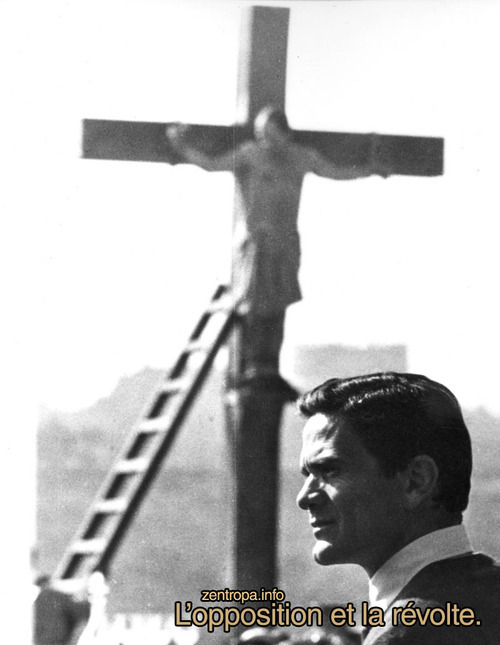
L'opposition et la révolte
par Pier Paolo Pasolini
Ex: http://zentropaville.tumblr.com
"L’Eglise est désormais condamnée à disparaître de par son appartenance à un monde humaniste du passé, qui constitue un obstacle à la nouvelle révolution industrielle. Le nouveau pouvoir nécessite, de la part des consommateurs, un esprit complètement pragmatique et hédoniste […] Il n’y a plus de place pour la religion et surtout pas pour l’Eglise. La conséquence de tout ça sera la dissolution naturelle de l’Eglise. […]
En reprenant une lutte qui d’ailleurs est dans sa tradition (la lutte de la papauté contre l’Empire), mais pas pour la conquête du pouvoir, l’Eglise pourrait être le guide grandiose, mais non autoritaire, de tous ceux, qui refusent (c’est un marxiste qui parle, et justement en qualité de marxiste) le nouveau pouvoir de la consommation, qui est complètement irréligieux, totalitaire, faussement tolérant et même, plus répressif que jamais, corrupteur, dégradant. C’est ce refus que l’Eglise pourrait symboliser, en retournant à ses origines, c’est-à-dire à l’opposition et à la révolte.”
00:05 Publié dans Réflexions personnelles | Lien permanent | Commentaires (0) | Tags : pier paolo pasolini, italie, réflexions personnelles, église, catholicisme, religion | | del.icio.us | | Digg | Facebook