Newton was the very first to see order and regularity bound up with the greatest simplicity, where before him disorder and mismatched heterogeneity were to be met with, whereas since then comets run in geometric paths.
Rousseau was the very first to discover under the heterogeneity of the assumed shapes of humanity its deeply hidden nature and the concealed law according to which providence through his observation is justified. Formerly the objections of Alfonso and Mani were still valid. After Newton and Rousseau, God is justified and Pope’s thesis is henceforth true.[2]
Here Kant, who was a great admirer of Newton, lauds Rousseau as the Newton of the human world. He also indicates the central problem that any Newton of the human world must face: the objections of Alfonso and Mani. What Alfonso and Mani are objecting to is the idea of divine providence.
King Alfonso X of Castile reportedly declared, “Let justice triumph though the world may perish,” implying that in this world there is no justice; he also reportedly said, upon inspecting the Ptolemaic system of the heavens, that “If I had been the creator of the world, I should have made the thing better.”[3]
Both claims imply that the created world is not ruled by a benevolent divine providence, but by the forces of evil, which is the position of Mani, the founder of Manicheanism.
To answer the objections of Alfonso and Mani, we must solve the problem of evil, i.e., we must produce a theodicy. We must show that the evils of the world are consistent with an omnipotent, omniscient, omnibenevolent, provident God–either by showing that the evils of the world are illusory, or by showing that they are the unavoidable characteristics of the best of all possible worlds, which is the thesis of Alexander Pope’s Essay on Man and Leibniz’s Theodicy, the thesis known as “optimism.”
Now, at first glance, it seems odd to attribute an optimistic solution to the problem of evil to Rousseau, for although Rousseau thought that the natural world is good, the same was not true of society. Consider this passage from Emile:
when . . . I seek to know my individual place in my species, and I consider its various ranks and the men who fill them, what happens to me? What a spectacle! Where is the order I had observed [in nature]? The picture of nature had presented me with only harmony and proportion; that of mankind presents me with only confusion and disorder! Concert reigns among the elements, and men are in chaos! The animals are happy; their king alone is miserable! O wisdom, where are your laws? O providence, it it thus that you rule the world? Beneficent Being, what has become of your power? I see evil on earth. (Emile,[4] 278)
Indeed, the overall tenor of Rousseau’s Discourse on the Sciences and the Arts (First Discourse, 1750[5]) and his Discourse on the Origins of Inequality (Second Discourse, 1754[6]) was so darkly pessimistic that Voltaire, who was himself no defender of optimism, declared them “books against the human race.”
The First Discourse argues that the progress of the arts and sciences from the Renaissance to the Enlightenment has served to corrupt rather than to improve morals. The advancement of civilization causes the decay of humanity.
The Second Discourse argues that civilization as such is absurd and evil–absurd because it arises from sheer Epicurean contingency rather than through providence or natural teleology, both of which aim at the good–and evil because it alienates us from our natural goodness, our natural freedom, and our natural sentiments of self-love and pity.
What, then, was Kant thinking of when he attributed a theodicy of the human world to Rousseau? How did he read Rousseau as an optimist? There are three Rousseauian texts that can support Kant’s optimistic reading: Emile, Of the Social Contract (1762), and the famous letter to Voltaire of August 18, 1756,[7] which was published without Rousseau’s permission and may have reached Kant. (I should also note that the following discussion is partial, for it abstracts from the crucial topic of Rousseau’s denial of original sin and assertion of the natural goodness of man.)
In his letter to Voltaire, Rousseau responds to Voltaire’s Poems on the Lisbon Disaster, an attack on optimism occasioned by the series of great earthquakes that destroyed much of Lisbon in 1755. Rousseau explicitly defends the optimism of Leibniz and Pope.
Furthermore, he makes it clear that he is an optimist about both the human and the natural worlds, arguing that the First and Second Discourses, contrary to the pessimistic impression they create, actually vindicate God’s providence by showing that God is not the author of mankind’s miseries. Man himself is their author.
Because mankind is free, we are the author of all of our moral miseries and, because we have the freedom to avoid or minimize most of our physical miseries, to the extent that we fail to do so, we are their authors as well. God is blameless.[8]
In Of the Social Contract, the project of a theodicy of the human world is apparent in the famous opening paragraph of Book I, Chapter 1:
Man is born free and everywhere he is in chains. One believes himself the master of others, and yet he is a greater slave than they. How has this change come about? I do not know. What can render it legitimate? I believe that I can settle this question.[9]
In the state of nature, man is free. In the civil condition, he is in chains, but the chains are not merely the iron fetters of slaves, but the fetters of vanity (amour-propre) which bind the masters as well. How did man pass from the state of nature to the civil state? Rousseau claims he does not know.
Now this is a startling claim, for Rousseau’s Second Discourse is precisely an account of man’s passage from the state of nature to the civil state. Apparently, whatever kind of account it is, it does not in Rousseau’s eyes constitute knowledge. This is an important point, to which we will return later.
Rousseau’s next question, “What can render it legitimate?” introduces the question of justice. Rousseau’s goal is to show us that the chains of civilization are legitimate, that they are justified.
It is not possible to offer a complete interpretation of Rousseau’s General Will doctrine here, so let me simply to assert that for Rousseau the civil state is not good because we choose it; rather we ought to choose it because it is good.
Furthermore, Rousseau does not think that only the ideal state of the Social Contract is preferable to the state of nature. He thinks that all really-existing civil states, save the most corrupt, are more choiceworthy than the state of nature; the civil state as such is better than the state of nature.
And why is the civil state good? Rousseau’s most explicit answer is Chapter 8 of Book I: “Of the Civil State”:
This transition from the state of nature to the civil state produces in man a very remarkable change, by substituting in his conduct justice for instinct, and by giving his actions a morality that they previously lacked. It is only when the voice of duty succeeds physical impulsion, and right succeeds appetite, that man, who till then had only looked after himself, sees that he is forced to act on other principles, and to consult his reason before listening to his inclinations. Although in this state he is deprived of many advantages he holds from nature, he gains such great ones in return, that his faculties are exercised and developed; his ideas are expanded; his feelings are ennobled; his whole soul is exalted to such a degree that, if the abuse of his new condition did not often degrade him to below that from which he has emerged, he should ceaselessly bless the happy moment that removed him from it forever, and transformed him from a stupid and ignorant animal into an intelligent being and a man.[10]
Now, in the context of Of the Social Contract, the alternative title of which is “Principles of Political Right,” it is only natural to construe the question of the legitimacy of the civil state as a matter of political or human justice. But the “happy moment” when man passed from the state of nature into the civil state marks the beginning of historical life; it is not the same as the moment in history when man passed from primitive and warlike society (Hobbes’ state of nature) to law-governed political society; rather it is the moment when the human world itself comes into existence.
The transition from warlike society to political society can be guided and illuminated by principles of political right. But the transition from nature to history is pre-political, and if we are to “ceaselessly bless” this moment, it is not in virtue of its political justice, but in virtue of a natural justice–a natural justice that in Emile is revealed to be a divine justice.
In Emile, particularly the Profession of Faith of a Savoyard Vicar in Book IV, Rousseau offers an explicit theodicy of the human world, arguing that man’s fall from nature into history is a felix culpa, even if it does violence to our natural freedom and sentiments, because it creates the conditions for the development of our moral and spiritual natures. Providence, therefore, is vindicated.
First, Rousseau argues that, although man chooses most of his miseries and is therefore responsible for them, the very freedom that creates these miseries is also the condition for his moral dignity:
To complain about God’s not preventing men from doing evil is to complain about His having given him an excellent nature, about His having put in man’s actions the morality which ennobles them, about His having given him the right to virtue. The supreme enjoyment is in satisfaction with oneself; it is in order to deserve this satisfaction that we are placed on Earth and endowed with freedom, that we are tempted by the passions and restrained by conscience. (Emile, 281)
Second, Rousseau argues that civilization makes possible the development of man’s rational faculties, whereas savages and peasants, although bright and active during childhood, become mentally dull and placid as adults. During childhood, young Emile, whose education is the subject of the book, is given all the freedom of young savages and peasants. But Emile will be taught to think, and thinking is an activity that presupposes the development of civilization. Therefore, the full development of Emile’s intellectual faculties requires that he leave the state of nature for the civil state. Thinking is good, and civilization, because it cultivates thinking, is good as well (Emile, 315–16).
Third, the cultivation of taste adds a great deal to the agreeableness of life; it teaches us to find pleasures virtually anywhere and to minimize pain and suffering (Emile, 344); it also makes us more finely attuned to the objective differences in the world around us; and it encourages us to take pleasure in reflection and discussion, thus creating the conditions for philosophy. The ideal place to cultivate taste, however, is not Arcadia or Sparta or Geneva, but decadent Paris:
If, in order to cultivate my disciple’s taste [speaks the preceptor, the narrator of Emile], I had to choose between taking him to countries where there has not yet been any cultivation of taste and to others where taste has already degenerated, I would proceed in reverse order. . . . taste is corrupted by an excessive delicacy which creates a sensitivity to things that the bulk of men do not perceive. This delicacy leads to a spirit of discussion, for the more subtle one is about things, the more they multiply. This subtlety makes feelings more delicate and less uniform. Then as many tastes are formed as there are individuals. In the disputes about preferences, philosophy and enlightenment are extended, and it is in this way that one learns to think. (Emile, 342)
Even the theater, Geneva’s ban on which Rousseau defended, is lauded as a school of taste (Emile, 344).
Finally, in book five of Emile, the political institutions which so frequently do violence to our natural freedom and sentiments are defended as necessary conditions for the development of our moral and spiritual nature:
If he [Emile] had been born in the heart of the woods, he would have lived happier and freer. But he would have had nothing to combat in order to follow his inclinations, and thus he soul have been good without merit; he would not have been virtuous; and now he knows how to be so in spite of his passions. The mere appearance of order brings him to know order and to love it. The public good, which serves others only as a pretext, is a real motive for him alone. He learns to struggle with himself, to conquer himself, to sacrifice his interest to the common interest. It is not true that he draws no profit from the laws. They give him the courage to be just even among wicked men. It is not true that they have not made him free. They have taught him to reign over himself. (Emile, 473)
It is important to note that Rousseau is not talking about the good laws of the ideal state described in Of the Social Contract, but about the bad laws of any and all really-existing states. For Rousseau, even bad laws are better than no laws at all, for laws as such awaken and actualize potencies of the soul which slumber in the state of nature. In particular, laws which prescribe actions contrary to our inclinations awaken our free will; such laws open up the latent distinction between the soul and the body (the soul understood as our moral personality, the body understood as the desires, drives, and inclinations of our physical frame), and finally such laws offer us occasions for virtue, understood as self-mastery.
Man in the state of nature is unreflective and therefore experiences no distinction between the self and its desires and inclinations. Freedom in the state of nature is experienced as the free play of inclination. It is only when a human being is presented with the choice of two incompatible courses of action, one determined by his inclinations and the other by the commandments of the law, that he becomes aware of his moral freedom, i.e., his capacity not simply to follow his impulses, but actively to choose his actions–and not simply to choose particular actions, but to choose the ultimate grounds for determining his actions.
When a human being is presented with the choice of acting upon the desires and incentives of the economy of nature or upon human laws–even absurd and unjust commands–if he chooses to suppress his natural inclinations to obey human laws, then he experiences a sublime elevation of his moral personality above his own body, and above the economy of nature in general, as well as a sense of pride in his moral strength and self-mastery.
Rousseau is fully cognizant of the cruelty of civilization, of its tendency to mortify and mutilate our natural freedom, our natural goodness, and our natural sentiments of self-love and pity. But even at its worst, civilization is justified by the fact that it awakens our distinctly human capacities to exercise moral freedom, to master our inclinations, to take responsibility for our actions. Civilization brings us to know and esteem ourselves as creatures who are not merely cogs in the clockwork of nature, but its masters and possessors. Therefore, civilization—even at its worst—is better than the state of nature. Therefore, the providence that brought us from nature to history is vindicated.
This, I think, is a plausible reconstruction of how Kant read Rousseau’s project as a theodicy of the human world. Now I wish to deal with an objection to this interpretation.
The Kantian interpretation of Rousseau can be characterized as theistic and dualistic, whereas most contemporary interpretations of Rousseau, particularly those influenced by Marx and Leo Strauss tend to treat Rousseau as a modern Epicurean, i.e., as an atheist and a materialist. The Epicurean interpretation of Rousseau is based primarily upon the Second Discourse, and I think that James H. Nichols, Jr. is correct to suggest that,
in this particular work Rousseau is most obviously influenced by Lucretius: the analysis of man’s primitive condition, and of the subsequent steps of development out of it; the character of prepolitical society; and thereafter the movement via disorder and violence to the institution by compact of political society with coercive laws–on all these points Rousseau follows the main lines of the Lucretian account.[11]
Both Rousseau and Lucretius regard man as naturally independent, self-sufficient, limited in his desires, and therefore as happy.
Both regard society as a realm of vanity, false opinions, and artificial desires which trap us in an alienating web of interdependence with other persons and external things, leading to competition, enmity, violence, oppression, and misery.
Finally, both Lucretius and Rousseau offer a non-teleological and non-providential account of man’s passage from nature into history.
Epicureanism is to this day the main alternative to teleological and theistic accounts of the origins of order. According to Epicurus, the appearance of order can be explained without reference to teleology or design, simply as the product of random material collisions which, over a very long time, accidentally produce pockets of order which can maintain and replicate themselves within the environing chaos.
On such an account, man does not leave the state of nature because of the inner-promptings of his nature. Nor does he leave it under the guidance of providence to fulfill a divine plan. Man leaves the state of nature simply because of the accumulation of a large number of essentially contingent and absurd events, such as volcanic eruptions, tectonic upheavals, and even–in the Essay on the Origin of Language–the sudden shifting of the earth’s axis of rotation away from the perpendicular of the plane of its orbit.
Rousseau makes no reference to natural teleology. And save for one reference, appeals to providence are conspicuously absent. Indeed, Rousseau’s account of man’s passage from the state of nature is even more Epicurean than Lucretius’s account, for Lucretius offers a harsher view of prehistoric life than Rousseau and therefore makes the passage from prehistory to history seem far more natural, whereas Rousseau paints an idyllic picture of prehistoric life, which makes the transition from nature to history seem all the more jarring and inexplicable.
Since the perspective of the Second Discourse is clearly Epicurean, i.e., atheistic and materialistic, if one accepts the Second Discourse as a statement of Rousseau’s metaphysical convictions, one is obligated to explain away Rousseau’s theistic and dualistic pronouncements–as well as his explicit critique and rejection of Epicureanism–in Emile, the letter to Voltaire, and elsewhere.
The strategy of Leo Strauss and Allan Bloom seems to be to assimilate the credo of the Savoyard vicar to Rousseau’s account of civil religion in Of the Social Contract. To put it crudely, the vicar’s credo is a salutary noble lie–something to be believed by Emile, but not by Rousseau himself.
Roger D. Masters, although he is a student of Strauss, rejects this approach–in my opinion quite rightly. Rousseau’s substantial agreement with the vicar’s credo is indicated by the fact that its language and arguments appear in texts written in Rousseau’s own name, such as the letter to Voltaire of August 18, 1756, the letter to Jacob Vernes of February 18, 1758, the Letters written from the Mountain, and the Reveries. Rousseau also adds his own approving notes to the Profession itself.[12]
On the basis of such evidence, Masters concludes that Rousseau’s private convictions were theistic and dualistic, although he maintains that these private convictions are “detachable” from Rousseau’s public philosophy, which remains atheistic and materialistic.
By contrast, the Kantian interpretation of Rousseau I wish to defend maintains that both Rousseau’s private convictions and his final philosophic system are dualistic and theistic.
But to maintain this thesis, I must explain, or explain away, the apparent Epicureanism of the Second Discourse. I wish to suggest that the Second Discourse really is an Epicurean account of man’s nature and his passage into history, but that it does not represent Rousseau’s final metaphysical position.
I do not, however, wish to argue that it represents an Epicurean “stage” in Rousseau’s “philosophical development.” Instead, I wish to suggest that the Epicureanism of the Second Discourse is merely hypothetical and provisional. This is, I think, the clear sense of the following passage:
Let us . . . begin by setting all the facts aside, for they do not affect the question. The researches which can be undertaken concerning this subject must not be taken for historical truths, but only for hypothetical and conditional reasonings better suited to clarify the nature of things than to show their true origin, like those of our physicists make every day concerning the formation of the world. Religion commands us to believe that since God Himself took men out of the state of nature immediately after creation, they are unequal because He wanted them to be so; but it does not forbid us to form conjectures, drawn solely from the nature of man and the beings surrounding him, about what the human race might have become if it has remained abandoned to itself. That is what I am asked and what I propose to examine in this Discourse.[13]
Those who wish to treat Rousseau as something more than a hypothetical and conditional Epicurean can, of course, treat this passage as merely an attempt to placate possible Christian censors by casting what is meant to be a true account of man’s nature and history as merely suppositious.
I think that this is clearly part of Rousseau’s intention. But I see no reason to conclude that his statement is also insincere, especially because I can offer a good philosophical reasons for why Rousseau might have adopted a hypothetical Epicureanism, and as a rule I think that we should always prefer philosophical explanations of a given passage instead of, or in addition to, extrinsic political explanations, and we should always prefer taking an author’s statement as sincere unless and until it resists such treatment.
What, then, is the philosophical explanation for Rousseau’s provisional adoption of a position he regards as ultimately false? I wish to suggest that the purpose of the Second Discourse is to lay the groundwork for a total critique of civilization. To offer a total critique of civilization, we must find a standpoint outside of civilization from which we can take the totality of civilization into view. This standpoint is the state of nature.
But why an Epicurean as opposed to, say, an Aristotelian account of the state of nature? Because for Aristotle, man is by nature both rational and political; for Aristotle, the actualization of man’s nature requires civilization; therefore, Aristotelian nature cannot provide a critical standpoint outside of civilization. Epicurean nature, however, can.
In the Second Discourse, man is by nature neither rational nor political. He is a simple, unreflective, undivided material being, wholly content with his lot. Civilization, when viewed from the state of nature, thus seems to be nothing more than a ghastly spectacle of suffering, and we are left to conclude that there’s nothing in it for us; we feel with a pang that our hearts are just not in it.
Given the choice, we would never have left the state of nature. Instead, we were forced out of it by mere accidents. Civilization as such, therefore, is both evil and absurd.
But why does Rousseau mount a total critique of civilization? Rousseau’s critique is not an end itself. Nor is it the prelude to a total revolutionary reconstruction of society. Instead, it is a prelude to an essentially conservative project of reconciliation–the reconciliation of man with civilization and with divine providence. It is a theodicy of the human world.
Rousseau constructs the strongest possible critique of civilization in order to oppose it with the strongest possible defense.
To mount this defense however, we must recognize that the sense of complete alienation from civilization produced by the Second Discourse is a product of its essentially atheistic and materialistic perspective.
Rousseau claims that civilization is based upon man’s internal dividedness against himself. Epicureanism, as a one-dimensional materialism, can conceive of man only as a unified being. Therefore, from the Epicurean point of view, the dividedness of civilization–any civilization–is a violent deformation of our nature.
Civilization would, however, be justified if man really is a divided being. If man really is divided into body and soul, then the only way to heal the violent dividedness of vanity is with the natural dividedness of virtue.
It is only by adopting a dualistic account of human nature and a theistic and providential metaphysics that we can reconcile ourselves to civilization.
This does not, of course imply that Rousseau was uninterested in social and political reform. What it does imply is that Rousseau accepted the essentially conservative principle that although bad laws ought to be changed, bad laws are still better than no laws at all; therefore, we should be cautious lest we discover we are more capable of destroying bad laws than creating better ones.
Notes
1. In the 1970s, at the University of Toronto’s Law School, there occurred a remarkable panel on Plato’s Republic, the principal members of which are numbered among this century’s greatest Plato interpreters: Hans-Georg Gadamer, Eric Voegelin, and Allan Bloom. Bloom prefaced his remarks on the Republic with a remarkable claim about Kant and Rousseau. He said, if memory serves, that “Kant was an absolutely extraordinary interpreter of Rousseau, perhaps the greatest interpreter of Rousseau who ever lived.” I find this claim interesting for many reasons, not the least of which is this: If Bloom’s estimation of the profundity of Kant’s reading is correct, then some of what Bloom himself says about Rousseau has to be wrong.
2. Immanuel Kant, Bemerkungen in den “Beobachtungen über das Gefühl des Schönen und Erhabenen,” ed. Marie Rischmüller (Hamburg: Felix Meiner, 1991), 48; my trans.
3. My source for the second anecdote is Ernst Cassirer, Rousseau, Kant, Goethe: Two Essays, trans. James Gutmann, Paul Oskar Kristeller, and John Hermann Randall, Jr. Princeton: Princeton University Press, 1945), 18, n22.
4. Jean-Jacques Rousseau, Emile, or On Education, trans. Allan Bloom (New York: Basic Books, 1979).
5. Jean-Jacques Rousseau, Discourse on the Sciences and Arts (First Discourse) and Polemics, ed. Roger D. Masters and Christopher Kelly, The Collected Writings of Rousseau, vol. 2 (Hanover and London: Dartmouth College/University Press of New England, 1992).
6. Jean-Jacques Rousseau, Discourse on the Origins of Inequality (Second Discourse), Polemics, and Political Economy, ed. Roger D. Masters and Christopher Kelly, The Collected Writings of Rousseau, vol. 3, ed. Roger D. Masters and Christopher Kelly (Hanover and London: Dartmouth College/University Press of New England, 1992).
7. Jean-Jacques Rousseau, Letter to Voltaire, August 18, 1756. Trans. Terence E. Marshall, in The Collected Writings of Rousseau, vol. 3.
8. Letter to Voltaire, 109–10, 111–12; cf. Emile, 281–2, 293.
9. Rousseau, Of the Social Contract, trans. Charles M. Sherover (New York: Harper and Row, 1984), 4.
10. Of the Social Contract, 18.
11. James H. Nichols, Jr., Epicurean Political Philosophy: The De rerum natura of Lucretius (Ithaca: Cornell University Press, 1976), 198–99.
12. Roger D. Masters, The Political Philosophy of Rousseau (Princeton: Princeton University Press, 1968), ch. 2.
13. Jean-Jacques Rousseau, The First and Second Discourses, ed., Roger D. Masters, trans. Roger D. Masters and Judith R. Bush (New York: St. Martin’s Press, 1964), 103.





 del.icio.us
 Digg
Digg Facebook


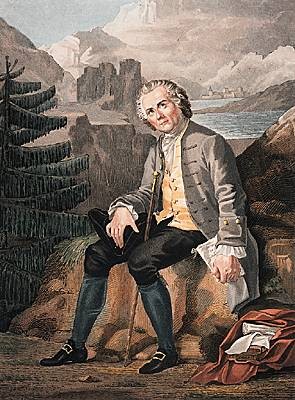 In 1762, Immanuel Kant did something unprecedented: he missed his daily walk. He stayed home to read Jean-Jacques Rousseau’s new book Emile, a philosophical novel on education which was to exercise a profound and revolutionary influence on his thought.[1] In one of his notes on Rousseau, from 1764–1765, Kant writes: