This essay is dedicated to George Hocking.
1. Introduction
Is there a connection between Ásatrú and White Nationalism? This has been a controversial issue among Ásatrúar for many years. For me, however, the answer is obvious. I regard Ásatrú and White Nationalism as so inseparably bound to one another that to espouse Ásatrú while rejecting White Nationalism is to involve oneself in a fatal contradiction (fatal, really, in more than just the logical sense).
Before I go any further, let me define my terms. For the uninitiated, Ásatrú refers to the religion of those who believe in the pre-Christian Germanic gods, principally Ódhinn (hence the religion is also sometimes referred to as “Odinism”). I use the term Ásatrú simply because it seems that we need a word to refer to the religion, and this seems as good to me as any.
By “White Nationalism” I mean, very simply, a movement which recognizes White people – people of European stock, in other words – as a distinct nation or race, with its own set of national interests, and that seeks to advance those interests. The principal interests of White people (of any people, actually) are their biological survival and the preservation of their culture. White nationalists believe that White people have as much right to assert and protect their interests as any other people.
Obviously, however, this movement arose because the dominant message communicated to Whites today by the cultural and political establishment is that they have no right to assert their group interests. Other racial and ethnic groups may assert their interests, but when Whites do likewise this is “racism.” This double standard is simply part and parcel of the general anti-White, anti-Western animus that now permeates academia, mainstream media, and politics in Europe and America. White nationalism has become necessary because White interests are genuinely imperiled.
Of course, Whites themselves have done a great deal to bring this peril about. Aside from their remarkably passive, uncomplaining tolerance of persons and ideologies openly hostile to them, Whites have also bought into a vision of the “good life” that emphasizes individualism and hedonism and absolves them of any obligation to bring a new generation into the world. The result is that the White birthrate has declined drastically, and created a situation in which Whites are essentially slated for minority status and dispossession in both Europe and America.
Contrary to how White Nationalism is portrayed by its detractors, it does not spring from hatred of other groups, nor does being a White Nationalist require us to hate non-Whites and wish them ill. It does, however, require us to recognize that our interests may sometimes conflict with those of other groups. And, in such situations, it asks us to choose our own group interests rather than to masochistically sacrifice those interests for the sake of others (something which is expected today of Whites, but not of any other group). White Nationalism, in effect, simply recommends to Whites that they do what we all know other groups are already doing and prioritize their own interests.
To take a familiar example, American Blacks clearly saw the 2008 presidential race in terms of “us vs. them.” Accordingly, 96% of them voted for Barack Obama, a fact which those in the mainstream media found so normal and unremarkable as to be unworthy of comment. On the other hand, when it was revealed that 55% of Whites voted for John McCain this was decried by many as “racism.” White people originated the utopian ideal of a society in which everyone has somehow gotten beyond thinking in terms of their group interests. But it’s time for them to face the harsh reality that this just isn’t going to happen. What this means is that if non-White groups insist on thinking and acting in terms of their group interests, then so must we.
I offer the above as a simple, frank, and accurate encapsulation of the nature of White Nationalism. But why must Ásatrú be linked with it? Why can’t Ásatrú, as a religion, be apolitical?
2. Ásatrú as Ethnic Religion
First of all, let’s begin with a very simple point: Ásatrú is an ethnic, not a creedal religion. Something is an “ethnic religion” if, quite simply, it is the religion of a specific people or ethnic group. Judaism and Hinduism are excellent examples of ethnic religions. One is a member of the religion simply by being born a member of the tribe or the nation.
A creedal religion is one in which membership is defined not by ethnic identity but rather, as the term implies, by profession of a creed. Islam, Christianity, and Buddhism are the three largest creedal religions. Because what counts in creedal religion is belief, not ethnicity, creedal religions are universalistic, accepting adherents from any and all races. On the other hand, because ethnic religions are the religions of a specific people they typically do not admit converts from other ethnic groups. (Both Judaism and Hinduism do admit converts in some cases, but they generally discourage conversion and do not – unlike the Christians and Muslims – proselytize.)
The term “Hinduism” is derived from the Persian word “Hindu,” which actually just denotes the Indian people. The etymology of “Judaism” is similar, deriving ultimately from a word that simply means “Jew.” The words themselves do not distinguish a member of the ethnic group from an adherent to the religion. And this ambiguity exists not just in language but in fact. For most Indians to be Indian is to be a Hindu (which really means, to be Indian is to be an Indian). I have even heard it said that it is possible to be an atheist Hindu. All that this means, of course, is that no matter what an Indian believes he can’t stop being an Indian (just like Karl Marx, who was an atheist, is still referred to as a Jewish, or German-Jewish philosopher). Of course, we might want to qualify this by saying an Indian cannot stop being an Indian in the ethnic sense. But the very identity of a people seems bound up with its religion – often in ways that the people themselves (who may outwardly profess secularism) may not be consciously aware of. And the identity of an ethnic religion is bound up with its people.
In truth, an ethnic religion flows from the unique nature of a specific people. Culture is a human product, and like all human products it is partially the result of features about us that are innate and unchosen. In recent years, scientists have brought forward overwhelming evidence that proves heredity shapes much about our behavior and personality that we had formerly thought was due to environment or “freedom of choice.” Some of the most impressive evidence – evidence which is quite simply astonishing – comes from studies of identical twins separated at birth.[1] These twins often dress alike, vote alike, have the same hobbies, share the same social attitudes, share the same tastes in art and music, drive the same make and model car, and achieve virtually identical scores on IQ tests.
An ethnic group is essentially a set of genetically similar people. It is more or less a very large extended family. What establishes group identity is relative similarity and relative difference: members of ethnic group X are considered such because, while they are not exactly the same, they are more like one another than they are like the members of group Y. Similarity is founded upon difference (an important point, to which I will return later). At some point in pre-history, members of distinct ethnic groups, made up of genetically-similar members, evolved religions. And these religions are remarkably different from one another. I consider it a truism, at this stage of our knowledge, to assert that these differences flow in part from the genetically distinctive natures of the ethnic groups involved. I say “in part” because obviously other factors were in play: e.g., geographic location, historical circumstances, etc.
We can actually dispense with all this newfangled talk about genetics and boil it down to this: an ethnic religion is a product of the innate, distinctive nature of a people. Differences between ethnic religions are in part attributable to innate, natural differences. And the reason why a particular religion works so well for a given people is quite simply because, individual differences aside, they share the same basic nature (though here again other factors may come into play, such as sharing the same circumstances).
Religions are not floating systems of acontextual abstractions that may be superimposed on any people, willy-nilly. This is true even of creedal religions. Every creedal religion was developed originally by a specific people and only subsequently was membership thrown open to all and sundry. Most famously, Christianity was originally a minor Jewish cult which, in its earliest days, admitted only Jews as adherents. This means that despite whatever universalistic cast it may have, a creedal religion is still shaped by the character of the people that originated it. This is the reason why our Northern European ancestors had to radically reshape Christianity (to “Germanize” it) before they could sign on. This “Germanization of Christianity” was actually a long process, which culminated in the terrific upheaval and bloodshed of the Reformation.[2] A religion forged by one people in one part of the world cannot be imposed upon a completely different people, in a completely different part of the world, without much suffering, violence, and betrayal of conscience.
Ásatrú is the ethnic religion of the Northern European peoples who speak Germanic languages. It is the product of that “ethnic group” (an ethnic group that to a great extent did not and does not to this day see itself as a distinct ethnic group). And it could not be the product of any other group. Oswald Spengler aptly described the soul of Northern European man as “Faustian.” He tells us that the “prime-symbol” of the Faustian is “pure and limitless space”:
Far apart as may seem the Christian hymnology of the south and the Eddas of the still heathen north, they are alike in the implicit space-endlessness of prosody, rhythmic syntax and imagery. Read the Dies Irae together with the Völuspá, which is little earlier; there is the same adamantine will to overcome and break all resistances of the visible.[3]
The Faustian soul is characterized by a solemn inwardness, tending towards solitude and melancholy – but matched by a ceaseless, outward-striving will. European man has always sought to go beyond: to explore, to find adventures in other lands, to conquer, to peer into the mysterious depths of things, to find new ways to control and manipulate his environment. This is not to say that these qualities are never found in other peoples, but – as Spengler recognized – they are most pronounced and developed in Northern European man.
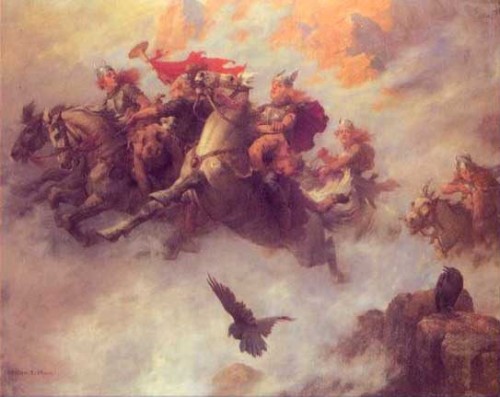
We find the Faustian spirit in our gods. Ódhinn is the ceaseless wanderer, and the leader of the wild hunt. From his throne, called Hlidskjalf, he can survey the entire world. His two ravens, Huginn and Muninn (Thought and Memory) fly over the earth, bringing news of all things back to him. But there are secrets concealed even from Ódhinn, and beings (such as the Norns) over which he has no power. Like us, he burns with a desire to know the hidden and to control his fate. So he hung on the windy tree, nights all nine, and won the secret of the runes – the hidden lore that explains all things. He sought wisdom too from Mimir’s well (the well of memory) and sacrificed an eye to drink from it. We are Ódhinn, and he is the embodiment of the Faustian spirit.
Spengler writes:
What is Valhalla? [It] is something beyond all sensible actualities floating in remote, dim, Faustian regions. Olympus rests on the homely Greek soil, the Paradise of the Fathers is a magic garden somewhere in the universe, but Valhalla is nowhere. Lost in the limitless, it appears with its inharmonious gods and heroes the supreme symbol of solitude. Siegfried, Parzeval, Tristan, Hamlet, Faust are the loneliest heroes in all the cultures. The longing for the woods, the mysterious compassion, the ineffable sense of forsakenness – it is all Faustian and only Faustian. Every one of us knows it. The motive returns with all its profundity in the Easter scene of Faust I.
“A longing pure and not to be described
drove me to wander over woods and fields,
and in a mist of hot abundant tears
I felt a world arise and live for me.”[4]
Ásatrú is an expression of the unique spirit of the Germanic peoples. And one could also plausibly claim that the spirit of the Germanic peoples just is Ásatrú, understanding its myth and lore simply as a way in which the people projects its spirit before itself, in concrete form. And this leads me back to where I began, to the “political” point of this essay: to value Ásatrú is to value the people of Ásatrú; to value their survival, their distinctness, and their flourishing. For one cannot have the one without the other.
Ásatrú would have not have been possible without the people who gave rise to it, and it cannot be sustained without that same people. Politically correct Ásatrú organizations like the Troth (formerly the Ring of Troth) essentially reject the idea that Ásatrú is an ethnic religion and treat it more or less on the model of the Unitarian Church, opening their doors to all peoples. But this is simply absurd. Ásatrú is not a trans-national “creed” that may be comfortably “professed” by all peoples. It is the worldview of a specific people, forged in its encounter with a certain part of the earth. The approach of organizations like the Troth does nothing more than demonstrate that their real religion is the civil religion of modern, secular liberalism, to which Ásatrú (and everything else) must be fitted. But no one with any knowledge of the sagas could possibly believe that Ásatrú is compatible with modern liberalism.
I am delighted if non-Whites find the lore of my ancestors fascinating. They may study it all they like – in fact, I would encourage them in this. But it is not their tradition and I would not invite them to consider themselves as “one of us” or to take part in our rituals. I find Shinto fascinating, and in general I am very interested in Japanese culture and have great respect for the Japanese people. But I would never seek to join the Shinto religion, because I am a White Westerner and it is not my tradition. And, by the way, should I seek to join Shinto and should the Japanese politely reject me, no one today would find it the least bit shocking or objectionable. Yet if we Ásatrúar take the same position and declare that our ethnic religion is for those of our ethnicity alone, this is regarded as a hideous form of “racism.” We need to do it anyway, and erect niding poles before the houses of the politically correct.
To repeat: to truly value Ásatrú must involve valuing the people who gave rise to Ásatrú and whose spirit the religion expresses. And valuing our people means seeking to preserve it and our culture, and, in all conflicts of interest between our people and some other, taking the side of our own people.
3. “Us” vs. “Them”
My last statement above reiterates the idea (mentioned early on in this essay) that there are conflicts of interest between human groups. I take this to be a truism, but in fact it is a controversial claim today. The ideal of multiculturalism, after all, is that of a society in which different groups happily coexist and have no fundamental conflicts of interest. But this ideal rests upon a breathtakingly shallow view of what “culture” consists in.
The liberal “celebration of diversity” is in fact a celebration of culture only in its external and superficial forms. In other words, to Western liberals “multiculturalism” winds up amounting simply to such things as the co-existence of different costumes, music, styles of dance, languages, and food. But the real guts of the different cultures consist in such things as how they view nature, how they view the divine, how they view men and women, and how they view the relative importance of their own group in the scheme of things. And it is by no means clear that members of cultures with radically different views on these matters can peacefully co-exist.[5]
It is chiefly affluent, college-educated White people who believe in the possibility of a Star Trek world without conflicts of group interests. Non-Whites typically do not believe that such a world is possible, and do not yearn for it, because they have a much keener sense of group identity than do Whites, and a much keener desire to promote the interests of their own group. White democrats are typically delighted when Black people move into their neighborhoods. When the situation is reversed, Blacks are comparatively less thrilled (the fact that the vast majority of them are also democrats does not seem to make much of a difference). Nor are Asians in Chinatown wringing their hands over why so few Latinos live on their block.
The reason for this is that these groups have a healthy proprietary sense. They believe that their neighborhoods belong to them. If others want to move in, this is perceived as a clear-cut conflict of interests. In fact, conflicts of interest between groups are real and ineradicable. They do not exist merely because individuals think that they exist, thus they cannot be eliminated simply by “changing people’s minds.” Conflicts of interest exist for the simple, metaphysical reason that every individual, and every group is something.
To be always means to be something; to possess a specific identity consisting of certain traits and not others. This is true of all things that exist: rocks, pencils, paramecia, human individuals, and human groups such as races or nations. But every identity is always an identity in difference. In other words, the identity of anything is constituted through the ways in which it is different from other things.
On the table to the left of my computer are two coffee mugs. They possess certain traits in common, in virtue of which I class them both as members of the same kind. But their possession of these traits is marked by difference. Both are ceramic and roughly the same height, but one of the mugs is thicker and heavier. Both can be filled with liquid, but the thin mug (because of its thinness) can contain more liquid. Both are emblazoned with designs, but the designs differ (one is just an image, but the other conveys a “message”: a quote from the agrarian author Wendell Berry).
A coffee mug is what it is by being different from other coffee mugs, but also by being different from everything else. The identity of something can be expressed positively, such as when we say that the mug is thick, four inches high, ceramic, and White. But every positive characteristic is actually a form of “not being”: the mug is thick and not thin, four inches high and not five, ceramic and not metal (or any other material), White and not some other color. The mug, furthermore, is characterized by being incapable of self-generated motion, stopping a bullet, standing for election, and a whole host of other things.
All identity is identity in difference, it does not matter what we are speaking of. And this includes peoples and cultures. The identity of a people is constituted through the ways in which it is not like other peoples. This leads to some peculiar problems that do not occur in the case of coffee mugs. The two mugs on my desk are different, but their differences do not lead to conflict. Only one of them rests on a coaster, but they cannot be said to be in competition for the coaster. With human beings it is quite different. Differences between human groups are always sources of potential conflict. This is also true, of course, of differences between human individuals – and of differences between individual animals, and animal species.
Our different ways of speaking, dressing, eating, practicing religion, making money, doing art, making music, raising children, understanding sex differences, and having sex are all perpetual sources of potential conflict between human groups. As are such things as differences of wealth and geographic location (others may want our land and our loot). To be a distinct human group is to be different from other groups, and where there is difference there is always, of necessity, friction, hostility, conflict, and often war. It is reasonable to see these as negatives, given the suffering they produce. But so long as there are distinct human groups these are ineradicable (which is exactly what some Leftists have realized in advocating miscegenation). Further, if we value the distinctness of our group – which really just amounts to saying if we value our group – then in a sense we have to recognize that friction with other groups is not entirely bad. It is simply a corollary of the fact that our group possesses identity; that it exists at all.
One of the shocking simplicities of multiculturalism is the naiveté with which the word “diversity” is invoked as a kind of feel-good mantra denoting something unqualifiedly positive. Diversity simply means difference, and human differences are not a happy, G-rated, child-friendly parade of colors, sounds, tastes, and scents. Diversity means perpetual conflict, misunderstanding, intolerance, and suspicion. Nevertheless: celebrate diversity! Because without diversity, without difference, we would be nothing at all.
The German political theorist Carl Schmitt (1888-1985) is famous for having argued that the “concept of the political” is founded on the distinction between “us vs. them,” or, as he actually puts it, friend and enemy. Do not be thrown by the word “political.” What Schmitt actually means is that human groups define themselves through opposition to an other. What unites a people is the recognition that they and their interests stand opposed to other groups, who have their own interests. From this sense of unity, a structure of power arises – a political order – in response to the opposition of the other. This involves such things as maintaining civil order and maintaining preparedness, so that if the threat of the other becomes acute the group will be ready to act.
Of course, I can easily imagine someone responding to this – quite reasonably – with the following objection: “Why must a group define itself in opposition to an other? Why must a group’s identity be built upon hostility and ill will?” But this objection misunderstands Schmitt’s position, and what the phrase “in opposition” really means. Schmitt’s claim is not specifically that group identity is founded upon hostility to some other group. Rather, what he means is that group identity is founded upon a sense of distinctness from other groups. However, as I have argued above, so long as this distinctness exists there is the ever-present possibility of conflicts of interest and hostility.
Schmitt writes that
The political enemy need not be morally evil or aesthetically ugly; he need not appear as an economic competitor, and it may even be advantageous to engage with him in business transactions. But he is, nevertheless, the other, the stranger; and it is sufficient for his nature that he is, in a specially intense way, existentially something different and alien, so that in the extreme case conflicts with him are possible.[6]
Schmitt goes on to note that all human divisions become political if they are so strong that they result in grouping human beings according to the friend-enemy distinction. This includes religious divisions. I ended the introduction to this essay with the rhetorical question “Why can’t Ásatrú, as a religion, be apolitical?” But even if we were to take the universalistic position of the Troth and regard Ásatrú as merely a set of “beliefs” that anyone can hold, we would still have to make a distinction between those who hold those beliefs and those who don’t; those within Ásatrú and those without. And we would have to recognize that outsiders are always potential “enemies”; that (as history has shown us countless times) doctrinal, religious differences frequently lead to hostilities.
As I have already shown, however, to understand Ásatrú as a creedal religion is to fundamentally distort and deform it. Ásatrú is an ethnic religion. Its identity – its distinctness – consists not just in its “beliefs,” but in the fact that it is a religion of this people not that one; and it is an expression of the nature of this people, not that one. To value and adhere to Ásatrú must therefore involve valuing the people of Ásatrú. However, we have seen that a people only constitutes itself as a people through difference. And where there is difference there is always the possibility of conflict.
To value the people of Ásatrú means, therefore, to recognize that there is no possibility of eliminating conflicts of interest between our people and other peoples. To value the people of Ásatrú means to be constantly vigilant in securing its interests, and always to choose our interests over those of other groups. “Us” vs. “them” is simply not going to go away. Indeed, as I alluded to earlier in this essay, the conflict between us and them has only intensified in recent years. And it is going to get worse. The survival of the people of Ásatrú itself is at stake. And without that people, there will be no Ásatrú.
So far I have offered a philosophical case for believing that adherence to Ásatrú must involve ethnic partisanism, and indeed that it must involve the uncompromising defense of our people’s interests. But let us set philosophical argument aside for the moment and simply ask what position is most in accord with the spirit of Ásatrú. Is it the position I have outlined, which insists on the organic connection between Ásatrú and our people and calls upon us, therefore, to defend our people’s interests even if that means ostracism, condemnation, or death? Or is it the position that disconnects Ásatrú from its people, insists that that people not commit the intolerable “racist” sin of asserting its interests, and enjoins them to cheerfully accept their dispossession and extinction? Which position is more in accord with the spirit of the sagas?
Those who believe that we can (or should) ignore differences and who dream of an end to all conflict are those who – whether they realize it or not – wish for the eradication of distinct identities. But without identity there is . . . nothing. Life – and being itself – is identity, and thus life is difference and strife. Our way – the pagan way of Ásatrú – is the affirmation of this life, red in tooth and claw. Their way is the way of death, extinction, annihilation. A “liberal pagan” is a contradiction in terms.
4. Just who is “our people”?
I now turn to some thorny questions about who it is that constitutes “our people.” I earlier defined the people of Ásatrú as Northern European people who speak Germanic languages. And I made it clear that I am speaking about a distinct ethnic group. Thus, someone whose ancestry is Nigerian or Chinese and happens to live in Denmark and speak Danish does not count. Ancestry is what counts here.
But at this point one might raise a problem with the argument of this essay thus far. I have attempted to make the case that Ásatrú is, or ought to be, inseparable from White Nationalism. But White Nationalism is not exclusively about defending the interests of the Germanic peoples. It’s also about defending the interests of those who are (again, ethnically) Italian, Spanish, Russian, Czech, Polish, Greek, etc. These are all “White people.” But not all of them can plausibly be called the people of Ásatrú.
Yes, one can argue that Ásatrú is but one variation of Indo-European spirituality, and that all of these people – in pre-Christian times – were practicing folk religions closely related to Ásatrú. But it would be awfully strained and artificial to argue that just because this is the case, we should therefore care about what happens to non-Germanic, European people. It seems like actually the most one can argue, using the sort of logic I’ve employed in this essay, is that Ásatrúar of genuinely Northern European or Germanic stock should care about the interests of other people of similar stock. But it is going too far to say that they should be “White Nationalists.”
This certainly seems like a major problem, but in fact it is not.
Let’s begin with an obvious point that I have so far not mentioned: it is natural for people to prefer others like themselves, and to feel greater sympathy for others like themselves. This has its basis, again, in genetic similarity. Brothers care more about their sisters, typically, than they care about their second cousins – even if they have all grown up in close proximity. Cousins typically care more about each other than they do about the neighbors, even if the neighbors are members of the same ethnic group. And neighbors of the same ethnic group typically care more about each other, and trust each more, than they do the neighbors down the block who belong to a different ethnic group.
It is quite natural for an Englishman to feel a greater tie to other Englishmen than to the French. And it quite natural for me, whose ancestry is predominantly Germanic (despite my Irish name) to feel closer to an Englishman than to a Frenchman. But there are times when I can feel quite close to a Frenchman. For example, if I happen to run into one while visiting Nigeria. In such circumstances, the cultural, temperamental, and even linguistic differences between us are going to feel very slight. Were a Dane around also, I’m guessing I would form a stronger bond with the Dane than with the Frenchman. But I would bond with the Frenchman as well because, after all, he’s like me too (just, perhaps, not as much like me).
So, who is our people? It is quite natural for me and others like me to feel closest of all to others of Germanic ancestry. But other Europeans are like me as well. By extension, they are my people as well. The analogy to family and extended family is useful here. I will always feel the closest bond with my immediate family. But I also feel a bond, though not as close, with my cousins. To take a hackneyed example, if my cousin Alfred were drowning in a lake and a perfect stranger were drowning as well and I could only save one, I would save my cousin. And no one would fault me.
If a White stranger were drowning in a lake and a black stranger were drowning as well and I could only save one, who would I save? I imagine I would probably act instinctively to save the White man – and I submit that this would be as natural (and unmalicious) a reaction as preferring to save one’s family member. Yet it would no doubt be denounced as “racism.” It would not matter to me if the White person were Danish or Greek. I would act instinctively to help him, just because he’s “like me.” This natural preference for one’s own is something to be cultivated and celebrated. It is thoroughly anathema to Christianity (which only permits preferring Christians to non-Christians, and not even that really), and it is thoroughly “pagan.”
My essay so far seems to be enjoining Ásatrúar to start caring about members of their own group. In fact, I am merely encouraging them to reflect on the ties they already feel with their own group – whether they are consciously aware of those feelings or not – and to affirm them without shame. However, today the truth is that I don’t just feel a tie to other Northern Europeans, but with White people generally.
It is natural for us to think of multiculturalism, massive non-White immigration into Europe and America, and the declining White birth rate as unmitigated disasters. But the “cunning of reason” is at work here, as it always is. The positive effect of all of this is that it can forge a sense of European – or White – identity and unity such as has never existed before. It is sobering to look back over the course of European history and to realize that there was a time (very recently, in fact) when it would have been nearly impossible for members of different European nations to see each other as “like us.” That the English used to be mortal enemies with the Spanish, that the Germans fought the Austrians, and the Austrians fought the Italians, and so on, now seems almost incredible. That some of these innumerable, fratricidal conflicts were (ostensibly) over different inflections of Christianity is positively sickening.
Of course, a liberal might object to my argument by saying that changing historical circumstances have also resulted in our feeling greater ties and greater sympathy with members of other races as well. Just as the English and the French now feel that they are basically more alike than opposed, so multiculturalism has resulted in our feeling natural sentiments of sympathy with the Chinese and the Nigerians as well. The evidence for this includes an increase in interracial marriages. Also, the fact that everyone today (excluding White racists) has at least one friend of another race. Doesn’t my position actually hypocritically enjoin us to ignore the natural sentiments we now feel toward other races? Or, putting it another way, aren’t I arbitrarily encouraging my readers to affirm some of their natural sentiments and to deny others?
The trouble with this argument is that it rests both on false claims, and on an overly narrow understanding of what “natural sentiments” are. First of all, it has always been the case that members of different races have been capable of feeling sympathy for, and bonding with one another. It is also the case that humans – of any race – form bonds with members of other species, as any pet owner can attest.
But the truth is that people of different races typically only form deep bonds with each other in unusual and extraordinary circumstances (e.g. if they happen to share the same foxhole). Otherwise, the bonds tend to be mostly temporary and do not go very deep (as is the case with co-worker “friends” of different races). Yes, interracial marriage is more common than it used to be, but the vast majority of people still prefer to marry within their race. And the divorce rate among interracial couples is significantly greater than that of same-race couples. And yes, it is true that everyone today has at least one friend of a different race – everyone on television, that is. The reality is that most people prefer the company of their own kind, and form the deepest bonds with others like themselves – whether we are talking about married couples, friends, roommates, coworkers, business partners, or what have you.
To return to my earlier example: is it possible that in addition to bonding with the Dane and the Frenchman I might also bond with a Nigerian? Absolutely. But the bond is unlikely to be as strong or as deep. And should strife erupt on my visit to Nigeria, should Nigerians begin killing Whites (as is happening right now to White farmers in Zimbabwe), I would unhesitatingly band together with my Dane and my Frenchman, and probably forget about my Nigerian friend entirely. (Disraeli really was right: “Race is everything. There is no other truth.”)
Finally, we must also keep in mind that “natural sentiments” are not confined to sympathy. Another natural sentiment is antipathy. And antipathy is born of difference; the greater the difference the stronger the likelihood of antipathy. Let us affirm all of our natural sentiments, both the bitter and the sweet.
5. Conclusion: Quo Vadis, Ásatrú?
I turn now to another consideration about who “our people” is. I can imagine a follower of Ásatrú objecting to the argument of this essay by saying “Look, why should I give a damn about ‘my people’? The vast majority of them regard Ásatrú as an absurdity. They are a people thoroughly corrupted by modern individualism and consumerism. They are lemmings passively cooperating in their own destruction. They are Last Men. Men without chests. Hollow men. Men without qualities. Trousered apes. Why should I stick my neck out and be a White Nationalist when it would cause most average White people to want spit in my face and call me names?”
I have heard such sentiments expressed not just by Ásatrúar, but by many Whites with no particular interest in Ásatrú. The trouble with this position, though, is that it simply expects too much of our people. It has always been the case, without exception, that the vast majority of the people of any race are essentially conformists who do as they are told, and are often incapable of perceiving what’s really good for them.
The greatness of our people does not consist in our being individualists who are always ready and willing to break with the crowd. The greatness of our people consists in what they are capable of when they are properly led. Yes, the sagas celebrate the deeds of heroic individuals who often break the rules. But such individuals are celebrated because they are exceptional. It is such men who lead, and command the loyalty of others (which is the virtue most conspicuously celebrated in the Germanic tradition). All peoples need leaders; they seldom if ever liberate or enlighten themselves. If great changes are to be made a vanguard is needed, and in the beginning that vanguard will be feared and despised.
Our people have undergone centuries of brainwashing by Christianity, the Enlightenment, and cultural Marxism (three peas in a pod, actually). It is unreasonable to expect them to overcome this quickly, and without a great deal of assistance. Instead of hating our own people for their degraded condition we must instead learn to pity them. And we must learn to love them as we do errant children.
This is, admittedly, not that easy. Especially given that the modern world does all it can to tear us apart from each other. The rapaciousness of capitalism sets brother against brother and uproots us from the towns our families have called home for generations. It turns marriages into “partnerships” of two upwardly mobile consumers who remain together so long as the arrangement is mutually advantageous. Feminism simply aids and abets this aberration of capitalism, setting men and women against each other. Sons are set against fathers by a culture that insists that youth must rebel against age, and that there is value only in youth. And neighbors are set against each other as well; gone is the trust that allowed us once upon a time to leave our doors unlocked.[7] It is a wonder that we are able to feel anything for each other at all. This is a problem that we must work to overcome, not worsen by abjuring the realm and declaring others like ourselves to be “hopeless.”
The culture of our people has changed radically over the centuries, mainly for the worse. Yes, we have been corrupted and so have our values. But in fact we are still fundamentally the same people. Early on in this essay I spoke of how Ásatrú is a product of the unique nature of our people – a product, if you like, of our genetically distinct nature. That nature has not changed. Genetically, we are the same as we were in the time of Arminius. Underneath the veneer of modern decadence we are still the same people who slaughtered 20,000 Romans in the Teutoburg Forest. We are still the same people who carved the runes and thrilled to stories of Ódhinn and the gods. We are still the same people whose ideal of feminine virtue was the bloodthirsty Gudrun. And we are the people of Shakespeare, Schiller, Goethe, Mozart, Beethoven, Nietzsche, and Wagner.
The bloodline still exists, and the potential still exists within the blood. Our religion, Ásatrú, is obsessed with clan and ancestral identity. And we modern Ásatrúar claim to honor our ancestors. So I ask you: is there a greater way to honor our ancestors than to act to safeguard and revivify their bloodline? We like to posture as Norsemen. But the truth is that our ancestors would never recognize most of us, because most of us have committed sins they would find incomprehensible. We have turned out backs on our own people – and are cheerfully, unashamedly in full retreat.
It is time to ask ourselves just exactly what Ásatrú is to us and where it is going. Is our aim simply that Ásatrú be accepted as yet another “lifestyle choice” in the great multicultural stew of New Age “spirituality”? Is it enough simply that we are able to get together with other oddballs like ourselves and put on silly costumes and perform rituals in dead languages? The only thing that can redeem Ásatrú and raise it above the level of being yet another modern form of isolating, self-indulgent eccentricity is if we come to see Ásatrú as requiring something great of us. And, again, what greater task could there be than the salvation of our people? Again, what task is more worthy of Ásatrú, the religion of epic heroes, of our ancestors, the religion in which blood is everything?
Ásatrú just is the heroic commitment to our people and to its spirit. Compared to this all else – the runes, Old Norse, drinking horns, mead, skaldic verse, and so on – is external and inessential. But it is completely unsurprising that so many would choose the external over the essential. This is the modern way. Especially when the essential involves a commitment to something as fundamentally anti-modern, “irrational,” and dangerous as loyalty to those like oneself, simply because they are like oneself. Nevertheless, this is it. Setting all externals and non-essentials aside, this is our ethnic religion; this is Ásatrú. To defend the people of Ásatrú and its spirit is itself Ásatrú.
It is time to reflect on the ambiguity of the term “ethnic religion,” about which I earlier said only a little. An ethnic religion is a religion “of” a people in more than one way. In the deepest way, an ethnic religion is the spirit of a unique people made manifest to itself. In a sense, it is through their ethnic religion that a people worships itself. The religion is the people, and the people are the religion. This is the most fundamental answer to the question of the connection between Ásatrú and “the political,” or the connection of Ásatrú to “White Nationalism.” There is no problem about connecting these, in fact. They are already together – tied together intimately and inseparably, whether this is recognized by all Ásatrúar (or all White Nationalists) or not.[8]
Notes
[1] See Nancy L. Segal, Born Together—Reared Apart: The Landmark Minnesota Twins Study (Cambridge: Harvard University Press, 2012).
[2] See James Russell, The Germanization of Early Medieval Christianity: A Sociohistorical Approach to Religious Transformation (New York: Oxford University Press, 1994).
[3] Oswald Spengler, The Decline of the West, Vol. I, trans. Charles Francis Atkinson (New York: Alfred A. Knopf, 1926), 185-86.
[5] Unless, of course all cultural differences are eliminated save the purely external, via the transformation of all peoples into homogenized, interchangeable consumers bereft of any deeply-felt convictions. This is, in fact, the hidden global capitalist agenda of multiculturalism, now being cheerfully advanced by useful idiots on the anti-capitalist Left.
[6] Carl Schmitt, The Concept of the Political, trans. George Schwab (Chicago: University of Chicago Press, 2007), 27.
[7] Studies have shown that in multicultural neighborhoods distrust is high, even among members of the same group.
[8] An interesting implication of all the above – which I cannot develop here – is the other side of the equation: White Nationalism is inseparably connected to Ásatrú. This will be resisted by many White Nationalists. Some are atheists who reject all religion. Others view Ásatrúar (not without some justification) as, at best, eccentrics in funny hats. But if my basic argument is effective, that Ásatrúar should be White Nationalists because Ásatrú is in fact the expression of the spirit of (Northern European) White people, then we must recognize that this also supports the claim that White Nationalists should be Ásatrúar – at least those of Northern European ancestry. There are movements of other European peoples that seek to revive worship of their old gods – such as the Greek organization Thyrsos Hellenes Ethnikoi – and I applaud them.





 del.icio.us
 Digg
Digg Facebook


 Daar kan ik een halve bibliotheek over volschrijven. Mijn inziens is de kern van de marxistische filosofie, dan ben ik nog niet bezig over de praktische uitwerking, al ronduit ketters, wegens gebrek aan een ander woord. Het is een ketterij op het vlak van religieuze beleving, marxisme verkondigt immers een ronduit messianistisch beeld waarbij het Paradijs hier op Aarde gebouwd kan worden zolang we ons maar onderwerpen aan de marxistische dogmatische richtlijnen. Marxisten zullen verkondigen dat zij, in tegenstelling tot religie, zich niet onderwerpen aan dogma's, maar dat is niet waar. Zij zien het inderdaad niet als dogma's, maar als een onbediscussieerbare waarheid. Tenslotte komt het altijd op enkele dingen neer; de mens is alleen (geen God), de mens dient vrij te zijn van dogma's of religieuze axioma's, alle menselijke historische feiten zijn terug te brengen tot socio-economische factoren en de mens wordt momenteel onderdrukt doordat hij de vruchten van zijn arbeid niet krijgt. Ook is de mens een onbeschreven blad dat enkel slecht wordt door negatieve impulsen die hij krijgt door de conformering aan maatschappelijk gezag (normen, waarden en tradities). Een compleet fout mensbeeld, zo uit de waanbeelden van Rousseau geplukt. Niet dat ik dit metafysisch verwerp, aangezien de realiteit me gelijk geeft. Het voorste deel van onze hersenen bevatten onze remmingen. Zelfs extreme schade daaraan kunnen wij overleven, maar dan wordt de mens teruggebracht naar zijn primitieve gedragingsfase, namelijk zonder sociale conventies en normen en waarden. Resultaat? Een egoïstisch wezen dat enkel aan zijn eigen direct belang denkt. Biologie 1 – 0 marxisme dus. Het marxisme gelooft ook in de blinde Terreur in naam van de waarheid (cfr. Rousseau met de volonté générale, uitgevoerd door Robbespierre en de jacobijnen en vandaag de dag nog altijd verdedigd door mensen als Zizek).