Ok

En poursuivant votre navigation sur ce site, vous acceptez l'utilisation de cookies. Ces derniers assurent le bon fonctionnement de nos services. En savoir plus.

mardi, 23 octobre 2012

Ce dimanche Méridien Zéro reçoit Thibault Isabel

Méridien Zéro a reçu Thibault Isabel, philosophe, pour évoquer avec lui ses travaux et réflexions sur les maux humains qui traversent les sociétés occidentales.

philosophie, thibault isabel, décadence, perte,

DIFFUSION DE L'EMISSION

LE DIMANCHE 21 OCTOBRE

http://www.meridien-zero.com/

Pour écouter:

http://www.meridien-zero.com/archive/2012/10/19/emission-n-115-un-monde-a-bout-de-souffle.html


20:43 Publié dans Philosophie | Lien permanent | Commentaires (0) | Tags : radio, radio libre, philosophie, thibaut isabel | |  del.icio.us | | Digg! Digg |  Facebook

Auf Kriegskurs: Europas Linke wirbt für „humanitäre Interventionen“

bombardements-sur-la-syrie_924081_460x306.jpg

Auf Kriegskurs: Europas Linke wirbt für „humanitäre Interventionen“

 
„Ich glaube an zwei Prinzipien: Nie wieder Krieg und nie wieder Auschwitz.“ (1)

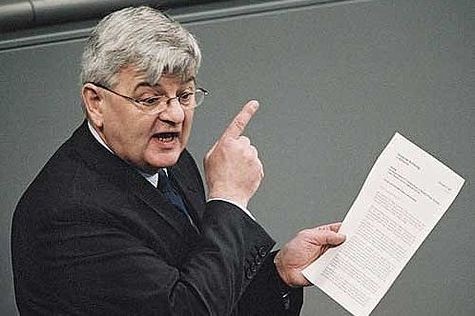
Diese Worte wurden auf dem Parteitag der Grünen im Mai 1999 gesprochen, der während des NATO-Bombardements auf Jugoslawien, an dem sich auch Deutschland beteiligte, stattfand. Sie kamen aus dem Mund des Grünen-Politikers und damaligen Außenministers Joschka Fischer. Sein Kommentar sollte den Krieg gegen das serbische Volk rechtfertigen. Dasselbe Volk, das bereits in zwei Weltkriegen unter dem deutschen Imperialismus zu leiden hatte.

In den 1970er Jahren war Fischer ein linksradikaler Aktivist und in den 1980er Jahren gehörte er zu den Mitbegründern der Grünen. Das Anliegen hinter der Parteigründung war es, den verschiedenen Umwelt- und Antikriegsgruppen eine parlamentarische Repräsentation zu verschaffen. Hätte in der damaligen Zeit jemand über die Möglichkeit gesprochen, dass diese Partei gegen Ende des Jahrtausends eine aktive Rolle in einem Aggressionskrieg gegen Jugoslawien spielen würde, es wäre als absurd abgestempelt worden. Eine direkte Beteiligung Deutschlands an einem Krieg war ein völliges Tabu, und niemand auf Seiten der Linken oder der Rechten hätte es gewagt, eine solche Option in Erwägung zu ziehen. Nach 1945 war es allgemeiner Konsens, dass von Deutschland nie wieder ein Krieg ausgehen sollte.

Der politische Übergang in Deutschland, der sich in großen Teilen Westeuropas widerspiegelte, ist wichtig für das Verständnis, wie es dazu kam, dass viele Mainstream-Linke zu modernen Kriegstreibern wurden, oftmals sogar in einem größeren Maße als ihre konservativen Widersacher.

Mit ihrem Eintreten für das Konzept des „Humanitären Interventionismus“ und ihrer moralischen Autorität erscheinen die „progressiven“ politischen Entscheidungsträger viel glaubwürdiger als die  lärmenden neokonservativen Hassprediger, wenn es darum geht, eine militärische Intervention vor der Bevölkerung zu rechtfertigen.

In Westeuropa sind die meisten Befürworter der Militarisierung innerhalb der Mainstream-Linken mit den grünen oder den sozialdemokratischen Parteien verbunden. Einer der ersten Verfechter militärischer „humanitärer Interventionen“ war Daniel Cohn-Bendit, Mitglied der Grünen in Frankreich. Er war auch einer der Vordenker der Abschaffung der europäischen Nationalstaaten zugunsten einer stärkeren Europäischen Union. Während des Bürgerkriegs in der ehemaligen jugoslawischen Republik Bosnien verlangte Cohn-Bendit die Bombardierung der Serben. Jeder, der damit nicht einverstanden sei, würde dieselbe Schuld auf sich laden wie diejenigen, die während des faschistischen Massenmords im Zweiten Weltkrieg tatenlos zuschauten:

„Schande über uns! Wir, die Generation, die unsere Eltern so sehr für ihre politische Feigheit missachtet hat, schauen jetzt selber scheinbar hilf- und machtlos und doch selbstgefällig dabei zu, wie die bosnischen Muslime Opfer einer ethnischen Säuberung werden.“  (2)

Während des Bosnien-Krieges wurde die Masche perfektioniert, mittels der Zeichnung von Parallelen zu den Verbrechen der Nazis jene zu dämonisieren, die den geostrategischen Interessen des Westens im Wege stehen. Exemplarisch dafür steht die Geschichte von den sogenannten Todescamps in Bosnien: Als Beweis für die angebliche Existenz von Konzentrationslagern, die von den Serben in Nazi-Manier betrieben würden, veröffentlichte eine britische Zeitung im August 1992 ein Foto, das einen abgemagerten Mann hinter einem Stacheldrahtzaun zeigt. Wie später jedoch der deutsche Journalist Thomas Deichmann herausfand, stand der Mann außerhalb des Zaunes und war  nicht hinter Stacheldraht gefangen. (3)

Natürlich gab es Gefangenenlager auf allen Seiten und die Bedingungen dort waren zweifellos oftmals schrecklich. Die Sache ist jedoch die, dass die westliche Propaganda versuchte, die Seite der Kroaten und Muslime reinzuwaschen, indem sie ganz und gar als Opfer dargestellt, während gleichzeitig die bosnischen Serben als Barbaren und Nazis präsentiert wurden.

Kontrahenten oder auch ganze Bevölkerungsgruppen mit einem Etikett zu versehen, um diese zu dämonisieren, ist kein neues Konzept in der Kriegspropaganda. Ein entpolitisiertes Verständnis von Faschismus, als lediglich eine Form des Nationalismus, ermöglicht es der postmodernen Linken, Aggressionskriege als „humanitäre Interventionen“ und somit „antifaschistische“ Aktionen zu präsentieren. Die traditionelle linke Sichtweise sieht im Faschismus hingegen nicht nur eine chauvinistische, rassistische Ideologie, sondern berücksichtigt auch dessen wirtschaftlichen Hintergrund und dessen Bündnis mit der Hochfinanz, der Rüstungsindustrie und den politischen Eliten.

fischer_plenum.jpg

Als der UN-Sicherheitsrat im März 2011 die Resolution 1973 zur Errichtung einer Flugverbotszone über Libyen verabschiedete, die als Vorwand für einen Angriff auf das Land diente, enthielt sich Deutschland zusammen mit Russland, China, Indien und Brasilien der Stimme. Die schwarz-gelbe Regierungskoalition erntete für diese Haltung heftige Kritik aus den Reihen der Sozialdemokraten und vor allem aus den Reihen der Grünen, die der Bundesregierung vorwarfen, nicht stärker eine Pro-Kriegs-Position bezogen zu haben. Der ehemalige Außenminister Joschka Fischer attackierte seinen Amtsnachfolger Guido Westerwelle dafür, die Resolution der Kriegstreiber nicht unterstützt zu haben und merkte an, dass der Anspruch Deutschlands auf einen ständigen Sitz im UN-Sicherheitsrat damit „in die Tonne getreten“ wurde. (4)

Es ist daher nicht überraschend, dass sich im gegenwärtigen Konflikt in Syrien – welcher erheblich vom Westen orchestriert und finanziert wird, wie auch die Bürgerkriege in Jugoslawien und Libyen – grüne und linksliberale Politiker in Westeuropa als die stärksten Befürworter einer Strategie der Eskalation gebärden. In einer Fernsehdebatte verwehrte sich die Grünen-Vorsitzende Claudia Roth gegenüber jeder Stimme der Vernunft, die für Verhandlungen mit der Assad-Regierung plädiert. (5) Zu diesen zählt auch der Autor und ehemalige Politiker Jürgen Todenhöfer, der eine ausgewogene Position vertritt und jüngst für ein Interview mit Bashar Al-Assad nach Damaskus reiste, damit die Welt auch die „andere Seite“ hören könne. (6) Die Tatsache, dass überhaupt jemand Al-Assad seine Meinung sagen lässt, war für Claudia Roth zu viel. Sie drückte ihre Verärgerung über Todenhöfers Reise in unmissverständlichen Worten aus.

Zur selben Zeit war es der frisch gewählte „sozialistische“ Präsident François Hollande, der als erstes westliches Staatsoberhaupt die Option eines Angriffs auf Syrien öffentlich in Erwägung zog. In seiner Erklärung ließ er die Welt wissen, dass er eine „internationale militärische Intervention in Syrien“ nicht ausschließe. (7)

Hollandes Wahl zum Präsidenten war Ausdruck der Hoffnung vieler Menschen, Nicolas Sarkozys reaktionärer, neoliberaler und korrupten Politik ein Ende zu bereiten und sie durch eine humanere Form zu ersetzen. Was die Außenpolitik angeht, setzt Hollande bedauerlicherweise die neokoloniale Agenda seines Vorgängers fort. (8)

Sowohl im Fall Libyens als auch Syriens forderte Bernard-Henri Levy, ein französischer Philosoph, professioneller Selbst-Promoter und häufig Objekt des Gespötts der Medien, seine Regierung zur Intervention auf, um das „Töten unschuldiger Zivilisten“ zu verhindern. (9) Sein Ruf nach Krieg wurde natürlich als humanistischer Graswurzel-Aktivismus verkauft. In einem offenen Brief an den Präsidenten, veröffentlicht unter anderem von der Huffington Post, zog er das Massaker in Hula als Rechtfertigung für eine Intervention heran. (10) Die Tatsache, dass die Fakten darauf hindeuten, dass es sich bei den Opfern um Anhänger des Assad-Regierung gehandelt hat und diese von Aufständischen getötet worden sind (11), konnte der Schwarz-Weiß-Malerei des virtuosen philanthropischen Aktivisten nichts anhaben.

Von „Auschwitz“ in Bosnien und im Kosovo hin zum „syrischen Diktator“, der Frauen und Kinder abschlachtet, die Strategie, mit der der Widerstand der Bevölkerung gegen einen Aggressionskrieg überwunden werden soll, bleibt dieselbe: Es wird an ihr Schuldbewusstsein und an ihr schlechtes Gewissen appelliert – die „schaut-nicht-tatenlos-zu“-Taktik. Und niemand beherrscht diese Taktik besser als die heutigen „progressiven“ falschen Samariter.

Eingedenk dessen wenden wir uns wieder dem Beispiel Deutschland zu. Bisher hat sich die deutsche Regierung aktiv daran beteiligt, antisyrische Propaganda zu verbreiten. Sie legt aber nicht dieselbe Begeisterung für eine Intervention an den Tag, wie sie sich in den Reihen der „Progressiven“ ausmachen lässt. Auch wenn sich nicht viel Positives über die neoliberale, US-freundliche Regierung Angela Merkels sagen lässt, so ist sie nicht in demselben Ausmaß wie die rot-grüne Opposition dazu bereit, das Risiko eines militärischen Abenteuers einzugehen und spricht sich dementsprechend weiterhin für eine „diplomatische Lösung“ aus. (12) Auch wenn die Vita der schwarz-gelben Regierung zeigt, dass sie weit davon entfernt ist, in Sachen Interventionismus unschuldig zu sein (13),  könnte es noch schlimmer kommen, falls sich nach den Bundestags-Wahlen im Jahr 2013 erneut eine rot-grüne Regierung konstituiert, wie es zwischen 1998 und 2005 der Fall war. Schließlich hat sie seinerzeit die historische Leistung vollbracht, zum ersten mal seit 1945 Kriege in der deutschen Öffentlichkeit salonfähig zu machen.


Der Artikel erschien im Original am 21. September bei Global Research unter dem Titel Europe’s Pro-War Leftists: Selling “Humanitarian Intervention.  Übersetzung: Hintergrund


Anmerkungen

(1) http://germanhistorydocs.ghi-dc.org/docpage.cfm?docpage_id=4440.
(2) http://web.archive.org/web/20101122200452/http://esiweb.org/index.php?lang=en&id=281&story_ID=19&slide_ID=3.
(3) http://web.archive.org/web/19991110185707/www.informinc.co.uk/LM/LM97/LM97_Bosnia.html.
(4) http://www.sueddeutsche.de/politik/streitfall-libyen-einsatz-deutsche-aussenpolitik-eine-farce-1.1075362.
(5) http://www.ardmediathek.de/das-erste/hart-aber-fair/21-00-besser-wegschauen-und-stillhalten-darf-uns-syrien?documentId=11083714.
(6) https://www.youtube.com/watch?v=NBJlpY1qX28.
(7) http://www.spiegel.de/international/world/french-president-leaves-open-possibility-of-military-intervention-in-syria-a-835906.html.
(8) Während seiner Präsidentschaft war Sarkozy verantwortlich für die militärischen Interventionen in Libyen und der Elfenbeinküste.
(9) http://www.guardian.co.uk/world/2012/may/25/levy-libya-film-screening-cannes-festival.
(10) http://www.huffingtonpost.com/bernardhenri-levy/syria-massacre-houla_b_1552380.html.
(11) Siehe beispielsweise: http://www.globalresearch.ca/index.php?context=va&aid=31455.
(12) http://www.tagesschau.de/ausland/syrien1576.html.
(13) So lässt Deutschland den Aufständischen über den Bundesnachrichtendienstes militärische Unterstützung zukommen. Siehe: http://www.wsws.org/articles/2012/aug2012/syri-a21.shtml.

Turkey leads US-sponsored Military Encirclement of Syria

web_syrie_turquie.jpg

Turkey leads US-sponsored Military Encirclement of Syria

Despite widely reported concerns of blowback in Syria due to the arming of jihadist groups, a military build-up on Syria’s borders is proceeding apace.

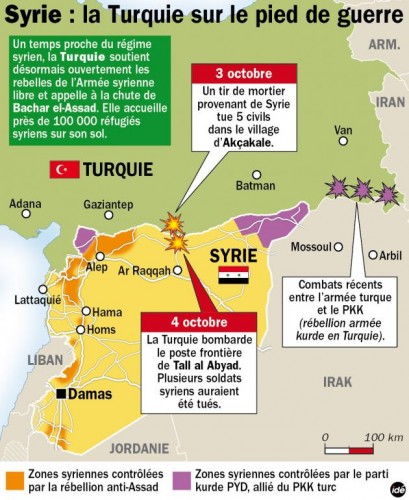
Racep Tayyip Erdogan’s Islamist government in Turkey is leading the way, using the pretext of stray mortar fire from Syria that killed five civilians to legitimise the deployment of 250 tanks, jets, helicopter gunships, troops, artillery emplacements and antiaircraft batteries on the border.

The Turkish Parliament recently granted war powers to Erdogan to send troops into Syria. Daily targeting of Syrian facilities was followed last week by the use of F16s to force down a civilian Syrian Airlines Airbus en route to Damascus from Moscow, with claims that it was carrying Russian weaponry.

Erdogan used the United Nations Security Council as a platform to attack Russia and China—“one or two members of the permanent five”—for vetoing anti-Syrian resolutions and demand an overhaul of the Security Council.

Turkey, along with the Gulf States led by Qatar, is also behind a push to unite Syria’s divided opposition forces, with the explicit aim of overcoming the qualms of the Western powers over arming the opposition and backing it militarily. There is an agreement to announce a joint leadership on November 4 at a conference in Qatar, just two days before the US presidential elections.

Foreign supporters “are telling us: ‘Sort yourselves out and unite, we need a clear and credible side to provide it with quality weapons,’” a source said.

Ensuring an effective command structure under the nominal discipline of the Free Syrian Army (FSA) and the actual control of Turkey and its allies requires the inclusion of rival military leaders Riad al-Asaad, Mustafa Sheikh and Mohammad Haj Ali (all defectors from the regime of Syrian President Bashar al-Assad), as well as various leaders of provincial military councils inside Syria. Funds are also being funneled into the Local Coordinating Committees—hitherto held up by various ex-left groups around the world as being independent of the imperialist powers.

UN Arab League mediator Lakhdar Brahimi is making great play of urging Iran to arrange a four-day cease-fire beginning October 25 to mark the Muslim religious holiday of Eid al-Adha. He is saying less about a proposal, more indicative of the UN’s role, to dispatch a 3,000-strong troop force to Syria.

The Daily Telegraph reported that Brahimi “has spent recent weeks quietly sounding out which countries would be willing to contribute soldiers” to such a force, ostensibly to be made operable following a future truce.

The direct involvement of US and British forces would be “unlikely”, given their role in Iraq, Afghanistan and Libya, so Brahimi “is thought to be looking at more nations that currently contribute to Unifil, the 15,000-strong mission set up to police Israel’s borders with Lebanon.”

These include Germany, France, Italy, Spain and Ireland—“one of which would be expected to play a leading role in the Syria peacekeeping force.”

The proposal was leaked by the Syrian National Council (SNC), with whom Brahami met in Turkey at the weekend. On Monday, the SNC was meeting for a two-day summit in the Qatari capital, Doha. Qatar’s prime minister, Sheikh Hamad bin Jassem al-Thani, took the occasion to push for military intervention in Syria. He told reporters, “Any mission that is not well armed will not fulfil its aim. For this, it must have enough members and equipment to carry out its duty.”

The SNC’s 35-member general secretariat was meeting in Doha to discuss “the establishment of mechanisms to administer the areas which have been liberated” in Syria, according to sources.

Discussions of the direct involvement of European troops in Syria are in line with confirmed reports that the US and Britain have despatched military forces to Jordan, for the purported purpose of policing its border and preventing a spill-over of the conflict.

US Defense Secretary Leon Panetta acknowledged the move at an October 10 meeting of NATO defence ministers in Brussels. The US has repeatedly issued denials of a growing military presence in Turkey located at the Incirlik airbase, but Panetta confirmed that Washington had “worked with” Turkey on “humanitarian, as well as chemical and biological weapons issues.”

The next day, the Times of London and the New York Times reported that Britain too has upward of 150 soldiers and military advisors in Jordan. Jordanian military sources said France may also be involved.

Anonymous senior US defence officials told Reuters that most of those sent to Jordan were Army Special Operations forces, deployed at a military centre near Amman and moving “back and forth to the Syrian border” to gather intelligence and “plan joint Jordanian-US military manoeuvres.”

There is “talk of contingency plans for a quick pre-emptive strike if al Assad loses control over his stock of chemical weapons in the civil war,” Reuters added.

Turkey’s bellicose stand has produced widespread media reports that the US and other NATO powers risk being “dragged into” a wider regional war. This in part reflects real concerns and divisions within imperialist ruling circles and in part an effort to conceal the Western powers’ instrumental role in encouraging military conflict.

Attention has been drawn to the refusal of NATO to heed appeals by Turkey for it to invoke Article 5 of its charter authorising the military defence of a member nation. But despite this, NATO has publicly gone a long way towards endorsing Turkey’s actions.

NATO Secretary-General Anders Fogh Rasmussen told reporters at the same Brussels summit that “obviously Turkey can rely on NATO solidarity… Taking into account the situation at our southeastern border, we have taken the steps necessary to make sure that we have all plans in place to protect and defend Turkey,” [emphasis added].

The previous day, a senior US defence official said, “We engage with Turkey to make sure that should the time come where Turkey needs help, we’re able to do what we can.”

In an indication of the type of discussions taking place in the corridors of power, several policy advisers have gone into print to outline their proposals for a proxy military intervention by Turkey to which the US could then lend overt support.

Jorge Benitez, a senior fellow at the Atlantic Council, urged in the October 15 Christian Science Monitor: “To preserve its credibility in Turkey and the region, NATO should offer radar aircraft and/or rapid reaction forces.”

“Too much attention has been focused on the question of invoking Article 5, the alliance’s mutual defence clause,” he added. Other options were available. Before the US-led war against Iraq in 2003, he noted, Turkey had requested a consultative meeting under Article 4 of the NATO treaty “to discuss how the alliance could help Turkey deter an attack from Iraq.”

Using this pretext, NATO approved Operation Display Deterrence, including the dispatch of four AWACS radar aircraft, five Patriot air defence batteries, equipment for chemical and biological defence, and “more than 1,000 ‘technically advanced and highly capable forces’ to support Turkey during the Iraq conflict.”

Soner Cagaptay of the Washington Institute for Near East Policy published an article in the October 11 New York Times on a three-point strategy he called “the right way for Turkey to intervene in Syria.”

He urged Turkey to “continue the current pattern of shelling across the border every time Syria targets Turkey” in order to “weaken Syrian forces” and let the FSA “fill the vacuum;” to “combine shelling with cross-border raids to target Kurdish militants in Syria;” and, if things “get worse along the border,” to stage “a limited invasion to contain the crisis as it did in Cyprus in the 1970s.”

Dugin Gets in the Ring

Dugin1.jpg

Dugin Gets in the Ring

Whither the Fourth Political Theory?


The Fourth Political Theory


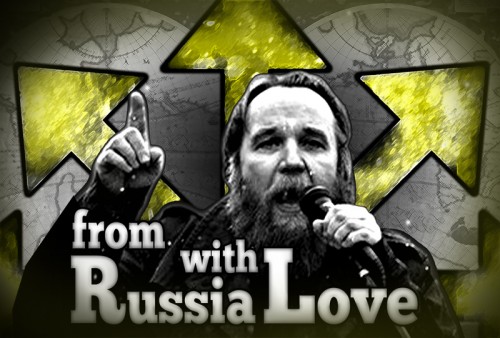
is a book that is clearly not short on ambition. I haven’t actually read it, but I already know more or less what is in it from past writings by its author Professor Alexander Dugin, as well as the lengthy video presentation he gave of his ideas at the Identitarian Ideas conference held earlier this year in Stockholm.
 

Dugin believes there have been three great ideologies in modern history – Liberalism, Communism, and Fascism/National Socialism – and that we are now seeing the formation of the Fourth, which is still waiting to be properly christened and so is known by an ordinal. In the footsteps of Locke, Marx, and Mussolini, we now have Dugin.

I greatly respect and like Dugin. With his Tolstoyan beard and aura of an old church father, he’s a personable and reassuring presence. But I also know how the academic world works, and how it finds all sorts of clever ways to serve different masters, and Professor Dugin is certainly well-connected to a lot of people in the Russian establishment. Is it a coincidence that his ideas support the existence of the Russian Orthodox Church or the multi-ethnic imperialism that is the unavoidable basis for a strong Russian state?

But onto the Fourth Political Theory, with its Millenialist feel of being the fourth and final horseman of the ideological apocalypse. OK, the Theory straps a cushion to its forehead by claiming to be a work in progress, so that any blows landed on it will be softened, but already much of the groundwork has been clearly laid. The road isn’t finished, but we can more or less see where it is headed under the guidance of Professor Dugin.

The Theory supposedly arises from the criticism and deconstruction of the previous three theories, which history has already revealed to be full of flaws and responsible for a great deal of suffering and confusion. Dugin seems happy enough to ride along with modern Liberalism’s historical demolition of Marxism and Fascism, as this makes it a tidy knuckle-to-knuckle, winner-takes-all match between his Fourth Theory and the still undefeated champion, Liberalism.

Seconds out – Ding! Ding! Ding!
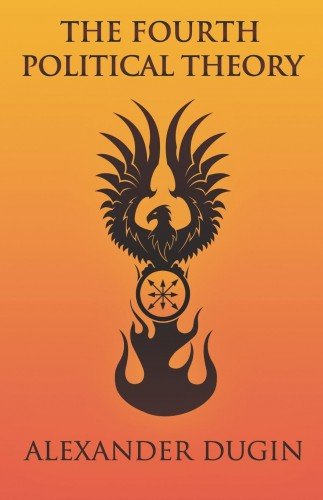
dugin-fpt.jpgDespite past attempts by the Second and Third Theories to claim the crown of modernity, Dugin believes that Liberalism has triumphed here and has managed to irrevocably present itself as the only truly “modern” way. It has also succeeded in presenting itself as the “natural order,” rather than a mere ideology.

To destroy Liberalism, Dugin strikes as these points. But rather than trying to claim that the Fourth Theory is more modern than Liberalism, his strategy is to try to get away from the whole idea of modernity itself by appealing to pre-modern values and conceptualizing them as post-modern eternal values. There is more than a touch of his Old Believer Russian Orthodoxy here.

This is not so much a heavy punch to the ribs of Liberalism as a bit of fancy footwork to avoid Liberalism’s nasty left hook. Modernity is not so easily discarded, as Dugin seems to believe. It operates as the measure of ideological victory, without which no battle can take place. His call to discard modernity is therefore a call for a defensive ceasefire or a time out.

Another key point for Dugin to attack is the subjects or agents of the other three theories. The economic classes of Marxism are presented as outmoded; Fascism’s state as something of a bourgeois innovation; and National Socialist race as a “kind of construction” and not very useful.

Although his punches are only glancing ones here, it does not matter, as these two systems are supposedly punch-drunk losers propping up the bar, muttering “I coulda been a contender.” Where Dugin is more effective is in battering Liberalism’s all-important individual.

This is his mighty opponent’s soft spot and Dugin makes hay here and even gets into position to unleash his KO, but this is where his attack comes unstuck. While all the previous systems have strong subjects/agents that human beings can all feel passionate about – race, nation, class, and our own beloved selves – the Fourth Theory substitutes Heidegger’s flat-footed and abstruse “Dasein” concept. You couldn’t imagine the Bastille being stormed or Stalingrad being held for the sheer pleasure of “being there”!

As a philosophical phrase that says very little by saying too much, it is appropriate that it is then extrapolated into a kind of blanket multi-polarity and call for a true multiculturalism (depoliticized in the case of Russia) and even multi-chronology. Regarding this latter concept, Dugin calls for a world where societies can exist that operate on different temporal patterns, such as cyclical, linear, or more complex. He also calls for the rejection of universal values and comparisons. This is clearly heavily defensive boxing, aimed at avoiding the clever jabs and looming thump that Liberalism is aiming at Putin’s Russia.

The Ascendant Order

Dugin’s interpretation of the previous three theories has a kind of grace, regularity, and ascendant pattern to it. There is natural and elegant progression from the individual to class, and from class to the state (or race). While the other three ideologies nobly struggled in the ring of modernity, and had subjects/agents that could inspire the masses, the Fourth Political Theory has a snatch of Heidegger embroidered on its boxing shorts and seems to be climbing through the ropes with its towel flying through the air behind it.

Perhaps the problem is ideology itself. While Dugin is happy to abandon notions of modernity, he is less happy to abandon ideology. This is only to be expected from an academic who eats, sleeps, and breathes ideology. So, do we actually need it?

Ideology has a progressive nature that does not endear it to many on the Right, but progress is essential in any system that is not based on pure stagnation. Even a cyclical system needs progress to get to the point of its collapse and rebirth. Ideology creates progress through competing with the status quo, or by helping a rising system to become manifest. Therefore, in addition to each ideology having a subject or an agent, history also demonstrates that it needs some kind of enemy or rival: Liberalism’s enemy was the old order; Marxism’s was Liberalism; Fascism’s was Marxism; and Neo-Liberalism’s was Fascism and Marxism.

The problem of the Neo-Liberal world order is that there seems no longer to be any enemy, thus endless stagnation looms. Progress will only arise when Neo-Liberalism in its turn becomes the defeated enemy. On this basis, a strong case exists for the necessity of a Fourth Ideology. But after this, will we need a fifth or sixth, and so on into infinity? The chances are that our technologically enhanced world cannot handle this kind of vast, intense dialectical struggle many times more, so it is essential that the Fourth Political Theory should internalize the engine of progress that has previously come from ideological conflict.

Escaping the Dialectical

As it now stands, the Fourth Political Theory is more a reflection of Russo-centric concerns, and also seems inconsistent with the broader ideological framework that Dugin has outlined. In order for it to gain wider credibility it will have to take on board some of the following points:

Firstly, it should be entirely divorced from any agenda that reflects specific political or religious goals or interests, such as those elements of Russian political pragmatism I constantly detect in Dugin’s work.

Secondly, modernity should not be abandoned. If we are to have an ideological battle, we need winners and losers, and we need a common standard by which to judge them. Communism understood this and so did Fascism, and both were ahead of Liberalism on points for most of their bouts. “Da Sein” and multi-chronology is a form of retreatism.

Thirdly, dismissing Communism and Fascism is premature. Although both were defeated, neither was a purely ideological defeat. Fascism’s defeat was mainly military, while Communism’s was economic. To use boxing terminology one last time, you could say that both were lucky knock outs. These two contestants should be readmitted to the ideological battle until they are defeated ideologically. Neo-liberalism is not capable of doing this. Only a later political theory will be capable of this.

Fourthly, the Fourth Political Theory should be adjusted to fit more neatly into Dugin’s grand pattern of ideological evolution. Only when this is done will it be successful. History shows that Marxism opposed but also used elements of Liberalism. Fascism opposed but also used elements of Marxism and to a lesser extent Liberalism. Therefore it seems likely that the Fourth Political Theory should oppose but also include elements of Fascism and to a lesser extent Marxism.

Fifthly, the Fourth Political Theory needs to find an appropriate subject/agent, one with an existence that the masses can relate to, and one that fits into the ascendant pattern of individual, class, and state/race. The only subject that fits this bill is humanity itself.

Sixthly, to avoid the dangers of endless stagnation and further dialectical struggles resulting in Armageddon, the Fourth Political Theory will need to internalize the progressive impetus.