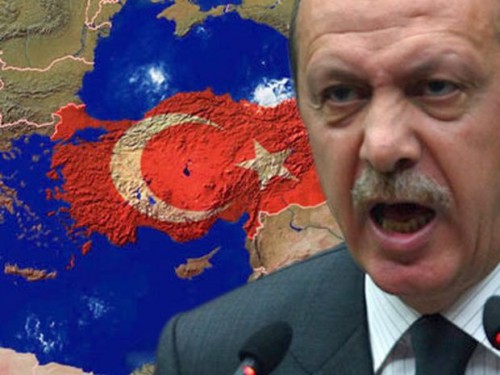
The eruption of the Syrian conflict early in 2011 heralded the demise of Turkey ’s officially pronounced strategy of “Zero Problems with Neighbors,” but more importantly, it revealed a “hidden agenda” in Turkish foreign policy under the government of Prime Minister Recep Tayyip Erdogan.
What Sreeram Chaulia, the Dean of the Jindal School of International Affairs in India ’s Sonipat, described as a “creeping hidden agenda” (http://rt.com on Sept. 15, 2013) is covered up ideologically as “Islamist.”
But in a more in-depth insight it is unfolding as neo-Ottomanism that is pragmatically using “Islamization,” both of Mustafa Kemal Ataturk’s legacy internally and Turkey ’s foreign policy regionally, as a tool to revive the Ottoman Empire that once was.
Invoking his country’s former imperial grandeur, Foreign Minister Ahmet Davotoglu had written: “As in the sixteenth century … we will once again make the Balkans, the Caucasus, and the Middle East, together with Turkey , the center of world politics in the future. That is the goal of Turkish foreign policy and we will achieve it.” (Emphasis added)
Quoted by Hillel Fradkin and Lewis Libby, writing in last March/April edition of www.worldaffairsjournal.org, the goal of Erdogan’s AKP ruling party for 2023, as proclaimed by its recent Fourth General Congress, is: “A great nation, a great power.” Erdogan urged the youth of Turkey to look not only to 2023, but to 2071 as well when Turkey “will reach the level of our Ottoman and Seljuk ancestors by the year 2071” as he said in December last year.
“2071 will mark one thousand years since the Battle of Manzikert,” when the Seljuk Turks defeated the Byzantine Empire and heralded the advent of the Ottoman one, according to Fradkin and Libby.
Some six months ago, Davotoglu felt so confident and optimistic to assess that “it was now finally possible to revise the order imposed” by the British – French Sykes-Picot Agreement of 1916 to divide the Arab legacy of the Ottoman Empire between them.
Davotoglu knows very well that Pan-Arabs have been ever since struggling unsuccessfully so far to unite as a nation and discard the legacy of the Sykes-Picot Agreement, but not to recur to the Ottoman status quo ante, but he knows as well that Islamist political movements like the Muslim Brotherhood International (MBI) and the Hizb ut-Tahrir al-Islami (Islamic Party of Liberation) were originally founded in Egypt and Palestine respectively in response to the collapse of the Ottoman Islamic caliphate.
However, Erdogan’s Islamist credentials cannot be excluded as simply a sham; his background, his practices in office since 2002 as well as his regional policies since the eruption of the Syrian conflict less than three years ago all reveal that he does believe in his version of Islam per se as the right tool to pursue his Ottoman not so-“hidden agenda.”
Erdogan obviously is seeking to recruit Muslims as merely “soldiers” who will fight not for Islam per se, but for his neo-Ottomanism ambitions. Early enough in December 1997, he was given a 10-month prison sentence for voicing a poem that read: “The mosques are our barracks, the domes our helmets, the minarets our bayonets and the faithful our soldiers;” the poem was considered a violation of Kemalism by the secular judiciary.
Deceiving ‘Window of Opportunity ’
However, Erdogan’s Machiavellianism finds no contradiction between his Islamist outreach and his promotion of the “Turkish model,” which sells what is termed as the “moderate” Sunni Islam within the context of Ataturk’s secular and liberal state as both an alternative to the conservative tribal-religious states in the Arabian Peninsula and to the sectarian rival of the conservative Shiite theocracy in Iran.
He perceived in the latest US withdrawal of focus from the Middle East towards the Pacific Ocean a resulting regional power vacuum providing him with an historic window of opportunity to fill the perceived vacuum.
“Weakening of Europe and the US’ waning influence in the Middle East” were seen by the leadership of Erdogan’s ruling party “as a new chance to establish Turkey as an influential player in the region,” Günter Seufert wrote in the German Stiftung Wissenschaft und Politik (SWP) on last October 14.
The US and Israel , in earnest to recruit Turkey against Iran , nurtured Erdogan’s illusion of regional leadership. He deluded himself with the unrealistic belief that Turkey could stand up to and sidestep the rising stars of the emerging Russian international polar, the emerging Iranian regional polar and the traditional regional players of Egypt and Saudi Arabia , let alone Iraq and Syria should they survive their current internal strife.
For sure, his allies in the Muslim Brotherhood International (MBI) and his thinly veiled Machiavellian logistical support of al-Qaeda – linked terrorist organizations are not and will not be a counter balance.
He first focused his Arab outreach on promoting the “Turkish model,” especially during the early months of the so-called “Arab Spring,” as the example he hoped will be followed by the revolting masses, which would have positioned him in the place of the regional mentor and leader.
But while the eruption of the Syrian conflict compelled him to reveal his Islamist “hidden agenda” and his alliance with the MBI, the removal of MBI last July from power in Egypt with all its geopolitical weight, supported by the other regional Arab heavy weight of Saudi Arabia, took him off guard and dispelled his ambitions for regional leadership, but more importantly revealed more his neo-Ottoman “hidden agenda” and pushed him to drop all the secular and liberal pretensions of his “Turkish model” rhetoric.
‘Arab Idol’ No More
Erdogan and his foreign policy engineer Davotoglu tried as well to exploit the Arab and Muslim adoption of the Palestine Question as the central item on their foreign policy agendas.
Since Erdogan’s encounter with the Israeli President Shimon Peres at the Economic Summit in Davos in January 2009, the Israeli attack on the Turkish humanitarian aid boat to Gaza, Mavi Marmara, the next year and Turkey’s courting of the Islamic Resistance Movement “Hamas,” the de facto rulers of the Israeli besieged Palestinian Gaza Strip, at the same time Gaza was targeted by the Israeli Operation Cast Lead in 2008-2009 then targeted again in the Israeli Operation Pillar of Defense in 2012, Turkey’s premier became the Arab idol who was invited to attend Arab Leage summit and ministerial meetings.
However, in interviews with ResearchTurkey, CNN Turk and other media outlets, Abdullatif Sener, a founder of Erdogan’s AKP party who served as deputy prime minister and minister of finance in successive AKP governments for about seven years before he broke out with Erdogan in 2008, highlighted Erdogan’s Machiavellianism and questioned the sincerity and credibility of his Islamic, Palestinian and Arab public posturing.
“Erdogan acts without considering religion even at some basic issues but he hands down sharp religious messages … I consider the AK Party not as an Islamic party but as a party which collect votes by using Islamic discourses,” Sener said, adding that, “the role in Middle East was assigned to him” and “the strongest logistic support” to Islamists who have “been carrying out terrorist activities” in Syria “is provided by Turkey” of Erdogan.
In an interview with CNN Turk, Sener dropped a bombshell when he pointed out that the AKP’s spat with Israel was “controlled.” During the diplomatic boycott of Israel many tenders were granted to Israeli companies and Turkey has agreed to grant partner status to Israel in NATO: “If the concern of the AKP is to confront Israel then why do they serve to the benefit of Israel ?” In another interview he said that the NATO radar systems installed in Malatya are there to protect Israel against Iran .
Sener argued that the biggest winner of the collapse of the Syrian government of President Bashar al-Assad would be Israel because it will weaken Lebanon ’s Hizbullah and Iran , yet Erdogan’s Turkey is the most ardent supporter of a regime change in Syria , he said.
Erdogan’s Syrian policy was the death knell to his strategy of “Zero Problems with Neighbors;” the bloody terrorist swamp of the Syrian conflict has drowned it in its quicksand.
Liz Sly’s story in the Washington Post on this November 17 highlighted how his Syrian policies “have gone awry” and counterproductive by “putting al-Qaeda on NATO’s (Turkish) borders for the first time.”
With his MBI alliance, he alienated Egypt , Saudi Arabia and the UAE, in addition to the other Arab heavy weights of Syria , Iraq and Algeria and was left with “zero friends” in the region.
According to Günter Seufert, Turkey ’s overall foreign policy, not only with regards to Syria , “has hit the brick wall” because the leadership of Erdogan’s ruling party “has viewed global political shifts through an ideologically (i.e. Islamist) tinted lens.”
Backpedaling too late
Now it seems Erdogan’s “ Turkey is already carefully backpedaling” on its foreign policy,” said Seufert. It “wants to reconnect” with Iran and “ Washington ’s request to end support for radical groups in Syria did not fall on deaf Turkish ears.”
“Reconnecting” with Iran and its Iraqi ruling sectarian brethren will alienate further the Saudis who could not tolerate similar reconnection by their historical and strategic US ally and who were already furious over Erdogan’s alliance with the Qatari financed and US sponsored Muslim Brotherhood and did not hesitate to publicly risk a rift with their US ally over the removal of the MBI from power in Egypt five months ago.
Within this context came Davotoglu’s recent visit to Baghdad , which “highlighted the need for great cooperation between Turkey and Iraq against the Sunni-Shiite conflict,” according to www.turkishweekly.net on this November 13. Moreover, he “personally” wanted “to spend the month of Muharram every year in (the Iraqi Shiite holy places of) Karbala and Najaf with our (Shiite) brothers there.”
Within the same “backpedaling” context came Erdogan’s playing the host last week to the president of the Iraqi Kurdistan Regional Government, Massoud Barzani, not in Ankara , but in Diyarbakir , which Turkish Kurds cherish as their capital in the same way Iraqi Kurds cherish Kirkuk .
However, on the same day of Barzani’s visit Erdogan ruled out the possibility of granting Turkish Kurds their universal right of self-determination when he announced “Islamic brotherhood” as the solution for the Kurdish ethnic conflict in Turkey , while his deputy, Bulent Arinc, announced that “a general amnesty” for Kurdish detainees “is not on today’s agenda.” Three days earlier, on this November 15, Turkish President Abdullah Gul said, “Turkey cannot permit (the) fait accompli” of declaring a Kurdish provisional self-rule along its southern borders in Syria which his prime minister’s counterproductive policies created together with an al-Qaeda-dominated northeastern strip of Syrian land.
Erdogan’s neo-Ottomanism charged by his Islamist sectarian ideology as a tool has backfired to alienate both Sunni and Shiite regional environment, the Syrian, Iraqi, Egyptian, Emirati, Saudi and Lebanese Arabs, Kurds, Armenians, Israelis and Iranians as well as Turkish and regional liberals and secularists. His foreign policy is in shambles with a heavy economic price as shown by the recent 13.2% devaluation of the Turkish lira against the US dollar.
“Backpedaling” might be too late to get Erdogan and his party through the upcoming local elections next March and the presidential elections which will follow in August next year.
Nicola Nasser is a veteran Arab journalist based in Birzeit, West Bank of the Israeli-occupied Palestinian territories. nassernicola@ymail.com

 del.icio.us
 Digg
Digg Facebook
 Paolo Gulisano ha scritto che il simbolismo di Lewis non è sentimentale ma “sacramentale”: “Le sue immagini funzionano spesso come simboli, che hanno la capacità di mostrare la verità e di farle raggiungere la coscienza del lettore e destare la sua meraviglia”. Non meno importante dell’altrove immaginato con Narnia è il viaggio dello scienziato Ransom nella trilogia fanta-teologica che comprende i romanzi Lontano dal pianeta silenzioso, Perelandra e Quell’orribile forza: “Durante il suo involontario viaggio interplanetario Ransom – scrive ancora Anna Maria Giorgi – sa comunque aprire gli occhi a scoprire una bellezza non solo fisica in quella che è la grande danza dell’universo, comprendendo che ‘spazio’ è una parola fredda e inadeguata per definire ‘il sommo oceano di splendore nel quale navigava’ “. Nel personaggio di Ransom, tra l’altro, rivivono alcune caratteristiche dell’amico Tolkien. Lewis non fu solo narratore di fiabe e inventore di miti ma anche un convinto propagandista. Il suo obiettivo polemico, sempre “aggredito” con senso dello humour e leggerezza, senza mai contaminarsi con il fanatismo, era la mentalità scientista e relativista, finché non scelse convintamente di far prevalere in lui l’uomo immaginativo, l’unico in grado di far nascere Narnia: “In me l’uomo immaginativo è più vecchio e opera con più continuità, e in questo senso è più basilare sia rispetto allo scrittore religioso, sia al critico…”.