

 del.icio.us
 Digg
Digg Facebook
The Americanization of the World, by William Thomas Stead.
With this post, I will begin a review of the above titled book, written in 1902. In order to provide context as to my purpose for and approach in this review, I will begin by re-introducing and expanding upon my working hypothesis under which I have been considering various events over the last century and more.
1) There is a group of elite that operate above politicians and national governments, working through think-tanks and other global foundations and institutions.
2) The elite are not all of one mind, although in many ways their interests are aligned and the tools through which they leverage control are equally beneficial to all.
3) Until the turn of the 20th century, much of this control was exercised through the British government and other British-based institutions.
4) Beginning as early as the late 19th century (and perhaps the mid-nineteenth century), two things were becoming clear to this group:
a.The ability of Great Britain to be an effective tool for global reach would soon reach its limits.
b.The potential reach through the United States was untapped and, relatively speaking, unlimited.
5) The commonality in philosophical heritage and language of the people in Great Britain and the United States made the US population susceptible to similar tools of control – tools already established and proven effective.
6) Actions were taken beginning in the late 19th century to effect the transition of this tool for global control from Great Britain to the United States.
7) These actions, through two World Wars, culminated in the United States moving to the position as the primary tool for control by the elite.
8) Winston Churchill – worshiped despite being the leading political figure during the entire span of the demise of the British Empire – played the key role in supporting this transition: both the decline of Great Britain and the ascendency of the United States as leader of this broader, English-speaking, elite controlled empire.
9) As opposed to looking elsewhere for world government, the United States has been the tool to implement world government – taking a leadership position in establishing the UN, IMF, World Bank, NATO, etc.
10) The good news? Decentralization will win out: witness the break-up of the artificial conglomerations of the USSR, Czechoslovakia, and Yugoslavia. Witness similar events unfolding in Iraq, the inability to consolidate in Afghanistan. Witness tiny Belgium, divided in two – yet somehow the entirety of Europe is going to meld into one? Much more capable thinkers than I am write of the coming of the end of the nation-state (see especially the sections on Barzun and van Creveld).
Some of the visible actions taken to move the US into this leadership position include:
1) The creation of the Federal Reserve in 1913
2) The engagement of the US into the Great War, despite overwhelming public opinion against getting involved in this European conflict
3) The engagement of the US into the Second World War, again despite overwhelming public opinion against getting involved in this conflict.
4) Various purposeful actions taken by the British government to a) overcome the historical animosities between the two countries, and b) move the US toward the position of global primacy.
If you find this too tin-foil-hat for you, there is little reason to continue reading this post (if you haven’t stopped already).
While reading 1939 – The War That Had Many Fathers, I came across another event that seems to have helped move the US into a position to take the hand-off from Great Britain: the assassination of President McKinley in 1901. As I explain here, this event helped to move the US from a negative or neutral posture toward Great Britain (and even somewhat favorable to Germany) toward a much more positive relationship with Great Britain through the presidency of Theodore Roosevelt.
This transition was but one step in what is known as the Great Rapprochement, the turning of US policy toward Great Britain in the period 1895 – 1915.
Also while reading the above-mentioned book I came across the name William Thomas Stead, and his book “The Americanization of the World.” Given the title and description of the book, and that this book was initially published in 1902 (precisely at the beginning of this changing relationship), it seemed to me a worthwhile read given the hypothesis I identify above.
With that lengthy preamble out of the way, I offer an even lengthier introduction of Mr. Stead….
Who was Stead? “William Thomas Stead (5 July 1849 – 15 April 1912) was an English newspaper editor….”
If his date of death seems familiar, it is because Stead died aboard the Titanic. Before this, he was a tremendously influential newspaper editor and author:
In 1880, Stead went to London to be assistant editor of the Liberal Pall Mall Gazette (a forerunner of the London Evening Standard), where he set about revolutionizing a traditionally conservative newspaper “written by gentlemen for gentlemen”.
Stead early on learned the power that the press could project over government action:
Stead’s first sensational campaign was based on a Nonconformist pamphlet, The Bitter Cry of Outcast London. His lurid stories of squalid life in the slums had a wholly beneficial effect on the capital. A Royal Commission recommended that the government should clear the slums and encourage low-cost housing in their place. It was Stead’s first success.
Despite being able to successfully move government to action, not every endeavor ended well; still, his reach and magnitude knew few limits:
In 1884, Stead pressured the government to send his friend General Gordon into Sudan to protect British interests in Khartoum. The eccentric Gordon disobeyed orders, and the siege of Khartoum, Gordon’s death, and the failure of the hugely expensive Gordon Relief Expedition was one of the great imperial disasters of the period.
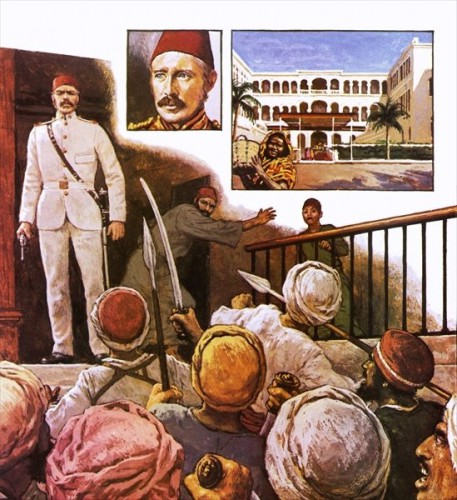
Gordon was sent to evacuate British citizens from a troubled region and to otherwise abandon Sudan. Once Gordon arrived, he apparently pursued a different course: he decided it was best to crush the Muslim uprising for fear that it would eventually spread to Egypt as well. Gordon, with 6,000 men, began a defense of Khartoum.
On March 18, 1884, the Mahdist army laid siege to the city. The rebels stopped river traffic and cut the telegraph line to Cairo. Khartoum was cut off from resupply, which led to food shortages, but could still communicate with the outside world by using messengers. Under pressure from the public, in August 1884, the British government decided to reverse its policy and send a relief force to Khartoum.
“Under pressure from the public” a relief expedition force was sent, but failed to arrive in time to save Gordon and his men:
On January 26, 1885, Khartoum fell to the Mahdist army of 50,000 men. At that time of year the Nile was shallow enough to cross by wading and the Mahdists were able to breach the city’s defenses by attacking the poorly-defended approaches from the river. The entire garrison was slaughtered, including General Gordon. His head was cut off and delivered to the Mahdi. Two days later the relief expedition entered the city to find that they were too late.
Lord Kitchener later reconquered Sudan.
Forgive my diversion into this tale of late nineteenth century British imperialism; however it serves to demonstrate the power and influence that Stead possessed. As cited above, “In 1884, Stead pressured the government to send his friend General Gordon into Sudan….” It seems reasonable that he also was the one to apply pressure to send aid to “his friend” Gordon.
More on Stead and his influence:
1885 saw him force the British government to supply an additional £5.5million to bolster weakening naval defenses, after which he published a series of articles. Stead was no hawk however; instead he believed Britain’s strong navy was necessary to maintain world peace.
Stead saw peace through war. He saw the British Navy as a global force for good. Consider how the tools used by the elite have not had to change a bit over the 125 years since Stead’s time, as the same tools used by Stead to help usurp wealth from the British middle class remain completely effective in the propaganda campaigns designed to usurp wealth from the middle class of the US today.
…he is also credited as originating the modern journalistic technique of creating a news event rather than just reporting it, as his most famous “investigation”, the Eliza Armstrong case, was to demonstrate.
Stead had other passions, showing an ability to understand future global consolidation well before any generally visible steps:
Stead was a pacifist and a campaigner for peace, who favored a “United States of Europe” and a “High Court of Justice among the nations”….
Stead held court in high places:
[Stead] was an early imperialist dreamer, whose influence on Cecil Rhodes in South Africa remained of primary importance; and many politicians and statesmen, who on most subjects were completely at variance with his ideas, nevertheless owed something to them. Rhodes made him his confidant….
Rhodes, of course, cornered the South African diamond market with the help of rather influential friends – call them the elite of the elite. Rhodes was also quite influential regarding British Imperial policy:
Historian Richard A. McFarlane has called Rhodes “as integral a participant in southern African and British imperial history as George Washington or Abraham Lincoln are in their respective eras in United States history…
And Rhodes was influenced by Stead.
Stead found his influence ever-growing:
The number of his publications gradually became very large, as he wrote with facility and sensational fervor on all sorts of subjects, from The Truth about Russia (1888) to If Christ Came to Chicago! (Laird & Lee, 1894), and from Mrs Booth (1900) to The Americanisation of the World (1902).
And finally, to show the well-rounded character of the man:
Stead claimed to be in receipt of messages from the spirit world, and, in 1892, to be able to produce automatic writing. His spirit contact was alleged to be the departed Julia Ames, an American temperance reformer and journalist whom he met in 1890 shortly before her death. In 1909 he established Julia’s Bureau where inquirers could obtain information about the spirit world from a group of resident mediums.
As mentioned, Stead died on the Titanic. His reputation survived:
Following his death, Stead was widely hailed as the greatest newspaperman of his age…. Like many journalists, he was a curious mixture of conviction, opportunism and sheer humbug. According to his biographer W. Sydney Robinson, “He twisted facts, invented stories, lied, betrayed confidences, but always with a genuine desire to reform the world – and himself.”
Why all of this background on Stead? Well, it seems he was a rather influential fellow within the British elite at precisely the time when the United States began its turn toward Great Britain: an empire which (to say nothing of the spat in 1776) less than a century before burned the White House and much of the capitol, and only a few decades before, while officially neutral, aided the South in their war for independence – guilty enough to ultimately pay restitution of $15.5 million for building war ships for the Confederacy.
Great Britain was officially neutral throughout the American Civil War, 1861–65. Elite opinion tended to favor the Confederacy, while public opinion tended to favor the United States.
I will suggest it is elite opinion that counts when it comes to matters of politics, for example:
Diplomatic observers were suspicious of British motives. The Russian Minister in Washington Eduard de Stoeckl noted, “The Cabinet of London is watching attentively the internal dissensions of the Union and awaits the result with an impatience which it has difficulty in disguising.” De Stoeckl advised his government that Britain would recognize the Confederate States at its earliest opportunity. Cassius Clay, the United States Minister in Russia, stated, “I saw at a glance where the feeling of England was. They hoped for our ruin! They are jealous of our power. They care neither for the South nor the North. They hate both.”
Yet as early as 1895 – only 30 years after the end of the war – the US and Britain began their courtship. And in the background was William Thomas Stead.
Finally, on to his book and the first chapter:
As it was through the Christian Church that the monotheism of the Jew conquered the world, so it may be through the Americans that the English ideals expressed in the English language may make a tour of the planet. (Page 3)
Setting aside the exaggeration of the claim, given the religion of statolatry (to borrow a phrase from Charles Burris), the comparison seems quite appropriate.
Stead saw the inevitability of the United States taking the preeminent position among the English-speaking nations. He looked at population growth over the preceding 100 years (including empire), but also at differentiating the white population from the non-white (a recurring theme in his writing); he felt strongly that it was the white population that was of importance.
We are comparing the English-speaking communities. The right of leadership does not depend upon how many millions, more or less, of colored people we have compelled to pay us taxes. (Page 5)
Stead, not shy, makes plain one purpose of colonizing people of color – compelling tax payments. Stead also discounts the millions of British subjects in, for example, India, Africa, and the West Indies when it comes to considering the trends of population and future supremacy.
Population should be weighed as well as counted. In a census return a Hottentot counts for as much as a Cecil Rhodes; a mean white on a southern swamp is the census equivalent for a Mr. J.P. Morgan or Mr. Edison.
A nation which has no illiterates can hardly be counted off against the Russians, only three per cent of whom can read or write. (Page 9)
He also sees no hope for reversal of this trend in favor of the US and to the detriment of Great Britain – not only in population but also industrial production and therefore capability of global reach.
Having presented this case, he suggests Britain embraces this inevitable change, restoring old bonds:
The philosophy of common sense teaches us that, seeing we can never again be the first, standing alone, we should lose no time in uniting our fortunes with those who have passed us in the race. Has the time not come when we should make a resolute effort to realize the unity of the English-speaking race? …while if we remain outside, nursing our Imperial insularity on monarchical lines, we are doomed to play second fiddle for the rest of our existence. Why not finally recognize the truth and act upon it? What sacrifices are there which can be regarded as too great to achieve the realization of the ideal of the unity of the English-speaking race? (Page 6)
Stead sees continuous contention between the United States and Great Britain for control of global trade, with Britain eventually and ultimately the loser. Stead is writing during the very early phases of the Great Rapprochement. As regarding great sacrifices, considering the tremendous work done by Great Britain behind the scenes to create the propaganda in the US necessary to drag the American people into two world wars (as I view these wars as key to formalizing the transition of power), it seems reasonable to conclude that Stead’s suggestion that no sacrifices should be considered too great was taken quite seriously.
Stead goes on to outline the power and control available through a united US and British front: population, land mass, control of the seas and most navigable rivers. And gold: “With the exception of Siberia they have seized all the best goldmines of the world.” (Page 7) Not a barbarous relic, apparently.
Between the two, they have seized the dominions of Spain, despoiled the Portuguese, the French and the Dutch, and left nothing but scraps to Italy and the Germans. (Page 7) The only statistic in which these non-English-speaking nations hold the lead is in the amount of national debt! (Page 11)
Stead is looking for a savior, someone to lead in bringing these two – the US and Britain – into one, with the US taking the leading position:
The question arises whether this gigantic aggregate can be pooled. We live in the day of combinations. Is there no Morgan who will undertake to bring about the greatest combination of all – a combination of the whole English Speaking race?
The same motive which has led to the building up of the Trust in the industrial world may bring about this great combination in the world of politics. (Page 12)
Presumably he is writing here of the work done by Morgan in consolidating the US steel industry. Of course, Morgan also had connections with the same elite family that assisted Rhodes with diamonds in South Africa:
In 1895, at the depths of the Panic of 1893, the Federal Treasury was nearly out of gold. President Grover Cleveland accepted Morgan’s offer to join with the Rothschilds and supply the U.S. Treasury with 3.5 million ounces of gold to restore the treasury surplus in exchange for a 30-year bond issue.
It should also be kept in mind: McKinley was a Rockefeller man; Rockefeller had ties to Germany. Teddy Roosevelt, beneficiary of McKinley’s assassination, was a Morgan man; Morgan was a strong friend of Britain. It seems the “Morgan” that Stead was looking for in the political combination was the same “Morgan” that he was referring to in the industrial combination.
Stead sees the impossibility of the American people accepting a combination where those in America would accept being subservient again to the crown:
It is, of course, manifestly impossible, even if it were desirable, for the Americans to come back within the pale of the British Empire. (Page 15)
Instead, he suggests Britain should accept reunion “on whatever terms may be arrived at.” (Page 15)
While not an overt political reunion, it certainly seems that a reunion was accepted by the British – and ultimately the U.S. If one visible actor can be placed at the center of this “success,” I will suggest it is Winston Churchill. For much of the first half of the 20th century, Churchill played a leading role in British politics; even when not in an official position, he was communicating directly with Roosevelt behind the scenes in order to facilitate America’s entry into the Second World War – the final event in ensuring the transition.
During this time, Britain (or more precisely, the British population) certainly paid the price of reunion – “whatever terms necessary,” as Stead suggested in 1902: the terms for the British population can be seen in the blood of two world wars, inflation, a depression, a loss of manufacture and industry. This price was paid over the next 50 years. In the end, the United States clearly stood on top of the English-speaking world.
One politician, more than any other, stood in a position of leadership and influence while Britain was economically and physically bled: Winston Churchill. Presiding (in various roles) over such a massive loss of Empire would normally result in the derision of the leader. Yet Churchill is exalted. Perhaps it has little to do with his role in the death of the British Empire, but because of his role in the birth of the larger, Anglo Empire. For this reason, the gatekeepers of mainstream history frame Churchill in a praiseworthy manner.
And one writer, a man who traveled within and influenced the highest circles of the elite, wrote the book before the events even occurred: William Thomas Stead.
I will continue with further posts regarding this book as I find comments of import. In the meantime, the examination of this one life and this first chapter has provided insights supportive of my working hypothesis regarding the transition of elite power and control from Great Britain to the United States.
 Il est toujours difficile de recenser un ouvrage qui l’a déjà été par nos soins. Aymeric Chauprade vient de publier la troisième édition, actualisée et augmentée, de sa Chronique du choc des civilisations. Intitulée « Civilisations en collisions » et mis en ligne sur le présent site le 9 octobre 2011, la précédente recension évoquait les qualités de cette deuxième édition qui valut l’éviction de son auteur de toutes les chaires universitaires à la suite d’une campagne de presse malveillante orchestrée par un de ces stipendiés par l’Oncle Sam.