Ok

En poursuivant votre navigation sur ce site, vous acceptez l'utilisation de cookies. Ces derniers assurent le bon fonctionnement de nos services. En savoir plus.

lundi, 10 février 2014

The Ukrainian Dystopia

unbenannt1.png

The Ukrainian Dystopia – Domestic and Foreign Factors

by Leonid Savin

Ex: http://www.geopolitica.ru

 
First of all, the situation in Ukraine is not as simple as it is being described by the Western media and Brussels/Washington politicians. The protest was started just before the Vilnius summit of the Eastern Partnership at the end of November 2013. Actually, most of protesters didn’t read the proposed agreement about the association with the EU, but were galvanized by leaders of the oppositional parties (Svoboda, Udar, Batkivschina). The slogan was that Ukraine is part of Europe (yes, of course, there was no doubt about this), but only a few interested individuals knew that such an agreement of association had previously been signed with… Jordan, Morocco, and some other countries.
 
This document was developed as tool of the EU’s soft power for engagement of the African and Eastern European markets. When President Yanukovich did not sign this agreement, the West initiated a colossal campaign against him: from political and diplomatic pressure to direct support of the Ukrainian opposition. We must take into account that the opposition, both nationalistic and liberal, was supported by the EU and USA years before through grant program.
 
Klichko’s Udar party was especially supported by Germany (he is also a resident of Germany). Russia has supported the decision of the Ukrainian president and provided a large discount for gas supplies and a loan of $15 billion. This gesture of good will was interpreted by the opposition and Ukrainian right-wing nationalists as the imperial ambitions of Moscow. From this point of view, Yanukovich is a puppet of Russia.
 
Some Ukrainian oligarchs also started to actually support the opposition because they are not pleased with Yanukovich and have their own funds abroad. Of course, there were long consultations between these oligarchs and Western politicians for how to better increase the pressure against the president, and the protests were intensified. We see that the general frontline of the protests was captured by ultra-radical groups similar to the Black Bloc of the antiglobalist movement a few years ago, but with a different political orientation.
 
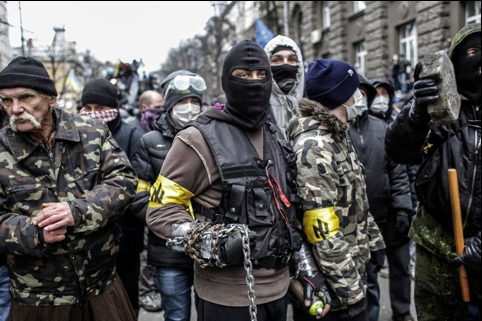
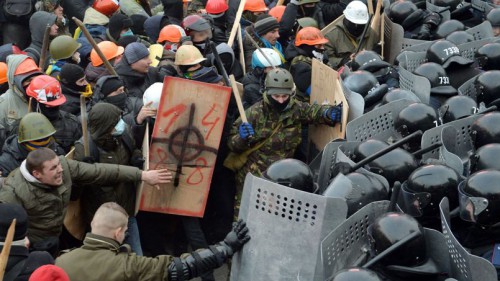
These right-wing groups committed most of the violence during the protests (the destruction of Lenin’s memorial, attacks on police with Molotov cocktails, the ‘occupying’ of governmental building), and the political opposition was an umbrella that brought together these radicals. In reality, neo-Nazi radicals are strongly against the EU and European values and have no any road map for the future of Ukraine. They are funded by an umbrella of opposition groups (300 UAH for a day’s stay on Maidan and 2000 UAH for those who attacked police with Molotov cocktails. 1 $ US = 8 UAH) and both structures (the political opposition and neo-Nazi urban insurgents) choose the victims – it is the president, the Party of Regions, and the police.
 
After violent attacks near the ministers’ offices, parliament issued new laws pertaining towards addressing responsibility for such acts of protests and violence. But even these measures did not provide a cure for the crisis. On 25 December, three policemen were captured by extremists (one was wounded by a knife) and illegally held in one of the captured buildings in Kiev. The same day, Yanukovich proposed giving the post of prime minister to the leader of the Batkivshina party (Yatsenyuk) and the post of vice-prime-minister to Klischko (they refused).
 
Despite Western allegations otherwise, there really wasn’t much police violence, and the government does have the legal right to use such power if need be. In two words, we have a conflict between the established legal structures (president, parliament, other governmental structures) and those with self-proclaimed legitimacy (the opposition with mass support), as described by Carl Schmitt. The problem is that the opposition is very active, but the followers of the president, government, and order are passive. When the “Euromaidan” civil activists in Kiev and other regions began their street blockades and use of violence, the majority of Ukrainians did nothing and hoped that the police and the security service would intervene. But a paralyzed police force cannot perform their own standard functions because the opposition describes such measures as “violence against the people”.
 
The current problem is that the opposition umbrella does not have control over the violent neo-Nazi groups in Kiev and other regions, and some opposition leaders are nervous about their own place in any future political system in Ukraine. Another problem is that the “Euromaidan” activists have raised support from abroad (including from the Ukrainian diaspora) under the idea of “the people fighting against an authoritarian regime”. The masses do not usually understand the complexity behind such situations, and thus, they are profitably manipulated by those who are directing the destabilization.
 
The Strategic Landscape
 
The general context of these (and previous) protests may be found in the political system of Ukraine – it is liberal capitalism. For the last ten years, the social sector was destroyed, and Ukraine experienced a rapid rise in unemployment. Many citizens therefore needed to go abroad for work (Russia, Poland, and the European countries) or immigrate. When the “Orange Revolution” started in 2004, there was lots of optimism. The majority believed in changing the status quo and there were many calls of “Yes, we can!”. But this process of reorganization was twisted and stagnant.
 
The leaders were politically impotent, and corruption increased by leaps and bounds. The governmental system became more rotten than it had ever been before, and this process continued to accelerate. When Yanukovich returned to the presidency, he did not do enough to pursue radical changes to this trend. He cares more about his own “clan”, and this began the conflict between the oligarchs.
 
As I wrote above, some of them began to support the opposition (whereas they had supported Yanukovich in the past). The feeling of “yes, indeed” penetrated the minds of some oligarchs and they began to play their own game. Yet, they did not understand that another game was already in effect and that they were simply pawns within it!
 
Yanukovich understood that associating with the EU would be the last major political decision he would make. After the agreement, he would have to release Yulia Timosehnko (the former prime minister) from jail, and there is even a chance that he himself would then be sent to jail! Secondly, EU association would mean the implementation of protective tariffs from Russia. Russian gas would then be sold to Ukraine for the same price as it is to the EU. For example, in 2014 it would be about $370-380 per 1000 cubic meters, but Belarus would only be paying $175!!!
 

ukrextrdr.jpg

 
The difference can most certainly be felt, especially when one thinks about the economy’s industrial complex. In the process of building the Customs Union and the Eurasian Union, Russia will be very sensitive about any economic vectors near and around its own space. Ukraine would lose access to the huge Russian (but also Belarusian and Kazakh) market for its own goods, as well as the cheap goods coming out of the Customs Union. But the protesters do not think in geopolitical norms. They only rely on emotions…
 
European Involvement
 
European leaders are really confused. The European and US politicians need to stop and think before they continue to act, as they do not fully understand what it is they are doing. In the EU, we see much more police violence during protests than is the norm. When information about right-wing neo-Nazi groups in Ukraine entered into the Western media, there was cognitive dissonance. When Ukrainian Jews were attacked by the same protesters standing in Maidan, there was a strong reaction from the international Jewish community, but the European establishment once more expressed cognitive dissonance.
 
They wanted a planned and manipulated reality, but real life is different than their constructed images of it. They even wanted to present different images and pictures of what is happening. After two people were killed, new questions emerged: what is happening inside the opposition’s camp, and why can’t the opposition leaders control the radical groups under their own umbrella? I think that the European security services have knowledge and experience in dealing with leaderless resistance movements and insurgent anarchism, but the recognition of this occurring in Ukraine would also lead to the recognition that the Ukrainian government must use force to combat this extremist (even with European assistance)! In actuality, the EU does not have special think tanks or well-educated analysts that focus on Ukraine. Therefore, the European community does not have enough information about what is happening there, what its roots are, and what the possible tree of scenarios could be.
 
The Goals of the Ukrainian Opposition
 
The opposition wants to organize new presidential and parliamentary elections because that is the only legal way to change the power system. Because new presidential elections are scheduled for March 2015, this crisis is a serious test for Yanukovich. For the opposition, it is chance to get more publicity, because until now, they were supported only by some regions. And with the promotional aid of the EU and US, such a goal will be easier. On the other hand, they do not have a single leader to rally behind, so we could see an internal battle be waged inside the opposition’s camp in the future.
 
Ukraine actually has a very clear electoral map where one can see which region votes for the Party of Regions and which support the nationalists’ parties. If confidence in Yanukovich decreases, then he will lose support from the East and South of Ukraine (his classic base of electoral support). Nonetheless, Yanukovich is a legal president and he will not leave office before his term is over – this is certain. His post is guaranteed by the Constitution, and he has already proposed a plan for ending the crisis. The opposition does not have any such constructive ideas, and they speak with the language of ultimatums. This attitude is impossible to use in any normal negotiations, and the EU understands this very well. Therefore, they (the outsiders) cannot propose anything and just have to wait to see what happens.
 
The Role of the Media 
 
Most of the Ukrainian and European media take an incendiary position. There has been a lot of misinformation spread about the events in Kiev. Some US media outlets have used strategic rhetoric, for example, the Foreign Affairs magazine issued by the Council on Foreign Relations used the word “ceasefire” in an article about the process of ongoing negotiations between the authorities and the opposition.
 
Such a discourse is symbolic of a war of conscience against the state of Ukraine. Blogs and social networks are also effective in advancing this campaign. If one looks at a map of the “Euromaidan” hashtag, most activity will be seen as coming from three locations – Kiev, Washington, and London! Alternative media can also be of use in finding out more information about various figures of the opposition, for example, Oleg Tyagnibok of the Svoboda Party (formerly the Social-Nationalist Party of Ukraine), statements from his hate speeches (mostly against Jews, Russians, Poles, and communists), his background, and where he gets his money from to fund his current activities.
 
External Actors 
 
Ukrainian MPs, the prime minister, and even oppositional leaders (Klichko) already recognized that there have been manipulations and interference from abroad. This means that external influence has already happened. If regime change occurs, this will not mean anything good for Ukrainians. Radicals are radicals under any regime. They will use Molotov cocktails again, but this time, the target of their attacks will be the EU’s occupational regime, the degraded culture of the West, banks, and corporations (under the auspices of honor and Ukrainian independence, of course). This type of bourgeois right-wing nationalist that we currently see on Maidan will be emancipated in the near future.
 
Some oppositional leaders will get preferential treatment from the West, while a select few will be used as technical actors during the consequent engagement of Ukraine with the West. European institutionalism is a good tool for gradual reforms, but with the rise of Euroscepticism, especially in the neighboring countries of Hungary and Slovakia, this will no longer be as easy as before. The “Palestine-ization” of Ukraine could worryingly occur. There is a serious present crisis affecting the state system, political processes, national identity, geopolitical thinking, and sovereignty. I think that the key decisions that we see in the upcoming days will address each of these topics. Then we will see a test that can gauge the actual sovereignty of Ukraine.
 
The Geopolitical Scale 
 
In this crisis, the main geopolitical actors are trying to get new experience in order to use it for their own benefits. Russia is following a clumsy strategy of engagement and acts more reactively than proactively. The EU seems to be a timid actor, as the Ukrainian vector had been a fault line in the European strategy for many years. Because of the economic crisis and problems with its own identity within the EU, Ukraine is perceived as a difficult partner.
 
The homogenization of the Ukrainian space would not go as easily as previously planned, and Ukrainian society is divided in their vision of the future. The US continues to battle against Russia and the Eurasian Union. For this reason, Ukraine is a good place to wage such a campaign. The timing is on the side of the US, because the Olympic Games in Sochi may distract the global public (in a similar fashion as the 2008 Olympic Games in China provided a cover for Saakashvili’s regime to begin military aggression against South Ossetia). In this situation, Ukraine loses its geopolitical maneuverability very quickly. The moderate balance that served as a useful political tool for Ukraine’s external activities during the presidency of Leonid Kuchma no longer works. This is because in a geopolitical sense, Ukraine does not understand the necessity of a strong alliance with Russia and the Eurasian bloc, as without it, the country will be slowly devoured by the EU and manipulated by the US. Separatism could also possibly occur in Ukraine.
 
The first mirage of this processes emerged in 2004, but now the situation is more complex and there will be more than two separate pieces if this scenario becomes reality. The Zakarpatie region (bordering Hungary and Slovakia) does not want to be in an independent Western Ukraine. The Crimea has some Tatars who generally supported the “Euromaidan” events, so a conflict in the Crimea Autonomous Republic is also possible there, especially when we take into account that many Tatars have already been waging jihad in Syria and now have experience in military insurgency.
 
Conclusion 
 
Any results of “Euromaidan” will be negative both for the Ukrainian people and regional geopolitics. The society inside of the country is divided, and part of it thinks in the framework of revenge and resentment (both sides of the current conflict). The process of reconciliation will not be fast and easy. The only possible way for a positive political development would be innovation, but the Ukrainian political elites are lazy and do not have enough intellectual skills and experience to devise such innovations, as neither do the opposition. European and US advisors will not bring winning ideas to the Ukrainian opposition. The radical nationalistic sector thinks only about the realization of their own ideas which are similar to xenophobia and Nazism. Because of the activity of these aforementioned elements, there is no possibility to marginalize and “freeze” them.
 
The oligarchs will also try to use radicals as a frontline to further their own profit. It is very strange that the nationalists cooperate so closely with the cosmopolitan oligarchs and the neoliberals in Ukraine, because the doctrine of Ukrainian nationalism is against oligarchy and globalization. This alliance thus symbolizes nothing besides the hypocrisy that is standard for business interests involved in politics. Therefore, the new state of a hypocritical Ukraine is the most plausible scenario that we will have in the future.

Comprendre l'antiracisme

00:05 Publié dans Evénement | Lien permanent | Commentaires (0) | Tags : alain soral, nantes, événement, antiracisme, politique, france | |  del.icio.us | | Digg! Digg |  Facebook

Non au redressement de la nature humaine !...

Non au redressement de la nature humaine !...

Nous reproduisons ci-dessous un point de vue de Philippe Bilger consacré à l'enseignement de la théorie du genre à l'école. Philippe Bilger anime le blog Justice au singulier.

Ex: http://metapoinfos.hautetfort.com

ABCD de l’égalité: non au redressement de la nature humaine

Cela a commencé avec le mariage pour tous. On pouvait penser que le mimétisme européen avait joué avec un engagement présidentiel à l’évidence plus facile à tenir que l’inversion de la courbe du chômage.

Cela a continué avec l’affaire Dieudonné et les injonctions du ministre de l’Intérieur qui dépassaient, et de très loin, le cadre de sa mission pourtant si difficile à assumer quand on constate les piètres résultats de la lutte contre l’insécurité en 2013. Ce n’était pas à lui d’intimider les spectateurs des représentations de Dieudonné en leur faisant la morale et en les stigmatisant quasiment. Devaient-ils demander à Manuel Valls la permission de sortir le soir?

Cela dure avec la conception de la justice socialiste qui, fuyant le réel et ses incommodités, rêve de l’avenir, fantasme sur le futur et élabore ses projets, qui le demeurent, pour un peuple imaginaire merveilleusement à l’écoute et détaché des misères humaines, des tragédies causées par les crimes et les délits.

Cela s’aggrave avec la théorie du genre et, même si les démentis des ministres sont sincères, il y a une aspiration de ceux qui nous gouvernent à faire de l’école et de l’enseignement tout autre chose que ce qu’ils devraient être. Apprendre, lire, écrire, calculer, s’imprégner de notre Histoire de France, se former à la passion des grands auteurs et de la littérature, apprivoiser les langues étrangères, autant d’objectifs et d’ambitions qui, pour être d’une heureuse banalité, sont aujourd’hui peu ou prou relégués au profit d’une éducation même plus civique mais bouleversante, destinée à constituer les établissements pour des lieux d’expérimentation et d’indifférenciation des sexes.

Dans 600 écoles de dix académies, si on n’apprend pas aux garçons à devenir des filles, les nouveaux ABCD de l’éducation, de la grande section de maternelle au CM2, s’assignent pour but de lutter contre les stéréotypes filles-garçons. “Nous voulons tout de même qu’il y ait égalité entre les hommes et les femmes au sein de la société, dans le choix d’un métier”, a déclaré Vincent Peillon (Le Parisien).

Soit, mais si une telle ambition est légitime, incombe-t-il à l’école de superposer sans cesse à ses missions fondamentales de plus en plus négligées des prises de conscience et des ateliers vecteurs d’une bouillie éthique et sociale difficilement assimilable ? L’enseignement est-il voué à diffuser une certaine conception de la morale qui se résume peu ou prou à un féminisme même plus raisonnable ? Serait-il absurde de laisser aux parents, aux familles, aux vies amoureuses et à l’influence aussi bien forte que subtile des hommes et des femmes dans leurs relations quotidiennes, la charge, l’honneur de se faire progresser, d’avancer en lucidité, en égalité ? La vie privée du président serait sacrée mais les intrusions dans notre sphère d’existence tolérables ? Est-il normal de poser la main de l’Etat, sa volonté orientée, son idéologie plus sectaire – une seule vision, toujours, de l’humain, de sa liberté, de sa responsabilité – qu’équitable, sur un monde qui appelle d’autres démarches, et surtout pas de la politique même déguisée en soie, en velours et en injonctions patelines à suivre ? Pourquoi s’immisce-t-il dans ce qui nous regarde au premier chef ?

Avec ces insensibles ou ostensibles dérives, je perçois l’émergence, dans la démocratie selon François Hollande, d’îlots de totalitarisme mou, d’un caporalisme collectif qui s’en donne d’autant plus à coeur joie qu’à défaut de changer le monde, de réformer la France, le pouvoir n’a plus que la ressource de s’en prendre aux “fondamentaux”, aux permanences, aux stabilités, à l’ordre, aux évidences de la nature.

Il y a de manière dévastatrice, sur tous les plans, une obsession de rupture. Si, en effet, parfois le naturel mérite d’être amendé ou complété par le culturel, nous n’en sommes plus là avec ce gouvernement. Pourquoi a-t-il une telle hantise devant ce qui coule de source, ce qui a été admis durant des siècles, ce qui a fait ses preuves et qui autorise une politique digne de ce nom ? Pourquoi la nature et ses leçons inspirent-elles autant de dégoût à ce pouvoir ? Parce que ce qui est proche, accessible, irréfutable, légitime fait peur ? Qu’on met le désordre et l’agitation là où on peut ? Que, dépassés par la nature, on a pris le parti de lui faire la peau ? Que la culture est un beau mot qui à force d’être exploité tourne à vide mais qu’on prétend s’en servir comme arme de guerre contre l’intolérable pesanteur des comportements et des déterminismes parce que ceux-ci seraient en eux-mêmes pervers ?

Parce que cette gauche ne sait plus quoi faire pour se faire remarquer. Alors elle change l’insupportable cohérence née du passé et du pragmatisme.

Ce totalitarisme qui pointe est soft, certes, mais clair et net. Logique aussi : la liberté est en effet une ennemie. Partout.

Pourquoi prétendre, à toute force ou à coups fourrés, dénaturer, confondre, enjoindre, ne pas succomber à l’immédiate compassion pour les victimes, détourner les institutions et les services de leur but, déséquilibrer une société, dégrader les identités, instiller de la mauvaise conscience dans des liens qui se sont toujours construits en s’opposant, qui s’opposent mais se complètent, quel besoin a l’Etat de venir s’immiscer dans ce qui ne le concerne pas ?

J’écoute, je lis Vincent Peillon et Najat Vallaud-Belkacem. Le premier : “La lutte contre les stéréotypes de genre – les opinions toutes faites sur les femmes et les hommes – et l’homophobie doit être menée avec force à tous les niveaux d’enseignement”. La seconde : “La théorie du genre, qui explique “l’identité sexuelle” des individus autant par le contexte socio-culturel que par la biologie a pour vertu d’aborder la question des inadmissibles inégalités persistantes entre les hommes et les femmes ou encore de l’homosexualité et de faire oeuvre de pédagogie sur ces sujets” (Le Figaro).

Pourquoi pas ? Mais il y a des politiques et des ministres pour cela. Ce prêchi-prêcha n’a pas sa place à l’école.

Les homosexuels se marient parce qu’il convenait de fabriquer une égalité artificielle. Des spectateurs sont réprimandés parce qu’ils croyaient avoir le droit, en démocratie, d’assister à des spectacles selon leur bon plaisir. L’angélisme gouvernemental s’obstine à faire céder les évidentes compassions pour les victimes et la rigueur qu’elles appelleraient en retour face aux constructions idéologiques gangrenées par la fuite du réel et fondées sur un autre peuple que celui, insupportable, réclamant sécurité et justice. L’école, les petits enfants et les enseignants sont embarqués dans un processus qui vise à déconstruire et à troubler. Le progressisme niais non seulement accable mais fait perdre son temps à un service public qui devrait pouvoir se concentrer sur l’essentiel.

Le naturel, partout, est chassé au galop.

Je suis contre le RNH. Contre le “redressement de la nature humaine” dont ce pouvoir s’est fait une dangereuse spécialité.

Philippe Bilger (Causeur, 3 février 2014)

Eurosceptische vloedgolf op komst

euroscepticisme.jpg

Europa van twee snelheden

Eurosceptische vloedgolf op komst

Ex: http://www.doorbraak.be

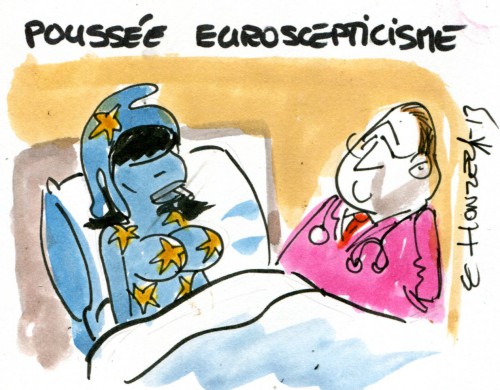
Europa lijkt steeds meer een continent op drift. Enorme schuldenbergen – zowel privaat als publiek -, hoge werkeloosheid en een stijgend risico op deflatie. Is er iemand die weet hoe het verder moet? En dan is er nog de vraag wie na de verkiezingen van 25 mei de voornaamste stuurman zal zijn. Een metershoge eurosceptische golf lijkt in aantocht.

- Lawrence Urbain (03.02.2014)

Afgelopen weekeinde verzamelden de Europese liberalen te Brussel. Guy Verhofstadt werd daar officieel gekozen tot kandidaat-voorzitter van de Europese commissie. Op zich was dat alles behalve een tour de force aangezien de Vlaamse liberaal binnen de ALDE-fractie als enige kandidaat werd voorgedragen. De degelijke Olli Rehn stapte eerder al uit de liberale wedloop. Het feit dat Verhofstadt binnen de eigen fractie minder dan 80% van de stemmen achter zich krijgt, doet her en der dan ook wenkbrauwen fronsen. De liberale fractie is een splijtzwam.

Binnen de ALDE zijn er enerzijds de partijen die volmondig inzetten op een supranationale staatsstructuur met bijbehorende federalisering. Progressief-liberale partijen als OpenVld en het Nederlandse D’66 maken deel uit van deze vleugel. Anderzijds is er een politieke groep die wil kiezen voor verregaande samenwerking, veelal op economisch vlak, zonder dat dit noodzakelijk dient uit te monden in een volledig gefedereerde Europese Unie. De Nederlandse conservatief-liberale VVD, alsook de Finse Centrumpartij van Rehn, alliëren zich veelal aan deze tweede, meer gematigde, groep. Ook het merendeel van de LibDems in het Verenigde Koninkrijk wenst een minder radicale koers te varen dan de lijn die Guy Verhofstadt voorstaat. Regelmatig komt er vanuit de brede basis van partijen dan ook tegenkanting ten overstaan van de Belgische oud-premier. Vaak komen deze geluiden uit landen als Nederland en Finland. Niet toevallig de nettobetalers van de EU. Denken we maar aan Mark Verheijen, EU-woordvoerder voor de VVD, die een tijd geleden Verhofstadt nog ‘een gevaarlijke man’ noemde. Ook een politieke coryfee als Frits Bolkestein, stelde meermaals dat ‘Verhofstadt blaft tegen de maan’.

Winst en verlies

Verwacht wordt dat de liberale fractie op 25 mei gedecimeerd zal worden. VVD in Nederland, Freie Demokratische Partei in Duitsland, LibDems in het Verenigd Koninkrijk, OpenVld bij ons… allen staan ze op (zwaar) verlies in de peilingen. De liberalen zullen zich bij een slechte uitslag achter de oren krabben en mogelijk hun politieke lijn ten overstaan van het EU-project moeten bijsturen. Het wordt tevens afwachten hoe goed de felste tegenstanders van een federale Europese Unie zullen scoren. Zowel de Ukip van Nigel Farrage, het Front National van Marine Le Pen en de PVV van Geert Wilders zullen winst boeken. Voorts is het zeker ook nuttig om met partijen als Alternative Für Deutschland en N-VA rekening te houden. Het lijkt bijzonder onwaarschijnlijk dat AfD aansluiting vindt bij de liberalen van Verhofstadt. De partij wil een splitsing van de eurozone, een voorstel dat voor zowat alle liberale partijen onbespreekbaar is. Eveneens is de positie van de N-VA binnen de veelal linkse fractie van regionalisten en groenen nagenoeg onhoudbaar geworden. Bart Staes (Groen) stelde onlangs dat de verzameling van regionalisten en groenen in het Europese parlement geen winkel is waar je zomaar binnen en buiten loopt. Als de N-VA deel wil blijven uitmaken van deze technische fractie, dan zal iemand als Johan Van Overtveldt zijn toon dienen te matigen.

Kortom: Er zal na 25 mei ferm geschoven en bijgeschaafd worden. Zowel binnen als tussen de fracties. Niet zozeer de uitslag van de verkiezingen is interessant, maar vooral de gevolgen die het de dagen en weken erna met zich zal meebrengen. Een splitsing van de Europese muntunie mag (momenteel) dan wel afgewend zijn, een eurofederalisme met mutualisering van de staatsschulden en eurobonds is nog niet voor morgen. Hoe graag de combattieve Guy Verhofstadt dat ook zou willen.


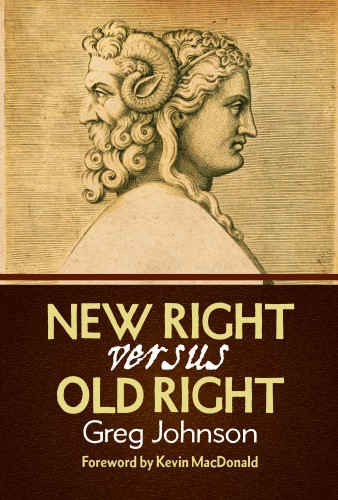
Greg Johnson’s New Right vs. Old Right

NewRightOldRight1crop1.jpg

Foreword to Greg Johnson’s New Right vs. Old Right

By Kevin MacDonald

Ex: http://www.counter-currents.com

Perhaps it’s best to start off with what New Right vs. Old Right [2]is not. Greg Johnson does not assail his readers with statistics to prove the Jewish role in the decline and impending fall of whites in America and elsewhere. He does not discuss the corruption of the media and the academic world and how they got that way. He does not discuss data on race differences in IQ and criminality to explain the behavior of non-white America. He doesn’t aim to refute the current mantra that race is nothing more than a social construct designed to provide white people with unearned privilege.

Those intellectual battles are over, and we have won, although the mainstream media and academic world continue to promulgate cultural Marxist blather as if it were a set of truths set in stone. The starting point for NRvOR is that the media, the academic world, and the political process are hopelessly corrupt. So where do we go from here?

Greg Johnson’s basic point is that we must work to create a metapolitics of explicit white identity—that is, a movement that will develop “the intellectual and cultural foundations for effective White Nationalist politics in North America, so that we can ultimately create a white homeland or homelands on this continent.”

Greg is one of the reasons why I think this is a feasible project. A very great reason for optimism is that there are so many intelligent, well-spoken people who “get it”—who understand that whites around the world are in decline and that there will be dire consequences if whites are unable to establish white homelands. People like Greg Johnson are part of a hugely important trend. I have recently met a great many young, intelligent, well-educated, and well-spoken people at conferences dedicated to activism on behalf of the interests of white America—the exact opposite of the image of uneducated, violent males sporting swastikas and missing a couple of teeth that has been so carefully crafted by our hostile elites.

Despite growing up with a constant barrage of multicultural, anti-white propaganda beginning in elementary school, these individuals understand that at this point America is an unfolding disaster as whites are increasingly displaced throughout the economic and political spectrum. They are acutely aware that whites are a minority of births in America and that whites will be a minority within their lifetimes—a minority with diminished prospects and increasingly victimized by the non-white majority, many of whom retain historical grudges against white America. It is very likely that the America of the future will be beset with chronic conflict among different racial/ethnic groups. The idea that America or the West can avoid such conflicts as their societies become ever more factionalized is magical and utopian.

The goal, therefore, is not, a “supremacism” that is in any way invidious. Rather, “the best way to ensure peace and good will among peoples and preserve human racial, cultural, and religious diversity is to give each distinct group a homeland where it can live and develop according to its own distinct nature and destiny.”

This is an attitude that seems to me to be pervasive in the white advocacy movement. It at once defuses a very effective bit of rhetoric of the Left—repeated with predictable regularity by organizations like the Southern Poverty Law Center. We are white advocates, people who, as Greg phrases it in several places following Michael Polignano, “take our own side” in issues of racial/ethnic conflict. And in taking our own side, we are doing exactly what racial/ethnic groups have done from time immemorial. No one accuses the Koreans of “Korean supremacism” for adopting policies aimed at retaining Korean demographic and cultural predominance. And imagine the horror by Western elites at a proposal to flood African countries with whites so that native Africans cease to be a political majority.

Make no mistake about it. The policies that are making whites minorities in lands they have dominated for hundreds or (in the case of Europe) thousands of years are not driven by utopian dreams of a raceless future, except among gullible, intimidated whites. The non-whites who are so enthusiastically embracing the decline of white political and cultural power are driven by hatred toward whites as a people and as a culture. This is a major theme of my writing on Jewish influence, and apparent as well in a host of non-white intellectuals and activists.

Greg Johnson received his Ph.D. in philosophy, and it shows. His forte is the well-developed argument presented in a lucid, easily understood style. There will be no complaints about this book being filled with turgid prose. And I can’t find any major disagreements.

I was particularly struck by several points. For example, unlike the European New Right, Greg is an advocate of white racial nationalism:

insofar as the breakdown of European national identities and the blending of European stocks in our North American context forces us (1) to give greater place to biological race and other deep roots of common European identity, and (2) to put greater emphasis on the Jewish question, given the role of American Jewry in promoting anti-white policies both in the United States and in white countries worldwide.

Right. As a biologist, there is always the tendency to see matters like race as a decontextualized matter. DNA, after all, is DNA. But American whites are indeed a very intermixed lot—a successful example of a European melting pot. In effect, we have created a new biological reality not present in any European country.

Nevertheless, we must remember that Europeans are in general closely related biologically, particularly in the north and east of Europe, as recent data continue to show. Indeed,

typical pairs of individuals drawn from across Europe have a good chance of sharing long stretches of [identical genes] by descent, even when they are separated by thousands of kilometers. We can furthermore conclude that pairs of individuals across Europe are reasonably likely to share common genetic ancestors within the last 1,000 years, and are certain to share many within the last 2,500 years.[1]

The white race is indeed a biological as well as a cultural reality. This biological reality forms a powerful basis for a scientifically based understanding of a commonality of interests wherever whites are living, whether in Europe or in the European diaspora.

And, yes, although the organized Jewish community has pursued the same set of policies favoring displacement-level immigration and multiculturalism throughout the West, Jewish influence varies in different Western societies. This brings up the need for developing a good model of cultural diffusion within the West. For example, academic culture is self-consciously international. If indeed the main impetus for the leftward shift is Jewish involvement in the Left beginning in the United States with the movements described in The Culture of Critique, it is not at all surprising that this culture spread to other areas with less Jewish influence given the pre-eminence of the U.S. in the post-World War II Western world. An aspiring academic in, say, Norway or Finland, who subscribes to a White Nationalist worldview would find himself ostracized from international academic societies, while countrymen who subscribed to the reigning cultural Marxism would find international recognition.

The same phenomenon occurs in the political realm, as, for example, when Austrian politician Jörg Haider joined a coalition government in 2000. This resulted in huge international pressure, with EU member states refusing to cooperate with the Austrian government and Israel withdrawing its ambassador. The assault on the Golden Dawn party in Greece is a more recent example. Any Western government that opposed continued immigration and multiculturalism would be subjected to similar pressures.

The culture of Western suicide exists throughout the white world, and dominating the most powerful country in the West goes a very long way to dominating the entire Western world, particularly given the fact that Jews often control media even in countries with very tiny Jewish populations, as with the Bonnier family in Norway and Sweden.

Greg does not shy away from discussing difficult issues having to do with National Socialism, supporting the ideal of an organic, hierarchical, meritocratic society dedicated to advancing the interests of whites and rejecting “party politics, totalitarianism, terrorism, imperialism, and genocide.

I agree entirely. It’s a very good strategy to confront such issues head-on rather than to leave them to be discussed solely by our enemies. It’s the same with the holocaust. The holocaust is simply not important for white advocacy, and whatever happened is not the responsibility of any living whites; it’s something that must be simply “stepped over,” to use Jonathan Bowden’s felicitous phrase. Even if the holocaust were proved to have never occurred to the satisfaction of one and all, there is more than enough resentment by Jews about their past in Europe and the United States to fuel the hostility toward the West that has been such a prominent feature of the organized Jewish community and so many influential Jewish individuals. The reality of Jews as a hostile elite aiming to displace white elites throughout the West would not change at all.

I should think that it would be uncontroversial that the white advocacy movement must be metapolitical, since there is a crying need to build up a self-confident, prideful culture than can eventually become mainstream. Greg’s argument that it is premature to pursue nationalist party politics—that at this point the money can be better used in education and organizing—will be more controversial. The question is whether these are really incompatible goals and, as Greg rightly notes, “We share the same broad aims, but we differ as to the best means of achieving them. We need to acknowledge these differences frankly, then divide our camp and pursue our common aims by the various paths that seem best to us.” Different ways should be attempted in the hope that eventually something will work. In the meantime, we must be as inclusive as possible.

In fact, nationalist parties have made substantial headway in Europe, and many observers are expecting a significant representation of nationalist parties to result from the 2014 European Parliament elections. With increasing success, the messages of these parties have inevitably become more widely known. Significantly, these parties have not developed with an explicitly pro-white or pro-ethnic nationalism agenda, but have rather attempted to stay under the radar of political correctness on race and on Jewish influence, basing themselves on an implicit ethnic nationalism that opposes immigration and multiculturalism for a whole host of reasons apart from the danger of ethnic swamping that is in fact lurking in the background. Not surprisingly, these messages are often most effective with the white working class, the group that has suffered the most from the immigration tsunami.

Indeed, I believe that model of change that I think most probable is that the revolution will begin in Europe with the success of one of these parties, particularly if it occurs in a pivotal country like France where there is a clear possibility that the Front National will obtain power, and in a context where other nationalist parties have substantial representation in other areas of Europe so that an effective countermovement of isolation and ostracism cannot develop. I think we are rapidly approaching such a situation now. Compared to America, Europe has the advantage of very ancient cultures and identities that are mortally endangered by this new dispensation. Once such a party gains power, then more explicit messages of ethnic and racial interests may become more acceptable, paving the way for more the dissemination of a theoretical framework based explicitly on ethnic interests.

I worry that in the absence of near-term political goals, a purely metapolitical movement is in danger of being a detached inward-looking, even self-serving elite. For one thing, the Left is completely in control of the academic scene and very actively— indeed passionately—polices any deviation from political correctness. This is quite unlike the situation in American universities where Franz Boas was able to control academic anthropology by the early 20th century, and several of the New York Intellectuals obtained positions at elite universities well before 1960. This is a very formidable barrier to the spread of an elite culture of white identity given the close relationship between universities and intellectual life in the West. There was no complaint from the academic world when the 1965 immigration law opened up immigration to the United States to all peoples of the world. Indeed, in several Western countries, Australia comes to mind, the movement to open up immigration to non-whites originated in the universities.

Even in America, with so many barriers against us, political action inside or outside the context of the electoral process could be a positive force for change. Americans need to see noisy, intelligent, attractive, committed white people marching in the street with signs opposed to immigration, multiculturalism, and the strident ethnic politics of other groups; there is a need for a steady drumbeat of political advertising where pro-white themes, whether explicitly white or not, are repeated over and over to the point that they become part of the furniture of life even if winning elections remains a distant goal.

Such movements may be particularly important for whites with less education who may be turned off by an elite culture of white identity. The white working class in fact has been the prime loser in the cultural changes promoted by our hostile elites. A great many of them are angry and, with less to lose than so many well-educated whites, they are an important natural constituency.

In any case, I wholeheartedly agree that we have to be open to a diversity of approaches.

Greg’s essay, “The Moral Factor,” raises the important issue of moral motivation which I think is an aspect of Western uniqueness. One does not see Chinese people agonizing over the fact that the Han Chinese greatly expanded their territory at the expense of other peoples. Nor does one see the Bantu peoples of Africa worrying about the ethics of displacing other African peoples as they spread far and wide from their homeland in Central Africa, including into South Africa where their treatment at the hands of white South Africans became Exhibit A for white evil during the apartheid era; nor do the Bantu-speaking peoples agonize about the widespread practice of slavery in Africa. Arabs do not apologize about their conquests in the name of Islam or their centuries-old role in slavery and the slave trade. As Greg notes, the Spaniards have apologized for the Reconquista that expelled the Muslims from Spain, but there are no apologies from the Muslims for the Conquista.

Whites are the only people to abolish slavery, and a great many of the activists and the fundamental popular sentiments so crucial in the ultimate victory over slavery were motivated by moral idealism, including especially empathy for slaves.[2] They did so despite very real costs to many individuals and to society as a whole, and all this occurred before the rise of the Jewish hostile elite. Indeed, this unique characteristic of whites is exploited by Jewish intellectuals for their own hateful ends. My basic theory is that this is a holdover of Northern European hunter-gatherer culture, where one’s status in a group is based on reputation for moral behavior (honesty, fair dealing) rather than on kinship relations—an aspect of Western individualism.

So I agree that “even if White Nationalism is politically meaningful, people will resist it if they think it is immoral. But they will move heaven and earth to establish white homelands if they think it is the right thing to do.” We must win the moral battle. The problem is that “our people overwhelmingly believe that our cause is unjust.” And yet, the moral argument for white survival is obvious and compelling. Fundamentally, our basic survival as a people and as a culture are threatened. As Greg notes, “the present system is not merely anti-white, it is genocidally anti-white.”

That’s enough for me to mark the present system as utterly depraved morally. It is profoundly immoral to inflict multiculturalism upon the white populations of the West, given that  ethnic conflict is absolutely predictable, based upon everything we know of the bloody history of ethnically divided societies. This is especially the case given that support for multiculturalism and support for their own demographic and political eclipse have never been majority views among whites. Whether in Australia or New Zealand, North America or Europe—in every case throughout the West, immigration and multi-culturalism have been projects of media, academic, and political elites. These changes have been top-down, not at all bottom-up.

We must pay more attention to the morality of infringing upon the legitimate rights and interests of the white majority. Everyone has rights and everyone has interests. The interests and rights of whites as a majority are no less morally legitimate than those of any other group. Whites must jettison the ideal of moral universalism and ask what is good for the future of whites.

On the basis of this collection of essays, Greg Johnson has a compelling vision of the impending disaster facing the people and culture of the West and what we can do about it right now. It is presented in a highly readable, well-argued manner that at once shows the power and confidence of the developing metapolitical culture of a Western renaissance. I wholeheartedly recommend it.

January 15, 2014

Note:

Greg Johnson’s New Right vs. Old Right is available for purchase here [2].

Notes

1. Ralph Peter and Graham Coop, “The Geography of Recent Genetic Ancestry across Europe,” PLOS Biology, vol. 11, no. 5 (May 7, 2013): e1001555. doi:10.1371/journal.pbio.100155

http://www.plosbiology.org/article/fetchObject.action?uri=info%3Adoi%2F10.1371%2Fjournal.pbio.1001555&representation=PDF [3]

2. Kevin MacDonald, “Empathy and Moral Universalism as Components of White Pathology: The Movement to Abolish Slavery in England,” The Occidental Quarterly, vol. 13, no. 2 (Summer 2013), pp. 39–63.


Article printed from Counter-Currents Publishing: http://www.counter-currents.com

URL to article: http://www.counter-currents.com/2014/02/foreword-to-greg-johnsons-new-right-vs-old-right/

URLs in this post:

[1] Image: http://www.counter-currents.com/wp-content/uploads/2014/01/NewRightOldRight1crop1.jpg

[2] New Right vs. Old Right : https://secure.counter-currents.com/new-right-vs-old-right/

[3] http://www.plosbiology.org/article/fetchObject.action?uri=info%3Adoi%2F10.1371%2Fjournal.pbio.1001555&representation=PDF: http://www.plosbiology.org/article/fetchObject.action?uri=info%3Adoi%2F10.1371%2Fjournal.pbio.1001555&representation=PDF


New Right vs. Old Right

Greg Johnson
Foreword by Kevin MacDonald
San Francisco: Counter-Currents, 2013
248 pages

Kindle E-book: $5.99

Nook E-book: $5.99

Hardcover and paperback release date: February 21, 2014

hardcover: $35 

Quantity:  

Note: The first 100 hardcovers ordered through this site will be numbered, signed, and personalized by the author. Unless otherwise indicated, the books will be personalized to the name that appears on the purchaser’s mailing address.

paperback: $20 

Quantity:  

Dr. Greg Johnson draws upon the ideas of the European New Right to promote a new approach to White Nationalist politics in North America. New Right vs. Old Right collects 32 essays in which Dr. Johnson sets out his vision of White Nationalist “metapolitics” and distinguishes it from Fascism and National Socialism (the “Old Right”), as well as conservatism and classical liberalism (the “Phony Right”).

Dr. Johnson rejects the Old Right’s party politics, totalitarianism, imperialism, and genocide in favor of the metapolitical project of constructing a hegemonic White Nationalist consciousness within a pluralistic society. He argues that White Nationalists are too dependent on the model of hierarchical organizations and need also to work on creating resilient lateral networks. He offers New Rightist answers to a number of disputed questions within the White Nationalist community, including white culpability for our decline, Hitler and National Socialism, the Jewish question, the holocaust, the role of women, Christianity vs. paganism, and the relationships of populism, elitism, and democracy. He sets out some basic principles for creating a growing, resilient, networked movement. Finally, he criticizes distractions and dead-ends like “mainstreaming,” conservatism, “premature” populism, and political violence.

Engagingly written and constructively critical, Greg Johnson’s New Right vs. Old Right is an important contribution to the emerging North American New Right.

Praise for New Right vs. Old Right

“Greg Johnson’s basic point is that we must work to create a metapolitics of explicit white identity—that is, a movement that will develop ‘the intellectual and cultural foundations for effective White Nationalist politics in North America, so that we can ultimately create a white homeland or homelands on this continent.’ Greg is one of the reasons why I think this is a feasible project. . . . Greg received his Ph.D. in philosophy, and it shows. His forte is the well-developed argument presented in a lucid, easily understood style. Nobody can complain about this book being filled with turgid prose. And I can’t find any major disagreements.”

—Kevin MacDonald, from the Foreword

“In New Right vs. Old Right, Greg Johnson lays out his vision for a pro-white movement more focused on ideas, education, and communication than on politics or thuggery. True to this vision, his writing is extremely accessible. Throughout this collection, Johnson breaks down complex philosophical concepts and challenging ideas into tight, efficient sentences and effective explanations. Johnson doesn’t drone on trying to sound clever. Like an enthusiastic professor, he truly wants his readers to understand why he believes it is morally right for whites—and all peoples—to determine their own collective destinies.”

—Jack Donovan, author of The Way of Men

“Dr. Greg Johnson’s New Right vs. Old Right delineates the differences between two ‘Rights,’ without repudiating the common philosophical origins of both in opposing egalitarianism and other passé ideologies that continue to dominate much of the world. The primary value of this collection of essays, however, is that Dr. Johnson asks the perennial question, from our side: “what is truth?” In doing so he lays the foundations for a morality of the New Right. This book is therefore unique in the English-speaking Rightist milieu that was, for much of the post-1945 era, poorly served in comparison to its counterparts in Europe. As such, Dr. Johnson’s book will be of relevance to many beyond the North American New Right, of which he is a founding father.”

—Kerry Bolton, author of Artists of the Right

“Greg Johnson’s New Right vs. Old Right is an important compilation that describes the North American New Right and explains how ‘this thing of ours’ differs from both the Old Right and the European New Right.

“Old Right terms like ‘National Socialism’ and ‘fascism’ do not accurately describe what we believe. We reject the narrow nationalism of the Old Right in favor of pan-Europeanism, and we also reject the totalitarianism and apocalyptic visions of bloodshed and genocide that are associated, rightly or wrongly, with Old Right thought and that are promoted by modern-day Nazis.

“On the other hand, the North American New Right differs from our European New Right counterparts: we reject their emphasis on narrow nationalist particularisms, their Continental existentialism that eschews Anglo empiricism, their naïve knee-jerk anti-Americanism, and their weakness on biological race and ‘the JQ.’

“The North American New Right is a new movement, neither constrained by a reactionary idealization of the nationalist past, nor beholden to the intellectual errors of the today’s Old World nationalists.

“You may not agree with everything in this volume. But there is no rigid ‘party line.’ There’s much room for discussion, disagreement, and debate as we articulate our worldview. We are still feeling our way around in the dark that precedes the new dawn, attempting to find our way on the proper path.

“This work represents an important signpost along that path. So, agree or disagree, I am confident that the readers will find this volume useful and illuminating. I invite the reader to join us in our crusade to reshape the future.”

—Ted Sallis

CONTENTS

Foreword by Kevin MacDonald

1. Introduction

Politics and Metapolitics

2. New Right vs. Old Right
3. Hegemony
4. Metapolitics and Occult Warfare
5. Theory and Practice
6. Reflections on Carl Schmitt’s The Concept of the Political
7. The Relevance of Philosophy to Political Change
8. The Moral Factor
9. The Psychology of Conversion

Disputed Questions

10. Our Fault?
11. The Burden of Hitler
12. Dealing with the Holocaust
13. White Nationalism & Jewish Nationalism
14. The Christian Question in White Nationalism
15. Racial Civil Religion
16. That Old-Time Liberalism
17. The Woman Question in White Nationalism
18. Notes on Populism, Elitism, & Democracy
19. The Perils of Positive Thinking
20. The Politics of Resentment
21. “Worse is Better”

Building a Movement

22. Learning from the Left
23. Explicit White Nationalism
24. Secret Agents
25. The Psychology of Apostasy
26. First, Do No Harm

Distractions and Dead Ends

27. White Nationalists and the Political “Mainstream”
28. Why Conservatives STILL Can’t Win
29. Status Competition, Jews, and Racialist Mainstreaming
30. The Laugh Test
31. Premature Populism
32. On Violence

Index

About the Author

Greg Johnson, Ph.D., is the Editor-in-Chief of Counter-Currents Publishing Ltd. and its journal North American New Right. He is author of Confessions of a Reluctant Hater (San Francisco: Counter-Currents, 2010) and Trevor Lynch’s White Nationalist Guide to the Movies (San Francisco: Counter-Currents, 2012).


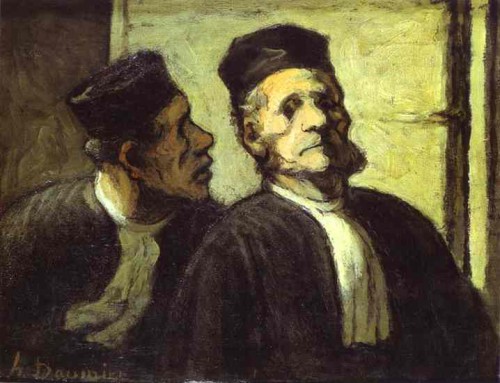
L’Europe de la bourgeoisie "libérale", de ses juristes et moralistes

Honore-Daumier-Two-Lawyers.JPG

L’Europe de la bourgeoisie "libérale", de ses juristes et moralistes
 
Un monde acéphale et sans pensée politique

Jacques-Yves Rossignol
Ex: http://metamag.fr 

Dans ses grandes lignes, l'histoire économique, contrairement aux théories professées par doctes enseignants en grandes écoles, experts  es-médias ou hommes politiques sortis de l’ENA, est très simple à comprendre. Evidemment, ici, ce sera un résumé dense et serré. Et un peu inhabituel.


Du mercantilisme au libéralisme


Autrefois, jadis, l'enrichissement était bon enfant. Tout comme la guerre ou la torture d'ailleurs. On ne pensait pas  faire du mal par sadisme ou par perversion. On pensait encore moins s'enrichir par des moyens compliqués et tortueux. On serrait simplement son trésor (que l'on avait par exemple raflé à celui dont on avait fracassé le crâne) envers soi.  Parfois on troquait ou achetait ce qu'on ne pouvait pas fabriquer ou dérober.


Un beau jour, on s'est aperçu que le capital s'accroissait par sa circulation. Par exemple : il n'est pas catastrophique d'acheter des marchandises à un prix exorbitant à A si je peux les revendre à un prix invraisemblable à B. Tout a changé : l'économie est devenue morale. Ce nouveau mode de fonctionnement parfaitement hypocrite n'étant possible que si l'on s'efforce d'entretenir de "bonnes relations" avec ses "partenaires économiques". On ne pille plus : on temporise, on berce, on flagorne.  Ainsi est née la mentalité à l'intérieur de laquelle nous vivons toujours : l'hypocrisie à fondement économique. Cette hypocrisie généralisée va même devenir une science : ce sera l'économie politique, la science de la duplicité morale, la seule science incapable d'avouer son fondement ultime (la défense inconditionnelle de la propriété privée, la cupidité portée à son point d'incandescence). Cette science va apprendre à tous et à chacun l'art de temporiser, de supporter et de flatter les gens que l'on rêve d'escroquer, de piétiner et d'anéantir.


Alors naîtra cette étrange idée d'humanité : l'humanité" c'est finalement l'ensemble des gens que l'on peut tenter d'escroquer, de tromper ou de voler d'une manière hypocrite et indicible. Et le discours humanitaire suivra : c'est l'ensemble des bavardages emphatiques chargés de dissimuler cette réalité d'une concurrence généralisée aussi épouvantable et décivilisatrice que souriante et imperturbable. La religion s'adaptera enfin à ces nouvelles nécessités : de naïve et candide, elle deviendra onctueuse et hypocrite, une façade permettant de dissimuler tout ce qui doit être dissimulé dans l'ordre de l'usure et de la pingrerie. 


En un mot comme en mille : on surenchérira constamment sur la morale dans les buts les plus immoraux. Ceci explique le flot de bavardage moral auquel nous sommes soumis aujourd'hui en capitalisme pourrissant. Le jeu habituel consistait à mener de vastes opérations de police contre ceux qui refusaient plus ou moins de participer à la sympathique hypocrisie décrite ci-dessus (les vendéens, les indiens d'Amérique, par exemple, ont bien connu ceci) puis à être pris soudain d'une commotion morale poignante à propos d'événements sans véritable rapport avec l'affaire en cause. Les braves gens n'osaient alors pas trop poser de questions face à une telle démonstration de moralité. Et l'on pouvait recommencer l'opération : dressage intensif à l'économie "libérale", épanchement de bons sentiments.


L'économie mécanisée : le crétinisme


Mais peu à peu les choses se sont compliquées : la surproduction de marchandises à écouler (à "réaliser") est devenue chronique. Il a fallu tromper les peuples les plus solvables d'une nouvelle manière, encore moins avouable que le baratinage moral. Il a fallu très exactement les crétiniser. Le seul moyen de continuer à faire des profits, c'était en effet le maintien des consommateurs solvables en situation d'aliénation permanente par l'industrie culturelle ("les médias"). Triste mais véridique !


Changement total de paradigme ! Bientôt on n'aura plus besoin d'hypocrisie affectée et compliquée : il n'y aura plus que des crétins consommant mécaniquement la pacotille imposée par le capitalisme pourrissant, même dans les pays de vieille civilisation ! Mais là, les occidentaux sont carrément les grands perdants. Parce que notre domaine, là où l'on était à l'aise, c'était quand même quelque chose de l'ordre de la pensée. 


Le capitalisme classique n'avait pas entièrement porté atteinte à la pensée. En capitalisme culturel ("médiatique"et surtout "musical'), la pensée cohérente est devenue impossible. Alors nous nous retrouvons dans une situation imprévue : abrutis et incapables d'identifier les conflits, les guerres menées contre nous. Incapables même d'identifier nos véritables assassins : la bourgeoisie "libérale", ses juristes et ses moralistes.


Nous nous retrouvons acéphales et donc sans pensée politique et çà, c'est quand même très ennuyeux.

00:05 Publié dans Actualité | Lien permanent | Commentaires (0) | Tags : europe, actualité, droit, économie, juristes | |  del.icio.us | | Digg! Digg |  Facebook

«L’échec des élites menace notre avenir»

eggheads.jpeg

Martin Wolf :

«L’échec des élites menace notre avenir»

Ex: http://fortune.fdesouche.com

Le divorce entre responsabilité et pouvoir porte atteinte à la notion même de gouvernance démocratique.

Les européens commémorent cette année le centenaire du déclenchement de la Première Guerre mondiale. Ce désastre a été le point de départ de trois décennies de sauvagerie et de stupidité, qui ont en grande partie détruit ce que la civilisation européenne recelait de positif au début du XXe siècle. Pour finir, comme Churchill le prédisait en juin 1940, “le Nouveau Monde, avec tout son pouvoir et sa puissance”, devait venir “à la rescousse libérer l’ancien”.

Les échecs des élites politiques, économiques et intellectuelles de l’Europe ont produit la catastrophe subie par leurs peuples de 1914 à 1945. C’est leur ignorance et leurs préjugés qui l’ont permise : des idées erronées et des valeurs négatives étaient à l’œuvre. Figurait parmi celles-ci la croyance atavique que les empires étaient non seulement brillants et rentables, mais que la guerre était glorieuse et contrôlable. C’est comme si une envie de suicide collectif avait saisi les dirigeants des grandes nations.

Les sociétés avancées comptent sur leurs élites pour que les choses, à défaut d’aller bien, ne deviennent au moins pas pire. Lorsque les élites échouent, l’ordre politique a de bonnes chances de s’effondrer, ce qui s’est produit pour les puissances vaincues à l’issue de la Première Guerre mondiale. Les empires russe, allemand et autrichien ont disparu, laissant à leur place de faibles héritiers, bientôt remplacés par les dictatures.

Le premier conflit mondial a également détruit les fondations de l’économie du XIXe siècle : le libre-échange et l’étalon-or. Les tentatives de les restaurer ont entraîné de nouveaux échecs des élites, autant américaines qu’ européennes cette fois. La Grande Dépression a fortement contribué à créer les conditions politiques de la Deuxième Guerre mondiale. Suivi de la Guerre froide, affrontement des démocraties avec une dictature engendrée par la Première Guerre mondiale.

Les conséquences épouvantables des échecs des élites ne sont pas surprenantes. Un contrat implicite existe entre les élites et le peuple : les premières disposent des privilèges et avantages liés au pouvoir et à la propriété ; le peuple, en échange, a droit à la sécurité et, à l’époque contemporaine, à une certaine prospérité. Si les élites échouent, elles courent le risque d’être remplacées.

Le remplacement des élites économiques, bureaucratiques et intellectuelles qui ont échoué est toujours tendu. Mais du moins le remplacement des élites politiques est-il rapide et propre dans une démocratie. Sous la dictature, cela prend d’habitude beaucoup de temps et c’est presque toujours sanglant. Il ne s’agit pas que d’Histoire.

C’est toujours vrai aujourd’hui. Si l’on veut tirer des enseignements de la Première Guerre mondiale pour le monde que nous connaissons, ce n’est pas à l’Europe actuelle qu’il faut nous intéresser, mais au Moyen-Orient, à la frontière de l’Inde et du Pakistan, et aux relations tendues entre une Chine en plein essor et ses voisins. Dans tous ces cas, un mauvais calcul aux conséquences meurtrières est possible, bien que le militarisme et l’impérialisme soient fort heureusement des idéologies bien moins présentes qu’il y a un siècle.

De nos jours, les nations puissantes acceptent l’idée selon laquelle la paix est plus propice à la prospérité qu’un illusoire butin de guerre. Mais cela ne signifie pas pour autant, hélas, que les pays occidentaux sont à l’abri des échecs de leurs élites. Ils sont au contraire en train de les vivre. Mais leurs échecs sont ceux d’une paix mal gérée, pas ceux de la guerre.

On peut constater trois échecs

Tout d’abord les élites économiques, financières, intellectuelles et politiques ont en grande partie mal apprécié les conséquences d’une libéralisation financière précipitée. Bercées par l’illusion de marchés financiers capables de se stabiliser d’eux-mêmes, elles ont non seulement permis, mais encouragé un gigantesque et profitable pari (pour la finance) sur l’expansion de la dette.

L’élite des décideurs n’a pas su évaluer correctement les perspectives de gain en jeu et, par dessus tout, les risques de crise systémique. Lorsque celle-ci s’est produite, elle a eu des conséquences désastreuses à plus d’un titre : l’économie s’est effondrée, le chômage a bondi, et l’endettement public a explosé.

L’élite dirigeante a été discréditée par son échec à empêcher cette catastrophe. L’élite financière a été discréditée parce qu’elle a dû être secourue.

L’élite politique a été discréditée par son empressement à financer ce sauvetage. L’élite intellectuelle (à savoir les économistes) a été discréditée par son échec à anticiper la crise et à se mettre d’accord sur ce qu’il fallait faire une fois qu’elle a eu lieu. Le sauvetage était nécessaire.

Mais ceux qui croient que les puissants ont sacrifié les contribuables aux intérêts des coupables ont raison. Ensuite nous constatons depuis trois décennies l’émergence d’une élite économique et financière mondialisée. Ses membres ont de moins en moins d’attaches avec les pays qui l’ont produite.

Cette évolution s’accompagne de l’affaiblissement de ce qui cimente la démocratie : la notion de citoyenneté.

La redistribution limitée des profits de la croissance économique renforce cette évolution. Elle conduit à une société de plus en plus ploutocratique.

Une certaine dose de ploutocratie est inévitable dans des démocraties bâties, comme il se doit, sur des économies de marché. Mais tout est toujours une question de dosage. Si la masse de la population considère que ses élites économiques gagnent beaucoup pour des résultats médiocres et qu’elles ne pensent qu’à elles-mêmes, en misant sur l’aide publique lorsque les affaires vont mal, les liens se rompent. Il est bien possible que nous soyons au début de ce pourrissement.

Enfin en créant l’euro, les européens ont fait passer leur projet des travaux pratiques à quelque chose de bien plus important pour les gens : le destin de leur monnaie. Rien n’était plus prévisible que les frictions entre européens sur la façon dont leur monnaie était bien ou mal gérée.

La crise financière, qui était probablement inévitable, entraîne à présent une foule de problèmes qui ne sont pas encore résolus. Les difficultés économiques des pays touchés par la crise sont évidentes : forte récession, chômage extrêmement élevé, émigration massive et dette trop lourde sont des menaces.

Tout cela est connu. Pour le moment c’est le désordre institutionnel de la zone euro qui est le moins souligné. Le pouvoir y est à présent concentré dans les mains des gouvernements des pays créanciers, principalement l’Allemagne, et d’un trio de bureaucraties non élues : la Commission européenne, la Banque centrale européenne et le Fonds monétaire international.

Les citoyens des pays touchés par la crise n’ont aucune influence sur celles-ci. Les responsables politiques qui leur doivent des comptes n’ont aucun pouvoir. Ce divorce entre responsabilité et pouvoir porte atteinte à la notion même de gouvernance démocratique. La crise de la zone euro n’est pas seulement économique.

Elle est aussi institutionnelle. Aucun de ces échecs ne ressemble en quoi que ce soit aux folies de 1914. Mais ils sont suffisamment importants pour semer le doute sur nos élites. La conséquence en est l’apparition d’un populisme menaçant dans les pays occidentaux, en particulier le populisme xénophobe de droite. La caractéristique des populistes de droite, c’est qu’ils sont rétrogrades.

Si les élites continuent d’échouer, les populistes en colère continueront leur progression.

Les élites doivent faire mieux. Sinon la fureur populaire risque de tous nous submerger.

Le Nouvel Economiste

00:05 Publié dans Actualité, Sociologie | Lien permanent | Commentaires (0) | Tags : sociologie, actualité, élites, déclin, décadence | |  del.icio.us | | Digg! Digg |  Facebook