



 del.icio.us
 Digg
Digg Facebook

 «La France poursuit l'auteur qui a longtemps été une épine dans le flanc de la mondialisation US, à cause de son attachement obstiné aux intérêts français autour du monde, plutôt qu'à ceux d'une «communauté mondiale» préfabriquée.(...) De Gaulle se refusait de jouer la carte américaine de l'après-guerre. (...) Dans le contexte actuel, quel meilleur moyen de saper le nationalisme français et décapiter toute résurgence d'une force anti-mondialiste que d'exploiter la vaste composante islamique non-assimilée de la France. Le but ultime de la mondialisation n'est pas de promouvoir les identités et les cultures ethniques, mais plutôt de les submerger dans un vaste melting-pot de consumérisme global, de déraciner l'individu de son identité et de son héritage, et de remplacer tout cela par le Centre commercial mondial, et le «village global». «Il faut donc, conclut l'auteur, inclure ici une redéfinition de l'Histoire de France, et y mettre l'accent sur le rôle des minorités non françaises dans l'ensemble de cette histoire redéfinie. Cela sous-entend que la génération de jeunes Américains Pepsi/MTV, ainsi que leurs guides/mentors issus des universités, serviront de repères (de phares) en vue d'une transformation (formatage) de la culture française, et une réécriture de l'Histoire de France selon un schéma mondialiste ».


And it isn’t the one that you are thinking of….
1939 – The War That Had Many Fathers, by Gerd Schultze-Rhonhof.
As mentioned in my first post on this book, the author has been dismissed in Germany regarding his historical views on the beginnings of the Second World War. From what I read in the preface, I found no reason to dismiss his views – and in any case, one can hold wrong views on certain subjects while providing valuable insights in others. It is for these hidden gems that I am reading the book. So, I continue.
I found one of those hidden gems in the first few pages – or is it a wacky assertion from a wrong-headed revisionist? If his point is valid, it provides a valuable insight – at least to me – into the manipulations by the elite at the turn of the last century and leading to the century of war.
The British – German Rivalry
The author begins by pointing to two mistakes by the German politicians prior to 1914 that led to the Great War:
They fail to extend the German – Russian Mutual Protection Pact, and they give to the economic upswing in Germany a maritime component.
The author sees in the first the opening for Russia to be drawn to France, and in the second a challenge to Britain on the seas. There is nothing terribly controversial here – many historians, mainstream and revisionist, have pointed to one or both of these factors.
From Britain’s view, Germany – post unification – was becoming the power on the continent with which it should have concern – replacing France. In various measures, Germany was growing into an economic powerhouse – the production of coal, iron, steel, etc. In 1887 in London, the “Merchandise Marks Act” was introduced, with the hope to attach stigma to products thereafter labeled “Made in Germany.”
Britain viewed it as good policy to keep a balance of power on the continent, thus freeing its hand elsewhere. Germany threatened not only that balance, but now could even threaten Britain itself. Britain’s views changed from seeing France as the primary continental threat to seeing this in in Germany:
On 1 January 1907 a top official of the British Foreign Ministry, Sir Eyre Crowe, drafts “an analysis of British Relations with France and Germany for his King.” … Now and in the future, Crowe concludes, Germany counts as England’s only opponent. (Page 22)
The British will therefore work to isolate Germany in the field of foreign policy, and the author suggests that German blunders provide the opportunity for this.
As mentioned, England previously saw France as its biggest competitor in the colonies; it now reached agreements with France on such matters. A 1904 treaty would coordinate colonial interests. In 1911, the British military promises France the support of six army divisions in the event of war with Germany. And without a proper treaty with Russia, this would one day place Germany in a strong vice.
Germaniam esse delendam to Protect Trade and Transport
Schultze-Rhonhof identifies comments coming out of England and against Germany almost immediately upon the formation of the German Reich in 1871. For example, he quotes Prime Minister Disraeli in a speech before the Lower House:
“The balance of power has been completely destroyed, and the country which suffers the most from this and feels the effect of this change most strongly, is England.” (Page 33)
Deputy Robert Peel adds that Germany has been united under a military “despotism.” (Page 33)
The author laments: “So Germany – just because unified – has already become a danger, and indeed for all of Europe.” (Page 34)
The press gets in on the act:
The London Saturday Review, an upper class journal, writes on 24 August 1895:
“We English have always waged war against our competitors in trade and transport. Our main competitor today is no longer France, but Germany…. In a war against Germany we would be in a position to win a lot and to lose nothing.” (Page 34)
On 1 February 1896 the same journal writes:
“If tomorrow every German were eliminated, there would be no British business nor any English enterprise which would not profit (lit “grow”). If every Englishman were to vanish tomorrow, the Germans would reap gains…. One of the two must quit the field. Get ready for the fight with Germany, for Germaniam esse delendam.” (Page 34)
Germany must be destroyed….
And again on 11 September 1897:
“Everywhere where the English flag has followed the Bible, and trade [has followed] the flag…the German trader fights the English…. States have waged wars for years over a town or rights to a throne; and should we not wage war when an annual trade of five billion is at stake?” (Page 34)
From the Belgian Ambassador in London to his ministry in Brussels on 24 May 1907, quoting Mr. Harmsworth (Lord Northcliffe), publisher of several daily papers in London:
“Yes we hate the Germans and that from the heart…. I will not allow my newspapers to print even the slightest thing that could hurt France. But I would not want them to carry anything at all that could be pleasant to the Germans.” (Page 38)
Is it a surprise to see the press doing the state’s bidding and leading the drumbeats to war?
Finally, Balfour is quoted, in response to the immorality of going to war for the purpose of protecting trade. It is suggested to Balfour: if Britain wants to keep up, work harder!
“That would mean we would have to lower our standard of living. Maybe a war would be easier for us.” (Page 38)
War is most certainly a racket! It is refreshing to know that there was a time when the politicians were more honest about this.
Why Not a British – US Rivalry?
Schultze-Rhonhof also examines the growth of production, trade, and naval resources of several other government powers. He concludes by asking: why does Britain fear Germany, when an even stronger opponent on the other side of the Atlantic, with far greater potential, was beginning to show its fangs?
Thus, the British fears of a threat could just as well have been ignited by North America’s fleet. The USA in regard to its industry and trade is also on track to overhaul England. And since 1898 it is acquiring colonies: Cuba, the Philippines, and Hawaii. (Page 31)
Yes, what gives? Schultze-Rhonhof provides his answer, and in it he identifies the assassination that helped to ensure the upcoming wars would be world wars – meaning the intervention of the United States.
Another reason lies in America’s apparent turning toward England. (Page 32)
By “apparent turning,” Schultze-Rhonhof here is describing what is called The Great Rapprochement:
The Great Rapprochement, according to historians including Bradford Perkins, describes the convergence of diplomatic, political, military and economic objectives between the United States and Great Britain in 1895-1915, the two decades before World War I.
This push for “convergence” was given widespread coverage on both sides of the Atlantic, influencing decision makers in both Britain and the United States.
At the turn of the last century, there was a powerful and well-known book, The Americanization of the World: The Trend of the Twentieth Century, by British celebrity journalist and editor of the Pall Mall Gazette, William T. Stead. In it, he predicted America’s inevitable – and providential – domination of the world.
From a conference paper outlining the book:
Stead, a tireless champion of Anglo-Saxon expansion, offered his prediction not in fear but in hope. Together, the United States and Britain would rule the world.
A century ago, Stead’s name was known to the public on both side of the Atlantic and to every prominent official in Europe and America.
As early as about 1870, in the immediate context of German unification, Stead advocated union between the British empire and the United States and came to defend what he called a “true Imperialism” aimed at the peace, security, unity, and humanitarian uplift of the world. In 1884 he campaigned for a larger Royal Navy. He wrote an article for the Pall Mall Gazette entitled “The Truth about the Navy,” attempting to provoke enough alarm over Britain’s vulnerability and Germany’s growing navy and colonial adventures to get Parliament to appropriate the necessary funds for a modern navy. Reading Sir John Seeley’s Expansion of England (1883) about this time inspired him with the idea of imperial federation. The scheme further expanded in his mind to bring the United States into an Anglo-Saxon union, reversing the blunder of George III. This proposal was similar to the campaign for Anglo-Saxon unification (or re-unification) waged by Stead’s friend Cecil Rhodes who famously said that he wanted to “paint the map red” with Britain’s empire. Other sympathizers included the industrialist Andrew Carnegie.
Given the determinism of history, Britain and Europe could either cooperate with the inevitable or wage a losing battle and end up Americanized against their will and without their consent. Germany and the Papacy seemed the most resistant to the Americanization of Europe. But the Kaiser’s bluster was as pointless as Canute’s command to the tide.
Stead saw war by the righteous as a means to bring about global peace.
The Assassination
Back to Schultze-Rhonhof:
Until McKinley’s presidency, the relations of the USA with the German Reich were always friendly and balanced. The English-American relationship, on the other hand, up to then is still burdened by the former British Colonial rule and England’s colonial wars in America.
With the assassination of McKinley in 1901 and the change to the presidency of Theodore Roosevelt a new kind of thinking arises in the USA. (Page 32)
Now this is where I struggled. Schultze-Rhonhof suggests that the change in US policy occurred after McKinley, not before. Yet all of the history I read suggests that McKinley is more like his successors than his predecessors – imperialism and all that. To further make this opaque, the Great Rapprochement is commonly dated as beginning in 1895.
Yet, Schultze-Rhonhof suggests this assassination was a turning point for US-German relations and US-British relations. Counter to McKinley:
Roosevelt and his successor Wilson are clearly anglophiles. They seek partnership with Great Britain. (Page 32)
So what gives? At this point, I had to go fishing.
McKinley vs. Roosevelt: What’s the Difference?
My first clue came here: Wall Street, Banks, and American Foreign Policy, by Murray Rothbard
William McKinley reflected the dominance of the Republican Party by the Rockefeller/Standard Oil interests. Standard Oil was originally headquartered at Rockefeller’s home in Cleveland, and the oil magnate had long had a commanding influence in Ohio Republican politics. In the early 1890s, Marcus Hanna, industrialist and high school chum of John D. Rockefeller, banded together with Rockefeller and other financiers to save McKinley from bankruptcy, and Hanna became McKinley’s top political adviser and chairman of the Republican National Committee. As a consolation prize to the Morgan interests for McKinley’s capture of the Republican nomination, Morgan man Garret A. Hobart, director of various Morgan companies, including the Liberty National Bank of New York City, became Vice-President.
The death of Hobart in 1899 left a “Morgan vacancy” in the Vice-Presidential spot, as McKinley walked into the nomination. McKinley and Hanna were both hostile to Roosevelt, considering him “erratic” and a “Madman,” but after several Morgan men turned down the nomination, and after the intensive lobbying of Morgan partner George W. Perkins, Teddy Roosevelt at last received the Vice-Presidential nomination. It is not surprising that virtually Teddy’s first act after the election of 1900 was to throw a lavish dinner in honor of J.P. Morgan.
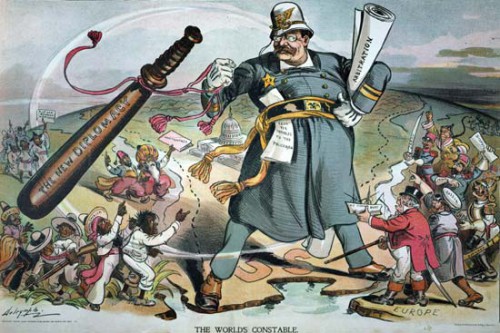
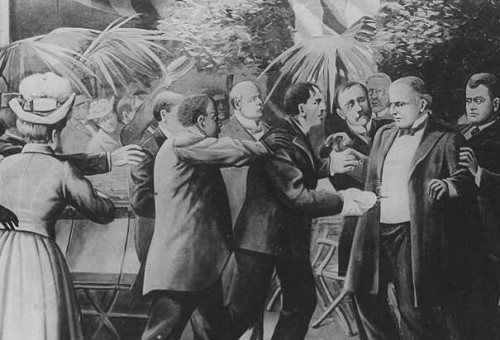
So McKinley was a Rockefeller man, and Roosevelt (McKinley’s vice-president) represented the House of Morgan. This, at least, is one bit of information that differentiates McKinley from Roosevelt. Of course, it would be somewhat irrelevant had not McKinley met his fate on September 6, 1901 (surviving, and believed to be improving, for eight more days). He was assassinated by a lone gunman; a nut, an “anarchist.”
Here again, I turn to Rothbard: “Investigate the Vice President First”
Next president to die in office was William McKinley of Ohio, long-time Rockefeller tool. Another lone nut was responsible, the “anarchist” Leon Czolgosz, who, like Guiteau, was quickly tried and executed by the Establishment. Even though Czolgosz was considered a flake and was not a member of any organized anarchist group, the assassination was used by the Establishment to smear anarchism and to outlaw anarchist ideas and agitation. Various obscure anti-sedition and anti-conspiracy laws trotted out from time to time by the Establishment were passed during this post-McKinley assassination hysteria. Beneficiary? The vaulting to power of Teddy Roosevelt, longtime tool of the competing Morgan (as opposed to Rockefeller) wing of the Republican Party. Teddy immediately started using the anti-trust weapon to try to destroy Rockefeller’s Standard Oil and Harriman’s Northern Securities, both bitter enemies of the Morgan world empire. Exhume McKinley, and also start a deep investigation of the possible role of Teddy and the Morgans. Was Czolgosz only a lone nut?
Perhaps something bigger was afoot…. But I still did not find the connection to this changing attitude toward Britain.
Surprise, surprise. Rothbard provides the answer here as well, from A History of Money and Banking in the United States:
As the nations moved toward World War II, the Morgans, who had long been closely connected with Britain and France, rose in importance in American foreign policy, while the Rockefellers, who had little connection with Britain and France and had patent agreements with I.G. Farben in Germany, fell in relative strength. Secretary of State Cordell Hull, a close longtime friend of FDR’s roving ambassador and Morgan man Norman H. Davis, took the lead in exerting pressure against Germany for its bilateral rather than multilateral trade agreements and for its exchange controls, all put in place to defend a chronically overvalued mark. (Page 344)
Rothbard is speaking here of World War II, but the relationships fit the scenario suggested by Schultze-Rhonhof.
The assassination of McKinley – a Rockefeller man favorable toward Germany – ensured the replacement by Teddy Roosevelt, a Morgan man. Morgan, favorably disposed toward Britain, had his man in place – a move that would ensure the US moves closer to Britain.
This one action helped to ensure a transition of the tool of global power projection, from Britain to the United States – as I have previously describedhere (in the context of the Second World War). Of course, the roots of World War Two are many and deep – including the Great War, and perhaps including McKinley’s assassination.
This transition from Britain to the US is explored further in “The Peaceful Transition of Power from the UK to the US,” by Feng Yongping. In this, there is also further exploration of the evolving relationships amongst and between the United States, Great Britain, and Germany:
With regard to Great Britain, binding itself in friendship with the United States and avoiding the towering costs of conflict also stands out as extremely significant in preserving the nation’s colonial power, which was seemingly on the verge of decline. Germans were predicting during the 1880s or 1890s that the United States would be drawn into war, with Bismark confidently predicting that Great Britain would confront the American navy in the Atlantic Ocean, generating a British – German alliance with a union of naval and land powers of strategic political benefit. In contrast, Great Britain chose reconciliation with the United States.
In 1905, US President Roosevelt told a British diplomat not to let the nightmare of war between English-speaking democracies keep him up at night. Roosevelt said that in preparing for potential outbreaks of war, a fight against Great Britain was not an issue, since it was an impossibility.
The US also provided similar assistance for the British in the Boer War. After conflict broke out there, Theodore Roosevelt promptly expressed his position of support, saying the war completely aligned the interests of the two English-speaking democracies and in turn, the interests of the civilized world, and that English should become the language of southern Zambezia. During the war, the United States presented Great Britain with great amounts of military supplies and extended credit for about 20% of Great Britain’s war expenses.
Selborne, British Lord of the Admiralty, commented that all subjects of the British Empire knew that war with America would be a colossal failure of British diplomacy. Home Secretary A.H. Lee said that he could not even fathom the possibility of the US and Great Britain actually fighting a war. The US President Theodore Roosevelt spoke nearly the same words in 1905, when he stated his belief that the danger of another British – US dispute had not only passed, but was gone forever. Compared with other large nations, he believed the feeling of friendship to be more genuine with England than with any other.
As previously mentioned, Schultze-Rhonhof’s work was dismissed in Germany. Yet, so far, I am finding that he points to events that have import – events not even found in other revisionist works. This connection – McKinley’s assassination as one of the roots of the Great War – is one that I have not read elsewhere.
It is a connection that is supported by Rothbard’s work. Schultze-Rhonhof seems to keep good company. If he is dismissed for reasons similar to those offered to dismiss Rothbard, I certainly will continue with an open mind.
(I thank Charles Burris for being generous with his comments toward one aspect of this post. Any errors in interpretation or historical fact are completely my own.)
Reprinted with permission from the Bionic Mosquito.