Ok

En poursuivant votre navigation sur ce site, vous acceptez l'utilisation de cookies. Ces derniers assurent le bon fonctionnement de nos services. En savoir plus.

vendredi, 13 juin 2014

Coups bas géopolitiques...

southern-corridor-2-en.jpg

COUPS BAS GEOPOLITIQUES...

Alain Cagnat

http://synthesenationale.hautetfort.com

& Terre et peuple cliquez ici

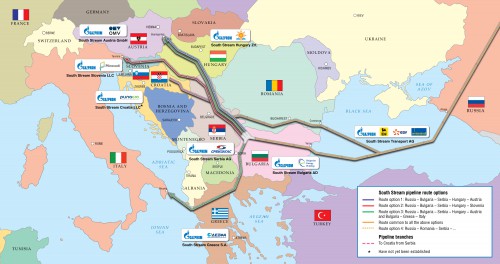
La Commission européenne a donné l'ordre à la Bulgarie de suspendre les travaux de construction du gazoduc South Stream sur son territoire, en la menaçant d'une procédure d'infraction qui ne pourrait que déboucher sur de lourdes sanctions financières. Qu'est-il reproché à la Bulgarie ? Tout simplement de contourner l'embargo décrété contre la Russie à propos de l'affaire ukrainienne.

Il s'agit en fait d'une nouvelle page du « Grand Jeu » des hydrocarbures. Souvenons-nous. Les bombardements de la Serbie par les avions de l'OTAN (Etats-Unis et Union européenne, dont la France), qui firent 2 000 victimes civiles, avaient pour but d'arracher la province du Kosovo à la Serbie. Peu de temps après, le nouvel Etat, aux mains des mafias albanaises, était reconnu par une minorité de pays (plusieurs pays de l'UE s'y refusent d'ailleurs, l'Espagne, la Grèce, Chypre...). Peu regardants sur la moralité de ses dirigeants, les Américains y installèrent deux énormes bases militaires, Bondsteel et Monteith. Leur finalité était de sécuriser les pipelines qui devaient transporter les hydrocarbures depuis la mer Caspienne et l'Asie centrale.

Les sécuriser contre qui ? Contre la Russie, évidemment. Les réalisations de l'oléoduc Bakou-Tbilissi-Ceyhan, puis du gazoduc Bakou-Tbilissi-Erzerum, permettaient d'acheminer les hydrocarbures depuis l'Azerbaïdjan jusqu'en Turquie (puis vers l'Europe et Israël) à travers la Géorgie, en évitant la Russie. L'Europe avait même un projet pharaonique de prolongement de ces tubes vers l'Europe, Nabucco.

Pour Moscou, il fallait absolument réagir et se parer de l'incertitude de ses voisins : la Pologne et les Pays baltes russophobes, la Biélorussie peu fiable de l'autocrate Loukachenko, l'Ukraine et la Géorgie qui lorgnaient vers l'Union européenne et surtout vers l'OTAN.

Au nord, le problème fut résolu par la construction du gazoduc Nord Stream qui relie directement la Russie à l'Allemagne, en passant sous la mer Baltique, évitant ainsi les Pays baltes, la Pologne et la Biélorussie. Il est à noter que cette entreprise fut réalisée en partenariat avec l'Allemagne et que le leadership en fut confié à Gerhard Schröder, l'ancien chancelier allemand. A croire que Berlin se méfie tout autant de ses partenaires baltes et polonais...

Au sud, Gazprom entreprit un chantier similaire en partenariat avec l'italien ENI: passer sous la mer Noire en évitant soigneusement la Géorgie et l'Ukraine pour déboucher en Bulgarie et servir ainsi l'ensemble de l'Europe du Sud.

Tout semblait sourire à Poutine. En premier lieu, la Géorgie avait pris une fessée en 2008, mettant à mal la stratégie américaine : à quoi bon protéger les pipelines depuis le Kosovo si ceux-ci sont sous la menace des chars russes en Géorgie même ? Quant au projet Nabucco, il fut purement et simplement abandonné faute de gaz à y transporter (les pays d'Asie centrale préférant les tubes russes).

La Bulgarie a tout intérêt à ce que le projet South Stream soit opérationnel : elle touchera d'énormes dividendes du transit gazier sur son territoire. La Commission européenne, en bonne exécutrice des intérêts américains, n'en a que faire. Le peuple bulgare peut crever ! Ce qui intéresse Bruxelles c'est d'envenimer la « guerre froide » avec la Russie de Poutine. Que les Ukrainiens, les Moldaves et autres Géorgiens qui rêvent d'appartenir à l'Union européenne et à l'OTAN réfléchissent bien. Ils n'ont rien à y gagner et y perdront leur liberté.

Russia’s Gazprom signs Agreement to Abandon the Dollar

how-america-is-losing-the-dollar.jpg

Grand Geopolitical Project: Russia’s Gazprom signs Agreement to Abandon the Dollar

Global Research, June 07, 2014

It’s only the tip of the iceberg. A grand geopolitical project is beginning to materialize…”

 On June 6 2014, the official Russian news agency Itar Tass announced what many were expecting since at least the beginning of the Ukrainian crisis: Russian main energy company, Gazprom Neft has finally “signed agreements with its consumers” to switch from Dollars to Euros (as transition to the ruble) “for payments under contracts”.

The announcement that the agreement has been actually signed and not just discussed was made by Gazprom’s Chief Executive Officer, Alexander Dyukov.

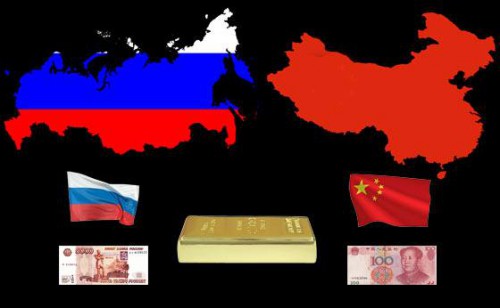
Despite the pressures from Wall Street and its military, propaganda and political apparatus, 9 out of 10 consumers of Gazprom’s oil and gas agreed to pay in Euros. Of course, the big watershed was the Gazprom unprecedented 30-years $400Bl natural gas supply to China signed in Shanghai last May 21 in the presence of President Putin and President Xi Jinping in the middle of the Anglo-american sponsored violent destabilization of Ukraine. In fact it is improper to talk a dollar denominated $400Bl, because this “biggest deal” will not be using dollars but the Renminbi (or Yuan) and the Russian Ruble. It links China and Russia economically and strategically for three decades, de facto (and maybe later also de jure) creating an unshakable symbiotic alliance that necessarily will involve the military aspect.

The Russia-China agreement is a clear defeat of the obsessive geopolitical attempts by Wall Street to keep the two country in a situation of competition or, ideally, war-like confrontation. It changes the structure of alliances. It strikes at the historical foundations of British colonial geopolitics (Divide and Rule). Under escalating pressures and threats to their national security, Russia and China overcame brilliantly historical, ideological, cultural differences which had previously been been by the colonial powers (and their financial heirs in Wall Street and the London’s city) for their “Divide & Conquer” strategy.

Furthermore, to the horror of London and Washington, China and Russia concluded an agreement with India (the BRICS!) breaking the other holy tenet of British colonial geopolitics: The secret to controlling Asia, and thus Eurasia has always been to instigate a perennial rivalry between India, China, and Russia. This was the formula for the 19th century “Great Game”. This was why Obama was selected to succeed George W Bush. The then vice Presidential candidate Joseph Biden announced it very openly on Aug 27 2008 at the Democratic Convention in Denver, explaining why the Obama-Biden duo had been chosen to take over the White House. The greatest mistake of the Bush administration and the Republicans, he said, was not their atrocious unchained warmongering, but their failure

“to face the biggest forces shaping this century. The emergence of Russia, China and India’s great powers”. Zbigniew Brzezinski’s protégé Barack Obama was to defeat this “threat”. Obviously they failed! But this explains the dogged, irrational, King Canute-style self-destructive arrogance that has taken over the present Administration.

The significance of these developments should be emphasized in relation to both the real economy and  the underlying financial structures. These developments in Eurasia are likely to have weaken on “the chains that have tied the European Union to Wall Street and the City of London”.  The end of the dollar payment system (Aka Petro-dollar) does not concern the currency of the United States or the United States as such. In fact overcoming this system could mean  the restoration of a rational and prosperous economy in the United States itself. What is known as “dollar system” has been just an instrument of feudal financial centers to loot the economy of the world. These centers are ready to do anything to save their right to loot. It is well known that whoever tried, until now, to create an alternative to the dollar system, met a ferocious reaction.

It is fitting to remember in this moment of great hope, the words of one of the very few great living strategists, Gen. Leonid Ivashov. On June 15 2011, reflecting on the savage destruction of Libya, the general who is an unofficial spokesman of the Russian armed forces and has been Russia’s representative in NATO, wrote

BRICS and the Mission of Reconfiguring the World.”

Whoever challenges the dollar hegemony, explained Ivashov, becomes a target. 

He gave precise examples: Iraq, Libya, Iran:

the countries which defied dollar dominance invariably came under heavy pressure and in a number of cases – under devastating attacks.” But the “the financial empires built by Rothschilds and Rockefellers are powerless against the five largest civilizations represented by the BRICS.”

Thus, Ivashov advocated a coordinated strategy by countries representing half of the world population to win their independence using their own currency.

“The shift to national currencies in the financial transactions between the BRICS countries should guarantee an unprecedented level of their independence…”

Since the collapse of the USSR, the countries which defied dollar dominance invariably came under heavy pressure and in a number of cases – under devastating attacks. Saddam Hussein –who banned dollar circulation in all spheres of Iraq’s economy including oil trade– was displaced and executed and his country was left in ruins. M. Gaddafi started switching Libya’s oil and gas business to gold-backed Arab currencies and air raids against the country followed almost immediately… Tehran had to put its plan to stay dollar-free on hold to avoid falling victim to aggression.

Still, even enjoying unlimited US support, the financial empires built by the Rothschilds and Rockefellers are powerless against the five largest civilizations represented by countries accounting for nearly half of the world’s population. BRICS is clearly immune to forceful pressure, its member countries do not appear vulnerable to color revolutions, and the strategy of provoking and exporting financial crises may easily backfire.

In contrast to the US and the EU, BRICS countries altogether own natural resources sufficient not only to keep their economies afloat in the settings of contracting availability of hydrocarbon fuels, food, potable water, and electric power but also to sustain vigorous economic growth. The shift to national currencies in the financial transactions between the BRICS countries should guarantee an unprecedented level of their independence from the US and from the West in general, but even that is only the tip of the iceberg. A grand geopolitical project is beginning to materialize

Now it’s the moment for Europe to decide the big step. The Ukrainian crisis is in reality a Battle for Europe.

The elites of Continental Europe — The Germany of Alfred Herrausen, the France of Charles De Gaulle, the Italy of Enrico Mattei and Aldo Moro, the Europe that tried to road of sovereignty and independence … have been until now terrorized and threatened exactly in the terms explained by Gen Ivashov. Now the Battle for Europe is raging. We will look in a coming article at the great European forces, the silent partners, still traumatized and scared, who are looking with trepidation and painful memories of the past defeats at the firm stand of Russia.

The Anti-Modernism of G. K. Chesterton

Neither Progressive nor Conservative: The Anti-Modernism of G. K. Chesterton

By Keith Preston

AlternativeRight.Com & http://attackthesystem.com


Gilbert Keith Chesterton (1874-1936) bears the distinction of being a writer who resisted virtually all of the dominant trends of his era. He lived during the late nineteenth and early twentieth century, precisely the time that modernity was fully consolidating itself within Western civilization more than a century after the apex of the Enlightenment and the French Revolution. Chesterton began his writing career as a young man and as the twentieth century was just beginning. As much as any other writer from his era, he predicted the horrors that century would entail.
 
A man of many talents and interests, Chesterton was a playwright, novelist, lecturer, journalist, poet, critic of literature and art, philosopher, and theologian. His work in many of these areas stands out as being among the very best of the era and continues to offer immense insight even in the present day. Among Chesterton’s circle of friends and intellectual sparring partners were such luminaries as H. G. Wells, Bertrand Russell, and George Bernard Shaw. His relationships with these men are themselves highly significant as each of them were among the leading “progressive” intellectuals of the era and fully committed to the modernist values of rationalism, secularism, and socialism. As these were all systems of thought that Chesterton adamantly opposed, it is striking that he could also count some of these figures as friends and engage them in amiable debate. It was during an era when the old liberal values of rational discourse and gentlemanly civility still prevailed, even among those who in many ways held polar opposite world views. It was before the time of the radical political polarization of modern intellectual life that began with the growth of the totalitarian movements of the early to middle twentieth century. The friendly exchanges between Chesterton and Shaw, for instance, even on topics of intense disagreement in many ways serve as a refreshing contrast to the rhetorical brutality that dominates much of today’s public discourse.

The dramatic changes that had occurred in Western society over the course of the nineteenth century had dramatically impacted the thinking of its leading intellects. The growth of industrial civilization has raised the general standards of living to levels that were hitherto not even dreamed of, and the rising incomes of the traditionally exploited industrial working class were finally allowing even the proletariat to share in at least some middle class comforts. The rise of new political ideologies such as liberalism and democracy had imparted to ordinary people political and legal rights that were previously reserved only for the nobility. Health standards also increased significantly as industrial civilization expanded and life expectancy began to grow longer. Scientific discovery and technological innovation exploded during the same era and human beings began to marvel at what they had accomplished and might be able to accomplish in the future. Religion-driven superstitions had begun to wane and the religious persecutions of the past had dwindled to near non-existence. Societies became ever more complex and out of this complexity came the need for an ever expanding class of specialists and more scientific approaches to social management. While only a hundred years had passed between the world as it was in 1800 and the world of 1900, the changes that had occurred in the previous century were so profound that the time difference might as well have been thousands of years.

The profundity of this civilization-wide change inspired the leading thinkers of the era to tremendous confidence and optimism regarding the future and human capabilities. If one surveys the literature of utopian writers of the era one immediately observes that many of these authors expressed a confidence in the future that now seems as quaint as it is absurd. The horrors of the twentieth century, with its genocides, total wars, atomic weaponry, and unprecedented levels of tyranny would subsequently shatter the naïve idealism of many who had previously viewed the advent of that century with great hopes that often approached the fantastic. The early twentieth century was a time of joyous naivete. Bertrand Russell would later insist that no one who was born after the beginning of the Great War which broke out in 1914 would ever know what it was like to be truly happy.

“Pick a star, any star” – the retro-futuristic optimism of the past

But G. K. Chesterton, while far from being a cynical or overly pessimistic figure, was not one who shared in this optimism. Indeed, he was one who understood the potential horrors that could be unleashed by the new society and new modes of thought as clearly as any other. To Chesterton, the progressives of his time were over confident to the point of arrogance and failed to recognize the dangers that might befall mankind as humanity boldly forged its way into the future. Perhaps one of Chesterton’s most prescient works of social criticism is Eugenics and Other Evils, published in 1917. [1] At the time the eugenics movement that was largely traceable to the thought of Darwin’s cousin, Francis Galton, had become a popular one in the world’s most advanced nations such as England, America, and Germany. It was a movement that in its day was regarded as progressive, enlightened and as applying scientific principles to the betterment of human society and even the human species itself. Its supporters included many leading thinkers and public figures of the era including Winston Churchill, Sidney and Beatrice Webb, John Maynard Keynes, Anthony Ludovici, Madison Grant, and Chesterton’s friends Wells and Shaw. Yet Chesterton was one of the earliest critics of the eugenics movement and regarded it as representing dangerous presumptions on the part of its proponents that would likely lead to horrific abuses of liberty and violations of the individual person which it eventually did.

One of Chesterton’s most persistent targets was the growing secularism of his era, a trend which continues to the present time. That Chesterton was a man of profound faith even as religion was being dwarfed by science among thinking and educated people during his time solidifies Chesterton’s role as a true intellectual maverick. It is this aspect of Chesterton’s thought that as much as anything else continues to win him the admiration of those who remain believers even during the twenty-first century. Chesterton was always a man of spiritual interests and even as a young man toyed with occultism and ouija boards. The development of his spiritual thinking later led him to regard himself and an “orthodox” Christian and Chesterton formally converted to Catholicism in 1922 at the age of forty-six. His admirer C. S. Lewis considered Chesterton’s writings on Christian subjects to be among the very best works in Christian apologetics.

In the intellectual climate of the early twenty-first century, religious thinking has fallen into even greater disrepute than it possessed in the early twentieth century. In relatively recent times, popular culture has produced a number of writers whose open contempt for religious believers has earned them a great deal of prominence. While intelligent believers who can offer thoughtful defenses of their views certainly still exist, it is also that case that religious belief or practice is at its lowest point yet in terms of popular enthusiasm in the Western world. Less than five percent of the British population attends religious services regularly and even in the United States, with its comparatively large population of religious fundamentalists, secularism has become the fastest growing religious perspective. Chesterton would no doubt be regarded as a rather anachronistic figure in such a cultural climate.

Abandoned church

The contemporary liberal and left-wing stereotype of a religious believer is that of an ignorant or narrow-minded bigot who is incapable of flexibility in his thinking and reacts with intolerance to those holding different points of view. Certainly, there are plenty of religious people who fit such stereotypes just as overly rigid and dogmatic persons can be found among adherents of any system of thought. Yet, a survey of both Chesterton’s writings on religion and his correspondence with friends of a secular persuasion indicates that Chesterton was the polar opposite of a bigoted, intolerant, religious fanatic. In his Christian apologetic work Orthodoxy, Chesterton wrote,

“To hope for all souls is imperative, and it is quite tenable that their salvation is inevitable…In Christian morals, in short, it is wicked to call a man ‘damned’: but it is strictly religious and philosophic to call him damnable.” 

Of his friend Shaw, he said, “In a sweeter and more solid civilization he would have been a great saint.”

In his latter years when he knew he was dying, H. G. Wells wrote to Chesterton, “If after all my Atheology turns out wrong and your Theology right I feel I shall always be able to pass into Heaven (if I want to) as a friend of G.K.C.’s. Bless you.” Chesterton wrote in response:

“If I turn out to be right, you will triumph, not by being a friend of mine, but by being a friend of Man, by having done a thousand things for men like me in every way from imagination to criticism. The thought of the vast variety of that work, and how it ranges from towering visions to tiny pricks of humor, overwhelmed me suddenly in retrospect; and I felt we have none of us ever said enough…Yours always, G. K. Chesterton.” [2]

It was also during Chesterton’s era that the classical socialist movement was initially starting to become powerful through the trade unions and labor parties and virtually all leading intellectuals of the era professed fidelity to the ideals of socialism. Yet just as Chesterton was a prescient critic of eugenics, he likewise offered an equally prescient critique of the totalitarian implications of state socialism. Because of this, he was often labeled a reactionary or conservative apologist for the plutocratic overlords of industrial capitalism by the Marxists of his era. But Chesterton was no friend of those who would exploit the poor and workings classes and was in fact a staunch critic of the industrial system as it was in the England of his era. “Who except a devil from Hell ever defended it?” he was alleged to have said when asked about capitalism as it was practiced in his day. [3]

Indeed, Chesterton’s criticisms of both industrial capitalism and state socialism led to the development of one of the most well-known and interesting aspects of his thought, the unique economic philosophy of distributism. Along with his dear friend and fellow Catholic traditionalist Hilaire Belloc (Shaw coined the term “Chesterbelloc” to describe the pair as inseparable as they were), Chesterton suggested the creation of an economic system where productive property would be spread to as many owners of capital as possible thereby producing many “small capitalists” rather than having capital concentrated into the hands of a few plutocrats, trusts, or the state itself.

The prevailing trends of the twentieth century were towards ever greater concentrations of power in large scale, pyramid-like institutions and ever expanding bureaucratic profligacy. Chesterton’s and Belloc’s economic ideas were frequently dismissed as quaint and archaic. However, technological developments in the cyber age have once again opened the door for exciting new possibilities concerning the prospects for the decentralization of economic life. Far from being anachronistic reactionaries, perhaps Chesterton and his friend Belloc were instead futuristic visionaries far ahead of their time.

It is clear enough that Chesterton was in many ways a model for what a public intellectual should be. He was a fiercely and genuinely independent thinker and one who stuck to his convictions with courage. Chesterton never hesitated to buck the prevailing trends of his day and was not concerned about earning the opprobrium of the chattering classes by doing so. He was above all a man of character, committed to intellectual integrity, sincere in his convictions, tolerant in his religious faith, and charitable in his relations with others. In his intellectual life, he wisely and quixotically criticized the worst excesses of the intellectual culture of his time. The twentieth century might have been a happier time if the counsel of G. K. Chesterton had been heeded.

NOTES:

[1] Chesterton, Gilbert Keith. Eugenics and Other Evils. Reprinted by CreateSpace Independent Publishing Platform; 1st edition (November 20, 2012). Originally published in 1917.

[2] Babinski, Edward T. Chesterton and Univeralism. Archived at http://www.tentmaker.org/biographies/chesterton.htm. Accessed on March 12, 2013.

[3] Friedman, David D. G. K. Chesterton-An Author Review, The Machinery of Freedom: Guide to Radical Capitalism. Second Edition. Archived at http://daviddfriedman.com/The_Machinery_of_Freedom_.pdf. Accessed on March 12, 2013.

Originally published in Chesterton: Thoughts & Perspectives, Volume Thirteen (edited by Troy Southgate) published by Black Front Press.

UNE NATION SANS RELIGION UNE RELIGION SANS NATION ?

chartres.jpg

UNE NATION SANS RELIGION UNE RELIGION SANS NATION ?
 
L’Europe peut disparaître
 
Laurent Mercoire
Ex: http://metamag.fr

La visite récente du pape François en Terre sainte (ou, selon le regard posé, en Israël, voire en Palestine) a mis en évidence une distorsion géographique : les lieux saints de la chrétienté sont dans un territoire qui ne lui appartient pas. Etonnant, si l’on considère les règles entourant le Saint-Sépulcre ? Non, car il s’agit ici de l’appartenance territoriale au sens d’un état souverain, et parfois même national. Or, si le Vatican est souverain, c’est d’abord sur quelques arpents de la ville de Rome. Le pape catholique ne décide guère de ce qui se fait à Jérusalem.


André Malraux prédisait comme essentielle la tâche de réintégrer les dieux lors du 21e siècle. Les premières années de ce dernier semblent aller dans ce sens, puisque la chute des TwinTowers en 2001 a été le début d’une décennie de guerre, prétendant réduire la menace exercée sur l’Occident par l’extrémisme islamiste. De plus, bien des états aujourd’hui, et pas des moindres, s’appuient sur une religion identitaire. Il en est ainsi de l’Inde, qui vient de porter à sa tête un parti hindouiste, ou de la Turquie qui tend à s’éloigner de la laïcité à un point tel que le centenaire de celle-ci ne puisse probablement pas être célébré dans la prochaine décennie. Le Japon ou la Chine tentent de retrouver certaines de leurs traditions ancestrales, qu’il s’agisse du shintoïsme, ou du confucianisme. Enfin, le renouveau de la Russie, voulu par son président, recourt à la puissance du sentiment orthodoxe. Au-delà de sa recherche identitaire dans la religion, ces pays présentent aussi une caractéristique trop souvent négligée : un peuple ( ou une part importante de leur peuple ) porteur lui aussi d’identité, conscient de son altérité, qu’il s’agisse des Hindous, des Turkmènes ou des Slaves russophones. De plus, chacun de ces états, faisant la somme de ses identités religieuses et ethniques, se reconnait comme une nation pratiquant une langue commune ( ce qui ne veut pas dire unique ). 


Pour en revenir à la Terre sainte, commune aux trois religions du Livre, le peuple hébreu a pris le contrôle des restes du Temple depuis un demi-siècle et entend bien que la nation d’Israël soit reconnue comme un état juif. L’Islam sunnite, qui contrôle, grâce à la monarchie wahhabite, deux de ses lieux saints les plus importants à Médine et à La Mecque, a cependant quelques difficultés à résoudre. Une souveraineté territoriale palestinienne permettrait le contrôle de son troisième lieu saint à Jérusalem ; à l’inverse, l’Iran chiite, réuni autour d’un peuple en grande part d’origine indo-européenne, est un rival, depuis le Golfe persique jusqu’au Liban. Malgré leurs différences, tous les Musulmans connaissent la différence qui existe en terre d’Islam et terre de guerre ( Dar al-Islamet Dar, al-Harb ). Qu’en est-il des Européens de religion chrétienne non orthodoxe, qui ont pourtant contrôlé la Terre sainte voici presque mille ans, certes pour quelques décennies seulement ?


Il ne semble exister aujourd’hui au sein de l’Union européenne qu’un seul état apparenté ( de très loin ) à une théocratie, le Royaume-Uni, dont le souverain est aussi le chef de l’église anglicane. Notons cependant que l’actuelle nation britannique, au-delà de ses qualité de tolérance bien connues, est soumise à la fois à un repli identitaire l’éloignant du continent, et à des tendances d’éclatement dont témoignent les dévolutions galloise et écossaise. Quant à l’Europe, elle a refusé maintes fois de s’assumer comme chrétienne, alors même que sa puissance jusqu’au 18e siècle a résulté de l’alliance des pouvoirs séculier et ecclésiastique. Ensuite, l’appel à la liberté de conscience des Lumières, la survenue des révolutions américaine et française, la défense des Droits de l’homme, récemment consacrée par l’Union européenne, ont signé le retour aux valeurs d’un christianisme primitif, auquel certains ont attribué un rôle important dans la chute de la Rome impériale. L’inconvénient de cette nouvelle « religion » est qu’elle n’apporte aucune synergie d’identité aux peuples et à leurs territoires ; elle nie l’idée même de souveraineté du peuple, en la dénigrant grâce au terme « populisme ». Les récentes élections ont d’ailleurs démontré que les Européens ne se reconnaissent pas encore en tant que tels. L’Union n’a pas non plus clairement défini son territoire, ne serait-ce que d’influence. Au Sud, l’admission de la Turquie a montré que les querelles byzantines subsistaient au-delà d’Istanbul, à l’Est la Russie vire de bord vers la Chine, et à l’Ouest le futur traité transatlantique fait disparaitre toute possibilité de créer un espace économique semi-autarcique. En bref, l’Union européenne ne s’identifie pas à un peuple, n’a pas su se doter d’une langue commune en un demi-siècle, contrôle mal son territoire, et défend une idéologie tout aussi généreuse que périlleuse.


Face aux géants identitaires qui s’annoncent, une conclusion pessimiste s’impose. L’Europe peut disparaître, et ses nations aussi, faute d’avoir voulu s’affirmer selon un modèle analogue à celui mis en œuvre par la troisième Rome chère à Vladimir Poutine. Une religion prosélyte, libre de toute attache territoriale, est certes attractive, notamment pour une espérance dans un autre monde ( cette espérance ancienne dans l’au-delà n’a plus la même valeur dans le monde d’ici au sein duquel les aspirations matérielles sont une priorité ). Une religion des Droits de l’homme est tout aussi séduisante, mais elle est dangereuse pour ses pratiquants quand, pour paraphraser Théodore Roosevelt ( à ne pas confondre avec son homonyme ), elle ne s’accompagne pas d’un gros bâton ( « big stick » ). Si ce 21e siècle doit être vraiment religieux, l’Europe devrait peut-être changer son logiciel, et rechercher un nouveau Jean Parisot de La Valette, certes hospitalier, mais aussi guerrier. Elle pourrait aussi recourir à des mythes plus anciens, assurée ainsi de trouver sur son territoire d’autres lieux sacrés comme source d’inspiration, d’union et de survie.