


lundi, 20 octobre 2008
T&P: La Russie est de retour

Volonté
Les Géorgiens avaient des armes américaines (et israéliennes). Elles ont été récupérées par les Ossètes, les Abkhazes et les Russes. Les Géorgiens avaient oublié un détail : malgré ce qu’ils leur avaient laissé croire, ces Américains qui leur ont obligeamment donné des armes n’allaient certainement pas s’en servir eux-mêmes. Pour deux raisons simples : d’une part ils préfèrent que d’autres prennent les coups à leur place (voir les tués français d’Afghanistan), d’autre part ils n’ont pas les moyens d’intervenir militairement dans le Caucase. En effet leur volonté d’hégémonie mondiale, qui reste entière (voir les déclarations d’Obama et de Mc Cain), est aujourd’hui bloquée par les bourbiers irakien et afghan, dans lesquels les Yankees ont englué l’essentiel de leurs forces disponibles. Il leur reste donc la solution de pousser en avant leurs marionnettes- mercenaires. Comme au Kosovo. Comme en Ukraine. Comme en Pologne.
Seulement, voilà. Les occidentaux ont cru, ou voulu croire qu’il y avait simple rodomontade lorsque Poutine a annoncé, avec son franc parler habituel, que le Kosovo était « un boomerang qui allait leur revenir dans la gueule ». Paroles verbales, comme disait l’autre ? Le président Medvedev explique posément que le boomerang a fonctionné : « Sans tenir compte des avertissements de la Russie, les pays occidentaux se sont précipités pour reconnaître la proclamation illégale d’indépendance du Kosovo à l’égard de la Serbie (…) Nous avons dit régulièrement qu’il serait impossible, après cela, de dire aux Abkhazes et aux Ossètes (…) que ce qui a été bon pour les Albanais du Kosovo ne l’est pas pour eux ».
Cette tranquille leçon de logique provoque la vertueuse indignation de l’éditorialiste du Monde (28 août) qui accuse les chefs russes de vouloir « refaire l’Empire ». Oui. Bien sûr. Et alors ? Il serait interdit aux Russes de faire ce qu’ont fait les Yankees et ce que s’apprêtent à faire les Chinois ? Au nom de quoi ? De la « démocratie » ? Cette tartufferie bouffonne qui, toujours et partout, est là pour justifier la dictature du fric ?
Les Russes mettent en application une maxime que nous aimons bien : là où il y a une volonté, il y a un chemin. Voilà ce que doivent avoir en tête, en permanence, ceux qui n’acceptent pas l’inacceptable – que ce soit la dictature de l’argent, du politiquement correct et de l’idéologie cosmopolite, l’invasion-occupation de notre terre par des peuples qui n’ont rien de commun avec nous, le lâche renoncement de trop de Gaulois vautrés dans les illusions d’un confort qui n’est, contrairement à ce qu’ils veulent croire, qu’un mirage provisoire.
Les zélotes de l’idéologie en place, exemplairement représentés par un Kouchner, jouent à faire peur aux braves gens : si vous n’êtes pas sages – c’est à dire si vous n’êtes pas les esclaves consentants de ce que nous représentons – vous aurez droit à l’Apocalypse. Ce qu’ils appellent l’Apocalypse, c’est la minute de vérité où les lois de la nature, les réalités environnementales, biologiques et ethniques vont reprendre leurs droits. De toutes nos forces, préparons cet instant béni.
Pierre VIAL
12:04 Publié dans Revue | Lien permanent | Commentaires (0) | Tags : russie, géopolitique, caucase, ossétie, abkhazie, mer noire, france |  |
|  del.icio.us |
  |
|  Digg |
  Facebook
Qu'est-ce que le "soft power"?
QU’EST-CE QUE LE SOFT POWER ?
Trouvé sur: http://coterue.over-blog.com
« Concrètement, le soft power atlantique, qu’est-ce que c’est pour le citoyen européen lambda ? C’est quand votre voisine vous parle du dernier épisode de Desesperate Housewifes ou quand vos parents sifflottent une chanson des Beatles qui leur rappelle leur jeunesse, cette jeunesse que l’on envoie comme à l’abattoir de l’intelligence voir le dernier block-buster américain. C’est quand les souvenirs des gens (de nos gens, des nôtres et de nous-mêmes) sont parasités par le vomi constant mais inexorable de la sous-culture utilisée par le vainqueur de la Seconde guerre mondiale, puis de la Guerre froide, comme une arme de guerre, comme une arme de destruction massive, comme une bombe radiologique au rayonnement continu, diffus, permanent et mortel. Comble de l’horreur organisée, le soft power, c’est quand des parents amènent leurs enfants fêter leur anniversaire au fast-food !
Et combien de braves gens l’ont fait autour de nous, preuve de la force d’imprégnation et de propagande culturelle modelante qu’a le soft power pour maintenir une hégémonie culturelle et politique. [...] Bref, le soft power, c’est quand l’individu déraciné, post-humain post-moderne, croit qu’il est libre de ses choix, opinions et actes, alors qu’il est justement plus que jamais la proie de l’idéologie de l’individualisme et du narcissisme de masse diffusée par la "puissance douce" mais implacable de la puissance hégémonique actuelle : l’Amérique-Monde, ou l’Occidentalisme, comme l’appelle Zinoviev. »
Pierre Vidar, "Guerre cognitive : le concept de soft power", ID Magazine n°11, automne 2007
00:39 Publié dans Théorie politique | Lien permanent | Commentaires (0) | Tags : politique, etats-unis, manipulations médiatiques, problèmes contemporains | | del.icio.us | | Digg | Facebook
Une démocratie de semi-expression
UNE DÉMOCRATIE DE SEMI-EXPRESSION

Chatouilleuse liberté d’expression ! Tout à chacun ne cesse de s’en gargariser, mais elle est une chose trop importante, sans doute, pour qu’on permette à n’importe qui d’en faire usage comme bon lui semble.
Jean-Marc Rouillan, deux fois condamné à la réclusion perpétuelle et actuellement en semi-liberté après vingt ans de détention, en fait l’amère expérience.
L’État est bon Prince, tout de même, mais point trop n’en faut : l’ancien membre d’Action Directe n’a en effet pas le droit – entre autres – « d’évoquer publiquement les faits pour lesquels il a été condamné. »
Des faits qui remontent à un quart de siècle, que tout le monde –à l’époque et ensuite – a largement commentés. Seul l’intéressé n’en a pas, aujourd’hui, la possibilité. Ses déclarations pourraient-elles être des révélations, gênantes pour certains ? Si c’était le cas, on a peine à croire qu’il n’ait pas encore trouvé le moyen de les exposer sur la place publique.
Non, si l’ancien leader d’Action directe risque de perdre l’aumône qui lui a été faite de cette généreuse « semi-liberté », ce n’est pas pour avoir évoqué son passé ou quelques zones restées dans l’ombres de celui-ci, mais pour avoir indiqué qu’il en aurait probablement le droit « s’il crachait sur tout ce (qu’ils) avaient fait » et que « par cette obligation de silence on empêche aussi (son) expérience de tirer son vrai bilan critique. » À la lâcheté de ne pas l’avoir, à l’époque, fait exécuter – lui et ses complices qui avaient sciemment versés le sang – la Justice française ajoute aujourd’hui l’ignominie d’exiger du militant politique qu’il est resté, qu’il devienne un renégat.
Cela fleure bon les méthodes des régimes de Joseph Staline ou de Mao Tse-Tong qui acculaient leurs ennemis politiques à se couvrir eux-mêmes d’opprobre pour bénéficier d’une mort plus rapide, sans torture.
Le jovial Petit Père des Peuples et le sympathique Grand Timonier entendaient ainsi imposer à leurs peuples leurs excitantes démocraties populaires.
Nicolas Sarkozy, moins sanguinaire, reconnaissons-le, semble, lui, en tenir plus simplement pour une démocratie de semi-expression.
Si Jean-Marc Rouillan était acculé à faire repentance, il bénéficierait à l’évidence de quelques conforts de vie, mais ce serait aussi une mise-à-mort. Celle du respect que l’on peut avoir pour quelqu’un qui a mis son existence au bout de ses convictions.
Aussi imbibées de sang soient-elles.
Philippe Randa
00:24 Publié dans Affaires européennes | Lien permanent | Commentaires (0) | Tags : france, terrorisme, manipulations médiatiques, gauche, gauchisme, action directe, totalitarisme | | del.icio.us | | Digg | Facebook
Spengler: Atlantis, Kasch et Turan
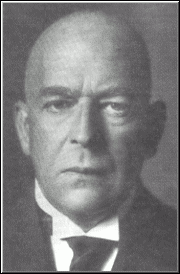
Robert Steuckers:
Les matrices préhistoriques des civilisations antiques dans l'œuvre posthume de Spengler: Atlantis, Kasch et Turan
Généralement, les morphologies de cultures et de civilisations proposées par Spengler dans son ouvrage le plus célèbre, Le déclin de l'Occident, sont les seules à être connues. Pourtant, ses positions ont changé après l'édition de cette somme. Le germaniste italien Domenico Conte en fait état dans son ouvrage récent sur Spengler. En effet, une étude plus approfondie des textes posthumes édités par Anton Mirko Koktanek, notamment Frühzeit der Weltgeschichte, qui rassemble les fragments d'une œuvre projetée mais jamais achevée, L'épopée de l'Homme.
Dans la phase de ses réflexions qui a immédiatement suivi la parution du Déclin de l'Occident, Spengler distinguait quatre stades dans l'histoire de l'humanité, qu'il désignait tout simplement par les quatre premières lettres de l'alphabet: a, b, c et d. Le stade “a” aurait ainsi duré une centaine de milliers d'années, aurait recouvert le paléolithique inférieur et accompagné les premières phases de l'hominisation. C'est au cours de ce stade qu'apparaît l'importance de la “main” pour l'homme. C'est, pour Spengler, l'âge du Granit. Le stade “b” aurait duré une dizaine de milliers d'années et se situerait au paléolithique inférieur, entre 20.000 et 7000/6000 avant notre ère. C'est au cours de cet âge que naît la notion de vie intérieure; apparaît “alors la véritable âme, inconnue des hommes du stade “a” tout comme elle est inconnue du nouveau-né”. C'est à partir de ce moment-là de son histoire que l'homme “est capable de produire des traces/souvenirs” et de comprendre le phénomène de la mort. Pour Spengler, c'est l'âge du Cristal. Les stades “a” et “b” sont anorganiques.
Le stade “c” a une durée de 3500 années: il commence avec le néolithique, à partir du sixième millénaire et jusqu'au troisième. C'est le stade où la pensée commence à s'articuler sur le langage et où les réalisations techniques les plus complexes deviennent possibles. Naissent alors les “cultures” dont les structures sont de type “amibien”. Le stade “d” est celui de l'“histoire mondiale” au sens conventionnel du terme. C'est celui des “grandes civilisations”, dont chacune dure environ 1000 ans. Ces civilisations ont des structures de type “végétal”. Les stades “c” et “d” sont organiques.
Spengler préférait cette classification psychologique-morphologique aux classifications imposées par les directeurs de musée qui subdivisaient les ères préhistoriques et historiques selon les matériaux utilisés pour la fabrication d'outils (pierre, bronze, fer). Spengler rejette aussi, à la suite de cette classification psychologique-morphologique, les visions trop évolutionnistes de l'histoire humaine: celles-ci, trop tributaires des idéaux faibles du XVIIIième siècle, induisaient l'idée “d'une transformation lente, flegmatique” du donné naturel, qui était peut-être évidente pour l'Anglais (du XVIIIième), mais incompatible avec la nature. L'évolution, pour Spengler, se fait à coup de catastrophes, d'irruptions soudaines, de mutations inattendues. «L'histoire du monde procède de catastrophes en catastrophes, sans se soucier de savoir si nous sommes en mesure de les comprendre. Aujourd'hui, avec H. de Vries, nous les appelons “mutations”. Il s'agit d'une transformation interne, qui affecte à l'improviste tous les exemplaires d'une espèce, sans “causes”, naturellement, comme pour toutes les choses dans la réalité. Tel est le rythme mystérieux du réel» (L'homme et la technique). Il n'y a donc pas d'évolution lente mais des transformations brusques, “épocales”. Natura facit saltus.
trois cultures-amibes
Dans le stade “c”, où émergent véritablement les matrices de la civilisation humaine, Spengler distingue trois “cultures-amibes”: Atlantis, Kasch et Turan. Cette terminologie n'apparaît que dans ses écrits posthumes et dans ses lettres. Les matrices civilisationnelles sont “amibes”, et non “plantes”, parce que les amibes sont mobiles, ne sont pas ancrées dans une terre précise. L'amibe est un organisme qui émet continuellement ses pseudopodes dans sa périphérie, en changeant sans cesse de forme. Ensuite, l'amibe se subdivise justement à la façon des amibes, produisant de nouvelles individualités qui s'éloignent de l'amibe-mère. Cette analogie implique que l'on ne peut pas délimiter avec précision le territoire d'une civilisation du stade “c”, parce que ses émanations de mode amibien peuvent être fort dispersées dans l'espace, fort éloignées de l'amibe-mère.
“Atlantis” est l'“Ouest” et s'étend de l'Irlande à l'Egypte; “Kasch” est le “Sud-Est”, une région comprise entre l'Inde et la Mer Rouge. “Turan” est le “Nord”, s'étendant de l'Europe centrale à la Chine. Spengler, explique Conte, a choisi cette terminologie rappelant d'“anciens noms mythologiques” afin de ne pas les confondre avec des espaces historiques ultérieurs, de type “végétal”, bien situés et circonscrits dans la géographie, alors qu'eux-mêmes sont dispersés et non localisables précisément.
Spengler ne croit pas au mythe platonicien de l'Atlantide, en un continent englouti, mais constate qu'un ensemble de sédiments civilisationnels sont repérables à l'Ouest, de l'Irlande à l'Egypte. ‘Kasch” est un nom que l'on retrouve dans l'Ancien Testament pour désigner le territoire de l'antique Nubie, région habitée par les Kaschites. Mais Spengler place la culture-amibe “Kasch” plus à l'Est, dans une région s'articulant entre le Turkestan, la Perse et l'Inde, sans doute en s'inspirant de l'anthropologue Frobenius. Quant à “Turan”, c'est le “Nord”, le haut-plateau touranique, qu'il pensait être le berceau des langues indo-européennes et ouralo-altaïques. C'est de là que sont parties les migrations de peuples “nordiques” (il n'y a nulle connotation racialisante chez Spengler) qui ont déboulé sur l'Europe, l'Inde et la Chine.
Atlantis: chaude et mobile; Kasch: tropicale et repue
Atlantis, Kasch et Turan sont des cultures porteuses de principes morphologiques, émergeant principalement dans les sphères de la religion et des arts. La religiosité d'Atlantis est “chaude et mobile”, centrée sur le culte des morts et sur la prééminence de la sphère ultra-tellurique. Les formes de sépultures, note Conte, témoignent du rapport intense avec le monde des morts: les tombes accusent toujours un fort relief, ou sont monumentales; les défunts sont embaumés et momifiés; on leur laisse ou apporte de la nourriture. Ce rapport obsessionnel avec la chaîne des ancêtres porte Spengler à théoriser la présence d'un principe “généalogique”. Les expressions artistiques d'Atlantis, ajoute Conte, sont centrées sur les constructions de pierre, gigantesques dans la mesure du possible, faites pour l'éternité, signes d'un sentiment de la vie qui n'est pas tourné vers un dépassement héroïque des limites, mais vers une sorte de “complaisance inerte”.
Kasch développe une religion “tropicale” et “repue”. Le problème de la vie ultra-tellurique est appréhendé avec une angoisse nettement moindre que dans Atlantis, car, dans la culture-amibe de Kasch domine une mathématique du cosmos (dont Babylone sera l'expression la plus grandiose), où les choses sont d'avance “rigidement déterminées”. La vie d'après la mort suscite l'indifférence. Si Atlantis est une “culture des tombes”, en Kasch, les tombes n'ont aucune signification. On y vit et on y procrée mais on y oublie les morts. Le symbole central de Kasch est le temple, d'où les prêtres scrutent la mathématique céleste. Si en Atlantis domine le principe généalogique, si les dieux et les déesses d'Atlantis sont père, mère, fils, fille, en Kasch, les divinités sont des astres. Y domine un principe cosmologique.
Turan: la civilisation des héros
Turan est la civilisation des héros, animée par une religiosité “froide”, axée sur le sens mystérieux de l'existence. La nature y est emplie de puissances impersonnelles. Pour la culture-amibe de Turan, la vie est un champ de bataille: “pour l'homme de ce Nord (Achille, Siegfried)”, écrit Spengler, “seule compte la vie avant la mort, la lutte contre le destin”. Le rapport hommes/divin n'est plus un rapport de dépendance: “la prostration cesse, la tête reste droite et haute; il y a “moi” (homme) et vous (les dieux)”. Les fils sont appelés à garder la mémoire de leurs pères mais ne laissent pas de nourriture à leurs cadavres. Pas d'embaumement ni de momification dans cette culture, mais incinération: les corps disparaissent, sont cachés dans des sépultures souterraines sans relief ou dispersés aux quatre vents. Seul demeure le sang du défunt, qui coule dans les veines de ses descendants. Turan est donc une culture sans architecture, où temples et sépultures n'ont pas d'importance et où seul compte un sens terrestre de l'existence. L'homme vit seul, confronté à lui-même, dans sa maison de bois ou de torchis ou dans sa tente de nomade.
Le char de combat
Spengler porte toute sa sympathie à cette culture-amibe de Turan, dont les porteurs aiment la vie aventureuse, sont animés par une volonté implaccable, sont violents et dépourvus de sentimentalité vaine. Ils sont des “hommes de faits”. Les divers peuples de Turan ne sont pas liés par des liens de sang, ni par une langue commune. Spengler n'a cure des recherches archéologiques et linguistiques visant à retrouver la patrie originelle des Indo-Européens ou à reconstituer la langue-source de tous les idiomes indo-européens actuels: le lien qui unit les peuples de Turan est technique, c'est l'utilisation du char de combat. Dans une conférence prononcée à Munich le 6 février 1934, et intitulée Der Streitwagen und seine Bedeutung für den Gang der Weltgeschichte (= Le char de combat et sa signification pour le cours de l'histoire mondiale), Spengler explique que cette arme constitue la clef pour comprendre l'histoire du second millénaire avant J.C.. C'est, dit-il, la première arme complexe: il faut un char (à deux roues et non un chariot à quatre roues moins mobile), un animal domestiqué et attelé, une préparation minutieuse du guerrier qui frappera désormais ses ennemis de haut en bas. Avec le char naît un type d'homme nouveau. Le char de combat est une invention révolutionnaire sur le plan militaire, mais aussi le principe formateur d'une humanité nouvelle. Les guerriers deviennent professionnels, tant les techiques qu'ils sont appelés à manier sont complexes, et se rassemblent au sein d'une caste qui aime le risque et l'aventure; ils font de la guerre le sens de leur vie.
L'arrivée de ces castes de “charistes” impétueux bouleversent l'ordre de cette très haute antiquité: en Grèce, ils bousculent les Achéiens, s'installent à Mycène; en Egypte, ce sont les Hyksos qui déferlent. Plus à l'Est, les Cassites se jettent sur Babylone. En Inde, les Aryens déboulent dans le sous-continent, “détruisent les cités” et s'installent sur les débris des civilisations dites de Mohenjo Daro et d'Harappa. En Chine, les Tchou arrivent au nord, montés sur leurs chars, comme leurs homologues grecs et hyksos. A partir de 1200, les principes guerriers règnent en Chine, en Inde et dans le monde antique de la Méditerranée. Les Hyksos et les Kassites détruisent les deux plus vieilles civilisations du Sud. Emergent alors trois nouvelles civilisations portées par les “charistes dominateurs”: la civilisation greco-romaine, la civilisation aryenne d'Inde et la civilisation chinoise issue des Tchou. Ces nouvelles civilisations, dont le principe est venu du Nord, de Turan, sont “plus viriles et énergiques que celles nées sur les rives du Nil et de l'Euphrate”. Mais les guerriers charistes succomberont aux séductions du Sud amollissant, déplore Spengler.
Un substrat héroïque commun
Cette théorie, Spengler l'a élaborée en accord avec le sinologue Gustav Haloun: il y a eu quasi simultanéité entre les invasions de Grèce, des Hyksos, de l'Inde et de la Chine. Spengler et Haloun estiment donc qu'il y a un substrat commun, guerrier et chariste, aux civilisations méditerranéenne, indienne et chinoise. Ce substrat est “héroïque”, comme le prouve les armes de Turan. Elles sont différentes de celles d'Atlantis: ce sont, outre le char, l'épée ou la hache, impliquant des duels entre combattants, alors qu'en Atlantis, les armes sont l'arc et la flèche, que Spengler juge “viles” car elles permettent d'éviter la confrontation physique directe avec l'adversaire, “de le regarder droit dans les yeux”. Dans la mythologie grecque, estime Spengler, arc et flèches sont autant d'indices d'un passé et d'influences pré-helléniques: Apollon-archer est originaire d'Asie Mineure, Artemis est libyque, tout comme Héraklès, etc. Le javelot est également “atlante”, tandis que la lance de choc est “touranique”. Pour comprendre ces époques éloignées, l'étude des armes est plus instructive que celle des ustensiles de cuisine ou des bijoux, conclut Spengler.
L'âme touranique dérive aussi d'un climat particulier et d'un paysage hostile: l'homme doit lutter sans cesse contre les éléments, devient ainsi plus dur, plus froid et plus hivernal. L'homme n'est pas seulement le produit d'une “chaîne généalogique”, il l'est tout autant d'un “paysage”. La rigueur climatique développe la “force de l'âme”. Les tropiques amolissent les caractères, les rapprochent d'une nature perçue comme plus maternante, favorisent les valeurs féminines.
Les écrits tardifs de Spengler et sa correspondance indiquent donc que ses positions ont changé après la parution du Déclin de l'Occident, où il survalorisait la civilisation faustienne, au détriment notamment de la civilisation antique. La focalisation de sa pensée sur le “char de combat” donne une dimension nouvelle à sa vision de l'histoire: l'homme grec et l'homme romain, l'homme indien-aryen et l'homme chinois, retrouvent tous grâce à ses yeux. La momification des pharaons était considérée dans Le déclin de l'Occident, comme l'expression égyptienne d'une volonté de durée, qu'il opposait à l'oubli impliqué par l'incinération indienne. Plus tard, la momification “atlante” déchoit à ses yeux au rang d'une obsession de l'au-delà, signalant une incapacité à affronter la vie terrestre. L'incinération “touranique”, en revanche, indique alors une volonté de concentrer ses efforts sur la vie réelle.
Un changement d'optique dicté par les circonstances?
La conception polycentrique, relativiste, non-eurocentrique et non-évolutionniste de l'histoire chez le Spengler du Déclin de l'Occident a fasciné des chercheurs et des anthropologues n'appartenant pas aux milieux de la droite allemande, notamment Alfred L. Kroeber ou Ruth F. Benedict. L'insistance sur le rôle historique majeur des castes de charistes de combat donne à l'œuvre tardive de Spengler une dimension plus guerrière, plus violente, plus mobile que ne recelait pas encore son Déclin. Doit-on attribuer ce changement de perspective à la situation de l'Allemagne vaincue, qui cherche à s'allier avec la jeune URSS (dans une perspective eurasienne-touranienne?), avec l'Inde en révolte contre la Grande-Bretagne (qu'il incluait auparavant dans la “civilisation faustienne”, à laquelle il donnera ensuite beaucoup moins d'importance), avec la Chine des “grands chefs de guerre”, parfois armés et encadrés par des officiers allemands? Spengler, par le biais de sa conférence, a-t-il cherché à donner une mythologie commune aux officiers ou aux révolutionnaires allemands, russes, chinois, mongols, indiens, afin de forger une prochaine fraternité d'arme, tout comme les “eurasistes” russes tentaient de donner à la nouvelle Russie soviétique une mythologie similaire, impliquant la réconciliation des Turco-Touraniens et des Slaves? La valorisation radicale du corps à corps “touranique” est-elle un écho au culte de l'“assaut” que l'on retrouvait dans le “nationalisme soldatique”, notamment celui des frères Jünger et de Schauwecker?
Enfin, pourquoi n'a-t-il rien écrit sur les Scythes, peuples de guerriers intrépides, maîtres des techniques équestres, qui fascinaient les Russes et sans doute, parmi eux, les théoriciens de l'eurasisme? Dernière question: le peu d'insistance sur les facteurs raciaux dans ce Spengler tardif est-il dû à un sentiment rancunier à l'égard des cousins anglais qui avaient trahi la solidarité germanique et à une mythologie nouvelle, où les peuples cavaliers du continent, toutes ethnies confondues (Mongols, Turco-Touraniens, descendants des Scythes, Cosaques et uhlans germaniques), devaient conjuguer leurs efforts contre les civilisations corrompues de l'Ouest et du Sud et contre les thalassocraties anglo-saxonnes? Les parallèles évident entre la mise en exergue du “char de combat” et certaines thèses de L'homme et la technique, ne sont-ils pas une concession à l'idéologie futuriste ambiante, dans la mesure où elle donne une explication technique et non plus religieuse à la culture-amibe touranienne? Autant de thèmes que l'histoire des idées devra clarifier en profondeur...
Robert STEUCKERS.
Domenico CONTE, Catene di civiltà. Studi su Spengler, Edizioni Scientifiche Italiane, Napoli, 1994, 394 p., Lire 58.000, ISBN 88-7104-242-924-1.
00:10 Publié dans Révolution conservatrice | Lien permanent | Commentaires (0) | Tags : eurasie, eurasisme, allemagne, oswald spengler, civilisations antiques, préhistoire, protohistoire | | del.icio.us | | Digg | Facebook
The Paris Hilton Syndrome
The Paris Hilton Syndrome
by Welf Herfurth (http://www.newrightausnz.com )
 This article concerns something that receives little attention from nationalists: celebrities and popular culture, and their influence on both our liberal democratic system and our consumerist society. More specifically, it concerns the role of women in our liberal democracy and popular culture. This subject matter is very much part of our lives: one cannot avoid the celebrity trash gossip magazines, American TV shows, and the role prominent women in our liberal democracy (such as Hilary Clinton). Moreover, our economy relies, to a great extent, on both consumerism – especially a consumerist lifestyle promoted heavily to women, through advertisements and celebrity culture – and female labour.
From a political view, does any of this matter? Do the antics of Paris Hilton, Britney Spears and Lindsay Lohan matter? Did Princess Diana matter? A person with an old-school, left-wing point of view would say, ‘No’. The fetishisation of celebrity women in our culture is a symptom of the fetishisation of capitalist consumer commodities. Once capitalism is abolished, the only women who will appear in advertisements, films and the like will be female communist role models – factory workers, rice paddy farmers, mothers bearing socialist babies and the like.
After the advent of the New Left, the analyses – of images of women in a capitalist society, as expressed through popular culture – became a little more sophisticated. The stern Soviet and Maoist bromides became somewhat old-fashioned, and the neo-Marxists argued that there was something deeper going on.
Here I will be taking an approach similar to that of the New Left – but will drawing upon Evola instead of Marcuse. Bill White, before his Nutzi phase, used to write some intelligent articles. One of them was on the subject of women in American popular culture, and used some Evolian concepts. (Unfortunately, it is no longer available on the Internet). Evola, I think, is a thinker who is the most suitable for this sort of thing. After all, many of his ‘spiritual types’, or ‘races’ (as he defines them) possess masculine and feminine characteristics. In essays like ‘Do we live in a gynaecocratic society?’ (1936), he said nearly all there is to be said on the subject. The present article will add little to the discussion – much of what Evola has written has yet to be surpassed – but the articles from the 1930s and 1940s are lacking in that they are out of date. They appear dated because Evola did not live in our age – the age of Angelina Jolie, ‘Buffy the Vampire Slayer’ and the Hilary Clinton presidential campaign bid.
1. Evola’s spiritual types
Evola’s work, as readers familiar with him know, defines a number of spiritual types, which are known to us through myths, religious texts, folklore and the like. Evola believes that these contain metaphysical truth – and that the task of the Traditionalist scholar is to interpret them. He regards descriptions of ancient events in the Bible, for instance, as history which is literally true – that is, accurate descriptions of the metaphysical states of affairs.
Evola often begins his narratives of ‘metaphysical history’, of the various ages of the metaphysical development (or, in his view, degeneration) of man, by positing a primordial ‘solar’, ‘Uranian’ spirituality, which is followed, in time, by the appearance of ‘Demetrian’, ‘Titanic’, and ‘Amazonian’ spiritualities (among others). It is the Amazonian spirituality which we shall first examine here.
The Amazonian spiritual type represents an interesting combination of both male and female spirituality. To Evola, Amazonian is both a reaction and a transmutation. ‘Demetrian’ spirituality is feminine, maternal, egalitarian, pacifist, collectivist – the closest there is to modern day pagan worship of ‘Mother Earth’ and the New Age cults. (Possibly, there is a link here to modern environmentalism as well). In contrast to this, there is the coarse ‘Titanic’ spirituality – cruel, masculine, militarist, phallic (in a purely physical way) and forever seeking after the higher, spiritual state as represented by the ‘Uranian’ and ‘solar’ spirituality. (There are several myths of giants and other demonic races who sought to attain the ‘solar’ spirituality by force – by storming Mount Olympus and so forth – and being punished by the Gods for their impudence). Amazonianism is a reaction against the coarseness of the Titanic spirituality, and is a defence of the virtues of Demetrianism. In Evola’s narrative of metaphysical history, the two rival spiritualities – the ultra-female Demetrian and the ultra-masculine Titanic – clashed, and produced a feminine spirituality which was not quite one or the other. Amazonianism is feminine, all right, but has taken on assertive, masculine and warrior characteristics. (Evola, of course, has nothing against militarism and the warrior: only the expressions of militarism without a higher, ‘solar’ spiritual aspect. The militarism of the Titanic spirituality is militarism devoid of any transcendent spirituality: it is the use of force only to attain purely material goals).
This Amazonianism is prevalent today. As Evola writes:
The woman often asserts her primacy in new ‘Amazonian’ forms. Thus we see the new masculinised sportswoman, the garconne, the woman who devotes herself to the unilateral development of her own body, betrays the mission which would be normal to her in a civilisation of virile type, becomes emancipated and independent and even bursts into the political field. And this is not all. (‘Do we live in a gynaecocratic society’ (1936), translation copyright © 2003 Thompkins and Cariou).
2. Amazons go pop
One can say that those tendencies identified by Evola in 1936 continued into the modern age. Indeed, to look at the popular culture of the last ten or so years, we can say that we are living in the age of Amazonianism. Women warriors abound: killer cyborgs, fighter pilots, deadly martial artists, female soldiers… One only has to think of Lara Croft, television shows like ‘Xena: Warrior Princess’, the remake of ‘Bionic Woman’, ‘Buffy the Vampire Slayer’, ‘Battlestar: Galactica’ (in which every single female character is an Amazon of some kind), ‘Dark Angel’, films such as ‘G.I. Jane’ (a 1997 film which was a portent of the future), ‘Kill Bill’, ‘Charlie’s Angels’… Even Guinevere, a more Demetrian figure, was reinterpreted as a bow-wielding Amazon-type in the 2004 film, ‘King Arthur’. (Of course, there are plenty of films and TV shows from the recent past with women warriors – there is ‘Barbarella’ (1968), the sixties British TV series ‘The Avengers’, the seventies version of ‘Bionic Woman’, Sigourney Weaver in ‘Alien’ (1979) and its sequels, the Afro-American kung-fu heroines of the seventies Blaxploitation films, the Linda Hamilton character in ‘Terminator 2’ (1991). There are also the multitude of heroines in American comic books. But it is only recently – in the past ten or so years – that the Amazonian woman warrior has reached the forefront).
Now, I am not such a prude that I dislike all American popular culture. I have enjoyed at least a few of the above films and TV shows. But the striking thing is their unreal depiction of women. A reviewer of ‘Charlie’s Angels’ (2000) at the Vanguard News Network site acerbically noted that the film simply wasn’t real: no amount of martial arts training, and psychological ‘positive thinking’, could give women the physical strength to overpower a man in a fight – it simply doesn’t happen. They do not have the strength, or the aggression. He cited an anecdote of an incident he witnessed in a parking lot, where a man was berating a woman for her poor driving manners. The woman was twice the man’s size, but put up with the man’s tirade and nodded meekly before climbing back into her car. In a ‘Charlie’s Angel’-type universe, she would, of course, given him a roundhouse kick or thrown him over her shoulder in a judo manoeuvre.
We all know from real life that female aggression is the exception and not the rule. War is a man’s business, and it is men who do most of the fighting (and dying) on the battlefield. True, there were female communist soldiers in the Vietnam War, and in the Soviet Union’s so-called ‘Great Patriotic War’: but again, these are exceptions.
So why is it, then, are women, in today’s action-based films and TV shows, increasingly depicted as flying fighter jets, kickboxing, shooting, breaking necks, etc., like men? Why are there women who are portrayed as having inhuman physical strength – a strength which exceeds that of the male characters (e.g., the superwomen in ‘Buffy’, ‘Xena’, ‘Battlestar’, ‘Bionic Woman’)? They are often shown bending steel bars, terrorising hapless male characters, and engaging in protracted martial arts contests with other warrior/killer women – all the things that men, or at least the men in the absurd pop fantasy world, should be doing.
Popular culture is all about fantasy – a character like James Bond, who is a connoisseur of fine wine, food and clothes, a great lover, a successful gambler, an unbeatable action hero – appeals to male fantasies. Possibly, the new wave of women warriors appeals to female fantasies. That is, the women who like these films and TV shows have wanted to do these sorts of things, but now, under the aegis of feminism (which teaches that women can be equal to men in every way), they can see those fantasies put up there on the big (or small) screen.
Nationalist writers who have touched upon the subject usually blame it on a conspiracy – a conspiracy, by the writers, directors and producers of Hollywood, to turn women into men, to masculinise them. Usually these analyses are couched in white nationalist terms: the white race is dying, and needs more children; but, because of feminism and other modern ills, white women are not reproducing enough.
Western popular culture, which is tremendously influential, certainly encourages ‘feminist’ childlessness. One can think of a few of the female warrior characters mentioned above who do have children – e.g., the Uma Thurman character in ‘Kill Bill’ – but childlessness, and the absence of the comforts of the hearth and home, are the rule. The women characters lead a transient life of adventuring, and children, husbands, mortgages and homemaking only serve to get in the way. (A hit single from the ‘Charlie’s Angels’ soundtrack was, appropriately enough, titled ‘Independent Woman’).
Whether or not white women are staving off pregnancy, in order to imitate the feminist pop icons, is beside the point. Likewise, it is beside the point whether or not white women should be bearing as many children as possible (and Evola would be vehemently against that notion). The point is that we are seeing an eruption of Amazonianism. Why?
Many white nationalists would blame it on the ethnicity of the group which controls Hollywood and the American TV studios, record companies, etc. – this group, they charge, wants to ‘Destroy the white race’ through promoting feminist childlessness, and race-mixing. Evola’s interpretation, in contrast, is that the explanation is metaphysical: we are living in a dark age (what he calls the Dark Age) which is seeing the eruption of spiritualities which are the negation of the Uranian, solar spirituality that he favours most. In other words, pop-culture Amazonianism is merely a sign of the times, and there is no one ethnic group foisting it upon us. It is an explanation I myself tend to agree with.
I should note here that a recent trend in the celebrity news media is to dwell obsessively on celebrity pregnancies. The media is in a frenzy of speculation over whether or not Nicole Kidman, or whoever, is pregnant, and stars who are already pregnant receive maximum news coverage. Certainly, 2007 was, in the world of the trash media, the Year of the Pregnant Celebrity. Which has drawn protestations from some female journalists, who complain that the trash media seems to think that the pregnancies of these celebrities is more noteworthy than their artistic accomplishments. (I myself think that the artistic accomplishments of the majority of both male and female celebrities in the 2007 were not very noteworthy, myself – so maybe celebrity pregnancies make better copy than anything Kidman, Heath Ledger, Naomi Watts, Russell Crowe and the rest have done this year).
Related to this is the practice of celebrity adoption, particularly the adoption of children from the Third World. Madonna and Jolie have adopted children from Africa, and, in Madonna’s case at least, have removed the child from its birth parents. Africa, of course, is portrayed in the Western media as a continent wracked by war, poverty, famine, corruption, repressive government, and barbaric sex crimes. And, what is more, Westerners – who are, in the liberal democratic discourse, citizens of a globalised world – are obliged to take care of Africa’s problems, through aid and peacemaking efforts, but also through adopting orphans from Sudan or wherever, and giving them ‘a better life’ in the West. Certainly, to judge by their actions, the Madonnas and Jolies seem to think that way. (Likewise, immigration of Africans, on humanitarian grounds, is another form of aid. That is, African immigrants from war-torn, oppressive countries, have the ‘right’ to a life in the West, to share in its abundance and prosperity).
3. Aphroditism and consumerism
It is a fact that women are very big consumers of luxury consumer goods: that is, consumer goods that we could easily live without – expensive clothes, shoes, home furnishings and the like. Any man who has ever leafed through a woman’s magazine, or watched a TV program on woman’s beauty ‘needs’, would draw the conclusion that women’s inner thought processes revolve largely around hair and skin care, makeup, diets, the prevention of ageing, makeovers, ‘looking good’ by buying the right clothes and shoes (and wearing them the right way) and the like. In comparison, men seem to pay little attention to these things: advertising aimed at men, for instance, gives the message that men are creatures whose sole preoccupations are beer, sport, cars and DIY home repairs.
My own conclusion is that the advertisers, magazine editors and others are largely correct: the vast majority of men, and women, are interested in those subjects, almost to the exclusion of anything else. I say this because those advertisers, manufacturers of luxury consumer goods, etc., would hardly be able to make a living otherwise, and they do – the market for women’s rejuvenating skin creams, for instance, is huge. Partially, this is all a result of living in a technologically-advanced society where machines do much of the ordinary, hum-drum chores of the household for us. Traditionally, women in the past had to look after the house, and attend to the domestic chores. But they did not have the labour-saving, and time-saving, devices that we have now. Food had to be consumed quickly because there no refrigerators; washing had to be done by hand. Children had to be looked after, with direct supervision, and now the TV functions as a babysitter. Because of automatic dishwasher, the washing machine and all the other domestic labour-saving devices, women who stay at home become bored, and tend to go shopping to relieve that boredom. Which is natural: many shopping malls are pleasant places, and buying a new consumer item – especially a luxury – can generate its own short-lived ‘high’, just like a cigarette, a cup of coffee, or a win at a poker machine. As a result, the instinct which leads a mother to provide for her children, the hunter-gatherer instinct, is inverted, and turned towards consumerism. And, for adolescent girls, spending on luxury items becomes a competition, fuelled by peer-pressure. They feel compelled to keep up with the likes of Paris Hilton – but do not have the means to keep up, i.e., Hilton’s inexhaustible wealth.
In addition to shopping-mall consumerism, another pleasure is the celebrity gossip magazine, covering the dreary trivialities of the lives of Angelina Jolie and Brad Pitt, Tom Cruise and Katie Holmes, and the rest, and the latest sordid escapades of Britney Spears and Paris Hilton. Princess Diana continues to generate news stories almost daily, even though she has been dead for ten years, and obviously, there is a market for every new scrap of information about her. (Incidentally, in my own experience, the majority of people interested in the British Royal Family are female).
The reason why such figures generate such fascination among women is vicarious identification: or rather, women want to be like Angelina Jolie and Princess Diana – they want that money, that luxurious lifestyle, the clothes, mansions, expensive holidays in luxury resorts, and affairs and marriages with handsome wealthy men. They also want to have their cake and eat it, too: that is, they want that lifestyle, and children – hence the media obsession with the pregnancies of wealthy female celebrities. All of this represents an escape from the routine, budget-restricted life: and the fact that the grass is always greener.
There is also an element of drama in the lives of these celebrity women, and danger: did Katie Holmes marry a Scientologist nutcase? Will Brad return to Jennifer Aniston and abandon Angelina? What does Kate Moss see in the out-of-control drug addict Pete Doherty? Will Victoria Beckham drop dead from an eating disorder? The media constantly focuses on scandal, infidelity, marriage troubles, anorexia and obesity, and general drama of all kinds – and where there is no drama and scandal, the media invents.
To a certain extent this is natural. Often, more politically-correct observers are surprised by the extent of two things: a) women’s tendency to place other women on a pedestal (e.g. Princess Diana, Jacqueline Onassis, Elizabeth Taylor, Princess Grace of Monaco and other celebrities, who exist on a hierarchical plane far above the masses); and b) women’s appetite for luxurious consumer goods. One has to recall the socialist ‘queen’ of Argentina, Evita Peron, a beautiful woman who clothed herself in expensive furs, wore expensive jewellery, etc. A true socialist should never do such things, but Evita was wildly popular with her constituency - impoverished, lower-class women - who approved of Evita’s ostentatious displays of wealth and conspicuous consumption.
Even though we live in a liberal democratic society, the masses still seem to feel the need for royalty, or at least, elevated figures of great wealth, beauty and refinement.
Vicarious identification, and wish-fulfilment, is at the heart of the fascination with the likes of Jolie and Princess Diana. But what of Lohan, Hilton and Spears? No woman would want to be like them, surely? I say this because these women are the unfortunates of the celebrity world: they are always in trouble, always having trouble with husbands and boyfriends, always going on self-destructive, booze- and drug-fuelled rampages (which often lead to arrest). And, not to put a fine word upon it, they are trash – they lack class.
For all her money, Britney Spears is trailer-trash, a lumpenproletarian who celebrated her wedding to the hip-hopping Kevin Federline with a wedding reception at KFCs. In addition, both Spears’ and Lohan’s careers are in decline: I know, from reading the entertainment pages, that Spears’ new album was outsold by a new release by the Eagles, and that Lohan is virtually broke from spending her wealth on drugs, dresses, extravagant holidays, houses, etc. No doubt many women envy the wealth of Hilton, Lohan, Spears (and that of a comparatively minor, but equally self-destructive celebrity, Amy Winehouse); but few would envy their lives. And then there is the question of sexual morality: conventional, conservative sexual morality – which still governs much of our lives – frowns on Hilton and her pornographic videos, etc., and certainly would not approve of a woman in real life who mimicked her behaviour, and that Lohan and Spears.
All of this is a kind of rebellion. But, instead of being a political rebellion, it is an individualist one. The energies that would be channelled into activism are now channelled into consumerism, escapism, and debauchery.
In my view, the cult of Lohan, Spears and Hilton is a symptom of what Evola calls ‘Aphroditism’. As Evola writes, in a rather sensationalistic passage:
Baumler wrote this, in the introduction to the already mentioned selected writings of Bachofen: “In the streets of Berlin, Paris or London, all you have to do is to observe for a moment a man or a woman to realise that the cult of Aphrodite is the one before which Zeus and Apollo had to beat a retreat…The present age bears, in fact, all the features of a gynaecocratic age. In a late and decadent civilisation, new temples of Isis and Astarte, of these Asian mother goddesses that were celebrated in orgies and licentiousness, in desperate sinking into sensual pleasure, arise. The fascinating female is the idol of our times, and, with painted lips, she walks through the European cities as she once did through Babylon. And as if she wanted to confirm Bachofen’s profound intuition, the lightly dressed modern ruler of man keeps in leash a dog, the ancient symbol of unlimited sexual promiscuity and infernal forces”… Woman and sensuality often become predominant motifs almost to a pathological and obsessive degree. In Anglo-Saxon civilisation, and particularly in America, the man who exhausts his life and time in business and the search for wealth, a wealth that, to a large extent, only serves to pay for feminine luxury, caprices, vices and refinements, has conceded to the woman the privilege and even the monopoly of dealing with ’spiritual’ things. (‘Do we live in a gynaecocratic society’ (1936), translation copyright © 2003 Thompkins and Cariou).
This explains, to my mind, the cult of Lohan, Spears and Hilton – trashy women who lead opulent lifestyles, who have public affairs, make pornographic films and who, despite their lumpen-esque behaviour, still occupy a privileged place in our society. They are like the pagan priestesses of the Venusian cults of the ancient world. (It can be said, too, that the explosion of pornography (and nudes in advertisements at newspaper stands, billboards and the rest) in the modern age, especially Internet pornography, is another sign of the resurgence of the cult of Venus, so to speak).
Men are the biggest consumers of all this pornography. But this is precisely the point: they are bound, spiritually, to this cult of Aphrodite, as manifested through ubiquitous pornography, nudity in advertising, etc., which has been created by other men (usually in the United States). They wallow in decadence while their countries, politically and economically, go to ruin. The situation is not so different from that of Germany in the time of the Weimar Republic, when the young men of Germany indulged in ‘Aphrodisian’ sensuality instead of defending their country against communism, and working to fix their country’s myriad foreign policy and economic problems.
4. Women in politics
The reader may point out that here I have neglected to examine another form of Amazonianism: the rise of the woman Statesman. At the time of writing, Hilary Clinton is making a bid for the White House – and many liberal feminists are supporting her campaign, regardless of what her actual policies are, because they feel that ‘It’s time for a woman president’.
Margaret Thatcher and Indira Ghandi were two women who set precedents for women being Heads of State (and it is no coincidence that Thatcher’s propagandists compared her to the British warrior queen, Boudicea, a decidedly Amazonian figure who will soon have a Hollywood film, in the style of ‘King Arthur’ (2004), made about her). But more interesting is the role that women play in getting male politicians elected. As 50% of the electorate, they play a vital role, of course: but they also, as wives and partners, play a role in motivating men to run for office. One only has to look at the instrumental roles Cherie Blair and Hilary Clinton played in elevating their respective spouses. Some wives, like the former Australian prime minister John Howard’s wife, and George W. Bush’s wife, seem to play a minimal role; others, like Cherie Blair, Hilary Clinton and wives of despots such as Marcos and Suharto, are a driving force.
This is natural, to a certain extent. Wives and female partners often tend to encourage their spouses to achieve more, to do more with their lives, to obtain the respect that they rightfully deserve (‘How could you let x work colleague speak to you like that?’), to occupy the station in life that they truly deserve. There are many examples from literature and popular culture (Lady Macbeth being one of the most famous). To a certain extent, this is all healthy, and the consequences are not always as evil as in the cases of Blair, Clinton and Macbeth.
Part of the problem in nationalism is not merely the lack of female members, but the lack of female members who are driving forces in men’s lives. Instead of constructive political activism, many men use nationalism as an excuse for drunken get-togethers, where the conversation consists of complaints about the behaviour of certain ethnic minorities. Without motivation, without the desire for success and achievement in politics, and all the appropriate skills for success, professionally and in the community, nationalists will accomplish little. They will also fail to attract admiring, supportive spouses.
And this, I think, is one of the many reasons why women are not attracted to nationalism (at least in the Anglo-Saxon countries): they see little in the way of material and social benefit. A woman who is a former trade-union lawyer can achieve a great deal of success in the Australian Labor Party, by simply mouthing all the things that the unions want her to say; but a similar career path, leading to similar success, is not available in nationalism – either for a woman or her spouse.
Having said that, an increase in the number of women members will not cure all ills. One only has to look at the Australian communists, who attract plenty of young women, all right – but women who are, in my experience, bitter and twisted because they feel persecuted against and discriminated against because of their sexual orientation.
One of the other things that women find unattractive about nationalism is, I think, its emphasis on women’s role as the progenitors of the white race – specifically, their responsibility as progenitors – brood mares, so to speak. (Both fascism and communism, historically, tended to laud women as child-bearers, homemakers and housewives. Nowadays, of course, women see this as too limiting). While, of course, the majority of women will end up having children at some point in their lives, there are metaphysical types – or what Camille Paglia calls ‘sexual personae’ – besides The Mother. (Indeed, the image of woman in nationalist propaganda, especially white nationalist propaganda, is often evocative of Demetrian spirituality – the exception being, of course, that the Demetrian, lunar mother type in nationalist propaganda is racialist.
Demetrianism is egalitarian, rejects hierarchy, and treats all people and all races as being equal. Nationalism, of course, does not reject hierarchy, and makes distinctions between the races. Its propaganda emphasises that it supports the notion of white motherhood, not motherhood in general). Nationalists should, I think, try and give women more options – and not restrict the role of woman to The Mother. After all, we nationalists do not want to produce another generation of bored housewives like those of the fifties, sixties and seventies, who resorted to anti-depressant pills and other legal drugs to relieve their boredom.
The solution? We do not want go down the communist route – communist ideology draws on Amazonian imagery (e.g., women as soldiers, factory workers in overalls and the rest). At the same time, it should be pointed out that fascism, historically, while championing the role of woman as mother, also possessed a modernist, feminist tinge (often overlooked by hostile communist and liberal commentators), making icons out of Amazonian figures like Leni Reißenstahl and Hanna Reitsch. Fascism owed its successes in winning the support of millions of Europeans, and many European women, because, I think, it was flexible in its ‘party line’ when it came to women.
5. Masculinity in nationalist politics
I was discussing the contents of this article with a friend of mine who is a nationalist intellectual and who writes articles for nationalist publications. I mentioned that I would touch upon the subject of Amazonianism in popular culture. Inevitably, we started talking about a related issue: the subculture of male ‘nerds’ in the West who are vociferous consumers of American pop culture (especially with a science-fiction or fantasy theme): e.g., films, television shows, comic books, manga, anime, role-playing games, computer games and the rest.
These men, who are often physically out of shape and badly groomed, seem to live in a world of pop fantasy which is completely disconnected from reality. They seem to have little interest in politics or anything else that happens in the real world. They also have little interest in anything which is part of the tradition of ‘high’ Western culture (that is, novels, films, plays, operas, paintings, sculpture which is not mass-produced American or Japanese junk). If a film does not have a science fiction or fantasy theme, they will not watch it: trying to sell them on the virtues of classic filmmakers, such as Godard, De Sica, Jean Renoir, for instance, is a futile task.
In the West, the phenomenon of ‘nerdism’ is ever increasing. From a nationalist standpoint, nerdism is harmful: it is, in fact, a selfish form of consumerism, of liberal individualism, which is about as bad as Paris Hilton, indiscriminate credit-card driven consumerism – in fact, it is probably the male equivalent. Young, impressionable women waste huge amounts of disposable income on shoes to increase their physical allure; young men, ‘Warhammer’ figures, to retreat from traditional masculine imperatives like finding a mate. (A young man playing a ‘World of Warcraft’ game can be transformed into a hero – that is, a hero on the Internet. In this, they are not so different from the ‘keyboard commandoes’ of nationalism, who are heroes on the Internet, but politically ineffectual in real life).
Again, I am not being prudish here: games like ‘World of Warcraft’ and the like are fun. But these young men are concentrating on these mass-produced entertainments to the point of excluding everything else; and, if they do not concentrate on some of the other problems afflicting our civilisation – e.g., the demographic threat posed by immigration – they will, in the end, have no popular culture entertainments left to enjoy. (E.g., the actors in any upcoming fantasy epics will all be non-white; traditional European themes, based on medieval European, and Celtic and Teutonic folklore, will be replaced by Hindu or African ones).
So how do we attract such young men to nationalism? Well, the problem is just that: how to attract them. Why should they want to be nationalists?
The answer is, I think, by appealing to a sense of heroism. Nationalist ideology, at its best, rests on, among other things, confrontations and glorious struggles against our enemies (who are, more often than not, the communists). Nationalist man is very much a heroic, martial man: someone brave enough to march down the street, in a demonstration, and stand side by side with his comrades, waving a nationalist flag and enduring the jeers, screams and provocations of the assembled communist Left who seek to ‘smash fascism’ by smashing him, physically. Martyrs in the nationalist canon, like Daniel Wrestström, are glorified – just like Boromir in ‘Lord of the Rings’. (More than a few observers have pointed out the correlation between nationalist ideology and epic fantasy – in particular, their glorification of daring, heroic feats). Nationalism, too, has a place for the physically slight men who are not street fighters – men like Goebbels, John Tyndall and William Pierce – who function as agitators, writing politically provocative speeches and articles, an act which, in our present age of politically-correct anti-free speech laws, carries its own risks. One can say that it takes a certain type of man – a man with guts – to want to become a nationalist. And this, I believe, is how one can appeal to the nerds: by offering them, like the army recruiters of old, the prospect of a life of excitement and danger (while hoping, of course, that none of them meet the end of the unfortunate Daniel Wrestström).
6. The Traditionalist rebellion
Fascism, and much of post-war nationalism, has always promulgated the one metaphysical type: the ‘heroic’, ‘solar’ type of spirituality. In Evola’s writing, the heroic spiritual type as an attempt to regain the primordial Uranian and solar spirituality, lost after the successive waves of distortions and deviations of previous epochs. The heroic epics of Hercules, Gilgamesh and others describe spiritual journeys – not mere adventures – which are quests for that lost, solar spirituality. It is masculine – Evola uses the term virile to describe it – but not the coarse, phallic masculinity of the Titanic type.
Now, this brand of metaphysics is bound to appeal to men in the current age, which is very much a feminised age. I am not talking here of the proliferation of Amazonianism in pop culture, or Aphroditism, etc., but in the structure of our economy itself.
I once read a statistic (which I am unfortunately able to find again and reproduce here) that most of the hundreds of thousands of jobs created in Australia in the last ten or so years have gone to women. Anecdotally, this seems to be the case: in our everyday dealings with the banks, the electricity companies, government agencies like the educational institutions, the hospitals, social security, the Road Traffic Authority and the like, are staffed by young (20s, 30s) white-collar women, who are (again, statistically) more likely than not to be single. Our lives, in the West, have become bureaucratised, thanks to the proliferation of government red tape, rules and regulations for everything, and most of the bureaucrats one encounters in one’s daily dealings with the banks, government institutions and the like, are, more often than not, from this class of young white-collar women.
So men are bound to encounter ‘bureaucrats’ of this type, again and again – dealing with bureaucracy is inevitable in today’s world – and certainly, this must have a demasculinising effect on men over the long term, especially given that our conventional morality tells us that it is a man’s responsibility (and a man’s alone) to support his wife and his children. That, of course, has changed, with the rise of the single-parent household: but the perception that a man has these moral responsibilities still lingers, and certainly, I know many men still have them. And the question is whether having households without fathers – in Australia, we have 750,000 people on sole parent’s benefit, the majority of them being female sole parents – is, socially, good or not. I myself would say no.
So why are there so many women in employment? The answer is, economics – or at least, the economics of the post-1970s period. The inflation of the 1970s - following the break-up of the Bretton Woods system of the gold standard and fixed exchange rates – led to an economic deterioration which was so widespread, and so ruinous, that men were unable to support their wives and children on one wage, as they did in the 1950s and 1960s. So women were forced to go out and work.
The solution to the problem is, of course, economic. In economist’s jargon, we need to increase the capital-labour ratio in favour of labour: that is, capital, invested in the market, has to become plentiful in comparison to labour. A bidding war for workers, between rival capitalists, will begin, and wages will go up – which will enable men to support wives and children on one income again. (That is, of course, that single income will be enough to pay for high house prices (for houses located near the city centres) and the modern consumerist lifestyle. Some would say no, and that a two-income household is necessary to meet such demands).
But, of course, such a solution is nowhere insight, especially given that incompetents today are in charge of running the economies of the West, as evinced by declining share market values, inflation, high interest rates and all the other ugly economic phenomena.
In the meantime, until the economy is fixed once and for all (and I myself am convinced that, under the system of liberal democracy, the economy will never be fixed, i.e., it will never benefit the good of the wider population but only to big business and its shareholders). Instead of purely economic solutions, we need nationalism of the kind described above – one that resurrects the imperial, solar and ‘virile’ virtues, in defiance of the present depraved age of Aphroditism, Amazonianism and all the anti-Traditionalist spiritualities. Nationalism becomes an act of rebellion.
Subconsciously, I think, the masses are Traditionalist: the ‘solar’ virtues are what the men and women of the West want. So we nationalists must be prepared to give ‘heroism’, in Evola’s sense, to them.
00:07 Publié dans Actualité | Lien permanent | Commentaires (0) | Tags : sociologie, festivisme, modernité, postmodernité, problèmes contemporains, décadence, féminisme | | del.icio.us | | Digg | Facebook