


mercredi, 12 octobre 2011
Sortie du n°6 du Livr'arbitres

Sortie du n°6 du Livr'arbitres...
Rappel : A l'occasion de la sortie de ce nouveau numéro, la revue organise une soirée littéraire et amicale le mercredi 12 octobre à partir de 20 heures au bar le 15 vins, 1, rue Dante, 75005 Paris (cliquez ici).
Avec la participation (et les possibles dédicaces) de: Francis Bergeron, François Bousquet, Patrick Gofman, Michel Mourlet, Emmanuel Ratier, Joseph Vebret, Miège, Innocent....
16:10 Publié dans Revue | Lien permanent | Commentaires (0) | Tags : revue, littérature, lettres |  |
|  del.icio.us |
  |
|  Digg |
  Facebook
Mega-US-Botschaften im Zentrum des »Eurasischen Balkans«
Mega-US-Botschaften im Zentrum des »Eurasischen Balkans«
Wolfgang Effenberger
Mit Neugier und Interesse folgte der Verfasser einer außergewöhnlichen Offerte nach Armenien. Die Einladung an die Wiege des Christentums und die Schnittstelle der Welten hatte der Präsident der DUA (Deutsche Universität in Armenien), Herr Eduard Saroyan, ausgesprochen. Vorgesehen waren jeweils ein Vortrag am Orientalischen Institut der Akademie der Wissenschaften von Armenien zum Thema »Armenien – Opfer geo-strategischer Interessen« sowie an der DUA. Hier sollte die Schwierigkeit im Umgang mit dem Völkermord an den Armeniern beleuchtet werden.
 |
|
Quelle: the armenian reporter |
Schon auf der Fahrt vom modernen Flughafen nach Eriwan fiel dem Verfasser entlang der Ausfallstraße ein kaum enden wollendes, mauerbewehrtes Areal auf.
Von meinem Gastgeber und Fahrer wurde ich unvermittelt aufgeklärt:
Es handelt sich um die US-Botschaft in Armenien! Dem Verfasser drängte sich sofort die Frage nach dem Zweck und den Motiven dieser ungewöhnlich großen und außerhalb der Hauptstadt liegenden Botschaft für einen Staat von drei Millionen Einwohnern auf.
Mehr: http://info.kopp-verlag.de/hintergruende/geostrategie/wolfgang-effenberger/mega-us-botschaften-im-zentrum-des-eurasischen-balkans-.html
00:15 Publié dans Actualité, Géopolitique | Lien permanent | Commentaires (0) | Tags : géopolitique, politique internationale, etats-unis, eurasie, asie, affaires asiatiques, atlantisme, asie centrale | | del.icio.us | | Digg | Facebook
Poutine relance l’idée d’une Union Eurasiatique
Andrea PERRONE:
Poutine relance l’idée d’une Union Eurasiatique
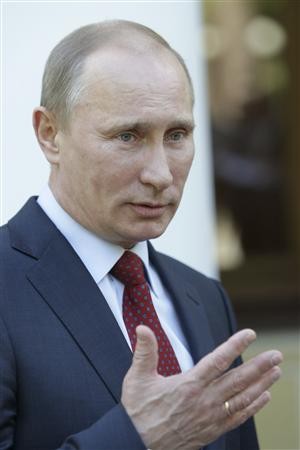 Dans un article publié dans le quotidien Izvestia, Poutine, nouveau candidat au Kremlin, souligne la nécessité de créer un espace économique commun de l’Atlantique au Pacifique
L’Eurasie, c’est l’avenir, a dit le premier ministre russe Vladimir Poutine, qui vient de relancer son projet d’une “Union Eurasiatique”, c’est-à-dire d’une union de toutes les anciennes républiques soviétiques en un espace économique unique et commun.
Il a annoncé ce projet dans un article intitulé “Projet d’intégration pour la nouvelle Eurasie: le futur en train de naître aujourd’hui”, et publié dans le quotidien de langue russe Izvestia. Le nouveau candidat à la présidence russe prévoit également, dans cet article, l’entrée possible du Kirghizistan et du Tadjikistan dans l’Union douanière existant déjà entre la Russie, la Biélorussie et la Kazakstan. Cette union recevrait pour nom “Communauté économique eurasiatique” et prendrait effet dès le 1 janvier prochain: elle se développera graduellement pour devenir un espace économique commun qui abolira toutes les barrières encore en place aujourd’hui. Dans son article, Poutine souligne que la Communauté aura une législation uniformisée et autorisera la libre circulation des citoyens de tous les pays qui en feront partie. Le nouveau candidat au Kremlin explique ensuite en détail quelles seront les perspectives que cette union rendra possibles, et déplore qu’en Occident on la stigmatise déjà comme un retour au passé. Poutine déclare alors que cette interprétation occidentale est “ingénue”. “Nous proposons un modèle d’union supranationale puissante capable de devenir l’un des pôles du monde moderne et de déployer un rôle efficace”. Cette union, ensuite, constituera un pont “entre l’Europe et la dynamique région de l’Asie-Pacifique”, le tout en une époque de globalisation accélérée. Depuis le 1 juillet 2011, a rappelé le premier ministre russe, “tout contrôle a été aboli sur la circulation des marchandises aux frontières intérieures de nos trois pays”. Cette mesure a permis de parachever un système douanier unique, dont les perspectives sont claires et permettront rapidement de réaliser de plus vastes initiatives commerciales. Et, ajoute Poutine, au départ de cette union douanière, “nous ferons un pas en avant vers un espace économique commun; nous sommes en train de créer un marché colossal, avec plus de 165 millions de consommateurs, avec une législation uniforme et une libre circulation des capitaux, des services et des forces de travail”.
C’est là un projet, précise Poutine, qui trouve ses racines dans l’actuelle union douanière entre la Russie, la Biélorussie et le Kazakstan: “La création d’une union douanière et d’espaces économiques communs ouvrent la porte à l’émergence, dans l’avenir, d’une union économique eurasiatique”. Grâce à cela, poursuit Poutine, “entrer dans cette Union Eurasiatique apportera des bénéfices économiques mais permettra aussi à tous les pays qui en feront partie, de s’intégrer à l’Europe plus rapidement, en partant d’une position de force”.
Poutine: “Le parcours pour en arriver à ce point fondamental a commencé il y a vingt ans, lorsque, après l’effondrement de l’Union Soviétique, on a créé la “Communauté des Etats Indépendants”. En règle général, nous pouvons dire que nous avions trouvé là un modèle qui a contribué à sauver une myriade de liens spirituels, de liens de civilisation, qui avaient uni nos peuples. Aujourd’hui nous agissons pour sauver la production, l’économie et les autres rapports, sans lequels notre vie serait inconcevable”, a conclu le premier ministre russe.
Le projet soutenu avec force par Poutine existe déjà dans les faits: il a été amorcé par l’Union douanière entre la Russie, la Biélorussie et la Kazakstan, qui, a affirmé Poutine, sera déjà complètement formalisée en 2012; une intégration plus ample verra ensuite le jour un an plus tard, en 2013. Telle qu’elle est conçue par le nouveau candidat au Kremlin, l’Union Eurasiatique est destinée à faire de sérieux bonds en avant à partir du 1 janvier prochain, par la création d’une énorme marché à trois, avec plus de 165 millions d’habitants, où citoyens et entreprises pourront se mouvoir librement pour asseoir la modernisation d’un vaste espace économique capable d’entrer en compétition avec l’UE mais aussi de dialoguer avec le Vieux Continent pour favoriser les échanges commerciaux et le rapprochement, tant sur le plan politique que sur le plan économique.
Andrea PERRONE
(article paru dans “Rinascita”, Rome, 5 octobre 2011, http://www.rinascita.eu ).
00:15 Publié dans Actualité, Affaires européennes, Eurasisme, Géopolitique | Lien permanent | Commentaires (0) | Tags : politique internationale, pioutine, russie, eurasie, eurasisme, europe, affaires européennes, asie, affaires asiatiques | | del.icio.us | | Digg | Facebook
Karzai s’éloigne du Pakistan et se rapproche de l’Inde
Ferdinando CALDA:
Karzai s’éloigne du Pakistan et se rapproche de l’Inde
Le Président afghan rencontre Singh pour renforcer les rapports bilatéraux
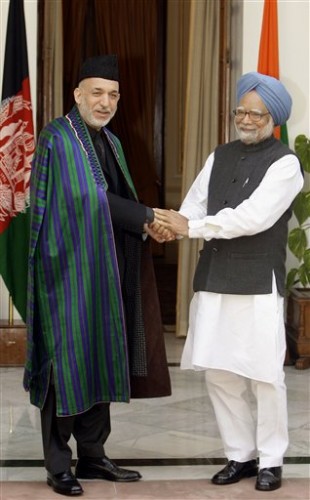 Le Président de l’Afghanistan, Hamid Karzai, revient d’une mission en Inde, à un moment plutôt délicat pour les équilibres et les alliances qui sont en train de se modifier dans la région. La visite du leader afghan —qui, le 4 octobre 2011, a rencontré le premier ministre indien Manmohan Singh et le ministre des affaires étrangères S. M. Krishna— revêt une signification particulière, à la lumière des tensions récentes entre les Afghans et leurs voisins pakistanais, ennemis historiques de la Nouvelle Dehli.
Tout en rappelant qu’Islamabad est l’unique interlocuteur plausible pour chercher à faire avancer un processus de paix avec les Talibans (vus les rapports présumés et privilégiés des services secrets pakistanais de l’ISI avec les miliciens islamistes et vu le fait que “tous les sanctuaires des terroristes se trouvent sur le territoire pakistanais), Karzai et quelques autres ministres de son gouvernement ont accusé le gouvernement du Pakistan de “ne pas soutenir nos efforts pour ramener la paix et la sécurité en Afghanistan”. L’assassinat récent de Burhanuddin Rabbani, chef du Haut Conseil de Paix afghan en charge des négociations avec les Talibans, a refroidi les rapports entre l’Afghanistan et le Pakistan. Une commission d’enquête afghane a affirmé que le fauteur de l’attentat est venu du Pakistan; hier, Kaboul a accusé les Pakistanais de ne pas collaborer à l’enquête.
Et tandis que le gouvernement afghan envoie des inspecteurs à Islamabad, Karzai s’envole vers la Nouvelle Dehli, pour la deuxième fois en un an, avec la ferme intention de renforcer dans l’avenir la coopération entre son pays et l’Inde. L’Inde ne peut certes étendre “militairement” son influence sur l’Afghanistan (du fait qu’elle n’a pas de frontière commune avec ce pays) mais pourrait très bien devenir un important partenaire commercial de Kaboul. Ce n’est pas un hasard si l’Inde est de fait l’un des principaux donateurs pour l’Afghanistan, où elle a investi plus de deux milliards de dollars depuis 2001. Cet effort semble avoir donné ses fruits, si l’on considère qu’au cours de l’année fiscale 2009-2010, le volume des échanges commerciaux entre les deux pays a atteint le chiffres de 588 millions de dollars. Il faut souliger tout particulièrement que l’Inde est aujourd’hui l’un des plus importants marchés pour les exportations afghanes de produits agricoles, un secteur sur lequel le gouvernement de Kaboul mise beaucoup. Cette nouvelle visite de Karzai devrait renforcer ultérieurement l’implication indienne en Afghanistan. Certaines sources évoquent d’ores et déjà un “accord de partenariat stratégique”, qui impliquerait les Indiens dans l’entraînement et la formation des forces de sécurité afghanes.
Mais l’Inde n’est pas le seul pays à vouloir occuper une place de première importance en Afghanistan, dès que les troupes de l’OTAN auront quitté le pays. Par sa position stratégique, tant économique que militaire, l’Afghanistan, comme depuis toujours, suscite bien des convoitises. Mis à part les Etats-Unis, qui sont en train de négocier avec Kaboul le droit de maintenir leurs bases pendant quelques décennies, il y a aussi la Russie et, surtout, la Chine qui investissent déjà dans la reconstruction du pays, dans l’espoir de s’accaparer des riches ressources du sous-sol afghan et de se réserver une présence garantie et stable sur le territoire. Il ne faut pas oublier non plus deux autres puissances régionales, l’Iran et l’Arabie Saoudite, dont la présence potentielle n’est certes pas aussi affichée, mais qui ne voudront sûrement pas courir le risque d’être exclus de tout contact avec l’Afghanistan dans les prochaines décennies.
Enfin, et ce n’est certainement pas là le moins important des facteurs en jeu, le Pakistan continue à voir dans les massifs montagneux afghans un éventuel refuge inaccessible, tout comme sont inaccessibles les dangereux sanctuaires des groupes armés islamistes, en cas de nouvelle guerre avec l’Inde.
Ferdinando CALDA.
( f.calda@rinascita.eu ).
(article paru dans “Rinascita”, Rome, 5 octobre 2011 – http://www.rinascita.eu ).
00:15 Publié dans Actualité, Géopolitique | Lien permanent | Commentaires (0) | Tags : inde, afghanistan, pakistan, moyen orient, politique internationale, géopolitique | | del.icio.us | | Digg | Facebook
J'avais un camarade par Angerfist62
00:05 Publié dans Militaria, Musique | Lien permanent | Commentaires (0) | Tags : musique, légion étrangère, militaria | | del.icio.us | | Digg | Facebook
This Difficult Individual Eustace Mullins—& the Remarkable Ezra Pound
This Difficult Individual Eustace Mullins—& the Remarkable Ezra Pound
By Beatrice Mott
Ex: http://www.toqonline.com/

Eustace Mullins
Earlier this year my friend Eustace Mullins passed away. He had been ailing for some time — at least since I first met him in 2006. Hopefully he is in a better place now.
Mr. Mullins made a huge mark on the nationalist community here in the United States, but also has a following in Europe and Japan. For those who have not read his books, Mr. Mullins attempted to expose the criminal syndicates that manipulate governments and the international financial system.
But Mr. Mullins’ most sparkling claim to fame was his partnership with Ezra Pound in order to write Secrets of the Federal Reserve — probably the most well-known exposé of how our government really works.
But nobody’s life is all sunshine and light. While Mr. Mullins’ work is among the most famous in the nationalist community, it is also some of the worst researched. He often fails to reference where he uncovered the material in his books. While Mr. Mullins was very perceptive of historical trends, his insights were sometimes overshadowed by unbalanced statements.
Authors wishing to quote Eustace’s books in their own writing make themselves an easy target for reasonable critics or hate organizations like the ADL. In this way, Mr. Mullins has done more harm to the movement than good.
I learned this the long way. Having read Secrets, I drove down to Staunton, VA in the summer of 2006 and spent an afternoon talking with Mr. Mullins. My goal was to find the origin of several stories and statements which I could not reference from the text. Mr. Mullins was an elderly gentleman and he couldn’t remember where he had found any of the material I was interested in. He simply replied: “It’s all in the Library of Congress. Back then they would let me wander the stacks.”
So I moved to D.C., a few blocks from the library and spent the better part of two years trying to retrace Mr. Mullins’ footsteps. Prior to this I had had several years’ experience as a researcher and was used to trying to find the proverbial “needle in a haystack.” They wouldn’t let me wander around the book storage facility (the stacks), but I scoured the catalog for anything that might contain the source for Mr. Mullins’ statements. I couldn’t verify any of the information in question.
Sadly, I realized that it would never be good practice to quote Mr. Mullins. But I hadn’t wasted the time. I know more about the Federal Reserve now than most people who work there and I learned about the fantastic Mr. Pound.
Ezra Pound is among the most remarkable men of the last 120 years. He made his name as a poet and guided W. B. Yeats, T.S. Elliot and E. Hemingway on their way to the Noble Prize (back when it meant something). He is the most brilliant founder of Modernism — a movement which sought to create art in a more precise and succinct form. Modernism can be seen as a natural reaction to the florid, heavy Victorian sensibility — it is not the meaningless abstractions we are assaulted with today.
Born in Idaho, Pound left the United States for Europe in 1908. In London he found an audience of educated people who appreciated his poetry. He married Dorothy Shakespear, a descendant of the playwright. Pound also befriended some of the most brilliant artists of the time and watched them butchered in the First World War.
Henri Gaudier-Brzeska [1], a sculptor and one of Ezra’s best friends, was one of these sacrifices. The Great War changed Pound’s outlook on life — no longer content with his artistic endeavors alone, he wanted to find out why that war happened.
 The answer he got bought him 12 years as a political prisoner in St. Elizabeth’s Hospital in Anacostia, just across the river from the Capitol in Washington D.C. Pound was never put on trial but was branded a traitor by the post-war American media.
What answer did Pound find? Our wars begin and end at the instigation of the international financial houses. The bankers make money on fighting and rebuilding by controlling credit. They colonize nations and have no loyalty to their host countries’ youth or culture. No sacrifice is too great for their profit.
Much of Pound’s work chronicles the effect of this parasitic financial class on societies: from ancient China to modern-day Europe. Pound was a polyglot and scoured numerous (well-documented) sources for historical background. The education that Mullins’ work promises is delivered by the truckload in Pound’s writing. Pound often lists his sources at the end of his work — and they always check out.
Eustace Mullins got to know Pound during the poet’s time as a political prisoner. He was introduced to Pound by an art professor from Washington’s Institute of Contemporary Arts which, in Mullins’ words, “housed the sad remnants of the ‘avant-garde‘ in America.”
According to Mr. Mullins, Pound took to him and commissioned Eustace to carry on his work investigating the international financial system. Pound gave Eustace an American dollar bill and asked him to find out what “Federal Reserve” printed across its top meant. Secrets, many derivative books, and thousands of conspiracy websites have sprung from that federal reserve note.
And here is where the story goes sour. Pound was a feared political prisoner incarcerated because of what he said in Italy about America’s involvement with the international bankers and warmongering. Pound was watched twenty four hours a day and was under the supervision of Dr. Winfred Overholser, the superintendent of the hospital.
Overholser was employed by the Office of Strategic Services (the CIA’s forerunner) to test drugs for the personality-profiling program, what would be called MK-ULTRA. (See John Marks’ The Search for “the Manchurian Candidate”: The CIA and Mind-Control [2]
Overholser was also a distinguished professor in the Psychiatry and Behavioral Sciences Department of George Washington University. This department provided students as test patients for the Frankfurt Schools’ personality profiling work, which the CIA was very interested in. Prophets of Deceit, first written by Leo Löwenthal [3] and Norbert Guterman in 1948, reads like a clumsy smear against Pound.
It does seem odd that a nationalist student would be allowed to continue the work of the dangerously brilliant Pound right under Winny’s nose. The story gets even stranger, as Mr. Mullins describes his stay in Washington during this time. He was housed at the Library of Congress — apparently he lived in one of the disused rooms in the Jefferson building and became good friends with Elizabeth Bishop [4].
Bishop was the Library of Congress’ “Consultant in Poetry” — quite a plum position. She was also identified by Frances Stonor Saunders as working with Nicolas Nabokov in Rio de Janeiro. Nabokov was paid by the CIA to handle South American-focused anti-Stalinist writers. (See The Cultural Cold War: The CIA and the World of Arts and Letters [5]
According to the CIA’s in-house historians, the Library was also a central focus for intelligence gathering [6] after the war, so it is doubly unlikely that just anybody would be allowed to poke around there after hours.
Whatever the motivation for letting Mullins in to see Pound was, the result has been that confusion, misinformation and unverifiable literature have clouded Pound’s message about the financial industry’s role in war. Fortunately Pound did plenty of his own writing.
According to Eustace, his relations with Pound’s relatives were strained after Pound’s release from prison. Pound moved back to Italy where he died in 1972. He was never the same after his stay with Overholser in St. E’s. The St. Elizabeth’s building is slated to become the new headquarters of the Department for Homeland Security [7].
Eustace went on to write many, many books about the abuses of government, big business and organized religion. They are very entertaining and are often insightful, but are arsenic from a researcher’s point of view. A book that contains interesting information without saying where the information came from is worse than no book at all.
While lackadaisical about references in his own writing, Mr. Mullins could be extremely perceptive and critical of the writing of others. I once told him how much respect I had for George Orwell’s daring to write 1984 — to which he sharply replied: “It’s a great piece of pro-government propaganda — they win in the end.” Mr. Mullins is of course right: Orwell’s Big Brother is always one step ahead, almost omniscient — and therefore invincible.
Eustace Mullins was much more than a writer. He became a political activist and befriended many prominent people in the American nationalist movement. But Mr. Mullins didn’t have much faith in American nationalism: It is a movement, he told me, that the government would never let go anywhere.
The Occidental Observer [8], March 20, 2010
00:05 Publié dans Economie, Littérature | Lien permanent | Commentaires (0) | Tags : etats-unis, ezra pound, littérature, lettres, lettres américaines, littérature américaine, usure, usurocratie | | del.icio.us | | Digg | Facebook