

vendredi, 09 mars 2012
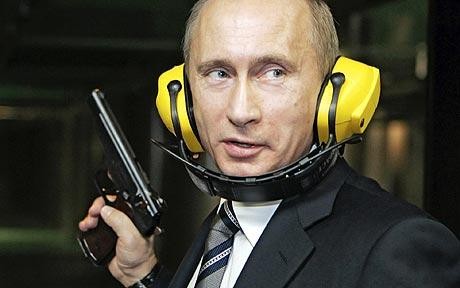
COMENTARIOS SOBRE LA AMPLIA VICTORIA ELECTORAL DE VLADIMIR PUTIN
11:02 Publié dans Actualité, Affaires européennes | Lien permanent | Commentaires (1) | Tags : politiquevinternationale, russie, poutine, élections russes, europe, affaires européennes |  |
|  del.icio.us |
  |
|  Digg |
  Facebook
Journée de la femme
JOURNEE DE LA FEMME

10:38 Publié dans Affiches | Lien permanent | Commentaires (3) | Tags : affiche, journée de la femme | | del.icio.us | | Digg | Facebook
L’Indonésie envisage de se joindre aux pays du BRICS
Le BRICS pourrait prochainement accueillir un nouveau membre dans la fronde envers l'hégémonie des USA: l'Indonésie. Plus grand et premier pays musulman (4ème population mondiale) proposant sa présence à leurs côtés.
L’Indonésie envisage de se joindre aux pays du BRICS
|
Ex: http://mbm.hautetfort.com/
|


|
|
L’Indonésie envisage de se joindre aux pays du BRICS. C’est ce qu’a déclaré l’ambassadeur de ce pays à Moscou.
Il a souligné à part le rôle du BRICS (Brésil, Russie, Inde, Chine, Afrique du Sud).
Quatrième pour l’importance de la population dans le monde, l’Indonésie peut contribuer à étendre l’influence du BRICS aussi bien à l’Asie du Sud-est, comme au monde islamique. Le pays joue un rôle actif au sein de l’Organisation de la coopération islamique.
10:24 Publié dans Actualité, Géopolitique | Lien permanent | Commentaires (0) | Tags : actualité, brics, eurasie, eurasisme, indonésie, multipolarité, géopolitique | | del.icio.us | | Digg | Facebook
Roosevelt, la destruction de l’Europe et le désastre de la première mondialisation
Roosevelt, la destruction de l’Europe et le désastre de la première mondialisation
Ex: http://qc.novopress.info/

par Nicolas Bonnal
Quand on se plaint du présent, il faut toujours se rappeler le bon vieux temps des guerres. Ceux qui s’étonnent du niveau abyssal de notre endettement ou du bilan désastreux – ce ne sont pas nos lecteurs – du printemps arabe et du bilan de la guerre en Irak ont ainsi besoin qu’on leur rafraichisse la mémoire.
J’ai toujours été étonné par l’incroyable dimension du désastre européen au lendemain de la deuxième guerre mondiale. Les pertes humaines sont bien sûr énormes, bien sûr imputables aux nazis et la à la guerre à l’Est, mais aussi bien sûr les pertes matérielles. Toute l’Europe occidentale a été bombardée, y compris les lieux saints du mont Cassin (les puissances protestantes voulaient intimider le pape). Staline contrôle tout l’orient de l’Europe et l’on laisse les guerres civiles et la disette s’installer un peu partout comme au bon vieux temps du moyen âge finissant. Même l’Angleterre a été ruinée, rincée même par son coopérant américain, et Churchill, auteur malheureux du conflit est chassé des Communes avec les huées. C’est l’époque d’Orwell, et ce n’est pas un hasard. Mais l’être humain aime être motivé par le désastre, on le sait depuis la Bible et Milton.
Il y a bien un responsable à tout cela, responsable qui a voulu et permis la destruction de l’Europe (nous avons été sauvés de la misère par son successeur Truman), l’anéantissement et non la défaire de l’Allemagne, la liquidation des empires coloniaux français et britanniques ; qui a voulu aussi la montée de la Chine communiste et le triomphe de l’union soviétique présentée avec son NKVD, son goulag et le Holodomorukrainien [1] comme un « paradis social mutualiste », y compris dans les films hollywoodiens de l’époque.
Ce responsable c’est Roosevelt auquel l’historien amateur (dans amateur il y a aimer, disait Orson Welles) Bernard Plouvier(1) a consacré un passionnant ouvrage à la fois synthétique et documenté. Il résume parfaitement le bellicisme insensé de Roosevelt qui a tout fait pour lancer le Japon dans la guerre, détruire l’Europe (plus de Français morts dans les bombardements libérateurs que de soldats US tués pendant la guerre !), diviser le monde et créer le réseau de bases et le fameux complexe militaro-industriel d’Eisenhower.
Roosevelt se laisse aussi hypnotiser, conifier disait Céline, par les mots comme nos idiots d’aujourd’hui. Il se lance dans une « croisade », exige une « capitulation sans condition » (en suivant le modèle affreux de l’incroyable guerre de sécession, premier scandale des temps modernes industriels), hurle et lance une « guerre totale » qui ne laisse d’autre choix à l’adversaire que de se mal comporter jusqu’au bout. Il laisse aussi les Juifs d’Europe à leur sort, et dès avant la guerre, alors que de tous côtés on le prévient et que même les nazis veulent faire des échanges hommes-matériel.
Mais pour Roosevelt la solution la pire est toujours la meilleure : il fallait en passer par la shoah et par soixante millions de morts pour que le nouvel ordre mondial auquel Roosevelt pense puisse s’établir ; et casser mille oeufs pour une petite omelette ; repensez au cas irakien.
Mille oeufs pour la mauvaise omelette. C’est d’une certaine manière l’héritage de cet impayable New Deal dont nous a rebattus les oreilles : le triplement de la dette n’a pas attendu Bush le guerrier et Obama le généreux ! Avec la guerre la dette aura sextuplé ! On a triplé en huit ans le nombre de fonctionnaires et on n’a pas créé d’emplois, la crise de 38 remettant sur la pavé des millions d’américains. Mais Roosevelt tient les médias et il est hélas réélu cherchant à sauver son économie par une guerre mondiale destinée à contrôler le pétrole, à mettre fin à la concurrence allemande et à ouvrir les marchés coloniaux de la Old Europe si chère à Rumsfeld…
En même temps il a socialisé l’économie américaine, fait exploser les impôts, avec des tranches à 100 %. Comme dit Bernard Plouvier : « L’Etat US, sous FDR, apprend à vivre à crédit ; c’est une leçon que les gouvernants des USA n’ont pas oubliée ». L’autre qu’ils n’ont pas oublié, c’est que la guerre fait vivre, et que le complexe militaro-industriel s’étend toujours plus, jusqu’aux enfants maintenant (j’en reparlerai).
Plouvier voit aussi un autre projet, et je pense à Bernanos et à son texte magique « La France contre les robots« . Roosevelt rêve d’un Etat mondial où tout est sous contrôle (cf. Orwell dont l’Etat se nomme Oceania en référence au damné Cromwell), et où l’homme, une fois qu’il sera transformé, va se comporter comme un robot discipliné et interchangeable.
« FDR compte transformer les peuples qui fourniront ses marchés à l’économie des USA en autant d’étudiants en l’art de vivre à l’américaine. »
Franklin Roosevelt, créature de la matrice américaine au détriment du peuple américain et du monde, mais surtout créateur à court terme des empires communistes et du champ de ruines européen et nippon, et du tiers-monde postcolonial…
Il est clair à la lecture de ce livre qu’il vaut mieux pour l’Europe et le monde un mauvais républicain qu’un bon démocrate à la Maison Blanche ; et que le grand Reagan fut celui qui nous libéra sur tous les plans de l’effroyable bilan politique et humain du sinistre grand homme.
Article printed from :: Novopress Québec: http://qc.novopress.info
URL to article: http://qc.novopress.info/10891/roosevelt-la-destruction-de-leurope-et-le-desastre-de-la-premiere-mondialisation/
00:07 Publié dans Histoire | Lien permanent | Commentaires (0) | Tags : histoire, franklin delano roosevelt, etats-unis, deuxième guerre mondiale, seconde guerre mondiale, europe, affaires européennes | | del.icio.us | | Digg | Facebook
The Struggle of Jean Thiriart
Claudio Mutti:
The Struggle of Jean Thiriart
 The last thought I have about Jean Thiriart is a letter that he wrote to me some months before he died: he was searching for a place in the Appenins, where he could have some trekking experience for two weeks. Almost seventy years old, he was full of inner strength: he didn’t parachute since some years before, but he travelled on his aliscafe in the Northern Sea.
In the 70s, as a young activist in “Young Europe”, the organization he leaded, I met him several times. I knew him in Parma in 1964, near a monument that immediately charmed his “Eurafrican” sensibility: it was the monument of Vittorio Bottego, a famous traveler in Juba area. Then I met him in some meetings of “Young Europe” and in a camping on the Alps. In 1967, just before the Zionist aggression against Egypt and Syria, I was in a crowded conference that he had in Bologna, where he explained why Europe had to support the Arabian world against Zionism. In 1968, I participated to a meeting organized by “Young Europe” in Ferrara, where Thiriart completely developed the anti-imperialist line: “Here in Europe, the only anti-American pivot is and will be a European left-wing nationalism […] What I mean is that a popular-oriented nationalism will be necessary for Europe […] a European national-communism would cause a great chain-reaction in terms of enthusiasm […] Guevara said that many Vietnams are necessary, and he was right. We need to transform Palestine into a new Vietnam”. This one was the last speech that I listened to.
Jean-François Thiriart was born in Bruxelles on March 22 1922 in a liberal-oriented family which had come from Lieges. During his youth he was a member of the Jeune Garde Socialiste Unifiée and in the Socialiste Anti-Fasciste Union. During a not short period he cooperated with professor Kessamier, president of the philosophical society Fichte Bund, originated from the national-bolshevist movement; then, with some other far-left elements supporting the alliance between Belgium and the national-socialist Reich, he became a member of the association Amis du Grand Reich Allemand. Because of this reason, he was condemned to death by the Belgian dealers of the Anglo-American forces in 1943: the English radio putted his name in the proscription list that was communicated to the résistance with all the instructions. After the “liberation”, he was condemned through an article of the Belgian Penal Law System, modified by the Belgian dealers of the Atlantists. He remained in jail for some years and, when he was free, the judge decided to forbid him to write.
In 1960, during the decolonization of Congo, Thiriart participated to the foundation of the Comité d’Action et de Défense des Belges d’Afrique, then evolved into the Mouvement d’Action Civique. On March 4th 1962, as a member of this movement, Thiriart met many members of other political European groups, in Venice; the conclusion of these meetings was a common declaration, in which they decided to make common efforts to create a “European National Party, built on the idea of the European Unity, able to fight the American enslavement of Western Europe and to support the reunification with the Eastern nations, from Poland to Bulgaria passing through Hungary”.
However, the project of the European Party failed after a short time, especially because of the micro-nationalist tendencies expressed by Italian and German members of the Venice Manifesto.
The lesson that Thiriart learned from this failure is that the European Party cannot be created by an alliance of micro-national movements, but it must be an European common organization since the beginning. So, in 1963, “Young Europe” was born; it was a movement strongly organized and active in Belgium, Nederland, France, Switzerland, Austria, Germany, Italy, Spain, Portugal and England. The political plan of “Young Europe” is explained inside the European Nation Manifesto, which begins so: “Between the Soviet block and the US block, our role is aimed to the building of a great motherland: a united, powerful and communitarian Europe […] from Brest to Bucharest”. The choice was for a Europe strongly united: “‘Federal Europe’ or ‘Europe of the Nations’ are both conceptions hiding lack of honesty and the inability of the people who support them. […] We condemn micro-nationalisms which keep European inhabitants divided”.
Europe must choose a strong armed neutrality and he must conquer its own atomic capacity; it must “abandon the UN circus” and support Latin America, who “fights for its unity and independence”. The Manifesto tried to find an alternative choice equally distant from the dominant social systems in the two Europes, claiming the “superiority of the worker over the capitalist” and the “superiority of man over the sworm”: “we want a dynamic community with the participation to the work of all men who compose it”. A new concept of organic representation was opposed to parliamentary democracy: “a political Senate, the Senate of European Nation built on the European provinces and composed of the highest personalities in the scientific outlook, in work, in the arts and literature; a syndical House that represents the interests of all the producers of Europe, finally free from the financial tyranny and from the stranger policy”. The Manifesto ended in this way: “We refuse ‘Europe in theory’. We refuse legal Europe. We condemn Strasbourg’s Europe ‘cause of her crime of treason. […] Or we will have a nation or we won’t have the independence. Against this legal Europe, we represent real Europe, Europe of the peoples, our Europe. We are the European Nation”.
After creating a school for political education of the members (that, from 1966 to 1968, published every month a magazine called L’Europe Communautaire), “Young Europe” tried to create a European Communitarian Syndicate and, in 1967, a university association (Università Europea), which was particularly strong in Italy. From 1963 to 1966 a new French magazine was published (Jeune Europe), with a weekly frequency; among the journals in the other countries, there was the Italian one called Europa Combattente, published every month.
From 1966 to 1968 La Nation Européenne was released, while La Nazione Europea was still published even in 1969, edited by the author of this article (one last release was published by Pino Balzano in Naples in 1970). La Nation Européenne, weekly magazine with a big format and, in some releases, composed of almost fifty pages, had important dealers: the political scientist Christian Perroux, the Algerian essayer Malek Bennabi, the deputy Francis Palmero, the Syrian Ambassador Selim el-Yafi, the Iraqi Ambassador Nather el-Omari, the leaders of the Algerian National Liberation Front Chérif Belkachem, Si Larbi and Djamil Mendimred, the president of the OLP Ahmed Choukeiri, the leader of the Vietcong mission in Algiers Tran Hoai Nam, the leader of the Black Panthers Stokeley Carmichael, the founder leader of the Centri d’Azione Agraria the prince Sforza Ruspoli, the writers Pierre Gripari and Anne-Marie Cabrini. Among the permanent reporters there were the professor Souad el-Charkawi (in Cairo) and Gilles Munier (in Algiers).
In the issue of February 1969, there was a long interview by Jean Thiriart with general Juan D. Peron, who admitted that he constantly read La Nation Européenne and completely agreed with its ideals. From his Spanish refuge in Madrid, the former president of Argentine declared that Castro and Guevara were developing the struggle for an independent Latin America, started many years before by the justicialist movement: “Castro – Peron said – is a promoter of the liberation. He had to ask help to an imperialism because the other one menaced to destroy him. But the Cubans’ aim is the liberation of the American Latin peoples. They have no other intention, but that one of the building of the continental countries. Che Guevara is a symbol of this fight. He was a great hero, because he served a great idea, until he became just this idea. He is the man of an ideal”.
Concerning the liberation of Europe, Thiriart projected to build some European Revolutionary Brigades to start the armed struggle against US invader. In 1966, he had a contact with Chinese Foreign Affairs Ministry Zhou Enlai in Bucharest, and he asked him to support the constitution of a political and military structure in Europe, to fight against the common enemy. In 1967, Thiriart was busy in Algiers: “It’s possible, it’s a must to consider a parallel action and hope the military formation of a kind of European revolutionary Reichswehr in Algeria. Nowadays, the governments of Belgium, Holland, England, Germany and Italy are in a different way the satellites of Washington; so, we, national-Europeans, European revolutionaries, we must go to Africa to form the cadres of a future political-military structure that, after serving in the Mediterranean Sea and in the Near Est, could fight in Europe to defeat the quislings of Washington. Delenda est Carthago”.
In the autumn of 1967, Gérard Bordes, headmaster of La Nation Européenne, went to Algeria to meet some members of the executive secretariat of National Liberation Front and Council for the Revolution. In April 1968, Bordes came back to Algeri with a Mémorandum à l’intention du gouvernement de la République Algérienne signed by himself and Thiriart, in which some proposals were contained: “European revolutionary patriots support the formation of special fighters for the future struggle against Israel; technical training of the future action aimed to a struggle against the Americans in Europe; building of an anti-American and anti-zionist information service for a simultaneous utilization in the Arabian countries and in Europe”.
The dialogue with Algeria had no results, so Thiriart started some talks with the Arabian countries of the Middle East. In fact, on June 3rd 1968, a militant of “Young Europe”, Roger Coudroy, fell in a battle against the Zionist army, while he was trying to enter into the occupied Palestine with a group of al-Fatah.
In the Autumn of 1968, Thiriart was invited by the governments of Iraq and Egypt, and by the Ba’ath Party. In Egypt he participated to the meeting of the Arabian Socialist Union, the Egyptian party of government; he was welcomed by several ministries and met the president Nasser. In Iraq he met some political personalities, among whom some leaders of the PLO, and was interviewed by some newspapers and mass media.
Anyway, the first aim of his travel was the trial to be supported in the creation of the European Brigades, which should participate to the national liberation struggle of Palestine and then should become the principal structure of a national liberation army in Europe. The Iraqi government denied its help, under Soviet pressure, so Thiriart’s aim failed. Disappointed by this failure, with no more economic means to support a high-level political struggle, Thiriart decided to stop his political activity.
From 1969 to 1981, Thiriart completely invested his time to his professional and syndical activity in the field of optometry, in which he obtained important promotions: he was president of the European Society of Optometry, of the Belgium National Union of Optometrists and Opticians, of Centre of Studies and Optical Sciences and he was a counselor in several commissions of the European Economic Community. Although this, in 1975 he was interviewed by Michel Schneider for the magazine Les Cahiers du Centre de Documentation Politique Universitaire of Aix-en-Provence and helped Yannick Sauveur to write his university final research about “Jean Thiriart and the European national-communitarianism” (Paris University, 1978). Another research has been published by Jean Beelen about the Mouvment d’Action Civique at the Free University of Bruxelles, six years before.
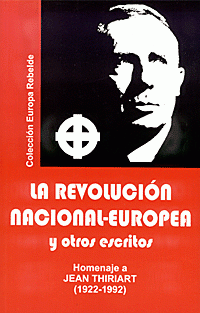 In 1981, a terrorist attack by Zionist criminals against his office in Bruxelles was the decisive input for Thiriart to restart political activity. He kept in touch again with the former dealer of La Nation Européenne, the Spanish historian Bernardo Gil Mugarza, who, during a long interview (108 questions), gave him the chance to newly and better explain his political thought. So a new book could take form: it was a book that Thiriart wanted to publish in Spanish and German languages, but it is still unpublished.
In the early 80s, Thiriart worked to a book that was never finished: The Euro-Soviet Empire from Vladivostok to Dublin. The plan of this work was composed of fifteen chapters, every one of which was divided into a lot of paragraphs. As the title of this book shows, the opinion of Thiriart about Soviet Union had completely changed. Left away the old motto “Neither Washington, nor Moscow”, Thiriart assumed a new idea that we could resume in this formula: “With Moscow, against Washington”. Thirteen years before, in truth, Thiriart had expressed his satisfaction about the Soviet military intervention in Prague, denouncing the Zionist plots in the so called “Prague Spring”, in the article Prague, l’URSS et l’Europe (“La Nation Européenne”, n. 29, November 1968), and he had started to define an “attention strategy” about the Soviet Union.
“A Western Europe free from US influence – he wrote – would permit to the Soviet Union to assume a role almost antagonist to the USA. A Western Europe allied, or a Western Europe aggregated to the USSR would be the end of the American imperialism […] If Russians want to separate Europeans from America – and they necessarily have to work for this aim in the long-term – it’s necessary they offer us the chance to create a European political organization against the American golden slavery. If they fear this political organization, the better way to solve this fear consists in the integration with it”.
In August 1992 Thiriart went to Moscow with Michel Schneider, headmaster of the magazine Nationalisme et République. They were welcomed by Aleksandr Dugin, who had already encountered Alain De Benoist and Robert Steuckers (in March), and had interviewed the author of this article for the Moscow TV (in June), after a meeting with the “red-brown” opposition.
The activity of Thiriart in Moscow – where there were also Carlo Terracciano and Marco Battarra as members of the European Liberation Front – was very intense. He did conferences, interviews, participated to a round table with Prokhanov, Ligacev, Dugin and Sultanov in the headquarter of the review Den, that published an article by Thiriart under the title “Europe to Vladivostok”; he had a meeting with Gennady Zyuganov; and another meeting with several members of the “red-brown” opposition, like Nikolai Pavlov and Sergej Baburin; he had a discussion with the philosopher and leader of the Islamic Renaissance Party Gaidar Jemal; he participated to a rally of Arabian students in the streets of Moscow.
On November 23rd, three months his coming-back to Belgium, Thiriart was stroked by a cardiac crisis.
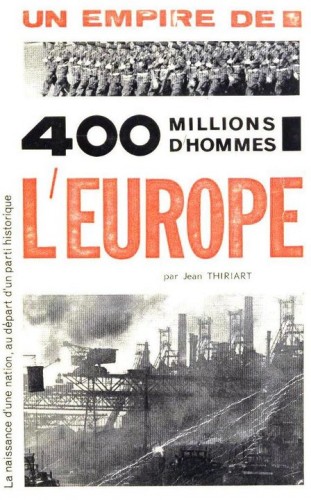
Published in 1964 in French language, Thiriart’s book An Empire of 400 millions of people: Europe, was translated into other six languages. The Italian translation was made by Massimo Costanzo (at that time, dealer of Europa Combattente), who had introduced the work with these words: “The book by Thiriart is destined to receive a great interest because of its precision and its accuracy. But where this accuracy comes from? From a very simple point: the Author has used an essentially political language, far from the smokes of ideologies and from abstract constructions. After a careful reading, you can find even some ideological elements inside the book, but these ones emerge from the political thesis, and not vice-versa, like it was in the national-European field until nowadays”.
The reader of this second Italian edition probably will agree with all what Massimo Costanzo wrote forty years ago. The reader will realize that this book, maybe the most famous one among all the books by Thiriart, is an actual book, able to preview a lot of factors, even if it’s naturally included in the historical situation in which it was written. It was able to preview, because it anticipated the collapse of the Soviet political system about ten years before the “euro-communism”; it’s at step with time, because the description of the US hegemony in Europe is nowadays a real fact.
In my library, I conserve a copy from the first edition of this book (“édité à Bruxelles, par Jean Thiriart, en Mai 1964”). The dedication that the Author wrote inside it contains an exhortation that I extend to young readers of today: “Votre jeunesse est belle. Elle a devant elle un Empire à bâtir”. Unlike Luttwak and Toni Negri, Thiriart well knew that Empire is the right contrary of imperialism and that the United States are not Rome, but Carthago.
(Transl. by A. Fais)
00:05 Publié dans Hommages | Lien permanent | Commentaires (0) | Tags : hommage, jean thiriart, nationalisme européen | | del.icio.us | | Digg | Facebook