

Ok

En poursuivant votre navigation sur ce site, vous acceptez l'utilisation de cookies. Ces derniers assurent le bon fonctionnement de nos services. En savoir plus.

mardi, 18 février 2014

Maurice Bardèche à Lyon le 1er mars

bardeche copie.jpg

Conférence d'Europe Identité

sur Maurice Bardèche

Lyon, 1 mars

00:08 Publié dans Evénement | Lien permanent | Commentaires (0) | Tags : événement, lyon, maurice bardèche, france | |  del.icio.us | | Digg! Digg |  Facebook

Raid Raquette

00:06 Publié dans Alpinisme, Evénement | Lien permanent | Commentaires (0) | Tags : événement, pyrénées, montagne, randonnées, sport | |  del.icio.us | | Digg! Digg |  Facebook

En Islande, les ressources naturelles sont maintenant « détenues par le peuple »

icelandicpeople.jpg

En Islande, les ressources naturelles sont maintenant «détenues par le peuple»
Ex: http://www.localisme.fr
 
Interview - La nouvelle Constitution islandaise, choisie par référendum, prévoit que les ressources naturelles soient « détenues par le peuple islandais ».

Entretien avec Victor David, juriste de l’environnement à l’Institut de recherche pour le développement (IRD).

Le projet de nouvelle Constitution islandaise prévoit que les ressources naturelles soient « détenues par le peuple islandais ». Quelle serait la portée de ce texte s’il était adopté ?

Victor David : Cette formulation est une façon politiquement correcte de parler de nationalisation des ressources naturelles. En Islande, un des grands enjeux concerne les produits de la mer. Quelques grosses entreprises concentrent presque l’ensemble des quotas de pêche. Cette nationalisation permettrait de renégocier les quotas vers une redistribution plus favorable à l’ensemble de la population. Les perspectives de trouver du pétrole dans les eaux territoriales islandaises en mer du Nord ne sont probablement pas non plus étrangères à cette proposition. Plus largement, la nationalisation est motivée par la crainte de voir des multinationales, voire des Etats étrangers via des entreprises publiques, accaparer les ressources. La Chine a par exemple essayé d’acquérir des terrains en Islande. Il faut cependant relativiser la portée du texte islandais qui ne fait référence qu’aux ressources non déjà privatisées. Il ne s’agit donc pas pour le gouvernement de faire une chasse aux compagnies privées.

Les changements sont donc assez marginaux ?

Non, car il existe encore beaucoup de ressources naturelles non encore transférées au secteur privé, en matière de pêche mais aussi les réserves pétrolières offshore qui n’en sont qu’au stade… de potentiel !

La référence au « peuple » ne donne-t-elle pas plus de prise aux citoyens sur leurs ressources que la seule nationalisation ?

Pas vraiment, dans la mesure où l’Islande est une démocratie représentative. Il faudrait la mise en place de mécanismes de participation pour que la population soit associée à la gestion des ressources. Par le biais de référendums locaux notamment. Alors, la propriété des peuples aurait plus de sens. Cela dit, il est vrai que le projet de constitution islandaise prévoit des référendums d’initiative citoyenne. 10% de la population pourrait provoquer un référendum, pourquoi pas, sur les ressources naturelles en cas de litige avec l’Etat.

Est-ce que ce projet laisse envisager une meilleure protection des ressources naturelles ?

L’environnement n’a pas forcément grand chose à y gagner. Derrière le vocable « ressources naturelles », on parle en effet moins de la flore, de la faune ou des paysages, que de tout ce qui peut s’avérer être une « richesse naturelle », comme le pétrole, les minerais ou les produits de la pêche. On soustrait aux appétits individuels les ressources naturelles qui ne sont pas déjà privatisées pour les donner au peuple. En réalité, c’est l’Etat qui les gère sous forme d’actionnariat majoritaire, sans nécessairement protéger la nature. Un vrai progrès ces dernières années en matière de protection des ressources naturelles vient de la constitution équatorienne de 2008 qui a décidé d’accorder des « droits fondamentaux » à la nature elle-même. Cela facilite en particulier la défense de l’environnement car ces droits permettent à toute personne de se faire le porte-parole de la nature devant la justice et de porter plainte sans avoir à justifier de préjudice personnel. Et les atteintes à l’environnement sont imprescriptibles.

Cette proposition de l’Islande s’inscrit-elle dans une tendance plus large ?

Oui, la nationalisation des ressources naturelles revient sur le devant de la scène. En toute légalité d’ailleurs puisque, depuis 1962, les Nations unies affirment la souveraineté des Etats sur les ressources naturelles. Ces dernières décennies, les Etats avaient pourtant utilisé ces droits pour privatiser les ressources, sous la pression du FMI et de la Banque mondiale. Depuis le début des années 2000, le Venezuela, la Bolivie et l’Equateur ont entamé ou renforcé la nationalisation de leurs ressources naturelles, notamment du pétrole mais pas seulement. En Bolivie, la nationalisation de l’eau a permis à l’Etat de reprendre la main sur ce secteur contre Suez. A Québec, les partis politiques nationalistes réclament régulièrement la souveraineté sur les ressources naturelles. Mais un effet pervers de ce genre de nationalisation est le risque de corruption, car les gouvernants deviennent les gestionnaires exclusifs de ces richesses. Il faut donc impérativement accroître la participation du public dans la prise de décision en matière de gestion des ressources naturelles et renforcer les garanties de transparence de l’action publique.


Cet article de Magali Reinert a initialement été publié, le 8 janvier, par Novethic, le média expert du développement durable.

Taliban bedreigen niet-islamitisch bergvolk

Taliban bedreigen niet-islamitisch bergvolk: bekeer je of sterf!

Ex: http://www.parool.nl
 
 
Kailash-vrouwen in Islamabad op een bijeenkomst over de verschillende culturen in het land. © epa

De Kalash, het Pakistaanse bergvolk dat zegt af te stammen van Alexander de Grote, zijn altijd veilig geweest achter hun muren van rots en ijs. Maar de Taliban hebben 'een gewapende strijd' aangekondigd tegen deze stam, omdat deze zich nooit heeft bekeerd tot de islam.

Er komen weinig buitenstaanders in de Chitral-vallei. De wegen zijn een groot deel van het jaar onbegaanbaar en voordat een vliegtuig het aandurft om op te stijgen, moeten de weersomstandigheden absoluut perfect zijn: de kleine luchthaven ligt weggemoffeld tussen bergtoppen van meer dan achtduizend meter hoog.

Dit is misschien wel het mooiste deel van Pakistan. Bergtoppen torenen woest, rauw en overdonderend boven de vallei uit. Overal is water: rivieren, beken en watervallen vechten zich een weg naar beneden en op sommige plaatsen verandert grijze rots in een boomgaard vol roze bloesem of velden vol wuivende tarwe.

Altijd met rust gelaten

Vroeger werd deze vallei gedomineerd door gematigde Ismaëlies, een aftakking van de islam die wordt geleid door de Agha Khan. Nu zijn soennitische moslims er in de meerderheid, maar ook zij hebben de 3.500 Kalash altijd met rust gelaten. De rijzige mannen en vrouwen, vaak met lichte ogen en een lichte huid, leven in hun afgelegen dorpen, ver in de bergen.

Soms ondernemen toeristen de lange reis om de Kalash te zien. Een enkele buitenlander. Een handjevol Pakistanen uit 'de vlaktes'. Die laatste groep is overigens niet erg populair bij de Kalash-vrouwen, zo vertelden ze in 2002 in een interview met de Volkskrant. 'Ze verstoppen hun eigen vrouwen, maar komen wel naar onze gezichten kijken', zei een jong meisje. 'Ze hebben geen respect.'

'Bekeer of sterf'


Begin deze maand, op 2 februari, verscheen er een video op een website van de Taliban die volgens persbureau AFP begint met prachtige beelden van de vallei. Daarna zegt een stem dat de Kalash zich tot de islam moeten bekeren, of zullen sterven.

'Bij de genade van Allah heeft een groeiend aantal mensen van de Kalash de islam omarmd. We willen aan de hele stam duidelijk maken dat de leden zullen worden vernietigd met hun beschermers, de westerse agenten, als ze niet bekeren.'

In de video worden internationale non-gouvernementele organisaties ervan beschuldigd in Chitral te infiltreren om de cultuur van de Kalash te beschermen, en daarmee mensen weg te houden van de islam. De liefdadigheidsorganisatie van de Agha Khan wordt hierbij als voorbeeld genoemd, en de stem zweert om dergelijke snode plannen in de kiem te smoren.

(Door: Sacha Kester)

The USA’s Asia Policy is Shifting

empire-in-asia-e1377199333368.png

Vladimir Odintsov :

The USA’s Asia Policy is Shifting

The February 5th discussion in Congress of the issue of the United States’ Asia policy came as a clear confirmation of the course taken by Washington influence by hawks: transitioning from the balanced approach of the past to solving territorial disputes in the Pacific Rim to a tougher stance, one including the use of force. The intent of updating future US activities in Asia is reflected in the very name of the congressional subcommittee hearing: “America’s Future in Asia: From Rebalancing to Managing Sovereignty Disputes.” It wholly confirmed Washington’s decision of transitioning to a position of imperial dictatorship in that area of the world, where in recent times the US has regularly expressed grievances against China regarding the recently announced Chinese Air Defense Identification Zone (ADIZ), which includes a number of islands in the South China Sea.

According to reports of various foreign observers, a fairly obvious tension in relations between the two countries has appeared in recent days, despite Washington’s outward declaration of willingness to develop a bilateral cooperation with China in a number of arenas. In the view of many analysts, this is largely due to a shift in US military strategy and its particular emphasis on the strengthening of its strategic presence in the Pacific region as a means of combating Chinese expansion in Asia. The sharpest of these confrontations are in the field of military strategy and of competition for influence over regional economic trade unions. The underlying motive for this is clear: each year 5.3 trillion dollars of the trade turnover takes place in the South China Sea, with US trade accounting for 1.2 trillion of the total amount.

A session of the Subcommittee on Europe, Eurasia and Emerging Threats of the Foreign Affairs Committee of the US House of Representatives termed “China’s Maritime and Other Geographic Threats” held on October 30th, 2013 is a clear indication of the growth of anti-Chinese sentiment in the American political establishment. This session, chaired by Congressman Dana Rohrabacher, witnessed a significant rise in the inciting of military confrontation with China in the Pacific Rim region, as well as a quest by US politicians to further strengthen US expansion in that part of the world by military confrontation with China, looking to Japan for support.

Giving testimony before a congressional subcommittee on February 5th, the US Assistant Secretary of State for East Asian and Pacific Affairs, Daniel Russel, stated that the United States is acting against “China’s incremental efforts to assert control over the area contained in the so-called “nine-dash line” (i.e. China’s territorial demands in the South China Sea)”. He added, “I think it is imperative that we be clear about what we mean when the United States says that we take no position on competing claims to sovereignty over disputed land features in the East China and South China Seas…we do take a strong position that maritime claims must accord with customary international law…”

This assertion, repeated several times during his testimony before Congress and in a briefing for foreign journalists which took place on February 4th in the US Department of State Foreign Press Center, may indicate significant changes in US foreign policy in the Asia-Pacific region. Before Russel’s testimony the United States officially announced its neutrality in respect to maritime disputes in the South China Sea, which was used by American diplomats primarily as a denial of the military component of Washington’s policy in the region. The White House now, however, takes a “strong position” on the issue and intends to use certain provisions of the UN Convention on the Law of the Sea (UNCLOS) – which the US itself has not yet joined – to place increased pressure on China and to denounce Beijing’s maritime demands.

Adjusting for the adoption of its modified position in the Pacific Rim region Washington “aided” the Philippine government in bringing a judicial lawsuit against China before the International Tribunal for the Law of the Sea (ITLOS), which will review the issue on March 30th of this year in Hague. This step, however, is clearly a link in Washington’s coordinated military propaganda campaign against China, as the same day that Russel gave testimony before Congress the New York Times published an interview with president of the Philippines Aquino, in which he compared Beijing’s territorial demands in the South China Sea with Hitler’s 1938 seizure of the Czech Sudetenland, equating China’s activities with those of Nazi Germany. In support of Aquino’s inflammatory comparison, on February 6th of this year The Atlantic temporarily carried an article with a critique of China.

When, with the clear sanction of the White House, the US media begins comparing a country with Nazi Germany, it becomes obvious that the American war machine is gaining momentum in its preparations for the next war, in which military industry circles have long been interested. The “informational support” of such a shift in US foreign policy was provided in the form of speeches delivered by a number of congressmen before congressional subcommittee hearings on maritime disputes, which took place last week. Testimony was brought by congressmen Ami Bera, Steve Chabot, Randy Forbes, Brad Sherman and a number of others in support of a forceful US position and of confrontation with Beijing over disputed territories in the Pacific Rim region.

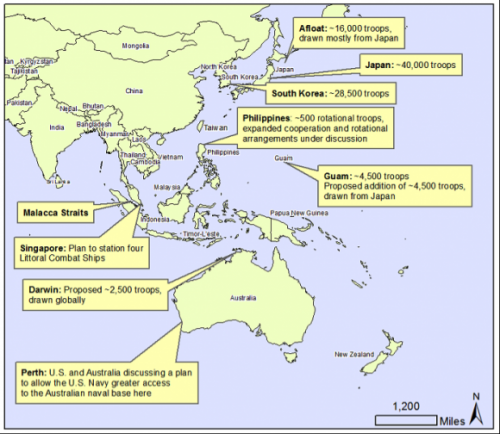
Meanwhile, an active relocation of the US submarine fleet in the Pacific Ocean is underway, as well as the modernization and expansion of the US military base on Guam, its largest base in the Western Pacific since World War II, although the military equipment there is already sufficient for large-scale military activities, according to a number of military experts. The building of additional military bases on the South Korean Island of Jeju, the Australian Cocos Islands and the expansion of its base on the Diego Garcia Islands is clearly in the Pentagon’s interest. Singapore has already given permission for the use of its Navy base, Chang, for better control over the Malacca Strait, through which 80% of its Chinese oil imports arrive…

Under such circumstances, the true agenda of US vice-president Biden and US Deputy Secretary of State William Burns’ visits to the region becomes increasingly clear, as well as that of the upcoming visits of Secretary of State John Kerry, Minister of Defense Chuck Hagel and a number of other high-level US officials. The US’s political balancing act in the Pacific Rim region is truly shifting.

Vladimir Odintsov, a political observer, exclusively for the online magazine New Eastern Outlook.