Ex: http://www.counter-currents.com/
An inner enemy is more dangerous than an outer one, because while he seems to belong, he is actually a kind of alien. An inner enemy is dangerous in two respects: first because of his own activity, and second, because of his usefulness to the outer enemy. . . . After the War, the American occupation of Europe and the despoliation of Europe were made possible only by the Michel-stratum,[1] which hired itself out to the enemy to establish vassal-governments, churchill-regimes, in every province of Europe. During this period between the Second and Third World Wars,[2] the Michel as an American agent is more dangerous than he would otherwise be himself. The reason for this is the advance of History since the 19th century has rendered his whole world-outlook completely useless to him, even for purposes of sabotage, while to the Americans it is still useful as a means of control over Europe. Thus the Culture-diseases of Culture-retardation remains in the body of Europe only because of the American occupation. — Francis Parker Yockey[3]
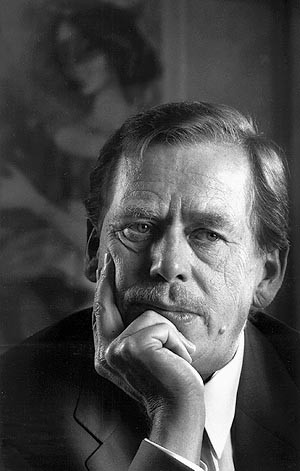 Václav Havel, the last president of Czechoslovakia and first president of the Czech Republic, died on December 18, 2011. His eulogies reveal him to be an excellent specimen for the study of the role of the “inner enemy” in the process of cultural pathology. In Havel we have a particularly devolved example of the Michel element that worked for the spiritual, political, cultural, and economic subjugation of the Western Cultural organism by the forces of cultural parasitism, distortion, and retardation. Indeed, the cultural pathologist can place him in the genus michelus along with such contemporaries such as Boris Yeltsin, Lech Wałęsa, and Mikhail Gorbachev.
The most apparent symptoms in identifying an apparently normal human as a member of genus michelus are the accolades received from media pundits and political and plutocratic luminaries, and in particular those directly from the organs of the Culture-Distorter. In this instance, like the much-lauded Gorbachev,[4] Havel receives his acclaim for the role he played in dismantling the Soviet bloc.
That the collapse of the Warsaw Pact was greeted with such acclaim and is remembered as “inspirational” by the Right, from nazis to conservatives, is an indication of the banality of much of the “Right,” which remains oblivious to the Soviet bloc having been the only major force of conservatism in the world, and to the USA being the global harbinger of decay.[5] This American role was recognized not only by Yockey, but also — approvingly — by Trotskyites, many of whom became avid Cold Warriors,[6] and by necon strategists such as Ralph Peters.[7]
Given that the Warsaw Pact was the only geopolitical entity that constrained American global hegemony, Havel’s contribution to its demise is lauded as a great victory for “democracy” and “freedom.” However, those are words that are used by many regimes and systems, no matter what their character, and have been euphemisms since the time of Woodrow Wilson’s Fourteen Points for post-war international reconstruction in the image desired by the US for the subordination of all nations, peoples, and cultures to everything that is conjured by the word “America.”
Havel is said to have been an idealistic opponent of the consumerist ethic, yet what is one to think of an individual who allowed himself to be mentored and patronized by the likes of George Soros and flitted about among the luminaries of plutocracy? Solzhenitsyn did not allow himself to be used in such a manner by the forces of Culture Distortion nor did he succumb to their blandishments. Solzhenitsyn was a mystic, Havel, as will be shown, a seedy Zionist purveyor of cultural syphilis.
Havel’s critique of “The West,” like Solzhenitsyn’s was perceptive, stating: “There is no need at all for different people, religions and cultures to adapt or conform to one another. . . . I think we help one another best if we make no pretenses, remain ourselves, and simply respect and honor one another, just as we are.”[8]
Here was a cultural icon who obviously knew the processes of leveling that were taking place in the world, but who was nonetheless willing to let himself be used in their service, for the sake of nebulous sales pitches like “democracy” and “human rights.” Like the much lauded Gorbachev, Havel became an icon of manufactured dissent in the interests of international capital that pulls the strings behind the façade of “democracy,” and, as will be seen, of the Culture Distorters who had long been fearful of the directions being taken by the descendants of the Black Hundreds, and worried that the Warsaw Pact constituted a new Axis of the type predicted by Yockey in his final essay “The World In Flames.”
The “velvet revolutions” that were instigated, funded, and planned by the Soros network, National Endowment for Democracy, Freedom House, and dozens of others, were a prelude to the same types of revolt that continue to be inflicted upon the former Soviet bloc states and that are taking place under the mantle of the “Arab Spring.”[9]
“Rootless Cosmopolitanism”
The collapse of Czechoslovakia as part of the implosion of the Soviet bloc provides a special example of the role of Culture-Distortion. Other than Culture pathologists such as Yockey, the Soviet leadership following the ouster of Trotsky and the Old Bolsheviks, were fully aware of the destructive nature of cultural nihilism. Ironically, the Soviet bloc stood as the only significant bulwark against what Hitler had termed “cultural bolshevism.” While Yockey’s theory of Culture Pathology[10] shows that the presence of a foreign body in the cultural organism spontaneously creates the phenomena of Culture-distortion, Culture-retardation, and Culture-parasitism; these symptoms can also be consciously pressed into the service of politics.
Kulturkampf is a major part of the world offensives of both plutocracy and Zionism to the extent that at the very beginnings of the Cold War the CIA recruited sundry disaffected anti-Soviet socialists, and in particular Trotskyites, into the Congress for Cultural Freedom to try and subvert the Soviet bloc and impose “American” values over the world in the name of “freedom of artistic expression.” Their favored mediums were Abstract Expressionism and jazz.[11] The Congress was established under the figurehead of Professor Sidney Hook, a “lifelong Menshevik” who had organized a committee for the defense of Leon Trotsky at the time of the Moscow Trials, and a recipient of the Congressional Medal of Freedom from Ronald Reagan. Other Congress luminaries included Bertrand Russell, the pacifist CND guru who had sought a pre-emptive nuclear strike against the USSR in the interests of “peace.” The Congress promoted the type of art that had been exposed as subversive “rootless cosmopolitanism” by Stalin, et al., who correctly perceived it as part of a political offensive.[12]
The program of Kulturkampf against the Soviet bloc can be traced to Trotsky, always a very handy tool for international finance. In 1938 André Breton,[13] Mexican communist muralist Diego Rivera,[14] and Leon Trotsky issued a manifesto entitled: Towards a Free Revolutionary Art.[15] The manifesto was published in the Autumn 1938 issue of The Partisan Review, a magazine that was of significance in the Cold War-Trotskyite offensive. Trotsky, according to Breton, had actually written the Manifesto, which states:
Insofar as it originates with an individual, insofar as it brings into play subjective talents to create something which brings about an objective enriching of culture, any philosophical, sociological, scientific, or artistic discovery seems to be the fruit of a precious chance, that is to say, the manifestation, more or less spontaneous, of necessity. . . . Specifically, we cannot remain indifferent to the intellectual conditions under which creative activity takes place, nor should we fail to pay all respect to those particular laws that govern intellectual creation.
In the contemporary world we must recognize the ever more widespread destruction of those conditions under which intellectual creation is possible. . . . The regime of Hitler, now that it has rid Germany of all those artists whose work expressed the slightest sympathy for liberty, however superficial, has reduced those who still consent to take up pen or brush to the status of domestic servants of the regime. . . . If reports may be believed, it is the same in the Soviet Union. . . . True art, which is not content to play variations on ready-made models but rather insists on expressing the inner needs of man and of mankind in its time — true art is unable not to be revolutionary, not to aspire to a complete and radical reconstruction of society. . . . We recognize that only the social revolution can sweep clean the path for a new culture. If, however, we reject all solidarity with the bureaucracy now in control of the Soviet Union it is precisely because, in our eyes, it represents, not communism, but its most treacherous and dangerous enemy. . . .
The criterion for art given here by Trotsky seems more of the nature of the anarchism of Breton and of the future New Left than of the collectivist nature of Marxism. F. Chernov, whose important statement on the arts from a Stalinist viewpoint will be considered below, was to refer to such art as “nihilism.”
Given that the manifesto was published in The Partisan Review, which was later to receive subsidies from the CIA and the Tax-exempt Foundations as party to what became the “Cultural Cold War,” this Trotskyist art manifesto served as the basis for the art policy that was adopted after World War II by the CIA and the globalists as part of the Cold War offensive.[16] Trotsky wrote Towards a Free Revolutionary Art as a call for mobilization by artists throughout the world, to oppose on the cultural front Fascism and Stalinism, which to many Leftists and communists were synonymous:
We know very well that thousands on thousands of isolated thinkers and artists are today scattered throughout the world, their voices drowned out by the loud choruses of well-disciplined liars. Hundreds of small local magazines are trying to gather youthful forces about them, seeking new paths and not subsidies. Every progressive tendency in art is destroyed by fascism as “degenerate.” Every free creation is called “fascist” by the Stalinists. Independent revolutionary art must now gather its forces for the struggle against reactionary persecution.[17]
While the Congress for Cultural Freedom was established in 1949, and on a more formal basis in 1951, its origins go back to the defender of Trotsky, Professor Sidney Hook, who had established an embryonic movement of similar name in 1938, and who served as the figurehead for the Congress knowingly under the auspices of the CIA.
The Stalinists responded with a vigorous call not only to “Soviet patriotism” but also to the cultural legacy of the Russian people. If one were looking for a Marxist articulation of cultural theory, it would more likely be found coming from the official and semi-official agencies of the USA, rather than those of the Soviet bloc.
In 1949 a major article in the organ of the Central Committee of the Bolshevik party, Chernov condemned the infiltration of cosmopolitanism in Soviet arts, sciences, and history.[18] The article stands as a counter-manifesto not only to the Trotskyites and the “cultural cold war” of the time, but also as an enduring repudiation of modernism and rootless cosmopolitanism as it continues to manifest in the present age of chaos.
Chernov began by referring to articles appearing in Pravda and Kultura i Zhizn (“Culture and Life”), which “unmasked an unpatriotic group of theatre critics, of rootless cosmopolitans, who came out against Soviet patriotism, against the great cultural achievements of the Russian people and of other peoples in our country.” Chernov described this coterie as “rootless cosmopolitans” and “propagandists for decadent bourgeois culture,” while they were “defaming “Soviet culture.” The culture of the “West” is described as “emaciated and decayed,” a description with which any Spenglerian would concur. The “Soviet culture” referred to by Chernov is the classic “great culture of the Russian people” and should not be mistaken as a reference to the “communist culture” that one would have in mind when thinking of the mass and crass propaganda spectacles of Maoist China. By 1949 the highest Soviet authority, whose views Chernov must have been conveying, had perceived that the USSR was the target of broad-ranging cultural subversion: “Harmful and corrupting petty ideas of bourgeois cosmopolitanism were also carried over into the realms of Soviet literature, Soviet film, graphic arts, in the area of philosophy, history, economic and juridical law and so forth.”[19]
It seems that these “rootless cosmopolitans” were stupid enough to believe that they were in a State that was still pursuing Marxian ideas, despite the clear message that had been given during the Moscow Trials a decade previously,[20] along with the virtual extinction of the “Old Bolsheviks.” One, comrade Subotsky had, as presumably a good Marxist, sought to undermine the concept of nationality, and repudiate the idea of the heroic ethos that had become an essential ingredient of Soviet life and doctrine, especially since the “Great Patriotic War.” Hence Chernov wrote damningly of this “rootless cosmopolitan” whose views on culture seem suspiciously Trotskyite:
The rootless-cosmopolitan Subotsky tried with all his might to exterminate all nationality from Soviet literature. Foaming at the mouth this cosmopolitan propagandist hurls epithets towards those Soviet writers, who want “on the outside, in language, in details of character a positive hero to express his belonging to this or that nationality.”[21]
Chernov continued: “These cosmopolitan goals of Subotsky are directed against Soviet patriotism and against Party policy, which always has attached great significance to the national qualities and national traditions of peoples.” Chernov then described an “antipatriotic group” promoting “national nihilism” in theater criticism, this concept being, “a manifestation of the antipatriotic ideology of bourgeois cosmopolitanism, disrespect for the national pride and the national dignity of peoples.”
Chernov identified “rootless cosmopolitism” as part of a specific foreign agenda, which was certainly formalized that year – 1949 – with the founding of the Congress for Cultural Freedom:
In the calculation of our foreign enemies they should divert Soviet literature and culture and Soviet science from the service of the Socialist cause. They try to infect Soviet literature, science, and art with all kinds of putrid influences, to weaken in such a way these powerful linchpins of the political training of the people, the education of the Soviet people in the spirit of active service to the socialist fatherland, to communist construction.
Chernov warned with prescience of what is today called the “cultural cold war” as a part of the “ideological weapon” of encirclement:
The most poisonous ideological weapon of the hostile capitalist encirclement is bourgeois cosmopolitanism. Consisting in part of cringing before foreign things and servility before bourgeois culture, rootless-cosmopolitanism produces special dangers, because cosmopolitanism is the ideological banner of militant international reaction, the ideal weapon in its hands for the struggle against socialism and democracy. Therefore the struggle with the ideology of cosmopolitanism, its total and definitive unmasking and overcoming acquires in the present time particular acuity and urgency.
At the foundation of this “rootless cosmopolitanism” is the spirit of money. the worship of Mammon, and Chernov’s description is again prescient of the present nature of international capital:
The bourgeoisie preaches the principle that money does not have a homeland, and that, wherever one can “make money,” wherever one may “have a profitable business,” there is his homeland. Here is the villainy that bourgeois cosmopolitanism is called on to conceal, to disguise, “to ennoble” the antipatriotic ideology of the rootless bourgeois-businessman, the huckster and the traveling salesman.
Chernov cogently stated precisely the agenda of the “cultural cold warriors” that was about to emerge from the USA: “In the era of imperialism the ideology of cosmopolitanism is a weapon in the struggle of imperialist plunderers seeking world domination.” And so it remains, as will be outlined in the concluding paragraphs.
If any doubt remained as to what Chernov meant by nationalism as the bulwark against international capital, and that Stalinism was an explicit repudiation of Marxist notions of internationalism despite Chernov’s necessary ideological allusions to Lenin, Chernov makes it plain that it is precisely the type of nationalism condemned by Marx that was nonetheless the foundation of the Soviet State of the Great Russians:
National sovereignty, the struggle of oppressed nations for their liberation, the patriotic feelings of freedom-loving peoples, and above all the mighty patriotism of the Soviet people — these still serve as a serious obstacle for predatory imperialistic aspirations, they prevent the imperialists’ accomplishing their plans of establishing world-wide domination. Seeking to crush the peoples’ will for resistance, the imperialist bourgeoisie and their agents in the camp of Right-wing socialists preach that national sovereignty purportedly became obsolete and a thing past its time, they proclaim the fiction of the very notion of nation and state independence.[22]
Chernov showed that the USSR and the Soviet bloc considered their own historic mission not as the center for “world revolution,” the ideal of the Trotskyites, but as the bulwark against one-worldism, and condemned the USA as the homeland of internationalism:
In the guise of cosmopolitan phraseology, in false slogans about the struggle against “nationalist selfishness,” hides the brutal face of the inciters of a new war, trying to bring about the fantastic notion of American rule over the world. From the imperialist circles of the USA today issues propaganda of “world citizenship” and “universal government.”
The Role of Culture Distortion in Czechoslovakia: Charter 77, Plastic People of the Universe
This globalist Kulturkampf was directed with effect against the Soviet bloc. As can be seen from the seminal article by Chernov, the Soviet authorities knew precisely how this was being undertaken, and they remained conscious of it until overwhelmed by these forces. While the intelligentsia, the media, and their wire-pullers voiced their indignation and derision against the philistinism of the Soviet authorities, and their regressive character, and, like the Fascist aesthetic, the supposed “banality” of “socialist realism,” an examination of both the American sponsorship of cultural nihilism and the Soviet understanding of this, shows that the Soviets were correct in their suspicions.
The Czechoslovak Soviet authorities were regarded as ridiculous throwbacks for their actually rather lame efforts to keep their youth from the supposedly wonderful freedoms of their counterparts in the West. The Western liberal conception of art – which is the same as that formulated by Trotsky in his 1938 manifesto – is supposedly apolitical, harmless, a matter of individual taste and choice and other inanities typical of liberalism. However, leading strategists of American global hegemony to the present day are open in their lauding of the USA as both the leading revolutionary[23] state and the role of Culture-distortion in making a nation succumb to the blandishments of what Yockey termed the “ethical syphilis of Hollywood.”[24]
This globalist Kulturkampf in its present-day form has been described by neocon military strategist Ralph Peters, who worked at the Office of the Deputy Chief of Staff for Intelligence, and elsewhere, stating that, “We are entering a new American century, in which we will become still wealthier, culturally more lethal, and increasingly powerful.” Peters outlined a strategy for subverting nations and peoples reticent about entering the “new American century,” by way of Hollywood, pop icons, and the dazzle of technology,[25] imposing a type of soft servitude over the world of the type described in Huxley’s Brave New World.[26] As Peters and Huxley have perceived, youth in particular are unable to resist the temptation of the “soft” option, of ego-driven nihilism and what amounts s to “freedom” from responsibility, in comparison to the spartan regimentation of the Soviet bloc.
The “rootless cosmopolitanism” or Kulturkampf directed against Czechoslovakia centered around “pop” music. The Charter 77 manifesto was drafted and a movement formed after the imprisonment of fans of the rock band, “Plastic People of the Universe.” It is significant that this was catalyst for what became the “velvet revolution.”
The rot that was eating away within the Warsaw Pact was organizationally focused on groups such as Charter 77 in Czechoslovakia and Solidarity in Poland. These groups were instigated and funded by the network of currency speculator George Soros and an array of subversive, largely US-based and Government connected think tanks. When Charter 77 was co-founded by Havel in 1977, its manifesto was published by the Western media by pre-arrangement, in the Frankfurter Allgemeine Zeitung, Corriere della Sera, The Times of London, and Le Monde.[27]
Just how significant this Kulturkampf in the service of globalization is, and not merely as a matter of “free expression,” and individualistic “personal choice” or “taste,” etc., can be seen in the role the band Plastic People of the Universe (PPU) played in serving as a catalyst for the “velvet revolution.” The band is acknowledged as musically “unremarkable” yet its backers ensured that it became politically remarkable. Their origins go back to the Zionist-orchestrated revolt in Czechoslovakia in 1968.[28] The band obtained the assistance of Canadian music teacher Paul Wilson, then resident in Czechoslovakia. They became the “fathers of the Czech musical underground.”[29]
One commentator states that “an entire community of Czech dissidents sprung up around the band.” According to bassist and founding member Milan Hlavsa: “The Plastic People emerged just as dozens and hundreds of other bands — we just loved rock’n’roll and wanted to be famous. We were too young to have a clear artistic ambition. All we did was pure intuition: no political notions or ambitions at all.”[30]
Despite the expressions of naiveté by Hlavsa it was precisely the type of youthful nihilism that the CIA and plutocrats had been promoting in the West in the form of the “New Left” as a means of manipulating pseudo-dissent. It followed the formulae that had been prescribed by the Congress for Cultural Freedom, and which is still utilized.
Although the band’s professional license was revoked by the Government in 1970 they hedged around the regulations, and their music was released in the West. Lyrics for the “non-political” PPU were written by “Czech dissident poet Egon Bondy.”[31] What emerged around PPU was a so-called “Second Culture” or “Other Culture” which played at Music Festivals. There were arrests, but apart from a few, most were released due to “international protests.” Canadian Paul Wilson was expelled. The official indictment accused the bands of “extreme vulgarity with an anti-socialist and an anti-social impact, most of them extolling nihilism, decadence, and clericalism.”[32]
It was in support of this cultural nihilism that Charter 77 emerged as a movement, with Havel as the figurehead, Havel stating that PPU were defending “life’s intrinsic desire to express itself freely, in its own authentic and sovereign way.”[33] Havel began selecting lyrics for PPU. This supposedly “non-political,” innocent, artistic free expression has since been described by The New York Times as being “wild, angry, and incendiary,” and “darkly subversive.” The NY Times enthused that PPU “helped change the future direction of a nation,” stating:
Václav Havel, the music-loving former Czech president and dissident who championed the band’s cause when several members were imprisoned in 1976 for disturbing the peace, credits it with inspiring Charter 77, the manifesto demanding human rights that laid the groundwork for the 1989 revolution. “The case against a group of young people who simply wanted to live in their own way,” he recalled, “was an attack by the totalitarian system on life itself, on the very essence of human freedom.”[34]
It was, stated Bilefsky, “the ultimate rock ’n’ roll rebellion.”[35]
Paul Wilson reminisced that it was through music that the puerile ideals of manipulated Western youth were introduced to their Czechoslovak counterparts:
One of the things that was very marked in the 1960s was that although intellectuals found it very hard to get a hold of books it was very easy for kids to be right on top of things because records were brought in and the music was broadcast over Voice of America and other radio stations. So, there was a very current music scene here, with a lot of knock-off bands and a lot of fans of different groups just the way you’d find them in the West. The other thing, too, is that the Prague music scene, very early, attracted the attention of the western press, because for them the existence of rock bands in a communist country was a sign of change.[36]
Note that the Voice of America and other US agencies were promoting this movement.
Charter 77 & Soros
It was against this background that the Charter 77 Foundation was established in Stockholm. Soros relates that he had funded this since 1981. The movement “sprung into operation inside Czechoslovakia armed like Pallas Athena,” in 1989. Soros hastened to the country, and with Charter founder F. Janouch, set up committees in Prague, Brno, and Bratislava, and “I put $1 million at their disposal.” He then began paying the staffs of the Civic Forum party and the newspaper Lidove Noviny by currency speculation. Soros states that together with Prince Kari Schwarzenberg, a supporter of the Charter 77 Foundation, and acting President Marian Calfa, “we all agreed that it was imperative to have Vaclav Havel elected president by the current rubber-stamp parliament.”[37]
Havel, like Gorbachev, was duly recognized for services rendered. An exhibition in his honor was established at Columbia University in 2006, with support from luminaries such as Soros, George H. W. Bush, Bill Clinton, [38] Richard Holbrooke, et al.[39] Havel served on the Board of Directors of Soros’ Drug Policy Alliance, designed to liberalize laws on narcotics, which might be viewed as part of the Soros agenda for undermining the stability of societies that are targeted for globalization, as part of a “liberal” and “progressive” agenda. One is here again reminded of the use of a narcotic, “Soma,” to keep the citizens docile in Huxley’s Brave New World; another cause that can moreover be portrayed as “radical” and “anti-Establishment,” while serving the “Establishment.” Among members on the “US Honorary Board” are such “progressives” and “humanitarians” as Former Secretary of State George P. Schultz, and former Reserve Bank Chairman Paul Volcker. The “International Honorary Board” includes, apart from Havel, Richard Branson, Sting, and Ruth Dreifuss.[40]
Havel became a member of the globalist elite, in attendance at their international conclaves for reshaping the post-Soviet world. One of these is the Club of Madrid,[41] one of many globalist think tanks that are designed to arrive at consensus on global governance among the self-chosen rulers. The Club of Madrid is a grant-making foundation set up in 2004 to raise funds for causes that promote the plutocratic version of “democracy.”[42] As one would expect, the omnipresent Soros is among the Club’s “President’s Circle of Donors.”[43] Havel was also an “Honorary Chair” of Freedom Now, a globalist organization with a cross-over of membership with the US globalist think tank, the Council on Foreign Relations.[44]
National Endowment for Democracy
Of particular interest is Havel’s association with the Congressionally-funded National Endowment for Democracy (NED), established in 1983 by Act of Congress. Havel is esteemed by NED, an organization intended to take over the role of the CIA in sponsoring “regime change.” NED was conceived by veteran Trotskyites whose hatred of the USSR turned many — including Trotsky’s widow Sedova — into rabid Cold Warriors, and from there into the present clique of neocons. NED was the brainchild of Tom Kahn, International Affairs Director of the AFL-CIO. He was a veteran of the Shachtmanite faction of American Trotskyism, which pursued an avidly anti-Soviet line. He had joined the Young Socialist League, the youth wing of Max Shachtman’s Independent Socialist League,[45] and the Young People’s Socialist League, which he continued to support until his death in 1992. Kahn was impressed by the Shachtmanite opposition to the USSR as the primary obstacle to world socialism.[46] At the outset of the Cold War Max Shachtman set his course, declaring: “In spite of all the differences that still exist among them, the capitalist world under American imperialist leadership and drive is developing an increasingly solid front against Russian imperialism.”[47]
In 2004 Havel received the American Friends of the Czech Republic (AFCR) “Civil Society Vision Award,” and was on the occasion eulogized by NED’s founding President, veteran Social Democrat Carl Gershman. AFCR appears close to globalism. Its Officers include former US Government functionaries such as Thomas Dine, of Radio Free Europe. The Treasurer and co-Director, Hana Callaghan, is a former advisor to Goldman Sachs.[48] Zbigniew Brzezinski, the rabidly anti-Soviet and Russophobic former US National Security, presently with the Center for Strategic and International Studies, is an AFCR “adviser,” as is fellow Russophobe, former US Secretary of State Henry Kissinger. Another is Michal Novack of the neocon American Enterprise Institute.[49] Havel is listed as a sponsor of AFCR, along with George W Bush; former US Secretary of State Madeleine K. Albright; James D. Wolfensohn, of the World Bank; Colin L. Powell, former U.S. Secretary of State. On the AFCR “Wall of Honor,” along with Havel are many corporates, including American International Group; Goldman, Sachs & Co.; Citigroup; J.P. Morgan Chase & Co.; David Rockefeller.[50]
In 2007 Havel received NED’s “Democracy Service Medal.” [51]
NED, like Soros, had been a major factor in the “velvet revolutions” throughout the Warsaw Pact states. This is termed by NED as “cross-border work” and had its origins “in a conference that was sponsored by the Polish-Czech-Slovak Solidarity Foundation in Wroclaw in early November of 1989.” According to Gershman:
That conference was the culmination of collaborative meetings and joint activities of Solidarity and the Workers’ Defense Committee in Poland and the Charter 77 dissidents in Czechoslovakia that began in October 1981, shortly before the declaration of Martial Law, and continued throughout the 1980s with gatherings on the “green border” of Poland and Czechoslovakia in the Karkonosze Mountains. The purpose of the Wroclaw conference was to support from the base of the new Polish democracy the dissident movement in Czechoslovakia in the hope that a similar breakthrough could be achieved there. Vaclav Havel was later to credit the conference and the cultural festival that accompanied it with helping to inspire the Velvet Revolution that occurred less than two weeks later.[52]
Gershman alludes to NED’s role in sponsoring the subversion that spread from Poland to Czechoslovakia:
It became clear to me from the many discussions I had with Polish activists in the aftermath of 1989 that they had a very firm and clearly thought through determination to support democracy in Poland’s immediate neighborhood and in the larger geopolitical sphere that once constituted the Soviet Bloc. This determination was partly based on moral considerations, since these activists had received support in their struggle from the NED, the AFL-CIO and others in the U.S. and Europe and felt an obligation to extend similar support to those still striving for democracy.[53]
Gershman states that this “cross border work” continues, and reaches today throughout the former Soviet Union in providing training.
The Zionist Factor
The offensive against the Soviet bloc was multi-faceted, and the fantasies of many “Rightists” to the contrary, the Soviet bloc was not only a bulwark against American hegemony, but also against the international ramifications of Zionism. The USSR became the principal enemy of American hegemonic interests with Stalin’s repudiation of the United National World Government and of the “Baruch Plan.” This repudiation was the catalyst of the Cold War, as noted by Yockey in his previously cited 1952 essay.
However, the message was clear to Zionism with the purging of Zionists and Jews in 1952, that the Soviet bloc, which had armed Israel at an early stage as part of a geopolitical plan for the Middle East, considered Zionism a primary enemy. The battle lines were drawn in Prague. Yockey regarded the trial of Jewish elements from the Communist party hierarchy on charges of “treason” as a symbolic gesture to World Jewry, stating that the event would have “gigantic repercussions” on the world. This was an “unmistakable turning point” as part of an historical process,[54] although I believe that it was part of a process that began as soon as Stalin assumed authority and eliminated the Trotskyites in 1928,[55] and Yockey does state in his 1952 essay that the purge was “neither the beginning nor the end.” Yockey stated that “henceforth, all must perforce reorient their policy in view of the undeniable reshaping of the world situation . . .”[56] Of course, most did not “reorient their policy,” and Hitlerites such as Arnold Leese, Colin Jordan, and Rockwell, and most old-line anti-Semites maintained the policy that “Communism is Jewish,” no matter what the “historical process,” and they claimed that the supposed Soviet opposition to Zionism was part of a Jewish hoax.[57] Nonetheless, history proceeds anyway . . . The Zionists themselves went frenetic from this point, while the Soviet bloc established Governmental departments to examine Zionism, and some of the best material on the subject came from the Soviet presses. Moscow became what Lendvai termed the “center and exporter of anti-Semitism.”[58]
Hence, in 1968 Zionists were a major factor in the first strike against the Soviet regime in Czechoslovakia. Zionists acknowledge this. The 1967 Arab-Israeli war “became the catalytic agent” for the disruption of the Czechoslovak regime. The regime had launched an anti-Zionist campaign during the war and was the first Soviet state after the USSR to sever diplomatic relations with Israel in 1967, and the first to send high-level military delegations to Egypt and Syria.[59] As with the revolt led by Havel, the liberal-infected intelligentsia were behind the effort to establish “socialism with a human face.” Letters and articles by disaffected elements protested against the regime’s anti-Zionist campaign, and these were read at the Czechoslovak Writers’ Congress of June 26–29, 1967. Ladislav Mnacko, the country’s most successful playwright, defiantly visited Israel, and condemned the Czechoslovak regime for its opposition to Zionism, with allusions to the 1952 purge.
A familiar theme emerged: supposedly “spontaneous” student protests, held on May Day, where youth carried Israeli flags and banners reading “Let Israel Live.” Students and faculty at Prague’s Charles University issued a petition calling for diplomatic relations with Israel to be resumed. This was followed by an appeal in the youth paper, Student, which announced the formation of a “Union of the Friends of Israel.” Student riots occurred in Warsaw, Poland, and the Communist party in Yugoslavia also condemned the anti- Zionist position of the Czechoslovaks.[60]
It seems difficult to imagine that all this sudden Zionist agitation arose “spontaneously,” any more than the “velvet revolutions” today occur “spontaneously” despite the same claims. TASS reported, “Israel and international Zionism had watched developments in Czechoslovakia closely since January 1968. . . . Israel as well as Zionist organizations in the United States and the West European counties have allocated huge sums to finance internal opposition in Czechoslovakia.”[61]
The pattern is the same as the actions of Soros, the NED, et al. in Poland, Czechoslovakia, and elsewhere. The attempt by Dubcek to install “socialism with a human face” was aborted by the Soviet military. The reconstructed regime was more avidly opposed to Zionism than ever. The Slovak Minister of the Interior, General Pepich, referred to “thirty-two foreign centers organizing subversive activities against Czechoslovakia,” including Zionist organizations operating from Austria.[62] Lendvai states that the Soviet invasion and its aftermath put an end to hopes by the Jews that the celebration of the Jewish millennium would be held in Prague. Few Jews were left, and only one rabbi.[63]
The subversion of Czechoslovakia had been long in the making. In 1951, shortly before the “treason trial,” William Oatis, Associated Press correspondent, was sentenced to 10 years imprisonment for espionage. In September 1968, Newsweek mentioned that he had had extremely wide connections in Czechoslovakia among Zionists. In 1957, a Secretary at the Israeli Embassy, Moshe Katz, was expelled from the country.[64] While Zionist apologists such as Lendvai insist that the pro-Zionist activism in Czechoslovakia that prompted the Russian invasion in 1968 was a spontaneous opposition to anti-Semitism, even he admits broadly to the allegations of the Soviet press and regime. Yuri Ivanov, in possibly one of the best books on World Zionism, writes:
A leading role in the Zionist activities was to be played by the inconspicuous “Main Documentary Centre” tucked away in Vienna. On the eve of the events in Czechoslovakia the Centre created a “daughter enterprise,” the Committee for Czechoslovak Refugees. It is significant that almost simultaneously a Centre for the Co-ordination of Fighters for the Freedom of Czechoslovakia was set up in Israel (which must have seemed a rather strange move, surely, to the ordinary Israeli, for whom the main thing in 1968 was the Israeli-Arab conflict).[65]
The Tel Aviv Zionist newspaper Maariv revealed the nature of the Centre’s activities in a routine report of October 6, 1968.
Yesterday the Co-ordination Centre sent a group of young Czech intellectuals resident in Israel to various European countries. The group’s task is to establish contact with Czechoslovak citizens outside the country. They are also to investigate the possibility of establishing contact with various groups inside Czechoslovakia. Part of the group is to go to Prague.
“The Co-ordination Centre in Israel,” the paper went on to say, “is becoming a world center of fighters for the freedom of Czechoslovakia. . . . Those who meet material difficulties and have insufficient means for activities in or outside Czechoslovakia are given material support . . . The Co-ordination Centre has prepared a program for organizing the publication of Literarni Listy, a paper which is the voice of democracy in Czechoslovakia. Contributions for this purpose may be sent to: Discount Bank, account No. 450055, Tel Aviv.”[66]
Zionist apologists do not explain the Soviet documentation on Zionism but broadly refer to Soviet contentions as being without merit and lacking credible evidence. The reader is invited to read the entire Ivanov book, which has been put online by Australian Nationalists.[67]
Havel Feted by Zionists
Hence, given the history of relations between Zionism and the Soviet bloc, and in particular Czechoslovakia, Havel readily endeared himself to the Zionists, as did Gorbachev.[68] As can be seen by comparing the modus operandi between the recent and present “velvet revolutions” in the Warsaw Pact states and the machinations of Zionism in Czechoslovakia in 1967–1968, there are many parallels. Eulogies quickly appeared for Havel throughout the world Zionist press.
Jewish World reported that the European Jewish Congress, “mourning the death” of Havel, issued a statement that, “Havel was known as a great friend of the Jews and did much to confront anti-Semitism and teach the lessons of the dark chapter of the Holocaust during his two terms in office.”
EJC President Dr. Moshe Kantor, who was a colleague of Havel’s on the European Council on Tolerance and Reconciliation, said that he would be sadly missed. “He was a figure for a new and modern Europe to emulate. President Havel lived through communism and led the Czech Republic to a new era helping move his countrymen through a troubled past to a more open, free and tolerant future. “President Havel was a true and steadfast friend of the Jewish people and will be missed by European Jewry.”[69]
Israeli President Shimon Peres described Havel’s death as “a loss for the entire world.” “Peres said that Havel was both his personal friend and a friend of Israel.”[70] The Jewish newspaper Forward relates the occasion that Havel attended the 1990 Salzburg Music Festival where he delivered a speech pointedly aimed at former UN Secretary General Kurt Waldheim (albeit without naming him) who was being pilloried for having fought with Germany during World War II, like most Austrians. As related by Forward, World Jewry found Havel’s moralizing humbuggery as the finest of sentiments, Havel ending with “confession liberates.” It is perhaps indicative of how low Havel would stoop to curry favor with those of wealth and power, and one might ask how much moral fortitude it takes to merely join the clamor of a global lynch party? Forward comments: “It was a quintessentially Havel-esque performance: deeply moral and slightly mischievous at the same time.”[71] Kirchick in the Forward article alludes to Czechoslovakia’s special role in opposing World Zionism, and Havel’s having pledged on New Year’s Day 1990 to re-establish diplomatic relations with Israel, which was done the following month. Kirchick continues:
In April of that year, Havel became the first leader of a free former Soviet bloc country to visit Israel. It was his second foreign trip as president of Czechoslovakia. . . . As president, Havel opposed the sale of weapons to regimes hostile to Israel, like Syria, a controversial move considering that communist-era Czechoslovakia (and Slovakia in particular) was a major exporter of arms to Soviet clients. Today, according to Israeli Ambassador Yaakov Levy, “the Czech Republic is considered by Israel to be its best friend in Europe and the European Union.”
In the early years of Czechoslovak independence, when many in the West worried about a resurgence of nationalism across the newly independent nations of the Eastern Bloc, Havel spoke out forcefully against anti-Semitism. Because of this, he became an enduring enemy of the nationalist right. In 1993, following the “Velvet Divorce” from Slovakia, a far-right party tried to block Havel’s election as president of the Czech Republic with a parliamentary filibuster, accusing Havel of being paid off in “shekels” by outside forces.
Havel continued to speak out for Israel and against anti-Semitism well after his retirement, in 2003. Last year, he co-founded the Friends of Israel Initiative, aimed at combating delegitimization of Israel in the realm of international institutions. Earlier this year, he criticized a Czech education ministry official revealed to have ties with far right organizations and Holocaust denial. When the man’s defenders said that his views should not have any bearing on his ability to hold a government job, Havel replied that he was “struck . . . that quasi-fascist or quasi-anti-Semitic or similar opinions should be expressed in one’s spare time, or during vacation, but not at the office. Yes, that’s it exactly: After all, a certain house painter also founded his party in a pub in Munich, not at the workplace.”
The above shows just how far Havel believed in “freedom.” Like all such “liberals” his liberality only extended to those who agree with liberal views. Havel was apparently happy to see a Government official purged from his job on the basis that he did not share Havel’s sycophantic attitude towards Zionism and plutocracy.
The author of the Forward eulogy, Kirchick, is a Fellow with the Foundation for Defense of Democracies, yet another neocon Cold War II think tank founded after 9/11 to help ensure that “the new American century” comes to fruition. Funded by the likes of the Bronfmans, its “leadership council” includes a scabrous crew of neocon identities such as former CIA director James Woolsey, Steve Forbes of Forbes Magazine, Bill Kristol of The Weekly Standard, Sen. Joseph Lieberman, et al.[72] Its advisers include such familiar names as Charles Krauthammer and Richard Perle.[73] A founding Chair was Jean Kirkpatrick, veteran post-Trot neocon.[74]
According to FDD “Freedom Scholar,” neocon strategist Michael Ledeen,[75] he can’t watch a video of Havel’s funeral without “tearing up.” One might wonder whether he has the same reaction to footage of Palestinian children being shot by Israeli soldiers, of wars of destruction meted out by the USA on the civilians of Serbia, Iraq, and Libya? Tellingly Ledeen brings us back to a major theme of this article, writing of Havel:
Did I mention that he loved music? Both rock and jazz, because he recognized their subversive power. He loved Frank Zappa, and made him the Czech “cultural ambassador.” When Bill Clinton visited Prague in the mid-nineties, Havel took him to a seedy nightclub, where the American president played sax with the locals (and his wife, Dagmar, visited the club on a walking tour of the city shortly after Havel’s death) . . . Havel loved to write “absurdist” plays and poems. He was a true heir to Kafka. Like Kafka, he had an uncanny grasp of the dynamics and resulting horrors of bureaucracy. And, like Kafka, he was a Zionist.[76]
Havel, as the pundits enthuse, was a lackey of international capital and globalization. By Ledeen’s own account, Havel was a seedy Zionist. The neo-Trotskyite-Zionist-plutocratic network has “unfinished business,” ensuring that there is no resurgence of a Europe of the spirit, but only an edifice founded on Mammon, a Europe subordinated to NATO, of which Havel was an enthusiast, and the continuation of the policy of surrounding Russia, until that land also succumbs to the same forces that shaped and cultivated Havel.
Notes
[1] For a definition of the Michel element see Yockey, Imperium (Sausalito, Ca.: The Noontide Press, 1969), pp. 405–406.
[2] Ironically, in seeing an inevitable world conflict between the USA and the Soviet bloc, might Yockey not have been underestimating the power of the Culture-distorter to cause the implosion of the Soviets?
[3] F. P. Yockey, The Enemy of Europe (Reedy, W.Va.: Liberty Bell Publications, 1981), “The Inner Enemy of Europe,” p. 48.
[10] F. P. Yockey, Imperium, “Cultural Vitalism (B) Culture Pathology.”
[12] F. Chernov, “Bourgeois Cosmopolitanism and its Reactionary Role,” Bolshevik: Theoretical and Political Magazine of the Central Committee of the All-Union Communist Party (Bolsheviks) ACP(B), Issue #5, March 15, 1949, pp. 30–41.
[13] Breton was the founding father of Surrealism. Joining the Communist Party in 1927, he was expelled in 1933 because of his association with Trotsky. Breton wrote of Surrealism in 1952: “It was in the black mirror of anarchism that surrealism first recognised itself.”
[14] In Mexico Trotsky lived with Diego Rivera and then with Diego’s wife, the artist Frida Kahlo, having reached Mexico in 1937, where he had his brain splattered by a Stalinist assassin in 1940.
[15] Leon Trotsky, André Breton, Diego Rivera, Towards a Free Revolutionary Art, July 25, 1938.
[16] The Cold War was precipitated by Stalin’s rejection of the United Nations as the basis for a world government. Stalin insisted that authority be vested in the Security Council with members’ power to veto, rather than the American proposal of authority being with the General Assembly where the Soviets would always be outvoted. Secondly, the Soviets perceived that the Baruch Plan for the “internationalization of atomic energy,” would mean US control. K. R. Bolton, “Origins of the Cold War: How Stalin Foiled a New World Order,” Foreign Policy Journal, May 31, 2010, http://www.foreignpolicyjournal.com/2010/05/31/origins-of-the-cold-war-how-stalin-foild-a-new-world-order/all/1 [3]
Yockey recognized the significance of this rejectionism by Stalin, writing of it in his 1952 essay “What is Behind the Hanging of the Eleven Jews in Prague?”
[17] Trotsky, Breton, Rivera, Towards a Free Revolutionary Art.
[18] Chernov, “Bourgeois Cosmopolitanism and its Reactionary Role.”
[19] Chernov, “Bourgeois Cosmopolitanism and its Reactionary Role.”
[21] Bolton, “The Moscow Trials in Historical Context.”
[22] Chernov, “Bourgeois Cosmopolitanism and its Reactionary Role.”
[23] In a nihilistic sense, insofar as America does not represent any high Idea, but was founded as an anti-Traditional revolt against Europe and on the basis of the political and ideological excrescences of Europe at its most decadent.
[24] F. P. Yockey, “Program of the European Liberation Front,” London, 1949, Point 5.
[26] K. R. Bolton, Revolution from Above: Manufacturing “Dissent” in the New World Order (London: Arktos, 2011), pp. 48–54.
[27] “Charter 77 After 30 Years,” The National Security Archive, The George Washington University, http://www.gwu.edu/~nsarchiv/NSAEBB/NSAEBB213/index.htm
[28] http://www.progarchives.com/artist.asp?id=2800
[29] http://www.progarchives.com/artist.asp?id=2800
[30] R. Unterberger, “The Plastic People of the Universe,” http://www.richieunterberger.com/ppu.html
[31] Unterberger, “The Plastic People of the Universe.”
[32] Unterberger, “The Plastic People of the Universe.”
[33] Unterberger, “The Plastic People of the Universe.”
[34] D. Bilefsky, “Czech’s Velvet Revolution Paved by Plastic People,” New York Times, November 15, 2009, http://www.nytimes.com/2009/11/16/world/europe/16iht-czech.html
[35] Bilefsky, “Czech’s Velvet Revolution Paved by Plastic People.”
[36] J. Velinger, “The Impact of the Plastic People on a Communist Universe,” Radio Praha, May 31, 2005, http://www.radio.cz/en/section/one-on-one/paul-wilson-the-impact-of-the-plastic-people-on-a-communist-universe
[37] G. Soros, Underwriting Democracy: Encouraging Free Enterprise & Democratic Reform Among the Soviets & in Eastern Europe (Jackson, Tenn.: Public Affairs, 2004), pp. 26–27.
[38] “Havel at Columbia,” http://havel.columbia.edu/about.html
[39] http://havel.columbia.edu/hostcommittee.html
[40] Drug Policy Alliance, http://www.drugpolicy.org/about-us/leadership/board-directors Dreifuss is a Swiss Social Democrat.
[41] Club of Madrid, Members, http://www.clubmadrid.org/en/estructura/members_1/letra:h
[42] http://www.clubmadrid.org/en/about
[43] “Partners & collaborators,” http://www.clubmadrid.org/en/partners_collaborators
[44] Freedom Now, Honorary co-Chairs, http://www.clubmadrid.org/en/partners_collaborators
[45] Rachelle Horowitz, “Tom Kahn and the Fight for Democracy: A Political Portrait and Personal Recollection,” Dissent Magazine, pp. 238–39. http://www.dissentmagazine.org/democratiya/article_pdfs/d11Horowitz.pdf
[46] Horowitz, “Tom Kahn and the Fight for Democracy,” p. 211.
[47] Max Shachtman, “Stalinism on the Decline: Tito versus Stalin, The Beginning of the End of the Russian Empire,” New International, vol. 14, no.6, August 1948, 172–78.
[48] AFCR, “Officers,” http://www.afocr.org/afocr-officers.html
[49] AFCR “Advisers,” http://www.afocr.org/afocr-advisors.html
[50] http://www.afocr.org/afocr-wall-of-honor.html
[51] http://www.ned.org/about/board/meet-our-president/archived-remarks-and-presentations/061704
[52] C. Gershman, “Giving Solidarity to the World,” symposium on Solidarity and the Future of Democratization, Georgetown University, Washington, D.C., May 19, 2009, http://www.ned.org/about/board/meet-our-president/archived-remarks-and-presentations/051909
[53] Gershman, “Giving Solidarity to the World.”
[54] F. P. Yockey, “What is behind the Hanging of Eleven Jews in Prague?”
[55] K. R. Bolton, “The Moscow Trials in Historical Context.” The canard that Stalin’s birth-name Dzhugashvili means “son of a Jew” in Georgian seems to be as etymologically sound as the British Israelite/Identity claim that Saxon means “Isaac’s Sons,” or the claim that Judah P. Benjamin was a “Rothschild relative.” A. Vaksberg, Stalin Against the Jews (New York: Alfred A. Knopf, 1994).
[56] F. P. Yockey, “What is behind the Hanging of Eleven Jews in Prague?”
[57] King Faisal of Saudi Arabia was a proponent of this theory, for example.
[58] P. Lendvai, Anti-Semitism in Eastern Europe (London: Macdonald & Co., 1971), p. 10.
[59] Lendvai, Anti-Semitism in Eastern Europe, pp. 260–61.
[60] Lendvai, Anti-Semitism in Eastern Europe, pp. 260–69.
[61] Lendvai, Anti-Semitism in Eastern Europe, pp. 290–91.
[62] Lendvai, Anti-Semitism in Eastern Europe, p. 294.
[63] Lendvai, Anti-Semitism in Eastern Europe, p. 296.
[64] Y. Ivanov, Caution, Zionism: Essays on the Ideology, Organization, and Practice of Zionism (Moscow: Progress Publishers, 1970), chapter 5, http://home.alphalink.com.au/~radnat/zionism/index.html
[65] Ivanov, Caution, Zionism, chapter 5.
[66] Ivanov, Caution, Zionism, chapter 5.
[67] Ivanov, Caution, Zionism, chapter 5.
[68] K. R. Bolton, “Mikhail Gorbachev: Globalist Superstar.”
[69] “EJC mourns death of Havel,” Jewish World, ynetnews.com, December 19, 2011, http://www.ynetnews.com/articles/0,7340,L-4163744,00.html
[70] N. Mozgovaya, “Israel President: Vaclav Havels’ death loss for entire world,” Haaretz.com, December 18, 2011, http://www.haaretz.com/news/international/israel-president-vaclav-havel-s-death-a-loss-for-the-entire-world-1.402157
[71] J. Kirchick, “Havel was friend of Israel and Jews: Czech Playwright-Turned-President Led Region to Right Path, The Jewish Daily Forward, December 20, 2011, http://www.forward.com/articles/148247/
[72] FDD Team, Leadership Council, http://www.defenddemocracy.org/about-fdd/team-overview/category/leadership-council
[73] FDD Team, Board of Advisers, http://www.defenddemocracy.org/about-fdd/team-overview/category/board-of-advisors
[74] http://www.defenddemocracy.org/about-fdd/team-overview/dr-jeane-j-kirkpatrick/
[75] Former consultant to the National Security Department, Defense Dept., and State Dept., media pundit.
[76] M. Ledeen, “Havel, Kafka and Us,” FDD, December 21, 2011, http://www.defenddemocracy.org/media-hit/havel-kafka-and-us/



 del.icio.us
 Digg
Digg Facebook




 Les éditions du Lérot publient une version préparatoire et le texte définitif de Mea Culpa de Louis-Ferdinand Céline. Une édition d’Henri Godard avec la reproduction intégrale du manuscrit. 104 pages, au format du manuscrit 21x27 cm. Tirage limité à 300 ex. numérotés, 50 euros. Nous reproduisons ci-dessous l'avant-propos d'Henri Godard.