

vendredi, 19 avril 2013
Peillon, prédicateur de la religion révolutionnaire
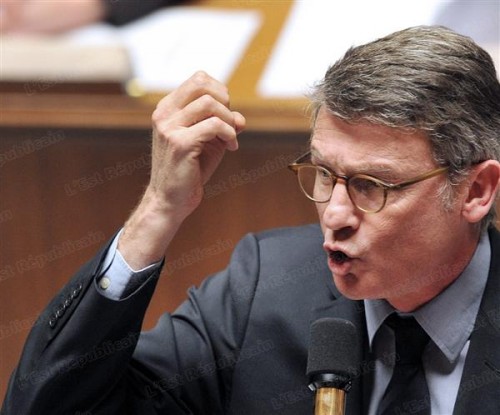
Peillon, prédicateur de la religion révolutionnaire
Voici ce que Vincent Peillon écrivait dans La Révolution française n’est pas terminée, 2008, le Seuil :
« La révolution française est l’irruption dans le temps de quelque chose qui n’appartient pas au temps, c’est un commencement absolu, c’est la présence et l’incarnation d’un sens, d’une régénération et d’une expiation du peuple français. 1789, l’année sans pareille, est celle de l’engendrement par un brusque saut de l’histoire d’un homme nouveau. La révolution est un événement méta-historique, c’est-à-dire un événement religieux. La révolution implique l’oubli total de ce qui précède la révolution. Et donc l’école a un rôle fondamental, puisque l’école doit dépouiller l’enfant de toutes ses attaches pré-républicaines pour l’élever jusqu’à devenir citoyen. Et c’est bien une nouvelle naissance, une transsubstantiation qui opère dans l’école et par l’école, cette nouvelle église avec son nouveau clergé, sa nouvelle liturgie, ses nouvelles tables de la loi.»
Et, le 2 septembre dernier, dans le Journal du dimanche, répondant à la journaliste Adeline Fleury : « Le point de départ de la laïcité c’est le respect absolu de la liberté de conscience. Pour donner la liberté du choix, il faut être capable d’arracher l’élève à tous les déterminismes, familial, ethnique, social, intellectuel… »
Et c’est à l’homme qui veut user de tant de violence révolutionnaire contre nos enfants, celui qui veut les « dépouiller » de toutes leurs racines, celui qui se vante de les « arracher » à leur famille, que M. Hollande, en Président « normal » a confié leur éducation !
Anne Lys
00:09 Publié dans Actualité, Affaires européennes, Ecole/Education, Politique | Lien permanent | Commentaires (0) | Tags : france, vincent peillon, éducation, école, europe, affaires européennes, politique internationale, politique |  |
|  del.icio.us |
  |
|  Digg |
  Facebook
Écrire contre la modernité
00:06 Publié dans Entretiens, Philosophie | Lien permanent | Commentaires (0) | Tags : philosophie, modernité, pierre le vigan, entretiens | | del.icio.us | | Digg | Facebook
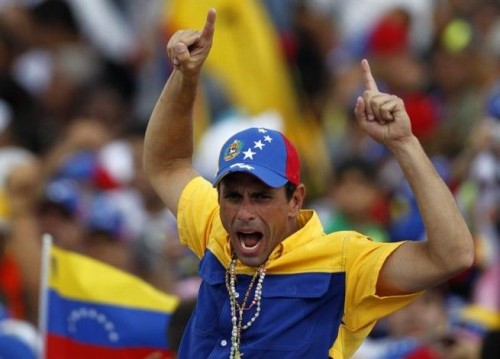
Capriles en zijn C.I.A.-vriendjes zijn duidelijk wat van plan in Venezuela
Dan is er ook nog de economische sabotage, waarbij deze keer vooral het elektriciteitsnetwerk geviseerd werd. Het was zeer opvallend dat, sinds in december Chávez opnieuw naar Cuba moest voor een operatie, het aantal stroompannes beduidend steeg. Na Chávez’ dood, toen het zeker was dat er nieuwe verkiezingen moesten komen, steeg het aantal pannes nog meer. Een duidelijke aanwijzing dat de problemen niet te wijten waren aan het systeem, maar moedwillig veroorzaakt werden. Tijdens de campagne van Maduro was het ook ‘merkwaardig’ dat de elektriciteit uitviel in delen van de steden waar hij sprak, en dat de problemen na zijn vertrek op wonderbaarlijke manier verdwenen. Dit alles opdat de bevolking de regering de schuld zou geven van de pannes. Ondertussen zijn er bewijzen van sabotage en zijn er verschillende daders opgepakt.
En dan is er nog de schaarste van voedingswaren en andere producten die moedwillig veroorzaakt wordt door privébedrijven, die van nature uit aanhangers zijn van Capriles. Het is een tactiek die ze al jaren toepassen: het illegaal opslaan van goederen zodat ze niet in de winkelrekken verschijnen. Opnieuw met het doel dat de bevolking de regering de schuld zou geven. Ondanks de inspanningen van de regering om deze praktijken op te sporen – er werden duizenden tonnen illegaal opgeslagen voedsel ontdekt – bereikte de schaarste toch nog een hoogtepunt enkele dagen voor de verkiezingen.
Hoewel haar tactieken bekend zijn, slaagt de oppositie er toch nog in er munt uit te slaan. We hadden na de verkiezingen verschillende contacten, zowel telefonisch als via de sociale media, met mensen die in Venezuela wonen en kwamen tot de conclusie dat één van de belangrijkste oorzaken van de tegenvallende resultaten de schaarste aan producten is. Velen trappen in de val en beseffen niet dat de schuld gezocht moet worden bij de oppositie. Ze gaan ervan uit dat de schuld bij de regering ligt en besluiten dan uiteindelijk maar om voor Capriles te stemmen."
00:05 Publié dans Actualité | Lien permanent | Commentaires (0) | Tags : politique internationale, venezuela, amérique du sud, amérique latine, henrique capriles, cia | | del.icio.us | | Digg | Facebook
To build a real Eurasia: few juridical ideas
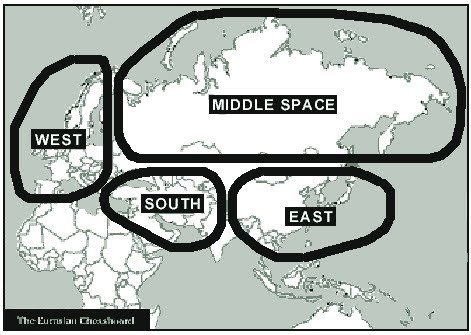
To build a real Eurasia: few juridical ideas
Ex: http://www.geopolitica.ru/
Trying to speak about continental political constructions, we need to understand their limits. Inside all human institutions there is a limit, because the possibility to create something able to satisfy always all interest is impossible.
In this case, we must look to the theories. All of them underline that in the moment when few great people want to introduce big ideas on public debate, a lot of critics will appear, not trying to accept and correct the positive aspects of these activities, but only speaking about the limits (economics, politics, human relations, etc.).
Eurasia is a big idea only if we want to thing to it; more than that – is a big idea if someone will try to explain this to the world. However, the dimension of these continents is huge, and a scientist will see easier the limits of this construction. And, when human society will be prepared, it could be a possibility to create a new European, maybe, after European Union model.
Inside all of these facts, Eurasian idea must be analyzed sine ira et studio (without hate and with morality), and few important aspects are brought by the national legislations and by the people who believe in them. Our text tries to describe some problems of this important equation, between ideas and legal possibilities to fulfill them.
1. The question of Eurasia is an Eurasian question or only a single country question?
Why this?
Because, as always, when we analyze “the political constructions”, we must note the difficulties to have a single vocabulary for every person who have access to the concept – as the main obstacle to construct … something.
Thus, out text will speak about Eurasia. It’s a concept with great socio-politic importance, and – following this idea, we’ll use to describe it two important search engines and its documents, to present “popular” (in fact, public) access to information about the concept.
Google reports 15,500,000 notes about Eurasia, and 8,500,000 to the question: What is Eurasia?
Wikipedia has its own page about Eurasia[1], where it can be read:
a) Eurasia is a continent or super-continent covering about 52,990,000 km2 (20,846,000 mi2) or about 10.6% of the Earth's surface (36.2% of the land area) located primarily in the eastern and northern hemispheres. Physio-graphically, it is a single continent, comprising the traditional continents of Europe and Asia (with Eurasia being a portmanteau of the two); the concepts of Europe and Asia as distinct continents date back to antiquity and their borders are geologically arbitrary. Eurasia, in turn, is part of the yet larger landmass of Afro-Eurasia, whereby Eurasia is joined to Africa at the Isthmus of Suez. Eurasia is inhabited by almost 4 billion people, more than 72.5% of the world's population (60% in Asia and 12.5% in Europe);
b) Eurasia is also sometimes used in geopolitics to refer to organizations of or affairs concerning the post-Soviet states, in particular Russia, the Central Asian republics, and the Transcaucasian republics. A prominent example of this usage is in the name of the Eurasian Economic Community, the organization including Kazakhstan, Russia, and some of their neighbors, and headquartered in Moscow and Astana. The word "Eurasia" is often used in Kazakhstan as the name of the continent or region in which that country is located. Numerous institutions in that country use it in their name, e.g., L. N. Gumilev Eurasian National University, the Eurasian Media Forum, the Eurasian Culture Foundation, the Eurasian Development Bank , or the Eurasian Bank. In 2007, Kazakhstan’s President Nursultan Nazarbayev proposed that a “Eurasia Canal” be built to connect the Caspian Sea and the Black Sea via the Kuma - Manych Depression in Russia, providing Kazakhstan and other Caspian-basin countries with a more efficient access path to the ocean than the existing Volga-Don Canal. This usage is somewhat analogous to the U.S. usage of the term Western Hemisphere when referring to the concepts and organizations dealing with the Americas (e.g., Council on Hemispheric Affairs or Western Hemisphere Institute for Security Cooperation)[2].
These texts are public and very easy to be found by anyone. The last site with great importance for our question (What is Eurasia) is www.eurasiancenter.org, an important site from Unites States of America. We present it here, because today it is considered the US as the single global power, so, we must be concern about the initiatives started from this part of the word.
2. On the other part, the main wisdom in Eurasian problems belongs o both continents – because the common history speaks louder. In the same time, on this big scientific and concept map the main role of debate belongs, naturally, to Russia and to Russian specialists.
In this case, we must note also few ideas:
a) Russia is the country to have the biggest part of its territory on both continents[3][4], but its position is not perfectly favorable to develop a total discourse on Eurasia, because the most emergent part of it is situated in Europe[5];
b) Russia represents a perfect roof for the world – in this case, its Eurasian idea represents a correspondence with a human body with two special arms: the body is settled in northern Siberia, near the Arctic Ocean. In the same time, the arms has a double significance: a left arm who keep a shield in the Asian direction (mainly China – for extension, yellow race people), and the right one, the most efficient and productive, is stretched to the Europe. In this case, we must note something special: the left had defended Europe from the Vladivostok to the Pamir Mountains, and the right one is over the Moscow and Petersburg. So, a logic question: where is situated the sight of Russia? In our opinion, this is settled to a big area, with a fragmented history: Central Asia – Caspian Sea – Black Sea, as always in the history of humanity, from the North (Sever) to the South (Yugo);
c) Eurasia is a new concept for history – it appeared in the 19th century, and only because it was on that time two empires who were important position on both continents: Russian and Turkish one. In this case, we must note an analogy: Christian Russia was opposed to Muslim Turkey on the same logic met after 1945 between Soviet Union and United States;
d) Eurasia is an old concept related to European union, because the unionist ideas on Europe was blocked always by the presence of Muslim Constantinople, and, more than that, by the internal battle between main European land powers (with a “big brother” behind – Great Britain);
e) If Russia is the main territory for this idea, we must note that in the 21st century ideas must be kept by a stronger population[6]; thus – the future of Eurasian ideas in Russia must be accompanied by a better demography.
3. Our opinion about Eurasia is expressed in a very “scholar language” for a correct order of ideas.
Eurasia is a great political concept, but not completes, because the map limits are not always well understand.
Looking to the world map, we must note that the human land is separated between two big parts, understood as Old World and New (Columbus) World. All scientists have a great problem when the want to separate the Old world, because:
a) Western Europe is more or less catholic, protestant or atheist and is strong separated by the eastern Europe (history and economy, mainly after European Union creation;
b) Eastern Europe don’t have a real limit, because Russia is situated on both continents;
c) Southern Europe is presented much more as part of Western Mediterranean Sea;
d) Southern Europe is related – because of Gibraltar and the same sea to Northern Africa;
e) Northern Africa is separated by a big desert (Sahara) to the rest of African continent (which is much richer with mineral resources than the Maghreb and Egypt);
f) Near East or Proche Orient[7] means Turkey (the other state with double Eurasian continental dimension), Caucasus, Jordan river territory and Egypt (a country belonging mainly to another continent (African), with a step in Asia (by territory and history) and ho was occupied and created as modern state by European powers of 19th century;
g) Near East is separated by the main Arabic population and energy resources by another strong desert;
h) Middle East has two important borders (mainly because of history): Central Asia – where the Russian influence is the main actor for the last almost 200 years – and the Chain Mountains Pamir – Himalaya;
i) India is separated by big rivers and big chain mountains to Pakistan (Indus), South East of Asia (yellow race) and China;
j) China is the Middle Empire, with one hand related to the south and with the other one to the north. Today we are not sure where Beijing looks straight: to Pacific Ocean or to Middle East, Russia and India[8] in the same time. Last years show us that both directions are possible; in our opinion, always the middle position obliged the state claiming this position to watch more carefully inside;
k) South East of Asia is related more with Australia, where an important position is kept by the United Kingdom (the same chief of state In Australia and New Zealand);
l) Japan represents – somehow – a padlock for almost all Asian powers with interests of Pacific Ocean: here, the key belong to Washington sea power (on Mahan admiral doctrine).
Thus, we cannot consider that the actual dimension of Eurasia is correct, related with the geography and mainly to the history. Despite all innovative technology, the desert is still a desert, a big chain mountain remain on the same position.
It is true: maritime ships can transport a lot of products (it is very interesting to observe the Chinese offensive in weak Europe’s ports[9]) and pipe-lines create a faster way to transport energy resources, but we must understand another limits:
a) Pipe-lines represent land states, land powers cooperating or in a perpetual competition (the differences between two attitudes is not always clear). In this case, we must note few moments when tensions can create bigger problems, as blocking of oil transport in Ukraine or terrorist attacks on pipe-lines. In the same time, it is very easy to control a pipe-line, because it is stable on the land for kilometers, and no one can pay guards for every 100 meters to have a perfect safety of them;
b) Maritime transport means to control the straits, and for Eurasia there are four very important ones: Skagerrack, Gibraltar, Malacca and the sea in the front of Arabian Peninsula, to control Red Sea and the Persian Gulf. We see here a strong position of United Kingdom, USA and to the sea powers by excellence. Inside this perimeter, there is Bosporus, Suez channel and a lack of military fleet for the “land powers of Eurasia”.
As conclusion: the author believe that Eurasia is a small concept, we need to add here Africa too – minimum the northern part, from French part of Senegal to Bab-el-Mandeb strait near the Ethiopia and Somalia; today Chinese politics introduce in the geopolitical equation whole Africa … and, in our opinion, soon we must be extend with Australia.
In this case, every state must understand its political dimension and its role on the Eur-Asi-African (our tri-continental proposal), named EAA, and to play well its card.
Following this idea, we must note the words of Professor J.L. Granatstein, on April 2011, at the reunion of Canadian Forces College[10]: “can a small or middle power have a Grand Strategy? Former diplomat Daryl Copeland defined Grand Strategy as a unifying, long-term vision of a country’s global values and interests; an expression of where the country is, and where it wants to go in the world; and an analysis of its potential and capacity to achieve its objective. I consider it a core element of statecraft.
That sounds difficult to derive for most nation-states, but to me it does not sound like Grand Strategy, at least not for smaller powers. Smaller countries can fight wars against other smaller powers or maneuvers to avoid them. They can join Great Power alliances or not. They can follow particular economic policies or decide not to. But they do not have Grand Strategies because they lack the human, industrial, and military resources to sustain them. In other words, the God of Grand Strategy is only found on the side of the big battalions. But small countries do have, like every other state, national interests, and their policies are (or should be) focused on advancing or protecting these interests and on their national survival.”
4. If we analyze Eurasia in this dimension, we must express another idea about the legal concept of Eurasia.
Legal concepts exist as it is written. In this scientific branch, words are words, and they cannot be understood in different senses. For any word it is a clear definition and a complex base for any different sense regarding any legal institution[11].
Eurasian is not a concept for legal sciences; we need international treaties to proclaim the existence of this new legal institution. Thus, the author will analyze briefly only few ideas, because the potential for this scientific debate is huge and we don’t have here enough space for it.
First of all, we must underline that inside Eurasia there are many legal systems, with many traditions – to create a real, single and unite Eurasia as concept and political entity, we need to harmonize these differences. For that, we can use only the legal principles, but …
“Although confirmed by Article 38 of the Statute of the International Court of Justice, the idea that there exist general principles of law that are recognized by civilized nations has lost ground in recent years. This fact raises the question of whether such general principles have any order-providing meaning or value beyond the State. If compared to the apparently “natural” systematic structure of state legal orders, the global legal space appears to lack a body of general rules and seems dominated by sectionalism and fragmentation. Indeed, it resembles the medieval legal order, characterized as that was by the simultaneous presence of various legal orders competing with each other. In reality, studies of legal history have led to a different understanding. We now know that that systematic structure was not natural. It was an integral part of a general pattern of morphological transformations undergone by the legal orders of states.”[12]
In this case, we don’t know which legal principles must be fulfilled, because there are many differences between European continental law and religious Islamic law; between Chinese system law and the Britain law. For this debate we can write books, but, of course, in national parliaments it will be a complicate debate, because no one wants to renounce to the history (at least).
Second question: if we want a single Eurasia, where it might be the capital of the state? Any political entity without a center (capital) collapse in less than 5 years: thus, where it must be!
Logics speak: at the middle of the distance, because it is necessary to offer equal access to all persons to all services which are ruled from this big center. So, we can look to Caucasus, maybe to the Near East: Damascus – or Baghdad? … Islamic capital means a different kind of administration of it, because here it was in the last two decades the most important military conflicts – it is need to a new urban architecture, for a capital of almost 4 billion inhabitants!
A lot of new institutions must be settled in this new capital: a Eurasian parliament, which must be able to adopt important, ethic laws, with a great availability for flexible interpretation, because:
a) These laws cannot be applied from the first moments, because it will be a great problem with internal constitution of the states, and with all secondary (administrative) legislation;
b) Looking to European Union constitutional treaty of 2006 and to the Lisbon Treaty of 2007, we can see the huge dimension of the texts[13]: if this it was possible for a group of 27 states with common legal tradition (Roman Empire, in fact), can we predict the legal dimension of a Constitution for Eurasia?
c) In that moment it must be start a global educational change, not only in Law faculties, to understand and to apply new law, but also in every state, because the complexity of changes cannot be seen in one day.
In this context, we have a single question: the loyalty of every person of Eurasia will belong to whom? Because the history never must be forgotten[14]!
Another question is related about the administrative organization of the territory – now, only one big state, but what kind of internal autonomy inside every small part of every state who compose the Eurasian state, because without a strong centralization is impossible to build a functioning state.
The last question is about the justice – where it must be The Supreme Court of Justice? Where it must be The Constitutional Court?
Regarding this; we must note that:
a) How many procedural steps (appeal, recourse and more) a person must do to be judged by the Supreme Court of Justice?
b) How it must be invoked the control from The Constitutional Court?
c) Who are the administrative institutions who shall fulfill the decision of the Eurasian justice? Only one example: in one state a person is affected by the behavior of another state. He claims the state, but this state is too strong to be punishing easily … ca we have equality between states?
Conclusion
In this case, Eurasia is a seductive idea. However, it can be tried to create such a state, but, in our opinion, legal problems are the “big stone”, in front of any political ideas. In fact, we must note the process of negotiations – it is not simple, and, of course, somebody negotiate in a big state, but national parliaments must accept, and, after that, because the dimensions of Eurasia are too big for today human society, it must be approved on referendum by citizens. And today we are not sure about their political opinions …
[2] This description is used at the bottom of the page, so, we can understand the option of the page author (and of a lot people, because this site is created by “everyone”).
[9] In a famous report: Global trends 2025 – A transformed world made by National Intelligence Office (Washington, 2008), there are few observations about Chinese limit of economic development related to export of goods (p. 29 – 31).
[10] J.L. Granatstein: Can Canada Have a Grand Strategy?, Canadian Defence & Foreign Affairs Institute, p. 2 – 3.
[11] E. Balan: Institutii administrative (Administrative institutions), CH Beck, Bucharest, 2008, p. 8
00:05 Publié dans Actualité, Affaires européennes, Eurasisme, Géopolitique | Lien permanent | Commentaires (0) | Tags : politique internationale, eurasie, eurasisme, europe, affaires européennes, géopolitique | | del.icio.us | | Digg | Facebook
Comment naissent les révolutions?
Dominique VENNER:
Comment naissent les révolutions?
C’est un sujet passionnant, très actuel et mal connu que la naissance des révolutions. Il avait été étudié par le sociologue Jules Monnerot (1908-1995) après les événements français de Mai 68 dans son livre Sociologie de la Révolution (Fayard, 1969). Travail précieux pour lequel son auteur a forgé une série de concepts applicables à toutes les situations.
S’agissant d’une étude sociologique et non d’une histoire des idées, Monnerot use d’une seule appellation, sans ignorer bien entendu tout ce qui sépare et oppose les différentes révolutions du XXe siècle, bolchevisme, fascisme italien, national-socialisme allemand, révolution de 1944, ou celle de 1968. Il estime en effet que ces phénomènes de foule relèvent de la même analyse sociologique, tout en faisant une nette différence entre révolutions de type conservatrice et révolutions déconstructrices.
Mais d’abord, Monnerot définit quelques concepts applicables à toute révolution. En premier lieu la « situation historique ». Elle est celle que l’on ne reverra jamais deux fois. C’est vrai pour 1789, 1917, 1922, 1933 ou 1968. Autre notion complémentaire : la « situation de détresse ». Elle se caractérise par des troubles non maîtrisés. La structure sociale se défait : les éléments ne sont plus à leur place.
Quand une société est stable, on y distingue des éléments sociaux normaux (« homogènes ») et des marginaux (« hétérogènes »). Les éléments marginaux sont en marge parce qu’ils y sont maintenus par la pression des éléments « homogènes ». Lorsqu’un seuil critique de bouleversement est atteint, la partie homogène commence à se dissocier. On observe alors comme une contagion de chaos.
Remarque intéressante qui s’applique aux révolutions conservatrices : « l’homogène, même en voie de dissociation, reste l’homogène ». Quand le bouleversement est radical, « du fond même de la société monte une demande de pouvoir ». Le fascisme, en 1922 ou 1933, fut par exemple une réponse à cette demande dans une société ayant un haut développement (industrie, sciences, culture). Dans une telle société, quand l’ordre s’est effondré, les éléments conservateurs (homogènes) deviennent provisoirement révolutionnaires par aspiration à l’ordre et demande de pouvoir.
Comment aboutit-on à une « situation révolutionnaire » ? Réponse synthétique de Monnerot : par carence au sommet. Une crise de régime se caractérise par une « pluralité des conflits ». Tout échappe à l’autorité du pouvoir en place, le désordre devient endémique. La société entre en « effervescence ».
L’effervescence n’est pas la révolution. Elle en est une phase, un moment, avec un début et une fin (un refroidissement) quand le milieu « n’est plus combustible ». Quand l’effervescence retombe, ce ne sont plus les mêmes qui sont aux commandes (Robespierre a été remplacé par Napoléon, Trotski par Staline, Balbo par Mussolini).
Situation révolutionnaire et effervescence font intervenir les « masses ». Ce sont des coagulations momentanées, les troupes des révolutions. Pour diriger les masses, leur donner un système nerveux, les jacobins, puis Lénine (en beaucoup plus efficace) ont conçu l’instrument du parti.
Ce que les léninistes appelaient « la radicalisation des masses », est une tendance à la politisation de catégories jusque-là conformistes et peu enclines à se passionner pour la chose publique (elles demandent surtout à l’État de faire son métier d’État). On entre alors dans une phase d’effervescence, « la société est parcourue en tous sens de réactions affectives intenses, comme les grains de limaille de fer par un courant magnétique ».
Les situations de détresse font apparaître sur le devant de la scène des élites violentes : les « hétérogènes subversifs », des irréguliers et marginaux que les barrières habituelles n’arrêtent pas. Ils contribuent à donner au mouvement sa force de rupture.
Dans une situation révolutionnaire, la carence et le besoin douloureux du pouvoir, peuvent jeter sur la voie de la révolution des éléments sociaux qui n’aspirent qu’à l’ordre. « Une heure vient où les Arditi, les jeunes lansquenets du Baltikum, les réprouvés qui le sont de moins en moins, n’apparaissent plus inquiétants, mais rassurants à la partie la plus homogène de la population. Ils semblent incarner à travers le malheur les valeurs de courage, de bravoure et de caractère sans quoi il n’est pas de grand pays… Même ceux qui ne sont pas leurs partisans pensent qu’il faut laisser faire l’expérience. » C’est un bon résumé des situations historiques d’exception. Mais, comme le précise Monnerot, la « situation historique » est celle que l’on ne revoit jamais deux fois.
Dans la France de 2013, sommes-nous entrés dans une « situation historique » ? Pas encore, bien entendu. Mais des signes attestent que l’on peut se diriger vers une telle situation imprévue. Ira-t-elle jusqu’au bout de ses promesses ? Il est trop tôt pour se prononcer. Mais rien n’est impossible.
Dominique Venner
00:05 Publié dans Nouvelle Droite, Théorie politique | Lien permanent | Commentaires (0) | Tags : jules monnerot, dominique venner, théorie politique, nouvelle droite, révolution, sciences politiques, politologie | | del.icio.us | | Digg | Facebook
Tradition Betrayed: The False Prophets of Modernism
00:05 Publié dans Philosophie | Lien permanent | Commentaires (0) | Tags : philosophie, tradition, traditionalisme, modernité | | del.icio.us | | Digg | Facebook