

mardi, 05 janvier 2016
Cranach d.J. in neuem Licht

Cranach d.J. in neuem Licht
Zum 500. Geburtstag würdigt Sachsen-Anhalt das Werk des großen Meisters in mehreren Ausstellungen
Lucas Cranach der Jüngere, ein bedeutender Maler der Renais-sance, erblickte in Wittenberg das Licht der Welt. Mit der Landesausstellung „Cranach der Jüngere 2015“ feiert Sachsen-Anhalt das Ereignis.
Lucas Cranach der Jüngere wurde am 4. Oktober 1515 in Wittenberg geboren. 500 Jahre später widmet die Lutherstadt dem Maler bis zum 1. November mit der Landesausstellung Sachsen-Anhalt 2015 das bis dato umfassendste Bild über sein Leben und Werk und gibt der Cranach-Forschung damit neuen Schwung.
Nach dem frühen Tod seines älteren Bruders Johannes, genannt Hans, 1537 wurde Lucas d. J. der designierte Chef der Werkstatt seines Vaters Lucas Cranach der Ältere, den die Malerei schon zu Lebzeiten nicht nur reich, sondern auch zum „Star“ gemacht hatte. Nach dem endgültigen Weggang des Vaters aus Wittenberg im Juli 1550 ging die volle Verantwortung für den Betrieb noch vor dessen Tod 1553 in Weimar auf ihn über.
Dieses Datum ist wichtig, da von da ab die Zuschreibung an Lucas d.J. eindeutig ist, wobei das Problem der Scheidung der Hände in dem schablonenhaften Werkstattbetrieb mit seinen zahlreichen Angestellten natürlich bleibt. Zum Verständnis der Cranach-Zeit gehört, dass sich das eigenständige Künstlerprofil der „Marke“ Cranach unterordnete. Denn Vater Lucas hatte etwas geschaffen, was im damaligen Reich einzigartig war: die Entwicklung eines spezifischen Stils, der es ihm ermöglichte, die vielen Aufträge bei gleichbleibend hoher und nahezu einheitlicher Qualität mit einer großen Schar von Gesellen und Hilfskräften zu bewältigen.
Lucas d.J. mag das ähnlich gesehen haben. Denn ein autonomes Selbstbildnis von ihm gibt es (bisher) nicht. Entsprechend sind die vielen hundert bekannten Cranach-Werke in der Regel nur mit dem Werkstattzeichen signiert: der geflügelten Schlange. Nur zwei kleine Bilder in der Ausstellung besitzen daneben die Initialen der Brüder Hans und Lucas d.J.
„Kein anderer mit einem Fürstenhof (hier: Kurfürst Friedrich der Weise von Sachsen) in vertraglicher Bindung stehender Werkstattbetrieb konnte im damaligen Reich vergleichbare Umsätze und Gewinne tätigen ...“, ist im Katalog zu lesen. Dass es dem jüngeren Cranach gelang, diese produktive Werkstatt mit unvermindert hoher Qualität erfolgreich fortzuführen, wird daher bei seinem Begräbnis 1585 auch besonders gewürdigt.
Dennoch, da ist sich die Kunstgeschichte schon länger einig, gelang es dem Jüngeren vor allem als Porträtist sein eigenes künstlerisches Talent zu zeigen, indem er das von seinem Vater entwickelte und immer weiter stilisierte Porträtschema durch lebensnahe Charakterstudien ersetzte. Das Bildnis seines Vaters von 1550 ist dafür vielleicht das bekannteste Beispiel.
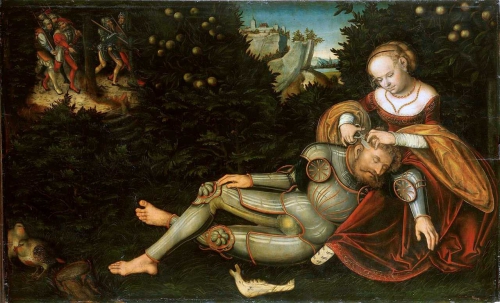
Mit der Präsentation der Porträtstudien von 13 sächsischen Fürsten und ihren Verwandten aus dem Musée des Beaux Arts in Reims ist den Wittenberger Kuratoren ein Coup gelungen, der den Titel der Ausstellung „Entdeckung eines Meisters“ rechtfertigt. Nur ein einziges Mal wurden die großartigen Zeichnungen bisher als geschlossenes Konvolut ausgestellt: 1951/52 in den USA. Ansonsten waren immer nur einzelne Blätter zu sehen. Dass sie jetzt am Standort ihrer Entstehung vollständig bewundert werden können, ist der Höhepunkt der Landesausstellung.
Zehn der Blätter sind um 1540 entstanden, drei werden auf die Zeit um 1545/1550 datiert. Nach neuesten Forschungen stammen sie alle von Lucas Cranach d.J. Die Zeichnungen gehörten einst zum Fundus der Cranach-Werkstatt, die damit über das Bildnis-Monopol der sächsischen Fürsten verfügte und so jederzeit neue Aufträge oder Nachbestellungen schnell und einfach erledigen konnte.
Der französische Miniaturmaler Jacques Philippe Ferrand hatte die Blätter 1687 auf einer Deutschlandreise von einem unbekannten Sammler erworben. Als sein Sohn Antoine Ferrand de Monthelon 1748 in Reims eine Zeichenschule ins Leben rief, wurden sie zum Lehrmaterial für seine Schüler. Mit seinem Nachlass kamen sie in den Besitz der Stadt Reims und bildeten den Grundstock des neu gegründeten Museums der Schönen Künste.
Als sie 1770 erstmals inventarisiert wurden, stufte man sie als „Köpfe von Albert (sic!) Dürer“ ein. Bald jedoch wurden sie auf einem Speicherboden des Rathauses ausgelagert und erst 1853 wiederentdeckt. Nach der Restaurierung (Doublierung) ordnete man sie Hans Holbein zu. Erst 1881 erkannte der Museumskustos Charles Loriquet in ihnen Blätter der Cranach-Werkstatt, von denen er zehn dem älteren Cranach und drei dem Sohn zuschrieb. Auch das 20. Jahrhundert bescherte den Zeichnungen – kriegsbedingt – ein wechselvolles Schicksal. Erst 1921 kehrten sie endgültig ins Reimser Museum zurück.
Mit insgesamt 120 Werken von über 60 internationalen Leihgebern widmet sich die Landesausstellung im frisch sanierten Augusteum direkt neben dem Lutherhaus vielen Aspekten, bleibt aber überschaubar. Den Anspruch auf eine vollständige Werkschau erhebt sie nicht. Dafür bieten sich die beiden authentischen Außenstellen am Anfang von Wittenbergs historischer Meile, der rund 1000 Meter langen fast schnurgeraden Hauptstraße durch die Altstadt – beginnend mit der Schlosskirche, an dessen Tür Luther seine 95 Thesen schlug, und endend am Augus-teum und Lutherhaus – als Ergänzung an.
Nach nur wenigen Minuten steht man vor den beiden stattlichen Cranach-Höfen Schlossstraße 1 und Markt 4. In letzterem, dem Geburtshaus von Lucas d.J., betritt man „Cranachs Welt“ und erhält einen Ein- und Überblick über die Familiengeschichte – sie verbindet sich angeblich sogar mit Goethe –, die Themen und Motive der Cranach-Werkstatt und den Werkstattprozess.
In „Cranachs Kirche“ St. Marien, der weltbekannten Predigtkirche von Martin Luther und Grabstätte von Lucas d.J., wurden die Cranachwerke im Chor für die Ausstellung aufwendig restauriert. Allen voran der große Reformationsaltar von 1547/48, von dem ein Film in der Sakristei das Vorher und Nachher zeigt. Besonders interessant ist dabei die neue Farbigkeit, die sich nach der Reinigung dem zarteren Kolorit des Jüngeren annähert und damit auch ein neues Licht auf das cranachsche Gesamtwerk wirft.
Angeschlossen sind die Schauen „Cranach in Anhalt. Vom alten zum neuen Glauben“ im Johannbau in Dessau und „Cranach im Gotischen Haus in Wörlitz“ im Wörlitzer Park. Zudem gibt es Korrespondenz-Projekte in ausgewählten Cranach-Kirchen der Region. Helga Schnehagen
Öffnungszeiten: Wittenberg Augusteum Montag bis Sonntag 9 bis 18 Uhr; St. Marien Mo bis Sonnabend 10 bis 18, Sonntag ab 12 Uhr; Cranach-Haus Montag bis Sonntag 10 bis 18 Uhr; Dessau Johannbau Dienstag bis Sonntag 10 bis 17 Uhr; Wörlitz Gotisches Haus Dienstag bis Sonntag 11 bis 17 Uhr. Internet: www.cranach2015.de
00:05 Publié dans art, Evénement | Lien permanent | Commentaires (0) | Tags : lucas cranach le jeune, art, allemagne, exposition, événement, wittenberg |  |
|  del.icio.us |
  |
|  Digg |
  Facebook
On left-wing Germans

Black and Blonde
On left-wing Germans
By Linh Dinh
Ex: http://www.lewrockwell.com
Nowadays, the United States exports almost nothing but weapons, noises, images and attitudes, and among the last, the black ghetto, keeping it real, thug, gangsta life is being gobbled up eagerly by millions all over, from Jakarta to Istanbul, to Berlin. White, yellow or brown, many pose enthusiastically as dwellers of the American black ghetto.
Their fantasy makeover is derived entirely from music videos and Hollywood films. In East Germany, the catalyst was Beat Street, one of the first hip-hop movies. Released in 1984, it was shown in East Germany merely a year later. Communist censors deemed it an indictment of Capitalism and the United States. To East German youths, however, it provided a mental escape from their Communist confinement. By spraying graffiti and break dancing, they could imagine themselves as living beyond the Iron Curtain.
Germany’s fascination and identification with American minorities started with the American Indian, whom many Germans still admire for his purity, simplicity and toughness. There is a saying, “An Indian feels no pain.” “Ein Indianer kennt keinen Schmerz.”
Just as the Germanic chieftain Arminius resisted Rome, defeated it in 9AD, the Amerindian is seen as a heroic warrior against much superior force. He’s also the antidote to the white man’s corruptions. Of course, Germany is still very white and, in many ways, the epitome of white civilization. Nevertheless, there is a longing among many Germans, at least occasionally, to strip away the deforming gown of civilization and be savage. Pagan impulses tug at the brand name underpants of each German.
Since the Amerindian is the ideal man, his society must be perfect, or nearly so. A most curious German, Christian Prieber, even had a plan to turn a Cherokee settlement into Utopia. Born in Saxony in 1697, Prieber was chased out for his subversive ideas, so he fled to England, leaving behind his wife and children. In 1735, Prieber arrived in the New World. After brief stops in Savannah and Charleston, Prieber ended up by 1736 in Great Tellico, a Cherokee town in present-day Tennessee. Accepted into their community, he quickly became their counselor. Prieber’s residence with the Cherokees ended after seven years, however, when he was arrested by the British. Accused of being an agent for the French, Prieber died in jail a year later.
Ludovick Grant, an English trader, described the prisoner, “he is a very extraordinary Kind of a Creature; he is a little ugly Man, but speaks almost all Languages fluently, particularly English, Dutch, French, Latin and Indian; he talks very prophanely against all Religions, but chiefly against the Protestant; he was setting up a Town at the Foot of the Mountains among the Cherokees, which was to be a City of Refuge for all Criminals, Debtors, and Slaves who would fly thither from Justice or their Masters […] being a great Scholar he soon made himself master of their Tongue, and by his insinuating manner Indeavoured to gain their hearts. He trimm’d his hair in the indian manner & painted as they did going generally almost naked except a shirt & a Flap. He told these people that they had been strangely deluded, that they had been tricked out of a great part of their Land by the English […] He proposed to them a new System or plan of Government, that all things should be in common amongst them, that even their Wives should be so and that the Children should be looked upon as the Children of the public and be taken care of as such and not by their natural parents […] that they should admit into their Society Creeks & Catawbaws, French & English, all Colours and Complexions, in short all who were of these principles […] He enumerates many whimsical Privileges and natural Rights, as he calls them, which his citizens are to be entitled to, particularly dissolving Marriages and allowing Community of Women, and all Kinds of Licenciousness […] it is a Pity so much Wit is applied to so bad Purposes.”
There is no evidence the Cherokees went along with Prieber’s social engineering, though they did accept his practical advices on how to deal with the treacherous and exploitative white man. He also taught them English measurements of distance and weight. An enemy of private property, organized religion and the nuclear family, Prieber was a Communist before his time. His gravitation towards the Cherokees is further proof of his rejection of Western Civilization. The Indians also provided him with a more malleable clay, he thought, to sculpt his Utopian masterpiece.
 The more one identifies with the primitive, the more one rejects the elaboration and refinement of advanced civilization. Germans are among the most civilized, and I don’t measure that by bombastic monuments, but by the subtlest civilized gestures. Outside the entrance of a shopping mall toilet, I noticed management had left bowls of water and dog food, and inside each bathroom stall at my university, there is a toilet bowl scrubber to use if necessary. Germans also rarely jaywalk or litter. Of course, they have also produced guys with names like Bach, Beckmann and Sebald. I work on Beethoven Street. Hey, rambling schmuck, and what about dudes with names like Mengele, Heydrich and, uh, Hitler?! I’m talking about civilization’s forms, not its moral contents. Except when they go berserk, Germans are among the most domesticated. In this, they resemble the Japanese. Both have been superbly toilet trained.
Urbanized and cultured, Germans miss their earthier, more savage selves, and this persistent longing has surfaced in movements such as Wandervogel [Wandering Bird], Völkisch [Folksy] and Blut and Boden [Blood and Soil], the last of which painted the Jew as a degenerate, urban egghead, and the true German as a rigorous, pure and timeless being that’s dirt coated, sun-splashed and wind lashed, not unlike an American Indian. In the 70’s, some German anarchists dubbed themselves Stadtindianer, or Urban Indians. (They were modeled after an Italian group, Indiani Metropolitani. “We have unearthed the battle ax!” went a rallying cry. “Abbiamo dissotterrato l’ascia di guerra!”)
With the advent of hip hop, German malcontents have a contemporary role model. Instead of the mythical American Indian, they can now mimic American ghetto blacks, as purveyed by Hollywood. In Beat Street, there are many panoramas of the South Bronx, with its abandoned homes, garbage and graffiti. With no such slums, Germany didn’t look quite gritty or cool enough, so the ghetto had to be willed into being. So far, German graffiti sprayers, window breakers and litterers are only partially successful, but give them time. They’ll get there.
Leipzig’s most ghetto-like neighborhood is Connewitz, and it’s not because poor people live there, but because it’s a stronghold of Communists and Anarchists. There’s hardly a building that’s not repeatedly marred by spray paint, and most of the graffiti are free of political contents. It’s just vandalism. Defending it, a young female Leipziger explained to me, “They don’t really care about private property.” All of the mom and pops that make up the majority of Connewitz businesses must be repainted constantly. That this is such a huge waste of manpower and resources doesn’t bother the “green” progressives of Leipzig.
On December 12th, 2015, the left went violent when less than a hundred rightists marched through Connewitz. A thousand Communists, Anarchists and other self-proclaimed militants hurled stones and bottles, set fires, injured 69 cops, damaged 50 police vehicles and broke scores of windows in their own neighborhood. Banks, including local credit unions, were particularly targeted. As an indication of the German police’s restraint, none of the raging leftists were hurt, though 23 were arrested.
I walked through Connewitz the next afternoon. Seeing all the broken windows, I could easily picture a day when all of these businesses would be forced to evacuate, leaving this once lovely section to resemble the menacing and dismal black ghetto of the hip German rebel’s fantasy. You can’t be oppressed if you don’t dwell in the ghetto.
Rap has gone a long way since Beat Street. Though it is a diverse form, its most salient characteristic is aggression. One doesn’t even need to understand the lyrics to grasp this. With its extreme narcissism, glorification of violence and contempt for women, quite a bit of rap is also against any civilization, not just the white man’s. Other musical genres, such as punk and heavy metal, also flaunt anti-social attitudes, but they don’t have the circulation of rap, and some of their worst practitioners aren’t international icons.
Ya, ya, I’m just an old head who don’t know nothing about creativity. I’ve never heard of Blumio, the Japanese-German who fillets and fish wraps the news in rhymes, and I ain’t got no appreciation for the exhilarating, rapid-fire flow of Samy Delux when he claims, quite rightly, of course, that he’s Germany’s best poet, “Ich bin so Schiller, so Goethe / So bitter, so böse / Noch immer der größte / Poet der hier lebt.” “I’m so Schiller, so Goethe / So acerbic, so wicked / Still the greatest / Poet who lives here.”
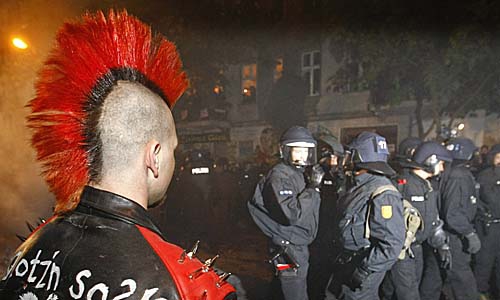 One of the earliest German hip hop albums was called “Krauts with Attitude,” a clear nod to N.W.A., “Niggas with Attitude.” N.W.A. has become very mainstream, of course, as attested by the 2015 release of Straight out of Compton. Around Leipzig, I now see stickers and posters of seven masked German militants, under the heading “STRAIGHT OUT OF CONNEWITZ.”
With their hatred of the state, nation and law and order, German leftist radicals see American ghetto blacks, as portrayed in movies, music videos and newscasts, as kindred spirits. Of course, they have no familiarity with ordinary black folks who go to work and church, and cherish quite traditional values. Seeing blacks rioting in American cities, these Germans cheer and look forward to doing the same. Hating not just the worst aspects of civilization, but nearly all of it, they just want to tear everything down, for Utopia, you see, is just beyond the blood red horizon.
In Berlin, there’s a graffiti of a black man pointing a gun, “HANDS UP.”
In Leipzig, there’s a painted silhouette of a man hovering over an upturned skateboard, with a balloon tied to his wrist, “KILL COPS.”
In Leipzig, one end of a bench has, “NO BRAIN.” The other end, “HATE COPS.”
All of the anti-cop graffiti I’ve seen in Germany are written in English, by the way. This is only appropriate since many of these radicals’ firmest and most up-to-date beliefs have also been imported from the USA. Even the slogans are often the same, i.e., “NO MAN IS ILLEGAL.” Believing themselves so progressive, they’re actually just puppets of the empire. No Arminiuses, they’re bit players in Rome’s master scheme. Media masturbated, they’re preparing their own kind for rape.
The Best of Linh Dinh
Linh Dinh [send him mail] is the author of two books of stories, five of poems, and a novel, Love Like Hate. He’s tracking our deteriorating socialscape through his frequently updated photo blog, Postcards from the End of America.
creativecommons.org
Previous article by Linh Dinh: Turkey’s Weasel Problem
00:05 Publié dans Actualité, Affaires européennes | Lien permanent | Commentaires (0) | Tags : gauche, gauches allemande, s allemagne, europe, affaires européennes | | del.icio.us | | Digg | Facebook
Bernard Lugan sur les crises saharo-sahéliennes
Conférence de Bernard Lugan sur les crises saharo-sahéliennes
Conférence donnée le 19 janvier 2015 au Centre Les diguières par le professeur Bernard Lugan sur les crises saharo-sahéliennes.
Africaniste, Bernard LUGAN est expert devant le TPIR (Tribunal
pénal international pour le Rwanda), professeur à l'Ecole de Guerre
et aux Ecoles supérieures militaires de Saint-Cyr Coëtquidan.
Il dirige la revue par internet « l'Afrique Réelle».
De la Libye au Nigeria et du Mali à la Somalie, l'arc de crise saharo-sahélien fait peser de très graves menaces sur toute l'Afrique de l'Ouest et sur l'Afrique du Nord. Ces crises sont d'abord des résurgences de conflits anciens aggravés par la modernité. Dans cette situation quelle pourrait être la stratégie de la France ?
http://bernardlugan.blogspot.fr/
00:05 Publié dans Actualité, Géopolitique | Lien permanent | Commentaires (0) | Tags : sahel, sahara, afrique, affaires africaines, géopolitique, politique internationale, bernard lugan | | del.icio.us | | Digg | Facebook
Laurent Ozon fait le point sur radio Courtoisie
Laurent Ozon fait le point sur radio Courtoisie dans le libre journal de Martin Peltier
00:05 Publié dans Actualité, Politique | Lien permanent | Commentaires (0) | Tags : actualité, laurent ozon, france, politique | | del.icio.us | | Digg | Facebook