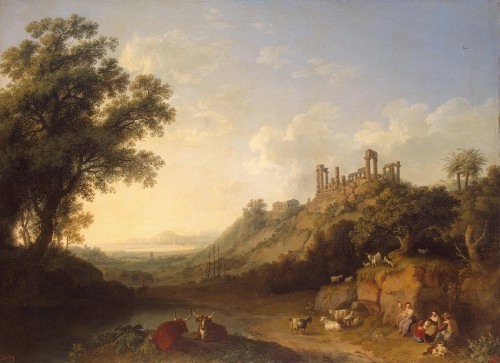
Ernst Jünger’s “Sicilian Letter to the Man in the Moon”
Ernst Jünger
Ex: http://www.counter-currents.com/
Translated by Andreas Faust
1.
Greetings you magician and friend of magicians! Friend of solitaries. Friend of heroes. Friend of lovers. Friend of the good and the bad. Knower of nighttime secrets. Tell me: where there is a knower — is there not already something more than can be known?
I still remember the hour when your face appeared in the window, large and terrible. Your light fell into the room like that ghostly sword which freezes all motion when drawn. Rising over the wide realms of stone, you see us slumbering close together with pale faces, like the countless white pupae which rest in the corners and corridors of ant cities, while the night wind roams through vast fir forests. Do we not appear to you like creatures of the deep — submerged in abysses of the sea?
My small room, too, appeared submerged — the room where I had sat up in bed, immersed in a solitude too deep to be broken by men. Things stood silent and motionless, in a strange light, like the sea creatures one glimpses beneath a curtain of algae on the ocean floor. Did they not appear mysteriously changed — and is change not the mask behind which the secret of life and death conceals itself? We all know these moments of uncertain expectation when one feels the voice of the unknown near, and listens for it to resound, and when the hidden conceals itself only with difficulty in every form. A crackling in the woodwork, the vibration of a glass, over which an invisible hand seems to brush — just as space itself is charged around the exertions of a being who hungers for sense, and who can catch its signals!
Language has taught us to hold Things in contempt. Grand words are like a grid stretched across a map. But isn’t a single fistful of earth greater than an entire cartographic world? Once, the whispering of nameless forms still had an urgency. There are signs scrawled on broken down fences and crossroad posts, which the burghers carelessly ignore as they pass. But the tramp notices — indeed, he knows a great deal about them. To him they are a cipher in which the essence of an entire district is revealed — its dangers and securities.
The child, too, is such a tramp, who only recently wandered through the dark gate which separates us from our timeless homeland. The child still understands the language of the runes of Things, which tell of a profound brotherhood of essences.
2.
I feared you in those days, as a being of malignant, magnetic power, and believed one could never stare directly into your full, gleaming radiance without being robbed of gravity, and sucked irresistibly into empty space. Sometimes I dreamt I let my caution slip, and saw myself in a long, white shirt, devoid of will, like a cork on a sinister flood tide, driven high above a landscape in whose depths lurked nightshade forests, and where the roofs of villages, castles, and churches glimmered like black silver — the sign language of a threatening geometry, directly apprehensible to the soul.
On such dream journeys my body was completely rigid. The toes were curled, fists closed, and the head bent back. I felt no fear — just a feeling of inescapable loneliness in a deserted world, governed mysteriously by silent powers.
3.
How this image later changed under the influence of the northern lights, whose first penetration of the fiery and proud heart was like a raging fever. There comes a time when one feels ashamed of one’s frenzied ecstasies, and another time when one again accepts them. Nor would one wish to have gone without the ecstasy of reason in its utmost excess, because in every triumph of life containing an absolute — in every enlightenment deeper than enlightenment — there too hides a spark of the eternal light and a shadow of the eternal darkness.
Dark assault on the infinite! Should a courageous heart be ashamed to be party to it? Military solitude of the siege tunnels, as seconds and millimetres pass; powerful front lines of the trenches in no man’s land, equipped with the strict mathematics of ramparts and sentry posts, with sparkling machines and fantastic instruments!
The idea willingly remains at that border where number dissolves into symbol, willingly revolves around both symbolic poles of the infinite, atom and star, and loves nothing more than taking booty on the battlefield of endless possibility. Was there any sorcerer’s apprentice who didn’t stand once behind the artificial predatory eye of the telescope, moved by the operation of silent clocks in cosmic trajectories, which never once belonged to the bustling crowd of psychologists?
Here danger looms, and he who loves danger loves to answer for it. He wants to be attacked with greater ferocity, so he can answer more ferociously in return. Light is more obscure by day than by night. He who has tasted doubt is certain to go beyond the frontiers of lucidity in search of the miraculous. He who doubted once must doubt still more, if he wishes to avoid despair. Whether one was capable of seeing a number or sign in the infinite — this question is the last and only measure to which a mind of this type will reply. But for each the position is another that he must win to be capable of deciding. Happy is that simplicity which knows not these forked paths — yet a wild and manly joy blooms on the edges of precipices.
In any case, was it not surprising to learn that behind the man in the moon, a light- and shadow-play was concealed, of plains, mountains, dried-up seas and extinct volcanoes? Here the strange suspicion of Svidrigajlov entered my mind — the suspicion that eternity is only a bare, whitewashed chamber, whose corners are inhabited by black spiders. One may enter . . . and that is all there is to eternity.
Yes, and why not? What is the air to one who breathes it? What does he care for the beyond when it gives him nothing that is not beyond as well?
A new topography is required.
4.
The drill thinks in a different way to the pincers, which grip one point after another. Its thread cuts broadly through several layers in the material, but through all the many points it touches in spiral motion, it is the tip which gives direction and energy to the thrust.* This relationship between chance and necessity, which do not exclude each other, but are mutually dependent, is also inherent in the words and images of a language, which claim to be the sole and final possibilities of understanding. Every word turns on an axis, which itself is incapable of containing words. The language I dream of must be comprehensible, or completely incomprehensible, until its last letters, as the expression of a great isolation which alone makes possible the highest love. There are crystals which are transparent solely in one direction.
But are not you yourself a master who knows how to put his riddle elaborately, that riddle of which only the text, not the solution, is communicable – just as the hunter sets his snares with great care but must then wait for a beast to stumble into them?
The solution itself is not important – only that the riddle is seen.
* “The motion of the screw, crooked and straight, is one and the same.” – Heraclitus
5.
You know how life is at the edges of dark forests: the gardens, lighted islands in the glow of lanterns, encircled by a magical whirling of music. You know the couples who lose each other silently in the darkness; your light meets their faces like pale masks, while lust accelerates their breathing and fear stifles it. You know the intoxicated ones who break out of the thicket.
You rose large over the thatched houses along the river, on that June night when one of your apprentices entered into closer brotherhood with you. The festive table was placed on the trampled threshing floor, and the weapons and red caps gleamed in the tobacco smoke on walls lined with fir twigs. Where now is the youth who so soon afterwards broke the secret seal of death, whose tidings were already prepared for him? He was there once, and is there evermore. How the first ecstasy pulls the heart like sails! Did you not love him as he sank for the first time in the depths, where elemental spirits mightily exalted power? Are there not hours when one is beloved by everything, like a flower who blossoms in wild innocence? Hours when from sheer excess we are shot like a projectile along the paths of habit? Only then do we begin to fly, and only in uncertainty is there a high objective.
I follow him with my eyes as if it had been today, for some experiences have a validity which eludes all laws of time. When wine’s fire melts away the growth rings which have yearly encircled this strange and wondrous heart, we discover in our depths that we have remained the same. O memory, key to the innermost forms contained in people and experiences! I am certain that you yourself are contained in the dark, bitter, intoxicating wine of death as the last and decisive triumph of Being over Existence. I greet you above all, you solitary revellers who keep your own company at table, and time and time again raise a glass to yourselves! What are we, other than mirror images of ourselves? And where we sit with ourselves in pairs, then the third one, God, is never far.
I see your protégé as he appears from a raging cloud of noise, before the low doors, over which the thin white horse’s skull gleams in the night light. The warm air, laden with the pollen of grasses like narcotic gunpowder, creates a wild eruption which drives him crying blindly into the silent landscape. He ran along the crest of the high wall bordering the meadows, and fell, oddly enough without pain, down into the thick grass. Further along the course turns to the feeling of a power, which seems to be nourished by unlimited resources. The large white umbrels gliding by like alien signals, the scent of a hot, fermenting earth, the bitter haze of the wild carrots and spotted hemlocks — all these like the pages of a book which opens of its own accord, in which eternally deep, miraculous relationships are described. No more thoughts whose properties melt darkly into each other. The nameless life will be greeted exultantly.
He penetrates the wide belt of reeds in the stream’s midst. Gases bubble up from the mud. The water embraces the glowing breast as if it had arms, and the face glides away along the dark mirror of the river. In the distance a weir thunders, and the ear, which has come near to the primeval language, feels dangerously enticed. The stars glimmer upwards from bottomless depths, and when the water swirls and eddies they begin to dance.
On the other bank the forest opens up; its thickets trap life, threateningly and in tangled lines. The roots spread their intertwining patterns of threads and tendrils, and the branches weave themselves into a net, in whose seams a swarm of faces move and change. Over the tops of the trees lattices of blind generative power intersect, their forms giving birth to both enmity and destruction, and the foot throws up the soft mist of decay where life dully mingles with death.
Then the clearing breaks open, and your light falls into the darkness like an excommunication of law. The trunks of the beech trees gleam like silver, the oaks like the dark bronze of ancient swords. Their crowns emerge in a powerful structure. The smallest twigs and the last blackberry stalks are touched by your light, unlocked and interpreted, and at the same time surrounded – struck by a great moment which makes everything significant and which chance surprises on its secret paths. They are part of an equation whose unknown symbols are written with glowing ink.
How the simple lines of the homeland are hidden even in the most intricate landscape! Happy allegory, in which a deeper allegory is embedded.
6.
What sustains us, if not the mysterious ray of light which sometimes flashes through the inner wilderness? People wish to speak, however imperfectly, of that which to them is more than human.
The attempts of science to contact distant stars are an important characteristic of this age. Not only the endeavour itself, but also its technical methods provoke a strange mixture of soberness and imagination. Is it not an astonishing proposal to draw with navigational lights the right-handed triangle of Pythagoras and its three quadrats over an expanse of the Sahara Desert? What does it matter to us whether a mathematician exists somewhere in the universe! But here is a living feature that calls to mind the language of the pyramids, an echo of the sacred origin of art, of the solemn knowledge of creation in its hidden meaning — with all conditions of abstract thought brought into harmony, and the devices of modern technology disguised.
Will the radio signals we hurl into the bottomless depths of icy space ever be received, this transformation of languages (whose boundaries lay in earthly mountains and rivers) into an electrical pulse which announces itself all the way to the borders of the infinite? Into which language will this translation be translated?
Wondrous Tibetans, whose monotonous prayers ring out from the cliff-top monasteries of the observatories! Would anyone wish to laugh at prayer wheels who was familiar with our landscapes, with their myriad of revolving wheels — those fierce agitations which move the hour hand of the clock and the furious crankshafts of aeroplanes? Sweet and dangerous opium of velocity!
But is it not true that in the innermost centre of the wheel stillness lies hidden? Stillness is the proto-language of velocity. Through translations one would like to see the velocity increase — all these increases can only be a translation of the proto-language. But how is man supposed to understand his own language?
See, you glance down over our cities. You saw many other kind of cities before them, and will see many others yet. Every individual house is well furnished and built for its own special purpose. There are narrow, winding streets established seemingly by chance in the course of time, just as the the fields of a farming area are divided according to long-forgotten inheritances. Other streets are straight and wide, their alignments determined by princes and master builders. The fossilizations of eras and races fit into each other in many different ways. The geology of the human soul is a special science. Between the churches and government buildings, villas and tenement houses, bazaars and entertainment palaces, train stations and industrial zones, life spreads out its cycles; the circulation is significant, solitude exceptional.
From so great a height, however, this vast store of organic and mechanical powers takes on another picture. Even an eye which observes it through the most powerful telescope could not fail to notice the difference. Indeed, the things do not actually change for that which stands over them, but rather present a different side. It is no longer the case that churches and castles are a thousand years old and warehouses and factories the products of yesterday; for something emerges that one could call their pattern — the common crystalline structure, in which the raw material has condensed. Even the vast diversity of goals and movements which they give rise to, the eye no longer takes as true. Down there are two people, who hurry past each other, two worlds in themselves, and one part of the city can be further from another than the north pole is from the south. But from yourself outwards, you who are a cosmic being and yet still a part of the earth, everything is perceived in its stillness, just like the separation whereby this life has taken form out of volcanic ferment and volatile liquids. O marvellous drama, time after time, as form upon form arises through the difference and hostility of eras and regions! This is what I call the deeper fraternity of life, in which every enmity is included.
For us down here, however, it is rarely permitted to see the aim fused with the meaning. And perhaps our highest endeavour is that stereoscopic glance which comprehends things in their more hidden, more dormant physicality. The necessary is a special dimension. We live in it, and as yet are only capable of beholding its projections in significant beings. There are signs, allegories and keys of many kinds — we are like the blind man who, while he can’t see anything, still feels the light in its vaguer quality — as warmth.
Is it not also the case that the blind man’s every movement takes place in what for a seeing eye is the light, although he himself is shrouded in eternal darkness? We never saw our face in more timeless mirrors. But so, too, do we speak a language whose significance is incomprehensible to us ourselves — a language of which every syllable is both transitory and immortal. Symbols are signs, which nevertheless give us consciousness of our values. They are first of all projections of forms from a hidden dimension, then, too, searchlights through which we hurl our signals into the unknown in a language pleasing to the gods. And these mysterious conversations, this chain of miraculous efforts from which the core of our history exists, which is a history of the battles of men and gods – - – : they are the only things which make learning worthwhile for humanity.
7.
True comparison, that is, the contemplation of things according to their location in necessary space, is the most marvellous method of the protective art. Its base is the mutual expression of the essential, and its peak the essential itself.
This is a kind of higher trigonometry, which deals with the mass of invisible fixed stars.
8.
I climbed on this radiant morning in the ravines of Monte Gallo. The red-brown earth of the gardens was still moist with dew, and under the lemon trees stood the red and yellow blossoms of the Sarazenenfrühlings like the pattern of an oriental rug. There, where the last leaves of the opuntias peered naked and curious over the reddish wall, were mountain pastures, towered over by cliffs and overblazed by yellow perennial spurges. Then the path led through a narrow valley carved from barren rock.
I do not know, and will not attempt to describe, how in the middle of these walls the insight emerged to me that a valley like this grasps the wayfarer more urgently with its stony language, as if a pure landscape were possible, or, put differently, a landscape like this one had deeper powers at its disposal. It probably never had awareness of rank, which would have been unclear to it, and in fact such moments are rare, when one recognises an ensouled life prevailing in nature from a physical expression of this life standing directly opposite. Yes, I believe it has again become possible in recent times. But it was just such a moment that surprised me in this hour — I felt the eyes of this valley resting on me with complete affection. Put differently: it was beyond doubt that this valley had its demon.
Straight away and still in the frenzy of discovery my gaze fell on your already very pale disc, which hovered close over the crest and could probably only be seen looking up from such depths. There rose again, in a strange flashing birth, the image of the man in the moon. Certainly, the lunar landscape with its rocks and valleys is a surface formulated by astronomical topography. But it is just as certain that, at the same time, it is available to that magical trigonometry of which we have spoken — that at the same time it is a region of spirits, and that the fantasy which gave it a face understood the primordial language of runes and the speech of demons with the depths of the childlike gaze.
But the incredible thing for me in this moment was to see both these masks, of one and the same Being, melt inseparably into each other. Because here for the first time an agonising conflict resolved itself, which I, great-grandson of an idealistic, grandson of a romantic, and son of a materialistic race, had hitherto regarded as irreconcilable. It didn’t exactly happen that an Either-Or metamorphosed into an As-Well-As. No, the real is just as fantastical as the fantastical is real.
That was the wonderful thing which delighted us about the doubled images we observed through the stereoscope as children: In the same moment in which they melted together into a single picture, the new dimension of depth burst out from them.
Yes, that is how it is; the age has brought home to us the old magical spells which were always present, if long forgotten. We feel that sense begins to weave itself in, hesitantly still, to the great work which we all create, which holds us in its spell.




 del.icio.us
 Digg
Digg Facebook
 Molti militari ed ex-funzionari CIA lavorano per Blackwater o società collegate create per sviare l’attenzione dalla propria cattiva reputazione e fanno alti profitti vendendo i propri vili servizi – che vanno dall’informazione e lo spionaggio all’infiltrazione, al lobbying politico fino all’addestramento paramilitare – per altri governi, banche e multinazionali.
 Quasi simultaneamente alla pubblicazione di quest’articolo su The Nation, la Via Campesina ha riferito l’acquisto di 500mila azioni di Monsanto, per più di 23 milioni di dollari, da parte della Fondazione Bill & Melinda Gates, che con tale azione ha finito di gettare via la sua nmaschera “filantropica”. Un’altra connessione che non sorprende.
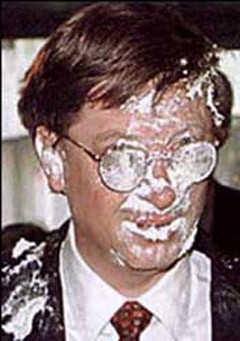 Benché Bill Gates possa tentare di dire che la Fondazione non sia collegata ai suoi affari, tutto ciò prova che è vero il contrario: la maggior parte delle loro donazioni finiscono per favorire gli investimenti commerciali del magnate, effettivamente non “donando” alcunché: anziché pagare tasse ai forzieri statali, investe i suoi profitti là dove gli frutta economicamente, compresa la propaganda sulle loro presunte buone intenzioni.
 Ex:
Ex: 