Ok

En poursuivant votre navigation sur ce site, vous acceptez l'utilisation de cookies. Ces derniers assurent le bon fonctionnement de nos services. En savoir plus.

samedi, 22 septembre 2012

Tout le monde est atteint...


Tout le monde est atteint...


Images


00:05 Publié dans Affiches | Lien permanent | Commentaires (0) | Tags : facebook, caricature | |  del.icio.us | | Digg! Digg |  Facebook

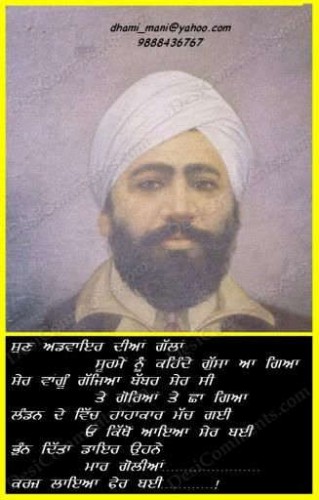
Revolutionary Sikh: The Last Words of Udham Singh

Revolutionary Sikh: The Last Words of Udham Singh

Who Was Udham Singh?

164841.jpgUdham Singh, a revolutionary nationalist, was born Sher Singh on 26 December 1899, at Sunam, in the then princely state of Patiala. His father, Tahal Singh, was at that time working as a watchman on a railway crossing in the neighbouring village of Upall. Sher Singh lost his parents before he was seven years and was admitted along with his brother Mukta Singh to the Central Khalsa Orphanage at Amritsar on 24 October 1907. As both brothers were administered the Sikh initiatory rites at the Orphanage, they received new names, Sher Singh becoming Udham Singh and Mukta Singh Sadhu Singh. In 1917, Udham Singh’s brother also died, leaving him alone in the world.

Udham Singh left the Orphanage after passing the matriculation examination in 1918. He was present in the Jallianvala Bag on the fateful Baisakhi day, 13 April 1919, when a peaceful assembly of people was fired upon by General Reginald Edward Harry Dyer, killing over one thousand people. The event which Udham Singh used to recall with anger and sorrow, turned him to the path of revolution. Soon after, he left India and went to the United States of America. He felt thrilled to learn about the militant activities of the Babar Akalis in the early 1920′s, and returned home. He had secretly brought with him some revolvers and was arrested by the police in Amritsar, and sentenced to four years imprisonment under the Arms Act. On release in 1931, he returned to his native Sunam, but harassed by the local police, he once again returned to Amritsar and opened a shop as a signboard painter, assuming the name of Ram Muhammad Singh Azad. This name, which he was to use later in England, was adopted to emphasize the unity of all the religious communities in India in their struggle for political freedom.

Udham Singh was deeply influenced by the activities of Bhagat Singh and his revolutionary group. In 1935, when he was on a visit to Kashmlr, he was found carrying Bhagat Singh’s portrait. He invariably referred to him as his guru. He loved to sing political songs, and was very fond of Ram Prasad Bismal, who was the leading poet of the revolutionaries. After staying for some months in Kashmlr, Udham Singh left India. He wandered about the continent for some time, and reached England by the mid-thirties. He was on the lookout for an opportunity to avenge the Jalliavala Bagh tragedy. The long-waited moment at last came on 13 March 1940. On that day, at 4.30 p.m. in the Caxton Hall, London, where a meeting of the East India Association was being held in conjunction with the Royal Central Asian Society, Udham Singh fired five to six shots from his pistol at Sir Michael O’Dwyer, who was governor of the Punjab when the Amritsar massacre had taken place. O’Dwyer was hit twice and fell to the ground dead and Lord Zetland, the Secretary of State for India, who was presiding over the meeting was injured. Udham Singh was overpowered with a smoking revolver. He in fact made no attempt to escape and continued saying that he had done his duty by his country.

On 1 April 1940, Udham Singh was formally charged with the murder of Sir Michael O’Dwyer. On 4 June 1940, he was committed to trial, at the Central Criminal Court, Old Bailey, before Justice Atkinson, who sentenced him to death. An appeal was filed on his behalf which was dismissed on 15 July 1940. On 31 July 1940, Udham Singh was hanged in Pentonville Prison in London.

Udham Singh was essentially a man of action and save his statement before the judge at his trial, there was no writing from his pen available to historians. Recently, letters written by him to Shiv Singh Jauhal during his days in prison after the shooting of Sir Michael O’Dwyer have been discovered and published. These letters show him as a man of great courage, with a sense of humor. He called himself a guest of His Majesty King George, and he looked upon death as a bride he was going to wed. By remaining cheerful to the last and going joyfully to the gallows, he followed the example of Bhagat Singh who had been his beau ideal. During the trial, Udham Singh had made a request that his ashes be sent back to his country, but this was not allowed. In 1975, however, the Government of India, at the instance of the Punjab Government, finally succeeded in bringing his ashes home. Lakhs of people gathered on the occasion to pay homage to his memory.

The Last Words of Udham Singh

On the 31st July, 1940, Udham Singh was hanged at Pentonville jail, London. On the 4th of June in the same year he had been arraigned before Mr. Justice Atkinson at the Central Criminal Court, the Old Bailey. Udham Singh was charged with the murder of Sir Michael O’Dwyer, the former Lieutenant-Governor of the Punjab who had approved of the action of Brigadier-General R.E.H. Dyer at Jallianwala Bagh, Amritsar on April 13, 1919, which had resulted in the massacre of hundreds of men, women and children and left over 1,000 wounded during the course of a peaceful political meeting. The assassination of O’Dwyer took place at the Caxton Hall, Westminster. The trial of Udham Singh lasted for two days, he was found guilty and was given the death sentence. On the 15th July, 1940, the Court of Criminal Appeal heard and dismissed the appeal of Udham Singh against the death sentence.

Prior to passing the sentence Mr. Justice Atkinson asked Udham Singh whether he had anything to say. Replying in the affirmative he began to read from prepared notes. The judge repeatedly interrupted Udham Singh and ordered the press not to report the statement. Both in Britain and India the government made strenuous efforts to ensure that the minimum publicity was given to the trial. Reuters were approached for this purpose.

The father of Udham Singh, Tehl Singh, was born into a poor peasant family and worked as a Railway Gate Keeper at the railway level crossing at Village Uppali. Udham Singh was born on 28th December, 1899 at Sanam, Sangrur District, Punjab. After the death of his father Udham Singh was brought up in a Sikh orphanage in Amritsar. The massacre at Jallianwala Bagh in 1919 was deeply engraved in the mind of the future martyr. At the age of 16 years Udham Singh defied the curfew and was wounded in the course of retrieving the body of the husband of one Rattan Devi in the aftermath of the slaughter. Subsequently Udham Singh travelled abroad in Africa, the United States and Europe. Over the years he met Lala Lajpat Rai, Kishen Singh and Bhagat Singh, whom he considered his guru and ‘his best friend’. In 1927 Udham Singh was arrested in Amritsar under the Arms Act. The impact of the Russian revolution on him is indicated by the fact that amongst the revolutionary tracts found by the raiding party was Rusi Ghaddar Gian Samachar. After serving his sentence and visiting his home town, Udham Singh resumed, his travels abroad. If it was the Jallianwala Bagh massacre which provided the turning point of his life which led him to avenge the dead, it was Bhagat Singh who provided him with the inspiration to pursue the path of revolutionary struggle.

Echoes of Kartar Singh Sarabha and Bhagat Singh may be found in the words of Udham Singh in the wake of the assassination of O’Dwyer.

‘I don’t care, I don’t mind dying. What Is the use of waiting till you get old? This Is no good. You want to die when you are young. That is good, that Is what I am doing’.

After a pause he added:

‘I am dying for my country’.

In a statement given on March 13th, 1940 be said:

‘I just shot to make protest. I have seen people starving In India under British Imperialism. I done it, the pistol went off three or four times. I am not sorry for protesting. It was my duty to do so. Put some more. Just for the sake of my country to protest. I do not mind my sentence. Ten, twenty, or fifty years or to be hanged. I done my duty.’

In a letter from Brixton Prison of 30th March, 1940, Udham Singh refers to Bhagat Singh in the following terms:

‘I never afraid of dying so soon I will be getting married with execution. I am not sorry as I am a soldier of my country it is since 10 years when my friend has left me behind and I am sure after my death I will see him as he is waiting for me it was 23rd and I hope they will hang me on the same date as he was.’

The British courts were able to silence for long the last words of Udham Singh. At last the speech has been released from the British Public Records Office.

Shorthand notes of the Statement made by Udham Singh after the Judge had asked him if he had anything to say as to why sentence should not be passed upon him according to Law.

Facing the Judge, he exclaimed, ‘I say down with British Imperialism. You say India do not have peace. We have only slavery. Generations of so called civilization has brought for us everything filthy and degenerating known to the human race. All you have to do is read your own history. If you have any human decency about you, you should die with shame. The brutality and bloodthirsty way in which the so called intellectuals who call themselves rulers of civilization in the world are of bastard blood…’

MR. JUSTICE ATKINSON: I am not going to listen to a political speech. If you have anything relevant to say about this case say it.

UDHAM SINGH: I have to say this. I wanted to protest.

The accused brandished the sheaf of papers from which he had been reading.

THE JUDGE: Is it in English?

UDHAM SINGH: You can understand what I am reading now.

THE JUDGE: I will understand much more if you give it to me to read.

UDHAM SINGH: I want the jury, I want the whole lot to hear it.

Mr. G.B. McClure (Prosecuting) reminded the Judge that under Section 6 of the Emergency Powers Act he could direct that Udham Singh’s speech be not reported or that it could be heard in camera.

THE JUDGE (to the accused): You may take it that nothing will be published of what you say. You must speak to the point. Now go on.

UDHAM SINGH: I am protesting. This is what I mean. I am quite innocent about that address. The jury were misled about that address. I am going to read this now.

THE JUDGE: Well, go on.

While the accused was perusing the papers, the Judge reminded him ‘You are only to say why sentence should not be passed according to law.’

UDHAM SINGH (shouting): ‘I do not care about sentence of death. It means nothing at all. I do not care about dying or anything. I do not worry about it at all. I am dying for a purpose.’ Thumping the rail of the dock, he exclaimed, ‘We are suffering from the British Empire.’ Udham Singh continued more quietly. ‘I am not afraid to die. I am proud to die, to have to free my native land and I hope that when I am gone, I hope that in my place will come thousands of my countrymen to drive you dirty dogs out; to free my country.’

‘I am standing before an English jury. I am in an English court. You people go to India and when you come back you are given a prize and put in the House of Commons. We come to England and we are sentenced to death.’

‘I never meant anything; but I will take it. I do not care anything about it, but when you dirty dogs come to India there comes a time when you will be cleaned out of India. All your British Imperialism will be smashed.’

‘Machine guns on the streets of India mow down thousands of poor women and children wherever your so-called flag of democracy and Christianity flies.’

‘Your conduct, your conduct – I am talking about the British government. I have nothing against the English people at all. I have more English friends living in England than I have in India. I have great sympathy with the workers of England. I am against the Imperialist Government.’

‘You people are suffering – workers. Everyone are suffering through these dirty dogs; these mad beasts. India is only slavery. Killing, mutilating and destroying – British Imperialism. People do not read about it in the papers. We know what is going on in India.’

MR. JUSTICE ATKINSON: I am not going to hear any more.

UDHAM SINGH: You do not want to listen to any more because you are tired of my speech, eh? I have a lot to say yet.

THE JUDGE: I am not going to hear any more of that statement.

UDHAM SINGH: You ask me what I have to say. I am saying it. Because you people are dirty. You do not want to hear from us what you are doing in India.

Thrusting his glasses back into his pocket, Udham Singh exclaimed three words in Hindustani and then shouted, Down with British Imperialism! Down with British dirty dogs!’

As he turned to leave the dock, the accused spat across the solicitor’s table.

After Singh had left the dock, the Judge turned to the Press and said:

‘I give a direction to the Press not to report any of the statement made by the accused in the dock. You understand, members of the press?’

00:05 Publié dans Histoire | Lien permanent | Commentaires (0) | Tags : udham singh, inde, histoire | |  del.icio.us | | Digg! Digg |  Facebook

Alain Soral: Political Incorrectness Ideology of Resistance

Alain Soral: Political Incorrectness Ideology of Resistance

Ex: http://openrevolt.info/

(An address pronounced in Villepreux the 2nd of November 2008)

This title implies to answer two prior questions :
1) What is Mondialism ?
2) What is political correctness ?

Let’s start with Mondialism.

Mondialism is not globalization.

Globalization is an inevitable process of material and immaterial exchange due to technological progress. We cannot go against it, and it is not desirable to do so. The rejection of globalization is not a desire of civilizationnal flashback. Not more that degrowth is a desire of recession… It is quite convenient to be able to get to Six-Fours in few hours by TGV and it is joyful to notice that a great number of active members of the Populist Party had the financial means to get there ! No ! What is at issue is Mondialism.

Mondialism is an ideological project, a sort of Laic religion that works to set up a world government through the dissolution of all the Nations of the world into a new humanity. It works to the dissolution of the Nations under the pretence of Universal Peace. The diversity of Nations and people being considered the reasons for wars that have brought bloodshed on Earth since the dawn of humanity…

This process was logically very involved after World War One through the League of Nations. It logically ebbed after the rising dangers that led to World War Two. It came back very strongly on the ruins of Nations after 1945, with NATO and the Universal Declaration of Human Rights. Short parenthesis : This declaration should not be confused with the Declaration of the Rights of Man and of the Citizen, which thought those rights in the concrete context of a rooted Nation : The French Nation, on behalf of a civilizationnal model, that J.C Martinez often talk about : The French Universalism. A civilisation with a planetary destiny, alternative to both the Islamic Ummah and the Anglo-Saxon Liberalism…

We then had after World War II two ideological systems, fighting against Nations and people who were considered as intrinsically bellicose : The Russian Socialism, now dead (I will not hammer at it uselessly !) and the American Liberalism, winner until today of the cold war.

The existing Mondialism is therefore twofold : At the same time a depraved ideological project from Enlightnment : A project where Universal Peace and reconciled Humanity through Kantian reason, meant to transcend scholastic obscurantism that came out of Europe’s religious War, finally turned to the obscurantism of Human Rights… Obscurantism of Human Rights… Or, banning the use of reason to criticize all the concrete wrongdoings of this totalitarian process on concrete Humanity, on behalf of blasphemy and heresy…

A Mondialism that is also, at the same time, the ineluctable slope of mercantile society : going from the free entrepreneur’s free entreprise to the Orwellian financial capitalism, where every man is from now on reduced to the role of wage-earner/consumer, enslaved to what Marxism calls : The law of concentration of Capital imposed by the falling rate of profit…

There is then, the convergence of two unifying processes : one that is ideological and thought : the Universal Human Rights, the other one that is economical and undergone : The commodification under the religion of profit. Two processes that blend today in the same project : The project of a World government under the aegis of the Anglo-Saxon Capitalism, on behalf of the ideology of abstract Human Rights…

In shorts : Therefore, Human rights are now the catechism of the dissolution of rooted people and Nations, dedicated to the generalized abstraction of global financial capitalism with a view to its complete World domination.

Domination over our wallets as well as our souls…

Political incorrectness :

This rapid presentation finished, it is quite easy to come to the second definition : What is political correctness ? And then, what is political incorrectness ? The political correctness is everything that accepts to submit, consciously or inconsciously, to the catechism of Human Rights. Political incorrectness is everything that opposes and resists to it !

Human Rightism has nothing to do anymore with the real rights of real people, attached to their local cultures and their Nations (As the passion for Olympic games or Football championship keep showing, since those contests between Nations and between Cities are the ones which are acclaimed). Nowadays, Human Rightism is the ideological armed wing of Mondialism, the smooth talk that comes with all subdues, all oppressions of movements that resist to the economico-ideological Mondialism, whether those are military, political or cultural resistances… Thereby, it is on behalf of Human Rights, leading, of course, to the right of humanitatian intervention and then to Kouchner’s responsibility to protect, that is now bombed the small Serbian Nation, because they resist to the Mondialist steamroller under American control, on behalf of their culture and history… It is on behalf of the totalitarian and bellicose Human Right ideology that is flouted the real rights of the real people everywhere on the planet. Whether the right for Serbians to remain Serbs, but also the right for Muslims to remain Muslims in Iran or Afghanistan…

But it is also on behalf of Human Rights that are dismantled social solidarities within the Nations and their people – the traditionnal social solidarities against Mondialist Capitalism – by substituting workers and middle classes’ social benefits for the social interest of “oppressed” pseudo-minorities (In reality vocal minorities…) : Gay rights, woman’s rights, youth rights, black people rights… Minorities that are just market segments serving the ideological merchant Mondialism, as the Italian ex-trotskyist and now publicist, Mister Toscani, had well illustrated in his excellent adverts “United Colors of Benetton”…

From then on, all resistance to this carving up : Refusal to see the Serbians as ennemies of humanity, whereas they only try to preserve their lifestyle, refusal to see gays as a social class, since the diversity of homosexuals cannot be reduced to a self-proclaimed gay lobby, and since the sodomy remains anyway a private leisure activity… Bref, any refusal to submit to the false pretence of those pseudo-Human Rights, which in reality consist in submitting people to the mondialist domination, is considered by the very same power as crime against humanity ! Here we are ! Sentence for “crime against humanity” that allows evicting from humanity the ones accused of it, reducing them to the level of subhumans and who, then, does not receive anymore those famous rights : The Germans and the Japanese after the war, the Palestinians today, the Iranians tomorrow, the activist and electors from the Front National for the past 30 years… Let’s now talk about the FN.

This implacable mechanic rapidly dismantled ; let’s have a closer look at France and its national movement… This national movement that i joined out of spirit of resistance to Mondialism and which was embodied those past 30 years in the FN, this united movement of national resistance, thanks to Jean Marie Le Pen’s political genius. I take this opportunity to warmly salute him… First remark, understood like this and i would say “well-understood” ! The FN is neither a right nor left-wing movement, since the right refers to the market, so to Mondialism, as much as the left refers to Internationalism, which amount to the same thing… The FN well-understood is therefore essentially a movement of resistance to Mondialism, both at the same time opposed to its right-wing liberal economy and its left-wing Human rightist ideology, the left-wing catechism being the humanist alibi of the economical proces of concentration of Capital and the process of domination by the “masters of the market”…

From this analysis we can logically deduct that if the FN, as a national opposition movement, wants to be coherent, it needs to fight both against the mercantile Mondialism and the political correctness, which is its ideology…

But, this is where i would allow myself a critique on both yesterday’s imprecisions and today’s temptations…

For many years, the FN was politically incorrect in terms of ideas (i am refering to the delightful and useful provocations of our president…) but was unfortunately economicaly way too liberal, which means that the FN was only partly disobedient… Let’s point out that National-Liberalism is an oxymoron, since liberal means “privatized” and when everything is privatized (central banks, public services, army…), the politics loses control of the Nation, even the FN ! Nowadays in the FN, the line between political correctness and Liberalism is rather reversed : Rigorous criticism of economic Mondialism, but renunciation of political incorrectness on behalf of de-demonization, which amount to the same incoherence and the same political impotence : Since submitting to the dictatorship of Human Rights and the blackmail of the crime against humanity is eventually a way to land up naked in the countryside at the hands of Mondialist ideology ! The slogan summarizing best what i want to say, slogan that is permanently thrown and on which we must not give up is the famous “never again” ! Suggesting : “Mondialism or Auschwitz”, and for the recalcitrants, the no less famous reductio ad Hitlerum ! In summary : Political incorrectness is by no means a useless game of provocations. Even if it is not always understood this way, it is the doctrine of resistance to Mondialism. Doctrine of disobedience whitout which the criticism restricted to economic Mondialism is unsufficient, powerless and even incoherent, just as political incorrectness unextended to the criticism of the liberal doctrine… Yesterday’s economic incoherence which is now outdated within the FN, thanks to Marine Le Pen excellent work !

Therefore, not only politically incorrect thoughts must not be abandoned, but at a time when the left, which used to lead the field with Marxism, has abandoned all thoughts, abandoning themselves to the obscurantism of Human Rights… At a time when no one thinks, neither left or right, since the right-wing wheeler-dealers have long ago settled for doing business… We, the nationalists, can regain control in terms of ideas as we are the only efficient critics of the system and we can become, in this desert, the thought leaders of tomorrow and embody the renewal of French genius!
Long live disobedience then!
And long live disobedient France!

Alain Soral


——————————————

Alain Soral has contributed the introduction to Alexander Dugin’s monumental new work The Fourth Political Theory’s English edition.  Order here and show support for our work at Open Revolt!


00:05 Publié dans Théorie politique | Lien permanent | Commentaires (0) | Tags : théorie politique, politologie, alain soral | |  del.icio.us | | Digg! Digg |  Facebook

Entretien avec Piero San Giorgio

Entretien avec Piero San Giorgio à propos de son nouveau livre Rue Barbare – survivre en ville

Ex: http://mecanopolis.org/

Le premier livre de Piero San Giorgio, Survivre à l’effondrement économique, connaît un succès retentissant. L’auteur, ancien responsable des marchés émergents dans l’industrie high-tech, qui se consacre désormais pleinement au « survivalisme », est persuadé que les problèmes auxquels le monde va devoir faire face dans les dix prochaines années vont entrainer « un effondrement économique massif et global qui ne laissera personne, riche ou pauvre, indemne ».

Avant la parution de son deuxième livre, « Rue Barbare –  survivre en ville », dont nous présentons un extrait à la fin de l’entretien, nous voulions rencontrer une nouvelle fois Piero San Giorgio. Entretien dans un bistrot genevois.

AJD : Piero, votre premier livre connaît un succès retentissant, comment vivez-vous cela ?

Piero San Giorgio : Je suis à la fois surpris, mais finalement pas étonné, car ce succès démontre que je suis en phase avec mon temps, et peut-être même un peu en avance. Sans prétention, je crois pouvoir dire que j’anticipe sur l’état du monde à venir, et si cela peut rendre service, ne serais-ce qu’à une seule personne, je m’en félicite. A titre personnel, je n’ai pas pour autant pris la « grosse tête », comme on dit. Je reste serein, d’une part parce que c’est ma nature profonde, et d’autre par car j’ai devant moi beaucoup de travail à réaliser. Ce premier livre est une introduction et j’ai des nombreux projets pour le futur.

Vous allez publier une deuxième livre pour le mois de novembre, pour lequel vous nous faites la faveur de nous remettre un extrait, que nous publions en fin d’article. Est-ce la suite du premier ?

C’est bien plus que ça. Ce livre est écrit à deux mains, en collaboration avec Volwest. Je pense que le titre, « Rue barbare, survivre en ville », est suffisamment évocateur. Nous nous nous sommes rendu compte que, lorsque la situation économique et sociale ne sera plus tenable et engendrera des troubles importants, ce qui ne va pas manquer d’arriver, tout le monde ne pourra pas se réfugier dans des BAD (Base Autonome Durable) à la campagne ou dans les montagnes, ce qui était le sujet de mon premier ouvrage. Nous avons donc rédigé un livre pratique, qui peut permettre à chacun de trouver les moyens de survivre à l’intérieur des villes.

Certains vous reprochent de surfer sur un climat de peur ambiante, en raison de la crise économique, du chômage, de l’insécurité grandissante… Que leur répondez-vous ?

Malheureusement, ceux qui me font ces reproches ne viennent jamais débattre avec moi. Je ne suis pas un auteur de science fiction. Mon premier livre, comme mes conférences, sont sourcées et documentées. Je ne me base que sur des faits établis, des données réelles et vérifiables et, partant de cela, j’anticipe sur un avenir qui ne peut apparaitre qu’inéluctable pour tous ceux qui sont doués d’un minimum de raison et de bon sens.

Vous pensez-donc que la société telle que nous la connaissons va disparaître au profit d’un chaos généralisé ?

C’est plus compliqué que cela et je renvoie vos lecteurs à mon premier ouvrage pour en avoir le détail. Mais, pour résumer, c’est une évidence que les flux énergétiques manquent aujourd’hui pour maintenir une société de consommation telle que nous l’avons connue ces quarante dernières années. Il est certain que la restructuration économique mondiale en cours va provoquer des troubles majeurs. On peut feindre de l’ignorer ou se préparer. C’est un choix personnel, mais qui aura ses conséquences.

Vous démontrez être très disponibles pour vos lecteurs, ce qui est rare pour un auteur. Envisagez-vous, au-delà de l’écriture, une activité de conseil ?

Je ne tiens pas trop à faire du survivalisme un business. Je vais d’ailleurs lever le pied sur les conférences. Je pense en avoir donné suffisamment, et certaines on parfois été organisées par des groupes dont je ne partage pas forcement les opinions politiques, ce qui m’a valu des étiquettes qui, je crois, ne me correspondent pas. Mais ce n’est pas grave, je vais volontiers là où on m’invite pour convaincre le plus grand nombre de familles à se préparer. Je suis disposé à aider tous ceux qui vont dans le sens de la philosophie de vie que j’essaie de mettre en place: autonomie, liberté, indépendance, retour à la terre. Je suis très sollicité, même dans le domaine qui est le votre, celui de la sécurité électronique. Un système d’alarme anti-intrusion adapté ou de la vidéo-protection ainsi que d’autres nouvelles technologies peuvent être des « multiplicateur de forces » et permettre d’assurer une meilleure protection, à condition qu’ils n’empêchent pas de conserver une autonomie énergétique. J’aime cette activité de conseil, mais toutefois ma priorité est de conserver un maximum de temps afin d’être proche de ma famille et des êtres qui me sont chers.

Entretien réalisé par Adrien Jacot-Descombes, pour Swisecurity.ch

Reproduction libre avec indication des sources

Télécharger l’extrait du nouveau livre de Piero San Giorgio

00:05 Publié dans Entretiens | Lien permanent | Commentaires (0) | Tags : ville, piero san giorgio, entretiens | |  del.icio.us | | Digg! Digg |  Facebook

William Morris, l'arte e il lavoro

William Morris, l'arte e il lavoro

di Alberto Melotto

Fonte: megachip [scheda fonte]

WilliamMorris 20120917

La parola rivoluzione, che noi socialisti siamo così spesso costretti ad usare, suona in modo sinistro alle orecchie della maggior parte della gente, anche se noi ci affanniamo a spiegare che essa non significa necessariamente un cambiamento che si attuerà all’insegna di tumulti e di ogni specie di violenza, così come non potrà significare un cambiamento che si produrrà automaticamente e contro la pubblica opinione ad opera di un gruppo di uomini riusciti in qualche modo a impadronirsi momentaneamente dell’esecutivo. Anche quando spieghiamo che usiamo la parola rivoluzione nel suo senso etimologico, intendendo per essa un cambiamento nelle basi della società, la gente ha paura all’idea di un mutamento tanto vasto che ci supplica di dire riforma e non rivoluzione”. (William Morris)

Signore e signori, ecco a voi William Morris. Artigiano produttore di oggetti di arredamento, poeta, romanziere, affiliato alla confraternita artistica dei preraffaelliti, socialista utopista e profetico. Di rado nell’opera di uno studioso engagé di fine ‘800 si riscontrano, lucidamente evidenziati e confutati, gli snodi e le contraddizioni del movimento operaio novecentesco: il fallimento del modello del socialismo autoritario, l’acquiescenza socialdemocratica verso la rigidità di ruoli voluta dal potere borghese.

Inoltre, Morris sviluppò temi che i posteri non osarono nemmeno affrontare, senza dubbio per timore di sembrare ingenui, naif, poco allineati: la volontà di creare un mondo dove il lavoro sia gioia e creazione artistica, la critica disinvolta allo strapotere della scienza e della tecnologia, la rivalutazione dell’ambiente naturale, l’altra grande vittima, insieme all’uomo, del degrado e dello sfruttamento capitalistico.

Un suo grande ammiratore, Oscar Wilde, raccontava una confidenza fattagli dallo stesso Morris:

“Ho tentato di rendere ogni mio lavoratore un artista, e quando dico un artista intendo dire un uomo”.

Nato in un ambiente benestante, Morris trovò nella cittadella universitaria di Oxford il luogo ideale per lasciarsi affascinare da una miriade di diversi interessi culturali e artistici, e forse proprio per questo motivo non concluse nessun corso regolare di studi. Oltre al socialismo cristiano di Charles Kingsley, poi temporaneamente abbandonato in favore del radicalismo borghese di marca liberale, troviamo l’influsso determinante di John Ruskin, che gli instilla l’amore per l’architettura.

     1. Il lavoro – valorizzazione delle capacità umane, non più strumento di oppressione

In Lavoro utile e inutile fatica, Morris mostra di voler sgombrare il tavolo da tutta una serie di luoghi comuni riguardanti il lavoro, prima di procedere nella direzione del teorizzare una nuova concezione sull’argomento.

È sbagliato, dice Morris, affermare entusiasticamente che ogni lavoro è una benedizione in sé. Congratularsi con il fortunato lavoratore per la sua operosità fa comodo soprattutto a coloro che vivono alle spalle degli altri. Non tutta la popolazione, infatti, è dedita ad attività lavorative, al contrario sussistono enormi differenze al riguardo.

Vi sono i ricchi, gli aristocratici:

che non fanno alcun lavoro: sappiamo tutti che consumano moltissimo senza produrre nulla. Ne consegue che debbono evidentemente essere mantenuti a spese di coloro che lavorano, proprio come i mendicanti, e sono un puro fardello per la comunità”.

Vi è poi l’alta borghesia, la classe che Marx avrebbe definito come “proprietaria dei mezzi di produzione”, la quale è impegnata in una forsennata e feroce gara, in patria e all’estero, per l’accumulo della ricchezza, con l’unico fine di potersi astrarre dal lavoro, e divenire così improduttivi, come sono da secolo gli aristocratici.

Dopo la massa degli impiegati e dei soldati, ecco i lavoratori manuali, obbligati, e questo diviene il punto focale del ragionamento di Morris, a produrre:

articoli lussuosi e stravaganti la cui domanda è legata all’esistenza delle classi ricche e improduttive, oggetti che chi conduce una vita degna e non corrotta non si sognerebbe neppure di volere”.

Morris sostiene dunque che il gusto della sua epoca per gli oggetti della vita quotidiana – mobilio, tendaggi – appare stravolto, avvelenato dai nefasti meccanismi di sfruttamento economico dell’uomo sull’uomo. Questa adulterazione del gusto si diffonde in ogni parte della società, poiché i poveri producono per uso personale dei manufatti che sono ridicole imitazioni del lusso dei ricchi. Tale deformità nel modo di concepire e di conseguenza guardare alle cose che prodotte proviene dalla disarmonica strutturazione del corpo sociale: una classe oziosa di improduttivi che si fa mantenere da un gran numero di schiavi.

Morris 2 20120917

Quali caratteristiche dovrebbe, invece, possedere il lavoro per donare speranza all’uomo, invece che causargli pena e sofferenza? Dovrebbe garantirgli la speranza del riposo: per quanto possa essere piacevole, esso comporta tuttavia una certa sofferenza animale nel mettere in moto le proprie energie. Il riposo dovrebbe essere abbastanza lungo, più lungo dello stretto necessario al recupero delle forze, e dovrebbe essere libero da preoccupazioni e da ansie.

Vi è poi la speranza del piacere del lavoro in sé: concetto, questo, rivoluzionario al massimo grado; Morris afferma risolutamente che l’uomo che lavora davvero utilizza le energie della mente e dell’animo oltre a quelle del corpo:

“la memoria e l’immaginazione lo aiutano nel lavoro. Non solo i suoi pensieri, ma anche i pensieri degli uomini delle trascorse età guidano le sue mani, egli crea in quanto parte della razza umana”.

La dimensione della creatività viene valutata come componente fondamentale nel dar corpo e significato all’atto del faticare, dare sfogo alle proprie capacità creative potrà dunque, donare quel piacere che sarà una soddisfazione quotidiana, una quotidiana ricompensa, nella società socialista. In una società di questo tipo, non si assisterà più al fenomeno dello spreco, da Morris certamente detestato: ovvero la produzione di sordidi surrogati per la povera gente che non può permettersi merce di buona qualità, e la produzione di oggetti pacchiani di lusso per i ricchi. Nella concezione di Morris, lo spreco è il volto perverso e malato della ricchezza di pochi, il profitto nato da uno stimolo produttivo insensato e privo di vere ragioni che non siano l’avidità.

     2. Le opzioni di fondo – compromesso socialdemocratico, comunismo e anarchia

Eclettico come soltanto certe figure vittoriane seppero essere, simili ai grandi del rinascimento, William Morris non fu soltanto uomo di pensiero, ma fin dalla gioventù seppe coniugare la passione per l’arte (considerata a torto dal grande pubblico) minore, con una mentalità imprenditoriale decisamente controcorrente, sia dal punto di vista estetico che affaristico.

Morris 3 20120917

Nel 1861, all’età di 27 anni, fondò, nelle sue stesse parole, “una specie di ditta per la produzione di oggetti di arredamento”, alla quale si aggiunse col tempo una piccola ma originale casa editrice. La ditta Morris si dimostrò fedele al suo afflato iniziale, ovvero contribuire all’emancipazione economica e sociale dei suoi dipendenti. Gli operai poterono godere di un migliore salario e partecipare attivamente alla fase creativa. Tale volontà non era del tutto sconosciuta in terra d’Inghilterra, nella prima metà del secolo l’industriale Richard Owen aveva fondato dei laboratori dove i lavoratori potevano partecipare ai guadagni relativi ai frutti delle loro fatiche. L’iniziativa di Owen naufragò tristemente perchè i prodotti non incontrarono i gusti del pubblico.

Tornando a Morris, va detto che egli non si illudeva che iniziative come quella da lui portata avanti potessero influenzare la gran parte dell’avida classe imprenditoriale inglese. Lungi dal concedersi ad un paternalismo dickensiano, Morris riponeva le sue speranze in un’avvenire solcato da un cambiamento radicale nella struttura della società. Per questo avversava strenuamente ogni forma di compromesso socialdemocratico.

Morris seppe riconoscere quelle che sarebbero divenute le linee portanti, i binari della dialettica politica inglese per almeno un secolo a venire: una classe operaia poco interessata all’idea di un cambiamento strutturale di regime in senso socialista, ma attenta ad ottenere relativi miglioramenti in seno al luogo di lavoro (migliori salari, più sicurezza) e più garanzie sul piano della cittadinanza (sanità e istruzione pubblica, pensione). Questo compromesso socialdemocratico, inibitore del conflitto fra le diverse classi e portatore di pace sociale, veniva demandato dai lavoratori in primo luogo all’efficiente azione dei sindacati, delle Trade Unions, che seppero orientare fin da subito le politiche del Labour Party.

È cosa nota che una forte percentuale dei delegati del Labour venivano concessi per Statuto ai rappresentanti delle Trade Unions. Il nostro autore non nascose mai il suo dissenso, venato di disprezzo, per quelli che definiva come dei “palliativi”. Egli non era certo così insensibile da mostrarsi disinteressato a dei miglioramenti immediati nelle condizioni di vita delle classi più umili, ma temeva fortemente che queste limitate riforme venissero percepite come l’obiettivo finale. Questo apparente slancio avrebbe, in realtà, lasciati inalterati i rapporti di subordinazione, anzi di schiavitù, esistenti nella rigida società capitalistica inglese:

“Il fatto di dare a moltissimi, o anche pochi, poveri, una vita un po’ meno disagiata, un po’ meno miserabile dell’attuale, non è certo in sé un bene da poco: ma sarebbe un grave male se incidesse negativamente sugl sforzi dell’intera classe lavoratrice per la conquista di una vera società di eguali … quel che mi chiedo è se la terribile organizzazione della società civile commerciale non stia giocando al gatto col topo con noi socialisti; se la società dell’ineguaglianza non stia accettando il marchingegno pseudosocialista e non lo stia adoperando allo scopo di mantenere quella società in una condizione in qualche modo ridimensionata ma sicura”.

manifesto sl 20120917

Il nostro compito, scrisse nell’articolo A che punto siamo?, è quello di formare i socialisti, di creare i presupposti di una coscienza sociale nuova, una coscienza sociale liberata dall’idea stessa di sfruttamento e di dominio. Fare a meno dei padroni. La sua coerenza lo portò in questo senso ad opporsi all’idea di mandare rappresentanti socialisti nel parlamento di Sua Maestà. Così, quando la Social-Democratic Federation, della quale era membro, nonché tesoriere, si espresse in massa per la partecipazione alle contese elettorali, egli favorì una scissione interna alla Federazione, che portò alla creazione della Socialist League, nel 1884. Testimonianza ricca di pungente sarcasmo di questa divisione è la lettera che Engels scrisse a Bernstein, e della quale riportiamo un passaggio:

“I dimissionari erano Aveling, Bax e Morris, i soli uomini onesti fra gli intellettuali, ma anche i tre più inetti, dal punto di vista pratico (due poeti e un filosofo), che per quanto si cerchi sia dato trovare”.

Certo le parole di Engels si debbono attribuire a un diffuso pregiudizio anti-umanista nella sinistra dell’epoca, resta da dimostrare che il tecnicismo positivista abbia saputo raggiungere risultati pratici di rilievo, a giudicare del disastro organizzativo della Russia di Stalin, Kruscev e Breznev ciò non sembra vero.

Non fermarsi fino alla piena realizzazione del socialismo, questa l’aspirazione di Morris, la realizzazione del comunismo. Con questo vocabolo egli intende porre l’accento sul diritto della popolazione ad accedere all’uso dei beni comuni, ovvero le risorse naturali come la terra. Anche sotto questo aspetto possiamo riscontrare la vicinanza del pensiero di Morris al corrente dibattito in seno al filone del pensiero decrescista, Latouche in primis. Tali beni comuni, non devono essere posseduti da singoli individui:

“In caso contrario, i proprietari dei mezzi di produzione saranno necessariamente i padroni di coloro che non possiedono abbastanza da liberarsi dal bisogno di pagare con una parte del proprio lavoro l’uso dei mezzi di produzione medesimi. I padroni o proprietari dei mezzi di produzione possiedono quindi praticamente i lavoratori: molto praticamente perché possono imporgli il genere di vita che devono condurre .. quindi le risorse della natura e la ricchezza usata per la produzione di ulteriore ricchezza, tutto insomma, dovrebbe essere messo in comune.

Quanto ai meccanismi regolatori di questa futura società comunista, Morris si dimostra giustamente restio a fornire indicazioni troppo precise; in lui il desiderio di portare alla partecipazione diretta le masse popolari è così forte e convinto da non lasciar spazio a rigide direttive. Si può solo prevedere come quella società non sarà.

Non verrà abolita qualsiasi forma di autorità, con buona pace dell’ala anarchica più intransigente. L’esercizio di una qualche autorità è pur necessario, ma d’altra parte, i vincoli della futura società comunista saranno volontari. Una volta stabilite alcune grandi linee di principio, si lascerà grande spazio alla:

“varietà di temperamenti, capacità e desideri che esiste fra gli uomini in tutto ciò che non rientra nella sfera delle prime necessità”.


     3. Alcune considerazioni finali

William Morris scrisse un romanzo utopico, News from nowhere, tradotto nella nostra lingua col titolo Notizie da nessun luogo, col preciso intento di raffigurare la società delle donne e degli uomini liberi. S’immagina che il narratore, un uomo di fine ‘800 nel quale è facile individuare un alter-ego dell’autore, venga trasportato magicamente in un futuro distante un centinaio d’anni, in un’Inghilterra liberata, grazie ad un’aspra guerra civile, dal dominio del capitale, un paese dove il benessere e la serenità sono condivisi dall’intera popolazione.

Morris 1 20120917

Va detto che la critica non considera il romanzo fra le vette più alte raggiunte da Morris in campo letterario, forse a causa di una raffigurazione fin troppo idilliaca e manichea di un tempo dove la felicità regna sovrana, tanto da far somigliare l’esistenza ad un “amoroso picnic”.

Ciò non sminuisce la cristallina volontà di pervenire ad una sostanziale rivoluzione, in grado di liberare l’essere umano da ceppi che sono prima di tutto di tipo culturale e psicologico. Morris non si tirò mai indietro, e nonostante le facili ironie engelsiane, seppe partecipare a cruente manifestazione di piazza, pur di accrescere il livello di protesta sociale. In particolare, è nota la sua partecipazione ad una delle tante Bloody Sunday, le domeniche di sangue, di cui è costellata la storia britannica.

In Londra in stato d’assedio, che come gli altri scritti finora citati fa parte della raccolta di articoli intitolata Come potremmo vivere, Morris ci racconta dei fatti del 13 novembre 1887, quando il governo tory-liberale, s’ispirò all’amorevole insegnamento di Bismarck per attaccare i disoccupati che avevano occupato Trafalgar Square.

La sua capacità d’immaginare un futuro e una società diversa ce lo restituisce come un fratello che solo l’ottusità e la parzialità di molto marxismo ci avevano tenuto nascosto, un obiettore di coscienza decrescista ante litteram. Valgano per William Morris le parole di Michail Bakunin:

È ricercando l’impossibile che l’uomo ha sempre realizzato il possibile. Coloro che si sono saggiamente limitati a ciò che appariva loro come possibile, non hanno mai avanzato di un solo passo”.


Tante altre notizie su www.ariannaeditrice.it

00:05 Publié dans art | Lien permanent | Commentaires (0) | Tags : 19ème siècle, william morris, art, artisanat, angleterre | |  del.icio.us | | Digg! Digg |  Facebook