Ok

En poursuivant votre navigation sur ce site, vous acceptez l'utilisation de cookies. Ces derniers assurent le bon fonctionnement de nos services. En savoir plus.

dimanche, 17 février 2013

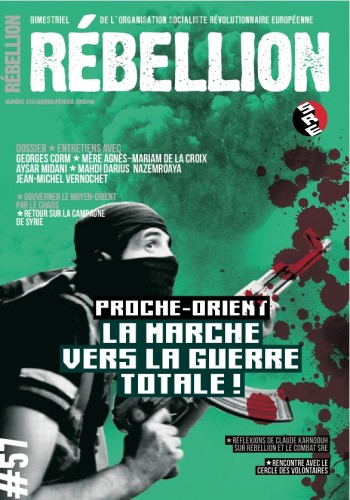
Rébellion n°57

Parution de Rébellion n°57
 
Edito : Et nozigue, où qu'on va ? 
Réflexion : Rébellion, comme une éclaircie dans un paysage politique blême par Claude Karnoouh

Dossier géopolitique du Proche-Orient :
Intro : la marche vers la guerre globale.
Gouverner  le Proche-Orient par le chaos.  
Entretien avec Georges Corm. 
Retour sur la campagne de Syrie par Jean de Lavaur.
A. Chauprade et les dynamiques internes de la Syrie. 
 Entretien avec Mère Agnès-Mariam de la Croix 
Entretien avec Ayssar Midani 
Entretien avec Madhi Darius Nazemroya. 

 Entretien avec Jean-Michel Vernochet et chronique de son livre " Iran la destruction nécessaire".
Média : Rencontre avec le Cercle des Volontaires par Pablito Waal 
Chronique livre sur la guerilla. 
 
Numéro de 44 pages au même prix. 
 
Disponible pour 4 euros auprès de 
Rébellion c/o RSE BP 62124 31020 TOULOUSE cedex 02 

http://rebellion.hautetfort.com/

 image.jpg

Le legioni romane sottomettono il grande schermo

Le legioni romane sottomettono il grande schermo

Ex: http://www.azionetradizionale.com/

(Il Giornale) – «L’’uomo è il più rapace di tutti gli animali», diceva Louis-Ferdinand Céline. È di certo così, ma, nella scala della rapacità, ci sono avvoltoi e ci sono aquile. Nella simbologia umana, i primi rappresentano istintività e parassitismo; le seconde, che non a caso vivono più in alto di tutti, raffigurano autorità, nobiltà, coraggio.
L’Impero romano, prima civiltà ad estendere il proprio dominio su tutto il mondo allora conosciuto, scelse appunto l’aquila come simbolo della autorità spirituale, e il fascio littorio come simbolo della legge. Da allora a oggi, l’aquila ha nei secoli rappresentato il simbolo della civiltà occidentale e della sua supremazia nel mondo.


The Eagle of the Ninth (L’aquila della Nona) è il titolo del film di Kevin Macdonald che arriverà il 9 settembre in Italia. Il romanzo omonimo di Rosemary Sutcliff, uscito nel 1954, da cui è tratto il film, ebbe un tale successo che l’autrice lo prolungò e ne fece una trilogia. Concepito come libro per ragazzi, oggi è considerato un classico. Il titolo si riferisce al vessillo della Nona Legione dell’esercito romano, che nel II secolo d.C. scomparve in Caledonia (l’attuale Scozia) ed è la storia di come il giovane Marcus Aquila (nomen omen) vent’anni dopo cerca di scoprire cosa era successo al condottiero della legione, suo padre Flavius Aquila, e ai suoi cinquemila uomini. Nella realtà storica, nulla si riuscì a sapere di questa legione che aveva osato avventurarsi oltre i confini del Vallo di Adriano, presumibilmente massacrata dalle feroci tribù barbariche che abitavano quelle terre inospitali. Nella fiction della Sutcliff invece, il centurione Marcus riesce nel suo intento: rintraccia i superstiti, combatte contro i barbari e recupera il simbolo sacro riscattando così la reputazione del padre.


Altri due film recenti si sono ispirati al romanzo della Sutcliff: L’ultima legione (The Last Legion) di Doug Lefler (2007) e Centurion di Neil Marshall (2010). The Eagle, peraltro girato nella stessa Scozia, senza dubbio ne rende lo spirito in maniera ammirevole.
Il film inizia con Marcus Aquila (Channing Tatum, che ha i perfetti tratti somatici del legionario) che arriva in Britannia, insidioso confine del mondo conosciuto, per mettersi al comando di una guarnigione indisciplinata. Il carismatico novizio si guadagna la riluttante ammirazione delle sue truppe, risvegliando il loro orgoglio e guidandole in battaglia contro gli indigeni ribelli. In uno di questi scontri (che il film rende con magistrale efficacia), dove Marcus e i suoi uomini formano una testuggine per affrontare i selvaggi britanni capeggiati da uno sciamano invasato, viene ferito gravemente. Nella seconda parte, il comandante legionario affronta una difficile guarigione in compagnia dell’anziano zio (il sempre brillante veterano Donald Sutherland), che compra per lui lo schiavo Esca (Jamie Bell), a cui Marcus aveva salvato la vita in un’arena gladiatoria. Decorato al valore ma considerato fisicamente inabile a continuare il servizio militare, offeso dagli insulti alla reputazione del padre da parte di presuntuosi politici romani, Marcus decide di scoprire cosa era successo alla Nona Legione in Caledonia, recuperare l’Aquila e riscattare il nome della famiglia. Accompagnato da Esca, si dirige oltre il Vallo di Adriano dove, prima di scoprire i segreti del passato, per sopravvivere i due saranno costretti a invertire i rispettivi ruoli di schiavo e padrone…
Unico difetto del film sono le scene finali, raffazzonate e facilone, in cui i due protagonisti restituiscono all’imperatore Adriano la sacra icona recuperata dalle barbare mani in cui era finita: la corte imperiale è ricreata in maniera superficiale e la figura di Adriano è resa in modo un po’ ridicolo. Peccato, perché per il resto il film è eccellente: ricostruzione storica ineccepibile, attori credibili, sceneggiatura (di Jeremy Brock) senza sbavature, fotografia (di Anthony Dod Mantle) superba. Soprattutto il regista Kevin MacDonald (The Last King of Scotland) sembra condividere e aderire a quelle virtù romane oggi così fuori moda come dovere, onore, pietà filiale. Un film dunque da non perdere, e che sarebbe piaciuto molto anche ai professori della Scuola di Mistica Fascista.

Valerio Zecchini

00:05 Publié dans Cinéma, Militaria | Lien permanent | Commentaires (0) | Tags : cinéma, 7ème art, films, légions romaines | |  del.icio.us | | Digg! Digg |  Facebook

Interview of Dari Dugina

Interview of Dari Dugina :

“We Live In The Era Of The End”


Open Revolt is very happy to present a conversation between the Eurasian Youth Union’s Dari Dougina and our own James Porrazzo.

Dari, the daugher of Alexander Dugin, in addition to her work in the Eurasian Youth Union is also the director of the project Alternative Europe for the Global Revolutionary Alliance.

Dari you are a second generation Eurasianist, daughter of our most important thinker and leader Alexander Dugin. Do you care to share with us your thoughts on being a young militant this deep into the Kali Yuga?

We live in the era of the end – that’s the end of culture, philosophy, politics, ideology. That’s the time without real movement; the Fukuyama’s gloomy prophecy of the ”end of history” turns to be a kind of reality. That’s the essence of Modernity, of Kali Yuga. We are living in the momentum of Finis Mundi. The arrival of Antichrist is in the agenda. This deep and exhausting night is the reign of quantity, masked by the tempting concepts such as Rhizome of Gilles Deleuze: the pieces of the modern Subject changes into the ”chair-woman” from the “Tokyo Gore Police” (post-modern Japanese film) – the individual of the modern paradigm turns into the pieces of dividuum. ”God is dead” and his place is occupied by the fragments of individual. But if we make a political analysis we will find out that this new state of the world is the project of liberalism. The extravagant ideas of Foucault seemingly revolutionary in their pathos after more scruple analyze show their conformist and (secretly) liberal bottom, that goes against the traditional hierarchy of values, establishing pervert “new order” where the summit is occupied by the self-adoring individual, atomistic decay. 
That’s hard to fight against the modernity, but sure – it’s unbearable to live in it – to agree with this state of the things – where all the systems are changed and the traditional values became a parody – being purged and mocked in all spheres of controls of modern paradigms. That’s the reign of the cultural hegemony.
 And this state of the world bothers us. We fight against it – for the divine order – for the ideal hierarchy. The cast-system in modern world is completely forgotten and transformed into a parody. But it has a fundamental point. In Plato’s republic – there is very interesting and important thought: casts and vertical hierarchy in politics are nothing but the reflection of the world of ideas and higher good. This model in politics manifests the basic metaphysical principles of the normal (spiritual) world. Destroying the primordial cast system it in the society – we negate the dignity of the divine being and his Order. Resigning from the casts system and traditional order, brilliantly described by Dumezil, we damage the hierarchy of our soul. Our soul is nothing but the system of casts with a wide harmony of justice which unites 3 parts of the soul (the philosophical – the intellect, the guardian – the will, and the merchants – the lust). 
Fighting for the tradition we are fighting for our deep nature as the human creature. Man is not something granted – it s the aim. And we are fighting for the truth of human nature (to be human is to strive to the superhumanity). That can be called a holly war.

What does the Fourth Political Theory mean to you?

That’s the light of the truth, of something rarely authentic in the post-modern times. That’s the right accent on the degrees of existence – the natural chords of the world laws. That’s something which grows up on the ruins of the human experience. There is no success without the first attempts – all of the past ideologies contained in them something what caused their failure.

The Fourth Political Theory – that’s the project of the best sides of divine order that can be manifested in our world – from liberalism we take the idea of the democracy (but not in it’s modern meaning) and  liberty in the Evolian sense; from communism we accept the idea of solidarity, anti-capitalism, anti-individualism and the idea of collectivism; from fascism we take the concept of vertical hierarchy and the will to power – the heroic codex of the Indo-European warrior.

All these past ideologies suffered from grave shortcomings – democracy with the addition of liberalism became  tyranny (the worst state-regime by Plato), communism defended the technocentric world with no traditions and origins, fascism followed the wrong geopolitical orientation, its racism was Western, Modern, liberal and anti-traditional.

The Fourth Political Theory is the global transgression of this defects – the final design of the future (open) history. It’s the only way to defend the truth.

For us – truth is the multipolar world, the blossoming variety of different cultures and traditions.

We are against racism, against the cultural and strategic racism of the USA’s Western modern civilization, which is perfectly described by professor John M. Hobson in ”The Europocentric conception of world politics”. The structural (open or subliminal) racism destroys charming complexity of the human societies – primitive or complex.

Do you find any special challenges as both a young woman and a activist in this age?

This spiritual war against (post)Modern world gives me the force to live.

I know, that I’m fighting against the hegemony of evil for the truth of the eternal Tradition. It is obscured now, not completely lost. Without it nothing could exist.

I think that any gender and age has its forms to access  the Tradition and its ways to challenge  Modernity.

My existential practice is to abdicate most values of the globalist youth. I think we need to be different from this thrash. I don’t believe in anything modern. Modernity is always wrong.

I consider love to be a form of initiation and spiritual realization. And the family should be the union of  spiritually similar persons.

Beyond your father, obviously, who else would you suggest young militants wishing to learn our ideas study?

I recommend to make acquaintance with the books of Rene Guenon, Julius Evola, Jean Parvulesco, Henri Corbin, Claudio Mutti, Sheikh Imran Nazar Hosein (traditionalism); Plato, Proclus, Schelling, Nietzsche, Martin Heidegger, E. Cioran (philosophy); Carl Schmitt, Alain de Benoist, Alain Soral (politics); John M. Hobson, Fabio Petito (IR); Gilbert Durand, G. Dumezil (sociology). The base kit of reading for our intellectual and political revolution.

You’ve now spent some time living in Western Europe. How would you compare the state of the West to the East, after first hand experience?

In fact, before my arrival to Europe I thought that this civilization is absolutely dead and no revolt could be possible there. I was comparing the modern liberal Europe to bog, with no possibility to protest against the hegemony of  liberalism.

Reading the foreign European press, seeing the articles with titles as ”Putin – the satan of Russia” / ” the luxury life of poor president Putin” / ” pussy riot – the great martyrs of the rotten Russia” – this idea was almost confirmed. But after a while I’ve found some political anti-globalist groups and movements of France – like Egalite&Reconcilation,  Engarda, Fils de France etc – and everything changed.

The swamps of Europe have transformed into something else – with the hidden possibility of revolt. I’ve found the ”other Europe”, the ”alternative” hidden empire, the secret geopolitical pole.

The real secret Europe should be awakened to fight and destroy its liberal double.

Now I’m absolutely sure, that there are 2 Europes; absolutely different – liberal decadent Atlanticist Europe and alternative Europe ( anti-globalist, anti-liberal, Eurasia-orientated).

Guenon wrote in the ”Crisis of the modern world” that we must divide the state of being anti-modern and anti-Western. To be against the modernity – is to help Occident in its fight against  Modernity, which is constructed on liberal codes. Europe has it’s own fundamental culture (I recommend the book of Alain de Benoist – “The traditions of Europe”). So I found this alternative, secret, powerful, Traditionalist other Europe and I put my hopes on its secret guardians.

We’ve organized with Egalite&Reconcilation a conference in Bordeaux in October with Alexander Dugin and Christian Bouchet in a huge hall but there was no place for all the volunteers who wanted to see this conference.

It shows that something begins to move…

Concerning my views on Russia – I’ve remarked that the bigger part of European people don’t trust the media information – and the interest to Russia grows up – it’s seen in the mode of learning Russian, of watching soviet films and many European people understand that the media of Europe are totally influenced by the hegemonic Leviathan, liberal globalist machine of lies.

So the seeds of protest are in the soil, with  time they’ll grow up, destroying the ”society of spectacle”.

Your whole family is a great inspiration to us here at Open Revolt and New Resistance. Do you have a message for your friends and comrades in North America?

I really can’t help admiring your intensive revolutionary work! The way you are working – in the media – is the way of killing the enemy ”with it’s own poison”, using the network warfare strategy. Evola spoke about that in his excellent book ”Ride the tiger”.

Uomo differenzziato is someone who stays in the center of modern civilization but don’t accept it in his inner empire of his heroic soul. He can use the means and arms of modernity to cause a mortal wound to the reign of quantity and its golems.

I can understand that the situation in USA now is difficult to stand. It’s the center of hell, but Holderlin wrote that the hero must throw himself into abyss, into the heart of the night and thus conquer the darkness.

Any closing thoughts you’d like to share?

Studying in the faculthttp://openrevolt.info/2013/01/23/we-live-in-the-era-of-the-end-a-interview-with-dari-dougina/y of philosophy and working on Plato and neo-platonism, I can remark, that politics is nothing but the manifestation of the basic metaphysical principles which lays in the fundament of being.

Making political war for the Fourth Political Theory we are also establishing the metaphysical order – manifesting it in the material world.

Our struggle is not only for the ideal human state – it is also the holy war for reestablishing the right ontology.

http://openrevolt.info/2013/01/23/we-live-in-the-era-of-the-end-a-interview-with-dari-dougina/

Some Sort of Nietzschean

Some Sort of Nietzschean

By Alex Kurtagić

Ex: http://www.counter-currents.com/

Wyndham Lewis in 1917 

Wyndham Lewis in 1917

Review:

Paul O’Keefe
Some Sort of Genius: A Life of Wyndham Lewis [2]
London: Pimlico, 2000

In his acknowledgment pages Paul O’Keefe states that it took him a decade—not including the years of research already donated to him by another writer—to complete his biography of Wyndham Lewis, a project he began in 1990 while he was president of the Wyndham Lewis Society. And this is apparent, for this volume, holding 700 pages of tightly packed print, offers an indefatigably detailed and masochistically researched account of the British modernist artist and author’s life.

Biographies differ in emphasis, depending on the author’s biases, and the tone here is set early in the first chapter, which consists of a detailed description of Lewis’ bisected brain—now preserved in the Pathology Museum of the Imperial College School of Medicine—and the progressive destruction (through compression of the adjacent structures) caused by the growth of its pituitary tumor, medically known as a chromophone adenoma. O’Keefe’s narration is temperate and balanced in the extreme, abstaining from either celebration or condemnation, or indeed evaluation, of his subject. Instead, we are presented with unvarnished facts and restrained descriptions of circumstances, and, where records have not survived or never existed and witness memories were unavailable, with the most disciplined of inference.

Initially, the effect of this cold detective approach is a certain literary anhedonia: the narrative barely raises the pulse, despite Lewis’ turbulent social life, truculence, and extraordinarily difficult personality. One feels that another author would have been able to produce much more dramatic prose with the same information.

All the same, O’Keefe’s biography is impressive, and after a somewhat laborious account of Lewis’ Bohemian early life and career—which, ironically, includes his most significant artistic period, coinciding with Cubism and Futurism, and now referred to as Vorticist—the pace picks up once we get to 1930, the year Apes of God (London: Arthur Press, 1930), Lewis’ savage satire of London’s literary scene and the Bloomsbury Group, was published. We learn, as we race through the decade, that Lewis would routinely ridicule his friends and patrons in his novels, where they would appear thinly disguised under a pseudonym. Few were spared, which led to many a falling out, libel writs, and loss of patronage. This, plus Lewis’ quarrelsome, irascible, ultra-individualistic, cruel, secretive, litigious, and somewhat paranoid personality, kept him always on the verge of bankruptcy, despite his tremendous creative energy and productivity. Indeed, when a group of friends decided to contribute monthly to a fund so that Lewis could work without financial worries—for he was always in arrears and in debt—he very quickly and rudely alienated his benefactors. This was probably because he resented being beholden to anyone. Any well-meaning gesture was an affront.

The book is hard to put down as we pass through the 1940s. From the late 1930s, when Lewis travelled to North America, where he alternated between Canada and the United States and where he remained until after the end of the war. There we are taken to what was probably the most bitter and penurious period in his life. By this time he had difficulties finding a publisher, having become notorious for attracting libel suits, locking horns with his earlier publishers, and not delivering manuscripts for which he had been paid an advance. In the United States his books were deemed by some not the most marketable. Commissions for portraits and other art, which he desperately needed and assiduously sought, were scarce and not proof against upsetting his patrons. They were also not terribly popular—in 1938 his portrait of T. S. Eliot had been rejected by the Royal Academy [3]. And speaking engagements, greatly facilitated by the publicity efforts of friend and future media guru Marshall McLuhan, proved insufficient and disappointing financially—Lewis was no Jonathan Bowden, in any event. Thus, he and his wife survived in cheap hotels and grim rented accommodation only a dollar, sometimes a few cents, away from eviction until 1945.

Lewis’ situation improved marginally thereafter, though by this time his eyesight was in steep decline, owing to his as-yet-undiagnosed pituitary tumor compressing his optic nerve. His 1949 portrait of T. S. Eliot would be his last painting. All the same, Lewis marched on, continuing to author substantial and difficult books—including the last two volumes of his Human Age trilogy, the first of which had been published many years earlier—even after he went blind in 1951. In his final years, Lewis benefited from the radio dramatisation of his trilogy and from his Civil List Pension, which, though exiguous, provided him with a bare minimum of security.

O’Keefe’s narration continues through to a search of Lewis’ condemned flat soon after his death and to his final resting place inside a niche in a wall at Golder’s Green Crematorium.

Despite its comprehensiveness in all that pertains to Lewis, O’Keefe’s biography has two major deficiencies, which stem from the fact that all we learn is tightly circumscribed to the facts and events relating to Lewis and his immediate social periphery. Firstly, aside from a few clinical descriptions, we learn very little about Lewis’ art and writing, or their cultural significance. By the time he finally receives a modicum of institutional honors and recognition, it comes almost unexpectedly; it is as if there had been a sudden sea change and the invisible powers who had previously been critical, suspicious, or unimpressed suddenly decided to relent. Secondly, there is virtually no wider historical, cultural, or sociological context, leaving Lewis’ life and work somewhat abstracted; the points of reference appear shadowy, remote, and somewhat peremptory. One can go too far in the opposite direction, of course, which would detract from a work that aims to be objective, devoid of opinion and coloration, or about an individual as opposed to his times, but it seems O’Keefe was a little too careful to avoid this.

We do obtain some perspective through Lewis’ relations with (and on occasion anecdotes involving some of) the various and now illustrious members of Lewis’ circle—which included Ezra Pound, T. S. Eliot, James Joyce, D. H. Lawrence, and W. B. Yeats—but this perspective remains somewhat shallow, and the individuals concerned remain somewhat distant. This may well be because Lewis was a study in detachment; we learn that for him friends were there to be used, and were friends only in so much as they were useful. Bowden described him [4] as “a bit of a rogue” and “a rascal,” and one can see why.

Having said that, in this biography Lewis does not come across as the iron-hard Right-winger that Bowden made him out to be. It is admitted that Lewis wrote a book called Hitler (London: Chatto and Windus, 1931), but he wrote it hastily and it seems he later regretted it, writing The Hitler Cult and How It Will End (London: J. M. Dent and Sons Ltd., 1939) and The Jews: Are They Human? (London: George Allen and Unwin, 1939), the latter of which is an attack against anti-Semitism. (O’Keefe also documents the frustration with Lewis of German National Socialists visiting the United Kingdom in the early 1930s in the face of the British author’s refusal to identify Communists as Jews—although this may have been recalcitrant individualism on the part of Lewis, for an anecdote a few hundred pages later on in the biography suggests he was aware of the “Jewish question,” a state not necessarily incompatible with dismissing anti-Semitism as “a racial red-herring.”)

It is admitted that Lewis met William Joyce and Oswald Mosley (O’Keefe, p. 370), but any relations in this biography appear vague and non-committal, his article in the British Union Quarterly notwithstanding. It is admitted also that, he wrote two other books (Left Wings Over Europe [London: Jonathan Cape, 1936] and Count Your Dead: They Are Alive! [London: Lovat Dickson, 1937]) which have been interpreted as in support for Mussolini and Franco respectively, but they are anti-war tracts. Later, Lewis would write Anglo-Saxony: A League that Works (Toronto: Ryerson, 1941), which is pro-democracy, and America and Cosmic Man (New York: Doubleday Company, 1949), where he pledges allegiance to a cosmic or cosmopolitan utopianism (Cosmic Man, p. 238).

Lewis’ politics were complex. Not Red, certainly, but not pure Black either. Now, Bowden, who knew O’Keefe for a time, described the latter as a liberal, and told in his 2006 talk about Lewis how, while being a member of the Wyndham Lewis Society, he told those present at an AGM that the society was “based on a lie”—proceeding then to accuse its members of revisionism, timidity, and denial. It may be that Bowden saw in Lewis want he wanted to see, or that his interpretation of Lewis as a Nietzschean metapolitical fascist owed to Bowden’s approaching his subject as a Nietzschean and a Stirnerite. Or that he focused only on the parts of Lewis that interested him, obviously the inter-war and then the late period.

In O’Keefe’s biography, certainly, Nietzsche does not figure in relation to Lewis. This is not to say, however, that Lewis was not a Nietzschean force or cannot be seen as such: aside from what can be gleaned from his prose or the conceptual elitism of his 1917 manifesto (“The Code of a Herdsman”), Lewis was certainly always against, always difficult and “rebarbative,” and always—despite his navigating a fairly wide circle of leading modernist artists and literati, alone against all, unabated by poverty and refusing to throw in the towel even after he went blind.

The reason for the above remarks is that I read this book as background research for a biography of Jonathan Bowden. Bowden mentioned Lewis frequently in his early writing, and among his effects after his death several books by Lewis were found, including Childermass (London: Chatto and Windus, 1928), The Revenge of Love (London: Cassell and Co. 1937), Self Condemned (London: Methuen Press, 1954), Apes of God, Snooty Baronet (London: Cassell and Co., 1932), Tarr (New York: Alfred A. Knopf, 1918; London: Chatto and Windus, 1928), and The Demon of Progress in the Arts (London: Methuen Press, 1954).

From the present biography of Lewis one can easily see the reasons why Bowden could have conceivably either identified with or seen something of himself in Lewis. Both lost a parent in early life. Both were prolific painters and writers, both of an experimental sort, though Bowden more than Lewis. Both identified with the politics of the Right, while also being aggressively individualistic, though, again, Bowden more than Lewis. Both were unafraid of—and indeed enjoyed—including friends and acquaintances in their prose, where these victims of cruel and often libellous psychoanalysis appeared quasi-cartoonified and only thinly disguised under pseudonyms. Both moved frequently during early adulthood and later lived closed off, hidden away at a recondite and obscure address. Both were secretive in their personal lives, which they strictly compartmentalized—in Lewis’ case, many of his friends were unaware of the fact that he had a wife and several children (by previous lovers) until Lewis was in late middle age; initially, he never mentioned her, few ever saw her, and no one was ever given access to the flat hidden behind a door below his studio, where she lived with him, until many years later. Both found wealth elusive, and were mostly interested in recognition. And there are other parallels. On the whole, however, Bowden was more consistent philosophically, harder politically, and a more extreme artist and writer.

Irrespective of your thoughts on modernism in general, Wyndham Lewis is sufficiently interesting on his own for this major biography to be educational and entertaining, though I suspect it will be those familiar with Jonathan Bowden’s oratory who will get the greater profit.


Article printed from Counter-Currents Publishing: http://www.counter-currents.com

URL to article: http://www.counter-currents.com/2013/02/some-sort-of-nietzschean/
