Ok

En poursuivant votre navigation sur ce site, vous acceptez l'utilisation de cookies. Ces derniers assurent le bon fonctionnement de nos services. En savoir plus.

mardi, 31 décembre 2013

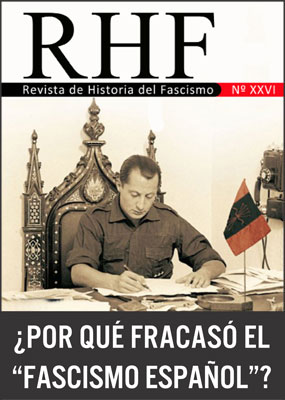
RHF nº XXVI

20131114092206-portada26medio.jpg

RHF n°XXVI

Acaba de aparecer el nº XXVI de la Revista de Historia del Fascismo correspondiente al mes de noviembre de 2013 que incluye los siguientes artículos:

Sumario:

DOSIER
Arde el Reichstag:
¿Cómo? ¿Cuándo? ¿Por qué?. Del 30 de enero al 5 de marzo de 1933: semanas decisivas

En la noche del 27 de febrero de 1933, cuando aún no se cumplía un mes del nombramiento de Hitler como Canciller, el Reichstag quedaba convertido en cenizas. Aun hoy subsiste en de­bate sobre quién incendió el edificio e incluso el autor material, Marinus Van Der Lubbe, ha sido rehabilitado en 1998. La respuesta del gobierno consistió en presentar una ley especial para la represión de estos actos de terrorismo que tuvo como consecuencia la prohibición del Partido Comunista Alemán (KPD) y sucesivas modificaciones legales que concentraron el poder en manos de Hitler. Presentamos la cronología de los acontecimientos y un análisis crítico del episodio.

NACIONAL-SINDICALISMO
Crónica de una frustración histórica
Las causas que impidieron el arraigo de un fascismo en España

La crónica del «fascismo español», esto es, del movi­miento nacional-sindicalista, es también la crónica de una permanente frustración que se manifestó ya desde los primeros momentos y que lo ha acompañado a lo largo de toda su historia. Debemos, pues, hablar de un «fascismo frustrado» mucho más que de una experiencia histórica consumada. Este artículo tiene dos partes, en la primera se aluden a las distintas causas que generaron esa frustración. En la segunda se describen las biografías de los dos principales exponentes de la «derecha falangista»: Onésimo Redondo Ortega y Julio Ruiz de Alda.

NACIONAL-SINDICALISMO
Dos biografías de la “derecha falangista”
Onésimo Redondo y Ruiz de Alda
(por Eduardo Núñez)

Después de esta introducción presentamos las biografías de los dos dirigentes falangistas más conocidos de su «ala derecha». Se trata de dos biografías sintéticas que nos sirven para situar a los personajes. Al lector le será sumamente fácil, con la introducción que hemos realizado, entender que situemos a estos dos personajes en la «derecha fa­langista». Vale la pena decir que, en el propio José Antonio, se percibe una evolución nítida a lo largo del año 1935 que lo va desplazando del «ala derecha», hacia nuevas posiciones. Esta evolución, por el contrario, no se percibe ni en Onésimo Redondo, ni en Julio Ruiz de Alda.

FASCISMOS INTERNACIONALES
Camisas doradas y el fascismo en México
(por Eduardo Basurto)

En el México insurgente del primer tercio del si­glo XX, tras las guerras cristeras (de las que León Degrelle fue un testigo excepcional) apareció el movimiento de los Camisas Doradas, rama militante de la Acción Revolucionaria Mexicanista, dirigida por Nicolás Rodríguez Carrasco, un movimiento que rechazaba a la democracia parlamentaria y el marxismo. Son considerados como el «partido fascista» mexicano más amplio y con una base más sólida. Su ciclo histórico fue breve pero aquí lo repasamos, desde sus orígenes hasta su extinción en el tiempo en el que la guerra ya había vuelto a prender en Europa.

NEOFASCISMO
Memorias de Stefano Delle Chiaie
Los años del exilio español

Reanudamos la traducción y publicación de las memorias de Stefano Delle Chiaie editadas en Italia con el título de El Águila y el Cóndor. Llega­mos a la dilatada etapa española en la que Delle Chiaie consigue crear, junto con el Comandante Borghese, una «santuario» en nuestro país cuya vigencia se prolongará hasta un año después de la muerte de Franco. Esta etapa es prolija en acontecimientos que están ligados en buena medida a las peripecias de la policía española de la época y que harán que el nombre de Delle Chiaie aparezca con mucha frecuencia en las primeras páginas de los medios de comunicación españoles durante la transición.

Formato 15x21 cm
232 páginas
Portada: cuatricomía, plastificada, con solapas
PVP: 18,00 €
Pedidos superiores a 10 ejemplares: 9:00 €

00:07 Publié dans Histoire, Revue | Lien permanent | Commentaires (0) | Tags : histoire, fascisme, revue, national-syndicalisme, espagne | |  del.icio.us | | Digg! Digg |  Facebook

Saudi Oil: Who Needs It?

SaudiArabiaOil.jpg

Pogos Anastasov

Ex: http://journal-neo.org

Saudi Oil: Who Needs It?

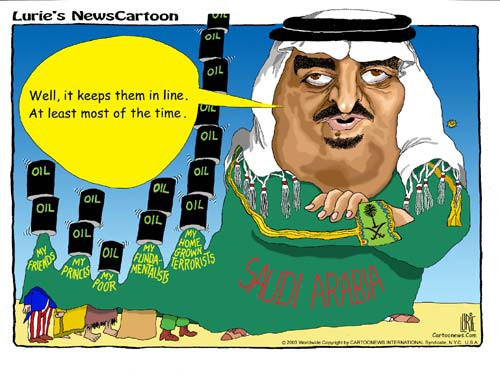
But these times same as the time of the oil embargo imposed by OPEC in 1973 at the KSA’s initiative to exert pressure on Western countries and make them change their policy regarding the Arab-Israeli conflict are long gone. Nowadays, neither OPEC nor Saudi Arabia can have a decisive influence on the international oil markets and the oil prices although Saudi Aramco, which is competing with Russia for first place in global oil production, produces up to 10.1 million barrels per day. In the last 40 years, the international market has seen the emergence of new players – Angola, Mexico, Venezuela and, most recently, the USA. American companies have not just reactivated old oil wells but also introduced to the market (only to the domestic market for now) a relatively new product – shale gas, the price for which, according to Saudi experts’ report published in the Saudi Gazette on 18 December of this year, has now dropped in North America from 13 dollars per million British thermal units (BTU) in 2008 to 4.29 dollars per million BTU in 2013.

As a result, their dependence on oil imports, due to which they have previously had to interfere in Middle Eastern matters, started to decrease drastically. According to the predictions of the International Energy Agency, by 2020 the USA will have become the world’s oil production leader leaving behind both Saudi Arabia and Russia. At approximately the same time (2018-2022), the United States will achieve energy independence, and by 2030 (according to a pessimistic forecast – by 2035) it will have turned into a net energy exporter. Even now, hydrocarbon supplies from the countries of the Persian Gulf to the USA do not exceed 10% of the overall oil production in the region, claims Daniel Yergin, head of Cambridge Energy Research Associates (CERA). In other words, Washington is not so much dependent on this region strategically as in the previous decades and, in fact, is even capable to reduce this dependence to zero in the coming years. Anyway, this dependence does not play a crucial role for the USA from now on, hence the US margin for political manoeuvre is increasing, which the USA has already demonstrated this year by the attempts to enter into a new configuration of its relations with Iran.

But Saudi Arabia is a different matter. Its margin for manoeuvre is shrinking. 90% of Riyadh’s revenue depends on oil and its price. The main consumers of Saudi hydrocarbons are now not the USA (it consumes 12% of the oil produced in the KSA), but China (more than 40 million tonnes a year out of about 250 million tonnes produced in the KSA), India and Southeast Asian countries. Moreover, this rapidly developing region is buying more and more oil from the Gulf countries.

Despite its strenuous attempts to develop the non-raw materials sector (petrochemistry, the production of aluminium, titanium and other metals), experts are positive that in the coming decades the KSA will not be able to significantly get rid of its oil dependence. And all indicators show that the country’s position in the energy sphere will be only getting worse and its capability to affect the policy of the leading Western countries will be reducing. This is caused by objective factors.

The fact is that, in the last 30 years, the KSA’s population has increased four-fold – from 5 to 20 million people (according to the 2010 census), and inclusive of foreign workers – to 28 million people, although unofficial estimates suggest the figure of 35 million people (if you also include illegal immigrants, against whom the Saudi authorities are now fighting tooth and nail). The country’s internal consumption of petroleum products has increased accordingly. It now constitutes 28% of the total volume of oil production, which virtually has not changed. If no decisive measures are undertaken, then by 2030 the country will be consuming nearly all of its oil. This means the KSA’s death since the country does not have any other significant sources of revenue, apart from oil. And they are unlikely to appear considering the complete closure by 2016 of the majority of the agricultural projects (grain, poultry farming) generating exports because of the depletion of water sources.

So how can these acute problems be solved? There are some solutions, both economic and political.

Probably, there will be a need for painful internal reforms in the economy. As Western experts point out, it is absolutely necessary to gradually refuse from subsidising the oil and electricity prices, which have remained unchanged for the last thirty years. In the KSA, a litre of petrol costs 15 cents – and that is an important factor for political stability. But this over-the-top cheapness encourages people’s wastefulness, who are used to driving huge off-road vehicles and having their air conditioners switched on 24 hours a day. It is clear that they cannot carry on living like that and that one day they will have to reject this economic model.

In the energy sector, they will have to start using nuclear power and as soon as possible make a decision on the construction of a complex of nuclear plants. The KSA has already been talking of the need to build 16 nuclear power units for two years but of no avail. There is still no sign of specialists, there are no contracts signed with foreign companies, although the negotiations with a Japanese-French consortium are in their advanced phase. But everyone knows that building a nuclear power plant takes between 6 and 12 years, which means that there is very little time left for the implementation of the projects.

The implementation of the widely touted solar energy projects has just started, and it is not clear whether they will play a significant role in energy production considering the technological problems associated with the adjustment of solar panels to Saudi Arabia’s hard climatic conditions – sand storms, sharp fluctuations of temperature etc. It is unlikely that solar stations will be able to significantly replace oil in the country’s economy.

Gasification of the country is a promising matter. Natural gas reserves, including in gas and condensate fields, are enormous in the KSA. But the implementation of such a major project will require large investments and, again, time, which is running out inexorably.

With regard to the foreign policy changes which could help the KSA to cope with the complex economic problems brewing up in the country, the voice of reason says that for Riyadh it will be good, first of all, to shift from the costly foreign policy of recent years and the ambitious projects of supporting the Arab “revolutions” on the basis of the export of home-grown ideology, which have already failed the leadership of Qatar; to withdraw from the exhausting and expensive confrontation with Iran (the support for the opposition in Syria alone costs billions); to search for compromise agreements with Tehran on the issues of security in the Persian Gulf instead of creating military-political blocs which have questionable goals (it is in its framework that it is planning to establish a single regional missile defence matching American systems) and which are not finding support among the neighbouring countries either.

Such agreements with the involvement of the great Powers may result in the creation in the Gulf region – in the case of the successful solution of the Iranian nuclear programme problem and settlement of the Syria crisis – of a collective security system similar to the one which has existed and quite successfully operated for nearly 40 years in Europe. In the event of such geopolitical choice (it is obvious that it needs to be supported by Iran as well), the KSA can get support from the world’s leading economies interested in ensuring stability in this rather sensitive region.

Pogos Anastasov, political analyst, orientalist, exclusively for the online magazine New Eastern Outlook.

Turkey Caught Up in a Storm

turkey-prot.jpg

Mikhail AGHAJANYAN
Ex: http://www.strategic-culture.org

Turkey Caught Up in a Storm

A corruption scandal has broken out in Turkey. At the epicenter of the scandal is the ruling Justice and Development Party (AKP). Over 50 people have been detained on suspicion of exceeding official authority, taking bribes, and merging authority and business (according to various data, between 52 and 84 people). The greatest resonance in the Turkish media was caused by the arrests of the sons of cabinet members. The hidden political motives for the revelations of corruption in the ranks of the ruling party are intriguing as well...

The scandal poses the greatest threat to Turkish Prime Minister Recep Erdogan, the leader of the AKP. He has always taken the position of an uncompromising fighter against corruption within the government system and outside of it, and now he himself has been affected by the corruption investigations. 

Commentators have proposed various explanations for the surfacing of a topic which compromises Erdogan and his party. They name a flare-up in the relations between two old friends (or rather, former friends) as the most likely detonator for the scandal. This refers to Erdogan and Fetullah Gulen, a Muslim cleric and founder of the Hizmet movement. The latter now lives in the American state of Pennsylvania, from which he continues to rule his «mini-empire», which includes media outlets and educational institutions (1), and influence social and political processes in Turkey. 

At the dawn of Erdogan's political career, as he was just starting to ascend the Olympus of power, there was complete harmony between him and Gulen. Gulen is an advocate of the systematic Islamicization of Turkey. His theological views combined with the ambitions of a political leader appealed to Erdogan. Gulen supported Erdogan in all the previous national elections. The flare-up in relations, Turkish commentators note, became noticeable in the first few months of 2012, when Erdogan and Gulen disagreed over several issues at once. The most sensitive among these for the «Gulenites» was the government's intention to close private schools. Approximately a quarter of such educational institutions in Turkey are closely tied with the Hizmet movement (they are often called «Gulen schools»). By autumn 2013 things had come to the point of direct confrontation. The Erdogan government moved from words to actions; several schools were forced to close their doors. This was a direct challenge to Erdogan's former ally. In response, the «Pennsylvania exile» brought all his influence to bear. Warnings to those in power appeared on the pages of Zaman, one of the most-read newspapers in Turkey, which is under Gulen's control. 

There are plenty of Gulen supporters in the ruling party, the corridors of power, and especially in the judicial and law enforcement systems of Turkey. If one is to believe Turkish journalists, it was pro-Gulen public prosecutors who initiated the corruption investigation. After Erdogan came to power in 2003, he promoted an entire cohort of personnel to responsible posts, including in the law enforcement system.  For all these years Erdogan's appointees have given no cause to doubt their loyalty to him. However, the flare-up between the prime minister and the influential Islamic authority figure has shown that the vector of loyalty can change.

At the same time, the agitation in the system of power built by Erdogan cannot be explained only by the conflict between Erdogan and Gulen. On the lower levels of the AKP there are growing sentiments in favor of a generational change in party leaders. In addition, some party members support the nomination of Abdullah Gul, the current president of Turkey, for another presidential term next year. The coming elections are to be held by direct voting for the first time (previously the president of Turkey was elected by the parliament). This part of the political elite sees Gul as a more level-headed statesman than the impulsive Erdogan, whose emotional disposition has recently led to several incidents in Turkey's relations with foreign partners.

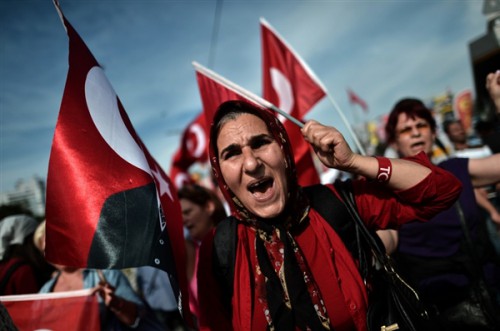
The nascent opposition to Erdogan and his circle has become especially difficult to restrain since summer 2013, when a wave of protests swept across the largest Turkish cities. The trigger was the clearing of Istanbul's Gezi Park and the building of a new shopping center on its territory. The authorities were able to localize the protests and prevent them from expanding beyond large cities. However, the demonstrations had deeper causes than environmental protection. Amid the complete removal of the Turkish army from positions of power and a series of prosecutions against senior generals, forces for which Erdogan's name was associated with total control over the media, a simulation of democratic reforms, and most importantly, the creeping Islamicization of Turkey, the aims and implementation of which has caused sharp disagreement even in the ranks of the ruling AKP, have become more active. 

The army returned to its barracks, and civilian activists took to the streets; fertile ground appeared for all the conflicts in society and the government to come to the surface. Up until then Gulen and his followers had been opposing Erdogan tacitly; the corruption scandal essentially was the first real manifestation of this group's capabilities. They sent Erdogan the signal that if he wants a «smear war», he'll get it. But first, let him think about what he will bring to the new elections next year (municipal and presidential). This is the somewhat simplified, but enlightening leitmotif of the current conflict between the prime minister and the preacher. The opinion of Turkish analyst Murat Yetkin is also worthy of attention: Gulen's supporters in the AKP are irritated by Erdogan's claims to ideological monopoly in the party and sole authority in the country.  

Erdogan reacted to the attacks on him and his team in his typical harsh style. The wave of arrests initiated by pro-Gulen public prosecutors was followed by a counter-wave of indictments. Now the public prosecutors and policemen themselves have fallen afoul of Turkish justice. Five Istanbul police officials were relieved of their duties a day after their subordinates made arrests on suspicion of corruption. Something similar could be observed in the «challenge-response» actions of Erdogan and his cabinet at the very beginning of the demonstrations in defense of Gezi Park in Istanbul. First Erdogan brought down the full force of Istanbul's police on the demonstrators, but then moved away from repressions. He started to hold a dialog with the protestors, albeit only in the intervals between firing water cannons at them and attacking them with tear gas. Something tells me that this time, too, after the energy of the conflict has dropped off, the various groups in power will start to resolve the conflicts through negotiation. Essentially, Erdogan has no other option, considering the upcoming elections; escalation of the conflict is not in his interests. 

Much will become clearer closer to the elections for the head of Turkey's largest city in March 2014. The country's main financial streams are concentrated in Istanbul, and over 18% of Turkey's 75 million people live there. Along with other metropolises of Western Turkey, the city has become a hotbed for protest sentiments with an anti-Erdogan tone. Victory in the Istanbul elections would serve as a stimulus for the current prime minister and his team to strengthen their power in the country. And then Gulen and his mudslinging will move to the ranks of less dangerous opponents to the impulsive yet charismatic Erdogan. 

(1) According to Turkish sources, Gulen's «mini-empire» includes 18 places of worship, 89 specialized religious schools, 207 trading companies, 373 teacher's colleges and around 500 dormitories in Turkey. Outside of Turkey there are 6 religious universities, 236 high schools, 2 elementary schools, 2 Turkish language study centers, 6 university preparation courses and 21 dormitories operating under the auspices of Gulen and his movement. They also publish 14 journals and broadcast on 2 national radio stations and the satellite television channel Samanyolu TV.


Republishing is welcomed with reference to Strategic Culture Foundation on-line journal www.strategic-culture.org.

République centre-africaine: l’enjeu, ce sont les matières premières!

rcasoldats.jpg

Bernhard TOMASCHITZ:

République centre-africaine: l’enjeu, ce sont les matières premières!


L’intervention française en République Centre-Africaine vise à s’assurer les réserves d’uranium et à contrer les manoeuvres américaines


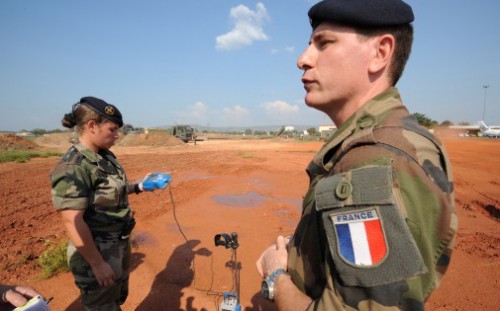
Le Président français François Hollande vient de s’engager une nouvelle fois dans une aventure militaire pour distraire l’opinion publique hexagonale, insatisfaite de sa politique intérieure. Après l’engagement français au Mali, au début de 2013, le président socialiste envoie cette fois ses troupes en RCA. Il y avait déjà 400 soldats français déployés dans ce pays en crise. 1600 autres viendront les rejoindre pour éviter que la RCA ne sombre dans la guerre civile. Hollande agit ainsi suite à un mandat du Conseil de Sécurité de l’ONU. En effet, depuis mars, l’alliance rebelle “Seleka” (= “Alliance”) est au pouvoir après avoir renversé le chef d’Etat François Bozizé. Depuis lors, les volences se sont multipliées dans le pays.


L’intervention française n’est pas seulement humanitaire. La RCA, ancienne colonie française d’une superficie de 620.000 km2, ne compte qu’à peine cinq millions d’habitants et sa densité est très faible. Elle recèle toutefois de grandes quantités de matières premières: de l’or, des diamants, du cuivre et de l’uranium. C’est évidemment cet uranium qui attise les convoitises de Paris. Finian Cunningham, qui travaille pour le “think tank” russe “Strategic Culture Foundation”, écrit à ce propos: “Les réserves (d’uranium) en RCA sont largement inexploitées. La France, qui dépend fortement du nucléaire pour la production de son électricité, avait commencé à construire des infrastructures minières pour transformer le minerais d’uranium, selon certaines sources”.


Les réserves connues d’uranium en RCA s’élèveraient à quelque 15.000 tonnes de minerais. En se basant sur ces chiffres, Cunningham écrit que la valeur stratégique de cet uranium ne saurait être surestimée pour les intérêts fondamentaux de la France. De fait, on trouve de l’uranium dans d’autres anciennes colonies françaises d’Afrique, dont le Mali et le Niger, “où la France, ces derniers temps, a déployé une politique interventionniste de plus vaste ampleur encore”.


Malgré ses énormes réserves de matières premières, la RCA est l’un des pays les plus pauvres du monde. C’est la politique de “Françafrique” qui serait la responsable de cette misère d’après Cunningham car elle n’a visé que les seuls intérêts de l’ancienne métropole. Cunningham: “La RCA est considérée comme un Etat failli plongée dans une crise permanente”. Le pays n’a jamais connu de gouvernement stable, suite à la succession ininterrompue de putsches et de contre-putsches qu’il a connue. Des éléments français ont orchestré quelques-uns de ces coups d’Etat, comme d’ailleurs dans d’autres anciennes colonies françaises.


Le dernier putsch perpétré dans la capitale Bangui en mars 2013 aurait, selon certains bruits, été possible seulement avec le soutien ou la tolérance de l’Occident. Pourtant, la réticence et la sobriété des médias occidentaux était frappante, alors que l’on prétend par ailleurs que les rebelles du mouvement “Seleka” ont des liens avec les islamistes. Le journaliste américain Patrick O’Connor donne une explication plausible: “Comparativement, la présence américaine en RCA est minime, ce qui pourrait rapidement conduire à une intervention de plus vaste ampleur. Les prétextes ne manquent pas: la crise humanitaire empire dans le pays; les éléments islamo-fondamentalistes prêtés au mouvement “Seleka” par certaines sources, etc.”.


Washington renforce son engagement militaire en Afrique centrale. Le 10 décembre 2013, l’agence de presse “Associated Press” annonce que le gouvernement d’Obama a demandé au ministère des affaires étrangères de dégager une somme de 60 millions de dollars pour fournir des armes et des équipements à la mission internationale patronnée par l’Union Africaine en RCA. Ensuite, le ministre de la défense Chuck Hagel a donné l’ordre à l’armée américaine d’aider le Burundi à transporter des troupes.


Le Président renversé Bozizé était considéré comme un allié important de la France. Mais il s’est peut-être lourdement trompé sur la fiabilité de Paris et de Washington. Après sa chute, Bozizé a accusé des “étrangers” (sans précision!) d’avoir soutenu les rebelles et pense que les troubles se sont déclenchés suite à l’octroi de contrats d’exploitation pétrolière à des sociétés chinoises et sud-africaines. Bozizé précise sa pensée: “Avant que je n’ait donné le pétrole aux Chinois, j’avais rencontré les gens de Total à Paris. Rien ne s’est passé. J’ai alors donné le pétrole aux Chinois et j’ai eu des problèmes”.


Conclusion: pour un Etat ou un pouvoir personnel africain, coopérer étroitement avec l’Empire du Milieu peut avoir de lourdes conséquences. En effet, depuis une bonne année, Washington et Pékin sont entrés dans une phase d’âpre concurrence pour s’emparer des énormes richesses minières de l’Afrique et Paris aussi cherche à s’octroyer une part de ce pactole. Abayomi Azikiwe, éditeur du “Pan-African News Wire”, estime que la France est désormais, elle aussi et au nom de son passé de puissance colonisatrice, une concurrente des Etats-Unis sur le continent africain. Les Etats-Unis sont effectivement intervenus de manière lourde dans les affaires de plusieurs pays africains au cours de ces dernières années. Azikiwe donne l’exemple patent de la constitution de l’Africom, “qui engage désormais des milliers de soldats dans des opérations sur l’ensemble du continent africain et face à ses côtes, tant à l’Ouest qu’à l’Est”.


La politique africaine de Washington consiste surtout à former et à équiper les forces armées de leurs “partenaires”, que ce soit au nom de la guerre planétaire contre le terrorisme ou au nom de la lutte contre le trafic international de drogues. L’Ouganda, dans ce jeu, est le principal allié des Américains en Afrique orientale. Un rapport de l’USAID, l’instance officielle qui chapeaute l’aide au développement, a été récemment adressé au Sénat des Etats-Unis; on peut y lire ces lignes: “Les UPDF (les forces de défense populaires ougandaises) sont les meilleures partenaires des Etats-Unis dans la guerre contre le terrorisme en Afrique orientale. Les UPDF déploient en ce moment 5000 soldats appartenant à des unités de combat en Somalie (...). Il faut aussi ajouter que les UPDF prévoient de mettre à disposition 2000 soldats supplémentaires pour les théâtres d’opération sud-soudanais et centre-africain, où, de concert avec leurs conseillers militaires américains, ils combatteront les forces de la LRA”. La LRA ou “Lord Resistance Army” (“L’Armée de Résistance du Seigneur”) est un groupe armé de fondamentalistes chrétiens, pourtant affaibli depuis quelques mois.


Bernhard TOMASCHITZ.

(article paru dans “zur Zeit”, Vienne, http://www.zurzeit.at, n°51-52/2013).