Ok

En poursuivant votre navigation sur ce site, vous acceptez l'utilisation de cookies. Ces derniers assurent le bon fonctionnement de nos services. En savoir plus.

dimanche, 12 janvier 2014

Lucien Cerise: Big Brother

00:07 Publié dans Evénement | Lien permanent | Commentaires (0) | Tags : événement, lyon, france, big brother, lucien cerise | |  del.icio.us | | Digg! Digg |  Facebook

Christophe Poitou : « Le totalitarisme économique, manipulations mondiales et répression financière »

Christophe Poitou : « Le totalitarisme économique, manipulations mondiales et répression financière »

Ex: http://fortune.fdesouche.com

Loligarchie est mauvaise perdante. Elle ne laissera pas ce qu’on appel le système, qui est un « tout subtil et maléfique », se faire balayer par une crise économique, ce qui pourtant serait logique. Elle s’est laissé surprendre en 2008 par Lehman, mais ne se fera probablement pas avoir ainsi deux fois, elle prendra toutes les mesures nécessaires. À commencer par le refinancement ad libitum des agents financiers en difficulté présentant un risque systémique.

« Dernière combine en date (avril 2013) évoquée pour refinancer les agents en difficulté sans toucher à la dette publique centrale : la mise à contribution forcée de l’assurance vie des particuliers pour soutenir les entreprises en difficulté. On parle là d’un détournement de près de 100 milliards »

Il s’agit d’éviter une crise trop monstrueuse qui se transformerait en crise politique majeure avec éventuellement l’arrivée au pouvoir de partis de sensibilité nationale ou l’avènement de telle ou telle situation qui la dérangerait trop. En fait, si on prend les choses avec du recul on peut dire que d’une certaine manière l’oligarchie se refinance elle-même dès qu’elle est en difficulté. Dans les faits, ce à quoi nous assistons depuis quelques temps.

Elle ne peut donc en quelques sorte jamais être en difficulté ni être en passe être renversée ?

Un krach obligataire dantesque aurait déjà du éclater en 2009/2010. Cela n’a pas été le cas. Certes, Sarkozy, Papandréou, Berlusconi ou Monti ont sauté, mais ça ne change pas grand-chose. Le système lui-même, lui, est toujours là. L’oligarchie a pris les mesures nécessaires sans la moindre légitimité ou consultation démocratique pour se maintenir et empêcher toute crise grave.

Quelles sont ces mesures ?

Ce sont ces mesures – en fait, ces sales méthodes – que j’examine une par une dans mon livre : la création monétaire dans ces diverses variantes, l’allongement de la maturité des titres, le partage forcé de la valeur ajoutée, l’extorsion fiscale, l’exportation de l’inflation, les manipulations des taux de change, ainsi que la manipulation à mon avis la plus satanique de toutes: les taux d’intérêt inversés ou négatifs.

J’examine aussi les diverses formes de répression financière dont le cas de Chypre fournit actuellement un exemple incroyable. La méga-gaffe récente du commissaire européen Jeroen Dijsselbloem sur le fait que la répression financière à Chypre pourrait être éventuellement transposé chez nous fait froid dans le dos !

Le masque tombe…

À vrai dire, c’est déjà en partie le cas. On s’apprête en France à puiser de force dans l’épargne de M. et Mme Dupont pour financer les HLM faute de pouvoir faire de la création monétaire et de la dette comme avant !

Une crise majeure n’est donc pas envisageable ?

Si, peut-être qu’en dépit de toutes ces mesures oligarchiques, une crise éclatera quand même… Ça ne me dérangerait pas d’ailleurs. Je dirais même que j’espère me tromper ! Vivement un monstrueux ouragan obligataire qui fasse valdinguer les puissants et emporte tout sur son passage de son souffle puissant et vengeur. Mais je n’y crois pas trop, hélas…

Le rôle des apatrides cosmopolites est d’ailleurs significatif dans cette stabilisation totalitaire que nous voyons actuellement : ils sont massivement pour la création monétaire en occident car elle préserve le système tel qu’il est et dans lequel ils ont de bonnes places…

Ils ne vont donc pas se tirer une balle dans le pied et se limoger eux-mêmes ?

Évidemment… En revanche, lorsque qu’ils n’ont pas de places assez bonnes à leur goût ou n’arrivent pas à se saisir d’actif réels, c’est l’inverse, ils essaient de renverser le système et non de le maintenir.

Logique ! Ils utilisent alors la déflation et non la création monétaire, à savoir la fuite des capitaux ou alors des phénomènes déstabilisants : sortie de capitaux, par exemple… Ils font régulièrement le coup en Russie… C’était le cas avant 1917 et c’est le cas actuellement sous Poutine… Chez nous, c’est le contraire, ils essaient de stabiliser de force le système.

Qu’en concluez-vous ?

Certes, techniquement nous pouvons vivre sur l’héritage de nos ancêtres encore un peu. L’économie peut continuer quelques temps toute seule comme un poulet sans tête, sans son noyau spirituel, car elle est très mécanisée et rodée dans ces process. Hop ! vous appuyez sur le bouton d’une machine à laver et ça marche tout seul pendant une heure… Mais l’économie ne survivra pas éternellement à l’affaiblissement de sa cause, c’est-à-dire à l’affaiblissement de la population française de souche qui l’a créée.

Bonne question, ça : qui a créé l’économie française ?

Les banquiers qui sont souvent des gros mégalomanes vous diront parfois qu’ils ont à eux tous seuls financé et créé la sidérurgie ou les chemins de fer. La vérité, c’est plutôt que c’est le dur labeur des paysans au cours des siècles qui a fondamentalement accru les rendements et dégagé une main-d’œuvre qui a permis l’essor de l’industrie.

Voyez aussi ce qui se passe en Afrique du Sud. En dépit des taux de croissance nominaux flatteurs qui ne veulent pas dire grand-chose, le pays entre dans une phase de délabrement grave car les Sud-Africains d’origine européenne qui ont créé cette économie s’en vont. Un article est paru d’ailleurs sur ce thème dans le pourtant très politiquement correct The Economist : South Africa cry the beloved country.

Le totalitarisme économique de Christophe Poitou, éditions de L’Æncre, collection « À nouveau siècle, nouveaux enjeux », dirigée par Philippe Randa, 250 pages, 25 euros.

Francephi

Fallujah: Obama’s Newest Headache

31C3FA37-BE96-4FDC-A2FA-6D8D8E15C8DE_mw1024_n_s.jpg

Fallujah: Obama’s Newest Headache

Melkulangara BHADRAKUMAR

Ex: http://www.strategic-culture.org

 
Guernica in the Spanish civil war, My Lai in the Vietnam War, Guantanamo Bay in the war on terror – these have been powerful symbols. The siege of Fallujah in May 2004 stands out in the Iraq War as the bloodiest battle that the United States fought since the Vietnam War. The US Marines suffered 40 deaths in the siege, while Iraqi civilian casualties were in the hundreds. The US forces reportedly used F-16 warplanes to blitz residential areas in Fallujah with cluster bombs. The majority of prisoners were executed…

As the US Marine Corps announced a ceasefire and withdrew in May 2004, mosques proclaimed the victory of insurgents and Fallujah’s transformation began as a sort of Islamic mini-state with Sharia law. So, in the fall of that year, in late October, the US military returned with another major offensive with aerial attacks and precision-guided missiles followed by a full-blooded assault by the Marines backed by artillery and armor in early November – Operation Phantom Fury. 

This is how CNN’s Karl Penhaul reported on November 9: «The sky over Fallujah seems to explode as U.S. Marines launch their much-trumpeted ground assault. War planes drop cluster bombs on insurgent positions and artillery batteries fire smoke rounds to conceal a Marine advance». According to Washington Post, white phosphorous grenades and artillery shells were used to create «walls of fire» in the city. Doctors later reported seeing melted corpses. No one knows the casualty figures; as of November 18 US military claimed 1200 ‘insurgents’ had been killed and 1000 captured… 

A Guardian report said over 70 percent of the city’s homes were destroyed along with sixty schools and sixty-five mosques and shrines. There has been anecdotal evidence of large increases in cancer, infant mortality, etc. among the survivors, triggering speculation that there was use of depleted uranium leading to environmental contamination. 

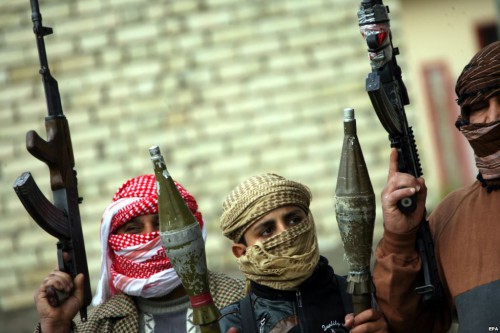
It is extremely important to recollect the horrendous living memory of Fallujah to understand what happened last week when the centre of the city fell into the hands of fighters from the al-Qaeda-linked Islamic State in Iraq and Levant [ISIL]. Fallujah, along with the capital of Anbar province, Ramadi, was a stronghold of Sunni insurgents during the US occupation of Iraq and al-Qaeda militants largely took over both cities last week. Hundreds of ISIL fighters have entered Fallujah. 

Pundits have begun analyzing the factors behind. The dominant narrative is that the Iraqi government led by Prime Minister Nouri al-Maliki failed to reach out to the Sunnis and alienating them during the period since the US troops pulled out in 2011. Indeed, the latest flare-up happened after Maliki dispatched troops last week to break up an year-old Sunni protest in Ramadi to voice their grievances of political exclusion. Almost all Sunnis have turned against the government and are opposed to the Iraqi security forces, although not all have aligned themselves with the ISIL. 

Meanwhile, the turmoil in Syria in which ISIL is playing a lead role has compounded the security situation in Iraq. The ISIL has been targeting Shi’ites, which at once gives the conflict in Anbar a sectarian overtone. Also, Iraq is heading for parliamentary poll in April and there are conspiracy theories that Maliki is calibrating a confrontation with Sunnis and raising the spectre of the al-Qaeda threat that might help him rally the Shi’ite opinion to support his re-election. 

However, Maliki’s decisions are also prompted by the real fear that his Shi’ite-led government is besieged and faces the threat of being overrun Sunnis. To say he contrived the al-Qaeda takeover in Fallujah stretches credulity. The ISIL comprises hardened fighters coming in from Syria where the US’ regional allies in the Persian Gulf, especially Saudi Arabia, have been inducting foreign fighters and supporting them financially and with weapons. Also to be factored in is the so-called Sahwa, the Awakening, which the US created as surrogate force to fight the al-Qaeda and was abandoned when the American troops withdrew in 2011. Most of its leaders have been assassinated. 

Suffice to say, in terms of political morality or strategy, the Barack Obama administration cannot wash its hands off the emergent situation in Fallujah. The blame for the Iraq’s unraveling as a nation should lie with the George W. Bush presidency. Bush’s forecast of ‘mission accomplished’ in Iraq and Gen. David Petraeus’ brag about the Awakening sound hollow today. 

To be sure, how Obama responds to the situation in Fallujah has wider implications for the US’ regional strategies. Secretary of State John Kerry said, «We’re not contemplating putting boots on the ground. This is their [Iraqis’] fight, but we’re going to help them in their fight». 

The White House spokesman Jay Carney said Washington is «accelerating» its deliveries of military equipment to Iraq and «looking to provide an additional shipment of Hellfire missiles» in the coming months as well as ten surveillance drones in the coming weeks and another 48 later this year. Carney added that Washington is «working closely with the Iraqis to develop a holistic strategy to isolate the al-Qaeda-affiliated groups», but ultimately Iraq must handle the conflict itself. 

The point is, US fought ferociously in 2004 to keep al-Qaeda out of Fallujah and now they’ve returned and may create a base there and this is every bit the US’ fight and Maliki government is a quasi-ally of Washington. The US’ interests in the region will be seriously hurt if al-Qaeda establishes another foothold in the region. And, of course, the whole region is watching Washington’s grit to take on al-Qaeda. 

The Republican hawks like Senators John McCain and Lindsey Graham blame Obama for the situation insofar as he didn’t try hard enough to reach an agreement with Maliki to keep US troops in Iraq beyond 2011. However, the criticism won’t gain traction as the domestic attitudes in the US favor the idea that despite the upheaval in the Middle East, the US will do well to seek a diplomatic and political engagement with the region rather than a military settlement. 

The choices that lie ahead for Obama can be viewed from three perspectives. First, the Fallujah situation sails into view at an awkward time – when the Obama administration proposes to maintain anywhere around ten to twelve thousand US troops in Afghanistan. That plan lacks support within the US and the Fallujah situation is a timely warning about the dangers of maintaining a large residual force in Afghanistan. 

Second, Fallujah highlights that the wars in Syria and Iraq and the dangerous slide in Lebanon have morphed. At the same time, Fallujah is not an al-Qaeda problem alone. It is a city that became irreconcilably alienated in the brutal violence of US occupation and it no longer feels it’s a part of Iraq. Thus, Fallujah calls attention to a far more fundamental question regarding the future of Iraq itself. This, again, holds some stark lessons for Afghanistan where too the US occupation hastened the fragmentation along ethnic and religious lines. A response to the crisis by accelerating weapons deliveries to the Iraqi government will not solve the problem and may even make it worse. 

A third stunning aspect is that the Fallujah situation finds the US and Iran on the same side. Their respective interests in Iraq vary but they share the profound concern that an international movement of Sunni fighters fired by Wahhabi ideology is raising the black flag of al-Qaeda along sectarian fault lines. Neither is willing to intervene and Tehran too promises military aid but shows reluctance to put ‘boots on the ground’. 

The Obama administration could be edging close to acknowledging Iran’s influence on regional issues – Iraq, Syria, Afghanistan, Yemen – and this hastens regional realignments. Saudi Arabia accuses the Obama administration of strengthening Iran’s regional at the expense of Washington’s traditional allies and also alleges that Tehran is pursuing a clever strategy to undermine the US-Saudi alliance. 

Indeed, Foreign Minister Mohammad Javad Zarif said at a meeting with a visiting delegation of Italian lawmakers on Sunday in Tehran that the spread of radicalism in the Middle East would pose unpredictable threats to other parts of the world as well unless countered through effective international cooperation. The Intelligence Minister Seyed Mahmoud Alavi claimed that the western powers realize that international cooperation is needed to counter the «threat of terrorism by Takfiri groups». 

Significantly, a bipartisan a group of influential figures in the US foreign policy establishment addressed a letter to the US Senate on Monday urging that no new sanctions be passed against Iran, warning that it would potentially move the US closer to war. Ryan Crocker who was a former ambassador to Iraq, led the initiative.

L’affaire Dieudonné : l’arbre qui cache la forêt de l’offensive contre Internet

shoahnanasprocé.jpg

Ex: http://www.polemia.com

L’affaire Dieudonné : l’arbre qui cache la forêt de l’offensive contre Internet

« Car, si personne ne bouge, c’est la pensée (…) qui sera étouffée ».

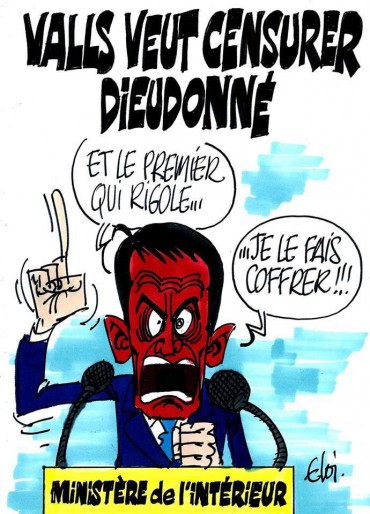
Que Manuel Valls, qui aura passé toute la trêve des confiseurs à ostraciser Dieudonné, s’affirme, « par [s]a femme, lié de manière éternelle à la communauté juive et à Israël » et qu’il soit « fier de faire partie d’un gouvernement qui veut bâtir une amitié forte avec Israël », nul ne le contestera puisqu’il l’a maintes fois affirmé, par exemple le 22 juillet 2012 à Strasbourg. Qu’il espère supplanter Jean-Marc Ayrault à Matignon à la faveur de ses dernières gesticulations, très médiatiques mais dérisoires au regard de sa défaite contre la criminalité et de son triste bilan de la Saint-Sylvestre (trois personnes assassinées à l’arme blanche et 1067 véhicules incendiés malgré le déploiement de 53.000 gendarmes et policiers) est une évidence. Mais le ministre de l’Intérieur réussira-t-il, grâce à sa circulaire du 6 janvier, à faire interdire par les préfets les spectacles de celui qu’il qualifie de « petit entrepreneur de la haine », « raciste et antisémite », obsédé par la « haine du juif » jusqu’à faire « l’apologie de la Shoah» ?

Pas impossible si les nervis de la Ligue de défense juive provoquaient des troubles à l’ordre public susceptibles de faire annuler la tournée de Dieudonné en province. Rappelons que la LDJ est une organisation interdite aux Etats-Unis et même en Israël pour son extrémisme mais qu’elle est protégée chez nous en haut lieu et par la gens Klarsfeld qui, à l’abri de ses Légions d’honneur (Madame est Grand-Croix et Monsieur Grand Officier), doit cornaquer ce mercredi à Nantes une manifestation hostile. (CG)

Un prétexte à la « normalisation » du Web


Encore qu’il s’agirait, si M. Valls parvenait à ses fins, d’une scandaleuse atteinte à la liberté d’expression doublée d’une atteinte encore plus monstrueuse à la liberté du travail – en application servile de la loi nationale-socialiste sur le Berufsverbot ou disqualification professionnelle, loi jugée scélérate à l’époque –, la question est peut-être secondaire et va bien au-delà du cas du seul Dieudonné M’Bala M’Bala – dont on peut penser ce qu’on veut, y compris du mal.

C’est la liberté d’expression de millions d’internautes français qui est menacée.

Le conflit s’était envenimé au fil des mois entre le journaliste Patrick Cohen, anchorman des matinales de France Inter qui avait dressé en mars une liste noire des individus nauséabonds, dont Dieudonné, à ne jamais inviter sur les antennes du service public, et l’humoriste ; ce dernier avait lancé en décembre, dans son théâtre parisien de La Main d’Or, une phrase provocatrice mais étrangement ambiguë : « Quand je l’entends parler, Patrick Cohen, j’me dis, tu vois, les chambres à gaz… Dommage. » Voulait-il dire par là « dommage que les chambres à gaz n’aient jamais existé » ou, au contraire – ce qui prouverait du moins que cet « antisémite » n’est nullement révisionniste, « dommage qu’elles n’existent plus » ?


Peu importe. Dès lors, la machine s’emballa et d’autant plus que, simultanément, le footeux antillais Nicolas Anelka, dont les multiples incartades verbales et le refus obstiné de chanter La Marseillaise quand il jouait d’aventure en équipe de France ne gênaient personne, célébrait d’une « quenelle », posture prétendument néo-nazie, le but qu’il venait de marquer outre-Manche pour son nouveau club de West Bromwich Albion. La photo blasphématoire, dédiée à « [son] ami Dieudonné », ayant fait le tour du monde (et des cités ethniques), le prétexte était tout trouvé pour passer aux choses sérieuses.


Soit, sovietico more, la « normalisation* » d’Internet, cet insupportable espace de liberté où peuvent s’étaler toutes les opinions et, plus grave, toutes les contestations des dogmes les mieux établis.


Une répression « légitime »


Car cette offensive couvait depuis plusieurs mois et, dès le 26 septembre dernier, sur le site Boulevard Voltaire, Jean-Yves Le Gallou avait accusé l’Union des étudiants juifs de France (UEJF), « bras armé du Conseil représentatif des institutions juives de France (CRIF) », de revêtir « l’habit du censeur » en se plaçant « en tête des tentatives de censure d’Internet : poursuites de blogs, poursuites de commentateurs, poursuites de réseaux sociaux ».


Comme pour donner raison au fondateur de Polémia, le CRIF publiait le 13 octobre contre la « Fachosphère du Net » une philippique de son spécialiste des médias Marc Knobel qui déplorait : « Certes, des associations antiracistes ont engagé des procédures afin de s’opposer à ces marchands de haine ; toutefois, pourquoi s’en remet-on en ce domaine au seul dévouement (sic) de ces associations ? La lutte contre le racisme et l’antisémitisme sur Internet n’incombe-t-elle pas AUSSI aux pouvoirs publics ? »

Le 17 octobre, toujours sur le site du CRIF, le même exhortait donc le gouvernement à appliquer dans toute sa rigueur la législation muselant « l’Internet de la haine », car « les restrictions à la liberté d’expression peuvent être considérées comme légitimes pour lutter contre le racisme », y compris dans les « nouveaux médias ». « Si le droit à la liberté vaut pour Internet, les restrictions à celle-ci s’appliquent également. Internet n’étant qu’un instrument et non un but en soi, il ne peut être tenu pour affranchi des lois nationales et internationales », théorisait M. Knobel.


Un président et un gouvernement aux ordres…


Message reçu. Accueillant le 16 décembre à l’Elysée Roger Cukierman, président du CRIF, à l’occasion du septantième anniversaire de ce lobby, le chef de l’Etat lui déclarait notamment: « Quand vous avez des choses à dire, Monsieur le Président, vous les dites et vous les dites librement, franchement, sincèrement, bruyamment et nous vous écoutons**. »


Rien d’étonnant, dans ces conditions, si, deux jours plus tard, les députés saisis d’une proposition de loi inspirée des préconisations de la pourtant très institutionnelle Commission nationale consultative des droits de l’homme (CNCDH) sur la nécessité d’étendre aux blogueurs la protection dont bénéficient les sources des journalistes, rejetaient ce texte ; et si, dans la foulée, la « Dieudosphère », considérée à tort ou à raison comme le fer de lance de la « Fachosphère », se retrouvait sous la mitraille qui, prenons-en le pari, ne s’arrêtera pas à cette seule cible.

« Haine sur Internet : la guerre est déclarée », triomphait donc le 3 janvier Daniel Makonnen, responsable de la communication de la LICRA, ravi de l’imminente mise au pas du Web.


Car, si « la Toile » s’est aussitôt enflammée devant la menace d’asservissement et d’épuration, on n’a noté du côté des humanistes homologués ni réserves ni scrupules mais au contraire une acceptation béate de la machine de guerre gouvernementale, un lâche soulagement devant le « courage » de l’équipe Ayrault qui s’apprête à faire voter un projet de loi étendant les possibilités de capter les données numériques, véritable « Patriot Act » à la française instaurant une sourcilleuse censure et incitant à la délation.


…et une Intelligentsia complice des éradicateurs


Défenseur des démocrates ukrainiens en lutte contre le tyran Poutine comme il l’avait été des honorables républicains libyens contre l’immonde Kadhafi, Bernard-Henri Lévy tresse ainsi des lauriers au petit Jdanov de la Place Beauvau, initiateur de la nouvelle « ligne générale »:

« Il y a un moment où […] il est du devoir de la parole publique de dire. Valls l’a fait, Valls a eu raison. Il n’y a rien de commun, rien, entre le travail d’un humoriste dont la liberté d’expression et donc de provocation est effectivement sacrée, et l’entreprise d’un agitateur néonazi qui fait ouvertement campagne sur des thèmes qui ne sont pas des opinions mais des délits. »


Cette opinion est partagée par Bertrand Delanoë qui, abandonnant la mairie de Paris dans l’espoir d’un maroquin ministériel, doit donner des gages. Dieudonné étant pour lui « quelqu’un qui fait l’apologie de crimes contre l’Humanité et qui par ses propos porte atteinte à la dignité humaine, il doit être combattu avec toutes les rigueurs de la loi ». Et surtout avec la force injuste de la loi.


Ce qui tombe bien puisque, tout aussi acharnée, Mme le Ministre délégué à l’Economie numérique Fleur Pellerin – Coréenne naguère adoptée par un couple français, cas également du camarade Jean-Vincent Placé, le gourou des Verts – s’est félicité de la possibilité « de faire condamner toute personne propageant des propos racistes sur les réseaux sociaux » : « Aujourd’hui, la Justice a les moyens techniques de faire appliquer les décisions et c’est ce qu’il faut faire, y compris dans le cas de Dieudonné », déclarait-elle le 31 décembre, sûre que sa collègue à la Justice Christiane Taubira, si indulgente aux FEMEN profanatrices de tant de nos églises et aux auteurs de crimes crapuleux, se montrera intransigeante à l’encontre des déviants idéologiques.


Un modèle démocratique : la Chine populaire !


Mais la palme de l’inconscience ou, si l’on préfère, du cynisme, revient sans doute à l’éthéré dandy qui sert de directeur à L’Express. Participant aux Grandes Gueules sur RMC le 3 janvier, Christophe Barbier proclamait ainsi : « Internet n’est pas un no man’s land. Internet est un champ d’impunité, mais ça se régule aussi, Internet. Entre nous, hein, les Chinois y arrivent bien. Si les dictatures y arrivent, il faut que les démocraties y arrivent aussi ! »


1484200_499139856871997_996429681_n.jpg

Quatre-vingts ans après le pamphlet de Paul Nizan, Les Chiens de garde (de l’ordre établi), sortait en 2012 un documentaire politique, Les Nouveaux Chiens de garde inspiré du livre éponyme de Serge Halimi. Christophe Barbier y était durement étrillé pour sa défense de la « mondialisation heureuse » et de l’idéologie dominante. On aurait pu croire qu’après son ode, digne d’un Garde rouge, à la répression, le personnage serait durablement tricard des plateaux. Tout au contraire, il était deux jours plus tard l’invité d’honneur du 19/20 de France 3 où il exalta l’ardente obligation d’une « pédagogie mémorielle » car « on ne peut pas rire de tout », proclame celui qui se présente comme « un esprit libre ».


Détail savoureux : M. Barbier, normalien controversé car, recalé au concours d’entrée rue d’Ulm, il n’en aurait suivi les cours qu’en auditeur libre et ne possède d’ailleurs qu’une maîtrise d’histoire, a tourné dans Doutes, un film de son épouse, Yamini Kumar-Cohen (elle-même directrice de la communication chez Hermès), censé fustiger le… « Politiquement Correct » ! Ce qui l’autorisait évidemment à réclamer, il y a deux ans déjà dans L’Express, « un droit mondial du Web ».


Un tel droit, également exigé par Ariel Wizman, son confrère de Canal+, qui réclamait le 28 novembre la création d’une « police du Net », selon lui « égout de la pensée », mène, on le sait, à l’alignement déjà observé par les « médias en servitude » et heureux de l’être, mais furieux de voir leurs certitudes, leurs oukases et leur magistère battus en brèche par de simples citoyens.


En 1984, la suspension de la nouvelle radio NRJ, dont la puissance d’émission brouillait toutes les antennes voisines, avait jeté dans la rue trois cent mille jeunes et forcé le pouvoir socialiste à reculer. L’enjeu est aujourd’hui bien plus important. Car, si personne ne bouge, c’est la pensée, dont a si peur M. Wizman, qui sera étouffée.


Notes :


(*) « Normalisation » : tel avait été l’euphémisme choisi en août 1968 par Michel Debré, alors ministre des Affaires étrangères de Charles De Gaulle, pour qualifier l’envoi des blindés soviétiques ayant pour mission de mater le « printemps de Prague ».
(**) Souligné par nous


Germany's military strategy

Bundeswehr_Soldaten_Freiwil.jpg

Germany's military strategy


The NATO defense strategy during the Cold War must have been a real nightmare for some West-German officers. Even the former West-German chancellor Helmut Schmidt said in 2007 in an interview that he was shocked when he was informed about the NATO plans in 1969. Schmidt said that there was a belt of nuclear mines crossing West-Germany which would detonate in case of a Soviet invasion. West-Germany was seen as the future nuclear battlefield. The country formally known as “Germany” would have been turned into a giant ground zero in the center of Europe. The Germans in West and East Germany were in the nuclear death row of the Cold War. 
 
The West-German army, the Bundeswehr, was part of those plans. The NATO strategy was: In case of a Soviet aggression, the Eastern Block armies will carry out their most powerful ground attack of the so called “Iron Curtain” in central Europe on Germany. It would be almost impossible to stop the Eastern armies before the Rhine River. West-Germany was supposed to be the “death trap” for the enemy?s armies, and for the German civilians. The Bundeswehr didn't play a big strategic role in that horrible scenario, the West-German soldiers might have been killed or defeated by the overwhelming Eastern forces and by the Western nuclear response within days. 
 
Germany in 1945: After the unconditional surrender of the German Wehrmacht, the former Reich became split in Zones of Occupation  by the allied powers. In the West US-American, British and French forces established their zones, in the center the Soviet occupation zone was established, East Germany was occupied by Poland and the Soviet Union. The Reich was destroyed; huge cities as Berlin, Hamburg, Konigsberg or Dresden became just ruins. Millions of German refugees became strayed; the former most powerful nation on continental Europe was disarmed and weakened down, thus creating a vacuum of power. The allied conference of Potsdam in the summer of 1945 made clear that there is now a new confrontation: The Western block under Anglo-American leadership against the Eastern communist block under Soviet leadership. In 1949 two German states were created: In the Western Zones of Occupation the Federal Republic of Germany (Bundesrepublik Deutschland), in Middle Germany the German Democratic Republic (Deutsche Demokratische Republik). At the time when these states were founded they didn?t have any military force. 
 
Germany remained completely demilitarized and any plans for a German military were clearly forbidden by Allied regulations. Only some naval mine-sweeping units continued to exist, but they remained unarmed and under Allied control and did not serve officially as a defense force. Even the Federal Border Protection Force (Bundesgrenzschutz), a mobile and lightly armed police force of 10,000 men, was formed only in 1951 - two years after the founding of the Federal Republic of Germany. A first proposal to integrate West German troops with soldiers of France, Belgium, the Netherlands, Luxembourg and Italy in a so called “European Defense Community”, in reality a Western European Army , was proposed but never realized. It was especially France who opposed any plans to rearm West Germany for a long time. “German militarism” was blamed to have caused both World Wars. Germany should never become a continental super power again. And the best “medicine” against militarism seemed to be not to permit any military forces.
 
With growing tensions between the communist Soviet Union and the liberal capitalist West, especially after the Korean War (1950-1953), this policy was to be revised. While the German Democratic Republic was already secretly rearming, the plans of a new West German force started in 1950 when former high-ranking German officers of the Wehrmacht were tasked by Chancellor Konrad Adenauer to discuss the options for rearmament. The so-called “Amt Blank”, the predecessor of the later Federal Ministry of Defense (Bundesverteidigungsministerium), was formed in 1950 in Bonn. 
 
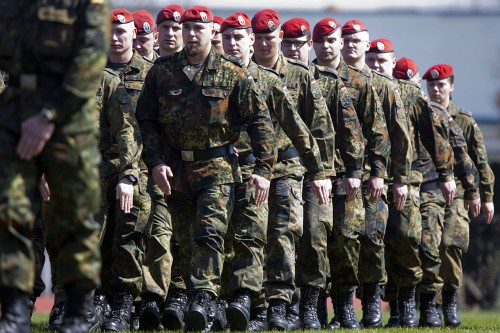
The West German “Bundeswehr” was officially established on the 200th birthday of the Prussian general Gerhard von Scharnhorst on November 12th, 1955. But the rearmament (“Wiederbewaffnung”) of West Germany was not easy at all. Huge protests raged against those plans. Not only traditional pacifists opposed to those plans, but also German neutralist politicians and intellectuals who campaigned for one united Germany were strongly against the rearmament. They saw in those plans the manifestation of the German partition. 
 
And there was another dilemma: Since the unconditional surrender of the German Wehrmacht, the allied powers put a lot of energy in the so called “denazificiation” of the Germans. The Wehrmacht was identified as one of the worst instruments of German militarism. The generals and officers of the Wehrmacht and the Waffen-SS were seen as bloodthirsty warmongers and war criminals. But all of a sudden the West asked especially for the Wehrmacht personnel. The reason for that political U-turn is easy: The Wehrmacht and the Waffen-SS were the only military forces with a certain experience in fighting the Soviet army during World War II. From the beginning, the new Bundeswehr suffered under an “identity conflict”. While the politics went on with stigmatizing the officers of the German World War II forces, the same officers had to build the new army. 
 
During the Cold War the Bundeswehr was the front line of NATO's conventional defense in Central Europe. The West German army had strength of 495,000 soldiers. The Cold War Historian John Lewis Gaddis assesses the Bundeswehr in his book “The Cold War - a New History” as “perhaps world?s best army”. But the Bundeswehr did not take part in any combat operations during the Cold War times. The West German armed forces were during the whole Cold War an integrated part of the NATO military strategy. 
 
After the reunification of Germany in 1990, the Bundeswehr was reduced to 370,000 military personnel in accordance with the Treaty on the Final Settlement with Respect to Germany between the two German governments and the Allies (2+4 Treaty). The former East German Nationale Volksarmee (NVA) was disbanded. About 50,000 Volksarmee personnel were integrated into the Bundeswehr on October 2nd, 1990. With the reduction, a large amount of the military hardware of the Bundeswehr, as well as of the Volksarmee was disposed. Most of the armored vehicles and fighter jet aircraft (Bundesluftwaffe - due to Reunification - was the only Air Force in the world that flew both Phantoms and MIGs) were dismantled under the international disarmament procedures. 
 
The re-united Germany didn?t quit the NATO membership. The NATO “reformed” itself after the official end of the Cold War. The North Atlantic alliance began an expansion with newly autonomous Eastern European states. For the Bundeswehr, the mission changed: It was transformed more and more into a force for international missions. Hopes that Germany will become a sovereign nation with an independent security and defense plan – of course within a European defense concept – were bitterly disappointed. The “homeland defense” doesn?t play a role anymore since the end of the Cold War – in the official “defense guidelines” (Verteidigungspolitische Richtlinien, VPR) from 1992 the term “homeland defense” was not even mentioned anymore. On the first glance the military idea of the Federal Republic of Germany seemed to have turned 180 degrees: Until 1990 there was the permanent danger of having a nuclear war on German soil, after 1990 the German ministry of defense was talking about the world wide mission of the German military.
 
The recent VPR from May 18th, 2011 were named “Safeguarding National Interests – Assuming International Responsibility – Shaping Security Together”. These VPR include confessions such as: “As an active member of the international community, Germany pursues its interests and is actively striving for a better and safer world.” 
 
And: “A direct territorial threat to Germany involving conventional military means remains an unlikely event. Over the past few years the strategic security environment has continued to change. Globalization has led to power shifts between states and groups of states as well as to the rise of new regional powers. Today, risks and threats are emerging above all from failing and failed states, acts of international terrorism, terrorist regimes and dictatorships, turmoil when these break up, criminal networks, climatic and natural disasters, from migration developments, from the scarcity of or shortages in the supply of natural resources and raw materials, from epidemics and pandemics, as well as from possible threats to critical infrastructure such as information technology.”
 
The German military mission is now completely detached from the German state. The official German understanding of the NATO membership turned from a defense alliance against a real existing threat into an abstract and conception alliance of transatlantic values and even to one of “Germany?s raisons d’etat”: 
 
“The North Atlantic Alliance remains the centerpiece of our defense efforts. Alliance solidarity and making a reliable and credible contribution to the Alliance are part of Germany’s raison d’etat. (…) The commitment of the United States to the security of Europe, as it is most prominently and effectively reflected in the North Atlantic Treaty Organization, remains a vital interest of Germany and its European allies. It is therefore our duty and our mission to preserve the unique quality of transatlantic relations, to strengthen our ties and our exchanges and to continue to develop the partnership with the United States by performing our tasks responsibly.”
 
The German Bundeswehr is today an international operation force, ready for action, “for a better world”. Of course the terms “security interest” and “national interests” are used until today, but also here the meaning changed: 
 
“German security interests include:
-preventing, mitigating and managing crises and conflicts that endanger the security of Germany and its allies;
-advocating and implementing positions on foreign and security policy in an assertive and credible way;
-strengthening transatlantic and European security and partnership;
-advocating the universality of human rights and principles of democracy, promoting global respect for international law and reducing the gap between the rich and the poor regions of the world;
-facilitating free and unrestricted world trade as well as free access to the high seas and to natural resources.”
 
The aspect of “advocating the universality of human rights and principles of democracy” especially became more and more dominant in German debates about security interests. This vision is assisted by the German Commissioner for Human Rights Policy and Humanitarian Aid: “It is in Germany’s own best interest to help make universal respect for human rights a reality. For enduring peaceful relations require stability, and there can be no long-term stability unless basic human rights are respected.”
 
Of course there is no explanation as to why the global enforcement of “human rights” should be German national security interest. But it became a type of magic mantra for German foreign politics, and the German Bundeswehr might become be more and more an armed force for those “human rights” missions. The end of the Cold War era changed the character of the Bundeswehr from a classical territorial army with a defensive character into an intervention force. Currently  there are Bundeswehr forces in Afghanistan and  Uzbekistan (ISAF), Kosovo (KFOR), in the Mediterranean Sea, at the Horn of Africa/Indian Ocean (Operation Atalanta), in Turkey (Operation Active Fence), Lebanon (UNIFIL), South Sudan (UNMISS), Sudan (UNAMID) and Mali.