Ok

En poursuivant votre navigation sur ce site, vous acceptez l'utilisation de cookies. Ces derniers assurent le bon fonctionnement de nos services. En savoir plus.

dimanche, 26 septembre 2010

Carl Schmitt: The End of the Weimar Republic

Carl Schmitt (part III)

The End of the Weimar Republic

Ex: http://www.alternativeright.com/

Carl Schmitt (part III)  
 
 Adolf Hitler Accepts the Weimar Chancellorship From President Paul von Hindenburg, January 30, 1933

Carl Schmitt accepted a professorship at the University of Berlin in 1928, having left his previous position at the University of Bonn. At this point, he was still only a law professor and legal scholar, and while highly regarded in his fields of endeavor, he was not an actual participant in the affairs of state. In 1929, Schmitt became personally acquainted with an official in the finance ministry named Johannes Popitz, and with General Kurt von Schleicher, an advisor to President Paul von Hindenburg.

Schleicher shared Schmitt’s concerns that the lack of a stable government would lead to civil war or seizure of power by the Nazis or communists. These fears accelerated after the economic catastrophe of 1929 demonstrated once again the ineptness of Germany’s parliamentary system. Schleicher devised a plan for a presidential government comprised of a chancellor and cabinet ministers that combined with the power of the army and the provisions of Article 48 would be able to essentially bypass the incompetent parliament and more effectively address Germany’s severe economic distress and prevent civil disorder or overthrow of the republic by extremists.

Heinrich Bruning of the Catholic Center Party was appointed chancellor by Hindenburg. The Reichstag subsequently rejected Bruning’s proposed economic reforms so Bruning set about to implement them as an emergency measure under Article 48. The Reichstag then exercised its own powers under Article 48 and rescinded Bruning’s decrees, and Bruning then dissolved the parliament on the grounds that the Reichstag had been unable to form a majority government. Such was the prerogative of the executive under the Weimar constitution.

In the years between 1930 and 1933, Carl Schmitt’s legal writings expressed concern with two primary issues. The first of these dealt with legal matters pertaining to constitutional questions raised by the presidential government Schleicher had formulated. The latter focused on the question of constitutional issues raised by the existence of anti-constitutional parties functioning within the context of the constitutional system.

Schmitt’s subsequent reputation as a conservative revolutionary has been enhanced by his personal friendship or association with prominent radical nationalists like Ernst Jünger and the “National Bolshevist” Ernst Niekisch, as well as the publication of Schmitt’s articles in journals associated with the conservative revolutionary movement during the late Weimar period. However, Schmitt himself was never any kind of revolutionary. Indeed, he spoke out against changes in the constitution of Weimar during its final years, believing that tampering with the constitution during a time of crisis would undermine the legitimacy of the entire system and invite opportunistic exploitation of the constitutional processes by radicals. His continued defense of the presidential powers granted by Article 48 was always intended as an effort to preserve the existing constitutional order.

The 1930 election produced major victories for the extremist parties. The communists increased their representation in the Reichstag from 54 to 77 seats, and the Nazis from 12 to 107 seats. The left-of-center Social Democrats (SPD) retained 143 seats, meaning that avowedly revolutionary parties were now the second and third largest parties in terms of parliamentary representation. The extremist parties never took their parliamentary roles seriously, but instead engaged in endless obstructionist tactics designed to de-legitimize the republic itself with hopes of seizing power once it finally collapsed. Meanwhile, violent street fighting between Nazi and communist paramilitary groups emerged as the numbers of unemployed Germans soared well into the millions.

In the April 1932 presidential election, Hitler stood against Hindenburg, and while Hindenburg was the winner, Hitler received an impressive thirty-seven percent of the vote. Meanwhile, the Nazis had become the dominant party in several regional governments, and their private army, the SA, had grown to the point where it was four times larger than the German army itself.

Schmitt published Legality and Legitimacy in 1932 in response to the rise of the extremist parties. This work dealt with matters of constitutional interpretation, specifically the means by which the constitutional order itself might be overthrown through the abuse of ordinary legal and constitutional processes. Schmitt argued that political constitutions represent specific sets of political values. These might include republicanism, provisions for an electoral process, church/state separation, property rights, freedom of the press, and so forth. Schmitt warned against interpreting the constitution in ways that allowed laws to be passed through formalistic means whose essence contradicted the wider set of values represented by the constitution.

Most important, Schmitt opposed methods of constitutional interpretation that would serve to create the political conditions under which the constitution itself could be overthrown. The core issue raised by Schmitt was the question of whether or not anti-constitutional parties such as the NSDAP or KPD should have what he called the “equal chance” to assume power legally. If such a party were to be allowed to gain control of the apparatus of the state itself, it could then use its position to destroy the constitutional order.

Schmitt argued that a political constitution should be interpreted according to its internal essence rather than strict formalistic adherence to its technical provisions, and applied according to the conditions imposed by the “concrete situation” at hand. On July 19, 1932, Schmitt published an editorial in a conservative journal concerning the election that was to be held on July 31. The editorial read in part:

Whoever provides the National Socialists with the majority on July 31, acts foolishly. … He gives this still immature ideological and political movement the possibility to change the constitution, to establish a state church, to dissolve the labor unions, etc. He surrenders Germany completely to this group….It would be extremely dangerous … because 51% gives the NSDAP a “political premium of incalculable significance.”

The subsequent election was an extremely successful one for the NSDAP, as they gained 37.8 percent of the seats in the parliament, while the KPD achieved 14.6 percent. The effect of the election results was that the anti-constitutional parties were in control of a majority of the Reichstag seats.

On the advice of General Schleicher, President Hindenburg had replaced Bruning as chancellor with Franz von Papen on May 30. Papen subsequently took an action that would lead to Schmitt’s participation in a dramatic trial of genuine historic significance before the supreme court of Germany.

Invoking Article 48, the Papen government suspended the state government of Prussia and placed the state under martial law. The justification for this was the Prussian regional government’s inability to maintain order in the face of civil unrest. Prussia was the largest of the German states, containing two-thirds of Germany’s land mass and three-fifths of its population. Though the state government had been controlled by the Social Democrats, the Nazis had made significant gains in the April 1932 election. Along the way, the Social Democrats had made considerable effort to block the rise of the Nazis with legal restrictions on their activities and various parliamentary maneuvers. There was also much violent conflict in Prussia between the Nazis and the Communists.

Papen, himself an anti-Nazi rightist, regarded the imposition of martial law as having the multiple purposes of breaking the power of the Social Democrats in Prussia, controlling the Communists, placating the Nazis by removing their Social Democratic rivals, and simultaneously preventing the Nazis from becoming embedded in regional institutions, particularly Prussia’s huge police force.

The Prussian state government appealed Papen’s decision to the supreme court and a trial was held in October of 1932. Schmitt was among three jurists who defended the Papen government’s policy before the court. Schmitt’s arguments reflected the method of constitutional interpretation he had been developing since the time martial law had been imposed during the Great War by the Wilhelmine government. Schmitt likewise applied the approach to political theory he had presented in his previous writings to the situation in Prussia. He argued that the Prussian state government had failed in its foremost constitutional duty to preserve public order. He further argued that because Papen had acted under the authority of President Hindenburg, Papen’s actions had been legitimate under Article 48.

Schmitt regarded the conflict in Prussia as a conflict between rival political parties. The Social Democrats who controlled the state government were attempting to repress the Nazis by imposing legal restrictions on them. However, the Social Democrats had also been impotent in their efforts to control violence by the Nazis and the communists. Schmitt rejected the argument that the Social Democrats were constitutionally legitimate in their legal efforts against the Nazis, as this simply amounted to one political party attempting to repress another. While the “equal chance” may be constitutionally denied to an anti-constitutional party, such a decision must be made by a neutral force, such as the president.

As a crucial part of his argument, Schmitt insisted that the office of the President was sovereign over the political parties and was responsible for preserving the constitution, public order, and the security of the state itself. Schmitt argued that with the Prussian state’s failure to maintain basic order, the situation in Prussia had essentially become a civil war between the political parties. Therefore, imposition of martial law by the chancellor, as an agent of the president, was necessary for the restoration of order.

Schmitt further argued that it was the president rather than the court that possessed the ultimate authority and responsibility for upholding the constitution, as the court possessed no means of politically enforcing its decisions. Ultimately, the court decided that while it rather than the president held responsibility for legal defense of the constitution, the situation in Prussia was severe enough to justify the appointment of a commissarial government by Papen, though Papen had not been justified in outright suspension of the Prussian state government. Essentially, the Papen government had won, as martial law remained in Prussia, and the state government continued to exist in name only.

During the winter months of 1932-33, Germany entered into an increasingly perilous situation. Papen, who had pushed for altering the constitution along fairly strident reactionary conservative lines, proved to be an extraordinarily unpopular chancellor and was replaced by Schleicher on December 3, 1932. But by this time, Papen had achieved the confidence of President von Hindenburg, if not that of the German public, while Hindenburg’s faith in Schleicher had diminished considerably. Papen began talks with Hitler, and the possibility emerged that Hitler might ascend to the chancellorship.

Joseph Bendersky summarized the events that followed:

By late January, when it appeared that either Papen or Hitler might become chancellor, Schleicher concluded that exceptional measures were required as a last resort. He requested that the president declare a state of emergency, ban the Nazi and Communist parties, and dissolve the Reichstag until stability could be restored. During the interim Schleicher would govern by emergency decrees. …

This was preferable to the potentially calamitous return of Papen, with his dangerous reform plans and unpopularity. It would also preclude the possibility that as chancellor Hitler would eventually usurp all power and completely destroy the constitution, even the nature of the German state, in favor of the proclaimed Third Reich. Had Hindenburg complied with Schleicher’s request, the president would have denied the equal chance to an anti-constitutional party and thus, in Schmitt’s estimate, truly acted as the defender of the constitution. … Having lost faith in Schleicher, fearing civil war, and trying to avoid violating his oath to uphold the constitution, Hindenburg refused. At this point, Schleicher was the only leader in a position to prevent the Nazi acquisition of power, if the president had only granted him the authorization. Consequently, Hitler acquired power not through the use of Article 48, but because it was not used against him.

[emphasis added]

The Schleicher plan had the full support of Schmitt, and was based in part on Schmitt’s view that “a constitutional system could not remain neutral towards its own basic principles, nor provide the legal means for its own destruction.” Yet the liberal, Catholic, and socialist press received word of the plan and mercilessly attacked Schleicher’s plan specifically and Schmitt’s ideas generally as creating the foundation for a presidential dictatorship, while remaining myopically oblivious to the immediate danger posed by Nazi and Communist control over the Reichstag and the possibility of Hitler’s achievement of executive power.

On January 30, 1933, Hitler became chancellor. That evening, Schmitt received the conservative revolutionary Wilhelm Stapel as a guest in his home while the Nazis staged a torchlight parade in Berlin’s Brandenburg Gate in celebration of Hitler’s appointment. Schmitt and Stapel discussed their alarm at the prospect of an imminent Nazi dictatorship and Schmitt felt the Weimar Republic had essentially committed suicide. If President von Hindenburg had heeded the advice of Schleicher and Schmitt, the Hitler regime would likely have never come into existence.

Carl Schmitt: The Concept of the Political

Carl Schmitt (Part II)

The Concept of the Political


Carl Schmitt (Part II) Carl Schmitt, circa 1928

It was in the context of the extraordinarily difficult times of the Weimar period that Carl Schmitt produced what are widely regarded as his two most influential books. The first of these examined the failures of liberal democracy as it was being practiced in Germany at the time. Schmitt regarded these failures as rooted in the weaknesses of liberal democratic theory itself. In the second work, Schmitt attempted to define the very essence of politics.

Schmitt's The Crisis of Parliamentary Democracy was first published in 1923.* In this work, Schmitt described the dysfunctional workings of the Weimar parliamentary system. He regarded this dysfunction as symptomatic of the inadequacies of the classical liberal theory of government. According to this theory as Schmitt interpreted it, the affairs of states are to be conducted on the basis of open discussion between proponents of competing ideas as a kind of empirical process. Schmitt contrasted this idealized view of parliamentarianism with the realities of its actual practice, such as cynical appeals by politicians to narrow self-interests on the part of constituents, bickering among narrow partisan forces, the use of propaganda and symbolism rather than rational discourse as a means of influencing public opinion, the binding of parliamentarians by party discipline, decisions made by means of backroom deals, rule by committee and so forth.

Schmitt recognized a fundamental distinction between liberalism, or "parliamentarianism," and democracy. Liberal theory advances the concept of a state where all retain equal political rights. Schmitt contrasted this with actual democratic practice as it has existed historically. Historic democracy rests on an "equality of equals," for instance, those holding a particular social position (as in ancient Greece), subscribing to particular religious beliefs or belonging to a specific national entity. Schmitt observed that democratic states have traditionally included a great deal of political and social inequality, from slavery to religious exclusionism to a stratified class hierarchy. Even modern democracies ostensibly organized on the principle of universal suffrage do not extend such democratic rights to residents of their colonial possessions. Beyond this level, states, even officially "democratic" ones, distinguish between their own citizens and those of other states.

At a fundamental level, there is an innate tension between liberalism and democracy. Liberalism is individualistic, whereas democracy sanctions the "general will" as the principle of political legitimacy. However, a consistent or coherent "general will" necessitates a level of homogeneity that by its very nature goes against the individualistic ethos of liberalism. This is the source of the "crisis of parliamentarianism" that Schmitt suggested. According to the democratic theory, rooted as it is in the ideas of Jean Jacques Rousseau, a legitimate state must reflect the "general will," but no general will can be discerned in a regime that simultaneously espouses liberalism. Lacking the homogeneity necessary for a democratic "general will," the state becomes fragmented into competing interests. Indeed, a liberal parliamentary state can actually act against the "peoples' will" and become undemocratic. By this same principle, anti-liberal states such as those organized according to the principles of fascism or Bolshevism can be democratic in so far as they reflect the "general will."

The Concept of the Political appeared in 1927. According to Schmitt, the irreducible minimum on which human political life is based.

The political must therefore rest on its own ultimate distinctions, to which all action with a specifically political meaning can be traced. Let us assume that in the realm of morality the final distinctions are between good and evil, in aesthetics beautiful and ugly, in economics profitable and unprofitable. […]

The specific political distinction to which political actions and motives can be reduced is that between friend and enemy. … In so far as it is not derived from other criteria, the antithesis of friend and enemy corresponds to the relatively independent criteria of other antitheses: good and evil in the moral sphere, beautiful and ugly in the aesthetic sphere, and so on. 

These categories need not be inclusive of one another. For instance, a political enemy need not be morally evil or aesthetically ugly. What is significant is that the enemy is the "other" and therefore a source of possible conflict.

The friend/enemy distinction is not dependent on the specific nature of the "enemy." It is merely enough that the enemy is a threat. The political enemy is also distinctive from personal enemies. Whatever one's personal thoughts about the political enemy, it remains true that the enemy is hostile to the collective to which one belongs. The first purpose of the state is to maintain its own existence as an organized collective prepared if necessary to do battle to the death with other organized collectives that pose an existential threat. This is the essential core of what is meant by the "political." Organized collectives within a particular state can also engage in such conflicts (i.e. civil war). Internal conflicts within a collective can threaten the survival of the collective as a whole. As long as existential threats to a collective remain, the friend/enemy concept that Schmitt considered to be the heart of politics will remain valid.

Schmitt has been accused by critics of attempting to drive a wedge between liberalism and democracy thereby contributing to the undermining of the Weimar regime's claims to legitimacy and helping to pave the way for a more overtly authoritarian or even totalitarian system of the kind that eventually emerged in the form of the Hitler dictatorship. He has also been accused of arguing for a more exclusionary form of the state, for instance, one that might practice exclusivity or even supremacy on ethnic or national grounds, and of attempting to sanction the use of war as a mere political instrument, independent of any normative considerations, perhaps even as an ideal unto itself. Implicit in these accusations is the idea that Schmitt’s works created a kind of intellectual framework that could later be used to justify at least some of the ideas of Nazism and even lead to an embrace of Nazism by Schmitt himself.

The expression "context is everything" becomes a quite relevant when examining these accusations regarding the work of Carl Schmitt. This important passage from the preface to the second edition of The Crisis of Parliamentary Democracy sheds light on Schmitt’s actual motivations:

That the parliamentary enterprise today is the lesser evil, that it will continue to be preferable to Bolshevism and dictatorship, that it would have unforeseen consequences were it to be discarded, that it is 'socially and technically' a very practical thing-all these are interesting and in part also correct observations. But they do not constitute the intellectual foundations of a specifically intended institution. Parliamentarianism exists today as a method of government and a political system. Just as everything else that exists and functions tolerably, it is useful-no more and no less. It counts for a great deal that even today it functions better than other untried methods, and that a minimum of order that is today actually at hand would be endangered by frivolous experiments. Every reasonable person would concede such arguments. But they do not carry weight in an argument about principles. Certainly no one would be so un-demanding that he regarded an intellectual foundation or a moral truth as proven by the question, “What else?”

This passage indicates that Schmitt was in fact wary of undermining the authority of the republic for its own sake or for the sake of implementing a revolutionary regime. Clearly, it would be rather difficult to reconcile such an outlook with the political millenarianism of either Marxism or National Socialism. The "crisis of parliamentary democracy" that Schmitt was addressing was a crisis of legitimacy. On what political or ethical principles does a liberal democratic state of the type Weimar establish its own legitimacy? This was an immensely important question, given the gulf between liberal theory and parliamentary democracy as it was actually being practiced in Weimar, the conflicts between liberal practice and democratic theories of legitimacy as they had previously been laid out by Rousseau and others and, perhaps most importantly, the challenges to liberalism and claims to "democratic" legitimacy being made at the time by proponents of revolutionary ideologies of both the Left and the Right.

Schmitt observed that democracy, broadly defined, had triumphed over older systems, such as monarchy, aristocracy and theocracy, by trumpeting its principle of "popular sovereignty." However, the advent of democracy had also undermined older theories on the foundations of political legitimacy, such as those rooted in religion ("divine right of kings"), dynastic lineages or mere appeals to tradition. Further, the triumphs of both liberalism and democracy had brought into fuller view the innate conflicts between the two. There is also the additional matter of the gap between the practice of politics (such as parliamentary procedures) and the ends of politics (such as the "will of the people").

Schmitt observed how parliamentarianism as a procedural methodology had a wide assortment of critics, including those representing the forces of reaction (royalists and clerics, for instance) and radicalism (from Marxists to anarchists). Schmitt also pointed out that he was by no means the first thinker to recognize these issues, citing Mosca, Jacob Burckhardt, Hilaire Belloc, G. K. Chesterton, and Michels, among others.

A fundamental question that concerned Schmitt is the matter of what the democratic "will of the people" actually means, and he observed that an ostensibly democratic state could adopt virtually any set of policy positions, "whether militarist or pacifist, absolutist or liberal, centralized or decentralized, progressive or reactionary, and again at different times without ceasing to be a democracy." He also raised the question of the fate of democracy in a society where "the people" cease to favor democracy. Can democracy be formally renounced in the name of democracy? For instance, can "the people" embrace Bolshevism or a fascist dictatorship as an expression of their democratic "general will"?

The flip side of this question asks whether a political class committed in theory to democracy can act undemocratically (against "the will of the people"), if the people display an insufficient level of education in the ways of democracy. How is the will of the people to be identified in the first place? Is it not possible for rulers to construct a "will of the people" of their own through the use of propaganda?

For Schmitt, these questions were not simply a matter of intellectual hair-splitting but were of vital importance in a weak, politically paralyzed liberal democratic state where the commitment of significant sectors of both the political class and the public at large to the preservation of liberal democracy was questionable, and where the overthrow of liberal democracy by proponents of other ideologies was a very real possibility.

Schmitt examined the claims of parliamentarianism to democratic legitimacy. He describes the liberal ideology that underlies parliamentarianism as follows:

It is essential that liberalism be understood as a consistent, comprehensive metaphysical system. Normally one only discusses the economic line of reasoning that social harmony and the maximization of wealth follow from the free economic competition of individuals. ... But all this is only an application of a general liberal principle...: That truth can be found through an unrestrained clash of opinion and that competition will produce harmony.

For Schmitt, this view reduces truth to "a mere function of the eternal competition of opinions." After pointing out the startling contrast between the theory and practice of liberalism, Schmitt suggested that liberal parliamentarian claims to legitimacy are rather weak and examined the claims of rival ideologies. Marxism replaces the liberal emphasis on the competition between opinions with a focus on competition between economic classes and, more generally, differing modes of production that rise and fall as history unfolds. Marxism is the inverse of liberalism, in that it replaces the intellectual with the material. The competition of economic classes is also much more intensified than the competition between opinions and commercial interests under liberalism. The Marxist class struggle is violent and bloody. Belief in parliamentary debate is replaced with belief in "direct action." Drawing from the same rationalist intellectual tradition as the radical democrats, Marxism rejects parliamentarianism as a sham covering the dictatorship of a particular class, i.e. the bourgeoisie. “True” democracy is achieved through the reversal of class relations under a proletarian state that rules in the interest of the laboring majority. Such a state need not utilize formal democratic procedures, but may exist as an "educational dictatorship" that functions to enlighten the proletariat regarding its true class interests.

Schmitt contrasted the rationalism of both liberalism and Marxism with irrationalism. Central to irrationalism is the idea of a political myth, comparable to the religious mythology of previous belief systems, and originally developed by the radical left-wing but having since been appropriated in Schmitt’s time by revolutionary nationalists. It is myth that motivates people to action, whether individually or collectively. It matters less whether a particular myth is true than if people are inspired by it.

At the close of Crisis, Schmitt quotes from a speech by Benito Mussolini from October 1922, shortly before the March on Rome. Said the Duce:


We have created a myth, this myth is a belief, a noble enthusiasm; it does not need to be reality, it is a striving and a hope, a belief and courage. Our myth is the nation, the great nation which we want to make into a concrete reality for ourselves.

Whatever Schmitt might have thought of movements of the radical Right in the 1920s, it is clear enough that his criticisms of liberalism were intended not so much as an effort to undermine democratic legitimacy so much as an effort to confront its inherent weaknesses with candor and intellectual rigor.

Schmitt also had no illusions about the need for strong and decisive political authority capable of acting in the interests of the nation during perilous times. As he remarks,

If democratic identity is taken seriously, then in an emergency no other constitutional institution can withstand the sole criterion of the peoples' will, however it is expressed.

In other words, the state must first act to preserve itself and the general welfare and well-being of the people at large. If necessary, the state may override narrow partisan interests, parliamentary procedure or, presumably, routine electoral processes. Such actions by political leadership may be illiberal, but they are not necessarily undemocratic, as the democratic general will does not include national suicide. Schmitt outlined this theory of the survival of the state as the first priority of politics in The Concept of the Political. The essence of the "political" is the existence of organized collectives prepared to meet existential threats to themselves with lethal force if necessary. The "political" is different from the moral, the aesthetic, the economic, or the religious as it involves, first and foremost, the possibility of groups of human beings killing other human beings.

This does not mean that war is necessarily "good" or something to be desired or agitated for. Indeed, it may often be in the political interests of a state to avoid war. However, any state that wishes to survive must be prepared to meet challenges to its existence, whether from conquest or domination by external forces or revolution and chaos from internal forces. Additionally, a state must be capable of recognizing its own interests and assume sole responsibility for doing so. A state that cannot identify its enemies and counter enemy forces effectively is threatened existentially.

Schmitt's political ideas are, of course, more easily understood in the context of Weimar's political situation. He was considering the position of a defeated and demoralized German nation that was unable to defend itself against external threats, and threatened internally by weak, chaotic and unpopular political leadership, economic hardship, political and ideological polarization and growing revolutionary movements, sometimes exhibiting terrorist or fanatical characteristics.

Schmitt regarded Germany as desperately in need of some sort of foundation for the establishment of a recognized, legitimate political authority capable of upholding the interests and advancing the well-being of the nation in the face of foreign enemies and above domestic factional interests. This view is far removed from the Nazi ideas of revolution, crude racial determinism, the cult of the leader, and war as a value unto itself. Schmitt is clearly a much different thinker than the adherents of the quasi-mystical nationalism common to the radical right-wing of the era. Weimar's failure was due in part to the failure of the political leadership to effectively address the questions raised by Schmitt. 

______________


*The German title -- Die geistesgeschichtliche Lage des heutigen Parlamentarismus -- literally means “the historical-spiritual condition of contemporary parliamentarianism.” The common rendering, “The Crisis of Parliamentary Democracy,” is certainly more euphonious, though it is problematic since one of Schmitt’s central points in the book is that parliamentarianism is not democratic.   

Carl Schmitt - Weimar: State of Exception

Carl Schmitt (Part I)

Weimar: State of Exception


Carl Schmitt (Part I) Carl Schmitt, the Return of the German Army Following World War I (photo: BBC)

Among the many fascinating figures that emerged from the intellectual culture of Germany’s interwar Weimar Republic, perhaps none is quite as significant or unique as Carl Schmitt. An eminent jurist and law professor during the Weimar era, Schmitt was arguably the greatest political theorist of the 20th century. He is also among the most widely misinterpreted or misunderstood.

The misconceptions regarding Schmitt are essentially traceable to two issues. The first of these is obvious enough: Schmitt’s collaboration with the Nazi regime during the early years of the Third Reich. The other reason why Schmitt’s ideas are so frequently misrepresented, if not reviled, in contemporary liberal intellectual circles may ultimately be the most important. Schmitt’s works in political and legal theory provide what is by far the most penetrating critique of the ideological and moral presumptions of modern liberal democracy and its institutional workings.

Like his friend and contemporary Ernst Junger, Schmitt lived to a very old age. His extraordinarily long life allowed him to witness many changes in the surrounding world that were as rapid as they were radical. He was born in 1888, the same year that Wilhelm II became the emperor of Germany, and died in 1985, the year Mikhail Gorbachev became the final General Secretary of the Communist Party of the Soviet Union. Schmitt wrote on legal and political matters for nearly seven decades. His earliest published works appeared in 1910 and his last article was published in 1978. Yet it is his writings from the Weimar period that are by far the most well known and, aside from his works during his brief association with the Nazis, his works during the Weimar era are also his most controversial.

Not only is it grossly inaccurate to regard Schmitt merely as a theoretician of Nazism, but it is also problematical even to characterize him as a German nationalist. For one thing, Schmitt originated from the Rhineland and his religious upbringing was Catholic, which automatically set him at odds both regionally and religiously with Germany’s Protestant and Prussian-born elites. As his biographer Joseph Bendersky noted, Schmitt’s physical appearance was “far more Latin than Germanic” and he had French-speaking relatives. Schmitt once said to the National-Bolshevik leader Ernst Niekisch, “I am Roman by origin, tradition, and right.”

At age nineteen, Schmitt entered the prestigious University of Berlin, which was exceedingly rare for someone with his lower middle-class origins, and on the advice of his uncle chose law as his area of specialization. This choice seems to have initially been the result of ambition rather than specificity of interest. Schmitt received his law degree in 1910 and subsequently worked as a law clerk in the Prussian civil service before passing the German equivalent of the bar examination in 1915. By this time, he had already published three books and four articles, thereby foreshadowing a lifetime as a highly prolific writer.

Even in his earliest writings, Schmitt demonstrated himself as an anti-liberal thinker. Some of this may be attributable to his precarious position as a member of Germany’s Catholic religious minority. As Catholics were distrusted by the Protestant elites, they faced discrimination with regards to professional advancement. Schmitt may therefore have recognized the need for someone in his situation to indicate strong loyalty and deference to the authority of the state. As a Catholic, Schmitt originated from a religious tradition that emphasized hierarchical authority and obedience to institutional norms.

Additionally, the prevailing political culture of Wilhelmine Germany was one where the individualism of classical liberalism and its emphasis on natural law and “natural rights” was in retreat in favor of a more positivist conception of law as the product of the sovereign state. To be sure, German legal philosophers of the period did not necessarily accept the view that anything decreed by the state was “right” by definition. For instance, neo-Kantians argued that just law preceded rather than originated from the state with the state having the moral purpose of upholding just law. Yet German legal theory of the time clearly placed its emphasis on authority rather than liberty.

Schmitt’s most influential writings have as their principal focus the role of the state in society and his view of the state as the essential caretaker of civilization. Like Hobbes before him, Schmitt regarded order and security to be the primary political values and Schmitt has not without good reason been referred to as the Hobbes of the 20th century. His earliest writings indicate an acceptance of the neo-Kantian view regarding the moral purpose of the state. Yet these neo-Kantian influences diminished as Schmitt struggled to come to terms with the events of the Great War and the Weimar Republic that emerged at the war’s conclusion.

Schmitt himself did not actually experience combat during the First World War. He had initially volunteered for a reserve unit but an injury sustained during training rendered him unfit for battle; Schmitt spent much of the war in Munich in a non-combatant capacity. Additionally, Schmitt was granted an extended leave of absence to serve as a lecturer at the University of Strassburg.

As martial law had been imposed in Germany during the course of the war, Schmitt’s articles on legal questions during this time dealt with the implications of this for legal theory and constitutional matters. Schmitt argued that the assumption of extraordinary powers by military commanders was justified when necessary for the preservation of order and the security of the state. However, Schmitt took the carefully nuanced view that such powers are themselves limited and temporary in nature. For instance, ordinary constitutional laws may be temporarily suspended and temporary emergency decrees enacted in the face of crisis, but only until the crisis is resolved. Nor can the administrators of martial law legitimately replace the legislature or the legal system, and by no means can the constitutional order itself be suspended.

Carl Schmitt was thirty years old in November of 1918 when Kaiser Wilhelm II abdicated and a republic was established. To understand the impact of these events on Schmitt’s life and the subsequent development of his thought, it is necessary to first understand the German political culture from which Schmitt originated and the profoundly destabilizing effect that the events of 1918 had on German political life.

Contemporary Westerners, particularly those in the English-speaking countries, are accustomed to thinking of politics in terms of elections and electoral cycles, parliamentary debates over controversial issues, judicial rulings, and so forth. Such was the habit of German thinkers in the Wilhelmine era as well, but with the key difference that politics was not specifically identified with the state apparatus itself.

German intellectuals customarily identified “politics” with the activities surrounding the German Reichstag, or parliament, which was subordinated to the wider institutional structures of German statecraft. These were the monarchy, the military, and the famous civil service bureaucracy, with the latter headed up primarily by appointees from the aristocracy. This machinery of state stood over and above the popular interests represented in the Reichstag, and pre-Weimar Germans had no tradition of parliamentary supremacy of the kind on which contemporary systems of liberal democracy are ostensibly based.

The state was regarded as a unifying force that provided stability and authority while upholding the interests of the German nation and keeping in check the fragmentation generated by quarrelling internal interests. This stability was eradicated by Germany’s military defeat, the imposition of the Treaty of Versailles, and the emergence of the republic.

The Weimar Republic was unstable from the beginning. The republican revolution that had culminated in the creation of a parliamentary democracy had been led by the more moderate social democrats, which were vigorously opposed by the more radical communists from the left and the monarchists from the right.

The Bolshevik Revolution had taken place in Russia in 1917, a short-lived communist regime took power in Hungary in 1919, and a series of communist uprisings in Germany naturally made upwardly mobile middle-class persons such as Schmitt fearful for their political and economic futures as well as their physical safety. During this time Schmitt published Political Romanticism where he attacked what he labeled as “subjective occasionalism.” This was a term Schmitt coined to describe the common outlook of German intellectuals who sought to remain apolitical in the pursuit of private interests or self-fulfillment. This perspective regarded politics as merely the prerogative of the state, and not as something the individual need directly engage himself with. Schmitt had come to regard this as an inadequate and outmoded outlook given the unavoidable challenges that Germany’s political situation had provided.

Schmitt published Dictatorship in 1921. This remains a highly controversial work and subsequent critics of Schmitt who dismiss him as an apologist for totalitarianism or who attack him for having created an intellectual framework conducive to the absolute rule of the Fuhrer during the Nazi period have often cited this particular work as evidence. However, Schmitt’s conception of “dictatorship” dealt with something considerably more expansive and abstract than what is implied by the term in present day popular (or often academic) discourse.

For Schmitt, a “dictatorship” is a situation where a particular constitutional order has either been abrogated or has fallen into what Schmitt referred to as a “state of exception.” As examples of the first kind of situation, Schmitt offered both the Leninist model of revolution and the National Assembly that had constructed the constitutional framework of Weimar. In both instances, a previously existing constitutional order had been dismissed as illegitimate, yet a new constitutional order had yet to be established. A sovereign dictatorship of this type functions to

represent the will of these formless and disorganized people, and to create the external conditions which permit the realization of the popular will in the form of a new political or constitutional system. Theoretically, a sovereign dictatorship is merely a transition, lasting only until the new order has been established.

By this definition, a “sovereign dictatorship” could include political forces as diverse as the Continental Congresses of the period of the American Revolution to the anarchist militias and workers councils that emerged in Catalonia during the Spanish civil war to guerrilla armies holding power in a particular region where the previously established government has retreated or collapsed during the course of an armed insurgency. Schmitt also advanced the concept of a “commissarial dictatorship” as opposed to a “sovereign dictatorship.”

Schmitt used as an illustration of this idea Article 48 from the Weimar constitution. This article allowed the German president to rule by decree in states of emergency where threats to the immediate security of the state or public order were involved. As he had initially suggested in his wartime articles concerning the administration of martial law, Schmitt regarded such powers as limited and temporary in nature and as rescinded by the wider constitutional order once the emergency situation has passed. Contrary to the image of Schmitt as a totalitarian apologist, Schmitt warned of the inherent dangers represented by the powers granted to the president under Article 48, noting that such powers could be used to attack and destroy the constitutional order itself.

The following year, in 1922, Schmitt published Political Theology. This work advanced two core arguments. The first of these was a challenge to the legal formalism represented by German jurists of the era such as Hans Kelsen. Kelsen’s outlook was not unlike that of contemporary American critics of “judicial activism” who regard law as normative unto itself and insist legal interpretation should be restricted to pure law as derived from constitutional texts and statutory legislation, irrespective of wider or related political, sociological or moral concerns. Schmitt considered this to be a naïve outlook that failed to consider two crucial and unavoidable matters: the reality and inevitability of political and social change, and exceptional cases. It was the latter of these that Schmitt was especially concerned with. It was the question of the “state of exception” that continued to be a preoccupation of Schmitt.

Exceptional cases involved situations where emergencies threatened the state itself. For Schmitt, the maintenance of basic order preceded constitutional norms and legal formalities. There is no constitution or law if there is chaos. The important question regarding exceptional cases was the matter of who decides when an emergency situation exists. Schmitt regarded this decision-making power as the prerogative of the sovereign. Within the constitutional framework of Weimar, sovereignty was held jointly by the Reich president and the Reichstag, meaning that the president could legitimately declare a state of emergency and temporarily rule by decree if the Reichstag agreed to grant him such powers.

While Schmitt was certainly a thinker of the Right, it is a mistake to group him together with proponents of the “conservative revolution” such as Moeller van den Bruck, Oswald Spengler, Edgar Jung, or Hugo von Hofmannsthal. There is no evidence of him having expressed affinity for the views of these thinkers or joining any of the organizations that emerged to promote their ideas. Schmitt’s conservatism was squarely within the Machiavellian tradition, and he counted Machiavelli, Hobbes, Jean Bodin and conservative counterrevolutionaries such as Joseph De Maistre and Juan Donoso Cortes as his influences.

During the Weimar era, Schmitt expressed no sympathy for the mystical nationalism of the radical Right, much less the vulgar racism and anti-Semitism of the Nazi movement. He was closer to the anti-liberal thinkers that James Burnham and others subsequently labeled as “the neo-Machiavellians.” These included Vilfredo Pareto, Robert Michels, Gaetano Mosca, and Georges Sorel along with aristocratic conservatives like Max Weber. These thinkers expressed skepticism regarding the prospects of liberalism and democracy and emphasized the role of elites, the irrational, and the power of myth with regards to the political. Though Schmitt never joined a political party during the Weimar era, within the spectrum of German politics of the time he can reasonably be categorized as something of a moderate. He had admirers on both the far Right and far Left, including sympathizers with the Conservative Revolution as well as prominent intellectuals associated with the Marxist Frankfurt School, such as Walter Benjamin, Franz Neumann, and Otto Kirchheimer.

Schmitt’s own natural affinities were mostly likely closest to the Catholic Center Party, which along with the Social Democrats who had led the revolution of 1918 were the most consistently supportive of the republic and the constitutional order, and which represented the broadest cross-section of economic, class, regional, and institutional interests of any of the major parties during Weimar.

Like Hobbes before him, Schmitt was intensely focused on how order might be maintained in a society prone to chaos. Both economic turmoil and political instability continually plagued the republic. Successive political coalitions failed in their efforts to create a durable government and chancellors came and went. The Reichstag was immobilized by the intractable nature of political parties representing narrow class, ideological, or economic interests and possessing irreconcilable differences with one another. Additionally, many of the political parties that formed during the Weimar era, including those with substantial representation in the Reichstag, possessed little or no genuine commitment to the preservation of the republican order itself. Extremist parties, most notably the German Communist Party (KPD) and the National Socialist German Workers Party (NSDAP), or the Nazis, as they came to be called, openly advocated its overthrow. Terrorism was practiced by extremists from both the right and left. Crisis after crisis appeared during the Weimar period, and the parliament was each time unable to deal with the latest emergency situation effectively. The preservation of order subsequently fell to the president. Article 48 of the constitution stated in part:

If a state does not fulfill the duties imposed by the Reich constitution or the laws of the Reich, the Reich president may enforce such duties with the aid of the armed forces. In the event that public order and security are seriously disturbed or endangered, the Reich president may take the necessary measures in order to restore public security and order, intervening, if necessary, with the aid of the armed forces. To achieve this goal, he may temporarily suspend entirely or in part, the stipulated basic rights in articles 114, 115, 117, 118, 123, 124, and 153. All measures undertaken in accordance with sections 1 or 2 of this article must be immediately reported to the Reichstag by the Reich president. These measures are to be suspended if the Reichstag so demands.

As an indication of the unstable nature of the Weimar republic, Article 48 was invoked more than two hundred and fifty times by successive presidents during the republic’s fifteen years of existence.

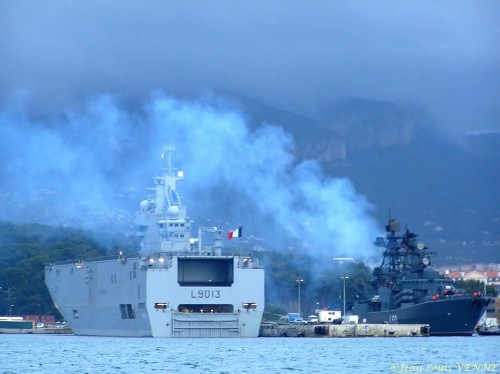
De la mer et de sa stratégie

 Russes8.jpg

Archives de SYNERGIES EUROPEENNES - 1986

De la mer et de sa stratégie


à propos d'un livre de Philippe Masson


par Ange Sampieru


Deux pensées géopolitiques

____________________________________________________________________________


La réflexion sur la stratégie maritime, à l'heure du retour de la géopolitique en politologie, participe de cette volonté des hommes de mieux intégrer dans leur intelligence du jeu des Etats les éléments de la géographie planétaire. Carl SCHMITT le faisait remarquer: nous vivons sur une planète que nous avons appelé la "Terre"; or, les 2/3 de la surface de cette "Terre" sont composés d'étendues marines!! L'école traditionnelle de géopolitique se compose dès lors de deux courants: le courant "continental", très répandu dans les milieux européens (HAUSHOFER, mais aussi CLAUSEWITZ) et le courant "océanique", mis en valeur dans l'aire culturelle anglo-saxonne (MAHAN) mais aussi, paradoxalement, en France, avec l'Amiral CASTEX, le Contre-Amiral SANGUINETTI ou l'Amiral Pierre LACOSTE.


Pour Philippe MASSON, l'école des stratèges européens, dont CLAUSEWITZ fut le maître à penser, révèle deux lacunes: la première, c'est de ne pas tenir suffisamment compte, dans sa théorie des guerres de partisans, de la guerilla comme force armée populaire (l'écrivain Ernst JüNGER est le seul, avec sa fameuse théorie du partisan à avoir abordé ce thème, encore que ce soit sous une forme moins directement militaire que guerrière et philosophique). La seconde lacune concerne précisément la puissance maritime. Philippe MASSON souligne en effet l'absence totale, chez CLAUSEWITZ, de réflexions construites sur le rôle des océans dans la guerre ni sur le poids pourtant réel des escadres dans les rapports de force entre Etats.


Dans cette pensée, la "frontière" stratégique reste essentiellement terrestre et l'absence de spéculations relatives aux thalassocraties apparaît générale dans la grande majorité des théories stratégiques en Europe (GUIBERT, JOMINI, von der GOLTZ, FOCH, LUDENDORFF). Cette ignorance oppose ce courant continental-européen au courant océanique, dont le plus illustre représentant fut l'Amiral américain MAHAN. Son ouvrage fondamental, paru en 1890 et intitulé "La puissance maritime dans l'Histoire", constitue une révolution dans le sens où la place accordée à la mer dans la stratégie militaire acquiert désormais une importance considérable. Le Times anglais a comparé d'ailleurs cette révolution à celle de NEWTON en astronomie. De telles réactions sont indices de l'intérêt immédiat que les théories de MAHAN connurent dans les milieux dirigeants de son époque, surtout en Grande-Bretagne et aux Etats-Unis. Contrairement au "Vom Kriege" de CLAUSEWITZ, le livre de MAHAN s'est révélé déterminant dans les décisions concrètes prises par les Etats maritimes, en matière de stratégie. La politique internationale des Etats-Unis, notamment, en a été constamment imprégnée et le demeure.


Les bases du Sea-Power selon Mahan

____________________________________________________________________________


La question que pose MAHAN, et à laquelle il apporte une réponse cohérente, est la suivante: quelles sont les bases du "Sea Power", autrement dit de la puissance maritime? L'étude de l'histoire lui fournit les matériaux d'une réponse complète. Il dégage d'abord les facteurs déterminants:

1) La position géographique d'abord. La position en bordure des routes maritimes fréquentées par exemple; un découpage des côtes favorables à l'établissement de ports, avec ressources suffisantes en "gens de mer" et base arrière industrielle à forte capacité productive pour soutenir l'activité maritime (construction et entretien d'une flotte de guerre).

2) Un facteur social ensuite. La pauvreté d'un pays côtier, tant du point de vue des ressources du sous-sol (richesses en matières premières ou en ressources alimentaires) que de la population (esprit d'aventure). MAHAN juge d'ailleurs les médiocres prestations maritimes françaises dues à la relative richesse des terres et à la clémence du climat.

3) Un facteur psycho-culturel aussi. La mentalité de "boutiquiers" des Hollandais et des Anglais est à l'origine de leur réussite maritime. La France, tournée vers une économie de nature "colbertienne", construite sur un mépris catholique de la profession commerciale, est exclue de cette philosophie mercantiliste, propice à l'économie d'échanges.

4) Un facteur institutionnel enfin: l'Etat peut réellement jouer un "rôle d'entraînement", appuyé en cela par les opinions dominantes de la société, prise au sens le plus large.


Bien entendu, chacun de ces facteurs cités peut être sujet à contestation. Ainsi, par exemple, nous pourrions évoquer le développement remarquable de l'activité maritime sous le règne de Louis XIV où les négociants bordelais, malouins ou nantais tenaient une place importante dans le commerce maritime mondial (toiles, draps, céréales).


Les stratégies des années 80


____________________________________________________________________________


A partir de ces constatations de départ, Philippe MASSON développe son étude en quatre points: après une analyse des théories stratégiques maritimes, il compare, dans une seconde partie, les différents types de stratégies développés et leurs enjeux. Dans une troisième partie de son travail, intitulée "La bataille", MASSON introduit ses lecteurs aux principes généraux de la bataille navale, à l'histoire des tactiques navales ainsi qu'à une typologie du personnel maritime. Il conclut par une étude aussi courte que concise sur le thème du "Chef et du hasard". Dans une quatrième partie, la stratégie maritime est replacée dans l'environnement moderne, celui du nucléaire et des missiles.


Nous nous intéresserons tout particulièrement à cette quatrième partie, dans la mesure où elle contient des implications directes sur la situation mondiale des années 80. L'invention de l'arme atomique a profondément modifié les règles de la stratégie maritime. Mais elle a aussi modifié la composition et la physionimie des flottes de combat.


Dans une première période, l'arme nucléaire est le monopole de fait d'une et une seule puissance mondiale: les Etats-Unis d'Amérique. Forte de ce monopole, cette dernière suit une stratégie répondant à l'absence de forces nucléaires chez son principal adversaire soviétique et cette stratégie sera celle des représailles massives. La maîtrise de l'arme atomique, à partir de 1955, en URSS, modifie la politique d'emploi de cette arme. Face à ce rétablissement de "l'équilibre" stratégique, on passe à une nouvelle stratégie, celle de la "destruction mutuelle assurée" (ou "Mutual Assured Destruction"; en abrégé, "MAD"), encore appelée "équilibre de la terreur".


Plus tard, de nouveaux pays entreront dans ce "club atomique" des possesseurs de l'armement nucléaire. Bien entendu, les forces navales de ces puissances n'échapperont pas aux mutations qu'induit ce phénomène, tant sur le plan de la réflexion stratégique que sur l'évolution de l'équipement. Les navires de la nouvelle flotte de guerre seront dotés de toute la gamme des missiles modernes, tant les classiques que ceux munis de charges nucléaires.


Suivant en cela les enseignements traditionnels, le porte-avion constitue toujours le pivot de toute flotte de combat (les Anglais parlant à son sujet de "capital ship"). Le meilleur exemple d'utilisation de ce type de navire est le porte-avion américain Nimitz. Avec ses 325 m de long et ses 41 m de large, ce porte-avion déplace une charge de 91.000 tonnes. Grâce à ses deux réacteurs nucléaires, il développe une puissance de 260.000 chevaux, soit une vitesse de croisière supérieure à 30 noeuds et un rayon d'action quasi illimité.


De plus, il peut emporter à son bord un arsenal impressionnant d'appareils de l'aéronavale: de l'intercepteur Tomcat à l'avion d'assaut Hornet ou Phantom, en passant par les hélicoptères Seaking, les avions de guerre électroniques Prowler ou encore l'appareil de veille et d'exploration Hawkeye. Chacun de ces porte-avions est par ailleurs accompagné d'une flotille de protection, allant du croiseur au destroyer, en comptant les frégates aptes à la lutte anti-sous-marine et à une riposte aux attaques aériennes; ces dernières sont équipées en général de missiles air-mer (dont la portée est de plus de 100 km), venant compléter une DCA plus classique. On a pu néanmoins constater au cours de la Guerre des Malouines la relative faiblesse de ces moyens de protection, notamment face à des chasseurs armés de missiles de type air-mer Exocet AM 39 qui, lancés en vol rasant, sont assez difficiles à intercepter. Dans la même catégorie, on peut signaler le danger que représente, pour les forces navales, le bombardier soviétique Backfire qui dispose d'un rayon d'action de 9000 km à une vitesse de 1 à 2,5 mach et dont l'armement, redoutable pour un navire de gros tonnage même bien protégé, se compose de missiles AS4 "Kitchen", à autodirecteur actif, munis de charges nucléaires et d'une portée impressionnante: 300 km.


Les autres bâtiments de surface de ces flottes possèdent aussi les missiles surface-surface, éventuellement équipés en charges nucléaires. Le premier essai d'utilisation opérationnelle de ce type de missile fut la destruction en juin 1967 de la vedette israëlienne "Elath" par un engin "Styx" de fabrication soviétique. Depuis, de nombreux modèles ont été mis au point, comme l'Exocet français, le Harpoon américain ou le Saab suédois. Les Américains ont même réussi à améliorer les performances de cette catégorie de missiles par le lancement d'un missile de croisière appelé Tomahawk. Ce dernier peut être mis en oeuvre aussi bien à partir d'un avion que d'un navire de surface ou d'un sous-marin. Il vole à une vitesse de 800 km/h à basse altitude avec un rayon d'action de 1300 km.


Les nouvelles générations de submersibles

___________________________________________________________________________


A cette famille de missile, souvent nucléaires, destinés à la destruction des navires de surface, il faut ajouter les nouvelles générations de submersibles. Inauguré en 1955 avec l'apparition du sous-marin américain Nautilus, les submersibles modernes possèdent des caractéristiques exceptionnelles: vitesse élevée, supérieure aux navires de surface, rayon d'action pratiquement illimité, affranchissement total vis-à-vis de la surface. La seule limite est en fait la résistance psychologique des équipages, séparés de tout durant les périodes longues de plongée. On trouve aujourd'hui deux types d'unités à propulsion nucléaires: 1) les sous-marins nucléaires lance-engins (SNLE), instruments très fiables dans le cadre d'une politique de dissuasion; ils sont armés de missiles ballistiques (entre 16 et 24) dont la portée a été régulièrement augmentée depuis les années 60... En 1960, les missiles américains Polaris avaient une portée de 1500 miles nautiques; les futurs Trident II D5 auront, eux, une portée de 6000 miles nautiques! L'Union Soviétique possède les missiles SS N8 d'une portée de 4500 miles nautiques, les nouveaux SS20 étant en cours d'élaboration. Quant aux cinq SNLE français, ils sont armés de missiles M20 (portée: 3000 km), en attendant la nouvelle génération des M4 ayant une portée de 4000 km.


Ajoutons à ces performances de longue portée et de vitesse, celle de la précision. Le "cercle d'erreur probable", autrement dit la dispersion des engins, varie de 1200 mètres pour les anciens missiles américains Poséidon à 500 mètres pour les Tridents I4. Tous ces missiles sont d'autre part améliorés dans le sens d'une multiplication des ogives portées et d'une réduction de leur puissance. Les missiles américains possèdent de 8 à 14 têtes de 50 à 100 kilotonnes qui, de surcroît, sont "marvées". C'est-à-dire qu'ils assument eux-mêmes leur trajectoire, de façon à éviter les risques d'interception et à faciliter la pénétration. La flotte soviétique est demeurée, quant à elle, au stade des missiles dits "mirvés", c'est-à-dire non guidés et lancés en grappe. Les nouveaux SSN20 seront sans aucun doute "marvés" et prêts à recevoir de 7 à 9 têtes marvées.


2) La seconde catégorie de sous-marins est celle des sous-marins nucléaires d'attaque (SNA). D'un tonnage moins important que les SNLE, ils peuvent atteindre 40 noeuds en plongée et 450 m d'immersion. Leur armement est à la fois très sophistiqué et très varié. A la base, une panoplie de torpilles filo-guidées ou auto-guidées, ainsi que des missiles aérodynamiques (type Subharpoon ou SM39, dérivé de l'Exocet français). La mission des SNA est plutôt d'ordre stratégique, de "mission stratégique". Repérer, pister et éventuellement détruire les SNLE adverses. D'où la constante amélioration en matière de silence et de discrétion des SNLE pour échapper aux recherches des SNA. Leur deuxième mission est l'attaque des forces de surface. Durant le conflit des Malouines, le SNA Conqueror a torpillé le bâtiment de surface argentin "General Belgrano", prouvant ainsi le danger de ce type de submersible mais aussi le caractère indispensable, dans une flotte moderne, de posséder des moyens réels et efficaces de lutte anti sous-marine. Le SNA est en outre armé de missiles qu'il peut lancer en immersion, à des distances variant entre 30 et 300 miles nautiques. Une troisième mission est celle, plus classique, d'action contre les lignes de communication. Le SNA peut aussi assurer, mission nouvelle, l'attaque contre des objectifs continentaux, soit situés sur le littoral soit franchement à l'intérieur des terres.


Face à cette diversification des tâches confiées à l'arme navale, l'Europe semble ne pas avoir répondu. Si, en 1939, ses flottes de guerre représentaient la majorité en terme de tonnage (60%), en 1980, elle n'est plus que de 15%! Les marines européennes, en dépit de capacités technologiques et industrielles élevées, ne peuvent plus répondre à l'éventail des missions exigées, à l'éventail des menaces potentielles ni même au maintien d'ensembles homogènes. Le cas le plus frappant est celui des pays nordiques, notamment en ce qui concerne un éventuel affrontement en Mer Baltique. Face aux forces du Pacte de Varsovie, en général bien adaptées aux conditions hydrographiques locales, les forces navales des pays riverains (RFA, Norvège, Danemark,...), englobés dans le système de défense occidental, ne pourraient pas aligner des qualités au moins égales aux forces qui leur font face.


La stratégie navale soviétique

____________________________________________________________________________


Une évolution remarquable est celle de l'Union Soviétique. A l'origine puissance continentale, elle est devenue aujourd'hui une véritable puissance navale. D'où une politique efficace où la géostratégie joue un rôle majeur. Les mutations technologiques ont été intégrées par ailleurs dans une politique mondiale où l'engagement naval tient une place prépondérante. Cette œuvre historique est, en partie, le résultat des efforts de l'Amiral GORTCHKOV qui a quitté son poste en 1986. La mission actuelle de la marine soviétique apparaît double. En période de paix, "elle constitue la projection de la puissance de l'URSS au-delà des mers" (p.310), autrement dit, elle assure la présence physique de la volonté politique soviétique sur les cinq continents (visites amicales, surveillance des "points chauds", etc.). Elle constitue aussi un vecteur de la propagande et de l'action révolutionnaires dans le monde. Comme le déclarait l'Amiral GORTCHKOV lui-même: "La marine soviétique marque et neutralise les forces navales américaines et facilite les processus révolutionnaires en Occident". Par là même, l'arme navale retrouve sa place dans une vision clausewitzienne de la politique extérieure d'un Etat. En outre, elle s'inscrit dans une approche traditionnelle des relations entre les forces armées et le pouvoir politique. La célèbre dichotomie proposée par le stratège allemand entre finalité politique et objectif militaire stratégique est implicitement restaurée dans la doctrine militaire de l'armée et de la marine soviétiques. Cette mission de présence et d'action "subversive" (nous préférons écrire "politique") est réservée à la flotte de surface, en liaison avec des navires "civils" soviétiques (flotilles de pêche, navires océanographiques, etc.) dont les missions complètent celle de la première (surveillance, observation, etc.). En temps de guerre, la mission de la marine soviétique est plus "traditionnelle". Elle assure la défense des approches maritimes de l'URSS, mais surtout participe directement aux actions de destruction du "potentiel militaro-économique" de l'adversaire. Pour le chef de la marine soviétique, il s'agit là de l'objectif majeur de son arme. Le but est moins le contrôle de la mer en soi que la participation à la guerre contre la terre adverse. La marine, ici, ne joue pas un rôle préventif mais préemptif, c'est-à-dire qu'elle devance une action d'offensive générale contre l'ennemi. Dans ce cas, elle a pour objectif la destruction des forces navales ennemies, autrement appelée dans le langage soviétique "bataille de la première salve", suivie d'opérations de plus grande ampleur contre les territoires ennemis en liaison étroite avec les forces de terre et de l'air. Les SNA soviétiques pourraient ainsi détruire le potentiel industriel ennemi situé en bordure du littoral au moyen de missiles aérodynamiques.


Nous nous devons donc de signaler la double nature de l'Union Soviétique en tant que grande puissance mondiale: elle est à la fois continentale et maritime. En dépit de certaines erreurs d'appréciation (comme la prétendue supériorité des transports terrestres sur les transports maritimes), le géopoliticien britannique MACKINDER a trouvé, a posteriori, dans le jeu mondial de l'URSS, une éclatante confirmation de ses théories. L'Union Soviétique est bien en effet le Heartland  identifié par le théoricien MACKINDER. Sa politique extérieure consiste bien en une destruction ou un affaiblissement réguliers des "croissants extérieurs", des cordons surpeuplés et sur-industrialisés, qui, par leur puissance économique et l'attraction qu'ils exercent, pourraient menacer à terme la sécurité et l'expansion de l'URSS. L'exportation de la révolution communiste comme soutien à l'objectif géopolitique jette un éclairage nouveau sur l'histoire des quarante dernières années, rejettant comme superficiel et schématique les analyses des anti-communistes professionnels.


En conclusion

____________________________________________________________________________


Philippe MASSON, en près de 350 pages, où les annexes assurent une fonction importante dans l'analyse des stratégies maritimes (notamment les cartes), nous démontre que, loin de disparaître, les marines tendent à jouer un rôle croissant dans la politique extérieure des Etats. Par l'intégration intelligente des progrès technologiques, les forces navales conjuguent une certaine autonomie vis-à-vis des points fixes (aérodromes et pistes terrestres) à une souplesse d'adaptation aux missions qui lui sont imparties. L'invulnérabilité des SNLE et autres SNA, totalement invisibles et irrepérables dans les fonds marins, permet une quasi efficacité de la politique de dissuasion, notamment dans le cadre de la doctrine de la seconde frappe.


Le seul handicap est la lenteur de leurs interventions. Aujourd'hui, les mers ne sont plus seulement des soutiens aux conflits terrestres; elles jouent désormais un rôle "à part entière" que personne ne peut plus leur contester. Aux Européens de prendre en compte cette nouvelle dimension de la politique, la dimension planétaire.


Ange SAMPIERU.


Philippe MASSON, De la mer et de sa stratégie, éditions Tallandier, Paris, 1986, 120 FF.