ex.: http://www.counter-currents.com/
1. Being a man of ideas, has literature played an important role in your life? What would you say were the texts that proved key in your personal and intellectual development? And why?
History and philosophy played more of a role in shaping my outlook than literature. In fact, I can’t name a single work of fiction, qua fiction, that has shaped my worldview. But works of fiction have provided me with concrete and vivid exemplifications of otherwise abstract ideas. I love philosophical novels. Plato’s dialogues, of course, qualify both as literature and philosophy.
Plato has had the greatest influence on my outlook, particularly the Republic, but also the Gorgias, Phaedrus, Symposium, Euthydemus, Euthyphro, Apology, Crito, and Phaedo. Rousseau’s philosophical novel Emile also influenced my thinking profoundly. I love Ayn Rand’s The Fountainhead and Atlas Shrugged, but classical liberalism, capitalism, and even individualism ultimately undermine aristocratic and heroic values.
The philosophers who have shaped me the most are Plato, Aristotle, Plotinus, Machiavelli, Vico, Rousseau, Kant, Hegel, Schopenhauer, Nietzsche, William James, Heidegger, Guénon, Evola. Alan Watts has had a huge impact as well, as have the Tao te Ching and the Upanishads.
Wagner’s music dramas are in a class by themselves, as texts somewhere between philosophy and literature/myth, married to some of the greatest music ever written. They are profound, and have influenced me profoundly.
Savitri Devi is also hard to categorize. She combines philosophy, history, religion, politics, and myth. She too has had a great influence on me.
As for literature proper: The writers I loved most as a child are ones I still love today: Poe, Tolkien, Kipling, and old illustrated compendiums of Greek and Norse mythology. Frank Herbert’s Dune books have also remained favorites. I like them more every time I return to them.
Later on I came to love Homer, Shakespeare, Blake, Goethe, Schiller, Baudelaire, Dickinson, Oscar Wilde, Yeats, Wallace Stevens, and Philip Larkin as poets and dramatists.
In terms of novels and stories, my favorite writers came to include Dostoevsky, Hugo, Flaubert, D. H. Lawrence, H. P. Lovecraft, Flannery O’Connor, and Yukio Mishima.
There are also “non-greats” whose voices I consistently enjoy: Edith Sitwell, Truman Capote, Evelyn Waugh.
I read a lot of Ray Bradbury, Kurt Vonnegut, and Aldous Huxley in my teens. Someday I want to revisit them. I think Bradbury will stand the test of time.
Literary criticism is very important to me. My favorite critics are D. H. Lawrence, Ezra Pound, Camille Paglia, and H. L. Mencken.
I have very little time to read fiction now, unfortunately. The last novel I read was Mister! I read too much non-fiction and spend too much time staring at the computer screen. I just can’t add more reading on top of that. So my primary form of intellectual recreation is watching movies and operas and listening to music.
2. I first became aware of you following your appointment as editor of The Occidental Quarterly. However, I understand you had already been active as a dissident writer for a number of years, during which you wrote under various pen names. What, in your particular case, made you opt in favor of pen names? And why did you decide eventually to do away with them?
When I wrote under pen names, I was working for people who would fire me if they knew my real views.
When I took the TOQ job, I was told I would have to use my own name. At the time, I was explained that since TOQ is the would-be flagship of the intellectual wing of the Anglophone movement, it would not be suitable to edit it under a pen name. I accepted that argument at face value and took the plunge. At that point, I crossed the Rubicon. After about a year, all my old professional “friends” and contacts simply melted away.
At the Counter-Currents/North American New Right site, I am consolidating all of my writings under two names: Greg Johnson for all the political articles and Trevor Lynch for most of the movie and television reviews.
3. The internet and ‘the real world’ are often presented as diametrical opposites, with the former cast as phony and the latter as the only thing that counts. But, isn’t the internet as real as the so-called real world? I say this because behind the keyboards and in front of the screens sit real people, whose behaviour in the ‘real world’ is both a cause and a result of what happens on the internet. I am aware of the argument against: many real people adopt fake online identities, but, ultimately, in the long run it is next to impossible for people not to betray their own thoughts and feelings online. Fake identities aside, is not the internet perhaps the most honest record of what is actually on people’s minds? Is not ‘the real world’ in fact phonier, since many don’t say what is on their minds in face-to-face situations for fear of social disapproval, professional consequences, or ostracism?
There have been recent studies that suggest that people lie more on the internet than in real life. But to some extent I agree with you: the internet is like the voting booth, and in its privacy and anonymity people can be more honest about controversial matters. In more mundane matters, usually connected to online dating and banal narcissism, the internet is a vast sewer of lies and imposture.
All this relates to the “ethics” of pen names. To me, it is purely a matter of individual discretion. I recommend pen names to those who want to communicate ideas but can’t under their own names. After all, it is the ideas that matter in the end, not the authors.
Yes, cowardly and dishonorable people often hide behind pen names. But narcissistic jackasses also write under their own names. To me, the most important consideration is to get as much truth as possible circulating out there. The labels and brands are less important than the content.
4. Your tenure as TOQ editor saw a number of innovations: an active online presence was developed and articles and reviews appeared that covered a much wider spectrum of cultural spaces than ever before. What were your aims for the TOQ during this period?
My aim was to make TOQ a metapolitical journal for a North American New Right, the goal of which was to lay the foundations of the White Republic. There were, however, limitations built into TOQ from the beginning that made that difficult.
A problem was that the journal did not have clearly articulated goals. There were basic topics and parameters in the founding documents, which were drawn up by Sam Francis, Louis Andrew, William Regnery, and Kevin Lamb: TOQ was to deal with biological race differences as well as the Jewish Question. TOQ was not to bash homosexuals. TOQ was to be neutral on religion.
The de facto editorial line, however, can be divined from the interview published with Alain de Benoist. Only about half the actual interview was published. Everything critical of scientific materialism and Christianity was dropped. Benoist, I imagine, was quite disgusted. I certainly was when I learned about it. (I plan to publish the discarded portions in the first volume of North American New Right.)
Now, to his credit, the original Editor Kevin Lamb frequently crossed these boundaries. When I took over as Editor, I quickly learned that I had to edit as if I had a scientific materialist over one shoulder and a religious fundamentalist over the other. I too went beyond those strictures. I made some improvements in the design and editing of the journal, but ultimately I did not do anything radically different than Lamb.
5. The term ‘metapolitics’ is often used within the intellectual class, and no doubt there are some who think it is all pretentious nonsense. Please explain this term for the layman, and why metapolitics is important. Why not just straight politics?
Metapolitics deals with foundational questions connected to politics, questions from history, philosophy, religious studies, the arts, and the human sciences.
One way of understanding the distinction between metapolitics and politics is in terms of values.
A political leader has to appeal to the existing values and attitudes of his constituency. The reason why White Nationalist politics is premature is that it offends the values of the electorate. (David Duke’s one win was a fluke. It won’t be allowed to happen again.) We can’t get what we want, because our people don’t want what we want. They think our goals are immoral. They also think they are incoherent and impractical.
They think these things, because our enemies have carefully laid the metapolitical foundations for the power they enjoy. They control academia, the school system, publishing, the arts, the news and entertainment media, and they have remade the American mind to their liking. My aim is to change people’s sense of what is politically desirable and right, and their sense of what is politically conceivable and possible.
That means that we have to explore ideas that would offend the majority of people.
6. So metapolitics is not the province of impractical bookworms, then. How does it relate to politics?
Metapolitics is about laying the foundations for political change. There are three levels to our struggle. (1) The metapolitical struggle to change values, culture, worldviews. (2) The metapolitical struggle to create a white community, and not just a virtual community, but an actual, real world, face-to-face community. A counter-culture needs to be embodied in a counter-community. (3) The political struggle for actual political power. In the end, we want political power, because we want to make the survival and flourishing of our people the law of the land, a matter of explicit policy, indeed the fundamental law and policy.
But metapolitics is not compatible with political activity within the present system and at the present time. Why? Because the prevailing metapolitical consensus rejects White Nationalism as immoral and impossible. This means that pushing our agenda in the present system is ultimately futile. Any gains will be at tremendous cost and will be easily reversed. You can swim against the current, but it is exhausting, and as soon as you run out of energy, the current will sweep you back to where you started. You can’t build the political superstructure before you lay the metapolitical foundations.
This is not to say that it is impossible for a deep-cover White Nationalist to pursue political power. I hope a lot of them are.
Nor is it impossible for system politicians to support initiatives that White Nationalists can support. For me, the only political issue in the United States that I care about is immigration, and there is reason for hope on that front. Politicians who are close to the right bank of the mainstream are pushing initiatives that might slow or halt the onslaught of illegal immigration. It is far short of what White Nationalists want—namely, a race-based immigration policy—but it would give us time by putting back the date when Whites become a minority in the United States. Given how disorganized and kook-infested the White Nationalist movement is in the United States, we need all the time we can get. Thus if it is possible for a White Nationalist to push immigration policy in the right direction, I say do it, so long as you do not divert our community’s resources into the political mainstream.
What I reject utterly is the idea that White Nationalists—a tiny, despised, poorly funded, poorly led minority—should divert any of our scare political capital into the mainstream at the cost of building up our own institutions and community. The mainstream is capable of taking care of itself. We need to take care of ourselves. If we don’t articulate our message and build our community, nobody else will.
We can’t buy mainstream politicians. They would flee from and denounce us if they knew who we are. Thus spending our political capital on people like that and expecting White Nationalist results is analogous to taking one’s capital to Las Vegas and playing craps as opposed to building one’s own business that will provide long-term steady income.
Gambling, of course, is more fun than hard work, and the political system, like Las Vegas, is full of people who will be your friend and stroke your ego as long as you have money to blow. But the house always wins in the end, so White Nationalists who put their capital behind system politicians end up cleaned out, burned out, and useless to our cause.
7. Does not the inherent need for dissimulation in politics make it incompatible with free enquiry and open intellectual debate?
Yes, I will grant that. And if I thought that the time for political struggle were at hand, and if I thought that someone had come up with the perfect “Noble Lie,” I would fall right in line.
But White Nationalist politics is premature. Yet the main impediment I encounter is giddy people thinking that the time for political struggle is at hand, and the only thing standing in the way of that are people like me who insist on talking about things like the problems of Christianity, European idears like fascism and (horrors!) National Socialism, etc. After all, these ideas won’t play in Peoria! They tell us that we need to shut down such discussions so our enemies don’t use them to scare away the voters.
Well, it doesn’t take a Ph.D. to see where this is going. The first thing we need to do is stop publishing articles that might offend mainstream Republican types. So we can’t publish articles about Black Metal, because that is “Satanic,” or Traditionalism because it is “occult,” or paganism because it is pagan. And we can’t be critical of capitalism either.
But you can’t stop there. Nothing offends Christian fundamentalists more than Darwinism, so scientific race studies and evolutionary psychological studies of the Jews are out too. Why talk about race and Jews at all, for that matter? Isn’t that divisive? Why not just get people riled up about “unfairness” and “double standards” against “European Americans” based on our “skin color”? Maybe we should just talk about restoring the Constitution.
In short, why not just close up shop? That is the ultimate end of this lemming-like stampede into the safe, respectable oblivion of mainstream conservatism.
The trouble with the mainstream, though, is that our enemies have done the metapolitical engineering work necessary to divert the conservative mainstream away from the turbines of political power and into the irrigation ditches of irrelevance.
So until the time is ripe for political struggle, I think that it is best to have the most open and free-wheeling intellectual debate possible. That is the only way we will create an intellectually exciting and morally credible metapolitical movement.
Besides, you can’t put the genie back in the bottle or the toothpaste back in the tube. For instance, even if I shut up tomorrow about the damaging effects Christianity has had on our racial survival, our enemies could still use that to scare Christians about Godless or Satanic racists. So we might as well keep the conversation going.
Besides, racially-conscious Christians will never reform their churches unless we constantly scourge them to do it. Otherwise, they tend to be far more interested in shutting down criticism in our camp than in confronting anti-White hatred in their churches.
Maybe metapolitical debate is folly from the point of view of political expediency. But as William Blake put it, the fool, if he persists in his folly, becomes wise. So we will persist.
We aren’t going to shut up and blend in, so people in the mainstream had better figure out ways of making us work to their advantage, if only by using us as boogey men to make them seem moderate by comparison.
8. Revolutionising the collective consciousness is probably one of the most difficult tasks that can be attempted, because for the most part people are not conscious of how they thinking is pre-determined by implicit rules and taken-for-granted notions that, because they seem self-evident truths, act to make ideology invisible. Truly unfettered intellectual debate feels threatening because it seeks to break out of that cognitive cage. Worse, this cage is so insidious that it even affects those who already are outside of the mainstream. What are the most common everyday manifestations you have encountered of the barriers to unfettered intellectual debate?
I can think of three.
First, there are people who read Counter-Currents/North American New Right and TOQ before them who imagine themselves being confronted with quotes from these publications on the campaign trail, or in a press conference, or on trial, or during pillow talk. (Not that they are politicians or otherwise likely to be interviewed by the press, but they have vivid imaginations.) They imagine themselves being tried before the court of today’s public opinion for holding heretical beliefs. And they are scared.
Well, they should be scared. That is the whole necessity for metapolitical struggle in the first place: to change prevailing public opinion. And to change public opinion, one must first have the courage to disagree with it, to buck it, to say things that might offend the public and that demagogues and lawyers can easily twist into a noose before a baying lynch mob.
A second perennial confusion is what Guillaume Faye calls the misapplication of the “apparatus logic” of a political party to an intellectual movement or publication. I try to survey the full variety of intellectual and cultural currents on the racialist right. Well of course somebody out there disagrees strongly with everything that I publish. Only a schizophrenic could hold Darwinian evolutionism and Guénonian devolutionism in the same mind, for instance.
But I routinely hear from people saying that I shouldn’t have published something, or that I need to remove something potentially offensive from the site. My standard reply is: If you don’t agree with something, write a rebuttal and we will publish that too.
Frequently, the reaction is incomprehension and anger. I realized that I am dealing with people who think in terms of a single intellectual orthodoxy in which offending opinions are not debated but simply made to disappear. It is the mentality that gave us the Inquisition and the Gulag.
Third, there is the related confusion that I call “representation logic”: the idea that everything published in a magazine represents the views of everybody else in the magazine, or everybody who subscribes to it, or everybody who donates to it. The consistent application of that sort of thinking would shut down all intellectual discussion.
For example, when I published Derek Hawthorne’s review of Jack Donovan’s Androphilia, I had one reader write in and say that he could not be part of the North American New Right because he wasn’t homosexual—as if everybody else who reads the site or writes for it were! Another fellow wondered if we were all “Satanists” because I published something by Julius Evola on Aleister Crowley. It doesn’t work that way.
9. When my essay about Black Metal appeared at TOQ Online, it elicited the highest number of comments ever seen for a TOQ article. Why do you think TOQ readers felt so strongly about such an obscure form of music? And why do you think people who obviously never heard the music felt entitled to have such strong opinions about it?
First of all, let me say that I thought very highly of that article. I was proud to have it appear in our pages. I knew nothing about Black Metal, so I was very happy to find such a sophisticated and well-informed perspective on it.
I wish I could find similarly high quality articles on the Neofolk scene and other white subcultures. We need to know what is out there and what works. We need to establish connections with these communities. Your article is a model of the sort of work that I want to publish in North American New Right (hint, hint).
I would have thought that White Nationalists would have been delighted to discover such a vast musical subculture in which radical white racial consciousness is the norm. Unfortunately, that was often not the case. I received more criticism for that article than anything else I published.
Christians (and gallant atheists who throw their honesty in the mud so Christians need not dirty their feet) were shocked at the associations with Satanism, paganism, and National Socialism. Others with premature fantasies of political activism were worried about how it would play in Peoria. Most of it was just bad faith posturing.
10. After editing TOQ, you founded a publishing house, Counter-Currents. What are your aims with this new enterprise? What can we expect from, and what would you like to make happen with, Counter-Currents in the next five to ten years?
Counter-Currents publishes North American New Right, which is a metapolitical journal that aims at laying the foundations for a white ethnostate in North America. North American New Right has two formats.
First, there is our webzine, at the Counter-Currents website, www.counter-currents.com, which publishes something new every day. The reason we publish online is because it increases the availability and thus the impact of an article, and it makes it immediately available to the public. Our goal is to save the world, after all. If something contributes to that end, it is worth publishing right away.
Second, we will publish an annual print volume, which contains the best of the website and additional articles, reviews, interviews, etc. This will be a handsome book along the lines of the journals Tyr or Alexandria: The Journal of Western Cosmological Traditions
 . The first volume, for 2010, will go to press in March 2011.
We also plan to publish around six books a year. Our format is to publish short books that can be read in a day, say in the range of 120 to 160 pages, with 200 being the upper limit. All our books will be published in limited numbered, hardcover editions of 100 copies plus standard hardcover and paperback editions.
Our first two volumes are Michael O’Meara’s Toward the White Republic and Michael Polignano’s Taking Our Own Side. Forthcoming volumes include works by Julius Evola, Alain de Benoist, Kerry Bolton, and Edmund Connelly.
Counter-Currents/North American New Right focuses on philosophy, political theory, religion, history, the arts, and popular culture with a White Nationalist metapolitical slant, and a special emphasis on whites in North America, since this is where we are located. We do not focus on science, policy studies, or the daily news cycle. We are not a political activist group, but a politically aware publishing house.
11. During the summer you wrote “Learning from the Left,” to which I responded with an article of my own, “Learning from the Right,” both on The Occidental Observer. In my article, I enumerated what I considered to be the failed strategies of the right. What are, in your opinion, the failed strategies of the right? And, having learnt from them, what do you propose should be the Right’s focus/approach in the coming decade?
I will speak specifically of the American scene.
I think the greatest failure of the post-WW II racial right is not dealing with the Jewish Question, whether through ignorance or cowardice. Instead, the tendency has been to use euphemisms, circumlocutions, and proxies to speak about the enemy: liberals, socialists, cultural Marxists, etc. But you cannot fight an enemy whom you refuse to name and understand. Is it any surprise that people have not been eager to follow leaders who reek of cowardice and moral confusion?
Next is the failure to identify what we are fighting for, again whether through ignorance or cowardice. We are fighting for the survival of white people in North America. Again, the tendency has been to use euphemisms, circumlocutions, or proxies: the Constitution, free enterprise, Christianity. The most preposterous one that I have heard is the claim that we are “the descendants of non-duophysite Christians as of 1492.” Of course this is not a definition of anything, just a euphemism for white Europeans, not Arabs or Jews. But why not just come out and say that? Is it any surprise that a movement where this passes for cleverness has gotten nowhere?
The third great failure is ceding the whole realm of culture and ideas to the Jews and trying to fight a merely political battle, which leads inevitably to the buffoonery of cornpone populism as an attempt to make an end run around the establishment’s lock on thinking people. But it just hasn’t worked. It might have worked 60 years ago, but it didn’t. But today Jews control the whole realm of explicit culture, for the thinking and unthinking alike.
Whites in North America will not be able to regain control of our destiny until we (1) openly avow and defend our racial identity and interests, (2) openly identify the leading role of the organized Jewish community in setting our race on the path to degradation and death, and (3) lay the metapolitical foundations for political power, which includes (a) spreading our message through the whole realm of culture and ideas and (b) fostering a concrete, real-world, racially-conscious white community.
12. As an intellectual, your theatre of war is the realm of ideas. Yet, people are seldom, if ever, persuaded through reason. Those who adopt dissident views adopt them because they were already innately pre-disposed toward them, and events facilitated a process of becoming truer to themselves. What does that mean for dissident intellectuals, from a political-strategical point of view?
Rational persuasion does not presuppose a blank slate model or an idea of reason as “pure” and unconditioned by factors other than truth. Maybe all reasoning is in the end is getting people to become aware of what they are already predisposed to believe. Which is implies that those people who lack that predisposition will never believe, no matter how good your argument may be.
Well, if that is so, then universalism is out. Democracy is out. Egalitarianism is out. But that sounds fine to me.
If we can persuade 5% of our people of the truth of our cause and get another 20% to identify with the program in essentially irrational or sub-rational ways, we can dominate the rest. Perhaps we can win the loyalty of 50% by delivering prosperity, security, and peace. Even if 25% can never get with the program, no matter what we do, because they have innate predispositions to reject it, they would just have to grumble and put up with the New Order. If their attitudes are genetic, then our eugenics program can target those traits and try to make them less prevalent in every future generation.
These numbers are arbitrary, but I think they communicate an important truth: a small minority of true believers, if it wins the allegiance of a somewhat larger minority of people who merely hold the right opinions without good reasons, can dominate the whole of society, essentially buy the loyalty of the majority, and completely disempower its die-hard opponents.
The real question for me is how to gain that second group, the larger minority of people who hold the right opinions but not necessarily for rational reasons. That is why metapolitics has to go beyond reason—beyond philosophy, beyond science—and engage myth, religion, and art.
One of my aims for Counter-Currents/North American New Right is to foster and promote a white artistic movement. I have done some writing on this topic, but my ideas are not yet ready for publication. The essence of the program, though, has two main parts.
First, we need to expose young, racially-conscious white artists to the great exemplars of the past. You don’t have to go back too far before one discovers that practically all great thinkers and artists are “right wing extremists” by present-day standards. Beyond that, many of the greatest artists of the 20th century were on our side as well. That is a tradition that we need to recover.
Second, we need to gather together white artists and foster them by creating a community of artists and critics. Critics can play an important role, even critics who are not artists themselves. Eventually, this will become the topic of a series of articles and reviews, which I then will bundle into a book.
13. The typical Right winger excels at critiquing what is wrong with modern Western society, but falls well short when it comes to imagining a future society in which the Right’s intellectual traditions comprise the mainstream of culture. William Pierce’s single broadcast, “White World,” set against his hundreds of other broadcasts, epitomizes this condition. Surely the future must not simply be a futile (and impossible) return to the 1930s. The Left, on the other hand, has always had a utopian vision. Describe a future society where Savitri Devi’s texts are canonical university textbooks, read without controversy.
This is why I think we need to cultivate artists. Artists project worlds. Harold Covington’s Northwest Quartet novels, for example, are enormously effective at communicating ideas. His novel The Hill of the Ravens is set in a future Northwest Republic, as are parts of A Distant Thunder
 .
.
Of course film is even more effective at communicating ideas than books. Film really is the realization of Wagner’s idea of the Gesamtkunstwerk.
Savitri Devi was politically to the right of Hitler. I guess the best image of a world where she is read without controversy is the final chapter of her Impeachment of Man: “Race, Economic, and Kindness: An Ideal World.”
14. Finally, how would you like to be remembered in 100 years? And how do you think you will be remembered by the enemy?
In truth, my initial reaction to your question is that I would like to be forgotten.
Human egoism is such an ugly thing. Narcissism is such a devastating personality trait in our movement—particularly the histrionic, “drama queen” variety. But there is a normal, healthy desire to be remembered that gets trampled and crushed by pathological narcissists stampeding toward what they imagine to be the stage of history and the spotlight of eternal glory. Of course in reality they end up telling the same stories to ever-dwindling meet, eat, and retreat groups; posturing on Facebook; or telling lies on internet forums.
I am less concerned with how I am remembered than by whom: I hope our people are alive and flourishing in a hundred years, and many centuries after that. As for our enemies: Frankly, I hope they lose their will to survive, suffer a demographic collapse, and eventually disappear. That is the sort of world in which I would like to be remembered.
I want to accomplish the goals I have set out above, and I would like them to contribute to that world. I want to leave the world a better place than I found it. I want to be part of the chain that carries what is best in our race and civilization onward and upward. Whether I am remembered or forgotten, I will still have played that role; it will be part of the permanent record of the cosmos, as unalterable as the laws of mathematics. That is more important than living on in other people’s memory.
Source: http://www.wermodandwermod.com/newsitems/news241120100028...




 del.icio.us
 Digg
Digg Facebook
 Sigue siendo el trabajo del filósofo alemán Emanuel Kant (1724-1804) Was ist Aufklärung?(1784) quien mejor ha definido qué es la Ilustración cuando afirmaba: “es la liberación del hombre de su culpable minoría de edad”. Es decir, de su incapacidad de servirse sólo de la razón sin depender de otra tutela, como lo fue la teología para la Edad Media, donde se afirmaba: philosophia ancilla teologíae= la filosofía es sierva de la teología.
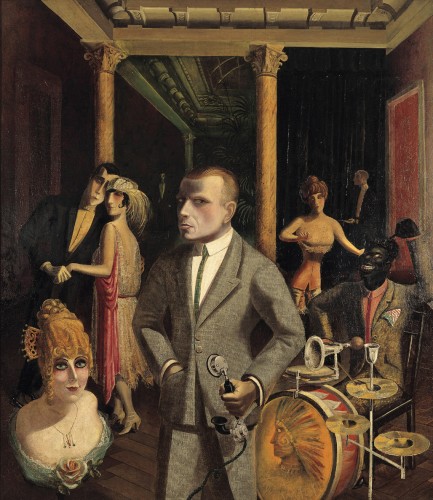
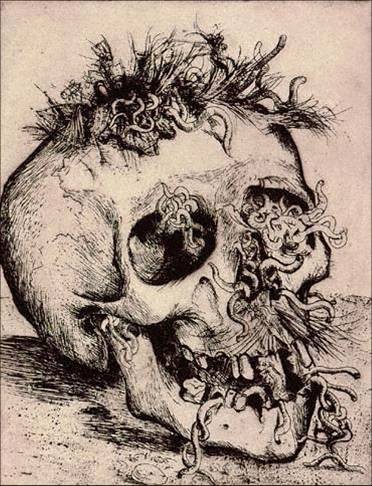 En 1914, Dix s'engageait en tant que volontaire dans l'armée. L'expérience devait, comme toute sa génération, profondément le marquer. S'il est une habitude de dépeindre Dix comme un pacifiste, son journal de guerre et sa correspondance montrent un caractère sensiblement différent. La guerre fut perçue par Dix, comme par beaucoup d'autres jeunes gens en Allemagne, comme l'offre d'un nouveau départ, d'une coupure radicale avec ce qui était ressenti comme la pesanteur de l'époque wilhelminienne, sa mesquinerie, son étroitesse, sa provincialité qu'une certaine littérature a si bien décrites. Elle annonçait la fin inévitable d'une époque. Les premiers combats, l'ampleur des destructions devaient, bien sûr, limiter l'enthousiasme des départs, mais le gigantisme des cataclysmes que réservait la guerre, n'en présentait pas moins quelque chose de fascinant. Le pacifiste Dix se rapproche par bien des aspects du Jünger des journaux de guerre. L'épreuve de la guerre pour Ernst Jünger trempe de nouveaux types d'hommes dans le monde d'orages et d'acier qu'offrent les combats dans les tranchées.
 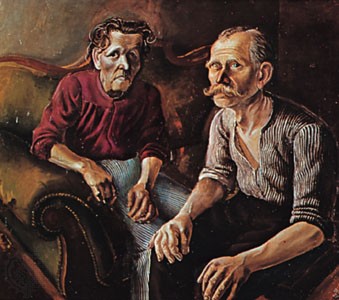 Une des peintures les plus justement célèbres de Dix, la Rue de Prague