

lundi, 21 janvier 2013
The Fourth Political Theory

Natella Speranskaya: How did you discover the Fourth Political Theory? And how would you evaluate its chances of becoming a major ideology of the 21st century?
Felix H. Widerstand: I discovered the Fourth Political Theory after making some research and looking for alternative political ways of organization. I understood that the concepts “left” and “right” are tricky and deceptive ways to mislead the people in order to divide them; and that there must be a real way to combat against globalism and resist the “new world order” that is being implemented by Zionist controlled West (USrael and it´s colony “EU”).
So, I discovered Third-positionism, and became a supporter of national-revolutionary movements in a multipolar geopolitical order (In the Arab countries they have Baathism, Nasserism; in Latinamerica they have Peronism, Bolivarianism; and in our countries we have Eurasianism). This is also known as "international nationalism"; against chauvinism and racism but for the preservation of all identities and of all cultures. I see Eurasianism, or the Fourth Political Theory, as a contemporary way of resistance for those of us who live “from the Canary Islands to Vladivostok”. For resistance against the plutocratic, materialistic, economicist sytem disguised as "democracy", and against american cultural imperialism.
The chances to become a major ideological force are now still low in my opinion (at least for westerners), because of the constant brainwashing that our society is exposed to. Consumerism, individualism, mammonism, and all kind of filth is being pumped in the brains of our people by the media on a daily basis. But the first step should be to spread the idea, to open the eyes of the people, letting them know that other ways of social organization are possible. Then, we need good leaders able to organize the people and who can stand strong and defiantly against the NWO, always defending national soveraignity, at all costs.
The best way of political organization is, in my opinion, a traditional one, were spiritual values are respected, were a collective pride is encorauged, and were social justice is implemented; against usury, exploitation and capitalism.
But this ideas are viewed as “extremist” “fascist” and “anti-democratic” by the politically correct left and by the politically correct right.
Natella Speranskaya: Leo Strauss when commenting on the fundamental work of Carl Schmitt The Concept of the Political notes that despite all radical critique of liberalism incorporated in it Schmitt does not follow it through since his critique remains within the scope of liberalism”. “His anti-Liberal tendencies, – claims Strauss, - remain constrained by “systematics of liberal thought” that has not been overcome so far, which – as Schmitt himself admits – “despite all failures cannot be substituted by any other system in today’s Europe. What would you identify as a solution to the problem of overcoming the liberal discourse? Could you consider the Fourth Political Theory by Alexander Dugin to be such a solution? The theory that is beyond the three major ideologies of the 20th century – Liberalism, Communism and Fascism, and that is against the Liberal doctrine.
Felix H. Widerstand: Indeed, the Liberal doctrine (plutocracy, usury and wild capitalism) is the parasitic economic system used by US-imperialists (Zionists, because Zionists are not only in “Israel”, they are in Washington and New York as well) to control the world and destroy the economic and national soveraignity of all countries that still follow independent policies and don´t bow to globalism. We have seen this very recently in Libya, we saw this in Iraq, in Yugoslavia, and are witnessing the same again with the events going on in Syria. What a coincidence that all countries that are being destroyed by the warmongers had an independent banking system and were not followers of the Liberal doctrine!!
Leo Strauss was the main perpetrator of the “neocon” ideology, he was a Zionist supremacist like all his powerful and now active followers (Elliott Abrams, Paul Wolfowitz, Charles Krauthammer, Richard Perle, Douglas Feith, and so on and so forth – all this filthy disgusting criminals have a very evil agenda)
The solution to liberalism would be to restore the national and economic soveraignity of all countries, in a geopolitically multipolar world. We must go out of the “European Union”, go out of the World Bank, Greece (for instance) should stop paying interests to the banksters of Goldmann Sachs; all countries wanting national soveraignity back should go out of all this international globalist organizations that, in an Orwellian way, are enslaving countries in the name of “freedom and democracy”.
I see Prof. Dugin´s organization and activism as a very good alternative to fight against this system.
Natella Speranskaya: Do you agree that today there are “two Europes”: the one – the liberal one (incorporating the idea of “open society”, human rights, registration of same-sex marriages, etc.) and the other Europe (“a different Europe”) – politically engaged, thinker, intellectual, spiritual, the one that considers the status quo and domination of liberal discourse as a real disaster and the betrayal of the European tradition. How would you evaluate chances of victory of a “different Europe” over the ”first” one?
Felix H. Widerstand: Of course, there are this two Europes; the first one is being imposed upon us by the Masonic architects of the liberal agenda – see the “Kalergi plan” – particularly since the so-called “Frankfurt School” (Horkheimer, Adorno, Marcuse…) started to spread all kind of filth and poison to overthrow the traditional European values and society with their “cultural Marxism” and “political correctness”; they (by the way) directly influenced the May ´68 protests in France (a CIA operation, the first “colour revolution”, long time before Ukraine´s) with agitators like Cohn-Bendit, to overthrow President De Gaulle, who did not bow to NATO as requested.
This “liberal Europe”, slowly suffocating us, is sadly the majoritary tendency; particularly in the West. The “other” Europe, the “different” one, is the one resisting to this psychological warfare and dominium strategy. We are the minority. But this spiritual, traditional Europe, proud and conscious of its roots and willing to preserve its soveraignity and its identity is geographically much better represented in the East: I see Russia as a big hope for all Europeans.
Natella Speranskaya: “There is nothing more tragic than a failure to understand the historical moment we are currently going through; - notes Alain de Benoist – this is the moment of postmodern globalization”. The French philosopher emphasizes the significance of the issue of a new Nomos of the Earth or a way of establishing international relations. What do you think the fourth Nomos will be like? Would you agree that the new Nomos is going to be Eurasian and multipolar (transition from universum to pluriversum)?
Felix H. Widerstand: Yes, we must rediscover our past, to better understand our present, because only if we understand our present we will be able to construct our future. A Multipolar worldview, like the one proposed by the Eurasian movement, is the only alternative against the planetary hegemony on the “one-World” imperialists.
Natella Speranskaya: Do you agree that the era of the white European human race has ended, and the future will be predetermined by Asian cultures and societies?
Felix H. Widerstand: I would rather say that the white European human race has being forced to an end in Europe, due to bio-social engineering, and a very careful and well prepared long-term programm (remember the Kalergi-plan).
Indeed, the Asian (particularly the Chinese and Indian masses) outnumber the Europeans extremely, and the Africans as well… They are very numerous, while the whites are always becoming less and less.
In this context of the Asian cultures, it is sad to point out that the great Japanese nation, with a heroic history and tradition, has been americanized in the last decades becoming also a corrupted capitalistic-mercantilistic society, almost as bad as the modern western civilization.
Natella Speranskaya: Do you consider Russia to be a part of Europe or do you accept the view that Russia and Europe represent two different civilizations?
Felix H. Widerstand: I consider Russia a particular, an own civilization, but with European roots. Nowadays there is a very huge difference in the average mentality of the ordinary westerner and the Russians (and other Eastern Europeans); because Russians and Easterners are still not that corrupted by western poison, and they are still able to preserve their heritage and identity.
Natella Speranskaya: Contemporary ideologies are based on the principle of secularity. Would you predict the return of religion, the return of sacrality? If so, in what form? Do you consider it to be Islam, Christianity, Paganism or any other forms of religion?
Felix H. Widerstand: The contemporary ideologies that proliferate in the West after the French Revolution and were reaffirmed during the XX century by freudo-marxist currents are indeed propagating secularism and atheism. The Masonic-talmudic architects behind these modern ideologies know perfectly well that this is the best method to weaken a society: by spreading individualism and condemning communitarism and spirituality: “Divide and conquer!”
Christianity has been infiltrated and destroyed from within in the western world, and almost all (organized churches) what remains is corrupt (the Vatican, the Protestant sects, etc). Only in the East, like in Russia, the Orthodox faith represents still a spiritual alternative. Islam, on the other side, has proved to be a good way of resistance for the Muslim countries. Particularly the Shia-current, practiced mostly in Iran, and that preserves also some ancient Persian Zoroastrian heritage. But also within Islam there is a tendency trying to destroy this religion from within, like a Trojan horse: It´s Saudi wahhabism, the “Calvinist” kind of Islam. This wahhabi (or salafi) fanatics are being supported by the West, this is the main ideology behind “Al-Qaeda” and all this terrorist groups which took over Libya and are trying to destroy Syria. Also, this is the ideology of the Chechen terrorists, and of the Bosnian ones in the Yugoslavian wars of the ´90. This demonic perversion, which has nothing to do with real Islam (like scholar Imran Hosein and many other real Muslims pointed out), is being used by the West as proxy, as mercenaries, as "useful idiots".
Zionist imperialism is trying to put Christianity and Islam against each other (“Clash of civilizations”), to destroy both of them more easily. And the sad thing is that they are being succesfull! We must awake and realize who the real enemy is.
While I sympathize with ancient Paganism, I think that we have to be very careful with the modern “neo-pagan” tendencies that are being spread in the West since the “hippy” times; all this “New Age” fake spirituality is also a part of this plan to overthrow culture and society.
In my opinion, every nation, every culture, should be attached to its own spiritual tradition; be proud of it and stay strong. We see this with sovereign national leaders like President Chávez from Venezuela, who is a fervent Catholic; or with President Lukashenko from Belarus who is a devout Orthodox Christian. Also the martyr Gaddafi, was a strong believer in Islam (he encouraged Sufism and Islamic studies in Libya). He condemned the Wahhabi terrorism and rightly pointed out that this disgusting Saudi ideology is nothing more than an infiltration of the Zionist West in the Arab-Muslim world.
00:05 Publié dans Actualité, Entretiens, Nouvelle Droite, Théorie politique | Lien permanent | Commentaires (0) | Tags : entretiens, nouvelle droite, théorie politique, sciences politiques, politologie |  |
|  del.icio.us |
  |
|  Digg |
  Facebook
DESMONTANDO EL MITO ANDALUSÍ. ANDALUCÍA Y LA IDENTIDAD CASTELLANA.
DESMONTANDO EL MITO ANDALUSÍ.
ANDALUCÍA Y LA IDENTIDAD CASTELLANA.
Enrique Ravello
Ex: http://enricravello.blogspot.com/

00:05 Publié dans Histoire | Lien permanent | Commentaires (0) | Tags : histoire, espagne, andalousie, identité castillane, castille, leon, reconquista | | del.icio.us | | Digg | Facebook
Oslo: Parc Vigeland, août 2011


00:05 Publié dans art | Lien permanent | Commentaires (0) | Tags : art, arts plastiques, sculpture, norvège, oslo, vigeland, parc vigeland | | del.icio.us | | Digg | Facebook
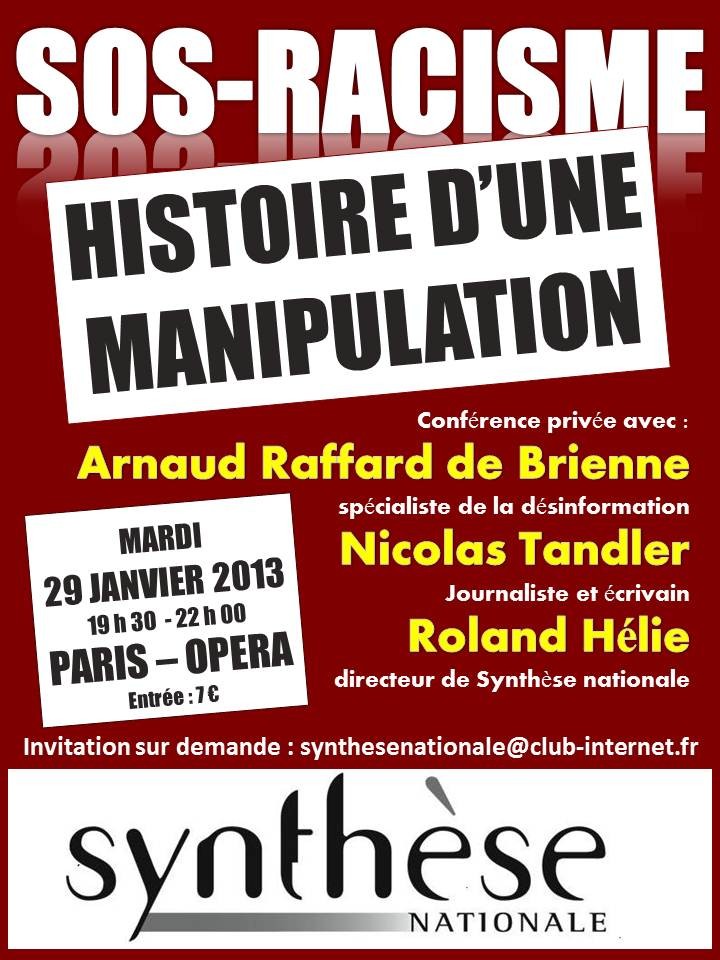
SOS-Racisme: histoire d'une manipulation
00:05 Publié dans Actualité, Evénement, Manipulations médiatiques | Lien permanent | Commentaires (0) | Tags : sos-racisme, événement, paris, france, manipulation, manipulations médiatiques | | del.icio.us | | Digg | Facebook
Classical Modernism & the Art of the Radical Right
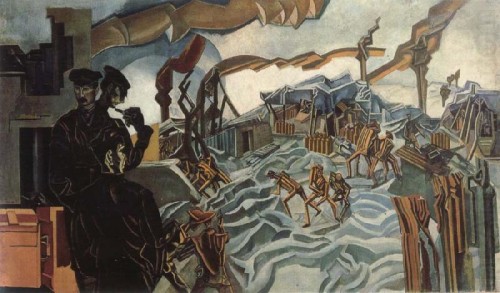
Classical Modernism & the Art of the Radical Right
By Jonathan Bowden
Edited by Alex Kurtagić
Editor’s Note:
The following is an excerpt from Jonathan Bowden’s Heat. He wrote the text aged 30, between July and September 1992. The text is reproduced as it appears, only lightly edited for spelling and punctuation.
. . . this brings a particular dilemma to the surface, namely the division between political and literary extremism. This is the division or discrepancy, if one exists, between the expectation, thought, and expression of a particular desire and its political realization. Indeed, Stephen Spender was quick to point out in his introduction to Alistair Hamilton’s book The Appeal of Fascism: Fascism and the Intellectuals [2] , that a large amount of guilt underlay the Leftist response to fascism in the thirties—namely, his own flirtation with communism, among others, could be explained by the proximity he saw between intellectual gestures and the irrationalism of the radical Right.
In a sense Spender had recognized that an enormous amount of anti-bourgeois emotion and Romantic conceit—the entire sweep of Romanticism, Symbolism, and the Decadence—had at root “fascistic” emotions. This was a somewhat sweeping statement, it had to be admitted, but it was not completely inaccurate. For as with the Symbolist and decadent liberal anarchist Octave Mirbeau and his Garden of Supplicants, a large amount of Romantic rhetoric was bourgeois anti-bourgeois. In other words, it was so radical it soon began to take leave of the class, namely the middle class, which had given it birth. It was Spender’s understanding (in a rudimentary way) of the thesis which George Lukács would later put in a more forceful manner (namely, in The Destruction of Reason) that turned this poet into a pansy-Bolshevik; a pink shade of red—a member of the Homintern. Yet Spender grasped a fundamental point, which is often overlooked, and this has to do with the educated antecedents of classical fascism. It is as if—at least at one level of consciousness—all work of a Romantic, pre-modern, anti-modern, illiberal, and anti-Victorian guise presaged a classical vision of the Right. It even penetrated into the early stages of modernism—where an attempt was made to clear away the “decadent” effluvium of High Romanticism with some sharp-edged early modernism, if not neo-classicism in modern guise. Hence, the fact that Lewis, Pound, Eliot, and Hulme were “soured” Romantics; cynical post-Romantics, if you will. Men who viewed Romanticism with a certain leavened sardonicism. It was a bitter and twisted form of modernism which looked to the past as it demolished it and to the future as it remonstrated with it on behalf of forms of the past. As a result, classical early modernism had two conflict strands within it. One of these went forward into an analysis of pure form—the architecture of formal misstatement—where all that matters is the consideration of a particular type of form; a formalist criteria, a logarithmic exercise in relation to the possibility of taste—whereby modern art produced through Surrealism and its aborted pre-birth/after-birth (Dadaism) to a consideration of color, tactility, and the instrumental nature of a form of vision. When there was nothing left to say—when art had been neutered by the nature of the photographic image, on the one hand, and the impossibility of expressing meaningful statement in a “bourgeois world,” on the other. (The latter in accordance with a particular type of minimalist Marxist aesthetic; the sort of thing which was an Adornoesque parody of itself.) While another tendency in modernism has yet to be explored and this is the proto-classicism which led early modernists to experiment with the possibility of a return to classical simplicity by virtue of a modernist aesthetic. This was why a large number of early modernists, like Epstein and Gaudier-Brzeska (whose work outraged traditionalists), were so interested in the purity of classical form—its aesthetic simplicity and proportion. Likewise, modern classicists, of a highly modernist and individualist character, like Maurras and T. E. Hulme, preached a new form of art which was spare, linear, rectangular, and masculine. In some respects, this predisposition teetered on the edge of two conflicting cultural vistas. On the one hand, it wished to go back even to before Romanticism, on the other, it wanted to recreate everything again in a way which had never been done before.
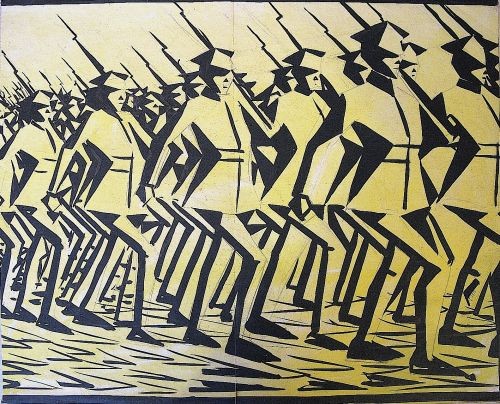
As can be seen from the projected career of various modernists, the modern aesthetic could only go so far, in that a large number would fall away before the vista of total modernity. This is in relation to a pitiful summation of complete modernism which entered into a form of reiterated stylization; sheer form in the pursuit of its absence, the formlessness of an aesthetic concerned with nothing but the possibility of misstatement. Hence, the fact that Lewis, Dalí, Marinetti, de Chirico, Roberts, Gaudier-Brzeska, and many more, gradually fell away from modernism—Dalí towards a symbolic, classical, neo-Romantic form of iconography, namely religious painting, and Lewis towards modernist figuration, expressive linearity, anti-abstraction, and blindness. Also, the latter was to repudiate a form of aesthetic futility, the abandoned purpose of nihilistic modernism—i.e., the sheer purposelessness of empty abstraction; the pursuit of a type of form which had nothing to communicate—in his book that was also a form of recantation, namely The Demon of Progress in the Arts [4].
So we can say that there was a form of arrested classicism within early modernism which later came to reject it. This type of art either put modernism at the service of a neo-classical state, i.e., futurism in Fascist Italy, or it embraced fully-fledged traditional neo-classicism à la Arno Breker and the return to a naturalist form of neo-Grecian art. This was a type of counter-revolution in relation to modernism; a reformatory form of counter-reformation—a type of European modernity that was anti-modernist, a modern form of non-formalist criteria, neither academic nor anti-academic. It was a form of anti-formalist, anti-Bolshevik revolutionary tradition in relation to artistic procedure. What became known—somewhat crassly—as “Nazi art.”
Indeed, it is interesting to note that after the war, after defeat, these various strands came together again, if only in the form of friendship between the various protagonists—namely, the practitioners of a form of pre-to-early modernism that had a classical bias and straightforward neo-classicists who were the radical and talented vanguard of a type of artistic traditionalism; revolutionary artistic traditionalism nonetheless. The people concerned were Breker, Dalí, Fuchs, Pound, Cocteau, Hauptmann, Céline, members of the Wagner family, Speer (if only retrospectively), and the gradual reconsideration of Vorticism and Futurism—as the political passions which had led to opposition against them began to fall away.
Source: http://www.wermodandwermod.com/newsitems/news110120131209.html [5]
Article printed from Counter-Currents Publishing: http://www.counter-currents.com
URL to article: http://www.counter-currents.com/2013/01/classical-modernism-and-the-art-of-the-radical-right/
00:04 Publié dans art | Lien permanent | Commentaires (0) | Tags : art, angleterre, wyndham lewis, peinture, avant-gardes | | del.icio.us | | Digg | Facebook