U.S. Embassy in Ankara Headquarter for ISIS War on Iraq – Hariri Insider
A “trusted source” close to the Saudi – Lebanese multi-billionaire and former Lebanese P.M. Saad Hariri told on condition of anonymity, that the final green light for the war on Iraq with ISIS or ISIL brigades was given behind closed doors, at the sidelines of the Atlantic Council’s Energy Summit in Istanbul, Turkey, on November 22 – 23, 2013.
The Atlantic Council is one of the most influential U.S. think tanks with regard to U.S. and NATO foreign policy and geopolitics. Atlantic Council President Frederick Kempe stressed the importance of the Energy Summit and the situation in the Middle East before the summit in November, saying:
“We view the current period as a turning point, just like 1918 and 1945. Turkey is in every way a central country, as a creator of regional stability. However much the USA and Turkey can work in unison, that is how effective they will be.”
The summit was, among others, attended by Turkey’s President Abdullah Gül, U.S. Energy Secretary Ernst Monitz, Atlantic Council President Frederick Kempe, former U.S. Secretary of State Madeleine Albright, former U.S. National Security Adviser Brent Scowcroft.
It is noteworthy that Scowcroft has long-standing ties to Henry Kissinger and to the Minister of Natural Resources of the Kurdish Administrated Region of Northern Iraq.
“Had Baghdad been more cooperative about the Syrian oil fields at Deir-Ez-Zor in early 2013 and about autonomy for the North [Iraq's northern, predominantly Kurdish region] they would possibly not have turned against al-Maliki; Or he would have been given more time”, said the Hariri insider during the almost two-hour-long conversation.

In April 2013 the EU lifted its ban on the import of Syrian oil from “rebel held territory to finance the opposition”.
In March 2013, U.S. Secretary of State John Kerry demanded that Iraq “stops the arms flow to Syria”, while U.S. weapons were flowing to ISIS via Saudi Arabia into Iraq and Jordan.
On Monday, April 22, 2013, 27 of the 28 E.U. foreign ministers agreed to lift the ban on the import of Syrian oil from opposition-held territories to allow the “opposition” to finance part of its campaign.
“ISIS that was supposed to control [the region around] Deir Ez-Zor. [Turkish Energy Minister Taner] Yildiz and [Kurdish] Energy Minister Ashti] Hawrami were to make sure the oil could flow via the Kirkuk – Ceyhan [pipeline];… Ankara put al-Maliki under a lot of pressure about the Kurdish autonomy and oil, too much pressure, too early, if you’d ask me”, the source said. He added that the pressure backfired.

Plotting: Red, by Maj.(r) Agha H.Amin. Blue, by Christof Lehmann
Previous reports confirmed that Baghdad started intercepting weapons and insurgents along the Saudi – Iraqi border, cutting off important supply lines for ISIS brigades around Deir Ez-Zor, and that Al-Maliki began complaining about a Saudi – Qatari-backed attempt to subvert the Iraqi State since late 2012. Noting my remark he replied:
“That is right, but the heavy increase in attacks came in May – June 2013, after al-Maliki ordered the military to al-Anbar “.
A previous article in nsnbc explains how Baghdad’s blockade caused problems in Jordan, because many of the transports of weapons, fighters and munitions had to be rerouted via Jordan.
The Hariri insider added that the oil fields should have been under ISIS control by August 2013, but that the plan failed for two reasons. The UK withdrew its support for the bombing of Syria. That in turn enabled the Syrian army to dislodge both ISIS and Jabhat al-Nusrah from Deir Ez-Zor in August.
“The situation was a disaster because in June Hariri, Yidiz, Hawrami, Scowcroft, and everybody was ready to talk about how to share the oil between the U.S., Turkey and E.U.. The Summit in November should have dealt with a fait accompli”, the Hariri source stressed, adding that Washington put a gun to al-Maliki’s head when he was invited to the White House.
Both the President of the Kurdish region of Iraq, Masoud Barzani and Iraqi PM Nouri al-Maliki were invited to Washington in early November 2013.
“Certain circles in Washington put a hell of a lot of pressure on Obama to put a gun to al-Maliki’s head”, said the Hariri source, adding that “time was running out and Obama was hesitant”. Asked what he meant with “time was running out” and if he could specify who it was that pushed Obama, he said:
“Barzani was losing his grip in the North (Kurdish Iraq); the election [in September] was a setback. All plans for distributing Iraqi oil via Turkey and for sidelining Baghdad were set between Kirkuk and Ankara in early November…
“Who exactly pressured Obama? I don’t know who delivered the message to Obama. I suspect Kerry had a word. It’s more important from where the message came, Kissinger, Scowcroft, Nuland and the Keagan clan, Stavridis, Petreaus, Riccardione, and the neo-con crowd at the [Atlantic] Council. … As far as I know ´someone` told Obama that he’d better pressure al-Maliki to go along with Kurdish autonomy by November or else. Who exactly ´advised` Obama is not as important as the fact that those people let him know that they would go ahead, with, or without him”.
Asked whether he knew details, how the final green light for the ISIS campaign was given, he said:
” Behind closed doors, in the presence of both Scowcroft, Hariri, and a couple of other people”. To my question “if he could be more specific” he replied “I could; I want to stay alive you know; Riccardione was tasked with the operation that day”.
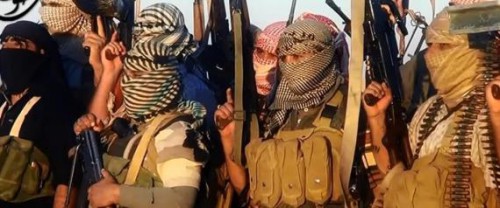
Noting that a prominent member of Saudi Arabia’s royal family, Prince Abdul Rachman al-Faisalhas been named as the one being “in command” of the ISIS brigades, and if he could either confirm or deny, he nodded, adding that “the Prince” is responsible for financing the operation and for part of the command structure, but that the operations headquarter is the U.S. Embassy in Ankara Turkey. “As far as I know, nothing moves without Ambassador Riccardione”, he added.
Ch/L – nsnbc 22.06.2014
ISIS Unveiled: The Identity of The Insurgency in Syria and Iraq

 del.icio.us
 Digg
Digg Facebook
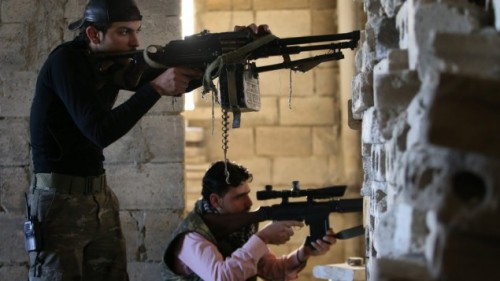
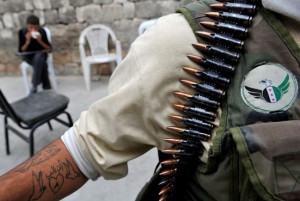 The third and final step the US must take upon losing a war is to leave chaos where victory was denied, and attach responsibility for the conflict to a disposable elected politician – in this case US President Barack Obama. While the war was clearly conceived during the administration of George Bush as early as 2007, it was executed under the watch of Obama. By attaching responsibility for the conflict to Obama, when his term is up and he passes into the hindsight of history, corporate-financier funded policy makers will have before them a clean slate upon which to begin carrying out the next leg of their continuous agenda.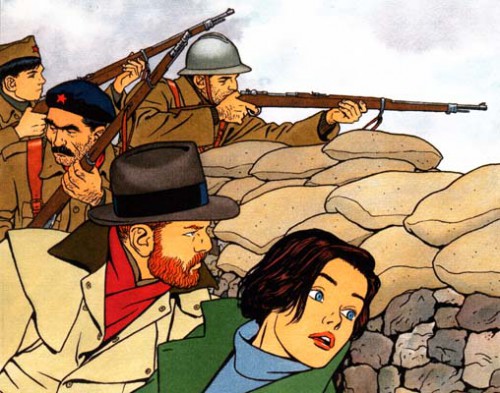
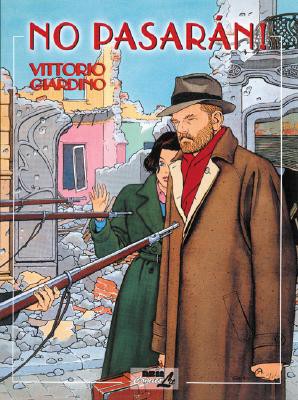 Spanischer Bürgerkrieg, Ebrofront, Sommer 1938: Leutnant Ritt wird zur Erschießung geführt, nachdem der „Genosse Kommissar“, Kusic, ihn wegen „Feigheit“ formlos zum Tode verurteilt hat. Ritts „Verbrechen“: Er hat nach vier Stunden unter dem Feuer von Franco-Truppen mit seinen Leuten den Rückzug aus deckungslosem Gelände angetreten, als bereits mehr als die Hälfte gefallen war. Ritts Frage, ob er seine Männer bis zum letzten hätte massakrieren lassen sollen, beantwortet der kommunistische Politkommissar ungerührt: „Jeder Offizier, der seine Position ohne schriftlichen Befehl verlässt, wird erschossen. Führt ihn ab!“ Die letzte Zigarette ist geraucht, die Gewehre des Erschießungskommandos sind durchgeladen, als Major Guido Treves gerade noch rechtzeitig eingreift, Ritt freilässt und dadurch in eine heftige Auseinandersetzung mit dem Kommissar gerät. Der zeigt den Retter Treves bei der Kommunistischen Partei an, für die der Fall klar ist: „Wir können es nicht zulassen, dass auf der Autorität eines Politkommissars herumgetrampelt wird.“