Ok

En poursuivant votre navigation sur ce site, vous acceptez l'utilisation de cookies. Ces derniers assurent le bon fonctionnement de nos services. En savoir plus.

samedi, 08 juin 2013

L’Islam politico turco: ascesa e declino di uno Stato precursore

tkém.jpg

L’Islam politico turco: ascesa e declino di uno Stato precursore

Dal primo giorno delle ad oggi le dimostrazioni hanno registrato tre morti, più di 2mila fermi e circa 2.500 feriti.

Sebastiano Caputo

Ex: http://www.rinascita.eu/

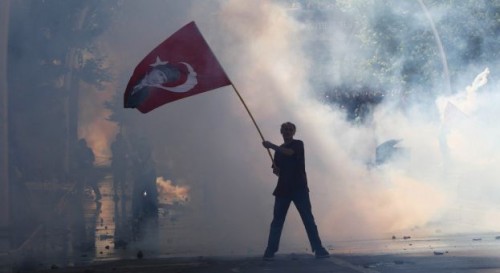
L’intera regione arabo-musulmana, dal Marocco al Pakistan, sta vivendo un clima incandescente nel quale le piazze non cedono alla violenza degli scontri. Recentemente la Turchia di Recep Tayyip Erdoğan è finita nel mirino dei dimostranti che da ormai sei giorni stanno continuando inesorabilmente una lotta contro un governo di maggioranza reputato eccessivamente autoritario. Dal primo giorno delle violenze, quando il 31 maggio la polizia aveva aggredito i manifestanti Verdi che protestavano pacificamente contro lo smantellamento del parco Gezi a Taksim, uno dei quartieri più importanti del centro della città di Istanbul, ad oggi le dimostrazioni si sono allargate a macchia d’olio su tutto il Paese facendo registrare ben tre morti, più di 2mila fermi e circa 2.500 feriti. Oltre alle immagini di estrema violenza che arrivano dal Paese turco, anche alcune altre notizie attestano le difficoltà del governo islamico nel placare la protesta. Infatti proprio ieri il quotidiano turco Hurriyet ha segnalato l’arresto, nella notte, a Smirne, di ventiquattro persone con l’accusa di aver fomentato i disordini e fatto propaganda su Twitter.
E a sei giorni dall’inizio degli scontri con le forze dell’ordine la situazione non sembra migliorare. Il premier Erdoğan, in visita in Marocco da qualche giorno, dovrebbe atterrare proprio oggi ad Ankara, nella speranza che le tensioni si attenuino e che il popolo in lotta si disperda. Diversi “capi-popolo” della rivolta hanno fatto sapere però di voler dimostrare il contrario al leader islamico, il quale recentemente aveva pensato di organizzare una contro-manifestazione proprio oggi, giorno del suo arrivo, con il rischio di provocare una guerra civile vera e propria. Dal Maghreb, Erdoğan ha attribuito le agitazioni al proselitismo di alcuni gruppi estremisti presenti sul territorio, tuttavia le sue affermazioni non corrispondono a quelle espresse dalla prima carica dello Stato, Abdullah Gül e dal vice premier Arinc, volto moderato del partito Giustizia e Sviluppo (Akp), il quale ha ammesso gli errori nella gestione della protesta iniziale contro la distruzione del Gezi Park a Istanbul. “Non sono riusciti a batterci attraverso le elezioni – aveva detto il premier – e ora ci riprovano utilizzando metodi anti-democratici”, dopo che il presidente Gül aveva affermato “se ci sono critiche e obiezioni, tolto il periodo elettorale, è normale che vengano espresse mediante proteste pacifiche”.
Le origini della rivolta popolare in Turchia appaiono estremamente difficili da inquadrare e risulta riduttivo limitarsi ad una sola motivazione tra i diversi dualismi - democrazia e autoritarismo, ecologia e capitalismo, laicità e islamismo, imperialismo e anti-imperialismo o ancora precarietà e crisi economica – attribuiti dai tanti gruppi associativi e partitici che stanno partecipando alle dimostrazioni. L’ondata di protesta che sta travolgendo il Paese sembrerebbe racchiudere al suo interno diverse correnti, la sensazione è comunque che stiano prevalendo le motivazioni politiche su quelle economiche. La Turchia è un Paese poco indebitato che ha evidenziato una crescita sostenuta e che sarà in costante accelerazione nei prossimi anni (nel 2015 il Pil turco sarà pari a 1,1 trilioni, 2,3 volte rispetto al 2005, divenendo la sesta potenza economica dietro alla Spagna). Tutto questo grazie all’azione combinata di tanti fattori che costituiscono tuttora i perni centrali dello sviluppo economico del Paese, tra questi la dimensione del mercato interno (74 milioni di abitanti di cui una maggioranza di giovani e una classe media che sta emergendo economicamente) e una posizione geografica strategica sia dal punto di vista economico (ponte di accesso a oltre 350 milioni di potenziali clienti in Russia, Asia Centrale, Nordafrica e Medio Oriente), sia da quello geopolitico, dato che la Turchia è imprescindibile per la Russia e per il fronte occidentale e atlantista.
Dinanzi allo stato attuale di crescita e sviluppo e nonostante le esistenti disparità sociali causate dall’ampio programma di privatizzazioni lanciato a seguito della crisi del 2001, molti analisti hanno ventilato erroneamente l’ipotesi di una “primavera turca” facendo riferimento alla “primavera araba” che ha travolto il Maghreb due anni fa. Ma è necessaria una distinzione, dato che in Nordafrica, a differenza dell’attuale rivolta turca, i sollevamenti popolari traevano le loro origini dalla situazione economica piuttosto che da quella politica. “Primavere arabe” che a seguito degli stravolgimenti dirigenziali hanno provocato una rivoluzione che è stata de facto solo culturale (islamizzazione della società) e politica (ascesa degli islamisti al potere in Egitto, Marocco, Tunisia, Libia), e che in qualche modo ha seguito la via della Turchia quale primo Paese musulmano in cui è salito al potere un partito che si rifà al moderno islam politico – o islamismo – ideato da Hasan al-Banna nel 1928, poi evoluto nella potente organizzazione dei Fratelli Musulmani (alle elezioni legislative del novembre 2002, Giustizia e Sviluppo (Akp), ottiene la maggioranza assoluta dei seggi in Parlamento e forma un governo monocolore).
Oggi il governo islamico di Recep Tayyip Erdoğan si trova a fare i conti con la protesta più violenta mai verificatasi in oltre dieci anni al potere (dal 2002). Contro la politica conservatrice del leader dell’Akp, propensa ad un islamizzazione silenziosa della società, ci sono gli studenti universitari, ad esempio della Bilgi University, insieme ai loro colleghi provenienti dalla prestigiosa Università del Bosforo, gli attivisti del Chp, fondato da Mustafa Kemal Ataturk, che incarna l’anima laica dell’opposizione all’attuale governo, i deputati del Bdp, il Partito curdo per la società democratica, impegnato con il premier in una delicata trattativa per mettere fine alla lotta armata dei separatisti del Partito dei lavoratori del Kurdistan (Pkk), il TGB (Unione dei Giovani Turchi), ma anche i sindacati, che si stanno mostrando decisi a svolgere un’azione politica di forte coesione con le altre componenti antagoniste, portando in piazza i loro iscritti e promettendo scioperi generali nei prossimi giorni. Nella mobilitazione generale ci sono anche i Verdi e il Partito Comunista di Turchia, forti oppositori alla sottomissione del premier alle logiche capitaliste, oltre che le associazioni che si oppongono visceralmente al collaborazionismo del governo nei confronti dell’aggressione alla Siria. Contro Erdoğan, insomma, c’è un intero popolo. Le “primavere arabe” si sono tramutate velocemente in inverni freddi a causa di un islamismo dilagante. L’Akp, fautore di un modello economico e sociale di stampo liberale e islamico-conservatore, da che era un partito precursore dell’Islam politico, rischia adesso di essere il primo governo della Confraternita a cadere, con il rischio di trascinare con sé tutti i governi della regione che hanno cavalcato la protesta in Nordafrica e che sono legati a doppio filo con i Fratelli Musulmani.


06 Giugno 2013 12:00:00 - http://www.rinascita.eu/index.php?action=news&id=21337

Neo-Ottomaans Turkije botst met modern Turkije

Neo-Ottomaans Turkije botst met modern Turkije

door Paul Vanden Bavière

Ex: http://www.uitpers.be/

turkije protestSedert de laatste week van mei neemt de beroering toe in Turkije. Wat begon als een protest tegen bouwplannen van premier Recep Tayyip Erdogan van de islamistische Partij voor Gerechtigheid en Ontwikkeling (AKP) op het laatste stukje groen bij het Taksim-plein in hartje Istanboel, is uitgedeind naar de hoofdstad Ankara en andere grote steden. Het protest heeft inmiddels veel nieuwe thema’s in de politieke arena gegooid.


Tien jaar nadat de AKP aan de macht kwam in Turkije zit er duidelijk sleet op de partij. En is er een tegenbeweging gegroeid rond een generatie, die geprofiteerd heeft van Erdogans economische successen, maar niets wil weten van zijn plannen Turkije om te vormen tot een verstikkend islamistisch land. Het protest is geen heropleving van het al lang gediscrediteerd republikeins Turkije, maar een zelfbevestiging van een opkomend modern Turkije, dat zich afzet tegen het streven naar een nieuwe of neo-ottomaanse maatschappij van de AKP.


Het Ottomaanse rijk, ontstaan in de 14de eeuw, en genoemd naar Osman I, kende een roemloos einde na de Eerste Wereldoorlog (1914-1918), waarin het de kant van de Duits-Oostenrijkse verliezers had gekozen. Daarom zou het ontmanteld worden. Het verloor zijn Arabische gebieden en de meeste nog resterende bezittingen op de Balkan. Generaal (pasha) Mustafa Kemal wist te voorkomen dat Grieken, Italianen, Fransen en Britten zich meester maakten van delen van Anatolië en dat in oosten Armeniërs en Koerden eigen staten zouden krijgen.


De generaal, later Atatürk (de vader van de Turken) genoemd. Ging resoluut de weg van de modernisering in westerse zin op. Hij zette de laatste Ottomaanse sultan af en schafte ook diens titel van kalief, opvolger van de profeet Mohammed, af. Turkije was niet langer de leider en de behoeder van de orthodoxie van de soennitische tak van de islam, veruit de belangrijkste tak. Dit tot grote spijt van vele Turken, die voor een groot deel vrome moslims waren en zijn – bij de laatste parlementsverkiezingen, die van 2011, behaalde de AKP bijna 50% van de stemmen.


Diepe staat


Meer nog Atatürk, ging de weg van scheiding van moskee en staat op: Turkije werd een seculiere staat – met dien verstande dat de Turkse regering wel de islam als staatsgodsdienst aannam maar tegelijkertijd de clerus onder een strikte controle hield. Imams worden opgeleid in staatsscholen, krijgen hun benoemingen van de staat, die ook instaat voor de bouw van moskeeën. Geen wildgroei van privé-initiatieven dus, die het staatsgezag uiteindelijk in gevaar zouden kunnen brengen.
De seculiere staat maakte het mogelijk dat de Turken die dat wensten, in tegenstelling tot in de meeste islamitische landen, zich konden onttrekken aan controle door de islamitische clerus en vrij hun mening over godsdienst konden uiten. Dat was een grote verdienste. Maar de Turkse Republiek was alles behalve een democratie. Pas in de jaren 1950 werd partijvorming toegelaten. Maar dan nog werd alles gecontroleerd door wat men de “diepe staat” noemt, een groep van generaals, die zich als behoeder van de erfenis van de in 1938 overleden Atatürk opwierp, van rechters, professoren, journalisten… De partijen moesten rekening houden met een aantal door de “diepe staat” uitgezette rode lijnen. Zo mocht het parlement niet debatteren over het budget van het leger en politie en zich niet moeien met het optreden van de militairen tegen van separatisme verdachte Koerden en tegen linkse groepen. Een optreden dat moorddadig was. De mensenrechten werden op alle manieren geschonden. Censuur en controle alom tegenwoordig. De democratie in Turkije was dus grotendeels fictie.


Hierin kwam geleidelijk verandering toen Turkije zijn kandidatuur stelde voor lidmaatschap van de Europese Unie, die een hele reeks voorwaarden stelde op gebied van economie, politiek en mensenrechten. Dat was het begin van het einde van het republikeinse establishment en van de “diepe staat”. Europa maakte het mogelijk dat de AKP in november 2002 de verkiezingen kon winnen zonder dat het leger een staatsgreep pleegde. Voor Erdogan begonnen jaren van manoeuvreren om uit de greep van de “diepe staat” te geraken. Daar slaagde hij in toen hij uiteindelijk de macht van de militairen wist te breken. Ook haalde hij bij elke opeenvolgende parlementsverkiezingen meer stemmen, waarin zijn economische successen een rol grote rol speelden. Erdogan bouwde de rol van de staat in de economie systematisch af en wist het investeringsklimaat te verbeteren door nieuwe wetten en reglementen. Turkije is nu de 15de grootste economie van de wereld en is grotendeels gespaard gebleven van de banken- en beurscrash van 2008.


Autoritair islamist


Maar Erdogan is en blijft een conservatieve islamist, die de Turkse maatschappij wil moraliseren. Hij heeft zich ook opgeworpen tot een autoritaire eerste minister, die geen tegenspraak duldt en ervoor gezorgd heeft dat duizenden politici, journalisten, linkse activisten, Koerden, militairen… in de gevangenis werden gestopt zonder veel bewijzen. Van persvrijheid houdt de eerste minister helemaal niet. Veel journalisten durven hun mening niet meer uiten uit vrees in de gevangenis te geraken en torenhoge boetes te krijgen. Krantenuitgevers die zich tegen de regeringspolitiek uitspreken kunnen op elk ogenblik enorme belastingsboetes krijgen.
Geleidelijk aan wordt de islamitische moraal aan de Turken opgedrongen. De hoofddoek, destijds door Atatürk gebannen uit publieke gebouwen, keert geleidelijk aan terug. In april begon Erdogan Ayran, yoghurt aangelengd met water, aan te prijzen als de Turkse nationale drank in de plaats van de gealcoholiseerde anijsdrank raki. Inmiddels werden al wetten ingediend om de verkoop van alcohol bij bepaalde plaatsen zoals scholen en moskeeën en op bepaalde uren te verbieden.


Enkele jaren geleden zorgde Erdogan tot bij de Europese Unie voor ophef toen hij een wet wou laten goedkeuren om overspel strafbaar te maken. Dat voorstel moest hij intrekken door de beroering die het internationaal verwekte. Nu laat Erdogan zich laatdunkend uit over homoseksualiteit – volgens hem een ziekte – en bestempelt hij abortus als moord.
Erdogan werpt zich de laatste paar jaren ook steeds meer op als de beschermer en behoeder van de soennitische islam, zoals de sultans-kaliefen dat vroeger deden. Daarom ook heeft hij zich aangesloten bij de soennitische as van Jordanië, Saoedi-Arabië en de andere monarchieën op  het Arabische schiereiland zoals Qatar en wil hij zijn voormalige vriend Bashar al-Assad, de president van Syrië, ten val brengen.


Dat moraliserend en conservatief beleid heeft hem een verlies aan populariteit opgeleverd bij de moderne Turken, die graag hun raki of hun Efes-pils willen blijven drinken. En de rol van soennitisch leider is niet goed gevallen bij de ongeveer 20 miljoen Turken die alevieten zijn, de Turkse tegenhanger van de Syrische alawieten, die beide zijn voortgekomen uit een dissidentie binnen het sjiisme. In Turkije steunen de alevieten de Syrische president Assad. Zij niet alleen, ook partijen als de Republikeinse Volkspartij (CHP), de partij die destijds door Atatürk werd opgericht, verwerpen de Syrië-politiek van Erdogan.


De vraag is nu of Erdogan onder de druk van de betogingen zal terugkrabbelen. Momenteel geeft hij de indruk van niet en verwerpt hij vergelijkingen van het huidige oproer in Turkije met de “Arabische lente”. Hij weet zich ook gesterkt door het feit dat bijna de helft van de Turken in de vorige verkiezingen voor hem hebben gestemd.


Finnish-Caucasian Emirate

Finnish-Caucasian Emirate

by Nikolai MALISHEVSKI

Ex: http://www.strategic-culture.org/
 

The facts revealing the «Finnish traсe» in the Boston marathon terrorist bombing have become a thing of general public knowledge. I offer just a cursory look at them to substantiate a warning: Europe is not immune from the events the Bostoners went through in April 2013.

Boston is home to a small community of ethnic Chechens in the United States. The office of Al Kifah is located on Beacon Street. In 1990 the organization sprang from the anti-Soviet jihad movement in Afghanistan. It was suspected of being implicated in the World Trade Center bombing that took place on February 26, 1993, as well as of connection to some terrorist activities on US soil. The bulk of the organization’s offices were closed down, but the Boston branch called Care International continued to function. It raised funds, provided all forms of logistical support, created brigades of suicide bombers and recruited fighters for jihadist causes in the United States. (1) Some of these mercenaries, like Aukai Collins, for instance, came back from Chechnya to collaborate with the Federal Bureau of Investigation (FBI) as informants. The United States special services let the Boston center of extremism in peace for about twenty years. The Tsarnaev brothers’ mother recalls, «Tamerlan was ‘really an extremist leader and that they were afraid of … He was controlled by the FBI for five years. They knew what my son was doing. They were following every step of his». (2)

As Finnish media reported on April 21, the Boston terrorist act perpetrators were influenced and directly controlled by the extremist website called Caucasus Center, which is located in Finland and has a reputation of being an information instrument of the Caucasus Emirate. The British Daily Mail published the article called Was Boston Bomber Inspired by Russia's Bin Laden? Mother Claims FBI Tracked Older Brother 'for FIVE YEARS' After Being Told by Moscow of Links to Chechen Terrorists (2) devoted to the links between the Tsarnaev brothers and Doku Umarov who heads the Center. Some American and Turkish journalists say Chechen Fatima Tlisova was a key connecting link between the Caucasus Emirate and the United States special services operating in the Caucasus (including Jamestown Foundation) (4) Islam Saidaev describes how these kind of people were recruited and used by Western and Georgian special services for support of Chechen separatists in his book called To Do Away With a Witness. The author is well acquainted with the details leading to the conclusion that, «The idea to create the Caucasus Emirate, which was spread around among Chechens, was a brainchild of Georgian special services and the Caucasus Center website».

Here are some facts from the biography of Doku Umarov which are not in the books as yet. He was born in 1965 in Achoy-Martan. In July 1992 his name was included into the federal wanted list for murder and rape. On his mother’s side he is a relative of terrorist Movsar Baraev, who took hostages in Nord-Ost Theater in the Moscow district. He is also a cousin of Arbi Baraev, who is well known for abducting people, including French national Vincent Koshtelya, three Britons: Peter Kennedy, Darren Hickey, Rudi Petschi and New Zealand-born Stan Shaw as well as many others. Umarov is a staunch believer in Wahhabism. He goes around by the names of Warrior-1, Abu Muslim and Aisa. By the end of 1990s he ran errands for Khattab, a CIA operative and a Canadian national, allegedly a native Jordanian reported to be deprived of his homeland’s citizenship for links to US special services. In the 2000s Doku Umarov was closely connected to and provided funds for another terrorist - Ruslan Gelaev. With Gelaev gone, he took his place as the leader of criminal gangs in Georgia. Umarov was the last «president» of self-proclaimed Ichkeria (2006-2007). In Russia he is on wanted list for instigating ethnic strife, looting, abductions, mass murders (he personally shot Russians and Chechens) and the complicity in terrorist activities. Not once he claimed responsibility for ordering such terrorist crimes as Nevsky express (2009), Moscow metro (2010) and Domodedovo airport (2011) bombings.

On October 7 2007 Doku Umarov proclaimed himself as emir of Caucasus Emirate - a purported Islamic state spanning several republics in the Russian North Caucasus - calling his followers to start a global jihad, «a holy duty for all the Muslims of the Caucasus». Back then he said, «Today our brothers fight in Afghanistan, Iraq, Somalia and Palestine. Whoever attacked Muslims, wherever they may be is our common enemy. It’s not Russia only, but also the United States, Great Britain, Israel, anyone who fights against Islam and Muslims». On June 2010 the United States put him on the list of international terrorists. On March 11 2011 the United Nations Security Council added him to the list of individuals allegedly associated with al-Qaeda. On March 26 2011 the U.S. Department of State authorized a reward of up to $5 million for information leading to the location of Doku Umarov. At that, the United States special services had done nothing to neutralize him till the Boston bombing.

According to Finnish internet media outlet Suomitanaan, the Caucasus Center is just a small part of widely spread extremists’ structure, located in Helsinki, Finland. (3) The organization is tasked with a priority mission of disseminating jihad throughout Europe and the United States. The Center is supported by prominent Finnish politicians and state officials who back the idea of «independent Ichkeria». For instance: Finnish Green party politician, current Minister of Intentional Development Heidi Hautala, former Member of the European Parliament, Tarja Kantola Special Adviser to the Minister for Foreign Affairs, Antero Leitzinger, a researcher at the Finnish Migration Service, being responsible for political asylum applications from the Caucasus. Finland is home to «Battalion of Chechen Martyrs», which added new members to its ranks after the Caucasus Center told would-be shahids (suicide bombers) that Tamerlan Tsarnaev died tortured by Americans. Some structures enjoying the support of Finnish state officials like Finnish-Russian Civic Forum, for instance, help the people who cannot wait «to set the fire of global jihad» to be transferred to other countries. The Boston tragedy brought into light the terrorists structures located in Finland. But the activities of the «Finnish-Caucasian Emirate» spread much further, far beyond the one state boundaries…

In 2011 it was reported that the younger son of former Chechen separatists’ leader Degi Dudaev, a citizen of Lithuania living in Vilnius, was detained by Lithuanian police. Back then Lietuvosrytas wrote that he was accused of being a member of a criminal gang involved in issuing faked Lithuanian passports, which went straight into the hands of Chechens, the same people as the Tsarnaev brothers, allowing them to move freely around the European Union.
1) More in detail: Berger J. Boston's Jihadist Past // Foreign Policy 22.04.2013 // foreignpolicy.com/articles/2013/04/22/bostons_jihadist_past; Berger J.M. Jihad Joe: Americans Who Go to War in the Name of Islam. Potomac Books, 2011. - 265 p..
2) Gallagher I., Stewart W. Was Boston bomber inspired by Russia's Bin Laden? // Daily Mail, 20.04.2013 // www.dailymail.co.uk/news/article-2312331/Was-Boston-bomber-inspired-Doku-Umarov-Mother-claims-FBI-tracked-older-brother7)-years-told-Moscow-links-Chechen-terrorists.html.
3) Boston terrorists were influenced and instructed by "Kavkaz Center", mouthpiece of terrorist Doku Umarov and his "Caucasus Emirate", operating in Helsinki, Finland // Suomitanaan, 21.04.2013 // suomitanaan.blogspot.ru/2013/04/boston-terrorists-were-influenced-and.html.
4) Madsen W. CIA Troublemaking in Caucasus // www.strategic-culture.org/news/2013/05/20/cia-troublemaking-in-caucasus.html

Euro-Atlantism must be replaced by Eurasianism

Euro-Atlantism must be replaced by Eurasianism

by Gabor VONA

Ex: http://www.geopolitica.ru/


- Mr. Vona, what is main idea of your political party and why is it important for Hungary to make revision of the relations with EU?

- Jobbik is a national conservative party which does not refrain from using radical means. So when they label us as radicals, they are wrong.  Radicalism is not a principle, it is a method. The reason why we are radicals is because the situation is radical as well. At the moment, we Hungarians are sick passengers on a sinking European ship that has lost its values. This is unbearable. First we must get off the ship, then cure our diseases. Hungary was not admitted to the EU so that we could develop. The goal was to colonize us, to exploit our cheap labour and acquire our markets. Western companies and banks now try to maintain their systems by using the profit they pump out of our country in the East. And this is just the economic side of the problem. The EU did not bring any good in terms of the spiritual, mental side, either. After the anti-value approach of Communism, we are now living in the valuelessness of capitalism. I personally follow traditionalist principles, in other words, I believe that Europe should get back to its own roots and rearrange its relationship with other traditional cultures that only exist in the East now.

- Jobbik has image of ultra right political party in Hungary and in Europe too. Do you agree with this label or have other outlook that can not be dealing with classical terms of "right", "left" and so on?

- If modernity, which stretches from the Renaissance through the Age of Enlightenment to global capitalism, is identified with the political left, then we definitely belong to the right. I and my party, however, cannot be located by using the left and right coordinates of current politology. The best way is to say that Jobbik is a national radical party, which is not chauvinistic, which defies global capitalism and three of its key representatives, the USA, the EU and Israel, from the platform of universal human values.

- Euroscepticism is very different in EU. Please can you to describe some particular issues ofHungary and neighbour countries related with this topic? What is role of euroatlanticism strategy in this process?

- The disapproval rate of the EU has just exceeded its approval rate in Hungary for the first time. There was an incredible brainwashing going on in the 1990s, so most people believed it was going to be good to join the EU, and that there was no other option. By now more and more people have realized that the whole thing was a setup. The Union needs markets, cheap labour and a garbage dump. How naive we were when we thought that the West was going to provide a historic compensation for the East to counterbalance  their exploiting and abandoning us quite a few times in history! The same applies to the neighbouring countries as well but Hungary is in the worst situation. The previous government signed every paper Brussels laid down in front of them, the current one is only interested in its own power, and antagonizes the whole EU for it. The common ground of the two governments is that neither has any concept whatsoever. So far I am the only politician in Hungary to declare that Euro-Atlantism must be replaced by Eurasianism.

- Did financial crisis had influence on protectionism moods or general aspects is civilizational and values factors? How much involved NGO's and external powers in desintegration of hole hungarian system (territory-language-culture-etc.)?

- The economic crisis indeed has a great influence on scepticism. The situation has revealed that the EU does not represent the interests of the whole community but the major Western member states - France, England, Germany. The influence of various external powers and organizations is becoming more and more obvious in people's eyes. I can go as far as to say that there is a revolution of consciousness going on in Hungary. This is of course painful, because people must give up many illusions, but it is inevitable because the future must be built on truth and reality. Consequently, what now seems to be a confusion in Hungarian society will clear  up, I hope, and give way to a society that is much more self-aware and has much clearer thinking.

 - If we'll look inside of Hungarian identity we'll find eurasian roots of this nation. How much this line presented in your politics?

- Completely.  The Hungarian nation has Turkic origin, and was formed by the Russian steppes into what it is now, then wandered to the West to establish a state in the Carpathian basin. Our Western integration has been going on for centuries, but we have never forgotten our Eastern origin and they could never uproot this concept from our minds. This duality has often had its drawbacks for us, but I believe it could be beneficial this time.

 - By the way what about connection with Russia in geopolitcal sense of nowadays?

- Jobbik is an anti-Communist party, yet we were the first in Hungary to seriously propose to settle our relations with the Russians. Not only in diplomatic speeches, but in reality as well. At the time of the Georgian conflict, when the whole Hungarian political elite was voicing their agreement with the American interests, we declared that this issue was about something completely different. When Viktor Orbán was sending sulky messages to Russia from opposition back in 2009, we already declared that he was making a huge mistake. Personally, I have good relations with several Russian diplomats in Budapest, and I am very happy that the Russian Embassy is always represented at our year-opening conferences. In my foreign policy plans, Russia - in addition to Germany and Turkey - is a key political and economic ally, partner for Hungary. 

- If we'll speak about global processes what is your position and prognosis for forthcoming events? How long U.S. will be superpower yet? What is E.U. future and how Eurasian integration will happens?

- Difficult question. The agony has definitely started and a new world order will have to be established. The alliance of the BRICS countries clearly shows that the time of the USA and EU has passed. The most fortunate turn of events would be if they themselves realized it, because that could prevent major conflicts and give way to a peaceful transformation. With regard to the framework of Eurasian cooperation, I don't see the actual opportunities yet, because first we must define the basic values and the consequent strategy that could attract the widest possible circles. This is the challenge now, and Jobbik is the only Hungarian political entity willing to meet it. The others are all Atlanticists, and they will remain so until history passes them.

- Thank you Mr. Vona for interview. Do you want to add something for our readers?

- Thank you for the opportunity.

By Leonid Savin

Syria Today, America Tomorrow

Syria Today, America Tomorrow

Image: MSNBC Media

John McCain took a brief respite from his long campaign to dispossess Americans to hang out with his new friends in Syria. McCain and his fellow travelers have transitioned from confident predictions that the reign of Bashar al-Assad is on its last legs to an angry insistence that America must supply the rebels with arms in over to overthrow him. Senator Rand Paul made the obvious point that America is war weary and the Syrian rebels are far more likely to assist al-Qaeda than the supposedly evil Assad. One suspects that McCain’s insistence on allying with terrorists and cannibals comes from his fanatical hatred of Putin than any supposed support for democracy.

Still, the situation in Syria has an importance that goes beyond the usual neoconservative stupidity and treason. It’s a model for the ethnopolitical future that the short sightedness of politicians like McCain is creating for what was once the United States.

The Syrian Civil War is less a battle for control of the state than an ethnic grudge match. Even years after the beginning of the conflict, a map of government and rebel controlled territory lines up almost exactly with the distribution of ethnic groups within the country. Almost a year ago, Tony Badran of The Weekly Standard pointed out that Assad’s strategy for survival is similar to that of the Crusaders—an interesting comparison considering that the Weekly Standard is apparently taking the side of Saladin. As Hezbollah has now declared its intention to openly back Assad (along with Iran), the conflict between Christians, Shiites, and Alawites against Israeli and American backed Sunnis is explicit.

Bashar al-Assad touched on a profound truth when he declared that unless he was victorious, it would be the end of Syria. Syria, as a meaningful entity, only exists because of Assad’s authoritarianism and Baathist ideology, an Arab nationalism deliberately intended to transcend sectarian differences. Absent this power and at least rhetorical ideological support, Syria will likely revert precisely into the divided regions it existed as during French rule.

The United States of America is backed by a similarly artificial foundation, the powerful civic creed of “Americanism” and the promise of eternal national prosperity. Colin Woodward created a model of the “Eleven Nations of North America,” as a guide to the cultural and economic components of the American Imperium and the similarly artificial Canadian entity. If anything, Woodward’s model underestimates the extent of North American divisions, as it neglects the critical importance of racial conflicts within these “nations,” from Blacks and Whites in Dixie to the tensions between Whites and American Indians in the Far West.

Colin Woodard's Nations of North America

Colin Woodard’s Nations of North America

Like tectonic plates, the fault lines of race, ethnicity, geography, and culture lie beneath the political issues of the day. To paraphrase Lord Palmerston, constituencies don’t have friends, they have interests, and rhetoric is simply an after-the-fact justification for those interests. “American exceptionalism” notwithstanding, if the federal system ever fails to deliver the goods, even for a brief moment, the American future could look a lot like the Syrian present.

Conférence de Pierre Le Vigan sur la pensée de Michéa


Conférence de Pierre Le Vigan

sur la pensée de Michéa

Nice