

mercredi, 18 décembre 2013
Soirée au "Crabe-Tambour"

21:51 Publié dans Evénement | Lien permanent | Commentaires (1) | Tags : événement, paris |  |
|  del.icio.us |
  |
|  Digg |
  Facebook
J. M. Vernochet sur la situation en Ukraine
12:00 Publié dans Actualité, Affaires européennes | Lien permanent | Commentaires (0) | Tags : ukraine, politique internationale, europe, affaires européennes | | del.icio.us | | Digg | Facebook
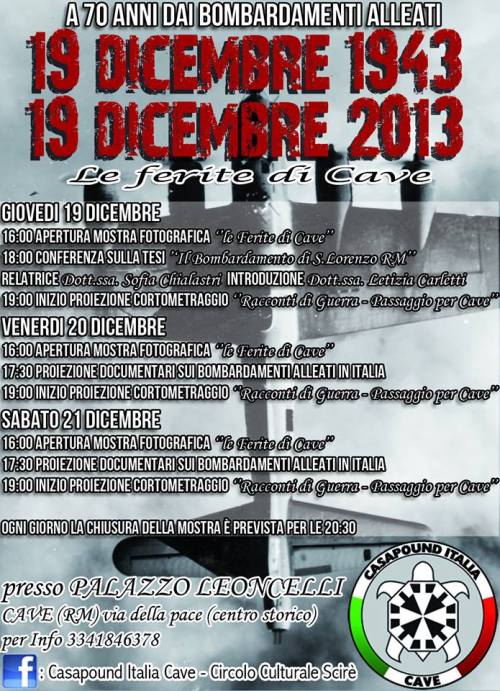
A 70 anni dai bombardamenti alleati
11:47 Publié dans Evénement, Histoire | Lien permanent | Commentaires (0) | Tags : italie, événement, histoire, bombardements, deuxième guerre mondiale, seconde guerre mondiale, commémoration | | del.icio.us | | Digg | Facebook
Instortend Amerika
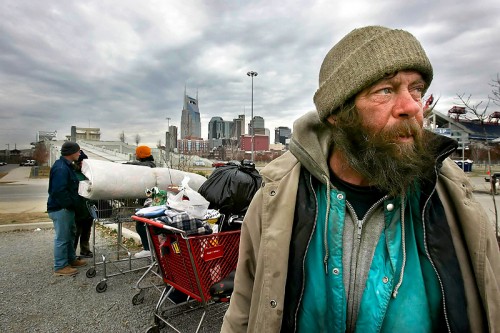
Instortend Amerika: 102 miljoen zonder werk, steden met 60% kinderarmoede
Obamacare absolute ramp: gemiddelde premiestijging voor gezonde 30 jarige Amerikaan 260% - Meerderheid jonge Amerikanen wil dat Obama verdwijnt
Barack Hussein Obama is hard op weg de met afstand allerslechtste president van Amerika ooit te worden.
De Verenigde Staten zinken maandelijks verder weg in wat met het oog op de statistieken een nieuwe Grote Depressie kan worden genoemd. Onder president Obama is er een tot op het bot verdeelde samenleving ontstaan die een explosie van geweld en armoede meemaakt. Tegelijkertijd nemen de met biljoenen belastinggeld geredde megabanken meer risico's dan ooit.
Maar liefst 102 miljoen Amerikanen behorende tot de beroepsbevolking hebben geen baan. Dat zijn er 27 miljoen meer dan in het jaar 2000. Toch beschouwt de regering maar 11 miljoen van hen als werkloos. Slechts 31% van de werkende Amerikanen heeft nog een 40 urige werkweek - 40% werkt langer, waarvan 9% meer dan 50 uur per week (2). Slechts 19% van de bevolking denkt dat de arbeidsmarkt er beter voorstaat dan vorig jaar. 6 miljoen jonge Amerikanen tussen de 16 en 24 hebben geen baan en zitten ook niet (meer) op school.
Bijna helft afhankelijk van overheid
40% van alle werknemers verdient minder dan $ 20.000 (ca. € 14.500) per jaar. 10% van alle banen wordt verzorgd door uitzendbureaus; van alle Amerikanen die parttime werken, leeft 25% onder de armoedegrens. Na inflatiecorrectie verdient 40% van alle werknemers minder dan een minimumloonverdiener in 1968.
Sinds de komst van Obama steeg de gemiddelde tijd dat iemand werkloos is van 19,8 weken naar 37,2 weken. Kleine zelfstandigen verdwijnen in snel tempo; slechts 7% van alle werknemers (buiten de landbouw) is nog een zelfstandige.
Met 49,2% waren nog nooit zoveel mensen geheel of gedeeltelijk afhankelijk van een uitkering of overheidstoelage. Consumenten moeten dan ook steeds meer op krediet kopen; dat aantal steeg de afgelopen 3 jaar met 22%. In dezelfde periode steeg het aantal studentenleningen met 61%. Bijna de helft van alle leerlingen op openbare scholen komt uit een gezin met een laag inkomen. 1,2 miljoen zijn zelfs dakloos, een stijging van 72% sinds het begin van de recessie / depressie.
Obamacare absolute ramp
Obamacare, het nieuwe socialistische gezondheidsstelsel, is een absolute ramp. Eind november hadden slechts 365.000 mensen zich aangemeld, terwijl al 4 miljoen mensen hun bestaande verzekering juist zijn kwijtgeraakt door het nieuwe systeem. De verwachting is dat het aantal Amerikanen zonder zorgverzekering zal stijgen naar maar liefst 100 miljoen.
Degenen die nog wel hun zorgverzekering houden, moeten daar veel meer voor gaan betalen. Een gezonde 30 jarige Amerikaan zal zijn premie dankzij Obamacare met maar liefst 260% zijn stijgen. Onlangs gaven we al het voorbeeld van een gezond werkend stel in Texas, dat van de overheid te horen kreeg dat hun verzekering 539% duurder wordt.
Obama gaf de afgelopen 5 jaar $ 3,7 biljoen uit aan de sociale zekerheid. Toch groeit de kloof tussen rijk en arm als nooit tevoren. De rijkste 10% bezit 74% van alle welvaart in het land. De gewone Amerikaan ziet zijn inkomen echter al 5 jaar lang -precies zolang Obama aan de macht is- teruglopen. Ter vergelijk: de 6 erfgenamen van Wal-Mart oprichter Sam Walton zijn net zo rijk als 1/3 van alle Amerikanen bij elkaar.
60% kinderarmoede in Detroit
Ook de Amerikaanse samenleving zelf is aan het instorten. Vorig jaar steeg het aantal gewelddadige misdaden met 15%. Nog nooit trouwden er zó weinig mensen: er worden slechts 6,8 huwelijken op iedere 1000 mensen gesloten. Het aantal mensen dat een eigen huis heeft daalt al sinds 2005. In Detroit, waar 78.000 woningen leeg staan, leeft een onvoorstelbare 60% van alle kinderen in armoede.
20% van alle Amerikanen heeft maandelijks niet genoeg geld om voldoende voedsel te kunnen kopen. Het aantal Amerikanen dat afhankelijk is van voedselbonnen, steeg van 17 miljoen in 2000 naar meer dan 47 miljoen nu, oftewel 20% van alle huishoudens en net zoveel als de hele bevolking van Spanje.
Meer schuld dan alle eerdere presidenten bij elkaar
De schuldenlast van de VS is explosief gestegen. In 1970 was de totale schuld van de overheid, de bedrijven en de consumenten minder dan $ 2 biljoen. Nu is dat ruim $ 56 biljoen. De officiële overheidsschuld steeg het afgelopen jaar verder door van $ 16,1 biljoen naar $ 17,2 biljoen. Alleen al in de eerste week van het fiscale jaar 2014 (dat begon in oktober) moest de overheid $ 1 biljoen lenen om de schulden te kunnen blijven financieren. Iedere week komt daar gemiddeld $ 100 miljard bij. (3)
Toen Obama aantrad, bedroeg de staatsschuld 71% van het BNP; inmiddels is dat gestegen naar 101%. Als dit in hetzelfde tempo doorgaat, zal de staatsschuld aan het einde van zijn termijn meer dan verdubbeld zijn, en zal Obama meer schulden hebben gemaakt dan alle eerdere Amerikaanse presidenten bij elkaar opgeteld. Nu al is de staatsschuld per hoofd van de bevolking hoger dan in Griekenland, Portugal, Italië, Ierland of Spanje.
Megabanken nog groter
Van de ruim 18.000 Amerikaanse banken in 1985 zijn er nu nog maar 6891 overgebleven. De grote megabanken doen het echter steeds beter. De 6 grootste banken, JPMorgan Chase, Bank of America, Citigroup, Wells Fargo, Goldman Sachs en Morgan Stanley zijn de afgelopen 5 jaar collectief 37% groter geworden. Deze 6 hebben 67% van alle financiële assets van de Amerikaanse banken -$ 14,4 biljoen- in bezit. JP Morgan Chase is ongeveer net zo groot als de hele Britse economie.
Vier van deze 'too big to fail' banken hebben voor ruim $ 40 biljoen aan derivaten op hun balansen staan. Bij Goldman Sachs is de totale blootstelling aan deze zeer risicovolle producten ruim 381 x groter dan hun financiële bezittingen.
Volgens de Bank for International Settlements in Basel bedraagt het totaal aan rentederivaten in het hele wereldwijde financieel systeem een duizelingwekkende $ 441 biljoen. De totale publieke en private schuldenlast op onze planeet steeg sinds het begin van de crisis in 2008 met 30%. Dat gebeurde ook in China; daar steeg de binnenlandse schuld in dezelfde tijd van $ 9 biljoen naar $ 23 biljoen.
Geen vertrouwen in overheid, Obama en elkaar
Alles in ogenschouw genomen is het dus niet vreemd dat 68% van de Amerikanen vindt dat hun land op de verkeerde weg zit. Nog maar 32% van de bevolking vertrouwt zijn medemens. Met het vertrouwen in de overheid is het nog veel slechter gesteld: slechts 19% van de Amerikanen heeft nog vertrouwen in 'Washington'. In 1958 was dat nog 73%. Een meerderheid van de Amerikanen tussen de 18 en 24 ziet Obama dan ook het liefste verdwijnen. In 2008 stemde 66% van de jongeren nog op Obama; zonder hun stem zou hij destijds niet hebben gewonnen. (4).
Xander
(1) The Economic Collapse
(2) Breitbart
(3) CNS News
(4) Town Hall
Zie ook o.a.:
15-12: 14 experts: 2014 wordt ongekend financieel en economisch rampjaar
22-11: Generaal: VS in grootste gevaar sinds 1939
21-11: (/ '2013 zal bekend worden als het jaar dat Amerika stierf' - Financiële experts: beurzen en Westerse systeem op rand van instorten)
20-11: Tientallen burgerorganisaties roepen op tot tweede Amerikaanse revolutie
15-11: Oud studiegenoot: Obama wil VS en christelijk Amerika van binnenuit vernietigen
10:43 Publié dans Actualité | Lien permanent | Commentaires (0) | Tags : actualité, politique internationale, économie, états-unis, pauvreté, paupérisme | | del.icio.us | | Digg | Facebook
S’OPPOSER AU DOGME DU LIBRE-AFFAIRISME MONDIALISTE
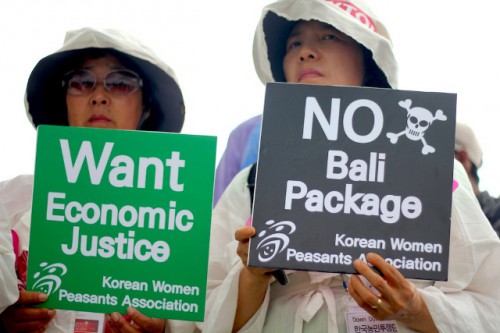
S’OPPOSER AU DOGME DU LIBRE-AFFAIRISME MONDIALISTE
OMC et accords de Bali : une ambiguïté voulue
Auran DerienEx: http://metamag.fr
Le Bréslien Roberto AZEVEDO, directeur de l’Organisation Mondiale du Commerce a obtenu la signature d’un accord à Bali, à l’occasion duquel les intervenants ont affirmé qu’il engendrerait 1.000 milliards de dollars de richesse dont un peu plus de la moitié reviendrait aux pays en développement.
Depuis que Lyssenko sert de référence, toutes ces organisations de pouvoir mentent sans vergogne. Deux faits sont troublants: Jamais n’est soulevé le problème des taux de change entre pays, quand les conditions monétaires des échanges sont les plus importantes de tout. De même, il n’apparaît aucune curiosité sur le fond et la forme des frontières. Cette question est tout aussi essentielle : De quoi les frontières sont-elles faites ?
Des criminels à la fête ?
Nous constatons trois types d’infamies. La première de toutes, en honneur depuis la rupture entre le dollar et l’or en 1973, s’appelle la surproduction monétaire, c'est-à-dire la production sans limites de dollars qui ne coûtent rien. A Bali, personne n’a osé se dresser contre ces méthodes. La seconde infamie est le collage politique de tout et n’importe quoi, appelé intégration politique. Appareiller tout et son contraire n’a aucune importance, lorsque l’objectif final est le contrôle du monde. Le troisième pilier est la volonté d’éliminer les marchés diversifiés et fonctionnant avec de nombreux acteurs, pour lui substituer des ententes qui permettent à cette finance de maintenir leur pouvoir. Tous ces points justifient le concept d’ambiguïté que l’on accole à l’accord de Bali.
Amuser les gogos
Il est fort probable qu’il s’agit d’amuser les gogos, maintenant que la quantité d’argent engendrée dépasse de plus de dizaines de fois la richesse mondiale et que l’économie est entre les griffes de 40 institutions, toutes à dominante financière. Des Fonds monétaires peuvent acheter toute la production de quelque bien que ce soit, toute la richesse d’un pays, jusqu’à la totalité de ce que dégagent les 150 pays qui ont participé à l’accord de Bali, lequel est divisé en trois volets : le thème des subventions à l’agriculture, les aides aux pays peu avancés sous forme de privilèges accordés à leurs exportations, le franchissement des frontières, avec la critique de toute forme de surveillance bureaucratique. Or, sur tous ces points, la double morale des financiers n’est pas freinée. Les instruments utilisés pour isoler certaines activités sont à la fois efficaces et complexes. Aux droits de douane sophistiqués s’ajoutent des quotas, des normes techniques et des obstacles sanitaires, de sorte qu’une appréciation correcte, globale de la protection est en réalité impossible. Par exemple, dans le monde agricole sont pratiqués des droits dits spécifiques (100 dollars par tonne, par exemple), plutôt que des droits ad valorem (un pourcentage de la valeur du produit entrant), mais parfois les deux se pratiquent simultanément. Et les subventions diverses multiplient les difficultés de toute comparaison. On sait que sur le terrain des procédures administratives (tests de vérification et de conformité) et le caractère imprévisible de celles-ci, les USA font preuve d’une hypocrisie remarquable.
Un peu plus de multilatéralisme ?
Qui ne comprend la mascarade contemporaine? En matière de commerce, une économie de marchés implique un cadre institutionnel approprié, ce qui pourrait être le cas avec l’OMC si ce dernier mettait à l’abri des effets pervers du désordre mondial. Le multilatéralisme doit être préféré aux relations bilatérales où le plus fort terrorise et détruit le plus faible. Mais une société industrielle a besoin de protection contre le dumping et les intermédiaires crapuleux, et toute civilisation maintient une agriculture pour créer une harmonie sociale entre villes et campagnes et conserver une autosuffisance seule manière de garder son indépendance.
La lumière s’éteint
L’OMC reste collée au dogme du libre affairisme qui détruit la vie et anéantit le peu de bien-être que certains pays avaient réussi à construire. Elle fait lever le ressentiment de tous ceux qui ne peuvent plus vivre dignement à cause des dogmatismes qui s’expriment en son sein. Les obsessions de cette haute finance mondialisée consistent à faire prévaloir le principe de la domination oligarchique sur tout et tous au détriment d’une coopération entre ensembles régionaux associés, groupant des zones de développement et de culture comparables, chacune développant des traits propres en se protégeant raisonnablement des autres. Dans le cadre actuel, la prodigieuse régression de l’humanité vers la barbarie se poursuivra à un rythme chaque jour plus rapide.
09:32 Publié dans Actualité, Economie | Lien permanent | Commentaires (0) | Tags : politique internationale, accords de bali, omc, économie, mondialisme, globalisation, libre-affairisme, libéralisme | | del.icio.us | | Digg | Facebook
Milestones of Eurasism
Milestones of Eurasism
By Alexander Dugin
Ex: http://www.counter-currents.com
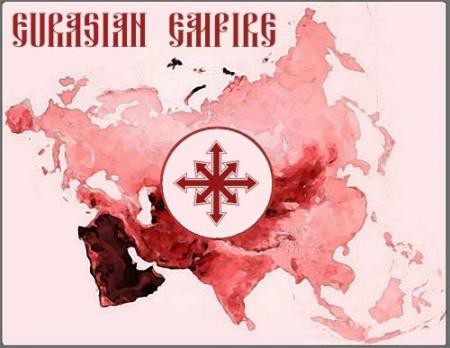
Eurasism is an ideological and social-political current born within the environment of the first wave of Russian emigration, united by the concept of Russian culture as a non-European phenomenon, presenting–among the varied world cultures–an original combination of western and eastern features; as a consequence, the Russian culture belongs to both East and West, and at the same time cannot be reduced either to the former or to the latter.
The founders of eurasism:
- N. S. Trubetskoy (1890–1938)–philologist and linguist.
- P. N. Savitsky (1895–1965)–geographer, economist.
- G. V. Florovsky (1893–1979)–historian of culture, theologian and patriot.
- G. V. Vernadsky (1877–1973)–historian and geopolitician.
- N. N. Alekseev – jurist and politologist.
- V. N. Ilin – historian of culture, literary scholar and theologian.
Eurasism’s main value consisted in ideas born out of the depth of the tradition of Russian history and statehood. Eurasism looked at the Russian culture not as to a simple component of the European civilization, as to an original civilization, summarizing the experience not only of the West as also–to the same extent–of the East. The Russian people, in this perspective, must not be placed neither among the European nor among the Asian peoples; it belongs to a fully original Eurasian ethnic community. Such originality of the Russian culture and statehood (showing at the same time European and Asian features) also defines the peculiar historical path of Russia, her national-state program, not coinciding with the Western-European tradition.
Foundations
Civilization concept
The Roman-German civilization has worked out its own system of principles and values, and promoted it to the rank of universal system. This Roman-German system has been imposed on the other peoples and cultures by force and ruse. The Western spiritual and material colonization of the rest of mankind is a negative phenomenon. Each people and culture has its own intrinsic right to evolve according to its own logic. Russia is an original civilization. She is called not only to counter the West, fully safeguarding its own road, but also to stand at the vanguard of the other peoples and countries on Earth defending their own freedom as civilizations.
Criticism of the Roman-German civilization
The Western civilization built its own system on the basis of the secularisation of Western Christianity (Catholicism and Protestantism), bringing to the fore such values like individualism, egoism, competition, technical progress, consumption, economic exploitation. The Roman-German civilization founds its right to globality not upon spiritual greatness, as upon rough material force. Even the spirituality and strength of the other peoples are evaluated only on the basis of its own image of the supremacy of rationalism and technical progress.
The space factor
There are no universal patterns of development. The plurality of landscapes on Earth produces a plurality of cultures, each one having its own cycles, internal criteria and logics. Geographical space has a huge (sometimes decisive) influence on peoples’ culture and national history. Every people, as long as it develops within some given geographical environment, elaborates its own national, ethical, juridical, linguistic, ritual, economic and political forms. The “place” where any people or state “development” happens predetermines to a great extent the path and sense of this “development”–up to the point when the two elements became one. It is impossible to separate history from spatial conditions, and the analysis of civilizations must proceed not only along the temporal axis (“before,” “after,” “development” or “non-development,” and so on) as also along the spatial axis (“east,” “west,” “steppe,” “mountains,” and so on). No single state or region has the right to pretend to be the standard for all the rest. Every people has its own pattern of development, its own “times,” its own “rationality,” and deserves to be understood and evaluated according to its own internal criteria.
The climate of Europe, the small extension of its spaces, the influence of its landscapes generated the peculiarity of the European civilization, where the influences of the wood (northern Europe) and of the coast (Mediterraneum) prevail. Different landscapes generated different kinds of civilizations: the boundless steppes generated the nomad empires (from the Scythians to the Turks), the loess lands the Chinese one, the mountain islands the Japanese one, the union of steppe and woods the Russian-Eurasian one. The mark of landscape lives in the whole history of each one of these civilizations, and cannot be either separated form them or suppressed.
State and nation
The first Russian slavophiles in the 19th century (Khomyakov, Aksakov, Kirevsky) insisted upon the uniqueness and originality of the Russian (Slav, Orthodox) civilization. This must be defended, preserved and strengthened against the West, on the one hand, and against liberal modernism (which also proceeds from the West), on the other. The slavophiles proclaimed the value of tradition, the greatness of the ancient times, the love for the Russian past, and warned against the inevitable dangers of progress and about the extraneousness of Russia to many aspects of the Western pattern.
From this school the eurasists inherited the positions of the latest slavophiles and further developed their theses in the sense of a positive evaluation of the Eastern influences.
The Muscovite Empire represents the highest development of the Russian statehood. The national idea achieves a new status; after Moscow’s refusal to recognize the Florentine Unia (arrest and proscription of the metropolitan Isidore) and the rapid decay, the Tsargrad Rus’ inherits the flag of the Orthodox empire.
Political platform
Wealth and prosperity, a strong state and an efficient economy, a powerful army and the development of production must be the instruments for the achievement of high ideals. The sense of the state and of the nation can be conferred only through the existence of a “leading idea.” That political regime, which supposes the establishment of a “leading idea” as a supreme value, was called by the eurasists as “ideocracy”–from the Greek “idea” and “kratos,” power. Russia is always thought of as the Sacred Rus’, as a power [derzhava] fulfilling its own peculiar historical mission. The eurasist world-view must also be the national idea of the forthcoming Russia, its “leading idea.”
The eurasist choice
Russia-Eurasia, being the expression of a steppe and woods empire of continental dimensions, requires her own pattern of leadership. This means, first of all, the ethics of collective responsibility, disinterest, reciprocal help, ascetism, will and tenaciousness. Only such qualities can allow keeping under control the wide and scarcely populated lands of the steppe-woodland Eurasian zone. The ruling class of Eurasia was formed on the basis of collectivism, asceticism, warlike virtue and rigid hierarchy.
Western democracy was formed in the particular conditions of ancient Athens and through the centuries-old history of insular England. Such democracy mirrors the peculiar features of the “local European development.” Such democracy does not represent a universal standard. Imitating the rules of the European “liberal-democracy” is senseless, impossible and dangerous for Russia-Eurasia. The participation of the Russian people to the political rule must be defined by a different term: “demotia,” from the Greek “demos,” people. Such participation does not reject hierarchy and must not be formalized into party-parliamentary structures. “Demotia” supposes a system of land council, district governments or national governments (in the case of peoples of small dimensions). It is developed on the basis of social self-government, of the “peasant” world. An example of “demotia” is the elective nature of church hierarchies on behalf of the parishioners in the Muscovite Rus’.
The work of L. N. Gumilev as a development of the eurasist thinking
Lev Nikolaevic Gumilev (1912–1992), son of the Russian poet N. Gumilev and of the poetess A. Akhmatova, was an ethnographer, historian and philosopher. He was profoundly influenced by the book of the Kalmuck eurasist E. Khara-Vadan “Gengis-Khan as an army leader” and by the works of Savitsky. In its own works Gumilev developed the fundamental eurasist theses. Towards the end of his life he used to call himself “the last of the eurasists.”
Basic elements of Gumilev’s theory
- The theory of passionarity [passionarnost’] as a development of the eurasist idealism;
- The essence of which, in his own view, lays in the fact that every ethnos, as a natural formation, is subject to the influence of some “energetic drives,” born out of the cosmos and causing the “passionarity effect,” that is an extreme activity and intensity of life. In such conditions the ethnos undergoes a “genetic mutation,” which leads to the birth of the “passionaries”–individuals of a special temper and talent. And those become the creators of new ethnoi, cultures, and states;
- Drawing the scientific attention upon the proto-history of the “nomad empires” of the East and the discovery of the colossal ethnic and cultural heritage of the autochthone ancient Asian peoples, which was wholly passed to the great culture of the ancient epoch, but afterwards fell into oblivion (Huns, Turks, Mongols, and so on);
- The development of a turkophile attitude in the theory of “ethnic complementarity.”
 An ethnos is in general any set of individuals, any “collective”: people, population, nation, tribe, family clan, based on a common historical destiny. “Our Great-Russian ancestors–wrote Gumilev–in the 15th, 16th and 17th centuries easily and rather quickly mixed with the Volga, Don and Obi Tatars and with the Buriates, who assimilated the Russian culture. The same Great-Russian easily mixed with the Yakuts, absorbing their identity and gradually coming into friendly contact with Kazakhs and Kalmucks. Through marriage links they pacifically coexisted with the Mongols in Central Asia, as the Mongols themselves and the Turks between the 14th and 16th centuries were fused with the Russians in Central Russia.” Therefore the history of the Muscovite Rus’ cannot be understood without the framework of the ethnic contacts between Russians and Tatars and the history of the Eurasian continent.
The advent of neo-eurasism: historical and social context
The crisis of the Soviet paradigm
In the mid-1980s the Soviet society began to lose its connection and ability to adequately reflect upon the external environment and itself. The Soviet models of self-understanding were showing their cracks. The society had lost its sense of orientation. Everybody felt the need for change, yet this was but a confused feeling, as no-one could tell the way the change would come from. In that time a rather unconvincing divide began to form: “forces of progress” and “forces of reaction,” “reformers” and “conservators of the past,” “partisans of reforms” and “enemies of reforms.”
Infatuation for the western models
In that situation the term “reform” became in itself a synonym of “liberal-democracy.” A hasty conclusion was inferred, from the objective fact of the crisis of the Soviet system, about the superiority of the western model and the necessity to copy it. At the theoretical level this was all but self-evident, since the “ideological map” offers a sharply more diversified system of choices than the primitive dualism: socialism vs. capitalism, Warsaw Pact vs. NATO. Yet it was just that primitive logic that prevailed: the “partisans of reform” became the unconditional apologists of the West, whose structure and logic they were ready to assimilate, while the “enemies of reform” proved to be the inertial preservers of the late Soviet system, whose structure and logic they grasped less and less. In such condition of lack of balance, the reformers/pro-westerners had on their side a potential of energy, novelty, expectations of change, creative drive, perspectives, while the “reactionaries” had nothing left but inertness, immobilism, the appeal to the customary and already-known. In just this psychological and aesthetic garb, liberal-democratic policy prevailed in the Russia of the 1990s, although nobody had been allowed to make a clear and conscious choice.
The collapse of the state unity
The result of “reforms” was the collapse of the Soviet state unity and the beginning of the fall of Russia as the heir of the USSR. The destruction of the Soviet system and “rationality” was not accompanied by the creation of a new system and a new rationality in conformity to national and historical conditions. There gradually prevailed a peculiar attitude toward Russia and her national history: the past, present and future of Russia began to be seen from the point of view of the West, to be evaluated as something stranger, transcending, alien (“this country” was the “reformers’” typical expression). That was not the Russian view of the West, as the Western view of Russia. No wonder that in such condition the adoption of the western schemes even in the “reformers’” theory was invoked not in order to create and strengthen the structure of the national state unity, but in order to destroy its remains. The destruction of the state was not a casual outcome of the “reforms”; as a matter of fact, it was among their strategic aims.
The birth of an anti-western (anti-liberal) opposition in the post-Soviet environment
In the course of the “reforms” and their “deepening,” the inadequacy of the simple reaction began to be clear to everyone. In that period (1989–90) began the formation of a “national-patriotic opposition,” in which there was the confluence of part of the “Soviet conservatives” (ready to a minimal level of reflection), groups of “reformers” disappointed with “reforms” or “having become conscious of their anti-state direction,” and groups of representatives of the patriotic movements, which had already formed during the perestroika and tried to shape the sentiment of “state power” [derzhava] in a non-communist (orthodox-monarchic, nationalist, etc.) context. With a severe delay, and despite the complete absence of external strategic, intellectual and material support, the conceptual model of post-Soviet patriotism began to vaguely take shape.
Neo-eurasism
Neo-eurasism arose in this framework as an ideological and political phenomenon, gradually turning into one of the main directions of the post-Soviet Russian patriotic self-consciousness.
Stages of development of the neo-eurasist ideology
1st stage (1985–90)
- Dugin’s seminars and lectures to various groups of the new-born conservative-patriotic movement. Criticism of the Soviet paradigm as lacking the spiritual and national qualitative element.
- In 1989 first publications on the review Sovetskaya literatura [Soviet Literature]. Dugin’s books are issued in Italy (Continente Russia [Continent Russia], 1989) and in Spain (Rusia Misterio de Eurasia [Russia, Mystery of Eurasia], 1990).
- In 1990 issue of René Guénon’s Crisis of the Modern World with comments by Dugin, and of Dugin’s Puti Absoljuta [The Paths of the Absolute], with the exposition of the foundations of the traditionalist philosophy.
In these years eurasism shows “right-wing conservative” features, close to historical traditionalism, with orthodox-monarchic, “ethnic-pochevennik” [i.e., linked to the ideas of soil and land] elements, sharply critical of “Left-wing” ideologies.
2nd stage (1991–93)
- Begins the revision of anti-communism, typical of the first stage of neo-eurasism. Revaluation of the Soviet period in the spirit of “national-bolshevism” and “Left-wing eurasism.”
- Journey to Moscow of the main representatives of the “New Right” (Alain de Benoist, Robert Steuckers, Carlo Terracciano, Marco Battarra, Claudio Mutti and others).
- Eurasism becomes popular among the patriotic opposition and the intellectuals. On the basis of terminological affinity, A. Sakharov already speaks about Eurasia, though only in a strictly geographic–instead of political and geopolitical–sense (and without ever making use of eurasism in itself, like he was before a convinced atlantist); a group of “democrats” tries to start a project of “democratic eurasism” (G. Popov, S. Stankevic, L. Ponomarev).
- O. Lobov, O. Soskovets, S. Baburin also speak about their own eurasism.
- In 1992–93 is issued the first number of Elements: Eurasist Review. Lectures on geopolitics and the foundations of eurasism in high schools and universities. Many translations, articles, seminars.
3rd stage (1994–98): theoretical development of the neo-eurasist orthodoxy
- Issue of Dugin’s main works Misterii Evrazii [Mysteries of Eurasia] (1996), Konspirologija [Conspirology] (1994), Osnovy Geopolitiki [Foundations of geopolitics] (1996), Konservativnaja revoljutsija [The conservative revolution] (1994), Tampliery proletariata [Knight Templars of the Proletariat] (1997). Works of Trubetskoy, Vernadsky, Alekseev and Savitsky are issued by “Agraf” editions (1995–98).
- Creation of the “Arctogaia” web-site (1996) – www.arctogaia.com [2].
- Direct and indirect references to eurasism appear in the programs of the KPFR (Communist Party], LDPR [Liberal-Democratic Party], NDR [New Democratic Russia] (that is left, right, and centre). Growing number of publications on eurasist themes. Issue of many eurasist digests.
- Criticism of eurasism from Russian nationalists, religious fundamentalists and orthodox communists, and also from the liberals.
- Manifestations of an academic “weak” version of eurasism (Prof. A. S. Panarin, V. Ya. Paschenko, F.Girenok and others) – with elements of the illuminist paradigm, denied by the eurasist orthodoxy – then evolving towards more radically anti-western, anti-liberal and anti-gobalist positions.
- Inauguration of a university dedicated to L. Gumilev in Astan [Kazakhstan].
4th stage (1998–2001)
- Gradual de-identification of neo-eurasism vis-à-vis the collateral political-cultural and party manifestations; turning to the autonomous direction (“Arctogaia,” “New University,” “Irruption” [Vtorzhenie]) outside the opposition and the extreme Left and Right-wing movements.
- Apology of staroobrjadchestvo [Old Rite].
- Shift to centrist political positions, supporting Primakov as the new premier. Dugin becomes the adviser to the Duma speaker G. N. Seleznev.
- Issue of the eurasist booklet Nash put’ [Our Path] (1998).
- Issue of Evraziikoe Vtorzhenie [Eurasist Irruption] as a supplement to Zavtra. Growing distance from the opposition and shift closer to the government’s positions.
- Theoretical researches, elaborations, issue of “The Russian Thing” [Russkaja vesch’] (2001), publications in Nezavisimaja Gazeta, Moskovskij Novosti, radio broadcasts about “Finis Mundi” on Radio 101, radio broadcasts on geopolitical subjects and neo-eurasism on Radio “Svobodnaja Rossija” (1998–2000).
5th stage (2001–2002)
- Foundation of the Pan-Russian Political Social Movement EURASIA on “radical centre” positions; declaration of full support to the President of the Russian Federation V. V. Putin (April 21, 2001).
- The leader of the Centre of Spiritual Management of the Russian Muslims, sheik-ul-islam Talgat Tadjuddin, adheres to EURASIA.
- Issue of the periodical Evraziizkoe obozrenie [Eurasist Review].
- Appearance of Jewish neo-eurasism (A. Eskin, A. Shmulevic, V. Bukarsky).
- Creation of the web-site of the Movement EURASIA: www.eurasia.com.ru [3]
- Conference on “Islamic Threat or Threat to Islam?.” Intervention by H. A. Noukhaev, Chechen theorist of “Islamic eurasism” (“Vedeno or Washington?,” Moscow, 2001].
- Issue of books by E. Khara-Davan and Ya. Bromberg (2002).
- Process of transformation of the Movement EURASIA into a party (2002).
Basic philosophical positions of neo-eurasism
 At the theoretical level neo-eurasism consists of the revival of the classic principles of the movement in a qualitatively new historical phase, and of the transformation of such principles into the foundations of an ideological and political program and a world-view. The heritage of the classic eurasists was accepted as the fundamental world-view for the ideal (political) struggle in the post-Soviet period, as the spiritual-political platform of “total patriotism.”
The neo-eurasists took over the basic positions of classical eurasism, chose them as a platform, as starting points, as the main theoretical bases and foundations for the future development and practical use. In the theoretical field, neo-eurasists consciously developed the main principles of classical eurasism taking into account the wide philosophical, cultural and political framework of the ideas of the 20th century.
Each one of the main positions of the classical eurasists (see the chapter on the “Foundations of classical eurasism”) revived its own conceptual development.
Civilization concept
Criticism of the western bourgeois society from “Left-wing” (social) positions was superimposed to the criticism of the same society from “Right-wing” (civilizational) positions. The eurasist idea about “rejecting the West” is reinforced by the rich weaponry of the “criticism of the West” by the same representatives of the West who disagree with the logic of its development (at least in the last centuries). The eurasist came only gradually, since the end of the 1980s to the mid-1990s, to this idea of the fusion of the most different (and often politically contradictory) concepts denying the “normative” character of the Western civilization.
The “criticism of the Roman-German civilization” was thoroughly stressed, being based on the prioritary analysis of the Anglo-Saxon world, of the US. According to the spirit of the German Conservative Revolution and of the European “New Right,” the “Western world” was differentiated into an Atlantic component (the US and England) and into a continental European component (properly speaking, a Roman-German component). Continental Europe is seen here as a neutral phenomenon, liable to be integrated–on some given conditions–in the eurasist project.
The spatial factor
Neo-eurasism is moved by the idea of the complete revision of the history of philosophy according to spatial positions. Here we find its trait-d’union in the most varied models of the cyclical vision of history, from Danilevsky to Spengler, from Toynbee to Gumilev.
Such a principle finds its most pregnant expression in traditionalist philosophy, which denies the ideas of evolution and progress and founds this denial upon detailed metaphysical calculations. Hence the traditional theory of “cosmic cycles,” of the “multiple states of Being,” of “sacred geography,” and so on. The basic principles of the theory of cycles are illustrated in detail by the works of Guénon (and his followers G. Georgel, T. Burckhardt, M. Eliade, H. Corbin). A full rehabilitation has been given to the concept of “traditional society,” either knowing no history at all, or realizing it according to the rites and myths of the “eternal return.” The history of Russia is seen not simply as one of the many local developments, but as the vanguard of the spatial system (East) opposed to the “temporal” one (West).
State and nation
Dialectics of national history
It is led up to its final, “dogmatical” formulation, including the historiosophic paradigm of “national-bolshevism” (N. Ustryalov) and its interpretation (M. Agursky). The pattern is as follows:
- The Kiev period as the announcement of the forthcoming national mission (IX-XIII centuries);
- Mongolian-Tatar invasion as a scud against the levelling European trends, the geopolitical and administrative push of the Horde is handed over to the Russians, division of the Russians between western and eastern Russians, differentiation among cultural kinds, formation of the Great-Russians on the basis of the “eastern Russians” under the Horde’s control (13th–15th centuries);
- The Muscovite Empire as the climax of the national-religious mission of Rus’ (Third Rome) (15th–end of the 17th century);
- Roman-German yoke (Romanov), collapse of national unity, separation between a pro-western elite and the national mass (end of the 17th-beginning of the 20th century);
- Soviet period, revenge of the national mass, period of the “Soviet messianism,” re-establishment of the basic parameters of the main muscovite line (20th century);
- Phase of troubles, that must end with a new eurasist push (beginning of the 21st century).
Political platform
Neo-eurasism owns the methodology of Vilfrido Pareto’s school, moves within the logic of the rehabilitation of “organic hierarchy,” gathers some Nietzschean motives, develops the doctrine of the “ontology of power,” of the Christian Orthodox concept of power as “kat’echon.” The idea of “elite” completes the constructions of the European traditionalists, authors of researches about the system of castes in the ancient society and of their ontology and sociology (R. Guénon, J. Evola, G. Dumézil, L. Dumont). Gumilev’s theory of “passionarity” lies at the roots of the concept of “new eurasist elite.”
The thesis of “demotia” is the continuation of the political theories of the “organic democracy” from J.-J. Rousseau to C. Schmitt, J. Freund, A. de Benoist and A. Mueller van der Bruck. Definition of the eurasist concept of “democracy” (“demotia”) as the “participation of the people to its own destiny.”
The thesis of “ideocracy” gives a foundation to the call to the ideas of “conservative revolution” and “third way,” in the light of the experience of Soviet, Israeli and Islamic ideocracies, analyses the reason of their historical failure. The critical reflection upon the qualitative content of the 20th century ideocracy brings to the consequent criticism of the Soviet period (supremacy of quantitative concepts and secular theories, disproportionate weight of the classist conception).
The following elements contribute to the development of the ideas of the classical eurasists:
The philosophy of traditionalism (Guénon, Evola, Burckhardt, Corbin), the idea of the radical decay of the “modern world,” profound teaching of the Tradition. The global concept of “modern world” (negative category) as the antithesis of the “world of Tradition” (positive category) gives the criticism of the Western civilization a basic metaphysic character, defining the eschatological, critical, fatal content of the fundamental (intellectual, technological, political and economic) processes having their origin in the West. The intuitions of the Russian conservatives, from the slavophiles to the classical eurasists, are completed by a fundamental theoretical base. (see A. Dugin, Absoljutnaja Rodina [The Absolute Homeland], Moscow 1999; Konets Sveta [The End of the World], Moscow 1997; Julius Evola et le conservatisme russe, Rome 1997).
The investigation on the origins of sacredness (M. Eliade, C. G. Jung, C. Levi-Strauss), the representations of the archaic consciousness as the paradigmatic complex manifestation laying at the roots of culture. The reduction of the many-sided human thinking, of culture, to ancient psychic layers, where fragments of archaic initiatic rites, myths, originary sacral complexes are concentrated. Interpretation of the content of rational culture through the system of the ancient, pre-rational beliefs (A. Dugin, “The evolution of the paradigmatic foundations of science” [Evoljutsija paradigmal’nyh osnovanij nauki], Moscow 2002).
The search for the symbolic paradigms of the space-time matrix, which lays at the roots of rites, languages and symbols (H. Wirth, paleo-epigraphic investigations). This attempt to give a foundation to the linguistic (Svityc-Illic), epigraphic (runology), mythological, folkloric, ritual and different monuments allows to rebuild an original map of the “sacred concept of the world” common to all the ancient Eurasian peoples, the existence of common roots (see A. Dugin Giperborejskaja Teorija [Hyperborean Theory], Moscow 1993.
A reassessment of the development of geopolitical ideas in the West (Mackinder, Haushofer, Lohhausen, Spykman, Brzeszinski, Thiriart and others). Since Mackinder’s epoch, geopolitical science has sharply evolved. The role of geopolitical constants in 20th century history appeared so clear as to make geopolitics an autonomous discipline. Within the geopolitical framework, the concept itself of “eurasism” and “Eurasia” acquired a new, wider meaning.
From some time onwards, eurasism, in a geopolitical sense, began to indicate the continental configuration of a strategic (existing or potential) bloc, created around Russia or its enlarged base, and as an antagonist (either actively or passively) to the strategic initiatives of the opposed geopolitical pole–“Atlantism,” at the head of which at the mid-20th century the US came to replace England.
The philosophy and the political idea of the Russian classics of eurasism in this situation have been considered as the most consequent and powerful expression (fulfilment) of eurasism in its strategic and geopolitical meaning. Thanks to the development of geopolitical investigations (A. Dugin, Osnovye geopolitiki [Foundations of geopolitics], Moscow 1997) neo-eurasism becomes a methodologically evolved phenomenon. Especially remarkable is the meaning of the Land – Sea pair (according to Carl Schmitt), the projection of this pair upon a plurality of phenomena – from the history of religions to economics.
The search for a global alternative to globalism, as an ultra-modern phenomenon, summarizing everything that is evaluated by eurasism (and neo-eurasism) as negative. Eurasism in a wider meaning becomes the conceptual platform of anti-globalism, or of the alternative globalism. “Eurasism” gathers all contemporary trends denying globalism any objective (let alone positive) content; it offers the anti-globalist intuition a new character of doctrinal generalization.
The assimilation of the social criticism of the “New Left” into a “conservative right-wing interpretation” (reflection upon the heritage of M. Foucault, G. Deleuze, A. Artaud, G. Debord). Assimilation of the critical thinking of the opponents of the bourgeois western system from the positions of anarchism, neo-marxism and so on. This conceptual pole represents a new stage of development of the “Left-wing” (national-bolshevik) tendencies existing also among the first eurasists (Suvchinskij, Karsavin, Efron), and also a method for the mutual understanding with the “left” wing of anti-globalism.
“Third way” economics, “autarchy of the great spaces.” Application of heterodox economic models to the post-Soviet Russian reality. Application of F. List’s theory of the “custom unions.” Actualization of the theories of S. Gesell. F. Schumpeter, F. Leroux, new eurasist reading of Keynes.
Source: Ab Aeterno, no. 3, June 2010.
Article printed from Counter-Currents Publishing: http://www.counter-currents.com
URL to article: http://www.counter-currents.com/2013/12/milestones-of-eurasism/
09:07 Publié dans Définitions, Eurasisme, Géopolitique, Nouvelle Droite | Lien permanent | Commentaires (0) | Tags : alexandre douguine, géopolitique, nouvelle droite, eurasisme, théorie politique, sciences politiques, politologie, lev gumilev | | del.icio.us | | Digg | Facebook