

vendredi, 16 mai 2014
R. Steuckers: révolution conservatrice

10:22 Publié dans Livre, Livre, Nouvelle Droite, Révolution conservatrice, Synergies européennes | Lien permanent | Commentaires (0) | Tags : robert steuckers, radio courtoisie, révolution conservatrice, livre, nouvelle droite, synergies européennes, allemagne, histoire |  |
|  del.icio.us |
  |
|  Digg |
  Facebook
Geoglyphology, An Ancient Science Rediscovered
Geoglyphology, An Ancient Science Rediscovered
Arthur D. Faram
Faram Research Foundation – Arlington, Texas
Recently Arthur Faram, while investigating his Celtic Genealogy, discovered an ancient and historically revealing science.
After determining that this science had not been mentioned in any previous publications, The Faram Research Foundation named the ancient science Geoglyphology. “Geo” for earth, “glyph” for writing and “ology “ for the study of… . The original function of Geoglyphology, by the ancients, was to mark and claim territories. Since its rediscovery, this ancient science has been used to expand both the search area and the knowledge base available to the Archeologist and related disciplines. In addition, since the science was primarily used to mark large territories, claimed by the originator of the geoglyph, the resultant findings are rewriting history.During our research it was discovered that ancient civilizations have, for millennia, passed down a previously unidentified science which was used to outline the boundaries of ancient civilizations, around the world. During their constant battle to expand, control and identify their territories, ancient civilizations have left a legacy of geoglyphs on the shores and highlands of land masses, and islands, around the world.
A well-known example of a geoglyphic survey marker is the Stonehenge monolith in England. Stonehenge has been known for centuries, as have other monoliths, for displaying astrological alignments which were designed into its construction. The science of studying astronomical alignments within geoglyphic structures has recently been scientifically accepted, having been given the name “Archaeoastronomy”. Until now, the geoglyphic attributes (Geoglyphology), which co-exist alongside the astronomic attributes of these structures, have been overlooked.
Currently, the majority of the information available to the Archeologist is gleaned from the information recovered at the dig site. In recent years, it has been discovered that a great majority of the ancient architectural, monolithic and geoglyphic structures built around the world, have a particular commonality. That commonality is that the structures are aligned in such a manner that the study of their linear alignment unveils a much larger story than can be attained at the dig site. A geoglyphical survey can immensely expand the cultural data available to both the archeologist and the related disciplines.
Geoglyphic studies uncover data that may have otherwise gone unnoticed by the various scientific disciplines working on a site. Data obtained from the geoglyphical study of a site can immensely expand the data available to the Archaeologist. These benefits may include determining the geographical range of the culture being studied, the level of sophistication that existed in relation to their understanding of mathematics and geometry, the cultures knowledge of world geography, the discovery of other archeological sites that were unknown prior to the geoglyphic extension of alignments associated with structures at the site, and the dating of the culture itself by the data collected both at the dig site and offsite locations which have been identified through the use of Geoglyphology. Previous successes, through the use of Geoglyphology, leave no doubt that Geoglyphology can play a major role in expanding the knowledge base available to various scientific disciplines.
Geoglyphology
A geoglyph consists of a large motif, or monument produced on the surface of the earth. This can be accomplished by building or sculpting stone monoliths, arranging patterns of multicolored earth or stones on the earth, or by the wall alignment of buildings such as at Caral, Peru. Through these and other geoglyphical techniques used by the ancients, our predecessors have left a rich history of their existence, and conquests, on our planet.
The practice of marking territories with geoglyphs has been passed down secretly for millennia. Since the practice of Geoglyphology is to mark a claimed territory, the practice would inherently require some degree of secrecy. Most of these survey markers are so large and so spread out, that they remain hidden unless someone that knows of their existence points them out. By being so large they are, for the most part, immune to tampering and remain hidden. When the builder needs to prove their prior claim to a given territory, they have but to point out their geoglyphic survey marker.
Another reason for keeping geoglyphs secret is that, as they are survey markers, they are a written record of the travels and history of the people that constructed them. Therefore, their exposure would be detrimental to any group that did not want ancient history to be revealed.
This ancient science has been used by civilizations including the Portuguese, Celts, Etruscans, Egyptians, Phoenicians, the Japanese and their predecessors. The oldest geoglyphic site confirmed to date is 26,400 years old.
What makes up a Geoglyph?
Glyph - A glyph can be any design that is used to convey a message.
Geoglyph - A geoglyph is a glyph that occurs on the ground.
Bearings - A bearing refers to the direction that any line, formed by a geoglyph, points in relation to “Magnetic North”. Magnetic bearings can be used at the origination point because they have not been distorted by magnetic deviations that exist between the starting point and the destination. A True or direct line is necessary once you depart the origination point because as you begin tracing a line away from the source, magnetic deviation becomes a factor. Magnetic deviation exists all over the world and renders the magnetic heading of a compass useless over long distances because of the error occurring naturally from the magnetism of the earth.
A true heading is the shortest distance between two points without having to consider magnetic deviation. True headings can be scribed on a globe, derived from Celestial Navigation, GPS, and computer software. These methods only produce straight lines which are not distorted by Magnetic Deviation.
Radials - Radials are bearings after they leave the source. At the source, Magnetic Bearings and True Headings are the same. This commonality exists as the result of there being no distortion occurring as a result of moving away from the source site. Once a direction away from the source is plotted it must be plotted on a true course, not a magnetic course, in order to avoid magnetic deviation.
Geoglyphs, for the most part, are so large that they can only be recognized from the air. The civilizations that placed these geoglyphs must have had mathematical capabilities well beyond anything we give them credit for. Some sites have been physically visited on the ground and, even knowing they are there, they are difficult to locate. The glyphs take on several forms. Some take the form of a triangle, another might be one or more circles, and another may be one or more lines touching or crossing each other. No matter what shape a glyph takes, any line can be a pointer to a place important to the creator of that glyph. (See the following chart.)

Above are a few examples of radials generated by various shapes that may comprise a geoglyph.
After applying the above criteria to a geoglyph it is then necessary to apply certain protocols which have been passed down for millennia from one civilization to another. These protocols allow the user to determine the destination and end point of the bearings emanating from the geoglyph. (Examples below.)
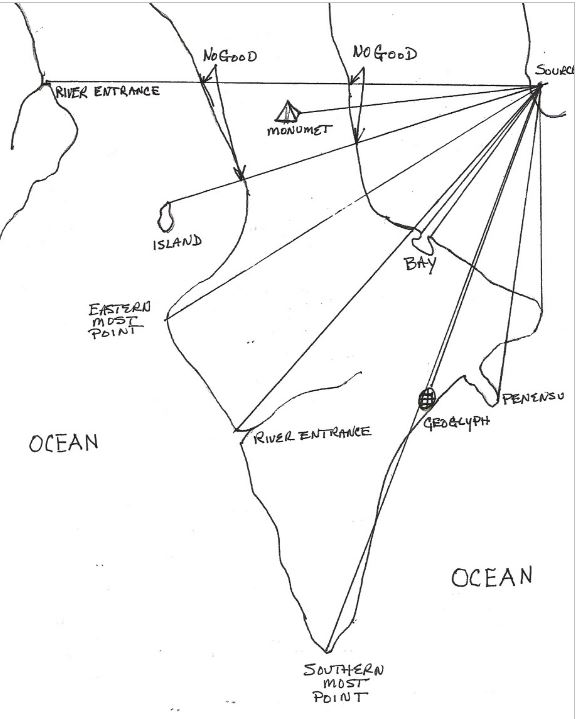
Some examples of the ancient protocols used to verify where the radial of a geoglyph ends.
Once the bearings are established for a geoglyph, at the point of origin, the bearings are extended in the form of radials (True Headings) to determine if, and where, they intersect with an object that meets the protocols which were established millennia ago. In order for an extended radial to be considered legitimate it must pass one of the protocols set down by the ancients. These points verify that the radial is legitimate and indicate the endpoint of the radial. A few examples are shown above and can include: the mouth of a river, another geoglyph, a monument, a location sacred to the culture that built the geoglyph and validated by being pointed out by a separate geoglyph, the entrance to a bay, a significant protrusion on a land mass such as the corner or tip of a continent, the tip of a peninsula, an island, or the highest mountain peak in an area. Most geoglyphs are located near water, and point to locations near the water. This would seem logical as the entrance to rivers and bays were the most recognizable geographic points to ancient sailors.
After some study, it was discovered that many mediums were used to construct geoglyphs. These included; the arrangement of stones, the planting of different colors of flora, the sterilizing of the ground, the scraping of the earth to reveal a different color underneath (Nazca), the changing or supplementing of natural geological features, the wall alignment of structures (Caral, Peru), the alignment of Monoliths (Stonehenge), the alignment of Pyramids (Worldwide), the creation of stone and earth mounds, and more. For instance, the edges of the mounds, of the so called Mississippian Culture, in the central and eastern United States have proven to be geoglyphic territorial pointers.
Ancient archeological locations, many previously unknown, have been identified through Geoglyphology. The accuracy of the calculations of the ancient peoples is incredible. The GPS accuracy of the modern software program is seldom more accurate than the orientations of the ancients. By calculating the bearing at the source one can follow the extended radial for sometimes thousands of miles and locate a related geoglyph with little or no error.
The percentage of success in locating a verifiable glyph or ancient location using each of the extended radials of any one glyph was variable, but ran in the range of 90% to 100%. Much of the lack of success was attributed to urbanization, overgrowth, vandalism, etc. Surprisingly, based on the glyphs that were found, there seems to be an incredible amount of durability built into the geoglyphs. It appears that the meteorological conditions at any given site were considered in determining the materials used. At sites where rain and wind are seldom seen, most glyphs were made of earth. At locations that encountered rain and wind, stones and rock were used.
Research results indicate that Geoglyphology holds great promise in expanding our understanding of the civilizations that have preceded us. Through the tireless efforts of many devoted scientists, and the creation of new technology, the world is on the cusp of a new awakening. To some this paradigm change will be quite uncomfortable.
Spherical Geometry
Geoglyphology exists in the world of Spherical Geometry. In Spherical Geometry there are no parallel lines. It is difficult to grasp the concept that two bearings of the same value can cross. That is because we are used to thinking in terms of Plane Geometry on a flat plane. However, all this changes when you draw lines on a sphere. In dealing with a sphere you enter the realm of Spherical Geometry.
Spherical Geometry is the study of figures on the surface of a sphere, as opposed to the type of geometry studied in Plane Geometry or Solid Geometry. In Spherical Geometry, straight lines are great circles; therefore, any two lines will always cross in two places somewhere on the sphere. A good example of this is to look at a globe of the earth. The Longitudinal lines cross at two places, the North and South Poles, however; the Latitudes never cross. That is because the Latitudes are an example of Plane Geometry slicing through the earth, while the Longitude is an example of Spherical Geometry when a line is drawn on the surface of the earth. Accomplished mathematician, as were the ancients, used a line to point to a distant object, or used two lines to come together at a distant point to highlight an important place. (See below.)

The preceding picture demonstrates how two lines, of the same heading, emanating from the same longitude, will always cross at two points on the globe and can be used to point to a specific point on the earth.
In the field of Geoglyphology, we are plotting lines in a spherical world and then displaying the results on a flat plane. The science of Geoglyphology could not have been rediscovered without the advent of the “Google Earth”, or similar, software. Google Earth software computes using Spherical Geometry and then displays the results on a flat plane. This type of precise mapping precludes the plotting of these bearings on a flat map. Maps become distorted when converted from a sphere to a flat map.
GEOGLYPH EXAMPLES
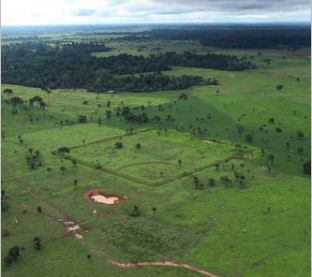
One of Over 300 Known Ancient Geoglyphs Constructed in the Amazon

The Pyramid Geoglyph at Yonaguni, Japan


The compelling question is; what knowledge did the ancients possess that allowed them to do these calculations. The most likely answer is the ancient knowledge passed down by their predecessors, and their obsession with astronomy.
Note: The current calculations performed in Geoglyphology require the use of a special software called “Google Earth”. Google’s software is able to calculate true spherical bearings on the curved surface of the earth and then display them correctly on a flat plane.
Bibliography:
Aveni, Anthony “The Lines of Nazca” Philadelphia (1990)
Faram, Arthur “Ancient Signposts” CreateSpace (2011).
Faram, Arthur “La Merica” Foundation Press, Dallas (2013).
Reindel, Markus/ Wagner, A. /Verlag, Springer “New Technologies for Archaeology: Multidisciplinary Investigations in Palpa and Nazca, Peru” Natural Science in Archaeology, Page 50, (2009).
Haughten, Brian “Hidden History: Lost Civilizations, Secret Knowledge, and Ancient Mysteries” Career Press (2007)
Professor Kennedy, David “Visible Only from Above, Mystifying “Nazca Lines” Discovered in Mideast”, MSNBC (Live Science) 9/15/2011.
Mann, Charles “The Geoglyphs of Palpa, Peru: Documentation, Analysis, and Interpretation” Germany (2008)
Parssinen, Marti/Schaan, Denise/Ranzi, Alceu “Pre-Columbian Geometric Earthworks in the upper Purus: a complex society in Western Amazonia” Antiquity Magazine, Volume 83 (322): Pages 1084-1095.
Reinhard, Johan “The Nazca Lines: A New perspective on their Origin and Meaning” Los Pinos, 6th edition, Lima (1996)
Romero, Simon On Sauerbier, Martin: “GIS-Based Management and Analysis of the Geoglyphs in the Palpa Region” ETH (2009) Amazon Photo by Douglas Engle, N.Y. Times
Romero, Simon “…Amazon’s Lost World” N.Y. Times January 14, 2012
Please click here to purchase Mr. Faram’s most recent book “La Merica”.

00:08 Publié dans archéologie, Livre, Livre | Lien permanent | Commentaires (0) | Tags : géoglyphologie, archéologie | | del.icio.us | | Digg | Facebook
Obama’s Alliance with Boko Haram
Obama’s Alliance with Boko Haram
By Daniel Greenfield
Ex: http://www.frontpagemag.com
Leftist policy is the search for the root cause of evil. Everything from a street mugging to planes flying into the World Trade Center is reduced to a root cause of social injustice. Throw poverty, oppression and a bunch of NGO buzzwords into a pot and out come the suicide bombings, drug dealing and mass rapes.
It doesn’t matter whether it’s Boko Haram, the Islamic terrorist group that kidnapped hundreds of Nigerian schoolgirls, or a drug dealer with a record as long as his tattooed arm.
Obama and Hillary resisted doing anything about Boko Haram because they believed that its root cause was the oppression of Muslims by the Nigerian government. Across the bloody years of Boko Haram terror, the State Department matched empty condemnations of Boko Haram’s killing sprees with condemnations of the Nigerian authorities for violating Muslim rights.
Michelle Obama and Hillary Clinton haven’t championed #BringBackOurGirls because it’s a hashtag in support of the kidnapped girls, but because it undermines the Nigerian government. They aren’t trying to help the kidnapped girls. They’re trying to bring down a government that hasn’t gone along with their agenda for appeasing Boko Haram and Nigerian Muslims.
The hashtag politics aren’t aimed at the terrorists. They’re aimed at helping the terrorists.
There’s a reason why the media and so many leftists have embraced the hashtag. #BringBackOurGirls isn’t a rescue. It denounces the Nigerian government for not having already gotten the job done even as the State Department stands ready to denounce any human rights violations during a rescue attempt.
Obama and Boko Haram want to bring down the Nigerian government and replace it with a leadership that is more amenable to appeasement. It’s the same thing that is happening in Israel and Egypt.
State Department officials responded to Boko Haram attacks over the years with the same litany of statistics about unemployment in the Muslim north and the 92 percent of children there who do not attend school. When Hillary Clinton was asked about the kidnappings by ABC News, she blamed Nigeria for not “ensuring that every child has the right and opportunity to go to school.”
Clinton acted as if she were unaware that Boko Haram opposes Muslim children going to school or that it would take the very same measures that her State Department has repeatedly opposed to make it possible for them to go to school. This is a familiar Catch 22 in which the authorities are blamed for not fixing the socioeconomic problems in terrorist regions that are impossible to fix without defeating the terrorists and blamed for violating the human rights of the terrorists when they try to defeat them.
The mainstream media has been more blatant about carrying Boko Haram’s bloody water. Their stories begin with the kidnapped schoolgirls and skip over to a sympathetic reading of history in which Boko Haram only took up arms after government brutality.
Two years ago the New York Times ran an op-ed titled, “In Nigeria, Boko Haram Is Not the Problem.”
The op-ed contended that Boko Haram didn’t exist, that it was a peaceful splinter group and that the Nigerian army was worse than Boko Haram. Somehow these three claims were made on the same page. The editorial warned the US not to give the impression that it supports Nigeria’s Christian president or it would infuriate Muslims and suggested that Christians might really be behind the Muslim terror attacks.
Last year, Secretary of State John Kerry , after a pro forma condemnation of Boko Haram terror, warned, “We are also deeply concerned by credible allegations that Nigerian security forces are committing gross human rights violations, which, in turn, only escalate the violence and fuel extremism.”
Kerry was blaming the victims of Boko Haram for the violence perpetrated against them and claiming that resistance to Boko Haram caused Boko Haram’s attacks.
The US Commission on International Religious Freedom, three of whose members had been appointed by Obama and one by Nancy Pelosi, issued a report blaming Nigeria for Boko Haram’s murderous Jihad.
The report’s findings claimed that the Nigerian government’s “violations of religious freedom” had led to “sectarian violence.” It echoed the propaganda of the Islamic terrorist group, stating that, “Boko Haram also justifies its attacks on churches by citing, among other things, state and federal government actions against Muslims.”
The report suggested that the Nigerian government was too focused on fighting Boko Haram and not focused enough on dealing with Christian violence against Muslims. “The Nigerian government’s failure to address chronic religion-related violence contrasts with its commitment to stop Boko Haram, which at times has resulted in the indiscriminate use of force against civilians and in human rights abuses.”
The solution was to scale back the fight against Boko Haram and appease Nigerian Muslims.
“In meetings with Nigerian officials, including Secretary Clinton’s meeting with Nigerian President Goodluck Jonathan in August 2012, the U.S. government consistently has urged the Nigerian government to expand its strategy against Boko Haram from solely a military solution to addressing problems of economic and political marginalization in the north, arguing that Boko Haram’s motivations are not religious but socio-economic,” the report stated.
“Additionally, senior U.S. officials frequently warn in private bilateral meetings and in public speeches that Nigerian security forces’ excessive use of force in response to Boko Haram is unacceptable and counterproductive.”
A year earlier, Deputy Secretary of State William Burns had proposed helping Nigeria develop “a comprehensive counterterrorism strategy” that includes “citizen engagement and dialogue.” This was really a proposal to export Obama’s failed appeasement strategy in Afghanistan that had cost over 1,600 American lives to Nigeria.
Boko Haram’s kidnapping of the schoolgirls is both convenient and inconvenient for Obama and the State Department. On the one hand it has brought negative attention to their stance on Boko Haram, but on the other hand it may end up toppling the Nigerian government and empowering Muslims. And they see a more flexible Nigerian government as the only means of coming to terms with Boko Haram.
This isn’t just their strategy for Nigeria. It’s their universal approach to Islamic terrorism. It’s why Kerry blamed Israel for the collapse of the peace talks with the PLO. It’s why Egypt is being pressured to free its Muslim Brotherhood detainees. And It’s why the United States is never allowed to defeat Al Qaeda.
Obama is trying to bring down governments that fight Islamic terrorism, whether in Egypt, Israel or Nigeria, and replace them with governments that appease terrorists. This shared goal creates an alliance, direct or indirect, open or covert, between Obama and the Muslim Brotherhood, Obama and the PLO and Obama and Boko Haram.
Freedom Center pamphlets now available on Kindle: Click here.
Subscribe to Frontpage’s TV show, The Glazov Gang, and LIKE it on Facebook.
Article printed from FrontPage Magazine: http://www.frontpagemag.com
URL to article: http://www.frontpagemag.com/2014/dgreenfield/obamas-alliance-with-boko-haram/
00:05 Publié dans Actualité | Lien permanent | Commentaires (0) | Tags : actualité, politique internationale, afrique, affaires africaines, nigéria, boko haram, islam, islamisme, géopolitique, afrique occidentale | | del.icio.us | | Digg | Facebook
Les Mistral pour la Russie : un enjeu stratégique majeur pour la France

Les Mistral pour la Russie: un enjeu stratégique majeur pour la France
par Aymeric Chauprade
En mars au journal de TF1, le ministre des affaires étrangères Laurent Fabius déclairait que « La France pourrait annuler les ventes des deux BPC si la Russie ne changeait pas de politique à l’égard de l’Ukraine et de la Crimée. »Les BPC, c’est-à-dire les Bâtiments de projection et de commandement, les deux navires militaires de type Mistral commandés en 2011 à la DCN (Direction des constructions navales).
Cette décision serait catastrophique à plusieurs égards. Pour le contrat lui-même bien sûr, qui pèse 1,2 milliards d’euros et qui conditionne un millier d’emplois à Saint-Nazaire. Il faudrait rendre l’argent déjà versé (la moitié), renvoyer la poupe des navires (construite en Russie) et s’acquitter d’importantes indemnités. En outre la France perdrait ses droits sur les plans du Mistral, déjà remis à la Russie, qui pourrait alors les construire elle-même. Une telle décision nous fermerait également la porte à tout futur contrat avec la Russie et notamment à son immense programme de réarmement naval (civil et militaire), estimé à plus de 50 milliards de dollars. Nos concurrents n’attendent que cela !
Mais au-delà, c’est la parole de la France qui est en jeu. Plusieurs contrats importants sont en cours de négociation, citons les 126 avions Rafale avec l’Inde pour un montant de 12 milliards d’euros, une série de contrats libanais financés par l’Arabie Saoudite pour 3 milliards de dollars, deux satellites espions avec les Emirats arabes unis… Mettons-nous à la place de ces pays, vont-ils s’engager plus loin sachant que ces méga-contrats peuvent être remis en cause du jour au lendemain pour des raisons diplomatiques ?
Car revenons à la source du problème : la Russie n’a pas militairement envahi la Crimée, auquel cas la question pourrait se poser, elle a simplement accepté le rattachement, après un référendum, de cette région très majoritairement peuplée de Russes et arbitrairement annexée à l’Ukraine en 1954. Si les différents diplomatiques, qui font partie de la vie des nations, même lorsqu’elles sont proches, doivent se traduire par des ruptures de contrats d’armement, autant faire une croix sur la capacité exportatrice de notre industrie de la défense ! Et au final sacrifier toute notre filière et perdre notre statut de puissance car, rappelons-le, ce secteur représente 165.000 emplois directs et autant d’emplois indirects, un chiffre d’affaire global de 17,5 milliards d’euros dont environ 30% est réalisé à l’exportation. La France est le quatrième exportateur d’armes mondial, derrière les États-Unis, la Grande-Bretagne et la Russie et ce résultat prouve l’excellence de nos industriels, que ce soit nos grands groupes ou notre réseau de PME. Se couper de cette compétition internationale à cause de revirements diplomatiques, perdre nos clients en rompant unilatéralement des contrats pourtant signés aurait des effets destructeurs sur l’ensemble de cet écosystème. Des milliers d’emplois seraient en jeu, mais aussi la place de la France dans le monde.
Le ministre de la défense Jean-Yves Le Drian a fait savoir que « la question de la suspension se posera au mois d’octobre » (date de livraison du premier BPC), « à condition que ce soit dans un ensemble de mesures » prises notamment au niveau européen. Il soumet ainsi la France à une décision prise à Bruxelles, ce qui est tout à fait inacceptable. La réintégration de la France dans le commandement intégré de l’OTAN en 2009 ne suffit pas, il faut qu’en plus elle fasse dépendre ses décisions de nature militaire de l’Union européenne ! Une UE qui ne possède pas de politique claire au niveau stratégique et demeure surtout inféodée aux intérêts américains (cf le Traité transatlantique), qui est tiraillée entre les intérêts contradictoires de ses membres, et qui s’incarne dans une personnalité controversée, aussi transparente que maladroite, à savoir Catherine Ashton. Et il faudrait que Paris abandonne encore sa souveraineté et se détermine par rapport à cet attelage qui ne sait pas où il va.
Dans ce domaine comme dans les autres, la France doit retrouver son indépendance, défendre ses intérêts stratégiques, penser en termes géopolitiques, dans la longue durée et non pas en fonction des émois soulevés par les journaux télévisés. L’industrie de la défense joue un rôle capital dans notre économie, par la place importante qu’elle occupe, par sa capacité exportatrice, on l’a dit, également par ses recherches en haute technologie qui profitent au secteur civil. Remettre en cause la livraison des deux navires commandés par la Russie reviendrait à se tirer une balle dans le pied, et dans cette optique tous les patriotes doivent clairement signifier au gouvernement qu’il fait fausse route.
Aymeric Chauprade
00:05 Publié dans Actualité, Affaires européennes, Défense | Lien permanent | Commentaires (0) | Tags : marine, politique internationale, russie, france, europe, affaires européennes, défense, armées, mistral, ayméric chauprade | | del.icio.us | | Digg | Facebook
Waren de Beatles Ierse nationalisten?

Tijdens de eerste, die ongeveer duurde van 1960 tot 1965, werden ze formidabel populair op wereldniveau met het coveren van bekende Amerikaanse rock and roll en al even Amerikaanse rhythm and blues nummers: I Got a Woman van Ray Charles, That’s all Right Mama van Elvis Presley, Roll over Beethoven van Chuck Berry, enz. De eigen muziek die ze tijdens die jaren uitbrengen, is hierop volledig geïnspireerd: I Want to hold your Hand, I Saw Her Standing There … Vanaf 1965 wagen ze zich verder en beginnen ze te experimenteren. Eerst vrij schuchter, voor het nummer Norvegian Wood schakelen ze bijvoorbeeld een sitar in en het overbekende Yesterday laten ze door een strijkorkest begeleiden. Van af dan zullen ze op veel radicalere wijze het ingeslagen pad blijven volgen. In die mate dat wanneer ze in 1967 de LP Sgt. Peppers Lonely Hearts Club Band op de markt brengen, deze door de recensent van de oerdeftige Britse Times een mijlpaal in de popgeschiedenis wordt genoemd. Het zijn de jaren van Let it Be, Hey Jude, Penny Lane, Strawberry Fields for Ever, Eleanor Rugby (deze opsomming is niet chronologisch) en zo vele andere. Ze hebben op dat ogenblik met hun meer gesofisticeerde muziek definitief de Merseybeat (genoemd naar de rivier Mersey, die door hun geboortestad Liverpool stroomt) ver achter zich gelaten. Ook de teksten die ze zingen hebben een hele verandering ondergaan. Misschien spreken ze u niet aan, geachte lezer, maar u zult moeten toegeven dat de inhoud van pakweg Let it Be of Eleanor Rugby heel wat meer diepte heeft dan die van She Loves You of die van A Hard Day’s Night. Ze durven zich zelf aan politiek wagen. Ze hebben uiteraard een links pacifistische reputatie, maar dit weerhoudt er hen niet van, in het nummer Revolution de draak met Mei 68 te steken. Oordeel zelf:
 Ondertussen staat Noord-Ierland in rep en roer. De bewoners uit de zogenaamde katholieke wijken van dat stukje Ierland waren in 1969 een vreedzame campagne voor gelijke burgerrechten begonnen (het censitair kiesrecht was er nog altijd van toepassing). De campagne werd door de Britsgezinde protestanten met veel geweld beantwoord. In die mate zelfs dat de IRA er zich toe verplicht zag haar wapens boven te halen om een aantal wijken tegen ware pogroms te beschermen. De Britse troepen die de politie te hulp kwamen, gingen zich algauw als een brutaal bezettingsleger gedragen. De situatie werd met de dag erger. Op 13 augustus 1971 gingen de Engelsen over tot de arrestatie van honderden Ieren die allemaal zonder vorm van proces voor onbepaalde tijd in het pas gebouwde concentratiekamp van Long Kesh werden opgesloten. Het trieste hoogtepunt werd bereikt op 30 januari 1972 (Bloody Sunday) toen Britse soldaten In Derry (op dat moment nog Londonderry) 13 burgers die aan een vreedzame manifestatie deelnamen, doodschoten. Dit alles liet John noch Paul onberoerd. Ze kwamen immers uit Liverpool, een stad die ten gevolge van de massale immigratie in de negentiende eeuw qua bevolking eerder Iers dan Brits is. Beiden zijn ze trouwens van Ierse afkomst: Lennon is de verengelste vorm van de Ierse familienaam O Lionnain die veel voorkomt in het Noord-Ierse graafschap Fermanagh en de ongehuwde moeder van Paul droeg de typisch Ierse naam Mary Mohin McCartney. Beiden zullen dan ook fel reageren. McCartney schrijft het lied Give Ireland Back to the Irish, dat hij met de Wings op plaat uitbrengt. Het refrein luidt:
Well it was Sunday bloody Sunday
Is there any one amongst you
Sunday bloody Sunday
You claim to be majority
They've got a lot to learn
Sunday bloody Sunday
You anglo pigs and Scotties
Sunday bloody Sunday
Well, it's always bloody Sunday
Repatriate to Britain
Sunday bloody Sunday
00:05 Publié dans Histoire | Lien permanent | Commentaires (0) | Tags : beatles, angleterre, irlande, nationalisme irlandais, chanson, années 60 | | del.icio.us | | Digg | Facebook
Hausse du cours des céréales sur fond d’événements en Ukraine

Hausse du cours des céréales sur fond d’événements en Ukraine
La crise en Ukraine provoque l’effervescence sur le marché mondial des céréales. Le prix de la tonne de blé à la bourse de Chicago a atteint un niveau record depuis mars dernier.
Actuellement les contrats sur les céréales à livrer en juillet sont conclus pour près de 270 $ la tonne. Odessa et encore quatre ports sur la mer Noire assurent près de 90 % des exportations ukrainiennes de blé. La recrudescence de la violence expose les exportations des produits agricoles, disent des acteurs du marché.
Le bond des prix à la bourse de Chicago est dû à la fois à plusieurs facteurs, disent des experts. Le premier est la révision à la baisse du rendement des céréales aux Etats-Unis. L’hiver dans les régions agraires du pays a été froid, une partie des céréales a gelé. A présent ces régions connaissent une vague de sècheresse, ce qui se ressentira également sur la récolte. Le deuxième facteur d’enchérissement des céréales est en fait la guerre civile en Ukraine. Les événements tragiques à Odessa ont mis de l’huile sur le feu. C’est dans cette région que se trouvent les ports d’où le blé est exporté. Le troisième facteur est lié aux spéculations.
Une hausse des prix devrait profiter aux fournisseurs de céréales. Car dans ce cas l’Ukraine pourra gagner davantage et compléter ses réserves en or et en devises. Or un tel scénario est peu probable. L’année dernière l’Ukraine a rentré une récolte record de 63 millions de t. Cette année les prévisions officielles se situent au niveau de 55-59 millions de t. Cela à cause des problèmes internes, notamment, le financement. La crise financière en Ukraine a privé les agriculteurs de la possibilité de prendre des crédits. Officiellement les banques ne refusent pas d’accorder un crédit, mais durcissent les conditions, en l’octroyant sur gage. A présent les agriculteurs ont dépensé leurs dernières économies pour les semailles, et 20 % des terres n’ont pas été labourées. Et vers l’automne tous les problèmes ukrainiens pourraient s’accentuer, estime Dmitri Rylko, directeur général de l’Institut de la conjoncture du marché agricole.
« Nous voyons d’assez substantiels problèmes avec des investissements à l’hectare. Notamment, il y aura moins d’engrais. Cela peut se répercuter sur le rendement et sur la qualité des céréales en Ukraine. Si la situation continue de se dégrader, les problèmes s’accumuleront pour culminer au moment de la rentrée de la récolte, quand on manquera tout simplement de ressources clés, par exemple, de carburant. On n’aura pas d’argent pour s’approvisionner. Les semailles des blés d’automne pourront être remises en question. »
Les événements politiques dans le sud et l’est de l’Ukraine sont un autre facteur important. L’Ukraine dépend beaucoup des contrats à long terme sur la livraison des céréales. Si les contrats anciens sont honorés, les commerçants ne se dépêchent pas d’en conclure de nouveaux. D’ailleurs, on ignore qui va garantir l’exécution de ces contrats, les événements en Ukraine étant facilement susceptibles de constituer une clause de « force majeure ». Et ces risques obligeront les acheteurs à rechercher des fournisseurs plus sûrs. Comme solution de remplacement les experts voient la Roumanie, la Bulgarie et la Russie.
- Source : Tatiana Golovanova
00:05 Publié dans Actualité, Affaires européennes, Economie | Lien permanent | Commentaires (0) | Tags : céréales, politique internationale, ukraine, agriculture, europe, affaires européennes, économie | | del.icio.us | | Digg | Facebook