Ok

En poursuivant votre navigation sur ce site, vous acceptez l'utilisation de cookies. Ces derniers assurent le bon fonctionnement de nos services. En savoir plus.

mercredi, 20 février 2013

Nostalgies dans l'oeuvre

LOUIS-~1.JPG

Le prochain colloque international des
« 20th and 21st Century French and Francophone Studies »,
qui aura pour thème
« Trace(s), Fragment(s), reste(s) »,
se tiendra
du mercredi 27 au samedi 30 mars 2013 à Atlanta.
 
Une session sera consacrée à Céline le samedi 30 mars
sur le thème des
« Nostalgies dans l'oeuvre de L.‐F. Celine ».
Quatre interventions sont au programme :
 
Nostalgies dans l'oeuvre
de L.‐F. Celine
 
• Veronique Flambard‐Weisbart (Loyola Marymount University)
Le rendu émotif ou la trace du silence animal
 
• Sven Thorsten Kilian (Université de Potsdam)
La trace de l’événement dans la poétique de Louis‐Ferdinand Céline
 
• Anne‐Catherine Dutoit (Arizona State University)
Tracing the Tsarist past : Céline’s nostalgic féerie in Bagatelles pour un massacre
 
• Francois‐Xavier Lavenne (Université Catholique de Louvain)
                                                                                                        
Ruines du passé, traces de l’avenir


Terrifiant mais si vrai : La France « orange mécanique »

Terrifiant mais si vrai : La France « orange mécanique » - Combat pour imposer la réalité

Terrifiant mais si vrai :

La France « orange mécanique »

Combat pour imposer la réalité

Jean Ansar

Ex: http://metamag.fr/

Nul n’est censé ignorer la réalité affirme la couverture du livre, « La France Orange mécanique ». 
 
Mais quand ceux qui la connaissent et sont chargés d’en informer les citoyens la cachent par sectarisme politique et volonté de ne pas donner des munitions à leurs adversaires, que faire ?
 
L’ennemi principal de l’esprit critique, c’est le journaliste conformiste. Le dénoncer est l’un de nos combats principaux.
 
La caste journalistique impose son idéologie par différents moyens. L’un des plus pernicieux est d’imposer un monde fictif face au monde réel. Il prive le citoyen des moyens de se faire une opinion objective. La valorisation des exclus, la dénonciation des discriminations se fait dans une représentation fausse de la société. Exclure par la pensée, n’est-ce pas pire que massacrer physiquement ? La France ressentie par les français n’est pas celle présentée par les médias. Le combat pour l’esprit critique passe par le droit d’être informé pour décider et par le rétablissement de la réalité et le droit d’y accéder par les moyens de communications et d’informations de masse.
 
 
Voila un livre indispensable qui y participe de façon irréfutable. Dans "La France Orange Mécanique", Laurent Obertone s'intéresse aux deux violences faites à la société d'aujourd'hui : la délinquance et la violence médiatique. Oui il y a une violence médiatique contre la liberté de penser. Le sous titre du livre est révélateur « Enquête sur un sujet tabou : l’ensauvagement d’une nation ».
 
Voici quelques exemples,  cités par l’auteur. « Ces derniers jours, un individu, que nous nommerons Vladimir, a écoppé de 30 ans de réclusion pour le meurtre de sa compagne, dont 22 ans de sureté. Le dit Vladimir, quelques semaines plus tôt, était jugé dans le cadre de la désormais célèbre « affaire des tournantes », où la justice a expliqué, sans trembler, qu'on pouvait être un violeur en réunion et s'en tirer avec du sursis. Sur 14 prévenus, Vladimir était l'heureux élu, le seul à prendre de la prison ferme. Un an. Pendant ce temps-là, on apprend que les barquettes de viande vendues dans un supermarché de Lille sont protégées par des antivols.
 
Pendant ce temps-là, un policier de la BAC a été lynché dans une « cité sensible » de Montpellier. Pendant ce temps-là, un Toulousain a eu l'idée pas très vivre-ensemble de klaxonner derrière un véhicule qui bloquait la chaussée d'un « quartier populaire ». Vigilants, vingt riverains lui ont administré une correction citoyenne, à coups de chaises et de tessons de bouteilles". Alors, pourquoi ce livre ?  Parce qu'aujourd'hui, un simple regard peut tuer.» 
L’auteur ne cède rien et riposte à ses détracteurs et inquisiteurs dont une intellectuelle auto-proclamée, l’écrivain et artiste, Marie Delarue à qui l’on souhaite de ne jamais rencontrer ceux qu’elle défend. « C’est une « angoisse funeste » d’exiger de la société qu’enfin, elle remplisse son devoir de sécurité. Vous dites carrément que je suis un « complotiste ». Les fantômes, les ovnis et l’insécurité, même combat ? L’Observatoire national de la délinquance et des réponses pénales, les criminologues, les policiers, les victimes, les citoyens inquiets, tous des illuminés ? Il n’y a pas de prisonniers, que des innocents sacrifiés. Que vous répondre, Madame, sinon que la secte des yeux ouverts vous salue. »
 
Dans "La France Orange Mécanique",  Laurent Obertone nous livre le résultat d'une collecte précise de témoignages, de faits divers, de statistiques, d'éléments factuels chiffrés et sourcés, et une analyse au final terrifiante. La France décrite par Obertone est un pays qui va mal, très mal. L'auteur ne va pas jusqu’au désespoir absolu, mais s'en rapproche souvent lorsqu'il étale les statistiques connues (et moins connues) de la criminalité en France, de l'état général des institutions, et de l'extraordinaire hypocrisie ou de l'incompétence des politiciens devant ces faits.  
 
Il constate comme nous, comme tant d’autres, le décalage maintenant gigantesque entre un monde journalistique esclave de ses préjugés et la réalité glaçante des faits divers qui s'empilent à un rythme soutenu notamment dans la presse locale  qui occulte moins la réalité. Ce constat terrifie les responsables politiques, quel que soit leur camp car il est la preuve de leur échec total. Il faut donc absolument l’occulter.
 
Voilà où nous en sommes,  la « France orange mécanique » le dit et montre du doigt ceux qui cachent la grande misère et les souffrances au quotidien de notre peuple et la dégradation de ses conditions de vie pour ne pas mettre en danger leurs certitudes politiques et leurs vérités qui sont des mensonges médiatiques.


Towards a Christian Zionist Foreign Policy

apocalypse_jpg.png

Towards a Christian Zionist Foreign Policy

By Philip Giraldi

Ex: http://attackthesystem.com/

Countries frequently define themselves by what they believe to be true. When reality and belief conflict that definition might well be referred to as a “national myth.” In the United States many believe that there exists a constitutionally mandated strict separation between religion and government. In practice, however, that separation has never really existed except insofar as Americans are free to practice whatever religion they choose or even none at all. The nation’s dominant religion Christianity has in fact shaped government policy in many important areas since the founding of the republic. Tax exemption for the churches would be one example of legislation favoring organized religion while in the nineteenth century the governments of a number of American states had religious clauses written into their constitutions and also collected special tithe taxes to support the locally dominant Christian denomination. The practice only ended with the passage of the Fourteenth Amendment in 1868.

Christian Zionism is not a religion per se, but rather a set of beliefs based on interpretations of specific parts of the Bible – notably the book of Revelations and parts of Ezekiel, Daniel, and Isaiah – that has made the return of the Jews to the Holy Land a precondition for the Second Coming of Christ. The belief that Israel is essential to the process has led to the fusion of Christianity with Zionism, hence the name of the movement.


The political significance of this viewpoint is enormous, meaning that a large block of Christians promotes a non-reality based foreign policy based on a controversial interpretation of the Bible that it embraces with considerable passion. Christian Zionism by definition consists of Christians (normally Protestant evangelicals) who believe that once the conditions are met for the second coming of Jesus Christ all true believers will be raptured up into heaven, though details of the sequence of events and timing are disputed. Many Christian Zionists believe that the Second Coming will happen soon, within one generation of the return of the Jews to the Holy Land, so they support the government and people of Israel completely and unconditionally in all that they do, to include fulfilling the prophecy through encouraging the expansion by force into all of historic Judea, which would include what remains of the Palestinian West Bank.

One other aspect of Christian Zionism is the belief by some that the end times, as they refer to it, will be preceded by world government (conveniently seen as the United Nations) and years of war and turmoil with a final enormous battle pitting the forces of good against the forces of evil in which all the evildoers will be destroyed and the righteous will be triumphant. The battle is supposed to take place at Armageddon, an undisclosed location in the Middle East that some believe is derived from the name of the ancient Hittite capital Megiddo.

That Christian Zionists believe the return of Christ is imminent and that there will be major wars and a final battle in the Middle East preceding it would appear to be irrelevant to most of us, but it has in this case real world consequences because of their involvement in American politics and most particularly in some aspects of US foreign policy. Evangelical Christians began to mobilize and became a potent political force in the late 1970s and 1980s in reaction to moves by the Jimmy Carter White House to challenge the tax status of independent Christian schools.

Many of the issues Christian Zionists initially supported were sectarian, reflected in their antipathy towards Catholicism which they describe as the “whore of Babylon” and their belief that the Pope is the Antichrist, or social, such as being anti-abortion and hostile to homosexual rights, but there was also from the start an abhorrence of “Godless Communism” and an identification with Israel. It was widely held that Israel should be protected above and beyond the normal American foreign policy interests in the Middle East region. Through the creation of organizations like the two million strong Christians United for Israel (CUFI), headed by Pastor John Hagee, this focus on Israel has obtained a mechanism for uniting evangelicals and providing them with the means and direction to lobby congress to continue high levels of aid for Israel and also to resist any attempts to challenge support for Israeli policies. This mechanism was most recently observed in action on January 28th when 200 CUFI leaders were flown to Washington all expenses paid by an “anonymous donor” to lobby their Senators against the confirmation of Chuck Hagel as Secretary of Defense, Hagel having been criticized as being less than completely supportive of Israel and hesitant to go to war with Iran on Israel’s behalf.

Though it is an organization that defines itself as Christian, CUFI supports war against Iran as a precursor to total global conflict. Hagee explains “The United States must join Israel in a pre-emptive military strike against Iran to fulfill God’s plan for both Israel and the West… a biblically prophesied end-time confrontation with Iran, which will lead to the Rapture, Tribulation, and Second Coming of Christ.”

Most evangelicals, even if they do not share all of the detailed CUFI agenda, favor Israel and have made Israel’s enemies their own. This focus on Israel coming from possibly as many as 60 million evangelicals is seen most powerfully in the Republican Party, which caters to their views, but it also has a certain appeal among Democrats. It is concentrated in a number of southern and border states, the Bible belt, which has meant that few congressmen from those states feel it to be in their interests to question what Israel does. In fact, they find it in their interests to do the contrary and frequently express loud and long their love for Israel, which may or may not be genuine. Some congressmen, including former Speaker of the House Dick Armey of Texas, embrace the full Armageddonist agenda, leading one to wonder why anyone would vote for a politician who fervently desires to bring about the end of the world.

This powerful block of pro-Israel sentiment provides a free pass to the illegal Israeli settlements and also to Tel Aviv’s brutal foreign policy vis-à-vis its neighbors, which has damaged other American interests in the region. It also means that any consideration of Arabs as aggrieved parties in the Middle Eastern fandango is seldom expressed, even though many of the Arabs being victimized by the Israel-centric policies are in fact Christian.

John Hagee has stated falsely that the Quran calls on all Muslims to kills Christians and Jews. The persistent identification of Muslims as enemies of Israel and also as supporters of terrorism by evangelicals in general and Christian Zionists in particular has led to a quite natural growth in Islamophobia in the United States. This prejudice arises from the perception that Islam is integral to the problems with the Arab world, leading to an unfortunate surge in those Americans, including congressmen like Peter King and Michelle Bachmann, who believe that Islam is an evil religion and that Muslims should be monitored by the authorities and even denied some basic civil rights or deported because they cannot be trusted. Because the Armageddonists believe that there will be a final confrontation with the forces of evil it has been necessary to identify the enemy and that enemy is, all too often, characterized as Muslims. Hagee has construed this conflict against the Muslim world as ongoing resistance to satanic proxies opposing the end time.

Neoconservatives, who most often might best be described as non-religious, were quick to identify the advantages derived from linking their cause with the evangelicals and established strong ties during the Reagan administration. Israel also recognized the benefits to be derived from a close and continuing relationship with the Christian Zionists even though Israel’s leaders almost certainly hold their noses while doing so, finding the return of Christ eschatology invidious as all Jews but those who convert will also die and go to hell when the world ends. When groups like CUFI organize their mass pilgrimages to visit Israel they spend all their time in Israel, often refusing to visit major Christian holy sites in Arab areas and never meeting with Palestinian Christians, whom they do not recognize as coreligionists. When the Christian Zionists gather in Jerusalem, they are often feted by Israeli leaders, including Prime Minister Benjamin Netanyahu, who frequently speak to them.

Some evangelical leaders to include John Hagee have also benefited from the relationship directly in other ways. The Israeli government has presented Hagee with a Lear executive jet, complete with crew, to make his evangelizing more comfortable. It has, of course, been suggested that American aid and tax free charitable contributions to Israel are thus recycled to support those groups that inevitably are willing to provide still more aid until the well in Washington finally runs dry.

So the bottom line is that the Christian Zionist involvement in American politics on behalf of the Washington’s relationship with Israel does not serve any conceivable U.S. national interests unless one assumes that Israel and the United States are essentially the same polity, which is unsustainable. On the contrary, the Christian Zionist politicizing has been a major element in supporting the generally obtuse U.S. foreign policy in the Middle East region and vis-à-vis other Muslim countries, a policy that has contributed to at least four wars while making the world a more dangerous place for all Americans. Christian Zionist promoted foreign policy serves a particularly narrowly construed parochial interest that, ironically, is intended to do whatever it takes to bring about the end of the world, possibly a victory for gentlemen like Pastor John Hagee if his interpretation of the bible is correct, but undeniably a disaster for the rest of us.

Extreemlinkse dictatuur


Jaak Peeters:

Extreemlinkse dictatuur

Ziezo: voortaan bestaan er in Gent geen allochtonen meer. Het stadsbestuur en alles wat ervan afhankelijk is zal het woord niet meer gebruiken. Men wil namelijk een “inclusief beleid” voeren. Iemand allochtoon noemen is dus exclusivistisch of, in hun eigen termen, stigmatiserend.

Op zichzelf zou de kritisch denkende toeschouwer hierbij de schouders ophalen: iets dergelijks kun je immers niet volhouden, want dan kan men de toeschrijving van wel erg veel bijvoeglijke naamwoorden stigmatiserend noemen. Een buurt “ros” noemen is stigmatiserend voor het grootste deel van haar bewoners; wijzen op de spaarzaamheid van Nederlanders kan stigmatiserend worden uitgelegd; men kan in dezelfde orde van gedachten opvallende kleding verbieden, wegens “stigmatiserend” zoals in het China van Mao. Enzovoorts.

De essentie is drieledig.

Ten eerste: extreemlinks aanvaardt geen kwalificaties die mensen van elkaar onderscheiden. Dat geldt het meest van al voor eigenschappen die menselijke groepen van elkaar onderscheiden. Die houding neemt extreemlinks vooral aan tegen naties en etnische groepen. Onderscheid maken tussen Vlamingen en Walen is al gauw “stigmatiserend”. Je hoort die beschuldiging ook werkelijk. Als extreemlinks onderscheidende kwalificaties wel aanvaardt, is het omdat ze de bestaande groepsstructuren kunnen beschadigen en dus in hààr discours passen. De  Antwerpse burgervader kan erover meespreken.

Sinds de Franse Revolutie is links, en dan vooral extreemlinks, gebiologeerd door het idee van de universele mens. Die universele mens is “leeg”.  Alles wat die mens onderscheidt van anderen, is verwerpelijk, antiek of hooguit aanvaardbaar binnen de persoonlijke levenssfeer.  Dat die persoonlijke en openbare levenssfeer door elkaar vloeien – postmodernisten leren ons toch dat identiteiten niet bestaan? – kan de pret niet bederven.

Voor het latere liberalisme en het daarop reagerende marxisme is deze lege mens Gefundenes Fressen. De vestiging van de utopie van de liberale maatschappij wordt immers gehinderd door een mensentype, dat nog andere doelen nastreeft dan zijn maximale materiële belang. Idem dito voor het marxisme, voor wie alles wat mensen van elkaar onderscheidt des duivels is, omdat het hinderlijk is in het kader van de klassenstrijd en niet compatibel met de utopie van de klassenloze werelddictatuur van het proletariaat.

Extreemlinks, dat in Gent de lakens blijkt uit te delen, heeft ons dus wel wat uit te leggen, omdat de vestiging van een marxistisch geïnspireerd bestuur in de derde grootste Vlaamse stad wel degelijk gevaarlijke consequenties kan hebben. Het kan toch niet verbazen dat in het Duitsland van de vroege twintigste eeuw de radenrepubliek werd weggeveegd?

Ten tweede: er zit iets niet snor met de manier waarop extreemlinks naar andere steden kijkt. Als Liesbeth Homans zegt dat de Antwerpse kiezer voor het beleid gekozen heeft dat ze nu ten uitvoer legt, dan legt ze een verklaring af van het zuiverste democratische water. Dat is inderdaad de essentie van de democratie: het bestuur voert een beleid naar de wensen van de kiezer. Sommigen, zoals Stefan Rummens, aarzelen niet om in zo’n geval te spreken over populisme. Men kan dat lezen in een recent nummer van het tijdschrift Filosofie. Dat is verdacht. Wat zou Rummens, en bij uitbreiding het Gentse stadsbestuur, zeggen als Antwerpen immigranten zou verwélkomen? Het antwoord laat zich uiteraard raden. Zodoende is de kiezer die wensen uit die met die van extreemlinks overeenkomen “democratisch” en de kiezer die dat niet doet is “populistisch”. Dat lijkt verdacht veel op de gang van zaken in de vroegere oosterse “volksdemocratieën”.

Dat betekent voorts dat extreemlinks zichzelf daarmee het recht toeschrijft over het gedrag van anderen morele oordelen uit te spreken. Extreemlinks verheft zich dus boven iedereen, ook de kiezer. Daarmee brengt het de democratie een steek recht in het hart toe. Want de democratie vereist nu net dat men zich onthoudt van morele oordelen over wat de kiezer heeft geoordeeld. Het enige wat in een democratie mogelijk kan zijn, is het informeren en daartoe dient een fatsoenlijk, dus neutraal openbaar debat.

Maar er is nog een derde element.

Het bannen van het woord allochtoon roept onvermijdelijk de wereld op die Orwell zo pakkend heeft geschilderd. Die wereld van de Big Brother, waarin een overheid het leven van iedereen tot in de details controleert om het te beheersen, is maar mogelijk dank zij het bestaan van Nieuwspraak. Oorlog is vrede! Vrijheid is slavernij! Onwetendheid is kracht!

Onderwerpen waarvoor men geen woorden heeft, kan men niet tot voorwerp van discussie nemen. Woorden ontstaan immers uit de behoefte iets te benoemen dat mensen belangrijk vinden.  Door de betekenis van woorden te verdraaien – zoals Orwell laat zien -, of sommige woorden te bannen – zoals extreemlinks in Gent wil – verhindert men de kiezer - dit is: de vrije burger - over dit onderwerp op een degelijke manier te discussiëren. Door die woorden te bannen die op onderscheid tussen mensen wijzen, wil extreemlinks haar wereld aan anderen opleggen. Niet door het eerlijke, open gesprek, maar volgens de principes van een Orwelliaanse dictatuur.

Waarmee extreemlinks op zichzelf de verdenking laat dat het haar niet om het lot van de allochtoon te doen is, maar om de vestiging van haar marxistische utopie.

Know Your Gnostics

Eric_Voegelin-banner-612x300.jpg

Know Your Gnostics


Eric Voegelin diagnosed the neoconservatives' disease

Eric Voegelin often is regarded as a major figure in 20th-century conservative thought—one of his concepts inspired what has been a popular catchphrase on the right for decades, “don’t immanentize the eschaton”—but he rejected ideological labels. In his youth, in Vienna, he attended the famous Mises Circle seminars, where he developed lasting friendships with figures who would be important in the revival of classical liberalism, such as F.A. Hayek, but he later rejected their libertarianism as yet another misguided offshoot of the Enlightenment project. Voegelin has sometimes been paired with the British political theorist Michael Oakeshott, who greatly admired his work, but he grounded his political theorizing in a spiritual vision in a way that was quite foreign to Oakeshott’s thought. Voegelin once wrote, “I have been called every conceivable name by partisans of this or that ideology… a Communist, a Fascist, a National Socialist, an old liberal, a new liberal, a Jew, a Catholic, a Protestant, a Platonist, a neo-Augustinian, a Thomist, and of course a Hegelian.”

But whatever paradoxes he embodied, Voegelin was, first and foremost, a passionate seeker for truth. He paid no attention to what party his findings might please or displease, and he was willing to abandon vast amounts of writing, material that might have enhanced his reputation as scholar, when the development of his thought led him to believe that he needed to pursue a different direction. As such, his ideas deserve the attention of anyone who sincerely seeks for the origins of political order. And they have a timely relevance given recent American ventures aimed at fixing the problems of the world through military interventions in far-flung regions.

Voegelin was born in Cologne, Germany in 1901. His family moved to Vienna when he was nine, and there he earned a Ph.D. in political science in 1922, under the dual supervision of Hans Kelsen, the author of the constitution of the new Austrian republic, and the economist Othmar Spann. He subsequently studied law in Berlin and Heidelberg and spent a summer at Oxford University mastering English. (He commented that his English was so poor when he arrived that he spent some minutes wondering why a street-corner speaker was so enthusiastic about the benefits of cheeses, before he realized the man was preaching about Jesus.) He then traveled to the United States, where he took courses at Columbia with John Dewey, Harvard with Alfred North Whitehead, and Wisconsin with John R. Commons, where he said he first discovered “the real, authentic America.”

Upon returning to Austria, he resumed attending the Mises Seminar, and he published two works critical of the then ascendant doctrine of racism. These made him a target of the Nazis and led to his dismissal from the University of Vienna after the Anschluss. As with many other Austrian intellectuals, the onslaught of Nazism made him leave Austria. (He and his wife managed to obtain their visas and flee to Switzerland on the very day the Gestapo came to seize his passport.) Voegelin eventually settled at Louisiana State University, where he taught for 16 years, before coming full circle and returning to Germany to promote American-style constitutional democracy in his native land. The hostility generated by his declaration that the blame for the rise of Nazism could not be pinned solely on the Nazi Party elite, but must be shared by the German people in general, led him to return to the United States, where he died in 1985.

During his lifelong search for the roots of social order, Voegelin came to understand politics not as an autonomous sphere of activity independent of a nation’s culture, but as the public articulation of how a society conceives the proper relationship of its members both to one another and to the rest of the cosmos. Only when a society’s political institutions are an organic product of a widely shared and existentially workable conception of mankind’s place in the universe will they successfully order social life. As a corollary of his understanding of political life, Voegelin rejected the contemporary, rationalist faith in the power of “well-designed,” written constitutions to ensure the continued existence of a healthy polity. He argued that “if a government is nothing but representative in the constitutional sense, a [truly] representational ruler will sooner or later make an end of it… When a representative does not fulfill his existential task, no constitutional legality of his position will save him.”

For Voegelin, a truly “representative” government entails, much more crucially than the relatively superficial fact that citizens have some voice in their government, first of all that a government addresses the basic needs of “securing domestic peace, the defense of the realm, the administration of justice, and taking care of the welfare of the people.” Secondly, a political order ought to represent its participants’ understanding of their place in the cosmos. It may help in grasping Voegelin’s meaning here to think of the Muslim world, where attempts to create liberal, constitutional democracies can result in Islamic theocracies instead: the first type of government is “representative” in the narrow, constitutional sense, while the second actually represents those societies’ own understanding of their place in the world.

Voegelin undertook extensive historical analysis to support his view of the representative character of healthy polities, analysis that appeared chiefly in his great, multi-volume works History of Political Ideas—which was largely unpublished during Voegelin’s life because his scholarship prompted him to change the focus of his research—and Order and History. This undertaking was more than merely illustrative of his ideas, since he understood political representation itself not as a timeless, static construct but as an ongoing historical process, so that an adequate political representation for one time and place will fail to be representative in a different time or for a different people.

The earliest type of representation Voegelin described is that characterizing the ancient “cosmological empires,” such as those of Egypt and the Near East. Their imperial governments succeeded in organizing those societies for millennia because they were grounded in cosmic mythologies that, while containing cyclical phenomena like day and night and the seasons, depicted the sequence of such cycles as eternal and unchanging. They “symbolized politically organized society as a cosmic analogue… by letting vegetative rhythms and celestial revolutions function as models for the structural and procedural order of society.”

The sensible course for members of a society with such a self-understanding was to reconcile themselves to their fixed roles in the functioning of this implacable, if awe-inspiring, universe. The emperor or pharaoh was a divine being, the representative for his society of the ruling god of the cosmic order, and as remote and unapproachable as was that god. The demise of the cosmological empires in the Mediterranean world came with Alexander the Great’s conquests. After his empire was divided among his generals following his death, the new monarchs could not plausibly claim the divine mandate that native rulers had asserted as the basis of their authority since their ascension was so clearly based on military conquest and not on some ancient act of a god seeking to provide the now-conquered peoples with a divine guide.

The basis of the Greek polis was the Hellenic pantheon. When the faith in that pantheon was undermined by the work of philosophers, the polis ceased to be a viable form of polity, as those resisting its passing recognized when they condemned Socrates to death for not believing in the civic gods. The Romans, a people not generally prone to theoretical speculation, managed to sustain their republican city-state model of politics far longer than had the Greeks but eventually the stresses produced by the spoils of possessing a vast empire and the demands of ruling it—as well as the increasing influence of Greek philosophical thought in Rome—proved fatal to that republic as well.

Mediterranean civilization then entered a period of crisis characterized by cynical, imperial rule by the Roman emperors and an urgent search for a new ordering principle for social existence among their subjects, which produced the multitude of cults and creeds that proliferated during the imperial centuries. The crisis was finally resolved when Christianity, institutionalized in the Catholic Church, triumphed as the new basis for organizing Western society, while the Orthodox Church, centered in Constantinople, played a similar role in the East.

Voegelin contends that this medieval Christian order began to fracture due to the de-spiritualization of the Church that resulted from its increasing focus on power over secular affairs. Having succeeded in restoring civil order to Western Europe during the several centuries following the fall of Rome, the Church would have done best, as Voegelin saw it, to have withdrawn voluntarily “from its material position as the greatest economic power, which could be justified earlier by the actual civilizing performance.” Furthermore, the new theories of natural philosophy produced by the emerging “independent, secular civilization… required a voluntary surrender on the part of the Church of those of its ancient civilizational elements which proved incompatible with the new Western civilization… [but] again the Church proved hesitant in adjusting adequately and in time.”

The crisis caused by the Church’s failure to adjust its situation to the new realities came to a head with the splintering of Western Christianity during the Protestant Reformation and the ascendancy of the authority the nation-state over that of the Church.

The newly dominant nation-states energetically and repeatedly attempted to create novel myths that could ground their rule over their subjects. But these were composed from what Voegelin called “hieroglyphs,” superficial invocations of a pre-existing concept that failed to embody its essence because those invoking it had not themselves experienced the reality behind the original concept. As hieroglyphs, the terms were adopted because of the perceived authority they embodied. But as they were being employed without the context from which their original validity arose, none of these efforts created a genuine basis for a stable and humane order.

The perception of the hollow core of the new social arrangements became the motivation for and the target of a series of modern utopian and revolutionary ideologies, culminating in fascism and communism. These movements evoked what had been living symbols for medieval Europe—such as “salvation,” “the end times,” and the “communion of the saints”—but as the revolutionaries had lost touch with the spiritual foundation of those symbols, they perverted them into political slogans, such as “emancipation of the proletariat,” “the communist utopia,” and “the revolutionary vanguard.”

This analysis is the source of the phrase “immanentize the eschaton”: as Voegelin understood it, these revolutionary movements had mistaken a spiritual symbol, that of the ultimate triumphant kingdom of heaven (the eschaton), for a possible goal of mundane politics, and they were attempting to create heaven on earth (the immanentizing) through revolutionary action. He sometimes described this urge to create heaven on earth by political means as “Gnostic,” especially in what remains his most popular work, The New Science of Politics. (Voegelin later came to question the historical accuracy of his choice of terminology.)

But communism and fascism were not the only options on the table when Voegelin was writing: the constitutional liberal democracies, especially those of the Anglosphere, resisted the revolutionary movements. While Voegelin was not a modern liberal, his attitude towards these regimes was considerably more sympathetic than it was towards communism or fascism. He saw certain tendencies in the Western democracies, such as the near worship of material well-being and the attempted cordoning off of religious convictions into a purely private sphere, as symptoms of the spiritual crisis unfolding in the West. On the other hand, he believed that in places like Britain and the United States there had been less destruction of the West’s classical and Christian cultural foundations, so that the liberal democracies had retained more cultural resources with which to combat the growing disorder than was present elsewhere in Europe.

As a result, he firmly supported the liberal democracies in their effort to resist communism and fascism, and his return to Germany after the war was prompted by the hope of promoting an American-inspired political system in his native land. We can best understand Voegelin’s attitude towards liberal democracy as being, “Well, this is the best we can do in the present situation.”

He saw the pendulum of order and decay as always in motion, and he was convinced that one day a new cosmology would arise that would be the basis for a new civilizational order. In the meantime, the Western democracies had at least worked out a way for people with profoundly divergent understandings of their place in the cosmos to live decently ordered lives in relative peace. Always a realist, Voegelin was not one to look down his nose at whatever order it is really possible to achieve in our actual circumstances.

But the liberal democracies are liable to fall victim to their own form of “immanentizing the eschaton” if they mistake the genuinely admirable, albeit limited, order they have been able to achieve for the universal goal of all history and all mankind. That error, I suggest, lies behind the utopian adventurism of America’s recent foreign policy, in both its neoconservative and liberal Wilsonian forms. Voegelin’s analysis of “Gnosticism” can help us to understand better the nature of that tendency in Western foreign policy. (We can still use his term “Gnostic” while acknowledging, as he did, its questionable historical connection to ancient Gnosticism.)

Voegelin was no pacifist—for instance, he was committed to the idea that the West had a responsibility to militarily resist the expansive barbarism of the Soviet Union. Yet it is unlikely that he would have had any patience for the utopian Western triumphalism often exhibited by neoconservatives and Wilsonians.

What Voegelin called “the Gnostic personality” has great difficulty accepting that the impermanence of temporal existence is inherent in its nature. Therefore, as he wrote, the Gnostic seeks to freeze “history into an everlasting final realm on this earth.” The common view that any nation not embracing some form of liberal, constitutional democracy is in need of Western re-education, by force if necessary, and the consequent fixation on installing such regimes wherever possible, displays a faith that we in the West have achieved the pinnacle of social arrangements and should “freeze history.”

One of the chief vices Voegelin ascribes to Gnosticism is the will to live in a dream world and the reluctance to allow reality to intrude upon the dream. During the many years of chaotic violence following America’s “victory” in Iraq, the difficulty of continuously evading the facts on the ground compelled some who supported the war to admit that things did not proceed as envisioned in their prewar fantasy. Even so, few of these reluctant realists are moved to concede that launching the war was a mistake. A popular dodge they engage in is to ask critics, “So, you’d prefer it if Hussein was still in power and still oppressing the Iraqi people?”

That riposte assumes that, if a goal is laudable when evaluated in a vacuum from which contraindications have been eliminated, then pursuing it is fully justified. Unfortunately, as the post-invasion years in Iraq demonstrate, it was quite possible to depose Hussein while creating greater misfortunes for Iraqis. The Western moral tradition developed primarily by the Greek philosophers and Christian theologians denied that a claim of good intentions was a sufficient defense of the morality of an action. This tradition held that anyone seeking to pursue the good was obligated to go further, giving as much prudent consideration to the likely ramifications of a choice as circumstances allowed.

But in the Gnostic dream world, the question of whether the supposed beneficiaries of one’s virtuously motivated crusade realistically can be expected to gain or lose as a result of it is dismissed as an unseemly compromise with reality. What matters to the Gnostic revolutionary is that his scheme intends a worthy outcome; that alone justifies undertaking it. Such contempt for attending to the messy and complex circumstances of the real world is exemplified in the account of George W. Bush’s foreign policy that one of his advisers provided to a puzzled journalist, Ron Suskind, who described their encounter in the New York Times Magazine:

The aide said that guys like me were ‘in what we call the reality-based community,’ which he defined as people who ‘believe that solutions emerge from your judicious study of discernible reality.’ I nodded and murmured something about enlightenment principles and empiricism. He cut me off. ‘That’s not the way the world really works anymore,’ he continued. ‘We’re an empire now, and when we act, we create our own reality. And while you’re studying that reality—judiciously, as you will—we’ll act again, creating other new realities, which you can study too, and that’s how things will sort out. We’re history’s actors… and you, all of you, will be left to just study what we do.’

As it became obvious that their Iraq adventure was not living up to its promise of rapidly and almost without cost producing a stable, democratic, and pro-Western regime in the midst of the Arab world, supporters of the war were loath to entertain the possibility that its failure was due to their unrealistic understanding of the situation. Instead, they often sought to place the blame on the shortcomings of those they nobly had attempted to rescue, namely, the people of Iraq. Voegelin had noted this Gnostic tendency several decades earlier: “The gap between intended and real effect will be imputed not to the Gnostic immorality of ignoring the structure of reality but to the immorality of some other person or society that does not behave as it should according to the dream conception of cause and effect.”

Much more could be said concerning the relevance of Voegelin’s political philosophy to our recent foreign policy, but the brief hints offered above should be enough to persuade those open to such realistic analysis to read The New Science of Politics and draw further conclusions for themselves.
 

While it is true that Voegelin resisted being assigned to any ideological pigeonhole, there are important aspects of his thought that are conservative in nature. He rejected the notion, sometimes present in romantic conservatism, that the solution to our present troubles can lie in the recreation of some past state of affairs: he was too keenly aware that history moves ever onward, and the past is irretrievably behind us, to fall prey to what we might call “nostalgic utopianism.” Nevertheless, he held that our traditions must be studied closely and adequately understood because, while it is nonsensical to try to duplicate the past, still it is only by understanding the insights achieved by our forebears that we can move forward with any hope of a happy outcome.

While historical circumstances never repeat, Voegelin understood human nature and its relation to the eternal to create a similar ground in all times and places, an insight that surely is at the core of any genuine conservatism. Thus, it is our task to recreate, in our own minds, the brilliant advances in understanding the human condition that were achieved by such figures as Plato, Aristotle, Augustine, and Aquinas. Those advances serve as the foundation for our efforts to respond adequately to the novel conditions of our time. Voegelin’s message is one that any thoughtful conservative must try heed.

Gene Callahan teaches economics at SUNY Purchase and is the author of Oakeshott on Rome and America.

Turquie: tremplin pour l’immigration clandestine


INTER-201048-Europe-immigration-Grece-Turquie.jpg

Dietmar HOLZFEIND:

Turquie: tremplin pour l’immigration clandestine

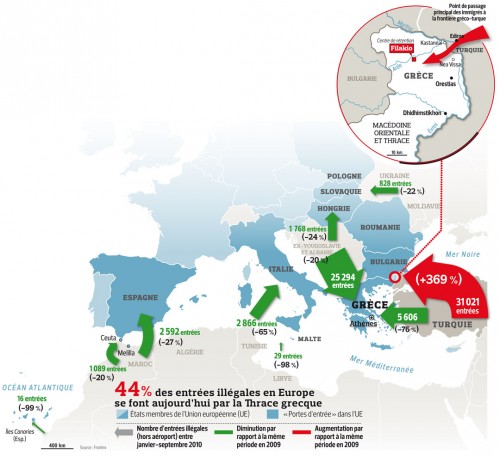
Istanbul, on le sait, est la ville la plus peuplée de Turquie; elle en est le centre commercial et économique et sert de plaque tournante pour accéder au reste du monde, mais surtout à l’Europe. L’agglomération stambouliote compte plus de treize millions d’habitants aujourd’hui: parmi eux, on estime que le nombre de migrants plus ou moins illégaux, venus de tous les coins du monde, est d’environ un demi million dont Ngoult Abdel, 23 ans, qui vient du Cameroun. Il prétend que sa famille ne peut plus le nourrir, là-bas en Afrique occidentale; par conséquent, il cherche une porte d’entrée pour s’installer dans l’Union Européenne. La Turquie semble être l’endroit idéal pour la trouver. Le pays a en effet 11.000 km de frontières et n’est pas très regardant quand il s’agit de distribuer des visas. Le pays candidat à l’adhésion à l’UE constitue donc le transit idéal pour tous ceux qui cherchent un meilleur avenir en Europe, donc dans l’Union Européenne.

Ngoult Abdel et ses amis ont pu se procurer, pour un tout petit montant, un visa d’un mois dès leur arrivée à l’aéroport Ataturk à Istanbul. La seule condition à remplir: il fallait être arrivé avec un vol des Turkish Airlines. Le même mode de fonctionnement vaut entretemps pour un pays plongé dans le chaos comme la Somalie. La compagnie aérienne turque vient tout récemment d’ouvrir une ligne directe entre ce pays failli et la Turquie.

Le voyage vers la Turquie coûte une petite fortune aux candidats réfugiés économiques. Il leur a fallu trouver la somme de 1300 euro, ce qui correspond souvent aux économies de leur famille tout entière. Mais le billet ne prévoit aucun retour. Abdel: “Nous avons entendu parler des mesures d’austérité en Europe mais nous voulons quand même y aller”. Le professeur Ahmet Icduygu, qui a rédigé un rapport sur les trafics d’êtres humains en Turquie pour le compte de l’Organisation internationale des migrations, le confirme: “Plus de la moitié des arrivants veut poursuivre sa route vers l’Europe et sans délai”.

En règle générale, cela ne fonctionne que par l’intermédiaire de bandes de passeurs biens organisés, qui exercent leurs activités peu reluisantes sans se cacher, au vu et au su des autorités officielles turques. Pour pouvoir financer leur passage vers l’UE, les migrants font des petits boulots illégalement, surtout dans le domaine de la construction, où ils peuvent s’estimer heureux s’ils gagnent 85 euro pour une semaine entière de travail pénible. La police ne s’intéresse pas à leur sort. Elle évite les quartiers où vivotent les illégaux. Un Africain commente la situation: “C’est la seule chose qu’il y a de bien ici”.

Les immigrés venus d’Asie ne connaissent pas une situation vraiment meilleure. La plupart d’entre eux viennent d’Afghanistan, où le monde occidental, sous la dictée de son hegemon américain, veille soi-disant, et depuis plus de dix ans, à ce que règnent l’ordre et le droit... On voit les résultats... Rien que durant l’année 2012, le nombre d’immigrés afghans a triplé! Les Afghans, entretemps, constituent 20% de tous les immigrants présents en Turquie. Certes, ces malheureux Afghans, pour la plupart, méritent bel et bien le label de “réfugié”, vu les combats incessants qui ruinent leur patrie mais la Turquie refuse de le leur accorder! Les autorités turques se réclament, pour justifier ce refus, d’une dérogation dont bénéficie leur pays depuis 1951, année où la convention de l’ONU réglant les problèmes de réfugiés a été adaptée pour la Turquie: cette dérogation permet à la Turquie de n’accepter que des réfugiés venus d’Europe.

Même si les migrants sont pris plus ou moins en charge par l’office d’aide aux réfugiés des Nations Unies, ils sont à terme contraints de basculer dans une “zone grise”, indéfinie, ou dans l’illégalité. Leur seule chance est donc de s’échapper en direction de l’UE, soit en payant des passeurs soit en tentant de se débrouiller eux-mêmes. L’une des routes les plus prisées jusqu’ici passait à travers la frontière grecque, du moins la partie où il n’y a pas de rivière à traverser. Mais cette portion de frontière est désormais fermée par une barrière anti-clandestins mise en place avec l’aide de l’Agence européenne Frontex. Voilà pourquoi, depuis quelques mois, on tente de forcer le passage à travers la frontière bulgare. Une fois en Bulgarie, les clandestins se retrouvent vite en Autriche ou dans les Länder allemands du sud.

Notre journal “zur Zeit” tiendra dorénavant une rubrique sur les diverses pistes utilisées par les passeurs et sur leurs méthodes peu ragoûtantes.

Dietmar HOLZFEIND.

(article paru dans “zur Zeit”, Vienne, Nr. 6/2013; http://www.zurzeit.at/ ).