Ok

En poursuivant votre navigation sur ce site, vous acceptez l'utilisation de cookies. Ces derniers assurent le bon fonctionnement de nos services. En savoir plus.

jeudi, 10 septembre 2009

PRESSESCHAU (Sept. 09 - 1)

presse.jpg

PRESSESCHAU - September 2009 (1)

Einige Links. Bei Interesse anklicken...


Afghanistan-Krieg
Obama will mehr Soldaten von Deutschland
Der August wird der Monat mit den höchsten Verlusten für die USA in Afghanistan seit Beginn des Militäreinsatzes. US-Präsident Obama fordert nach SPIEGEL-Informationen nun mehr deutsche Truppen – allerdings machen der Bundeswehr am Hindukusch schon jetzt Personalnot und marode Ausrüstung zu schaffen.
http://www.spiegel.de/politik/ausland/0,1518,645785,00.html

Weißer Südafrikaner als Flüchtling anerkannt
Kanada hat einen weißen Südafrikaner als „rassistisch Verfolgten“ anerkannt. Der regierende ANC tobt. Der Mann war insgesamt sieben Mal von Schwarzen überfallen worden. Er gab an, die Regierung unternehme nichts in Sachen Kriminalität gegen Weiße. Die Einwanderungsbehörde befand, daß der Weiße „eher ein Opfer wegen seiner Rasse als ein Opfer von Kriminalität ist“. Anerkennung eines Rassismus gegen Weiße – im politisch korrekten Europa unvorstellbar!
http://www.pi-news.net/2009/09/weisser-suedafrikaner-als-fluechtling-anerkannt/
http://afrikaner-genocide-achives.blogspot.com/

Weißrußland
Lukaschenko gesteht Wahlfälschung – nach unten
http://www.welt.de/politik/ausland/article4414017/Lukaschenko-gesteht-Wahlfaelschung-nach-unten.html
http://diepresse.com/home/politik/aussenpolitik/504697/index.do?from=gl.home_politik

Israel
Olmert wegen Korruption angeklagt
http://www.faz.net/s/RubDDBDABB9457A437BAA85A49C26FB23A0/Doc~EE6EAC992EF52477E833BA2DE0ED27A69~ATpl~Ecommon~Scontent.html
http://de.euronews.net/2009/09/01/israels-justiz-greift-in-der-polit-szene-durch-/

Schutz Homosexueller soll ins Grundgesetz
HAMBURG. Die Hamburger Bürgerschaft setzt sich dafür ein, den Schutz Homosexueller vor Diskriminierung im Grundgesetz zu verankern. Sowohl die Regierungsparteien CDU und Grüne als auch die oppositionellen Sozialdemokraten haben angekündigt, einem solchen Antrag zuzustimmen.
http://www.jungefreiheit.de/Single-News-Display.154+M50ba891e14d.0.html

Studie
Finanzkrise vernichtete bislang 10,5 Billionen Dollar
Von Martin Greive
Ein Jahr nach der spektakulären Pleite der US-Investmentbank Lehman Brothers kommt die ganze Wahrheit ans Licht. Laut einer aktuellen Berechnung für WELT ONLINE hat der Kollaps der Finanzwirtschaft weltweit einen Schaden von 10,5 Billionen Dollar verursacht – davon ein beträchtlicher Teil in Deutschland. Doch der Crash hat auch etwas Gutes.
http://www.welt.de/wirtschaft/article4418941/Finanzkrise-vernichtete-bislang-10-5-Billionen-Dollar.html

Extrem-Geothermie
Forscher holen Hitze aus Hannovers Boden
Von Henning Zander, Hannover
In Deutschland läßt sich die Erdwärme kaum nutzen, dachte man bisher. Forscher wollen nun das Gegenteil beweisen. In der norddeutschen Tiefebene bohren sie ein vier Kilometer tiefes Loch. Die Hitze aus dem Inneren der Erde könnte Deutschlands Energieproblem lösen.
http://www.spiegel.de/wirtschaft/unternehmen/0,1518,646096,00.html

Günter Kießling
Einst gedemütigter Bundeswehr-General gestorben
http://www.focus.de/politik/deutschland/guenter-kiessling-einst-gedemuetigter-bundeswehr-general-gestorben_aid_430529.html

Streit um Hessischen Kulturpreis beigelegt
Christliche Preisträger nun doch für Kermani
http://www.faz.net/s/Rub9B4326FE2669456BAC0CF17E0C7E9105/Doc~E105DF3DDEDC344F3AC870C478B9E3A96~ATpl~Ecommon~Scontent.html

Euthanasie
von Karlheinz Weißmann
Die Interviews auf der letzten Seite von „Bilder und Zeiten“ können mich immer wieder überraschen. Oft bittet die FAZ jemand zum Gespräch, dessen Name mir noch nie begegnet ist. So auch im Fall von Carl-Henning Wijmark, einem schwedischen Autor, der seinen Ruhm vor langer Zeit mit einer „pornographischen Nazi-Satire“ begründete und seit Beginn des neuen Jahrhunderts als „Vordenker der Demographie-Debatte sichtbar“ wurde.
Sei dem, wie dem sei. In dem Interview, das Wijmark am vergangen Sonnabend gegeben hat, ging es jedenfalls um Euthanasie und vor allem um die Tendenz in seiner skandinavischen Heimat wie in der Schweiz, den Niederlanden und Belgien, aktive Sterbehilfe an alten Menschen zu legalisieren.
http://www.sezession.de/6670/euthanasie.html#more-6670

Menschwerdung
von Anni Mursula
Seit dem Zweiten Weltkrieg ist in Deutschland wohl kaum etwas so heilig wie die Menschenwürde. Sie ist der unantastbare Kern des Grundgesetzes und steht niemals zur Diskussion.
Doch in der Realität gilt der Schutz der Menschenwürde nicht für das ungeborene Leben. Um die Argumentation für die Abtreibung dennoch ethisch und gutmenschlich akzeptabel zu machen, wird immer suggeriert, daß ein Embryo erst Mensch werden muß, um die Menschenrechte zu erhalten.
Wo dieses Menschsein anfängt, wird beliebig verschoben: Mal ist es nach der Einnistung des Embryos, mal nach der zwölften Schwangerschaftswoche, mal ist eine vermutete Behinderung des Ungeborenen Grund genug, ihm das Lebensrecht abzusprechen. Wird eine Behinderung diagnostiziert, kann das Kind bis zum Einsetzen der Wehen abgetrieben werden. (Vorausgesetzt die Mutter sagt, sie komme damit psychisch nicht zurecht.)
http://www.jungefreiheit.de/Single-News-Display.154+M52e05a9d96d.0.html

###

Ziemlich scharfer, aber letztlich doch recht treffender Kommentar aus der Diskussion zur Abtreibungsfrage im JF-Leserforum:

(...) Abtreibung ist illegitim, sofern sie aus Egoismus und Lebensfeindlichkeit geschieht. Anders sieht es bei der kriminologischen (nach Vergewaltigung) und der medizinischen Indikation aus (bei Lebensgefahr für die Mutter bzw. schwerer Schädigung des Kindes). Hier halte ich Abtreibung für absolut legitim und notwendig.

Wem ist damit gedient, wenn Paare mit Kinderwunsch nach der Geburt eines schwerbehinderten Kindes, das nun ihre lebenslange Fürsorge verlangt, so gebunden sind, daß sie in der Folge häufig auf weitere Kinder verzichten, obwohl sie aller Wahrscheinlichkeit noch gesunden Nachwuchs hätten haben können? Auch dies ist lebensfeindlich, da im Ergebnis das biologische Aussterben dieser Erblinien steht. Ich weiß nicht, was daran konservativ sein soll.

Deshalb stehe ich auch der Pränatal- und Präimplantationsdiagnostik keineswegs negativ gegenüber. Sofern sie verantwortungsvoll eingesetzt werden (d.h. lebensdienlich und damit im besten Sinne konservativ), können derartige eugenische Maßnahmen durchaus ein Segen sein. Darüber sollten die christlich-konservativen Heuchler und Pharisäer mit ihrem wie eine Monstranz vor sich hergetragenen Gutmenschentum mal nachdenken!

###

Rot-Rot-Grün
Linke träumen von der Macht im Land
Die Landtagswahlen könnten eine historische Zäsur bedeuten. Möglicherweise wird es erstmals rot-rot-grüne Landesregierungen geben – gleich im Doppelpack. Sowohl im Saarland als auch in Thüringen zeigt sich insbesondere die Linke enorm stark. Schon warnen die Mahner.
http://www.spiegel.de/politik/deutschland/0,1518,645908,00.html

Planmäßige Ausgrenzung
Von Mina Buts
Darf ein guter Pfadfinder heutzutage ein Zugabteil mit Jugendlichen vom Freibund teilen? Die Antwort lautet ganz klar: Nein, darf er nicht! Zu groß ist die Gefahr, etwas von dem Gedankengut, das im Freibund vertreten wird, könne auf die Pfadfinder übertragen werden.
http://www.jungefreiheit.de/Single-News-Display.154+M57eedf1305f.0.html

Einer der ewigen Stichwortgeber hat sich mal wieder gemeldet
GdP-Vorsitzender Konrad Freiberg: Polizei warnt vor Gewalt durch Neonazis
http://www.focus.de/politik/weitere-meldungen/rechtsextremismus-polizei-warnt-nach-festnahme-von-bombenbauer-vor-eskalation_aid_430369.html

Attac-Geschäftsführerin Sabine Leidig wechselt zur Linkspartei
http://www.pressrelations.de/new/standard/result_main.cfm?r=380104&sid=&aktion=jour_pm&quelle=0&n_firmanr_=109361&pfach=1&detail=1&sektor=pm&popup_vorschau=0
http://www.bild.de/BILD/regional/frankfurt/dpa/2009/08/28/spitzenkandidatin-leidig-tritt-in-die-linke.html

Mythen
Die Feuer der Hölle
Der als Polizistenmörder verurteilte schwarze Autor Mumia Abu-Jamal ist der berühmteste Todeskandidat der Welt. Linke verehren ihn, die Witwe Maureen Faulkner aber kämpft für ihre Wahrheit. Nun sieht es so aus, als würde sie gewinnen. Von Cordula Meyer
http://www.spiegel.de/spiegel/0,1518,645083,00.html

Die taz-Journalistin und Egon Flaig
von Thorsten Hinz
Unlängst wurde in Berlin-Kreuzberg eine taz-Journalistin von einem Türken angesprochen, und zwar von hinten: „Zieh dir einen BH an, es stört mich, wie du rumläufst.“ Der Mann war um die 30, die Frau anderthalb Jahrzehnte älter. „In dem Moment war ich nur wortlos, geplättet und fühlte mich erniedrigt“, berichtete sie. „Welches Recht nehmen sich solche Typen eigentlich heraus, nicht nur über die Kleidung fremder Frauen zu urteilen, sondern ihnen dieses Urteil auch noch in einem Befehlston mitzuteilen?“
http://www.jungefreiheit.de/Single-News-Display.154+M568653a1779.0.html

Im Bundestag notiert: Gedenktafel für gefallene deutsche ISAF-Soldaten
Verteidigung/Kleine Anfrage
Berlin: (hib/AW/STO) Die Fraktion Die Linke möchte von der Bundesregierung wissen, warum die Gedenktafel für gefallene deutsche ISAF-Soldaten auf dem internationalen Friedhof in Kabul in Nähe zum Grab von Manfred Oberdörffer errichtet wurde. In ihrer Kleinen Anfrage (16/13902) führt die Fraktion an, Oberdörffer habe der „nationalsozialistischen Wehrmacht-Spezialeinheit ,Brandenburg‘“ angehört und sei 1941 „als Geheimagent zur Vorbereitung einer weiteren Angriffsfront der faschistischen Kriegsführung in Asien“ gestorben.

Deserteur-Denkmal in Köln eingeweiht
von Hinrich Robohm
http://www.jungefreiheit.de/Single-News-Display.154+M5726d8d7820.0.html

Das Trauma
von Thorsten Hinz
Am 70. Jahrestag des Kriegsausbruchs wird Kanzlerin Merkel sich zu einer Gedenkveranstaltung in Danzig einfinden. Dort wird sie verbreiten, was sie eben auf einer Vertriebenenveranstaltung sagte: daß die Vertreibung „unmittelbare Folge deutscher Verbrechen“ war und es „kein Umdeuten der Geschichte“ gibt.
http://www.jungefreiheit.de/Single-News-Display.154+M53b5d627f41.0.html

So sieht’s der Pole ...
Zweiter Weltkrieg
Die andere Erinnerung an 1939
Wenn Angela Merkel und Wladimir Putin kommende Woche nach Danzig reisen, werden sie bei der Gedenkfeier zum Kriegsbeginn vor 70 Jahren mit Polens Sicht auf den Überfall (sic!) konfrontiert werden. Auf SPIEGEL ONLINE erklärt Pawel Machcewicz, Berater von Premier Donald Tusk, warum die Polen den Zweiten Weltkrieg anders erinnern – und dem deutschen Gedenkbetrieb mißtrauen.
http://einestages.spiegel.de/static/topicalbumbackground/4823/die_andere_erinnerung_an_1939.html

Sven Felix Kellerhoff von der WELT hetzt gegen Scheil und Schultze-Rhonhof ...
„Polen wartet, fast fatalistisch“
Von Sven Felix Kellerhoff
Hitlers Schuld am Zweiten Weltkrieg steht eindeutig fest. Dennoch verkaufen sich apologetische Bücher zum 1. September 1939 gut
http://www.welt.de/die-welt/kultur/article4437824/Polen-wartet-fast-fatalistisch.html

Scheil und Schultze-Rhonhof
Von Götz Kubitschek
Die Historiker Stefan Scheil und Gerd Schultze-Rhonhof sind ziemlich erfolgreich in ihrem Versuch, die Diplomatiegeschichte im Vorfeld des Zweiten Weltkriegs einer Revision zu unterziehen. Während „die Zunft“ ihrer Fachkollegen die Auseinandersetzung mit ihnen scheut, kauft das Publikum die gut lesbaren und in redlichem Ton verfaßten Bücher in großen Stückzahlen.
Deshalb versucht Sven Felix Kellerhoff in der heutigen „Welt“, einen weiteren Riegel vor dieses aus seiner Sicht unstatthafte Treiben zu schieben. Weil ihm das inhaltlich nicht gelingen kann, muß er zum Denunziationsinstrumentarium greifen.
http://www.sezession.de/7044/scheil-und-schultze-rhonhof.html#more-7044

Die polnische Besetzung von Gleiwitz
von Stefan Scheil
Die Ansichten über Ursachen und Verantwortungen für den Ausbruch des Zweiten Weltkrieges sind in Bewegung gekommen, davon zeugen ausnahmsweise sogar einige Beiträge in großen deutschen Zeitungen.
http://www.sezession.de/7049/die-polnische-besetzung-von-gleiwitz.html

Der Weg in den Krieg
BERLIN. Vor siebzig Jahren begann mit der Beschießung der Westerplatte bei Danzig der Zweite Weltkrieg. Die Ursachen für den Konflikt, der sich schließlich zum Weltbrand ausweitete, liegen jedoch weiter zurück.
In einer Serie für die JUNGE FREIHEIT erläutert Generalmajor a. D. Gerd Schultze-Rhonhof die Vorgeschichte des 1. September 1939.
http://www.jungefreiheit.de/Single-News-Display.154+M5d6eb49d759.0.html

Generalmajor a.D. Gerd Schultze-Rhonhof über die Ursachen des Zweiten
Weltkriegs. Knapp einstündige Rede
http://video.google.com/videoplay?docid=-1423208573050100159&hl=de

Ein Kino-Film sollte den „Überfall“ rechtfertigen
Von Hanns-Georg Rodek
Es ist ein Bild, aus unzähligen amerikanischen Western vertraut: ein Treck, der bis zum Horizont reicht, Siedler in ihren Planwagen auf dem Weg gen Westen, wo ein neues, besseres Leben auf sie wartet. Auch das deutsche Kino hat solch eine Szene aufzuweisen. Sie stammt aus „Heimkehr“, und auch hier fährt eine unendlich lange Kolonne von Siedlerwagen ins gelobte Land, nach Westen, „heim ins Reich“.
http://www.welt.de/die-welt/kultur/article4437822/Ein-Kino-Film-sollte-den-Ueberfall-rechtfertigen.html

Geschichte, die nicht vergeht
Von Gerhard Gnauck
Auch 70 Jahre nach Ausbruch des Zweiten Weltkriegs ringen Europas Politiker um die richtigen Worte
http://www.welt.de/die-welt/kultur/article4437829/Geschichte-die-nicht-vergeht.html

Zweiter Weltkrieg
Polen warnt vor „Verfälschung“ der Geschichte
Genau heute vor siebzig Jahren beschoß das deutsche Kriegsschiff „Schleswig-Holstein“ das zur Festung ausgebaute polnische Munitionsdepot in Danzig. Polens höchste Repräsentanten haben nun bei der Gedenkfeier zu Beginn des Zweiten Weltkriegs an die Verantwortung Deutschlands erinnert. Sie warnten davor, die Geschichte zu vergessen.
http://www.welt.de/politik/ausland/article4438278/Polen-warnt-vor-Verfaelschung-der-Geschichte.html

Ansonsten wären die polnischen Ulanen wohl vermutlich schon bis Berlin vorgedrungen gewesen ...
Gedenken an Zweiten Weltkrieg
Kaczynski wirft Sowjetunion „Messerstich in den Rücken“ vor
Polens Präsident hat bei der Gedenkfeier zum Ausbruch des Zweiten Weltkriegs scharfe Töne gegen die frühere Sowjetunion angeschlagen: Stalin habe Polen mit dem Einmarsch der Roten Armee im September 1939 einen tödlichen Stoß versetzt, sagte Lech Kaczynski.
http://www.spiegel.de/politik/ausland/0,1518,646181,00.html

Polen
Merkel, Putin und Kaczynski gedenken Beginn des Zweiten Weltkriegs
Bundeskanzlerin Merkel, Rußlands Ministerpräsident Putin und weitere Politiker haben in Polen mit Präsident Lech Kaczynski eine Zeremonie zum Gedenken an den Beginn des Zweiten Weltkriegs begonnen. Auf der Westerplatte in Danzig wurde ein Kranz niedergelegt. Merkel unterstrich Deutschlands Verantwortung für den Zweiten Weltkrieg, Kaczynski würdigte Soldaten, die gegen Nazi-Deutschland kämpften.
http://www.focus.de/panorama/vermischtes/polen-merkel-putin-und-kaczynski-gedenken-beginn-des-zweiten-weltkriegs_aid_431595.html

Zitat Donald Tusk: „Wir sind hier zusammengekommen, um daran zu erinnern, wer den Krieg begonnen hat, wer der Schuldige war, wer der Henker in dem Krieg war und wer das Opfer der Aggression war.“

Polen: „Für Demut kein Grund“
DANZIG. Um Viertel vor fünf, siebzig Jahre nach den ersten Schüssen des deutschen Linienschiffes „Schleswig-Holstein“ auf das polnische Munitionsdepot auf der Westerplatte im damaligen Freistaat Danzig, haben die Spitzen des polnisches Staates die nationalen Gedenkfeierlichkeiten eröffnet. Staatspräsident Lech Kaczyński (PiS) und Ministerpräsident Donald Tusk (PO) warnten in ihren Ansprachen vor Umdeutungen der Geschichte.
http://www.jungefreiheit.de/Single-News-Display.154+M5d574615fdf.0.html

Das Merkel übertrifft sich mal wieder selbst. Hündischer geht’s nicht ...
„Ich verneige mich vor den Opfern“
Von Lars-Broder Keil
Merkel bekennt sich in Danzig zur „immerwährenden Verantwortung“ Deutschlands für Kriegsleid und Holocaust
http://www.welt.de/die-welt/politik/article4444950/Ich-verneige-mich-vor-den-Opfern.html

1. September 2009. Kanzlerin Merkel erinnert an deutsche Kriegsschuld und betont „immerwährende geschichtliche Verantwortung“ (was immer das sein soll) ...
http://www.google.com/hostednews/afp/article/ALeqM5iaIDwS-IoF6I0AyAOeHlngI1ahcA
http://derstandard.at/fs/1250691529347/Ueberfall-auf-Polen-Merkel-bekennt-sich-zu-Deutschlands-Schuld
http://www.abendblatt.de/politik/deutschland/article1165031/Kanzlerin-Merkel-verneigt-sich-vor-Kriegsopfern.html
http://www.focus.de/panorama/vermischtes/70-jahrestag-des-zweiten-weltkriegs-merkel-bekennt-sich-zur-geschichtlichen-verantwortung-deutschlands_aid_431797.html

Putin erkennt russische Kriegsschuld nicht an
70 Jahre Kriegsbeginn
Alle warten auf Putin – doch der schweigt zu Stalin
http://www.welt.de/politik/deutschland/article4443063/Alle-warten-auf-Putin-doch-der-schweigt-zu-Stalin.html

Geschichte im „Stern“
Angriff auf Polen:
Der Weg in den Vernichtungskrieg
http://www.stern.de/politik/deutschland/angriff-auf-polen-der-weg-in-den-vernichtungskrieg-1506349.html

Wolfgang Venohr, Kriegsschuld und die Deutschen in Polen
von Dieter Stein
http://www.jungefreiheit.de/Single-News-Display.154+M5297d164e6f.0.html

Mehrheit der Polen heißt „Zwangsaussiedlungen“ gut
Eine überwältigende Mehrheit der Polen sieht die Zwangsaussiedelungen der Deutschen nach dem Zweiten Weltkrieg als gerechtfertigt. Zwischen 1939 und 1945 kamen sechs Millionen Polen (sic!) gewaltsam ums Leben.
http://diepresse.com/home/politik/zeitgeschichte/505236/index.do?_vl_backlink=/home/politik/index.do

Ein Beispiel für deutschen „Schuldstolz“ ...
Kolumne Kopfwelten: Hitlers Erbe
70 Jahre ist der Beginn des 2. Weltkriegs her. Muß sich auch die Internet-Generation noch schuldig fühlen für die Verbrechen ihrer Urgroßväter? Neue psychologische Forschungen geben eine Antwort. Von Frank Ochmann
http://www.stern.de/wissen/mensch/muskeltest/kolumne-kopfwelten-hitlers-erbe-1506473.html

Über die Vorgeschichte wüßte man gerne mehr ...
Massaker
Wie die Deutschen im polnischen Borów metzelten
Von Gerhard Gnauck
750 Dörfer metzelten die Wehrmacht und die deutschen Polizeikräfte in Polen nieder, darunter Borów. Konrad Schuller hat seine Bewohner besucht und mit den letzten Überlebenden gesprochen. In einer packenden Reportage erzählt er von ihrem Leid, aber auch von den Tätern und was sie nach 1945 trieben. [Interessant sind auch die Leserkommentare!]
http://www.welt.de/kultur/literarischewelt/article4417880/Wie-die-Deutschen-im-polnischen-Borow-metzelten.html

SPIEGEL-TV: Hitlers Westfeldzug
http://www.spiegel.de/video/video-1018716.html

Letzter Senf zu Tarantino
Von Thorsten Hinz
http://www.jungefreiheit.de/Single-News-Display.154+M590401dd143.0.html

Ein Besuch lohnt sich ...
Staats- und Wirtschaftspolitische Gesellschaft e.V.
http://www.swg-hamburg.de/index.html

Die englischsprachige Ausgabe von SPIEGEL Online über den Umgang der heutigen Deutschen mit der Schlacht im Teutoburger Wald ...
Battle of the Teutoburg Forest
Germany Recalls Myth That Created the Nation
By David Crossland in Kalkriese, Germany
http://www.spiegel.de/international/germany/0,1518,644913,00.html

Schöppingen auf der Flucht vor Rechts
In Schöppingen ist man auf der Flucht vor der rechten Gefahr. Selbst nachdem ein 18jähriger einem irakischen Asylbewerber zum Opfer gefallen ist, wird sorgfältig nur nach rechts geschaut. So dient denn auch dieser Mord dem „Kampf gegen Rechts“. Zu den Trauerfeierlichkeiten am Donnerstag schickte die Antifa Wächter vorbei, und am Freitag wurden die Schüler vorzeitig entlassen, weil angeblich Rechtsextreme die Schule stürmen wollten.
Die Westfalennachrichten schieben den vorgezogenen Schulschluß nach Angaben des Schulleiters auf „aktive Trauerbewältigung“. Eine Drohung habe es nicht gegeben. Schöppinger Eltern kommentieren.
http://www.pi-news.net/2009/08/schoeppingen-auf-der-flucht-vor-rechts/

Schulschließung: „Alles nur geträumt?“
Schöppingen – Wurden die Schulen in Schöppingen am Freitag vorzeitig geschlossen, weil mit den trauernden Schülern nach dem gewaltsamen Tod eines 18jährigen ein normaler Unterricht nicht mehr möglich war? Oder gab es – anders als Polizei und Schulen es darstellen – doch anonyme Drohungen, die zu diesem Schritt veranlaßten? Darüber wird in Schöppingen inzwischen kontrovers diskutiert. Polizei und Schulleitungen hatten am Freitag auf Anfrage der WN mitgeteilt, daß das vorzeitige Unterrichtsende nur aufgrund der Stimmungslage der Schüler erfolgt sei. Ein Polizeisprecher verneinte auf konkrete Nachfrage, daß es Drohungen gegeben habe. Die Polizei blieb auch am Wochenende bei dieser Darstellung. Ein Sprecher der Kreispolizeibehörde Borken machte auf erneute Anfrage der WN deutlich, daß der vorzeitige Unterrichtsabbruch nicht in Folge anonymer Drohungen erfolgt sei. Im Internet habe es lediglich Hinweise darauf gegeben, daß Rechtsextreme zu einer Demonstration i
 n Schöppingen erscheinen könnten. Diesen Hinweisen sei die Polizei nachgegangen und habe in diesem Zusammenhang auch eine Schülerin aus Schöppingen vernommen. Dabei sei der Internet-Hinweis, so der Polizeisprecher wörtlich, „wie eine Blase geplatzt“. Vor Ort in Schöppingen sei es am Freitag – dem Tag der Beerdigung des 18jährigen Opfers – nicht zu irgendwelchen Demonstrationen gekommen.
http://www.ahlener-zeitung.de/lokales/kreis_borken/schoeppingen/1114606_Schulschliessung_Alles_nur_getraeumt.html


Auseinandersetzung zwischen Deutschen und Türken in Brandenburg ...
GEWALT: Tatort Lindow: Die Täter sind bekannt
Gegenseitige Beschimpfungen standen am Beginn der Auseinandersetzung / Staatsanwaltschaft ermittelt
http://www.maerkischeallgemeine.de/cms/beitrag/11593447/61299/Gegenseitige-Beschimpfungen-standen-am-Beginn-der-Auseinandersetzung-Staatsanwaltschaft.html

Nach der Schägerei
Türkiyemspor-Präsident erhebt Vorwürfe gegen Ermittler
Nach dem Vorfall zwischen Lindower Jugendlichen und jungen Fußballspielern des Berliner Vereins Türkiyemspor diskutiert der Ort über die Auslegung der Ereignisse. Viele Lindower wollen nicht an einen fremdenfeindlichen Übergriff glauben. Die Staatsanwaltschaft ermittelt gegen beide Seiten.
http://www.tagesspiegel.de/berlin/Brandenburg-Tuerkiyemspor-Lindow;art128,2885783

POL-F: 090824 - 1057 Gallusviertel: Randalierende Spieler lösen Polizeieinsatz auf Fußballplatz aus
Frankfurt (ots) – Am Sonntag, den 23.08.2009 gegen 16.00 Uhr, wurde der Polizeinotruf während eines Fußballspiels von einem Mitglied der Gästemannschaft informiert, daß sie unter anderem durch Ordner der Gastgeber auf dem Sportplatz an der Sondershausenstraße massiv beleidigt und durch Handgreiflichkeiten attackiert werden. Darüber hinaus wären ihnen Schläge nach dem Spiel angedroht worden. Vorausgegangen waren angeblich strittige Schiedsrichterentscheidungen. Da sie in der Vergangenheit schlechte Erfahrungen mit den Gastgebern gemacht hatten, verständigte man die Polizei.
Entgegen der Darstellung einiger Vertreter der Gastgeber hat das aggressive Verhalten von Spielern und sonstigen Verantwortlichen zu dem Erscheinen der Polizei vor Ort geführt. Die Notwendigkeit der Polizei zeigte sich schon beim Eintreffen. Hier schlug ihnen bereits eine deutlich aufgeheizte Stimmung seitens der Gastgeber entgegen. Es kam durch mehrere Spieler der Platzherren unmittelbar zu massiven Beleidigungen und Bedrohungen der Beamten. Ein 30jähriger Marokkaner beleidigte noch aus dem laufenden Spiel heraus die Beamten mit „dreckige Hurensöhne“, „Schmok“, „Weicheier“ und weiteres mehr.
http://www.presseportal.de/polizeipresse/pm/4970/1462697/polizeipraesidium_frankfurt_am_main

Haarsträubendes Video über Ausländerterror in Berlin ...
Kriminelle Ausländer zeigen ihr Waffenarsenal – Akte09
http://www.youtube.com/watch?v=jMGmbhEAZUc

Hier noch einmal die zu Beginn des „Akte“-Berichts gezeigte Attacke in voller Länge ...
Ausländergewalt: Orientalen prügeln auf Polizisten ein
http://www.youtube.com/watch?v=huNaVq0wwJw

Früh übt sich ...
Köln – Mehmet (8): „Ich stech euch ab“
http://www.express.de/nachrichten/region/koeln/ich-stech-euch-ab_artikel_1251217065251.html

Molenbeek(Brüssel): Polizei kapituliert im Mohammedaner-Viertel
http://www.youtube.com/watch?v=jacisnCWbk4

Staatliche Bekenntnisschulen
Andersgläubige müssen draußen bleiben
Von Hermann Horstkotte
„Kurze Beine, kurze Wege“ – diese plausible Regel für Erstkläßler hat Nordrhein-Westfalen abgeschafft. Dort zählt jetzt der Taufschein an einem Drittel der staatlichen Schulen mehr als gute Nachbarschaft. Die Folge: Katholiken bleiben unter sich, vor allem Muslime werden ausgegrenzt.
http://www.spiegel.de/schulspiegel/wissen/0,1518,645731,00.html

361° Toleranz – Antwort auf den Aufruf der Bundeskanzlerin
http://www.youtube.com/watch?v=5hK-7zLvc2k

361 Grad Toleranz – Mobbing gegen Deutsche
http://www.youtube.com/watch?v=An6JedBSmIg

Erstkläßler
Warum früh eingeschulte Kinder seltener aufs Gymnasium wechseln
Für viele Eltern kann die Grundschule gar nicht früh genug losgehen. Doch oft hat das fürs Kind Nachteile. Die Forscherin Andrea Mühlenweg, 32, erklärt im Interview, wieso ein paar Tage viel ausmachen können und der schnellste Weg nicht immer eine Abkürzung ist.
http://www.spiegel.de/schulspiegel/wissen/0,1518,645004,00.html

Wörter, die keiner versteht
Die schlimmsten „Sprachpanscher des Jahres“
„Slacklining“, „Gymmotion“ und „Feel Well Woman“: Mit solchen Wortschöpfungen hat sich der Deutsche Turner-Bund (DTB) beim Verein Deutsche Sprache sehr unbeliebt gemacht. Deshalb wurde der DTB jetzt zum „Sprachpanscher des Jahres“ gekürt. Auf den Plätzen folgen zwei große Konzerne.
http://www.welt.de/kultur/article4417540/Die-schlimmsten-Sprachpanscher-des-Jahres.html

Hausbesetzung als bürgerliche Geste
Die Wohlfühl-Variante der Hafenstraße: In Hamburg haben junge Künstler leere Häuser im Gängeviertel besetzt und alle sind dafür. Tim Ackermann traf den Schirmherrn der Besetzer, Daniel Richter
http://www.welt.de/die-welt/kultur/literatur/article4425233/Hausbesetzung-als-buergerliche-Geste.html

Antike Schriften
Jäger des verlorenen Wissens
Von Dirk Husemann
Nur ein Prozent aller Schriften der Griechen, Römer und Ägypter soll die Zeiten überdauert haben. Bis heute suchen Forscher nach den Überresten der Bibliothek von Alexandria – und in Papyrusfragmenten nach Gedanken aus einer vergangenen Welt.
http://www.spiegel.de/wissenschaft/mensch/0,1518,644238,00.html

Unbewußte Signale
Schluckauf – ein Überbleibsel der Evolution
Von Harald Czycholl
„Da denkt jemand an dich“ ist die gängigste Erklärung für den Schluckauf. Dabei ist es eigentlich schlicht ein Nerv, der da gereizt wird. Schon als Fötus im Mutterleib gibt es die Hickser. Der längste bekannte Schluckauf eines Menschen dauerte fast 70 Jahre. Gegen Schluckauf hilft ein alter Trick.
http://www.welt.de/wissenschaft/medizin/article4448407/Schluckauf-ein-Ueberbleibsel-der-Evolution.html

Snapshots of the Continent Entre Deux Guerres: Keyserling's Europe (1928) and Spengler's Hour of Decision (1934)

Snapshots Of The Continent Entre Deux Guerres:

Keyserling’s Europe (1928)

And

Spengler’s Hour Of Decision (1934)

Swiftly on beginning my graduate-student career in 1984 I observed that people calling themselves intellectuals – the kind of people whom one met in those days as fellows in graduate humanities programs – tended to be obsessed with topicality and immediacy.  Some adhered explicitly to one or another ideology of the a-historical, identifying so strongly with a perceived avant-garde or “cutting edge” that yesterday struck them as contemptible, a thing to be denounced so as to make way for the reformation of existence.  But the majority were (and I suppose are) conformists looking for cues about what effective poses they might strike or words employ to signify their being “with it.”  To be “with it” in a comparative literature program in California in the mid-1980s meant to be conversant with “theory,” and “theory” in turn meant the latest oracular pronouncement by the Francophone philosophe du jour, as issued almost before the writer wrote it by the those beacons of scholastic responsibility, the university presses.  First it was Michel Foucault, then Jacques Derrida, and then Jean-Michel Lyotard.  As tomorrow swiftly became yesterday, one sensed a panic to keep up with the horizonless succession of “with-it” gurus in fear that one might appear to others, better informed, as clownishly derrière-garde.

Being reactionary by conviction, I decided on an opposite course: to ignore the avant-garde and to read backwards, as it were, into the archive of forgotten and marginal books that no one deemed respectable by the establishment was reading anymore, and sideways into the contemporarily unorthodox.  Part of the providential harvest of that eccentric project, which became a habit, is my acquaintance with two quirky tomes that, despite their oddness, seem to me to stand out as notable achievements of the European mind in the decade before World War Two.  One is Count Hermann Keyserling’s Europe (1928); the other is Oswald Spengler’s “other book,” The Hour of Decision (1934).   Both speak to us, in the God-forsaken present moment, with no small critical alacrity.

I. Spengler has proved a more durable figure than Keyserling, but the reading audience during the early years of the Weimar Republic would have known Keyserling better than Spengler.  People talked about Spengler, but they read Keyserling, whose style was the more accessible.  Of Baltic Junker descent, Graf Hermann Alexander Keyserling (1880 – 1946) fared badly in the aftermath of the Great War.  He lost title to Rayküll, the hereditary Keyserling estate in Junker-dominated Livonia, when the newly independent Estonian Republic, conspicuously failing to reverse erstwhile Bolshevik policy, expropriated (or rather re-expropriated) the fixed holdings of the German-speaking ex-aristocracy.  Keyserling found himself stateless, dispossessed, and in search of a career, his sole remaining asset consisting in his education (higher studies at Dorpat, Heidelberg, and Vienna).  Marriage to Otto von Bismarck’s granddaughter (1919) returned Keyserling to something like a station while the success of his first book, The Travel Diary of a Philosopher (1922), stabilized his finances.  The Travel Diary, immediately translated into a half-dozen languages including English, remains readable, even fascinating.  In 1914, before the outbreak of hostilities, Keyserling had undertaken a global circumnavigation, the lesson of which the Diary, a nation-by-nation account of the world at that moment, meditatively records.


The Diary bespeaks a cosmopolitan-liberal attitude, flavored by a pronounced mystical inclination.  Europe, or Das Spektrum Europas in the original German, will strike readers by contrast as an apology (highly qualified) both for nationalism and for individualism.  Keyserling’s “spectroscopic analyses” of the various European peoples, in their peculiar individualities as well as in their complex relation to one another, advances the argument that, if Europe ever were to forge administrative unity out of its querulous variety, it would only ever do so by granting full rights and legitimacy to the varieties.

Keyserling favors a modest pan-European government, whose chief function would be the mediation of disputes between the otherwise sovereign nation-states, but characteristically he supplies no details.  Keyserling’s notion of a pan-European administration differs in its modesty from many being advanced at the time by such as H. G. Wells, whose speculative utopias – as for example in Men Like Gods – uniformly foresee the dissolution of the nation-state, not just into a pan-European arrangement, but, rather, into a World Republic.  Of course, Wells assumes that English, not French or Mandarin, will be the singular unifying tongue of that Republic.  The elites will educate people so that anything like a national identity disappears completely in the first captive generation.  In the concluding chapter of Europe, in a discussion of national “style,” Keyserling insists on the contrast between his own sense of identity and the “international,” or specifically political type of identity, promulgated by the Communists and Socialists.  In the case of the specifically political identity, the subject yields his individuality to merge with the ideological construction.   Keyserling reacts to this as to a toxin.  “When I analyze my own self-consciousness,” Keyserling poses, “what do I find myself to be?”

Keyserling answers: “First and foremost, I am myself; second, an aristocrat; third, a Keyserling; fourth, a Westerner; fifth, a European; sixth, a Balt; seventh, a German; eighth, a Russian; ninth, a Frenchman – yes, a Frenchman, for the years during which France was my teacher influenced my ego deeply.”  We note that politics never enters into it.  Reading the autobiographical passages of Europe, especially those in the chapter on “The Baltic States,” one gets the impression, incidentally, that belonging to Baltdom ranks as rather more important for Keyserling’s self-assessment than its place in his explicit hierarchy of identities would suggest.

Europe deploys a well-thought-out dialectic of individual and national character, whose subtleties Keyserling presents in his “Introduction.”  In the same “Introduction,” the author also sets forth his case for the absolute legitimacy of judging nations and cultures against one another.  Keyserling fixes over the whole of Europe an epigraph drawn from Paul to the Romans: “For all have sinned and come short of the glory of God.”  His dialectic follows from his conviction of imperfectness both of the basic human nature and of human arrangements for the conduct of political existence.

Keyserling can note, by way of a widely applicable example, that the Latin subject’s sense of his status as “civis Romanus… awoke in him as an individual a profound sense of self-discipline and obligation”; Keyserling can also assert that, “The man who attempts to deduce his own worth from the fact that he is a member of a particular group is thinking askew, and, besides presenting an absurd spectacle, gets himself disliked.”  The two statements imply, for Keyserling, no contradiction.  In the spirit of Saint Paul, Keyserling indeed hazards the sweeping – and, to some, disturbing – rule that, “in not a single nation is the national element, as such, bound up with anything of worth” because “the gifts of every nation are balanced by complementary defects.” As Keyserling sees things, “the only value in the national spirit is that it may serve as the basic material, as the principle of form, for the individual.”  In the ironic consequence, as Keyserling closes out his syllogism, “it is for this very reason that every nation instinctively measures its standing by the number and quality of world-important figures which it has produced.”

Whereas on the one hand in Keyserling’s epigrammatic judgment, “the individual and the unique are more than the nation, be it one’s own or another,” on the other hand “value and mass have absolutely nothing to do with each other.”  Apropos of Keyserling’s disdain for the “mass,” he notes that, “Christ preached love of one’s neighbor just because he did not have in mind philanthropy and democracy.”

Invoking Hebrew theology and German music as examples, Keyserling argues that: “A nation can achieve significance for humanity only in certain respects; namely, those wherein its special aptitudes fit it to become the appointed organ for all humanity.” Thus to evoke “abstract considerations of justice” is for Keyserling a “useless” exercise flying in the face of a “cosmic truth.” Given the central role of the individual in Keyserling’s scheme, readers will register little surprise when, in Europe, the author insists that the individual not only possesses the right, but indeed lives under an ethical imperative, to render public judgment on collectivities, with reference to a metaphysical hierarchy of values.  “Strength and beauty are higher, in the absolute sense, than weakness and ugliness; superiority is higher, too, in the absolute sense, than inferiority, and the aristocratic is higher than the plebieian.”  Europe offers, among other pleasures, Keyserling’s giving himself “free rein” to articulate such judgments in a spirit of “inner liberation,” in which the cultured reader will surely participate, treating everyone with equal severity and irony.

Keyserling admits, “There are some who will have for this book nothing but resentment.”  He hopes indeed that “all Pharisees, all Philistines, all nitwits, the bourgeois, the humorless, the thick-witted, will be deeply, thoroughly hurt.”  These are words almost more apt – but certainly more apt, supremely apt – for Anno Domine 2009 than for 1928; but one nevertheless presupposes their legitimacy in context.  Keyserling reminds his readers in advance that he will have imposed the same criteria in assessing “my own people,” meaning the Balts, as in assessing others.


II. One can only sample the wares, so to speak, in a summary of Europe, keeping in mind Keyserling’s warning that he must necessarily offend the easily offended.  Readers will need to explore Europe on their own to discover what Keyserling has to say about Netherlanders, Hungarians, Romanians, Swedes, and Swiss.  What follows makes reference only to the chapters on England, France, and Germany.  Does the order of the chapters imply even the most modest of hierarchies, with the first chapter taking up the analysis of England?  Keyserling must have recognized the importance of his Anglophone audience to his popularity.  His treatment of the English, while unsparing in principle, does seem warmed somewhat by fondness.  For Keyserling, that odd phenomenon of “Anglomania” (nowadays one would say “Anglophilia”) tells us something, by way of indirection, about its object.  “One nation sees itself mirrored in the other, not as it is, but as it would like to be; just as, during the World War, every nation attributed to its enemy the worst features of its own unconscious.”

On England.  With characteristic nakedness of statement, Keyserling credits the Anglo-Saxon, not with “intelligence” but rather with “instinct.”  According to Keyserling, “the whole [English] nation… has an unconquerable prejudice against thinking, and, above all, against any insistence on intellectual problems.”  Being creatures of instinct, Englishmen act with certitude or at least with the appearance of certitude.  It is this certitude, translated pragmatically as the habit of taking bold action, which others so admire, even while misunderstanding it, in the Anglo-Saxon spirit.  “The Englishman… is an animal-man”; and “at the lowest end of the scale he is the horse-man, with corresponding equine features.”  The aversion to ratiocination explains the British Empire, which “simply grew up, with no intention on anybody’s part,” to be governed by the colonial-administrator type, who “rarely thinks of anything but food, drink, sport, and, if he is young, flirtations.”

More than God, whatever his sectarian dispensation, Keyserling’s Englishman worships “the rules of the game.”  Thus his “loyalty to one’s land, one’s party, one’s class, one’s prejudices… the first law” so that “the question of absolute value is beside the point.”  From these inclinations stem “British empiricism, so despised by the French, which enables the British successfully to anticipate the crises precipitated by the spirit of the times.”  Yet if the Englishman were ungifted intellectually, he would be, in Keyserling’s estimate, “all the more gifted psychologically,” with the consequence that the Briton possesses “skill in handling human material [that] is extraordinary.”  Nestling at the core of that gift is the principle, which Keyserling classifies as “primitive,” that one should “live and let live.”  The English sense of individuality and of rights is likewise primitive, in the positive sense of being a reversion, against the modern tide, to the atheling-egotism of the Beowulf heroes and King Alfred.  More than any other European nation, England has preserved medieval customs that might prove healthily anodyne to the deculturation inherent in modernity.  Yet Keyserling fears that the English will fail to preserve custom and will plunge into “the Mass Age” more thoroughly than other nations, just as the offshoot American nation, in his judgment, had already done.

On France.  Chortling Gallic readers need only to have turned the page to receive their own stinging dose of Keyserling’s patented forthrightness.  It starts out flatteringly enough.  Whereas the Englishman lives according to instinct, the Frenchman, taking him in the generality, behaves like a “universally intelligible life-form”; one sees in him a creature of “the conscious” and of “the intellect,” whose rationality has concocted, in the Gallic idiom, “a perfect language for itself.”  So it is that “all Occidental ideology, whenever it can be expressed at all in French, finds in the body of that language its most intelligible expression.”  Nevertheless, “however clear the intelligence of the Frenchman may be, his self-consciousness is emotional rather than intellectual,” being as such, “easily and violently aroused,” with the emotion itself its “own ultimate justification.”  From Parisian emotiveness, from the esteem in which others regard France, and using the intellectual precision of the French language, comes the least attractive of Gallic qualities: “The Frenchman… has always seen in his opponent the enemy of civilization.”  Just that inclination emerged in 1914, but the ferocity of the Jacobins showed its presence at the birth of the French Republic.

As Keyserling sees it, however, France is not a dynamic, but an essentially conservative, nation, which is what has enabled it to survive its endless cycle of revolutions.  The real role of France after 1918 should not have been, as the French took it on themselves to do through the League of Nations, to “restore” – that is, to transform – Europe after some rational pattern; it should have been to conserve the precious vestiges of pre-Revolutionary culture.  “The French are par excellence the culture nation of Europe.”

On Germany.  On the topic of Germany, Keyserling begins by quoting his old friend Count Benckendorff, the Czar’s ambassador in London: Ne dites pas les allemands; il n’y a que des allemands.”  (“Speak not of the Germans; there are only Germans.”)  According to Keyserling, “The German exists only from the viewpoint of others”; yet not quite, as one can make applicable generalizations.  A German is an “object creature” whose “life-element lies, once and for all, in that which, externally, emerges most typically in the cult of the object.”  A German is by nature therefore an expert, dedicated to his own expertise and to expertise qua itself as the principle of orderly existence.  Keyserling avails himself of a standing joke: “If there were two gates, on the first of which was inscribed To Heaven, and on the other To Lectures about Heaven, all Germans would make for the second.”  German interest in objects and objectives gives rise to German technical prodigality – the German primacy in precision Engineering and the mechanical systematization of everyday life.  Despite its orientation to the objects, the German mentality suffers from “unreality.”  How so?

“The personal element in man,” Keyserling remarks, “declines in direct proportion as his consciousness becomes centered in detached, externalized ideas; and for those who have to deal with him it really becomes impossible to know what they can expect and what they can rely on.”  Keyserling does not foresee the collapse of the Weimar Republic and the catastrophe of the dictatorship, but he does, in the just-quoted sentence, see the cause of both.

The concluding chapter of Europe attempts a summing-up with a forecast.  Keyserling writes: “Europe is emerging as a unity because, faced at closer range by an overwhelming non-European humanity, the things which Europeans have in common are becoming more significant than those which divide them, and thus new factors are beginning to predominate over old ones in the common consciousness.”  But, in compliance with his dialectic, Keyserling issues a warning.  The unification of the European nations as they confront the non-European must avoid the result of producing “frantic Pan-Europeans” who, forgetting the specificity of the constituent nationalities, “understand each other not better, but worse than before.”  If that were to happen, Europe would have been effectively “Americanized.”  Keyserling concludes on an ominous note: “More than one culture has died out before reaching full blossom.  Atlantis, the Gondwana continent, went the way of death.  Infinite is human stupidity, human slothfulness.”

III. Keyserling and Oswald Spengler (1880 – 1936) never exactly knew each other; rather, they lived in standoffish awareness of each other, with Keyserling playing the more extroverted and Spengler the more introverted role.  In February 1922, Keyserling wrote to Spengler from Darmstadt, enclosing his review of The Decline of the West, and inviting Spengler to participate in a “School of Wisdom” seminar to be held at the Count’s Darmstadt house.  (The “School of Wisdom” was Keyserling’s lecture-foundation, which operated from 1920 until the Nazi regime shut it down in 1933.)  Spengler declined the invitation on the grounds that the audience was likely to be “young people stuffed with theoretical learning.”  Spengler remarked to Keyserling in his reply, that, “by wisdom I understand something that one obtains after decades of hard practical work, quite apart from learning.”  Spengler makes his adieu by promising to have his publisher send the new edition of The Decline to his correspondent.  The tone of Keyserling’s invitation perhaps abraded Spengler’s sense of propriety; Keyserling does presume a willingness to cooperate that, to Spengler, might have seemed a bit too peremptory. Keyserling nevertheless rightly presupposed that he shared many judgments with Spengler – just not the judgment concerning the obligatory status of a social invitation from Keyserling.


The Hour of Decision, like everything that Spengler authored, is a rich mine of observation and insight, difficult to summarize, mainly because it communicates so thoroughly with the monumental Decline, to which it forms an epilogue.  The core of The Hour is its diptych of concluding chapters on what Spengler calls “The White World-Revolution” and “The Coloured World-Revolution.”  As in the case of Keyserling’s ironic forthrightness, only more so, Spengler’s plain speaking makes him consummately politically incorrect.  The Hitlerian regime would suppress The Hour just as it suppressed Keyserling’s Darmstadt lecture-institute.  Both were unforgivably heterodox in the totalitarian context.  Spengler, writing in the onset of “die Nazizeit,” saw nothing particularly new in the dire developments of the day, only an intensification of the familiar Tendenz.  The West’s terminal crisis had been in progress already for a hundred chaotic years; the great spectacle of disintegration would only continue, not merely in the external world of institutions and forms, but also in the internal world of spiritual integrity.

Conjuring the image of the modern megalopolis and echoing Ortega’s alarm over the masses, Spengler writes, “A pile of atoms is no more alive than a single one.”  Crudely quantitative in its mental processes, the modern mass subject equates “the material product of economic activity” with “civilization and history.”  Spengler insists that economics is merely a sleight-of-hand discourse for disguising the real nature of the “catastrophe” that has overcome the West, which is a failure of cultural nerve.

In The Hour, Spengler builds on notions he had developed in The Decline, particularly the idea that the West has ceased to be a “Culture,” a healthy, vital thing, and has entered into the moribund phase of its life, or what Spengler calls “Civilization.” Into the megalopolis, “this world of stone and petrifaction,” writes Spengler, “flock ever-growing crowds of peasant folk uprooted from the land, the ‘masses’ in the terrifying sense, formless human sand from which artificial and therefore fleeting figures can be kneaded.”  Spengler stresses the formlessness of “Civilization,” in which “the instinct for the permanence of family and race” stands abolished.  Where “Culture is growth,” and “an abundance of children,” “Civilization” is “cold intelligence… the mere intelligence of the day, of the daily papers, ephemeral literature, and national assemblies,” with no urge to prolong itself as settled custom, well-bred offspring, or a posterity that honors tradition.  The “White World-Revolution” consists in the triumph of “the mob, the underworld in every sense.”

The mob, which sees everything from below, hates refinement and despises anything permanent.  The masses want “liberation from all… bonds [and] from every kind of form and custom, from all the people whose mode of life they feel in their dull fury to be superior.”  Hence the appeal of egalitarianism to the masses.  But, as Spengler argues, egalitarianism is really only a slogan, a euphemism.  The real trend is “Nihilism.”

The pattern of “Nihilism” emerged in the French Revolution, with its vocabulary of leveling, as in the radically politicizing etiquette of citoyen” and in the supposedly universal demand for “Liberty, Equality, and Fraternity.”  “The central demand of political liberalism,” writes Spengler, consists in “the desire to be free from the ethical restrictions of the Old Culture.”  Yet as Spengler insists: “The demand was anything but universal; it was only called so by the ranters and writers who lived by it and sought to further private aims through this freedom.”  We see this identical pattern today in the various concocted emergencies and so-called universal demands that the current thoroughly liberal-nihilistic regime in the United States trots out serially to justify its consolidation of power, whereby it ceaselessly attacks what remains in the American body-politic of form and custom.  In Spengler’s aphorism: “Active liberalism progresses from Jacobinism to Bolshevism logically.”

In Spengler’s judgment, moreover, one would make a mistake in equating Bolshevism, as people would have done in the 1930s, uniquely with the Soviet Union.  “Actually [Bolshevism] was born in Western Europe, and born indeed of logical necessity as the last phase of the liberal democracy of 1770 – which is to say, of the presumptuous intention to control living history by paper systems and ideals.”

When Spengler remarks on the theme of tolerance (so-called) in liberalism-nihilism, one thinks again of the existing situation in Europe and North America the first decade of the Twenty-First Century.  Inherent to form is its rigorous exclusion of the formless.  In its aggressive demand for inclusion of the rightly excluded, which belongs to its destructive impetus, the liberal-nihilistic regime works actively to de-stigmatize anti-social behavior.  Thus under liberalism-nihilism “tolerance is extended,” by self-denominating representatives of the people, “to the destructive forces, not demanded by them.”  Of course, the “destructive forces” do not refuse the extension.  On historical analogy, Spengler refers to this as “the Gracchan method.”  When once, as had already happened in Europe in Spengler’s time, “the concept of the proletariat [had] been accepted by the middle classes,” then the formula for cultural suicide had at last all of its ingredients in place.  “I am aware,” writes Spengler, “that most people will refuse with horror to admit that this irrevocable crashing of everything that centuries have built up was intentional, the result of deliberate working to that end… But it is so.”


IV. Like another, later analyst of modernity in its agony, Eric Voegelin, Spengler sees at the root of Liberalism-Nihilism the perversion of a religious idea.  “All Communist systems in the West are in fact derived from Christian theological thought: More’s Utopia, the Sun-State of the Dominica Campanella, the doctrines of Luther’s disciples Karlstadt and Thomas Münzer, and Fichte’s state-socialism… Christian theology is the grandmother of Bolshevism.”  The materialism – which is again a type of nihilism – of Marxism and socialism never contradicts the case for liberalism-nihilism as a perversion of Gospel themes.  “As soon as one mixes up the concepts of poverty, hunger, distress, work, and wages (with the moral undertone of rich and poor, right and wrong) and is led thereby to join in the social and economic demands of the proletarian sort – that is, money demands – one is a materialist.”  But, this being Spengler’s point, one may have the belief-attitude with respect to one’s materialist doctrines that the fanatic of God has for his mental idol, with the concomitant fierceness and ruthlessness.  The end of real Christianity is “renunciation.”  With reference to the sentence of Adam, writes Spengler, the Gospel tells men, “do not regard this hard meaning of life as misery and seek to circumvent it by party politics.”

In a precise description of the modern, immigration-friendly, general-welfare state, Spengler remarks that “for proletarian election propaganda,” an opposite principle to the Gospel one is required: “The materialist prefers to eat the bread that others have earned in the sweat of their face.”  When the Gracchan rabble dominates from below so that the demagogues might manipulate from above, then it will come to pass that “the parasitic egoism of inferior minds, who regard the economic life of other people, and that of the whole, as an object from which to squeeze with the least possible exertion the greatest possible enjoyment” will seek its bestial end in “panem et circenses.”  Once the majority descends to vulgar consumption through extortion – and through a mere pretence of work under the welfare-umbrella of “the political wage” – then the society has doomed itself.  It can only lurch in the direction of its inevitable demise.  Even the keen-eyed will not want to confront reality.  They will, as Spengler writes, “refuse in horror” to believe what they see.  Spengler might have been thinking about a letter from his correspondent Roderich Schlubach dated 9 October 1931.  Schlubach writes: “I frankly admit that much of what you prophesied [in The Decline] has taken place.  The decline of the West seems to be at hand, and still I do not believe in an end of the world, only in an entire change in our circumstances.”

That is “The White World-Revolution” – the triumph of rabble-envy, the destruction of form, childlessness, and the childishness of mass entertainments.  Indeed, “an entire change in our circumstances,” as Schlubach says, not grasping that his words mean the opposite of what he intends.  What of “The Coloured World-Revolution”?  Keyserling had admonished, in the concluding chapter of Europe, that Europe in its chafing unity would come under threat from the nearby non-European world.  In Spengler’s historical theory, the threat of external barbarism always coincides with the passage of the “Culture” into its deliquescent rabble-stage – the stage that the Decline-author ironically calls “Civilization.”  Earlier, in the robustness of the culture-stage, the ascendant people inevitably imposes itself on neighboring and foreign peoples whose levels of social complexity and technical sophistication are lower and who cannot effectively resist encroachment.  Spengler emphasizes that it cannot be otherwise.  The people of the less-developed society gradually grow conscious of a difference, which the emergent demagogue-class of the more-developed society in its liberal paroxysm swiftly encourages them to see as an injustice.

Thus, Spengler asserts, “the White Revolution since 1770 has been preparing the soil for the Coloured one.”  The process has followed this course:

The literature of the English liberals like Mill and Spencer… supplied the “world outlook” to the higher schools of India.  And thence the way to Marx was easy for the young reformers themselves to find.  Sun Yat Sen, the leader of the Chinese Revolution, found it in America.  And out of it all there arose a revolutionary literature of which the Radicalism puts that of Marx and Borodin to shame.

Spengler, who was consciously and deliberately distancing himself from the National Socialists, reminds his readers that he is not “speaking of race… in the sense in which it is the fashion among anti-Semites in Europe and America today.”  He is simply comparing the attitude to life of existing peoples.  The Western nations compete for dominance with non-Western nations whether they want to do so or not.  The non-Western nations, like Japan, act in bold accord with ideologies that cast the West in a scapegoat role, and that are overtly racist.  The West has enemies.  It cannot choose not to be in enmity with them; they choose enmity peremptorily.  The West can either stand up to its assailants or succumb.  When Spengler turns to demography, to his tally of Western birth-replacement deficits and burgeoning populations elsewhere, his discourse strikes us, not as dated, but as entirely contemporary.  “The women’s emancipation of Ibsen’s time wanted, not freedom from the husband, but freedom from the child, from the burden of children, just as men’s emancipation in the same period signified freedom from the duties towards family, nation, and State.”

The attitude of the European middle class, judging by its failure to oppose the vulgarization of society and again by its unwillingness to perpetuate itself in offspring, is one of abdication before the forces of nothingness – this is true whether it is 1934 or 2009.  Like the proletariat, the bourgeoisie then and now hungers only for panem et circenses, or, as we so quaintly call it in present-day America, the consumer lifestyle.  Spengler predicts, in The Hour, that the non-Western world will grow increasingly hostile and predatory towards the West, seeing the decadent nations as easy pickings and seeking opportunities to assault and humiliate the bitterly resented other.  Spengler believes that the nihilistic tendency of Western revolutionaries will merge with the similar tendencies of their non-Western, colonial or ex-colonial counterparts and that the internal and external masses will cooperate in a common destructive project.  What else was the bizarre alliance between the Nazi regime in Berlin and the Bushidoregime in Tokyo?  Or between Heinrich Himmler and the Grand Mufti of Jerusalem?  Just this intimate cooperation of homebred totalitarians with inassimilable fellah-collaborators seems today to be the case, for example, in Great Britain and Sweden – and to no little extent, not merely with respect to illegal Mexican immigration, in the United States as well.

The Hour of Decision remains a shocking book.  It will shock even conservatives because they cannot have avoided being assimilated in some degree to the prevailing dogma about what one may or may not say.  One can imagine the reaction of contemporary liberals to the book if only they knew anything about it: spitting, blood-shot indignation.  Contemporary liberals have already banned almost the entirety of Spengler’s vocabulary under the strictures of self-abasing multiculturalist dhimmi-mentality. The Hour is also a radical book, not least in its notion, also present in both volumes of The Decline that, the crisis of the West, which began already in the Eighteenth Century, would likely play itself out right through the end of the Twentieth Century and beyond.  The disquiet that comes across at the end of Keyserling’s Europe, which appeared as we recall in 1928, asserts itself as greatly heightened apprehension in the final chapter of The Hour, which appeared in German in 1934 and in English in 1936, after Goebbels had suppressed further publication of the German edition.  The National Socialists, like modern liberals, could not bear to be identified by a strong voice, as who and what they actually were.

Ernst Jünger - La guerra y los coleopteros

Ernst Jünger - La guerra y los coleópteros

Publicado en diario El Pais, Suplemento de Cultura. EL PAÍS, Barcelona

Ex: http://elfrentenegro.blogspot.com/

En 1985, con motivo del 90 aniversario de Jünger, el periodista Julien Hervier realizó una serie de entrevistas al escritor en su refugio de Wilflingen destinadas a la radio alemana. En 1986 fueron publicadas en forma de libro por Gallimard y en 1990, en castellano, por Fondo de Cultura Económica. Las siguientes frases de Jünger han sido extraídas de esas entrevistas.

• «Cuando la vida de un hombre presenta una unidad, esto se debe a su carácter. Uno es arrojado a las situaciones más diversas. Pero en cuanto a lo que podríamos llamar la melodía de la vida, está allí desde el principio; y hasta que el barco se hunda, como en el Titanic, se la sigue tocando, se repite exactamente. Esto es cierto para cada existencia, pero no todas las melodías son encantadoras».

• «Yo he logrado conservar mi estilo, incluso en las guerras».

• «Para mí, un acontecimiento importantísimo fue la gran ofensiva del 21 de marzo de 1918. Fue un gran encuentro: millares de hombres perecieron en minutos. Es difícil describir tal fenómeno: por ejemplo, se suprimió el miedo. Esto ya es un signo de que grandes potencias se encuentran muy próximas. Pero debo decir que también estar en las selvas vírgenes, arriba de Río de Janeiro, sentado en un lindero, donde revolotean colibríes y se tiene la impresión de que las flores se están abriendo, es asimismo muy hermoso. O más bien, esto es lo bello, porque la guerra no lo es: no es sino terrible».

• «Me sería muy agradable consagrarme a mis coleópteros».

• «Hay que respetar la propia historia. Experimento por ese joven teniente que fui (el de Tempestades de acero) una verdadera simpatía, aunque me siento muy lejos de él».

• «Esa es la ventaja del orden estricto, del ejército prusiano, de la Compañía de Jesús o de la flota inglesa: cada uno sabe lo que tiene que hacer. Pero si usted va a un café frecuentado por literatos... ¡esa gente es mucho más pérfida que los generales!».

• «Cada generación recibe las cualidades que necesita para afrontar su tiempo».

• «El segundo poder de las profundidades es Eros; allí donde dos seres se aman, sustraen una parte de su terreno al Leviatán».

• «Mi interés por la droga me ha valido diversas dificultades. Pero tomo la droga muy en serio como para pensar que se puede hacer de ella un hábito».

• «La participación política no puede más que dañar lo que hay de esencial en un autor».

• «Desde el principio la fisonomía de Hitler me pareció sospechosa».

• «La descripción del paraíso nunca se hace con tal éxito como la del infierno».

Les contributions à Il Regime Fascista du Prince Karl Anton Rohan

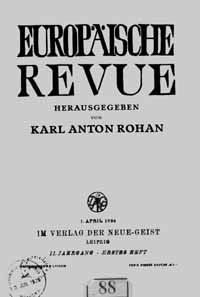
EurRev370.jpg


Archives de SYNERGIES EUROPEENNES - 1991

Robert STEUCKERS:

Les contributions à Il Regime Fascista du Prince Karl Anton Rohan (1898-1975)


Le Prince Karl Anton Rohan, issu d'une très ancienne famille bretonne, émigrée à Vienne et devenue autrichienne, fonde en 1924 le Verband für kulturelle Zusammenarbeit  (= Association pour la Coopération Culturelle) et édite à Berlin, de 1925 à 1936, la célèbre Europäische Revue,  qui donne aux cercles conservateurs et conservateurs-révolutionnaires (dans l'optique jungkonservativ)  une dimension européenne, supra-nationale, impériale (dans le sens de Reich).  Huppés et mondains, les cercles regroupés autour de l'Europäische Revue  influençaient les milieux diplomatiques. Après que le Prince Rohan ait passé le flambeau de rédacteur-en-chef au Dr. Joachim Moras, l'importance du Conseiller d'Etat prussien, le Prof. Dr. Baron Axel von Freytagh-Loringhoven, n'a cessé de croître dans la revue.

Le Prince Rohan, dans son ouvrage Schicksalstunde Europas. Erkenntnisse und Bekenntnisse, Wirklichkeiten und Möglichkeiten  (Leykam-Verlag, Graz, 1937), a esquissé un bilan de l'histoire spirituelle et événémentielle de l'Europe, en abordant le problème central de la personnalité dans l'éthique qu'il qualifiait de «spécifiquement européenne», en amorçant une réflexion sur le matérialisme et le rationalisme, erreurs philosophiques et politiques du monde moderne, et en annonçant le retour à l'avant-plan d'idées et d'idéaux non révolutionnaires, voire contre-révolutionnaires, pour lesquels, croyait-il, le fascisme et le national-socialisme préparaient le terrain, parce qu'ils étaient des réactions radicalement anti-bourgeoises. Les aristocrates qui ont encore en eux les vieux réflexes constructeurs du politique reviendront tout naturellement au pouvoir; mais ceux qui sont épuisés dans leur vitalité et leur créativité devront se ressourcer dans le grand nombre: «les vieilles figures sont fissurées; elles devraient se replonger dans le nombre, de façon à ce que, au départ de cette immersion dans le nombre, de nouvelles figures puissent croître et remonter à la surface»  (p.383).

«Tout comme la caste supérieure déterminée par le sang et constituée par l'aristocratie n'a pas pu inclure dans les structures du pouvoir de l'ancien régime les forces montantes de la révolution bourgeoise, les autorités éphémères du monde bourgeois du XIXième siècle ont échoué dans leur tentative de capter et de diriger sur des voies d'ordre la "révolte des masses", la révolution de l'anti-bourgeois. Dans le vaste processus historique qu'est la révolution sociale, les anciennes autorités ont été broyées, étrillées, et aucune autorité nouvelle n'est encore apparue. Pour être plus précis: les signes avant-coureurs d'une nouvelle et véritable autorité ne sont présents sur la scène que depuis peu de temps; cette autorité nouvelle doit mûrir et s'affirmer. Ceux qui constituaient l'élite sont désormais fatigués. La vision du monde de nos relativistes d'esprit et de morale n'était vraiment pas appropriée pour servir de plate-forme à une domination sur les masses, au sein desquels même les plus arriérés savent désormais lire et écrire. Et les pédérastes et demi-puceaux  émanant de la "jeunesse dorée" des classes supérieures urbanisées ne pouvaient évidemment pas apparaître aux yeux de l'ouvrier comme l'élite de ses vœux, à laquelle il devrait se soumettre. Les classes supérieures et la masse se comportent dans l'histoire comme le conscient et l'inconscient dans l'homme. La santé, au sens social comme au sens psychologique, est cet état de choses, dans lequel le dessous et le dessus entretiennent un rapport d'échange constant et fructueux, où le dessus est reconnu par le dessous, où le dessous donne au dessus la direction (vox populi, vox dei), où le dessus comprend le dessous et où la répartition naturelle des rôles de l'un et de l'autre se maintient en harmonie. Ce qui signifie que le haut, et seul le haut, doit agir, toutefois en acceptant une responsabilité pour le tout; et ces strates supérieures doivent agir en concordance avec les aspirations de la masse et avec ses exigences qui sont évidemment générales et confuses. Si la masse veut agir immédiatement (sans intermédiaire), en révolte contre le haut, alors il arrive ce qui arrive à l'individu qui agit au moment où son subconscient oblitère sa conscience: il y a des pots cassés et notre homme obtient presque toujours le contraire de ce qu'il avait désiré. Car, de toute éternité, le rôle des classes supérieures, de la direction, ou, au niveau de l'individu, de la conscience, c'est d'adapter et de canaliser dans le réel les sombres émotions et pulsions de la masse ou de l'inconscient. Sans ce rôle de régulateur et de transformateur, surviennent immanquablement des catastrophes. Si cet équilibre normal et sain, cette oscillation entre le haut et le bas, sont interrompus, la conscience poursuit sa vie sans lien avec son socle fait d'inconscient, si elle plane dans les airs, alors nous voyons apparaître les premières manifestations de fatigue. Sont alors nécessaires le repos, la détente, la récréation, la distraction. Toute révolution n'est jamais autre chose, ne peut jamais être autre chose, que l'expulsion d'une élite dominante par une élite dominée qui aspire à exercer le pouvoir; or tout processus révolutionnaire commence au sein des élites. On y est fatigué, on ne croit plus à ses propres forces. On trouve que ceux d'en bas, que les adversaires, ont en fait raison dans ce qu'ils disent et revendiquent. On décide de ne pas résister et on est balayé. C'est ainsi qu'en 1918 les monarchies ont été abandonnées par les détenteurs du pouvoir, avant même qu'elles n'aient été réellement attaquées. Si l'élite fatiguée ne veut pas prendre connaissance de ses symptomes, elle vivra de sa propre substance; alors la masse inconsciente, qui a perdu toute relation normale avec l'élite, se fera plus critique et plus turbulente. On verra alors apparaître de véritables troubles qui iront en crescendo, jusqu'aux crises névrotiques, jusqu'aux dépressions nerveuses. Si l'élite, qui a perdu toute véritable autorité et donc toute légitimité, refuse de se retirer du pouvoir, elle s'en tiendra au droit positif contre le droit naturel et refusera de faire passer les réformes nécessaires; alors la révolution dégénère en guerre civile»  (pp. 381-383) . «La première démarche à accomplir, pour forger de nouvelles figures, une nouvelle élite qui entretient un contact sain avec la base, c'est de vivifier les hiérarchies que la révolution et la contre-révolution ont constituées. Il s'agit ici de construire une communauté de volonté. Discipline sévère, inclusion dans un ordre, mais aussi travail sans relâche aux postes qui ont été assignés, exécution précise des ordres reçus, voilà les premisses. Mais pour monter plus haut dans la nouvelle hiérarchie, il faut adhérer à un mythe politique, il faut être intérieurement emporté par l'esprit d'une Weltanschauung. Derrière les slogans que sont la "révolution mondiale", l'Italianità et la Romanità, le Volkstum et la race nordique, se profile toute une construction doctrinale avec ses fondements d'ordre historique, sociologique, économique, scientifique et aussi moral: il faut les accepter sans conditions car ils sont les présupposés qui fondent la confiance au sein de la communauté de volonté, qui sont nécessaires à l'exercice des plus hautes fonctions»  (pp. 383-384). A la lecture de ces extraits, on s'aperçoit que l'intérêt d'Evola pour Rohan (et vice-versa: Rohan cite Révolte contre le monde moderne  en page 25 de Schicksalsstunde Europas,  op. cit.) vient d'une volonté partagée entre les deux hommes de dépasser définitivement les limites étroites du bourgeoisisme, de reforger dans la «mobilisation totale» une nouvelle aristocratie européenne supra-nationale. Pour Rohan, le fascisme italien et le national-socialisme allemand sont des effervescences provisoires, brutales et violentes, qui s'avèrent nécessaires pendant le laps de temps où il n'y a plus de véritable autorité. Dès que la «domination des meilleurs» sera installée, «la crispation se détendra, la militarisation actuelle des peuples se relâchera. Car la violence ne doit s'exercer que là où manque une autorité véritable. Un pouvoir réel devra nécessairement octroyer davantage de liberté, sans pour autant craindre l'effondrement des peuples et des Etats ni une diminution de leur puissance de frappe en cas de guerre ou en temps de paix»  (p. 386). «Le nouveau type dominant, anti-bourgeois, a fait appel aux masses, il les a politisées, il les a fusionnées en unités disciplinées sous le signe de mythes nouveaux»  (p. 387).

Dans Il Regime fascista, Rohan aborde la problèmatique de l'«autre Europe», qui est, écrit-il, «notre Europe», c'est-à-dire celle de la nouvelle phalange anti-bourgeoise, regroupant des ressortissants des anciennes aristocraties (comme, par exemple, Evola et lui-même) et les élites nouvelles, fascistes ou nationales-socialistes, qui ont réussi la «mobilisation totale» des énergies populaires. Dans l'article intitulé «L'altra Europa, la "nostra" Europa» (16 février 1934), Rohan oppose sa conception de l'Europe à celle d'un autre aristocrate autrichien, le Comte Richard Nikolaus Coudenhove-Kalergi, auteur, en 1924, d'un projet de «Paneurope», regroupant tous les Etats du continent à l'exclusion de l'Angleterre et de la Russie. Cette Paneurope, qui a enthousiasmé Briand et Stresemann, devait s'inscrire dans la tradition libérale-démocratique et en étendre les principes à l'ensemble du continent. Rohan et Evola sont «paneuropéens», mais à l'enseigne de valeurs diamétralement opposées au libéralisme et au démocratisme, nés dans le sillage de 1789 ou imités des modes anglo-saxonnes.