US Strategy in Eurasia and Drug Production in Afghanistan
Tiberio Graziani
Eurasia. Rivista di Studi Geopolitici
(Eurasia. Journal of Geopolitical Studies - Italy)
www.eurasia-rivista.org - direzione@eurasia-rivista.org
 A geopolitical approach aimed at understanding the relationship between the worldwide US strategy and the presence of North American forces in Afghanistan is given. The US penetration in the Eurasian landmass is stressed particularly with regard to the Central Asian area, considered as the underbelly of Eurasia in the context of the US geopolitics. In order to determine the real players in the Afghan theatre, a critics is moved to some general concepts used in geopolitical and international relations studies. The main characteristics of potential candidates able to overcome the Afghan drug question are discussed. Among these a particular role is due to Iran, Russia ad China. Anyway, due to the interrelations between the US strategy in Eurasia and the stabilization of Afghanistan, this latter can be fully accomplished only in view of the Eurasian integration process.
Key words: Afghanistan, geopolitical, Eurasian, Eurasia, drug
presentation
In order to address properly, without any ideological prejudice, but with intellectual honesty, the question about the drug production in Afghanistan and the related international problems, it is necessary and useful to define (even if schematically) the geopolitical framework and to further clarify some concepts, usually assumed as well known and commonly shared.
the geopolitical framework
Considering the main global actors nowadays, namely US, Russia, China and India, their geographic position in the two distinct areas of America and Eurasia, and, above all, their relations in terms of power and world geo-strategy, Afghanistan constitutes, together with Caucasus and the Central Asian Republics, a large area (fig. 1), whose destabilization offers an advantage to US, i.e. to the geopolitical player exterior to the Eurasian context. In particular, the destabilization of this large zone assures the US at least three geopolitical and geo-strategic opportunities: a) its progressive penetration in the Eurasian landmass; b) the containment of Russia; c) the creation of a vulnus in Eurasian landmass.
US penetration in Eurasia – US encirclement of Eurasia
As stated by Henry Kissinger, the bi-oceanic nation of US is an island outside of Eurasian Continent. From the geopolitical point of view, this particular position has determined the main vectors of the expansion of US over the Planet. The first was the control of the entire Western hemisphere (North and South America), the second one has been the race for the hegemony on the Euroafroasian landmass, that is to say the Eastern hemisphere.
Regarding the penetrating process of US in the Eurasian landmass, starting from the European peninsula, it is worthy to remind that it began , in the course of the I WW with the interference of Washington in the internal quarrels among the European Nations and Empires. The penetration continued during the II WW. In April 1945, the supposed “Liberators” occupied the Western side of Europe up to East Berlin. Starting from this date, Washington and the Pentagon have considered Europe, i.e. the Western side of Eurasia, just as a US bridgehead dropped on the Eurasian landmass. US imposed a similar role to the other occupied nation, Japan, representing the Eastern insular arc of Eurasia. From an Eurasian point of view, the north American “pincer” was the true result of the II WW.
With the creation of some particular military “devices” like NATO (North Atlantic Treaty Organization) (1949), the security treaty among Australia, New Zealand, United States (ANZUS, 1951), the Baghdad Pact, that afterwards evolved in CENTO Pact (Central Treaty Organisation, 1959), the Manila Pact – SEATO (South East Asia Treaty Organization, 1954), the military encirclement of the whole Eurasian landmass was accomplished in less than one decade.
The third step of the US long march towards the heart of Eurasia, starting from its Western side, was carried out in 1956, during the Suez crisis, with the progressive removal of France and, under some aspects, also of Great Britain as geopolitical actors in Mediterranean sea. On the basis of the “special relationship” between Tel-Aviv and Washington, US became an important player of the Near Eastern area in a time lapse shorter than 10 years. Following the new role assumed in the Near and Middle East, US was able either to consolidate its hegemonic leadership within the Western system or to consider the Mediterranean sea as the initial portion of the long path that, eventually, could permit to the US troops to reach the Central Asian region. The infiltration of US in the large Eurasian area proceeded also in other geopolitical sectors, particularly in the South-Eastern one (Korea, 1950-1953; Vietnam, 1960-1975).
Coherently with the strategy aimed at dominating the eastern hemisphere, Washington worked also on the diplomatic side, focusing its attention towards Beijing. With the creation of the axis Washington – Beijing, conceived by the tandem Kissinger - Nixon (1971-1972), US contributed to increase the fracture inside the so-called socialist field, constituted by China and URSS and, thus, to block any potential “welding” between the two “lungs” of Eurasia, China and Russia.
During the seventies, two main geopolitical axis faced each other within the Eurasian landmass: the Washington-Islamabad-Beijing axis and the Moscow-New Delhi one.
1979, the destabilization’s year and its legacy in the today’s Afghanistan
Among the many events in international relations occurred in 1979, two are of pivotal importance for their contribution to the upsetting of the geopolitical asset, based at the time on the equilibrium between the United States and the URSS.
We are speaking of the Islamic revolution in Iran and of the Russian military involvement in Afghanistan.
Following the takeover of Iran by the Ayatollah Khomeyni, one of the essential pillars of the western geopolitical architecture, with the US as a leader, was destroyed.
The Pahlavi monarchy could easily be used as a pawn in the fight between the US and the URSS, and when it disappeared both Washington and the Pentagon were forced to conceive a new role for the US in the world politics. A new Iran, now autonomous and out of control, introduced a variation in the regional geopolitical chessboard, possibly able to induce a profound crisis within the “steady” bipolar system. Moreover, the new Iran, established as a regional power against the US and Israel, possessed such characteristics (especially the geographic extent and centrality, and the political-religious homogeneity) as to compete for the hegemony on at least part of the Middle-East, in open contrast to similar interests of Ankara and Tel-Aviv, faithful allies of Washington, Islamabad, Baghdad and Riyadh. For such reasons, the Washington strategists, in agreement with their bicentennial “geopolitics of chaos”, persuaded the Iraq under Saddam Hussein to start a war against Iran. The destabilization of the whole area allowed Washington and the Western Countries enough time to plan a long-lasting strategy and in the meantime to wear down the soviet bear.
In an interview released to the French weekly newspaper Le Nouvel Observateur (January 15-21, 1998, p. 76), Zbigniew Brzezinski, President Jimmy Carter's national security adviser, revealed that CIA secretly operated in Afghanistan to undermine the power of the regime in Kabul since July, 1979, that is to say, five months before the Soviet invasion. Indeed, it was July 3, 1979, that President Carter signed the first directive for secret aid to the opponents of the pro-Soviet regime in Kabul. And that very day the US strategist of Polish origin wrote a note to President Carter in which he explained that this aid was going to induce a Soviet military intervention. And this was precisely what happened on the following December. In the same interview, Brzezinski remembers that, when the Soviets invaded Afghanistan, he wrote another note to President Carter in which he expressed his opinion that at that point the USA had the opportunity of giving to the USSR its Vietnam War.
In Brezinski’s opinion, this intervention was unsustainable for Moscow and in time would have led to the Soviet Empire collapse. In fact, the long war of the Soviets in support of the communist regime in Kabul further contributed to weaken the Soviet Union, already engaged in a severe internal crisis, concerning both political- bureaucratic and socio-economic aspects. As we now well know, the Soviet withdrawal from the afghan theatre left behind an exhausted country, whose politics, economy and geo-strategic asset were extremely weak. As a matter of fact, after less than 10 years from the Teheran revolution, the entire region had been completely destabilized only to the advantage of the western system. The parallel and unrestrained decline of the Soviet Union, accelerated by the afghan adventure, and, afterwards in the nineties, the dismemberment of the Yugoslavian Federation (a sort of buffer state between the western and soviet blocks) changed the balance of power to favour the US expansionism in the Eurasia region.
After the bipolar system, a new geopolitical era began, that of the “unipolar moment”, in which the USA were the “hyperpuissance” (according to the definition of the French minister Hubert Védrin).
However, the new unipolar system was going to have a short life and indeed it ended at the beginning of the XXI century, when Russia re-emerged as a strategic challenger in global affairs and, at the same time, China and India, the two Asian giants, emerged as economic and strategic powers. On the global level, we have to consider also the growing wheight of some countries of Indiolatin America, such as Brazil, Venezuela. The very important relations among these countries with China, Russia and Iran seem to assume a strategic value and prefigure a new multipolar system, whose two main pillars coul be constituted by Eurasia an Indiolatin America.
Afghanistan, due to its geographical characteristics, to its location as respect to the Soviet State (its neighbouring nations Turkmenistan, Uzbekistan and Tajikistan were, at that time, Soviet Republics), and to the wide variety of ethnic groups forming its population, different either in culture or in religion, represented for Washington an important portion of the so-called “arc of crisis”, namely that geographical region linking the southern boundaries of the USSR and the Arabian Sea. The Afghanistan trap for the URSS was therefore chosen for evident geopolitical and geo-strategic reasons.
From the geopolitical point of view, Afghanistan is clearly representative of a crisis zone, being from time immemorial the scene for the conflicts among the Great Powers.
The area is now “ruled” by the governmental entity established by US forces and named Islamic Republic of Afghanistan, but traditionally the Pashtun tribes have dominated over the other ethnic groups (Tajiks, Hazaras, Uzbeks, Turkmens, Balochs). Its history was spent as part of larger events concerning the interaction and the prolonged fighting among the three neighbouring great geopolitical entities: the Moghul Empire, the Uzbek Khanate and the Persian Empire. In the XVIII and XIX centuries, when the Country was under the rule of the Kingdom of Afghanistan, the area became strategic in the rivalry and conflict between the British Empire and the Russian Empire for supremacy in Central Asia, termed "The Great Game". The Russian land empire, in its efforts to secure access to the Indian Ocean, to India and to China, collided with the interests of the British maritime empire, that, for its part, sought to extend in the Eurasian landmass, using India as staging post, towards the East, to Burma, China, Tibet and the basin of the Yangtze river, and towards the West, to the present-day Pakistan, to Afghanistan and Iran, as far as the Caucasus, the Black Sea, to Mesopotamia and the Persian Gulf.
Towards the end of the XX century, in the framework of the bipolar system, Afghanistan became the battlefield where, once again, a maritime Power, the USA, confronted a land Power, the URSS.
The actors that confronted each other in this battlefield were basically: URSS troops, Afghan tribes and the so-called mujahideen, these latter supported by US, Pakistan and Saudi Arabia.
After the leaving of the Soviet troops from the afghan chessboard, the taliban movement assumed a growing important role in the region, on the basis of at least three main factors: a) ambiguous relations with some components of Pakistan secret services; b) ambiguous relations with US (a sort of “legacy” relied on the previous contacts between US and some components of the “mujahideen” movement, occurred during the Soviet - afghan war); c) the wahhabism as an ideological-religious platform directly useful to the interests of Saudi Arabia in its projection towards some zones as Bosnia, the Middle East area and the Caucasus (namely Chechnya and Dagestan).
The three elements mentioned above allowed the taliban movement, for one hand, to insert and root itself in the afghan zone, gaining a growing weight on the military (with the creation and consolidation of the so-called sanctuaries) and economic (namely control of the drug traffic) levels, for other hand, impeded it to become an autonomous organization. Actually, because of the infiltration of US, Pakistan and Saudi Arabia, the taliban movement has to be considered a local organization directed by external players. These kind of considerations allows us to better understand and explain the choice of Obama and Karzai to open a dialogue with the Talibans, even to include some of them in local governments. Moreover, the apparent contradiction of the US (and Karzai) behaviours in Afghanistan, that could be explained according the theory and praxis for which the involvement of the enemy in institutional responsibilities aims to weaken it, follows the classic rule of the US geopolitical praxis, that is to maintain in a state of crisis a region considered strategic.
As we well know now, the drug production in Afghanistan has gone up more or less 40 times since the country’s occupation by NATO.
If we consider the solutions adopted so far by US forces and aimed at containing and overcoming the drug trafficking question in the more general context of the US geopolitical praxis, we can observe that US forces and NATO seem “wasting” their time: drug production and diffusion in the southern part of the country are still going on. As we well know, the large-scale drug production is impossible in this area, because of the non-stop fighting. On the contrary, US and NATO forces focus their strategic interest in the northern side of the country. Here, they have built roads and bridges linking Afghanistan to Tajikistan), the road to Russia via Uzbekistan, Kyrgyzstan and Azerbaijan (see A. Barentsev, Afghan Heroine flow channelled to Russia, FONDSK). This modus operandi reveals openly the real intentions of Pentagon and Washington: opening a road towards Russia, starting from Afghanistan and the Central Asian republics. Actually NATO and other western forces do not conduct an effective fight against drug production and trafficking.
In such context, the supposed US/NATO fight against drug production and trafficking in Afghanistan seem to belong to the field of the western rhetoric more than to be a concrete fact (Fig. 2).
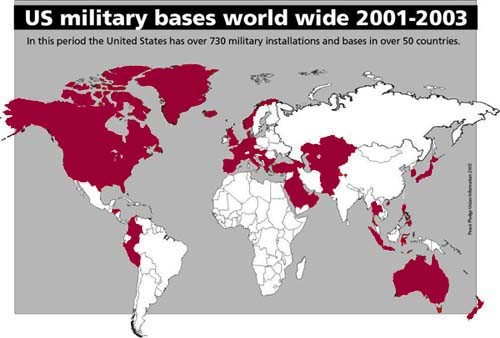
Similarly, the fight against taliban movement seem clearly subordinated to (and thus depending on) the general US strategy in the Eurasian landmass. Nowadays, this strategy consists in the setting up of military garrisons of US and its Western allies in the long strip that, starting from Morocco, crosses the Mediterranean sea and arrives as far as the Central Asian republics. The main aims of this garrisons are: a) the separation of Europe from North Africa; b) the control of north Africa and Near East (particularly the zone constituted by Turkey, Syria and Iran – using the Camp Bondsteel base, located in Kosovo ); b) the containment of Russia, and, under some aspects, of China too; c) an attempt of cutting the Eurasian landmass in two parts; d) the enlargement of the “arc of crisis” in the Central Asian area [Brzezinski defines this area the “Balkans of Eurasia” (the definition of the former advisor of president Carter sounds more as programmatic than as an objective description of the area)].
Creating a geopolitical chasm in Central Asia, i.d. a vulnus in Eurasia landmass, could lead to hostility and enmity among the main players in Asia, Russia, India and China (fig. 3). The only beneficiary of this game would be the US.
Other than the attempt “to knife” Eurasia along the illustrated path (from Mediterranean sea up to the Central Asia), we observe that US disposes (since 2008) of AFRICOM and, of course, of the related cooperative security locations in Africa: a useful “ military “device” which projection is also directed to Middle East and part of Central Asia (fig. 4).
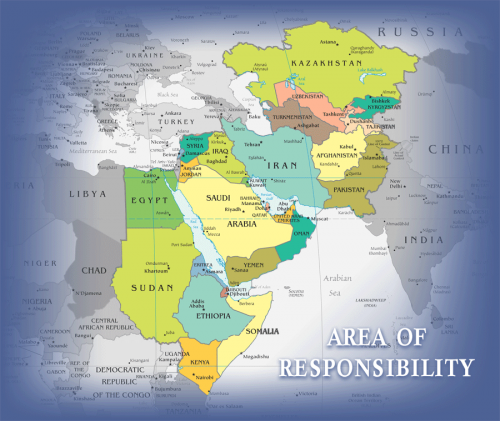
In order to understand the importance of the Central Asian zone for the US strategy aimed at its hegemony on the Eurasian landmass, it is enough to give a glance at the following picture (fig. 5) illustrating the US Commanders’ areas of responsibilities. The picture is representative of what we can name – paraphrasing the expression “the white man’s burden” formulated by the bard of the British imperialism, Rudyard Kipling, 1899 – the US’ burden.
general remarks on “accepted and shared” concepts
With the goal to reach a larger understanding of the complex dynamics acting presently at global level, it is useful criticizing some general concepts we consider accepted and shared. As we know, in the frame of the geopolitical analyses, the correct use of terms and concepts is at least as important as, those ones related to the description of the reality through maps and diagrams. For instance, the so-called “globalization” is only an euphemistic expression for economic expansionism of the US and the its capitalistic western allies (see Jacques Sapir, Le nouveau XXI siécle, Paris, 2008, p. 63-64). Even the rhetoric call to fight for the supposed “human rights”, or similar democratic values, spread by some think thanks, governments or simple civil activists, emphasizes the colonialist aspect of the US on the mass media and culture, without any consideration to other ways of life, like those expressed by no-western civilisations, i.e. more than three quarts of the world population. Among these concepts, we have to consider the most important one from the geopolitical (and international relations) point of view, that is the supposed International Community. The expression “International Community” does not mean anything in geopolitical terms. Actually, the International Community is not a real entity; its related concept sounds, simultaneously, like an aspiration of some utopian activists and a specific falsification of the history.
As in the worldwide real life we know State, Nations, People, International organisations [generally on the basis of (hegemonic) “alliances”] and, of course the relations among these entities, speaking of International Community means to mis-describe the real powers nowadays acting at global and local scales.
Considering now the focus of the present meeting, aimed at finding “shared solutions” for the afghan drug question in the context of the “International Community” (I.C.), honestly we have to underline, as analysts, that instead of I.C. it is more practical speaking of real players involved (and that could be involved) in the Afghan zone.
the real players in the afghan theatre
For analytical reasons is useful to aggregate the players concerning the Afghan theatre in the following three categories: external players; local players; players who potentially could be involved in the afghan context. Afterwards we can easily define some conditions in order to delineate the characters of those partners who could be able to stabilize - effectively - the entire geopolitical area.
External players: US and NATO-ISAF (except Turkey) forces are to be considered external players because of their full strangeness to the specific geopolitical area, even if conceived in a broad sense;
Local players: among the local players we can enumerate the bordering countries (Iran, Turkmenistan, Uzbekistan, Tajikistan, China, Pakistan), the tribes, the insurgent forces, the Talibans and the “governmental” entity led by Karzai.
Regarding the players belonging to the third category as defined above, we can include the Collective Security Treaty Organisation (CSTO), the Shanghai Cooperation Organisation (SCO), i.e. the main Eurasian organisations with a large experience in managing questions related to the border control and drug trafficking of Central Asian area, and the Eurasian Economic Community (EURASEC). Moreover we have to mention also ONU, in particularly the United Nations Office on Drugs and Crime (UNODOC).
The potential partners able to overcome the drug question in Afghanistan have to present at least the following characteristics: a) the knowledge of the local dynamics related to the ethnic, cultural, religious an economic aspects; b) the acknowledgement by the local population as part of the same cultural context (obviously in a large meaning); c) the will to coordinate collectively the actions without any prejudice or mental reserve within a Eurasian program.
The partners presenting the features synthetically described above are those included in the second and third categories. As matter of fact US and NATO – ISAF forces are perceived from the local population as what they really are: occupying forces. Moreover, considering the NATO role as hegemonic alliance led by Washington and acting within the framework of the US global strategy, its presence in Afghanistan should be considered a serious obstacle to the stabilization of the entire area. The Talibans and even the governmental entity, do not appear, due to the ambiguous relations that they seem to have with the occupying US forces, to be candidate partners in a collaborative effort to triumph over the drug question in Afghanistan.
The real players able to stabilize the area are - without any doubt - the Afghanistan bordering countries and the Eurasian organizations. Among the bordering countries, a special role could be carried on by Iran. Teheran is the only country that has demonstrated to assure the security of Afghan-Iranian border, specially for drug trafficking. Also Moscow and Beijing assume an important function in the stabilization of the area and in the fight to drug trafficking, because Russia and China, it is worth to remind it, are the main powers of the Eurasian organizations above mentioned. A strategic axis between the two “lungs” of Eurasia, balanced by the Central Asian republics and India, could constitute the lasting solution for the stabilization of the area and hence the drug question. Only in the frame of a shared Eurasian plan aimed at stabilizing the area – conceived and carried on by Eurasian players –, it is possible to dialogue with local tribes and with those insurgent movements which are clearly not directed by external players.
conclusions
The stabilization of the afghan area is an essential requirement for any plan aimed to face the drug production and trafficking.
However, because of the pivotal role of Afghanistan in the Middle East and in the Central Asian regions, the strategy to stabilize the area has to be conceived in the context of the integration of the Eurasian landmass. Candidates particularly interested to halt the drug production and traffic are the Afghanistan bordering Countries.
US and NATO forces, because of their clear geopolitical praxis aimed at hegemonizing the Eurasian landmass, are not plausible candidate.




 del.icio.us
 Digg
Digg Facebook

 La "Mère Volga" se meurt...