

dimanche, 08 mars 2009
Dans les coulisses de la crise, la nouvelle guerre du pétrole
Dans les coulisses de la Crise, la nouvelle guerre du pétrole

Par Maxime Lion
Altermedia France
L’organisation des Pays exportateurs de Pétrole (Opep) pourrait procéder à une nouvelle baisse de sa production, en mars, lors de sa prochaine réunion à Vienne. C’est en tout cas ce qu’a affirmé samedi à Alger le ministre algérien de l’Énergie et des mines Chakib Khelil. Raisons invoquées : le possible maintien à la baisse des cours du brut. Ceci alors même que l’Agence internationale de l’Énergie abaissait vendredi ses prévisions de demande mondiale pétrolière, tablant désormais sur une contraction en 2009 comme en 2008. L’occasion de faire le point sur un marché fondamental de l’économie moderne où le politique n’est jamais loin.
Une véritable guerre « discrète » fait aujourd’hui rage sur le marché du Pétrole. Du côté des offreurs, l’Organisation des Pays Producteurs de Pétrole, qui représente 40 % de la production mondiale et qui bénéficie du soutien de la Russie, se veut le syndicats de défense des pays producteur : il rêve d’un baril de pétrole à 60 $ afin de rentabiliser l’ensemble des exploitations des ses membres, et d’assurer de confortables profits pour les plus compétitifs d’entre eux, comme l’Arabie Saoudite. La demande, quant à elle, s’organise pour l’essentiel autour des pôles occidentaux et asiatiques. Cependant, les États-Unis, premier consommateur au monde d’hydrocarbure et inventeurs de toute la filière économique du pétrole, donne le la : le prix du pétrole est actuellement gouverné par le niveau des stocks américains de pétrole. Depuis l’été dernier, il oriente les courts toujours dans le même sens, la baisse.
Si la baisse des courts s’explique avant tout par une cause objective - la chute de la demande de pétrole attestée par la litanie des rapports mensuels de l’Agence Internationale de l’Énergie annonçant une régression de la consommation de brut de 0,6 % en 2009 - elle devrait être compensée en grande partie par le diminution de la production de l’OPEP, suivie par celle opérée par la Russie. L’objectif est de relancer le baril à la hausse pour atteindre un objectif de court terme de 45 $ la baril. Or, peine perdue : alors que les consignes ont été relativement suivies par les pays membres de l’organisation, la production se maintient, voire augmente légèrement. Qui sont les coupables, augmentant leur production contre toute logique économique ? La réponse : des pays à la fois producteur et consommateur qui ont plus à perdre dans les surcoûts d’un pétrole en hausse que dans les pertes de leur propre puits… et en tout premier lieu les États-Unis, suivis de la Chine et du Brésil.
La baisse des courts du pétrole semble ainsi être devenu un objectif majeur de la politique américaine. Certains y ont vu un motif essentiel de la volonté de l’oncle Sam de freiner les ardeurs israéliennes quant à une campagne de raids aériens sur l’Iran, craignant les conséquences d’un conflit prolongé au Moyen Orient sur les courts de l’or noir. Qu’est-ce qui pousse les Américains à maintenir à grand frais les courts du pétrole à des courts les plus bas possibles, quitte à hypothéquer l’avenir de leur propre industrie pétrolière ?
La réponse est simple : le choix de la surchauffe de la planche à billet comme moyen de venir à bout de la crise, voire de la dépression économique. Le nouveau président O’Bama a promis d’injecter 850 milliards de dollars dans l’économie américaine sous forme d’infrastructures et de réduction d’impôts. D’où vient l’argent ? De bons du trésor dont la valeur repose dans la crédulité des étrangers dans la puissance de l’Oncle Sam. Si ces derniers ne suffisent pas, la planche à billet fera le reste. Or ce schéma ne fonctionne que tant que la confiance en la monnaie est maintenue par une inflation quasi nulle, garantissant, du moins à court terme, son pouvoir d’achat. Or le facteur principal de la chute de l’inflation aux Etats-unis, au point qu’elle devienne une véritable déflation, est justement la chute des courts des hydrocarbures. Une forte augmentation des courts de pétrole, ou choc exogène, suite à une crise géopolitique, aurait pour conséquence de relancer dramatiquement l’inflation et ainsi de transformer les injections massives de liquidités dans l’économie en empoisonnement du système financier mondial. A la crise - se matérialisant par la chute des valeurs des actifs, actions et immobiliers, c’est-à-dire une destruction de richesse - s’ajouterait l’effondrement du dollar, ce qui finirait de laminer le revenu des actifs… Il s’agit du pire scénario des économistes, l’hyper-inflation, qui se caractérise par une défiance générale pour la monnaie papier dite fiduciaire. Cette dernière revient à sa valeur intrinsèque, c’est-à-dire quasi-nulle, celle d’un petit papier imprimé en quadrichromie… Ceci signifierait l’arrêt de mort du dollar, et donc la fin de l’empire américain car il n’y a pas d’Empire sans impôt impérial.
Les liens entre le Politique et l’Économique ne sont jamais aussi forts qu’en tant que crise, et l’Histoire n’est jamais loin. Si la crise a aujourd’hui surtout le goût amer des licenciements et du marasme, marquant la fin d’un modèle économique, elle est aussi l’annonce de changements profonds, du mutations insoupçonnées. A nous de les décryptées afin de fêter la fin de ce « monde vétuste et sans joie… »
Article printed from AMI France: http://fr.altermedia.info
URL to article: http://fr.altermedia.info/general/dans-les-coulisses-de-la-crise-la-nouvelle-guerre-du-petrole_19607.html
00:36 Publié dans Actualité | Lien permanent | Commentaires (0) | Tags : pétrole, énergie, hydrocarbures, crise, finances, économie, géopolitiquen, géoéconomie |  |
|  del.icio.us |
  |
|  Digg |
  Facebook
Un Gran Hermano en el ciberespacio


El que tiene la información tiene el poder y desde esa posición asimétrica ideará diversos mecanismos y utilizará diferentes herramientas para continuar ejerciéndolo. Es en ese afán por mantenerse en el poder, donde aquel que lo concentra logra crear sus propios medios de comunicación y utilizarlos como instrumentos para sus fines. Y es en ese afán donde la censura, la omisión, la tergiversación, la supremacía de una fuente sobre otra, prevalecen en la información que circula. (Ver: “Reflexiones sobre Internet. La pecera ciberespacial”. APM 13/6/2007)
Desde el procedimiento óptico de Jeremías Bentham, considerado en el siglo XVIII como la gran innovación para ejercer bien y fácilmente el poder, pasando por la propaganda de Joseph Goebbels (el jefe de la propenda nazi), los recortes de cinta de video tapes y las prohibiciones de publicar o decir, el poderío económico y político centrado sobretodo en multinacionales, instaura de forma continua procedimientos de poder, innovadores, diversos, eficaces para socavar los principios de expresión, libertad y democracia.
Adaptado a las nuevas tecnologías, el control de la información logró infiltrarse en el ciberespacio. Días atrás se conoció la noticia de que la conocida red social Facebook, con millones de usuarios en el mundo, cambiaba las políticas de uso y se adjudicaba de forma perpetua los derechos comerciales del material que sus usuarios subían y compartían en la red.
La noticia causó críticas y revuelos dentro y fuera de la “República de Facebook” que obligaron a Mark Zuckerberg, joven dueño de la red, a retornar a las condiciones previas de uso mientras “se resuelven los temas que la gente ha propuesto”, escribía el muchacho en su blog.
Facebook es un sitio web de redes sociales creado por Zuckerberg en 2004 como plataforma para conectar a estudiantes de la Universidad de Harvard, donde el muchacho estudiaba. Pero la idea de Zuckerberg pronto se convirtió en un boom, extendiéndose a otras universidades estadounidenses hasta que, en 2006, se abrió al público. En apenas un año, el invento del estudiante de Harvard se convirtió en uno de los sitios con mayores visitas de la web. En noviembre de 2008, la propia web de estadísticas de Facebook, contó más de 175 millones de usuarios activos en todo el mundo.
Facebook no para de crecer. Hace dos semanas, la empresa de medición en Internet Compete.com la catalogó como el sitio web de redes sociales más popular del mundo, con casi 1.200 millones de visitas en enero.
Compete.com publicó los conteos que muestran cómo Facebook se ubica en primer lugar, seguido por MySpace y por el servicio de micro-blogging Twitter que pasó del lugar 22 al tercero. MySpace recibió en enero 810 millones de visitas mientras que Twitter fue visitado 54.2 millones veces, de acuerdo a datos ofrecidos por la compañía.
Desde Facebook explican que uno de los motivos de la crecida de usuarios es que desde el año pasado se lanzó su versión en francés, alemán y español para impulsar su expansión fuera de Estados Unidos.
En tanto, a comienzos de este año, Zuckerberg vendió a Microsoft el 1,6 por ciento de su empresa. El motivo de la venta: Bill Gates, el dueño de la multinacional de informática, vio oro en polvo en la cantidad de datos que se publican sobre gustos y preferencias. Un mega negocio para una publicidad personalizada y on line que le pretende sacar plazas a Google.
La red brinda posibilidades de que todo se sepa, desde el lugar de trabajo, situación sentimental, educación, gustos musicales y hasta simpatías políticas. En el “boletín”, se pueden hallar grupos de apoyo o repudio a los presidentes de Bolivia y Venezuela, Evo Morales y Hugo Chávez. Espacios de amor y odio a la presidenta argentina Cristina Fernández, para las Fuerzas Armadas Revolucionarias de Colombia (FARC) o para el ex mandatario estadounidense George Bush. Incluso los genocidas latinoamericanos Jorge Rafael Videla, Augusto Pinochet y Anastacio Somoza, gozan de partidarios.
Miles de historias se conocen en Facebook, ya que lo privado pasa a ser público y la red social ejerce control sobre todo lo publicado en la plataforma. Este último enunciado fue el detonante de miles de críticas contra Mark Zuckerberg.
Es que el pasado 4 de febrero, el joven empresario introdujo sin aviso perceptible una serie de arreglos al pocas veces leído terms of service que establece las condiciones de uso. Allí, Zuckerberg fijaba que se le otorgaba a Facebook “el derecho irrevocable, perpetuo, no exclusivo, transferible y mundial de utilizar, copiar, publicar, difundir, almacenar, ejecutar, transmitir, scanear, modificar, editar, traducir, adaptar, redistribuir cualquier contenido depositado en el portal".
Si bien esa cláusula preexistió siempre en la plataforma, Zuckerberg eliminaba un principio de privacidad, aquel que aseguraba que el contenido de un espacio podía ser borrado del portal en cualquier momento. “Si usted lo borra, el derecho acordado a Facebook evocado antes vencerá automáticamente, aunque la empresa puede conservar copias archivadas", fijaba la plataforma.
La desaparición de esas oraciones en las condiciones de uso significaba que se le cedía (incluso post mortem) a Facebook la propiedad comercial de todo aquello que se subía a la plataforma. Incluso si entre los miembros de la red, se encontraban artistas, hubiesen estado condenados también a conceder el derecho de sus creaciones a Zuckerberg.
Si bien el joven millonario debió abandonar esas pretensiones de control de la información, lo hizo de forma momentánea hasta tanto se decida lo mejor para todos en Facebook. El intento de cambio en las políticas de uso convertía en legal lo ilegal: almacenar los datos de los usuarios. Al momento que alguien da de baja su perfil, la empresa no borra la información, porque si el usuario decide nuevamente dar de alta su cuenta, de inmediato sus datos aparecen en la red. Entonces, con esos cambios los datos hubieran pasado legalmente a ser parte de Facebook.
No es la primera vez que aparecen roces en Facebook por el control de la información. En 2007, el proyecto Beacon que pasaba información sobre la actividad de usuarios a compañías de publicidad debió ser abortado luego de las críticas de los integrantes de la red.
Ese manejo en la información privada de los usuarios induce a representar a la red social como el Gran Hermano omnisciente y virtual que todo lo ve y todo lo sabe. Si bien los datos aislados de cada persona que sube su perfil a Facebook no tienen valor, sí lo tiene la información de millones de usuarios, sobre todo en términos financieros y políticos.
Es por ello que la mayor preocupación radica en reflexionar cómo una vez más desde los centros de poder se busca el dominio y el control de la información desde una arista de las nuevas tecnologías, como lo constituyen las redes sociales. Evitar la desinformación para el caso de las redes sociales e impedir el control de cada espacio gratuito y democrático para Internet, es un desafío para aquellos que buscan hacerle frente a esa parte hegemónica y poderosa que intenta liderar y concentrar el mundo.
vromero@prensamercosur.com.ar
http://www.prensamercosur.com.ar/apm/nota_completa.php?idnota=4214
00:20 Publié dans Manipulations médiatiques | Lien permanent | Commentaires (0) | Tags : medias, manipulation, espionnage, totalitarisme | | del.icio.us | | Digg | Facebook
Lezing Verdinaso / Louis Gueuning
Lezing Verdinaso

Op donderdag 19-02 werden we vereerd met het bezoek van Vbr. OS Filip de Cauwer, de pro-senior van KVHV-Leuven, die kwam spreken over de naoorlogse ontwikkeling van het Verdinaso en de drijvende kracht achter deze ontwikkeling, L. Gueuning.
Gueuning kan beschouwd worden als de figuur die na de Tweede Wereldoorlog de ideologie van Joris Van Severen en het Verdinaso heeft geconsolideerd, zonder zelf evenwel onverdienstelijk te blijven door actieve bijdrage aan de uitbouw van deze overgeërfde ideologie.
Hoewel het Verdinaso in haar beginperiode tijdens de jaren 30′ voornamelijk werd gekenmerkt door een anti-Belgische tendens en de hoop op het oprichten van een hernieuwd Diets rijk, werd er in 1934 door de kopstukken van deze beweging, J. Van Severen en W. Moens, een diepgaande herdefiniëring van de ideologie van het Verdinaso geformuleerd, ook wel de geschiedenis ingegaan als de ‘Nieuwe Marsrichting’. Er werd een nieuw politiek objectief gesteld in het vormen van een nieuwe staat naar model en grondgebied van de laatmiddeleeuwse Bourgondische Nederlanden. Deze Nieuwe Marsrichting werd grondig uitgediept en uitgewerkt om niet enkel het oppervlakkige politieke niveau te beslaan, maar om uit te groeien tot een totaalsysteem van het menselijk handelen en denken. Door deze diepgaande evolutie komt het zwaartepunt van de Verdinaso-beweging voornamelijk na 1934 te liggen.
Gueuning kwam in 1939 in contact met Van Severen, met wie hij al gauw een hechte vriendschap en intense correspondentie onderhield. Hij werd door Van Severen aangeduid als hoofd van het Verdinaso voor de Romaanse gouwen, en richtte tijdens de oorlog, na de executie van Van Severen, de ‘Joris Van Severen-orde’ op, met als doel de nagedachtenis en het denkwerk van Van Severen te eren, te bewaren en verder uit te werken, door middel van publicaties en bijeenkomsten.
Tijdens de oorlog wenste Gueuning een onafhankelijke koers te varen, en bleef hij nadruk leggen op de zelfstandigheid van de Nederlanden. Zo bleek hij niet te winnen voor collaboratie met de Duitse bezetter in tegenstelling tot het VNV, terwijl hij evenmin samenwerking met de geallieerden op prijs stelde. Dat deze manifeste weigering partij te kiezen in het mondiale conflict niet in dank werd afgenomen, kon Gueuning aan de lijve ondervinden. Gueuning werd het slachtoffer van vervolging zowel tijdens de repressie kort na het eind van de oorlog door de geallieerden, als tijdens de oorlog zelf onder de Duitse Gestapo. Echter bleek zijn ambivalente koers zijn redding, aangezien hij beide vervolgingsprocessen zonder al te veel kleerscheuren doorkwam.
Na de oorlog stichtte Gueuning het ‘Albrecht-en-Isabella-college’, een eliteschool waarvan hij directeur werd. Hij bleef tijdens zijn leven onverminderd werken publiceren rond de nagedachtenis en ideologie van Van Severen, waaraan hij zijn originele bijdrage bracht. Tevens legde hij zich toe op politieke mobilisatie en bewustwording, zoals moge blijken uit de organisatie van de eerste ‘Staten-Generaal van Verzet tegen het Regime’ in 1952.
Na zijn dood werd de ‘Louis-Gueuning-stichting’ in het leven geroepen, met hetzelfde doel dat hijzelf met zijn eigen organisatie met Joris Van Severen voor ogen had: het bewaren en uitdragen van de nagedachtenis van een interessant denker uit de vorige eeuw.
Hieronder volgt een kort overzicht van de brandpunten waarrond Gueuning zijn denken heeft verweven met dat van zijn voorganger en zijn mentor, Joris Van Severen.
Allereerst werd het denken van Gueuning getekend door een sterke manifestatie van het begrippenpaar personalisme en roeping, dat hij heeft meegekregen van Van Severen. Personalisme houdt in dat iedere actie van de mens als individu of als deel van een groep ten dienste staat van de volledige ontplooiing van iedere mens als persoon. Vanuit deze peiler van zijn denken kan men verklaren waarom Gueuning nogal weigerachtig stond t.o.v. collaboratie met het regime van Nazi-Duitsland, dat als totalitair regime een volledig andere invalshoek had op het menselijk wezen. Het is duidelijk dat enige voorzichtigheid geboden is bij het bestempelen van Gueuning als een loutere exponent van de totalitaire Nieuwe-Ordebewegingen. Zulk een onvoorzichtige vereenzelviging kan enkel uitgelokt worden door de uiterlijke gelijkenissen tussen Verdinaso en de totalitaire bewegingen, zoals de gedeelde nadruk van beide op orde. Echter werd ook dit ‘totalitaire’ begrip door Gueuning via zijn personele invalshoek bekeken: orde zag hij als een noodzakelijk middel dat de mens zich in zelfdiscipline moest opleggen om zo tot een zo efficiënt mogelijke persoonlijke ontwikkeling te komen. Deze originele visie kan men verklaren vanuit het persoonlijke leven van Gueuning, van beroep was hij namelijk onderwijzer (cf. zijn stichting van een eigen school in 1950).
Complementair aan het personalisme was het begrip roeping. Gueuning kan beschouwd worden als een exponent van Aristoteles in die zin dat hij zowel persoonlijk als politiek handelen van de mens zag als een teleologisch proces. Ieder mens heeft een unieke roeping in zijn leven en in de maatschappij die hij zo goed mogelijk moet invullen. Zingeving aan handelen en leven van de mens vloeit voort uit het vervullen van deze roeping. Ieder individu haalt tevens zijn uniciteit uit het feit dat iedere roeping uniek is. Iedere aparte en unieke roeping wordt in vervulling gebracht op het niveau dat gevormd wordt door het samenkomen van deze vervulde roepingen, het maatschappelijk vlak.
Vanuit deze teleologische visie evolueert Gueuning de noties van orde, vrijheid en maatschappij. Een maatschappij dient op ieder niveau de roeping van ieder individu te ondersteunen, daar zij tegelijkertijd de resultante is van deze vervulde roepingen. Maatschappij kan men aldus definiëren als de voedingsbodem én het resultaat van zichzelf ontplooiende individuen. Vrijheid wordt in dit kader niet bekeken vanuit een libertijnse bril als een doel op zich, maar wederom als een middel in de ontplooiing van de mens, zoals dat met de notie orde hetzelfde geval is.
Een verregaande originaliteit blijkt uit de toepassing van het besproken begrippenpaar vanuit persoonlijk vlak op het politieke vlak. Net zoals individuen hebben staten een unieke roeping bepaald door hun eigen uniciteit. Deze gedachtengang kan de kritische houding verklaren die Gueuning aannam t.o.v. het naoorlogse Europese eenmakingsproces. Hoewel hij een fervent voorstander was van een Europese integratie op ideëele en culturele basis, keurde hij juist het actuele proces af vanuit de verkeerd motivatie ervan. Een Europese Unie als louter middel tot economische doelen had voor hem noch zin noch slaagkans.
Een Europa van de toekomst moest voor hem een eenheid in verscheidenheid worden, ‘Unitas in diversitate’, waarin iedere natie zijn eigenheid behouden zag juist door de vervulling van een specifieke roeping. Het nationalisme zou als kader voor Europese integratie de unieke aard van ieder Europees volk vrijwaren. De Bourgondische Nederlanden kende hij een bevoorrechte status toe als motor van het Europese integratieproces vanuit een analyse van de geschiedenis van de Nederlanden. Doorheen de geschiedenis van Europa hadden de Nederladen de functie vervuld van transitzone, een zone voor contact tussen en integratie van de verscheidene Europese grootmachten.
Raf Praet v. Raffen, Ab-Actis KVHV-Gent, 2008-2009
00:14 Publié dans Histoire | Lien permanent | Commentaires (0) | Tags : pays-bas, grands pays-bas, belgique, belgicana, flandre, wallonie, solidarisme, nationalisme, mouvement étudiant | | del.icio.us | | Digg | Facebook
When American Imperialism chased Spain out of Cuba
When American Imperialism chased Spain out of Cuba
by Philippe Conrad
A century ago, in 1898, the Cuban war broke out against Spain. It was an American war that was «altruistic and moral». Through this war, which called on the resources of misinformation and brainwashing, the United States began its career as a world power.
«All is quiet here; there are no problems and there’ll be no war, I want to come back»…«Stay where you are please and send us pictures, I am responsible for preparing the war…» This exchange of telegrams between Frederic Remington, the reporter-artist of the New York Journal, and his boss, William Randolph Hearst, on the eve of the Spanish-American conflict of 1898, just about sums up the situation at the moment. It shows the part that the manipulation of American public opinion played in unleashing this war. We shall have to wait until the First World War before governments, those of the Anglo-Saxon countries in the first place, have recourse on a such a grand scale to these propaganda tricks. But the stakes were considerable, for it was a question of chasing Europe – or more precisely a Spain that was only a shadow of its former self – from the American hemisphere in order to perfect the hegemony of the United States over the New World as a whole.
The right to possession of the world
America’s designs on Cuba and on the Caribbean sea simply and quite naturally completed the geopolitical grand design which was to make the new state into a continental power, opening onto the two oceans and able to impose its domination over the whole western hemisphere. These designs were clear even in the 1820s when John Quincy Adams considered that Cuba was the key to the Caribbean and that its proximity to Florida and the mouth of the Mississippi would one day make it necessary, «through the simple law of political gravitation», for America to seize it. What held Washington back at that time was fear of English reaction, for London might worry about the fate in store for Jamaica. For American officials, it was better to be patient and leave Cuba in the hands of an enfeebled Spain rather than engage in an action likely to justify British opposition. It was enough to wait for the right moment or for circumstances to appear most favourable for the realisation of what John Fiske called, in 1885, the «manifest destiny» of the United States.
In those last years of the century, projects for driving a canal through the Central American isthmus at Nicaragua or Panama gave new life to the already old desires of the Washington government. Several theorists at that time justified America’s ambitions, and in their wake their formed in Congress a whole «imperialist» clan demanding a foreign policy in keeping with the industrial dynamism which was making of the USA a world economic power. In 1885, Pastor Joshua Strong wrote Our country in which he exalted «the superiority of the Anglo-Saxon race». Five years later, John W Burgess, professor of political sciences at the University of Columbia, insisted on the rights possessed by the Anglo-Saxons to world dominion: «Their mission is to lead political civilisation in the modern world and to bring this civilisation to the barbarous races […] since it is in the interest of world civilisation that law, order and true liberty, which is its corollary, should reign throughout the world…» That same year, Admiral T Mahan published his book The influence of Sea Power upon History, which foretells an impressive rise in the strength of America’s naval power. The United States must take control of the Caribbean Sea and of the future canal that will join the Atlantic to the Pacific. They must also push their expansion into the Pacific, notably into the Hawaiian archipelago. Under the presidency of the republican Benjamin Harrison (1889-1893), the secretary of State James Blaine was preparing the way for these various projects, but the election of the democrat Stephen G Cleveland seems to have put a stop to them, at least temporarily. However, his republican opponents were not put off, and Henry Cabot Lodge, the naval commission’s spokesman at the House of representatives, made a speech in 1895, wherein he claimed Cuba and the Hawaiian islands for the United States. There thus came into being a thoroughgoing «imperialist» movement inspired by that «jingoism» which, at the same period, lay behind the politics of a Joseph Chamberlain in England.
At the heart of this movement, the young Theodore Roosevelt was already there, writing to Cabot Lodge, his mentor in politics, that «the country needs a war». The elections in 1897, which bring the republican William Mac Kinley to power, enable the young Roosevelt to become Under-Secretary of State for the Navy, in 1897. Two months later, he explained to the officer cadets at the Naval College «that the diplomat must be the servant and not the master of the soldier». In November of the same year, he wrote to a naval officer to say that he hoped for a war against Spain «to aid the Cubans in a humanitarian concern». But above all «to guarantee complete liberty for America from European domination… This war will be a great lesson, and we shall profit greatly from it». In December 1897, when commercial circles and the economic press were showing their opposition to a war for Cuba, the hot-headed under-secretary of State affirmed that «we shall have this war for the liberty of Cuba despite the timidity of commercial interests…»
Press campaigns and sending of weapons
The United States had already offered on several occasions since 1843 to buy from Spain the main island of the Caribbean, but each time the government of Madrid had amiably turned down these offers. In 1850, therefore, the American administration encouraged the installation in New York of a Cuban council favourable to the island’s independence, and from 1865 Washington supported these rebels by supplying them with arms and money. Between 1868 and 1878, the first war of independence came to nothing. The United States’ interest in the island did not wane, however, for it was they who bought nearly all the sugar exported from the island, and American capital investments in this market amounted to fifty million dollars of the island’s economy. Founded in 1892, José Martí’s Cuban revolutionary party was supported financially by Edwin F Atkins, the American sugar «king».
When a fresh insurrection broke out on the island in February 1895, the democrat president Cleveland and his Secretary of State Bryan had no wish to intervene directly. The death of Martí, killed in the fighting in May, did not put an end to the rebellion. The North American press then undertook to set public opinion against Spain. It sounded off against the death of several Cuban revolutionaries, denounced the fact that American citizens were in jail on the island, and exalted the courage of Evangelina Cisneros, the daughter of a rebel leader, whom W R Hearst had removed from Cuba so that she might be given a triumphant welcome in New York… It finally published a false letter from Dupuy de Lôme, the Spanish ambassador to Washington, in which Mac Kinley was presented as a «low level politician». During that time, from June 1895 to May 1897, forty-two naval convoys brought arms to the insurgents from the American coasts.
On the island itself, however, Spain’s new representative, General Blanco, succeeded in forming a government by uniting the reformists and autonomists, but excluding those in favour of independence who were supported by the USA. It was a few days later, following the riots in Havana, that the battleship Maine entered the port, on a «courtesy» visit.
It is now known very precisely that the decision to go to war against Spain, if she persisted in her refusal to sell Cuba, was taken in 1896. A recent military history congress, held in March 1998, has revealed the detail of the plans prepared for this eventuality. The scenario was then written down. On 25 January 1898, the battleship Maine, therefore, entered the port of Havana, followed fifteen days later by the cruiser Montgomery which had just laid anchor in the port of Matanzas. Three weeks later, on 15 February, the accidental explosion of a submarine mine sank the Maine in the port of Havana. Two hundred and sixty American sailors were killed in the explosion, which everyone now recognises as having been purely accidental, and some even think it was plainly provoked by the Americans (it is interesting to note that no officer was among the victims; they were all at a reception in the town). The official American report is no less accusatory of Spain. Madrid proposed entrusting the enquiry to a mixed commission, but Washington refused. The Spanish government then turned towards its European counterparts and solicited the arbitration of Pope Leo XIII, but obtained nothing, even though it accepted the immediate armistice imposed by Mac Kinley on 10 April. The American senate will soon vote for the necessary funding for «an altruistic and moral war which will bring about the liberation of Cuba», and war was declared on 24 April. A «splendid little war» for the Secretary of State John Hay, a war which rekindled that led by Spain against the Cuban rebels, a conflict which, according to General Blanco «would have come to an end, had it not been for American malevolence».
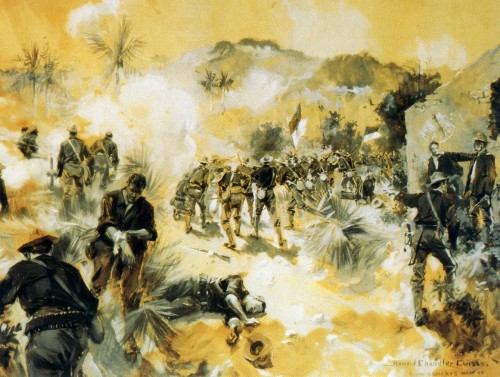
It was in the Philippines that the Americans struck their first blows since Admiral Dewey destroyed Admiral Montojo’s fleet in the harbour of Manila, outside Cavite. The conquest of Porto Rico was a military walkover and, at Cuba, Admiral Cervera’s fleet was totally outstripped on the technical level by the American ships, and destroyed on 3 July outside Santiago. Fifteen thousand Americans landed at the end of the month of June, but still Colonel Theodore Roosevelt’s Rough Riders had to put up a furious fight against the troops of Generals Linares and Vara del Rey, on 16 July, and overcame the defences of the hill of San Juan. In coming to take part in the battle himself, Roosevelt put his deeds in line with his words. On 17 July, Santiago de Cuba capitulated. On 12 August, through French mediation, an armistice was concluded prior to peace negotiations which ended in the Treaty of Paris, signed on the following 10 December.
Spain was made to abandon all sovereignty over Cuba, she also lost Puerto Rico and had to yield the Philippines and Guam to the USA for twenty million dollars. A little later, she also had to cede to the conqueror – who had seized the Hawaiian Islands during the month of August – those of the Mariannas, the Carolinas and the Palaos. It was a peace that seemed like a second death of the Spanish Empire and which opened the way to a spectacular rise in the power of the United States. Theodore Roosevelt will be able to wave his big stick in the Caribbean. Cuba, San Domingo, Nicaragua and the Panama, separated from Columbia in 1903, will become American quasi-protectorates. Once annexed, the Philippines will become the theatre of a revolt, which will last four years at a cost of five thousand dead to the new occupants. Cuba will endure a four-year military occupation, and it is only after accepting a treaty placing her in a state of total subjection to Washington that the island will be able to have its «sovereignty» recognised. The «corollary» is Roosevelt with his Monroe doctrine henceforth reserving the right of the United States to intervene in the affairs of neighbouring countries if deemed necessary for the re-establishment of order. Senator Beaveridge, from Indiana, can now consider that «God has not prepared the peoples of English and Teutonic tongue over a thousand years simply for them to admire themselves vainly and passively. No, he made us to be the organising masters of the world in order to establish order where chaos reigns. He has given us the spirit of progress in order to conquer the forces of reaction throughout the whole world. He has placed within us the gift of governing so that we may give government to savage and senile peoples. Without such a force, the world would relapse into barbarity and the night. And of all our race, he has designated the American people as his chosen nation to begin the regeneration of the world.»
To justify intervention, all means are good!
Arnaud Imatz
Certain papers of the New York press played a decisive role in preparing public opinion to accept American intervention in Cuba. The main papers here were the New York Journal, bought by William Randolph Hearst in 1895 and the World, owned by Joseph Pulitzer, to which we should add the Sun and the Herald. This press cultivated sensationalism to the point of practising a veritable disinformation campaign as a way of «advancing the event». […]
For this popular press, avid for spectacular events likely to appeal to the imagination of the masses, Cuba will provide particularly rich material. A most rudimentary kind of manichaeism thus presents the Spaniards as uncouth and sadistic brutes, representatives of a backward country, subjects of an anachronistic and corrupt monarchy. They were attributed with every kind of crime and atrocity, which happily completed the «black legend» developed by Anglo-Saxon historiography regarding the conquest of America by the subjects of Charles V and of Philippe II. It was a very useful way for the Anglo-Saxon colonisers of North America to have their own treatment of the Indians forgotten. Terror, violence and famine were the rule in Cuba for a press all too content to reproduce the communiqués from the Junta Cubana, the council of exiles installed in New York. The «testimonies» of victims filled up entirely fabricated dossiers, containing detailed accounts of Spanish depravity. […]
The reassembling and regrouping of whole populations into camps led to a heavy mortality rate among the prisoners, as a result of epidemics, which also struck the Spanish soldiers. But Hearst and his journalists did not skimp over the figures. Six hundred thousand dead, not one less, more or less one third of the island’s population, in other words a veritable genocide before the word was coined. In fact, the most serious studies undertaken by American research workers in the course of the following decades have revealed that human losses for the period 1895-1898, including the Spanish victims, did not exceed the number one hundred thousand. The lie was exposed with the publication in 1932 of a work initiated by the Baton Rouge University in Louisiana, called Public Opinion and the Spanish-American War. A study in war propaganda. None of which was of much importance forty or so years later. By blowing American popular opinion white hot, by exploiting the false letter from Ambassador Dupuy de Lôme, by giving credit to the myth of an attack responsible for the explosion of the Maine, Hearst and Pulitzer had played their part and made it possible to justify America’s control over Cuba.
00:05 Publié dans Histoire | Lien permanent | Commentaires (0) | Tags : géopolitique, etats-unis, cuba, espagne, amérique latine, amérique du sud, amérique, impérialisme, génocide, crimes de guerre | | del.icio.us | | Digg | Facebook