



 del.icio.us
 Digg
Digg Facebook



Part I: Africa’s New Thirty Years’ War?
Mali at first glance seems a most unlikely place for the NATO powers, led by a neo-colonialist French government of Socialist President Francois Hollande (and quietly backed to the hilt by the Obama Administration), to launch what is being called by some a new Thirty Years’ War Against Terrorism.
Mali, with a population of some 12 million, and a landmass three and a half times the size of Germany, is a land-locked largely Saharan Desert country in the center of western Africa, bordered by Algeria to its north, Mauritania to its west, Senegal, Guinea, Ivory Coast, Burkina Faso and Niger to its southern part. People I know who have spent time there before the recent US-led efforts at destabilization called it one of the most peaceful and beautiful places on earth, the home of Timbuktu. Its people are some ninety percent Muslim of varying persuasions. It has a rural subsistence agriculture and adult illiteracy of nearly 50%. Yet this country is suddenly the center of a new global “war on terror.”
On January 20 Britain’s Prime Minister David Cameron announced his country’s curious resolve to dedicate itself to deal with “the terrorism threat” in Mali and north Africa. Cameron declared, “It will require a response that is about years, even decades, rather than months, and it requires a response that…has an absolutely iron resolve…” [1] Britain in its colonial heyday never had a stake in Mali. Until it won independence in 1960, Mali was a French colony.
On January 11, after more than a year of behind-the-scenes pressure on the neighboring Algeria to get them entangled in an invasion of its neighbor Mali, Hollande decided to make a direct French military intervention with US backing. His government launched air strikes in the rebel-held north of Mali against a fanatical Salafist band of jihadist cutthroats calling itself Al-Qaeda in the Islamic-Mahgreb (AQIM). The pretext for the seemingly swift French action was a military move by a tiny group of Islamic Jihadists of the Tuareg people, Asnar Dine, affiliated with the larger AQIM. On January 10 Asnar Dine – backed by other Islamist groups – attacked the southern town of Konna. That marked the first time since the Tuareg rebellion in early 2012 that Jihadist rebels moved out of traditional Tuareg territory in the northern desert to spread Islamic law to the south of Mali.
As French journalist Thierry Meyssan noted, French forces were remarkably well prepared: “The transitional President, Dioncounda Traore, declared a state of emergency and called to France for help. Paris intervened within hours to prevent the fall of the capital, Bamako. Far-sightedly, the Elysée had already pre-positioned in Mali troops from the 1st Marine Infantry Parachute Regiment (“the Colonials”) and the 13th Parachute Dragoon Regiment, helicopters from the COS (Special Operations Command), three Mirage 2000D’s, two Mirage F-1’s, three C135’s, a C130 Hercules and a C160 Transall.” [2] What a convenient coincidence.
By January 21 US Air Force transport planes began delivering hundreds of French elite soldiers and military equipment to Mali, ostensibly to roll back what we were told was an out-of-control terrorist advance south towards the Mali capital. [3] French Defense Minister Jean-Yves Le Drian told media the number of its ‘boots on the ground’ in Mali had reached 2,000, adding that “around 4,000 troops will be mobilized for this operation,” in Mali and outside bases. [4]
But there are strong indications the French agenda in Mali is anything but humanitarian. In a France 5 TV interview, Le Drian carelessly admitted, “The goal is the total reconquest of Mali. We will not leave any pockets.” And President Francois Hollande said French troops would remain in the region long enough “to defeat terrorism.” The United States, Canada, Britain, Belgium, Germany and Denmark have all said they would support the French operation against Mali. [5]
Mali itself, like much of Africa is rich in raw materials. It has large reserves of gold, uranium and most recently, though western oil companies try to hide it, of oil, lots of oil. The French preferred to ignore Mali’s vast resources, keeping it a poor subsistence agriculture country. Under the deposed democratically-elected President Amadou Toumani Toure, for the first time the government initiated a systematic mapping of the vast wealth under its soil. According to Mamadou Igor Diarra, previous mining minister, Malian soil contains copper, uranium, phosphate, bauxite, gems and in particular, a large percentage of gold in addition to oil and gas. Thus, Mali is one of the countries in the world with the most raw materials. With its gold mining, the country is already one of the leading exploiters directly behind South Africa and Ghana. [6] Two thirds of France’s electricity is from nuclear power and sources of new uranium are essential. Presently, France draws significant uranium imports from neighboring Niger.
Now the picture gets a little complex.
According to usually reliable former US military experts with direct familiarity with the region, speaking on condition of anonymity, US and NATO Special Forces actually trained the same “terrorist” bands now justifying a neo-colonial US-backed invasion of Mali by France. The major question is why would Washington and Paris train the terrorists they are now acting to destroy in a “war on terror?” Were they really surprised at the lack of NATO loyalty from their trainees? And what is behind AFRICOM’s American-backed French takeover of Mali?
Part II: AFRICOM and ‘Victoria’s Secrets’
The truth about what is really going on in Mali and with AFRICOM and NATO countries, especially France is a little bit like a geopolitical “Victoria’s Secret”—what you think you see is definitely not what you will get.
We are being told repeatedly in recent months that something supposedly calling itself Al Qaeda—the organization officially charged by the US Government as responsible for pulverizing three towers of the World Trade Center and blowing a gaping hole in the side of the Pentagon on September 11, 2001—has regrouped.
According to the popular media account and statements of various NATO member country government officials, the original group of the late Osama bin Laden, holed up we are supposed to believe somewhere in the caves of Tora Bora in Afghanistan, has apparently adopted a modern business model and is handing out Al Qaeda official franchises in a style something like a ‘McDonalds of Terrorism,’ from Al Qaeda in Iraq to Libyan Islamic Fighting Group in Libya and now Al-Qaeda-in-the Islamic-Maghreb.
I’ve even heard reports that a new Al Qaeda “official” franchise has just been given, bizarre as it sounds, to something called DRCCAQ or Democratic Republic of Congo Christian (sic) Al Qaeda. [7] Now that’s a stretch which reminds one of an equally bizarre sect called Jews for Jesus created back in the hippie days of the Vietnam War era. Can it be that the architects of all these murky groups have so little imagination?
If we are to believe the official story, the group being blamed in Mali for most all the trouble is Al Qaeda in the Islamic Maghreb (AQIM for short). The murky AQIM itself is actually a product of several behind-the-scenes workings. Originally it was based in Algeria across the border from Mali and called itself the Salafist Group for Preaching and Combat (GSPC according to its French name).
In 2006 Al Qaeda’s head guru in absence of Osama bin Laden, Egyptian jihadist Ayman al-Zawahiri, publicly announced the granting to the Algerian GSPC the Al Qaeda franchise. The name was changed to Al-Qaeda-in-the Islamic-Mahgreb and Algerian counter-terror operations pushed them in the past two years over the desert border into northern Mali. AQIM reportedly is little more than a well-armed criminal band that gets its money from running South American cocaine from Africa into Europe, or from arms dealing and human trafficking. [8]
A year later, in 2007, the enterprising al-Zawahiri added another building block to his Al Qaeda chain of thugs when he officially announced the merger between the Libyan LIFG and al-Qaeda in the Islamic Mahgreb (AQIM).
The LIFG or Libyan Islamic Fighting Group, was formed by a Libyan-born jihadist named Abdelhakim Belhaj. Belhaj was trained by the CIA as part of the US-financed Mujahideen in Afghanistan during the 1980s alongside another CIA trainee then named Osama bin Laden. In essence, as the journalist Pepe Escobar notes, “for all practical purposes, since then, LIFG/AQIM have been one and the same – and Belhaj was/is its emir.” [9]
That becomes even more interesting when we find that Belhaj’s men – who, as Escobar writes, were at the forefront of a militia of Berbers from the mountains southwest of Tripoli, the so-called Tripoli Brigade—were trained in secret for two months by US Special Forces. [10]
LIFG played a key role in the US and French-backed toppling of Libya’s Qaddafi, turning Libya today into what one observer describes as the “world’s largest open air arms bazaar.” Those arms are reportedly flooding from Benghazi to Mali and other various hotspot targets of destabilization, including, according to what was suggested at the recent US Senate Foreign Relations testimony of outgoing Secretary of State Hillary Clinton, by the boatload from Libya to Turkey where they were being channeled into the various foreign terrorist insurgents sent into Syria to fuel the destruction of Syria. [11]
Now what does this unusual conglomerate globalized terror organization, LIFG-GPSC-AQIM intend in Mali and beyond, and how does that suit AFRICOM and French aims?
Part III: Curious Mali Coup and AQIM terror—exquisite timing
Events in the formerly peaceful, democratic Mali began to get very strange on March 22, 2012 when Malian President Amadou Toumani Toure was ousted and driven into exile in a military coup one month before a scheduled presidential election. Toure had earlier instituted a multi-party democratic system. The putsch leader, Captain Amadou Haya Sanogo, received military training in the US, at Fort Benning, Georgia and the Marine Corps base in Quantico, Virginia according to AFRICOM’s spokesman. [12] Sanogo claimed the military coup was necessary because Toure’s government was not doing enough to quell Tuareg unrest in northern Mali.
As Meyssan points out, the March 2012 military coup against Toure was suspicious in every regard. A previously unheard-of group called CNRDRE (in English: National Commitee for the Recovery of Democracy and the Restoration of the State) overthrew Touré and declared intention to restore Mali law and order in the north.
“This resulted in great confusion,” Meyssan goes on, “since the putschists were incapable of explaining how their actions would improve the situation. The overthrow of the President was even stranger since a presidential election was to be held five weeks later and the outgoing President was not running for office. The CNRDRE is composed of officers who were trained in the United States. They halted the election process and handed power to one of their candidates, who happened to be the Francophile Dioncounda Traore. This sleight of hand was legalized by the CEDEAO (or in English, ECOWAS—Economic Community of West African States), whose President is none other than Alassane Ouattara, who was placed in power in the Ivory Coast by the French army a year earlier.” [13]
Alassane Ouattara, educated in economics in the US, is a former senior IMF official who in 2011 forced out his Ivory Coast presidential rival with French military assistance. He owes his job not to “the New York Times,” but to French Special Forces. [14]
At the time of the military coup, the unrest in question was from an ethnic tribe, Tuareg, a secular, nomadic group of pastoral cattle-herding people who demanded independence from Mali in early 2012.
The Tuareg Rebellion was reportedly armed and financed by France who repatriated Tuaregs who had been fighting in Libya for the purpose of splitting the north of Mali along Algeria’s border, from the rest of the country and declaring Sharia law. It only lasted from January to April 2012, at which time the nomadic Tuareg fighters rode off to their nomad haunts in the central Sahara and borders of the Sahel, a vast borderless desert area between Libya and Algeria, Mali and Niger. That left the Algerian-Libyan LIFG/Al Qaeda in the Islamic Maghreb and their associates in the Jihadist Asnar Dine to carry out the dirty work for Paris. [15]
In their 2012 battle for independence from Mali, the Tuareg had made an unholy alliance with the Jihadist AQIM. Both groups, briefly joined together with Asnar Dine, another islamist organization led by Iyad Ag Ghaly. Asnar Dine is believed to have ties to Al-Qaeda in the Islamic Maghreb which is led by Ag Ghaly’s cousin, Hamada Ag Hama. Ansar Dine wants the imposition of strict Sharia law across Mali.
The three main groups briefly joined forces the moment Mali was plunged into chaos following the March 2012 military coup. The coup leader was Captain Amadou Haya Sanogo, who received military training at the Marine Corps camp at Quantico, Virginia and Special Forces training at Fort Benning, Georgia in the US. In a bizarre play of events, despite the claim the coup was driven by the civilian government’s failure to contain the rebellion in the north, the Malian military lost control of the regional capitals of Kidal, Gao, and Timbuktu within ten days of Sanogo’s assuming office. Reuters describe the farcical coup as “a spectacular own-goal.” [16]
The violation of Mali’s constitution by the military was used to trigger severe sanctions against the central military government. Mali was suspended from membership in the African Union; the World Bank and African Development Bank have suspended aid. The US has cut half of the $140 million in aid that it sends each year, all of which created chaos in Mali and made it virtually impossible for the government to respond to the growing loss of territory in the north to Salafists.
Part IV: Terror-Anti-Terror
What then ensued is like a page ripped out of the insurgency-counter-insurgency textbook of Britain’s Brigadier Frank E. Kitson during the 1950s British Mau Mau operations in Kenya. The Jihadist insurgency in the North and the simultaneous military coup in the capital led to a situation in which Mali was immediately isolated and massively punished with economic sanctions.
Acting with indecent haste, the US and French-controlled regional 15-member Economic Community of West African States (ECOWAS) demanded the coup leaders restore civilian rule. On March 26, the US cut off all military aid to the impoverished country, ensuring maximum chaos just as the Jihadists made their major push south., Then at a meeting April 2 in Dakar, Senegal, ECOWAS members closed their countries’ borders with land-locked Mali and imposed severe sanctions, including cutting off access to the regional bank, raising the possibility that Mali will soon be unable to pay for essential supplies, including gasoline.
The same military that “trains” the terrorists also trains the “anti-terrorists.” This seems a bizarre contradiction in policy only when we fail to grasp the essence of US and British-developed methods of irregular warfare employed actively since the early 1950’s.
The method was originally termed Low Intensity Warfare by the British Army officer who developed and refined the method for control of subject areas in Malaysia, Kenya during the Mau Mau 1950’s freedom struggles and later for the British Army in Northern Ireland. Low intensity warfare as he termed it in a book by that name, [17] involves use of deception, of infiltration of double-agents, provocateurs, and use of defectors into legitimate popular movements such as those struggles for colonial independence after 1945.
The method is sometimes referred to as “Gang/Counter-Gang.” The essence is that the orchestrating intelligence agency or military occupying force, whether the British Army in Kenya or the CIA in Afghanistan, de facto controls the actions of both sides in an internal conflict, creating small civil wars or gang wars to the aim of dividing the overall legitimate movement and creating the pretext for outside military force in what the US now has deceptively renamed as “Peace-Keeping Operations” or PKO. [18]
In his advanced course on American Military Intervention Since Vietnam, Grant Hammond of the US Air War College refers openly to Low Intensity Conflict aka Peace Keeping Operations as “war by another name.” [19]
We begin to see the bloody footprints of a not-so-well-disguised French recolonisation of former French Africa, this time using Al-Qaeda terror as the springboard to direct military presence for the first time in more than half a century. French troops will likely stay on to help Mali in a “peace keeping operation.” The US is fully backing France as AFRICOM’s “cat’s paw.” And Al Qaeda in the Islamic Maghreb and its spinoffs make the whole NATO military intervention possible.
Washington claimed to have been caught blind-sided by the military coup. According to press reports, a confidential internal review completed July 2012 by the Pentagon’s Africa Command (AFRICOM) concluded that the coup had unfolded too fast for American intelligence analysts to detect any clear warning signs. “The coup in Mali progressed very rapidly and with very little warning,” said AFRICOM spokesman, Col. Tom Davis. “The spark that ignited it occurred within their junior military ranks, who ultimately overthrew the government, not at the senior leadership level where warning signs might have been more easily noticed.” [20] That view is strongly disputed. In an off-the-record interview with The New York Times, one Special Operations Forces officer disagreed, saying, “This has been brewing for five years. The analysts got complacent in their assumptions and did not see the big changes and the impacts of them, like the big weaponry coming out of Libya and the different, more Islamic fighters who came back.” [21]
More accurate it seems, AFRICOM had been “brewing” the crisis for five years since it began operations in late 2007. Mali for the Pentagon is but the next building block in the militarization of all of Africa by AFRICOM using proxy forces like France to do the dirty work. The Mali intervention using France upfront is but one building block in a project for the total militarization of Africa whose prime goal is not capturing strategic resources like oil, gas, uranium, gold or iron ore. The strategic target is China and the rapidly growing Chinese business presence across Africa over the past decade. The goal of AFRICOM is to push China out of Africa or at least to irreparably cripple her independent access to those African resources. An economically independent China, so goes thinking in various Pentagon offices or Washington neo-conservative think-tanks, can be a politically independent China. God forbid! So they believe.
Part V: AFRICOM Agenda in Mali: Target China
The Mali operation is but the tip of a huge African iceberg. AFRICOM, the Pentagon’s US Africa Command was signed into existence by President George W. Bush in late 2007. Its prime purpose was to counter the dramatically growing Chinese economic and political influence across Africa. Alarm bells went off in Washington in October 2006 when the Chinese President hosted an historic Beijing summit, the Forum on China-Africa Cooperation (FOCAC), which brought nearly fifty African heads of state and ministers to the Chinese capital. In 2008, ahead of a twelve-day eight-nation tour of Africa—the third such journey since he took office in 2003—Chinese President Hu Jintao announced a three-year, $3 billion program in preferential loans and expanded aid for Africa. These funds came on top of the $3 billion in loans and $2 billion in export credits that Hu announced earlier.
Trade between China and African countries exploded in the ensuing four years as French and US influence over the “Dark Continent” waned. China’s trade with Africa reached $166 billion in 2011, according to Chinese statistics, and African exports to China – primarily resources to fuel Chinese industries – rose to $93 billion from $5.6 billion over the past decade. In July 2012 China offered African countries $20 billion in loans over the next three years, double the amount pledged in the previous three-year period. [22]
For Washington, making AFRICOM operational as soon as possible was an urgent geopolitical priority. It began operation on October 1, 2008 from headquarters in Stuttgart, Germany. Since the Bush-Cheney Administration signed the directive creating AFRICOM in February 2007, it has been a direct response to China’s successful African economic diplomacy.
AFRICOM defines its mission as follows: “Africa Command has administrative responsibility for US military support to US government policy in Africa, to include military-to-military relationships with 53 African nations.” They admit working closely with US Embassies and State Department across Africa, an unusual admission which also includes with USAID: “US Africa Command provides personnel and logistical support to State Department-funded activities. Command personnel work closely with US embassies in Africa to coordinate training programs to improve African nations’ security capacity.” [23]
Speaking to the International Peace Operations Association in Washington, D.C. on Oct. 27, 2008 General Kip Ward, Commander of AFRICOM defined the command’s mission as, “in concert with other US government agencies and international partners, [to conduct] sustained security engagements through military-to-military programs, military-sponsored activities, and other military operations as directed to promote a stable and secure African environment in support of US foreign policy.” [24]
Various Washington sources state openly, AFRICOM was created to counter the growing presence of China in Africa, and China’s increasing success, to secure long-term economic agreements for raw materials from Africa in exchange for Chinese aid and production sharing agreements and royalties. By informed accounts, the Chinese have been far shrewder. Instead of offering savage IMF-dictated austerity and economic chaos as the West has, China is offering large credits, soft loans to build roads and schools in order to create good will.
Dr. J. Peter Pham, a leading Washington insider and an advisor of the US State and Defense Departments, states openly that among the aims of the new AFRICOM, is the objective of, “protecting access to hydrocarbons and other strategic resources which Africa has in abundance … a task which includes ensuring against the vulnerability of those natural riches and ensuring that no other interested third parties, such as China, India, Japan, or Russia, obtain monopolies or preferential treatment.”
In testimony before the US Congress supporting creation of AFRICOM in 2007, Pham, who is closely associated with the neo-conservative think-tank, Foundation for Defense of Democracies, stated:
This natural wealth makes Africa an inviting target for the attentions of the People’s Republic of China, whose dynamic economy, averaging 9 percent growth per annum over the last two decades, has an almost insatiable thirst for oil as well as a need for other natural resources to sustain it. China is currently importing approximately 2.6 million barrels of crude per day, about half of its consumption;…roughly a third of its imports come from African sources…perhaps no other foreign region rivals Africa as the object of Beijing’s sustained strategic interest in recent years…
… many analysts expect that Africa—especially the states along its oil-rich western coastline—will increasingly becoming a theatre for strategic competition between the United States and its only real near-peer competitor on the global stage, China, as both countries seek to expand their influence and secure access to resources. [25]
To counter the growing Chinese influence across Africa Washington has enlisted the economically weak and politically desperate French with promises of supporting a French revival of its former African colonial empire in one form or another. The strategy, as becomes clear in the wake of the French-US use of Al Qaeda terrorists to bring down Ghaddafi in Libya and now to wreak havoc across the Sahara from Mali, is to foster ethnic wars and sectarian hatred between Berbers, Arabs, and others in North Africa—divide and rule.
It appears they have even co-opted an earlier French blueprint for direct control. In a groundbreaking analysis, Canadian geopolitical analyst and sociologist, Mahdi Darius Nazemroaya writes, “The map used by Washington for combating terrorism under the Pan-Sahel Initiative says a lot. The range or area of activity for the terrorists, within the borders of Algeria, Libya, Niger, Chad, Mali, and Mauritania according to Washington’s designation, is very similar to the boundaries or borders of the colonial territorial entity which France attempted to sustain in Africa in 1957. Paris had planned to prop up this African entity in the western central Sahara as a French department (province) directly tied to France, along with coastal Algeria.” [26]
The French called it the Common Organization of the Saharan Regions (Organisation commune des regions sahariennes, OCRS). It comprised the inner boundaries of the Sahel and Saharan countries of Mali, Niger, Chad, and Algeria. Paris used it to control the resource-rich countries for French exploitation of such raw materials as oil, gas, and uranium.

- French map of Sahara in 1958 compared with USAFRICOM Pan-Sahal Initiative map (below) of terror threat in Sahara today.
- Source: GlobalResearch.ca)
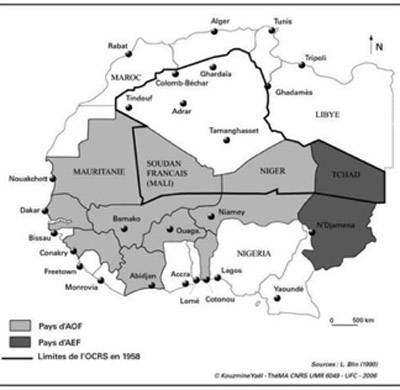
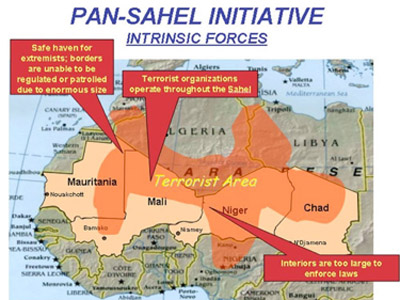
He adds that Washington clearly had this energy-rich and resource-rich area in mind when it drew the areas of Africa that need to be “cleansed” of alleged terrorist cells and gangs. At least now AFRICOM had “a plan” for its new African strategy. The French Institute of Foreign Relations (Institut français des relations internationals, IFRI) openly discussed this tie between the terrorists and energy-rich areas in a March 2011 report. [27]
The map used by Washington for combating terrorism under the Pentagon Pan-Sahel Initiative shows an area of activity for the terrorists, inside Algeria, Libya, Niger, Chad, Mali, and Mauritania according to Washington’s designation. The Trans-Saharan Counterterrorism Initiative (TSCTI) was begun by the Pentagon in 2005. Mali, Chad, Mauritania, and Niger were now joined by Algeria, Mauritania, Morocco, Senegal, Nigeria, and Tunisia in a ring of military cooperation with the Pentagon. The Trans-Saharan Counterterrorism Initiative was transferred to the command of AFRICOM on October 1, 2008. [28]
The Pentagon map is remarkably similar to the boundaries or borders of the colonial territorial entity which France attempted to sustain in Africa in 1957. Paris had planned to prop up this African entity in the western central Sahara as a French department (province) directly tied to France, along with coastal Algeria—the Common Organization of the Saharan Regions (Organisation commune des regions sahariennes, OCRS). It comprised the inner boundaries of the Sahel and Saharan countries of Mali, Niger, Chad, and Algeria. The plans were foiled during the Cold War by the Algerian and other African countries’ independence wars against French colonial rule, France’s “Vietnam.” France was forced to dissolve the OCRS in 1962, because of Algerian independence and the anti-colonial mood in Africa. [29] The neo-colonial ambitions in Paris however, did not vanish.
The French make no secret of their alarm over growing Chinese influence in former French Africa. French Finance Minister Pierre Moscovici stated in Abidjan last December that French companies must go on the offensive and fight the growing influence of rival China for a stake in Africa’s increasingly competitive markets. “It’s evident that China is more and more present in Africa…(French) companies that have the means must go on the offensive. They must be more present on the ground. They have to fight,” Moscovici stated during a trip to Ivory Coast. [30]
Clearly Paris had in mind a military offensive to back the economic offensive he foresaw for French companies in Africa.
Notes
[1] James Kirkup, David Cameron: North African terror fight will take decades, The Telegraph, London, 20 January 2013.
[2] Thierry Meyssan, Mali: One war can hide another, Voltaire Network, 23 January 2013.
[3] Staff Sgt. Nathanael Callon United States Air Forces in Europe/Air Forces Africa Public Affairs, US planes deliver French troops to Mali, AFNS, January 25, 2013.
[4] S. Alambaigi, French Defense Minister: 2000 boots on ground in Mali, 19 January 2013.
[5] Freya Petersen,France aiming for ’total reconquest’ of Mali, French foreign minister says, January 20, 2013.
[6] Christian v. Hiller, Mali’s hidden Treasures, April 12, 2012, Frankfurter Allgemeine Zeitung.
[7] Sources include private discussion with retired US military active in Africa.
[8] William Thornberry and Jaclyn Levy, Al Qaeda in the Islamic Maghreb, CSIS, September 2011, Case Study No. 4.
[9] Pepe Escobar, How al-Qaeda got to rule in Tripoli, Asia Times Online, August 30, 2011.
[10] Ibid.
[11] Jason Howerton, Rand Paul Grills Clinton at Benghazi Hearing: ‘Had I Been President…I Would Have Relieved You of Your Post’,www.theblaze.com, Jan. 23, 2013.
[12] Craig Whitlock, Leader of Mali military coup trained in U.S., March 24, 2012, The Washington Post.
[13] Thierry Meyssan, op. cit.
[14] AFP, [Ivory Coast’s ex-President Gbagbo ‘arrested in Abidjan’ by French forces leading Ouattara troops, April 11th, 2011.
[15] Thierry Meyssan, op. cit.
[16] Cheick Dioura and Adama Diarra, Mali Rebels Assault Gao, Northern Garrison“, The Huffington Post, Reuters.
[17] Frank E. Kitson, Low Intensity Operations: Subversion, Insurgency and Peacekeeping, London, 1971, Faber and Faber.
[18] C.M. Olsson and E.P. Guittet, Counter Insurgency, Low Intensity Conflict and Peace Operations: A Genealogy of the Transformations of Warfare, March 5, 2005 paper presented at the annual meeting of the International Studies Association.
[19] Grant T. Hammond, Low-intensity Conflict: War by another name, London, Small Wars and Insurgencies, Vol.1, Issue 3, December 1990, pp. 226-238.
[20] Defenders for Freedom, Justice & Equality, US Hands Off Mali An Analysis of the Recent Events in the Republic of Mali,. MRzine, May 2, 2012.
[21] Adam Nossiter, Eric Schmitt, Mark Mazzetti, French Strikes in Mali Supplant Caution of US, The New York Times, January 13, 2013.
[22] Joe Bavier, French firms must fight China for stake in Africa—Moscovici,, Reuters, December 1, 2012.
[23] AFRICOM, US Africa Command Fact Sheet, September 2, 2010.
[24] Ibid.
[25] F. William Engdahl, NATO’s War on Libya is Directed against China: AFRICOM and the Threat to China’s National Energy Security, September 26, 2011.
[26] Mahdi Darius Nazemroaya and Julien Teil, America’s Conquest of Africa: The Roles of France and Israel, GlobalResearch, October 06, 2011.
[27] Ibid.
[28] Ibid.
[29] Ibid.
[30] Joe Bavier, Op. cit.

