


mardi, 24 mars 2009
Ethnic Cleansing of the Kafirs in Pakistan
Ethnic Cleansing of the Kafirs in Pakistan

(Kalash women)
By Abbas Zaidi
In all the languages spoken in Pakistan, Kafir means "Infidel" and Kafiristan means "Land of the Infidels." (Kafir also means "infidel" in Arabic.) Yet, ironically Kafiristan in Pakistan is believed to be a paradise located in the northwest part of the country: lakes, waterfalls, green forests teeming with wildlife, snow and a mellow sun.
But it is not just the place itself that fascinates; it is the women of Kafiristan, part-fairy and part-human whose beauty, as the story goes, can make a man lose his religion. "When a Kafir woman drinks water, you can see it streaming down her throat. One can count the veins on her body," is the standard text regarding the Kafir woman's delicateness. They are believed to be whiter than white.
But who are these Kafirs?
The advent of the Kafirs in Northwest of Pakistan
--what is known now as the Kalash Valley consisting of the Birir, Bumboret and Rumbor sub-valleys--and southern Afghanistan, predates the birth of Islam by several centuries. As of now, the Kalash Valley is a part of Chitral, a very large administrative region in Northwest of Pakistan. The Kafirs are believed to be descendants of the warriors who arrived with Alexander the Great and decided to stay on. His-
torically, the Kafirs have remained an isolated ethnic group who were left undisturbed by both the Muslim rulers of India and by the British Raj. Many Western historians during the Raj were surprised to find the Kafirs' physical resemblance to be so similar to their own that they proudly declared that they and the Kafirs were of the same stock. As such, the Kafirs were allowed to freely practice their ancient customs, including ritual alcohol consump-
tion, promiscuous dancing and ritual free sex.
The tragic watershed in Kafiri history came towards the end of the 19th century when in South Afghanistan their population was decimated in the name of Islam. The Afghan ruler at that time declared that either the Kafirs would be converted to Islam or be wiped off the face of the earth. The Afghan campaign was a total success, and the dawn of the 20th century did not see a single Kafir living in Afghan-istan as a Kafir. Even the names of their villages were Islamised.
The Kafirs on the other side of the border were spared genocide due, one might suppose, to the Raj. In 1947 the Raj ended and Pakistan came into being, but the Kafirs continued to lead their lives as they had lived them for centuries. The legends about the beauty of the Kafir women and the landscape continued in a quasi-Orientalist mode. Every so often one heard about someone marrying a Kafir woman and bringing her home, though no one ever actually saw one. (In the legends and tales about Kafiristan the Kafir men are significant by their absence.)
It was only in the early 1970s that the people of Pakistan began to hear about the Kafirs in the national media, when Kafiristan was facing famine. Thanks to then Prime Minister Zulfiqar Ali Bhutto, a tragedy was averted and he became the Kafirs' hero.
But then came the CIA-sponsored Afghanistan jihad and Iran's Islamic Revolution in 1979. Ayatollah Khomeini challenged, inter alia, the US, the Arab monarchies and Pakistan's military dictatorship. Pakistan's progressive religious groups also became inspired by the Iranian Revolution and started planning in terms of a revolution for Pakistan too. They were a curious mix of Islam and Marxism. Some of them were extremely anti-American and anti-Soviet; some of them preferred the atheistic Soviet Union to the anti-Islamic United States and had their socialist friends in Afghanistan; and some of them pro-Khomeini, and Khomeini had challenged the US as no one had ever done before. Hence, the Iranian Revolution unfied them into an anti-American front. They called the Afghan refugees of those days "the absconders" and the jihad-wagers "the CIA agents."
General Zia ul Haq, Pakistan's longest-reigning dictator to date, was the enfant gate of the Saudi Royal Family, with a proven track record of loyalty to his masters in Jordan as well. The US needed a strongman in Islamabad to offset pro-Iranian and anti-American sentiments and to oppose the Soviets on its behalf. Hence it became vital to divide Pakistan along sectarian lines. Only the Deobandi-Wahabi (see end note #2) version of Islam could produce the desired results. So, in order to out-
Khomeini Khomeini, the General introduced his own brand of Islamisation. That same year Zulfiqar Ali Bhutto was hange, with the full blessing of the US government. 1979, that annus mirabilis, marked the beginning of the end for the Kafirs.
In 1981 Ronald Reagan provided a multi-billion-dollar "aid" package in order to help Pakistan intensify the Afghanistan jihad. General Zia called upon the nation to go one step further than the Government in bringing Islam to every nook and corner of Pakistan. As a result, countless Tablighi (proselytizing) parties confronted every Muslim and non-Muslim Pakistani preaching the Deobandi-Wahabi version of Islam. Coincidentally, that year saw klashnikovs and heroin begin to penetrate every nook and cranny of Pakistan. The Kafirs got the first taste of things to come when some Tablighi zealots illegally occupied a large cultivated piece of their land in Bumboret and built a mosque.
What happened after that is not hard to discover. The Afghan refugees and the Pathan Tablighi parties (now known as the Taliban) seized nearly 70 percent of Kafir land during the period 1981 to 1995. They built mosques and seminaries where, in addition to learning the Koran by rote only, students learn the arts of war, techniques that are used against India in Kashmir and against Muslim and non-Muslim relig-ious minorities within Pakistan as well as against "infidels" elsewhere. The first fruit of the Afghanistan jihad for the Kafirs was the decimation of the Kalash forests and wildlife by the Afghan refugees. As the vegetation grew sparse, the Kafirs' cattle met the same fate as their forests, and the traditional Kafir means of livelihood was irreparably destroyed.
Once the Afghan refugees and the Tablighis became entrenched in Chitral, the forced conversion of the Kafirs began. Gun-toting Tablighis made it clear that in order to go on living in Pakistan (Pakistan means "Land of the Pure") the Kafirs must convert to Islam. For the Kafirs any place beyond the Kalash Valley is as alien as Mars. The kidnapping and forced marriage--and hence forced conversion--of the Kafir women to the Muslims, mostly Tablighi Pathans, continues to this day. These women are not allowed to see their relatives unless the relatives also convert. It is no secret that many of these women are sold at auction. Men are circumcised against their will. The Tablighis carry klashnikovs as a matter of routine and have killed many Kafirs who resisted conversion to the Tablighi Islam. No Kafir is allowed to carry a gun.
The poverty of the Kafirs has also been a big factor in their conversion to Tablighi Islam. Within the Chitral society they are completely ostracized for being "Kafirs", a term that illiterate people (and illiteracy in Chitral is the norm) understand to mean "infidels." The government does not give loans to Kafirs; the police and the judiciary have never taken any action against the appropriation of Kafir land by the Tablighis. The only source of income for the Kafirs are the Tablighis who lend them money at high interest. Since the Kafirs cannot pay off these loans, the only course left for them is either to convert or surrender their properties to the Tablighis.
While electricity, available through gasoline generators, and tap water are available to every Muslim in the Kalash Valley, and loudspeakers relay azzan and Koranic recitations throughout the day, there is not a single Kafir house that has electricity or a water tap. Their living conditions are indescribable. The Chitral winter is Siberian. The mosques and seminaries have heaters and warm water. The Kafirs' houses remain dark all winter, and they have to melt snow for drinking water. They cut wood to make fire. Their houses are actually large single rooms that remain shut for the six months of winter. Humans and animals live in them together. One can only imagine the stink and the lack of sanitation. There are no toilets. In summer, people use the open fields to relieve themselves; in winter they relieve themselves inside their houses, the same as their animals. One finds human and animal waste every-
where.
There is not a single hospital nor even a minor dispensary in the whole of Kafiristan. The Tablighis have 4x4 jeeps, but few Kafirs have any kind of vehicles. Many Kafirs have died, when basic emergency aid could have saved them, such as during childbirth. The Kafiri diet is basic and monotonous, and one rarely sees either a male or female Kafir who looks physically strong. The women's veins show plainly because of their malnourished state. Their characteristic long necks are dirty, and you only have to come close to one to know that they seldom get to take a bath.
Needless to say, Kafir culture is now nonexistent, thanks to the Tablighis. In the 1980s it was thought that the Kafirs as a distinct cultural group would become extinct by the end of the century. But they still linger on, though their number now is no more than two thousand. The government of Pakistan takes great pride in having established the Kalash Foundation "to preserve and propagate Kafir culture." But the facts speak otherwise. It is true that the Kalash Foundation has somewhat slowed the steamroller of the Tablighi Islam. But it has not done anything positive for the Kafirs. No effort has been made to give their language written documentation, and there does not exist even a single standard text devoted to Kafiri culture.
Visitors to the Kalash Valley have to pay a toll to enter. The toll ticket given to the visitor is jokingly called "the zoo ticket." The Kafirs and what is left of their culture have been preserved merely to cater to the tastes for the exotic of generals, bureaucrats, politicians and foreign dignitaries. Thanks to the Kalash Foundation, the Kafirs have become little more than anthropological artifacts. The World Wildlife Federation has been crying blue murder over the fact that only five thousand tigers remain in their natural habitat. Who cares that only two thousand Kafirs remain, despite a captivity-cum-protection program supposedly accorded them by the Pakistani government?
Meanwhile, the Tablighi are pushing to convert these few remaining pagans, and it is unlikely that the Kafirs will last very long into the 21st century. Kafir culture will end up--like so many indigenous cultures elsewhere--in the "cultural centers" of the big cities under the oversight of the Ministry of Cultural Affairs. One may surmise that in future the converted Kafirs and their progeny will be engaged in fighting Indians, the religious minorities of Pakistan and "infidels" elsewhere. Meanwhile, in order to edify and entertain their audiences, Muslims employed by the Ministry of Cultural Affairs will stage exhibitions of Kafiri culture, dressing up and posing as the Kafirs whom the government and the Tablighis have systematically eliminated.
Notes
1. I felt forced to write this piece after reading "The Islamization of the Kalash Kafirs" by Akbar S. Ahmed in his book Pakistan Society (Oxford University Press, Karachi, 1986). I was appalled to read that the author, "the Margaret Mead of Islam" did not even once touch upon the destruction of the Kafirs. He does mention the "formidable social, and psychological pressures resulting from being viewed as 'dirty' non-believers by aggressive and powerful neighbors," but ends his chapter with a high note of optimism that everything for the Kafirs will be all right in the course of time. Maybe he could not appreciate the true nature of the situation because at the time of his writing he was an important member of General Zia's bureaucracy.
2. A word about the Tablighis and their version of Islam. Within the Sunni sect in Pakistan and India there are two major sub-sects: the Brelvis and the Deobandis. The Deobandis are very close to the Wahabis of Saudi Arabia in their literalist interpretation of Islam. That is why the Deobandis and the Wahabis work side by side, from politics to jihad. The ubiquitous proselytizing groups in Pakistan and elsewhere are overwhelmingly Deobandi. The Deobandis believe that except for themselves and the Wahabis all other sects of Islam are heretical and must be exterminated. In the 1970s in Pakistan it was chiefly the Wahabis and the Deobandis who succeeded in having the Ahmedis declared non-Muslims, a declaration later constitutionalised by General Zia, himself a Deobandi. The Sipa-e-Sihaba of Pakistan and the Taliban of Afghanistan are Deobandi who are financially supported by the Saudi Royal Family. It's interesting to note that within Sunni Islam the Deobandis and the Brelvis are not found anywhere outside India and Pakistan. The creation of these two sects was one of the masterstrokes of the Raj in its divide-and-rule policy.
3. The Kafirs have become the victim of Tablighis Islam. Islam, however, is a religion whose God--Allah--by His own claim is, inter alia, the Beneficent, the Benevolent and the Merciful. Allah strictly forbids Muslims to carry out forced conversion.
Abbas Zaidi <manoo@brunet.bn> was editor ofThe Ravi (1985), Pakistan's premier and oldest academic magazine published by Government College, Lahore. He also edited Interface (1990-91) for the Program in Literary Linguistics, University of Strathclyde, Glasgow. Zaidi has taught English Literature in Bahauddin Zakariya University, Multan, and worked as assistant editor for The Nation, Lahore.)
http://www.gowanusbooks.com/kafirs.htm

(Kalash woman)
00:15 Publié dans Eurasisme | Lien permanent | Commentaires (2) | Tags : ethnologie, nettoyage ethnique, génocide, ethnocide, himalaya, eurasie, eurasisme, indo-européens, pakistan, anthropologie |  |
|  del.icio.us |
  |
|  Digg |
  Facebook
Aleksandr Solzjenitsyn - Leven, woord en daad van een merkwaardige Rus
Aleksandr Solzjenitsyn
Leven, woord en daad van een merkwaardige Rus
Ex: http://onsverbond.wordpress.com/
Op 3 augustus 2008 overleed de Russische auteur en voormalig dissident Aleksandr Soljzenitsyn. Naar aanleiding van zijn overlijden volgt hier een beknopte schets van het leven, het werk en de nalatenschap van een van de monumenten uit de Russische literatuur.

LEVEN
<Aleksandr Soljzenitsyn werd op 11 december 1918 geboren te Kisovodsk als zoon van een tsaristische officier die gesneuveld was tijdens de Eerste Wereldoorlog. Als overtuigd communist sloot de jonge Soljzenitsyn zich in 1941 aan bij het Rode Leger, na zijn studies in de wis- en natuurkunde te hebben vervolmaakt. Als wiskundig specialist we
rd hij als officier ingedeeld bij de artillerieregimenten van het Rode Leger, hoewel hij reeds vroeg in opspraak kwam
door kritische uitlatingen aan het adres van Stalin in een briefwisseling met een kameraad aan het front. Dit ‘vergrijp’ kwam de kritische jongeling duur te staan: hij werd veroordeeld tot dwangarbeid in diverse werkkampen. Bij de dood van Stalin in 1953 werd zijn straf omgezet in drie jaar ballingschap in de Sovjetrepubliek Kazachstan. Zijn ervaringen met de concentatiekampen in die jaren zou Soljzenitsyn later neerschrijven in zijn romans In de eerste cirkel (1968) en Het Kankerpaviljoen (1968).
De dood van Sta
lin leidde een versoepeling in van de censuurpolitiek onder het bewind van Nikita Chroesjtsjov, waarop Soljzenitsyn de kans zag tot het publiceren van zijn werken. Een in 1962 gepubliceerde novelle Een dag in het leven van Ivan Denisovitsj vormde een klinkend debuut van zijn literaire carrière, hetgeen hem op slag beroemd maakte.
| Sovjetleider Jozef Stalin. |
Na het afzetten van Chroesjtsjov in 1964 en ook door het succes van Soljzenitsyn verscherpte de censuur zich weer in de USSR, onder meer op aandringen van een conservatief-communistisch gezinde groep van cultuurpolitici in het Kremlin. Aantijgingen, pestcampagnes en dreigementen van de KGB en andere Sovjetautoriteiten aan Soljzenitsyns adres lieten na deze institutionele hervormingen niet op zich wachten en het geheel culmineerde in een buitengewoon stoutmoedige reactie van de dissident zelf: in 1967 schreef hij een open brief aan het 4de Congres van de Schrijversbond met een duidelijke vraag tot het afschaffen van de Sovjetcensuur.
Het intellectueel verzet van de auteur werd stilletjes aan opgemerkt in het kapitalistische Westen naarmate zijn werken er met mondjesmaat gepubliceerd raakten en officiële erkenning van de strijd van de auteur liet dan ook niet lang meer op zich wachten. In 1970 werd immers, ondanks een hetze in de Sovjetpers en Westerse angst voor de eventuele politieke implicaties van deze erkenning, de Nobelprijs voor Literatuur aan Soljzenitsyn toegekend. Deze erkenning gaf het regime in Sovjet-Rusland een nieuwe aanleiding om zijn pijlen op de dissident te richten, hoewel ook deze keer Soljzenitsyn van zich afbeet in een stoutmoedige tot zelfs arrogant aandoende reactie. Naar aanleiding van de vuilbekkende artikels tegen zijn persoon in de Sovjetpers schreef hij een brief aan partij-ideoloog Soeslov met daarin een voor de autoriteiten onaanvaardbaar eisenpakket: Soljzenitsyn wenste zijn werken onder meer te zien verschijnen in nieuwe oplagen en in de rekken van de Sovjetbibliotheken.
| Premier Poetin en Aleksandr Soljzenitsyn. |
Van 1973 tot 1975 gaf Soljzenitsyn de verschillende delen van zijn roman De Goelagarchipel uit, hetgeen hem de ultieme straf opleverde: hij werd in 1974 verbannen uit de Sovjetunie. Soljzenitsyn trok in 1976 naar de VS, waar hij in 1978 de Westerse intelligentsia tegen zich in het harnas joeg door zich kritisch uit te laten over het kapitalisme en de consumptiemaatschappij van het Westen in een toespraak aan de universiteit van Harvard. Na de val van de USSR keerde hij terug naar Rusland, waar hij in 1994 een triomfantelijke zegetocht maakte doorheen het onmetelijke land. Soljzenitsyn bleef onafgebroken werken publiceren tot aan zijn dood op 3 augustus jl. In 2007 kreeg hij de Staatsprijs voor Humanitaire Verdiensten en tijdens de laatste fasen van zijn leven bouwde hij een vriendschapsband op met Vladimir Poetin, voormalig president en huidig premier van Rusland.
IDEOLOGIE EN ENKELE PARALLELLEN
| Aleksandr Soljzenitsyn. |
Soljzenitsyn kan gezien worden als de literair-culturele grondlegger van een nieuwe en toch traditionele koers die Rusland volgens hem zou moeten volgen om zich uit de naweeën van het Sovjettijdperk te ontworstelen en op te staan als de rechtmatige culturele en politieke grootmacht die Rusland altijd was in zijn eeuwenlange en rijke culturele en politieke geschiedenis. Deze ‘Russische Mythe’, die centraal staat in de gedachtegang van Soljzenitsyn en ook is neergeschreven in zijn literaire werken, berust op de idee dat een volk als gemeenschap fundamenteel verschillend van andere volkeren zijn goddelijke zending moet vervullen om zijn plaats in te nemen in het lappendeken van volkeren: ieder volk heeft deze plicht van hogerhand meegekregen, zodat de mens als soort kan uitblinken in de verschillende facetten waarin deze soort kan voorkomen. Deze ideologische visie stamt uit de vroegste fasen van het nationalistisch denken, het vredevol ‘Romantisch nationalisme’ uit het begin van de 19de eeuw.
Verder heeft Soljzenitsyn diepgaande kritieken geformuleerd op de latere vorm van nationalisme, die met het darwinisme de poort openzette naar de gruwelen van de Tweede Wereldoorlog en de creatie van de Sovjetunie. Tevens uitte hij in de jaren 1970 bijtende kritiek op de Amerikaanse consumptiemaatschappij als een gedegenereerde vorm van de Verlichtingsidealen die mede aan de wieg stonden van nationalisme en Romantiek in de vroege 19de eeuw. Essentieel in Soljzenitsyns visie is een aandeel van het transcendente – het godsdienstige – in het streven van de mens per volk. Dit aandeel verheft het streven van de mens immers tot een ethisch hoogstaand niveau, hetgeen een ethische buffer installeert tegen moreel laakbare uitspattingen als gevolg van misinterpretaties van menselijke ideologische systemen, zoals in de Westerse consumptiemaatschappij – waar van hun intrinsieke waardigheid ontdane mensen als vee op een veemarkt worden geschat op hun consumptie- en productiewaarde – en zoals in het Oosten het geval was met de gruwel van de USSR.
Soljzenitsyns visie op Rusland oefende een enorme invloed uit op de hedendaagse politieke en culturele elite, zowel binnen als buiten Rusland. Dit stelde hem in contact met enkele andere markante personages uit de laatste decennia van de 20ste eeuw, waarvan met sommigen de gelijkenissen en tegenstrijdigheden soms uit onverwachte hoek komen.
Zo had Soljzenitsyns denken veel parallellen met de politieke visie en actie van het vorige hoofd van de Rooms-Katholieke Kerk, paus Johannes-Paulus II. Ondanks de traditionele reserve van het orthodoxe christendom ten opzichte van het rooms-katholicisme vinden we treffende gelijkenissen in het denken van beide figuren. Beiden gingen uit van een innige verwevenheid van goddelijke zending en menselijk handelen in het geheel van het wereldgebeuren. Een mens als individu en als lid van een volksgemeenschap komen in de wereld met een goddelijk doel, waarbij het lijden als typisch christelijke trek een doel kan hebben in het leven van een mens. Let maar op het lijden van Soljzenitsyn als politiek dissident, hetgeen hij omsmeedde tot een wapen met als doel het vormen van een cultureel gefundeerd alternatief voor de USSR, wat uiteindelijk tot politieke verwezenlijking leidde in het kleine aandeel dat Soljzenitsyn had in de val van de USSR, zoals ook paus Johannes-Paulus II dat heeft gehad.
Een tweede duidelijke parallel is te trekken tussen Soljzenitsyn en premier Poetin. Met recht kan gezegd worden dat Poetin voor een deel op politiek vlak in praktijk bracht wat Soljzenitsyn op cultureel-literair vlak met Rusland voor ogen had. Tekenend voor deze parallel is de vriendschap die beiden opbouwden in de laatste jaren van Soljzenitsyns leven en de officiële erkenning die Poetin gaf aan het werk en de nalatenschap van zijn vriend door hem in 2007 de Staatsprijs voor Humanitaire Verdiensten te schenken.
ENKELE BEDENKINGEN
| Sovjetleider Nikita Chroesjtsjov. |
Door de aard van zijn literaire activiteit en doordat Soljzenitsyn vanaf zijn debuut onafgebroken schreef en publiceerde, is zijn werk een perfecte literaire barometer om af te leiden hoe het gebruik van censuur in de USSR evolueerde. Onder Stalin heerste er een streng repressief klimaat, wat we kunnen opmerken uit het meteen versoepelen van Solzjenitsyns straf van dienst in een werkkamp naar ballingschap bij Stalins dood in 1953. Deze versoepeling op gebied van repressie en censuur kenmerkt het bewind van Nikita Chroesjtsjov, die de censuur terugschroefde om zich – postuum – af te zetten tegen zijn voormalig politiek rivaal en voorganger Stalin. Merk op dat Soljzenitsyns straf, die hij had opgelopen vanwege zijn kritiek op Stalin, werd verminderd en dat zijn 1ste novelle, Een dag in het leven van Ivan Denisovitsj, eveneens een kritiek op Stalin, in 1962 mocht verschijnen. Net zoals de dood van Stalin een cesuur vormde in de evolutie van het Sovjet-Russische censuurbeleid, leidde ook het afzetten van Chroesjtsjov in de nasleep van de Cubacrisis en een hongersnood in de USSR tot verandering in het censuurbeleid. De censuur werd verscherpt, wat men kan merken in de steeds grotere tegenkanting culminerend in Soljzenitsyns moedige open brief in 1967 met vraag tot het afschaffen van de censuur.
Soljzenitsyn heeft een reputatie nagelaten van moedig politiek dissident, die in tegenstelling tot de normaal menselijke reactie op repressie – zich gedeisd te houden – tot de selecte groep bleek te behoren die zich niet alleen niets aantrok van deze repressie, maar zelfs aanstoot nam aan tegenwerking om de stok nog eens extra in het hoenderhok te gooien, getuige voornoemde open brief in 1967 en zijn aanstootgevende eisenpakket aan partij-ideoloog Soeslov in 1970. Daarmee is Soljzenitsyn tot op vandaag een spreekwoordelijk voorbeeld van politieke moed – en dit niet voor vijf minuten (!), maar gedurende zijn gehele leven – ondanks alle tegenslagen en ronduit vijandige omstandigheden.
Hoewel bij het beschouwen van zijn literaire carrière misschien de nuchtere nuancering zou kunnen gemaakt worden dat Soljzenitsyn na verloop van tijd zijn imago van dissident probeerde te cultiveren, als middel tot persoonlijke bekendheid en voordeel, valt deze overweging dadelijk in het niet bij het overdenken van de risico’s die gepaard gaan met het uiten van kritiek op een regime dat onmenselijke middelen niet schuwde om ‘incorrecte’ meningen de kop in te drukken. Een nuchtere kosten-baten-analyse door een charlatan zou de balans in het voordeel van het plat opportunisme doen overslaan, een weg die Soljzenitsyn zeker niet bewandeld heeft, zodat we met recht en rede kunnen besluiten dat Soljzenitsyn gerekend mag worden tot een van de dapperste idealisten van de laatste eeuw.
Tenslotte kan Soljzenitsyn behalve tot de selecte groep van politiek-culturele koppigaards ook nog gerekend worden tot de uiterst selecte en uitverkoren groep die niet alleen een politieke verschuiving mee heeft kunnen realiseren, maar echter de gevolgen van zijn politiek-literaire activiteiten tevens nog verwezenlijkt zag tijdens zijn eigen leven, of tenminste een schuchter begin daarvan. Soljzenitsyn kan aldus genoemd worden als het voorbeeld bij uitstek van hoe literatuur en een politiek geëngageerde levensloop hun stempel kunnen drukken op de bestaande politieke realiteit, getuige de wederopstanding van Rusland uit de as van de USSR en de persoonlijke band tussen Soljzenitsyn en een van de machtigste figuren van Rusland.
Vbr. stud. philol. Raf Praet
00:15 Publié dans Littérature | Lien permanent | Commentaires (0) | Tags : russie, littérature, lettres, lettres russes, littérature russe, anti-communisme, communisme, dissidence, union soviétique | | del.icio.us | | Digg | Facebook
The Kalash: The Lost Tribe of Alexander the Great
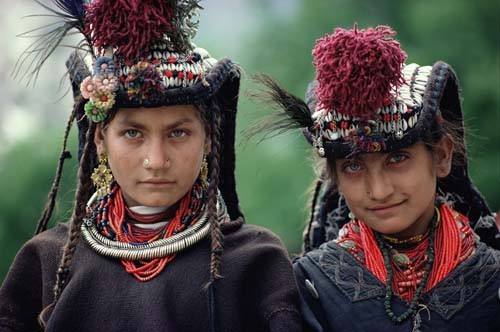
The Kalash: The Lost Tribe of Alexander the Great
by Aithon
Ex: http://www.creternity.com/
When the great hero and general, Alexander, who was as great as the god Apollo and Zeus, left his troops here, he asked them to stay here in this land without changing their beliefs and traditions, their laws and culture until he returned from the battles in the East. This is a story that is told not in a village in Greece but on the the mountainsides of the great Hindu Kush. In this remote area of the northwestern region of Pakistan lives a peculiar tribe, the Kalash. The Kalash proclaim with pride that they are the direct descendents of Alexander the Great. There are many similarities between them and the Hellenes of Alexander the Greats time. Similarities such as religion, culture, and language reinforce their claims to Hellenic ancestry.
The Kalash are a polytheistic people, meaning that they believe in many gods. The gods that they believe in are the twelve gods of Ancient Greece which makes them the only people who continue this worship! Gods such as Zeus, the god of gods, Apollo, the god of the sun, and Aphrodite, the goddess of beauty, are such gods that they pay homage to. Shrines which are found in every Kalash village remind us of the religious sanctuaries we would stumble across in Ancient Greece. They serve as houses of worship where prayers and sacrifices are offered. Oracles who played a major role in acting as mediators and spokespeople between the gods and the mortals still hold a position of importance in the social structure of the Kalash. Every question or prayer towards the gods is usually followed by a sacrifice of an animal. It is reminiscent of the sacrifices the Hellenes gave to the gods to assure them a victory over the city of Troy.
Religions always possess certain traditions and rituals which are observed by their followers. The Kalash practice a ritual that is celebrated on August 6th. This feast day is named the Day of the Transfiguration. It is the day where the grapes are brought out to the god Dionysus to be blessed and to guarantee them of a plentiful crop. This ritual can be traced back to Ancient Greece where it was practiced by the cult of Dionysus who paid their respect to the god of fertility and wine. An active member of the cult of Dionysus was Olympia, mother of Alexander the Great, who is said to have recruited many of her sons soldiers and who in return practiced it throughout their expedition (Alexandrou, pg. 184).
The Kalash also live a lifestyle that can be positively compared to that of the Ancient Greeks. Let us start with the observation of their homes. The Kalash are the only people in the East who make and use accessories such as chairs and stools that cannot be found anywhere else in the surrounding regions! Their chairs are decorated with drawings such as the rams horns which symbolize the horns that decorated Alexander the Greats helmet. Battle scenes depicting Greek soldiers are also observed. In the recent archaeological discoveries in Vergina, Greek archaeologists found the exact same replicas as the ones the Kalash use in their homes (National Herald, pg. 7).
As we know, Pakistan is a nation ruled by Islamic law. Under the law of the Koran alcohol consumption is prohibited. When we enter the region of the Kalash we encounter fields that are inhabited by grape vines. The Kalash are the only people who produce and consume wine and indulge themselves in feasts such as for the aforementioned feast of Dionysus. Greeks such as Socrates would participate in wine feasts such as we come across in the Symposium. Their feasts are always followed by songs and dances. The Kalash dance in a cyclical motion and the men usually follow it by loud cries of i-a and i-o which can be traced back to the battle cries let loose by Alexanders soldiers. There is a saying held by the Pakistanis who state that only the Greeks and the Kalash whistle in such a way (Alexandrou, pg 87).
In 1896 a British explorer by the name of George Robertson visited the Kalash and did a study on them. He concluded that fifty percent of the Kalashs language derives from Ancient Greek. Such similarities can be found in their gods names. Zeus is called Zeo, Aphrodite is called Frodait, the name Dionysus has kept the same pronounciation. The Kalash have words such as demos meaning city-state and use the word ela as an imperative command meaning come here. There was recently a tablet found in a village of the Kalash whose message was in the form of hieroglyphics. When the code was deciphered the message read, Alexander the Great lives forever (National Herald, pg.8).
In this article we have observed similarities between people of the past, the ancient Greeks and people of the present, the Kalash. Through these similarities the Kalash have justified their claim as descendants of Alexander the Great. Ancient Greece and the tales of Alexander the Great were once believed to exist only in history books. However as the article insists, these great legacies live on with the Kalash of the mountainous Hindu Kush.
BIBLIOGRAPHY:
Alexandrou Dimitris N., "Kalash, The Greeks of the Himalayans", Thessaloniki, Greece, 1997
00:10 Publié dans Histoire | Lien permanent | Commentaires (0) | Tags : histoire, antiquité, ethnologie, grèce antique, asie centrale, inde, himalaya, eurasisme, eurasie | | del.icio.us | | Digg | Facebook
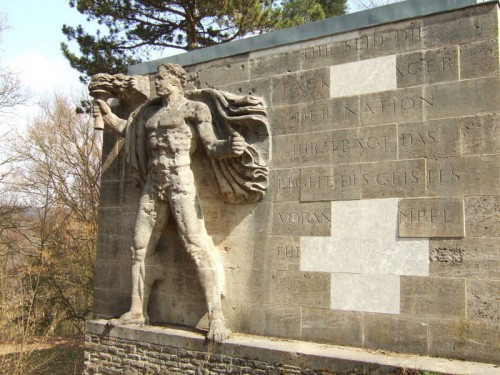
Le porteur de Torche de Willy Meller
00:10 Publié dans art | Lien permanent | Commentaires (0) | Tags : art, sculpture, allemagne | | del.icio.us | | Digg | Facebook
Figure du Partisan chez Schmitt, figures du rebelle et de l'anarque chez Jünger
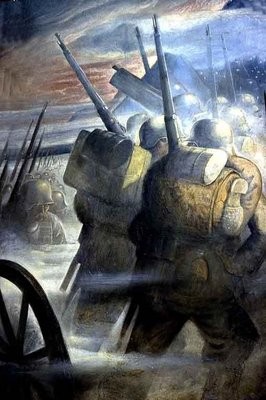
Figure du Partisan chez Schmitt, figures du rebelle et de l'anarque chez Jünger
(intervention d'Alessandra Colla - Université d'été de la FACE, 1995)
Les notions de rebelle ou d'anarque chez Jünger en impliquent une autre: celle du “recours aux forêts”. En recourant aux forêts, l'anarque (le rebelle) manifeste sa libre volonté de chercher lui-même sa propre voie et de se soustraire ainsi à la massification qui est le lot du plus grand nombre. Mais comment survivre dans le désert spirituel de cette massification? Dans Eumeswil, l'anarque, qui affine le concept de rebelle et le hisse à un niveau qualitatif supérieur, est l'homme qui veut affirmer sa propre liberté. Mais en dehors du système, avec ses propres moyens. Le rebelle, puis l'anarque, maintiennent leur propre identité, ils n'acceptent de jouer aucun rôle dans la société étouffante qu'ils cherchent à fuir. En revanche, ils cherchent leurs pairs, avec l'espoir ténu de former de nouvelles élites qui agiront directement sur les noyaux vitaux du système. Face à ces figures proches du rebelle et de l'anarque, le partisan de Schmitt est l'héritier des maquisards français, yougoslaves ou soviétiques de la deuxième guerre mondiale. Mais le partisan n'est pas en dehors de toute loi: il reçoit ses déterminations d'une instance extérieure à lui, sur laquelle il n'a aucune prise. Après son combat et en cas de victoire, le partisan se hisse au pouvoir et le rend aussi routinier qu'auparavant, donc aussi insupportable, aussi étouffant.
Débat: Le système produit des “décalés”, non des anarques, et peut se justifier par la présence même de ces “décalés”, prouver de la sorte qu'il n'est pas aussi totalitaire et étouffant qu'il n'en a l'air. Le “décalé” est celui qui se taille une toute petite sphère d'autonomie dans le système, sans en sortir, en profitant des avantages matériels qu'il offre: le “décalé” est donc un “Canada Dry” par rapport à l'anarque. Le marketing du système utilise l'atypisme formel du décalé, qui est ainsi parfaitement récupéré, sans le moindre heurt. L'anarque se caractérise par une discipline intérieure, par un travail en profondeur sur lui-même, qu'est incapable de parfaire le décalé.
(notes prises par Catherine Niclaisse).
00:05 Publié dans Littérature | Lien permanent | Commentaires (0) | Tags : philosophie, tradition, sciences politiques, théorie politique, politologie, lettres, lettres allemandes, littérature, littérature allemande, révolution conservatrice | | del.icio.us | | Digg | Facebook