

vendredi, 27 mars 2009
Tiberio Graziani: "Les Etats-Unis utilisent l'Europe comme tête de pont pour attaquer l'Eurasie"
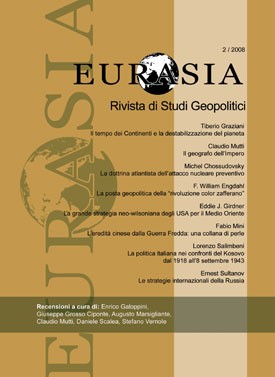
Tiberio Graziani:
“Les Etats-Unis utilisent l’Europe comme tête de pont pour attaquer l’Eurasie”
Entretien accordé à http://russiatoday.ru/
La crise financière mondiale ne concerne pas uniquement l’argent, même si elle a commencé à Wall Street”, nous explique Tiberio Graziani, éditeur du magazine italien “Eurasia”, qui se spécialise dans les études géopolitiques. Tiberio Graziani est également l’auteur de plusieurs ouvrages de géopolitique.
Q.: Dans le monde entier, les gouvernements ont adopté des mesures protectionnistes. Celles-ci touchent tous les niveaux de la société. En Italie, nous voyons que la population apporte son soutien aux politiques anti-immigrationnistes, qualifiées d’extrême-droite. Comment l’Italie peut-elle, comment pouvons-nous, tous autant que nous sommes, survivre à cette crise financière mondiale?
TG: D’abord, nous devrions réflechir aux raisons de cette crise financière qui a aussi touché la production au niveau industriel, aux Etats-Unis dans un premier temps, et ensuite dans tout le monde occidental, lequel se compose de tris piliers, les Etats-Unis, l’Europe et le Japon. La crise a touché l’ensemble du marché mondial. Pour l’Italie, les effets de la crise se sont manifestés un peu plus tard et, à mes yeux, ne s’afficheront dans toute leur netteté qu’en 2009 et en 2010.
Parce que l’économie italienne repose essentiellement sur des petites et moyennes entreprises, nous n’avons pas affaire, chez nous, à de fortes concentrations industrielles, raison pour laquelle l’Italie fait montre de davantage de flexibilité pour affronter et contenir la crise. Quoi qu’il en soit, la crise sera fort profonde.
Nous serons en mesure de surmonter la crise financière si nous parvenons à oeuvrer dans un contexte géo-économique continental. Cela signifie que nous devrons concevoir des modes de fonctionnement économique où les économies de pays émergents comme la Russie, la Chine et l’Inde joueront un rôle. La crise ne pourra se résoudre seulement à l’aide de recettes étroitement nationales ou par les effets de recettes concoctées uniquement à Bruxelles par la seule Union Européenne.
Q.: Parlons un peu de la récente crise gazière, où l’Italie a été bien moins touchée que les Balkans ou l’Europe orientale, mais a néanmoins été prise, elle aussi, en otage. La vérité sur cette crise a été occultée. Quelle est l’origine de la querelle?
TG: L’origine de la querelle gazière entre Kiev et Moscou? Elle est en réalité un effet de l’élargissement de l’OTAN en direction de l’Europe de l’Est et de l’extension de l’UE dans la même région. Ces deux élargissements parallèles ont été perçus à Moscou comme une agression occidentale contre son “voisinage proche”.
Ce type d’élargissement a commencé dès 1989, immédiatement après la chute du Mur de Berlin. A partir de ce moment-là, les Etats-Unis ont décidé de gérer à eux seuls l’ensemble de la planète. Dans cette optique, ils ont choisi l’Europe occidentale comme base de départ pour avancer leurs pions en direction de la Russie et de l’Asie centrale, car, comme chacun sait, l’Asie centrale possède d’immenses ressources en gaz naturel et en pétrole. Les Etats-Unis ont commencé par étendre leur influence sur les pays de l’ancien Pacte de Varsovie et sur quelques pays ayant auparavant fait partie de l’Union Soviétique, comme l’Ukraine.
A partir de 1990, l’Ukraine a entamé un processus de séparation, a cherché à détacher son avenir géopolitique de son environnement naturel et donc à s’éloigner de Moscou et de la Russie. Si nous analysons bien la “révolution orange”, nous constatons tout de suite que derrière les réalisations de cette soi-disant “société civile” ukrainienne, se profilaient des intérêts venus en droite ligne d’au-delà de l’Atlantique, téléguidés depuis Washington. Dans ce contexte, nous ne devons pas oublier l’influence de quelques “philanthropes” auto-proclamés tels George Sörös qui ont contribué à déstabiliser l’Ukraine et aussi les républiques de l’ex-Yougoslavie.
Lorsque l’Ukraine a abandonné, ou tenté d’abandonner, son environnement géopolitique naturel, qui lui assignait la mission d’être le partenaire privilégié de Moscou, il devenait évident que, pour les livraisons de gaz, Moscou allait imposer à l’Ukraine les prix du marché, puisque Kiev ne pouvait plus être considéré comme un client à privilégier mais comme un client pareil à n’importe quel autre. Les prix du gaz ont donc augmenté, une augmentation qui a également touché l’Europe, parce que les dirigeants ukrainiens se sont privés d’une souveraineté propre et ne sont mus que par des intérêts occidentaux. Au lieu d’envisager un accord économique, comme on le fait généralement entre pays souverains, l’Ukraine a aggravé la situation en siphonnant le gaz destiné aux nations européennes.
Cette véritable raison de la crise a été délibérément ignorée par la presse des pays de l’Europe de l’Est, mais aussi par la presse italienne. Dans la querelle du gaz, la plupart des journalistes italiens n’ont pas focalisé leur attention sur les causes réelles du conflit mais se sont complus à diaboliser le gouvernement russe, en l’accusant d’utiliser les ressorts de la géopolitique comme une arme dans le conflit gazier; or le Président Medvedev et le Premier Ministre Poutine n’ont fait que facturer au prix du marché les transactions gazières, selon les règles de la normalité économique.
Q.: Mais l’Ukraine est sur le point de défaillir. Les Russes ne doivent pas escompter que l’Ukraine paiera le prix du marché l’an prochain...
TG: Je crois qu’il est toujours possible de trouver un accord économique. Moscou et Kiev peuvent négocier un moratoire. J’aimerais bien rappeler qu’il ne s’agit pas seulement d’un problème économique, d’un problème d’import-export, mais d’un enjeu géopolitique majeur. A l’évidence, si l’Ukraine choisit de rejoindre le camp occidental sous le “leadership” de Washington, cette option atlantiste affectera dans l’avenir non seulement les transactions gazières, mais toutes les autres relations économiques. De ce fait, je crois qu’il sera possible, à terme, de trouver une solution économique mais l’obstacle vient de Kiev, parce que Kiev est inféodé aux intérêts de Washington.
Q.: Tournons nos regards vers Washington et évoquons les bases américaines sur le sol italien: qu’en dit l’opinion publique dans votre pays?
TG: La plupart des gens sont conscients que la présence effective de bases militaires américaines en Italie mais n’en tirent aucune conclusion politique. Ainsi, quand nous avons eu le cas de l’agrandissement de la base de Vicenza dans le nord de l’Italie, les arguments des adversaires de ces travaux étaient essentiellement d’ordre écologique. L’argument principal, qu’il aurait fallu développer, est demeuré occulté; en effet, l’agrandissement de cette base sert les forces armées américaines dans la mesure où elles auront l’occasion, dans l’avenir, d’entrer plus facilement en contact avec une base proche, située en Serbie, qui dépend aussi directement de Washington. Dans l’avenir, à partir de ces bases, les Américains pourront intervenir dans la périphérie de l’Europe et au Proche et au Moyen-Orient, contre des Etats comme la Syrie ou l’Iran et aussi, dans une certaine mesure, contre la Russie. La nation yougoslave, en l’occurrence la Serbie, n’a pas été choisie par hasard, mais parce qu’elle a des accointances culturelles et ethniques avec la Russie.
Q.: La crise gazière a tendu les rapports entre la Russie et l’UE car bon nombre de pays de l’UE sont en train de chercher des fournisseurs alternatifs. La Russie doit-elle s’en inquiéter?
TG: Non, je ne pense pas que la Russie doit s’en inquiéter. Je pense que chaque pays doit chercher les meilleures opportunités qu’offre le marché des ressources et viser l’autonomie énergétique. Dans un contexte géopolitique plus vaste, celui de l’Eurasie, je pense que les relations entre la Russie et l’Europe, entre la Russie et l’Italie, devrait reposer sur les intérêts économiques. Nous devons échanger de la haute technologie, des technologies militaires, des ressources énergétiques et, bien entendu, procéder à des échanges culturels. Je pense que les échanges culturels entre, d’une part, l’UE et l’Italie, et, d’autre part, la Fédération de Russie devraient être renforcés.
Après la seconde guerre mondiale, il y a plus de soixante ans, les relations culturelles entre l’Europe occidentale et la Russie se sont considérablement amenuisées parce qu’elles ont été sabotées par la classe intellectuelle dominante en Europe, qui soutenait le processus d’occidentalisation ou plutôt d’américanisation de la culture européenne. Si nous comparons les littératures européenne et italienne de ces récentes années avec celles des années 30, par exemple, nous constatons que beaucoup d’écrivains italiens utilisent désormais une langue viciée, incorrecte, avec trop d’emprunts à l’anglais. C’est l’un des résultats de la colonisation culturelle que nous a imposée Washington depuis la fin de la seconde guerre mondiale. Mais il serait tout aussi pertinent de remarquer que cette tendance au déclin se perçoit également dans les pays de l’ex-bloc soviétique.
Q.: Quelle est l’attitude globale de l’Italie à l’égard de la Russie? Les Russes peuvent-ils compter sur l’Italie pour qu’elle joue un rôle important dans l’amélioration des relations entre l’UE et la Russie?
TG: L’Italie est certainement, avec d’autres pays de l’UE, un partenaire potentiel de la Russie mais, pour devenir un partenaire réel et non plus seulement potentiel, l’Italie doit acquérir davantage de liberté et obtenir une souveraineté politique totale, qu’elle ne possède pas actuellement. J’aime répéter qu’il existe en Italie aujourd’hui plus de cent sites militaires dépendant directement des Américains, des sites qui sont partie prenante du projet américain d’étendre l’influence de Washington sur l’ensemble de la péninsule européenne. Dans de telles conditions, l’Italie et les autres pays européens se heurtent à des limites et ne peuvent exprimer sans filtre leurs intérêts propres sur les plans politique et économique. Il faut cependant reconnaître qu’au cours de ces dernières années, la politique économique des présidents russes successifs, Poutine et Medvedev, a jeté les bases qu’il faut pour que l’Italie devienne un véritable partenaire de la Russie, non seulement sur le plan économique mais aussi sur le plan politique et même, à mon avis, sur le plan militaire. L’Italie est au centre de la Méditerranée et occupe de ce fait une position stratégique importante. En outre, la position centrale de l’Italie est vitale au niveau géopolitique. Et ce serait une bonne chose si elle jouait de cet atout dans l’optique d’une intégration eurasienne.
Je crois que les relations entre l’Italie et la Russie s’améliorent; j’en veux pour preuve les initiatives d’entrepreneurs italiens, qui vont dans le bon sens, parce qu’ils contournent les limites imposées par un pouvoir politique qui réside, in fine, à Washington ou à Londres.
Q.: Vos critiques à l’endroit de Washington sont particulièrement sévères; vous décrivez les Etats-Unis comme une nation impériale alors que notre monde actuel n’est plus du tout unipolaire...
TG: Mes critiques à l’endroit de Washington sont sévères parce que les Etats-Unis ont inclu l’Europe dans leur propre espace géopolitique et la considèrent comme une tête de pont pour attaquer l’ensemble du territoire eurasien. C’est là la raison majeure de mes positions critiques. Mais, vous avez raison, il faut tenir compte de la situation réelle des Etats-Unis dans le monde actuel. Ceux-ci devraient se rendre compte que l’époque, où ils étaient la seule superpuissance, est révolue. Aujourd’hui, dans la première décennie du 21ème siècle, nous avons affaire, du point de vue géopolitique, à un système multipolaire avec la Russie, la Chine, l’Inde, les Etats-Unis et certains Etats d’Amérique du Sud, qui sont en train de créer une entité géopolitique propre; je pense au Brésil, à l’Argentine, au Chili, au Venezuela et, bien sûr, à la Bolivie. En effet, au vu des libertés que se permettent ces pays sud-américains, en constatant leurs audaces, l’UE devrait s’en inspirer pour quitter le camp occidental dominé par les Etats-Unis et la Grande-Bretagne.
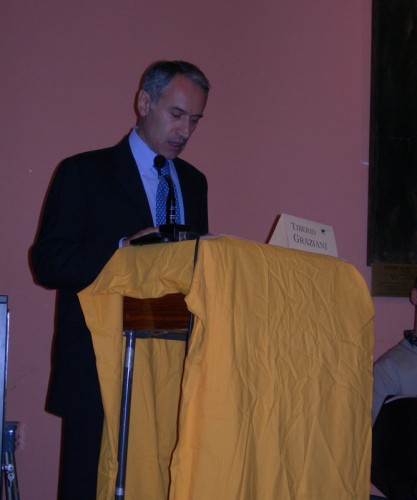
Q.: Vous voyagez beaucoup dans toute l’Europe et surtout dans les régions agitées et dans les points chauds. Vous avez participé à l’organisation des élections en Transnistrie. Il y a une île au large de la Sardaigne, qui faisait partie du territoire italien, et qui vient de déclarer son indépendance, en se disant inspirée par l’Abkhazie et l’Ossétie du Sud. Existe-t-il une formule universelle pour affronter le problème des séparatismes?
TG: Chacun de ces problèmes est foncièrement différent de l’autre. En Sardaigne, il y a un mouvement politique séparatiste depuis quelques années mais les gens qui le formaient font partie du gouvernement italien aujourd’hui. Pour la Transnistrie, il faut voir la situation sous l’angle géostratégique. Des pays comme la Moldavie et la Roumanie subissent le poids des Etats-Unis et de l’OTAN. La Transnistrie représente ce que l’on appelle un “conflit gelé”. Je pense que l’indépendance de la Transnistrie serait intéressante car nous aurions, dans ce cas, un territoire auquel les Etats-Unis n’auraient pas accès. Ce serait un territoire de liberté du point de vue eurasien parce que cette Transnistrie serait souveraine. Je n’analyse pas le fait que constitue cette république au départ des attitudes ou de l’idéologie du gouvernement qu’elle possède. J’analyse son existence dans le contexte géopolitique et géostratégique général. De ce fait, je prends acte que la Transnistrie est une république souveraine et que sur son territoire réduit il n’y a aucune base de l’OTAN.
(entretien paru sur http://russiatoday.ru/ ; 16 mars 2009; traduction française: Robert Steuckers).
00:38 Publié dans Eurasisme | Lien permanent | Commentaires (0) | Tags : eurasisme, eurasie, politique, géopolitique, crise, gaz, énergie, ukraine, russie, italie |  |
|  del.icio.us |
  |
|  Digg |
  Facebook
Revolutionary Conservative: Interview with Jonathan Bowden

REVOLUTIONARY CONSERVATIVE:
INTERVIEW WITH JONATHAN BOWDEN
Interviewed by Troy Southgate - http://www.rosenoire.org/
REVOLUTIONARY CONSERVATIVE: INTERVIEW WITH JONATHAN BOWDEN As conducted by Troy Southgate
Jonathan Bowden is the Chairman of the New Right and a man I am proud to regard both as a like-minded spirit and a friend. The following interview was conducted in the summer of 2007.
Q1: Your family background is a heady mix of Irish and Mancunian and you were brought up in rural Kent. Would you say that any of this helped to shape your intellectual development in any significant way?
JB: One’s origins obviously influence the way everything turns out in the end. I actually spent many of my formative years in the south Oxfordshire countryside, but I do admit that the Kent coast offers a certain draw. I was born in Pembury maternity hospital in mid-Kent in 1962 and the family later branched out into Bearstead after that. I remember a blue Volkswagen beetle, an extremely low-lying bungalow, roundabouts, that sort of thing… it was all very middle-class. I especially recall a Gothic moment from my own childhood; it concerned a mad woman or witch who lived up the way. She seemed to be a sort of Grendel’s mother – you know the kind. Anyway, rumour had it that she used to sit stark naked behind her letter box, dressed only in a black balaclava helmet, and any woman passing by would then be subjected to ferocious abuse. Scatology wasn’t the word for it, if you take my drift. Then, after a certain time had elapsed, the police would be called and she’d be sat there, dressed up to the nines, with cream teas and all the rest of it. It was essentially an elaborate attempt to flirt with, seduce or just fraternise with the local policemen. Then, as soon as they’d departed and she’d promised to behave, our wired sister would be back at the letter box fulminating. All other women were the object of her hate. No feminist sisterhood in evidence there, then. Its sexual hysteria and related screamings – I remember it all as if it were yesterday. My mother was terrified of her. We always had to go round the other way. Gothic or macabre things like that have always intrigued me – it’s the hint of chaos underneath bourgeois suburban conformism, you see. Life – when you stop to consider it – is really a painting through which people articulate their own death. What interests me is the artistry to it; it’s what our forebears, the Elizabethans, used to call the skull beneath the skin.
Q2: A few years ago now, you published a series of books under a different name. Tell us more about the themes involved and what you were trying to achieve at the time.
JB: Yes, I admit that your question is along the right lines. I’ve written a great deal down in the years and under various names – one of them happened to be John Michael McCloughlin, as I recall. I’ve certainly written between thirty and fifty books – depending on how you choose to look at it. At one level I’ve composed purely for myself – fiction, plays, non-fiction, memoirs, belle lettres, higher journalism, lyrics, prosody, experimental or stream-of-consciousness work, you name it. At present it’s all beginning to appear on the internet. My website – www.jonathanbowden.co.uk – contains one full manuscript. It’s an e-Book in PDF format. It’s entitled Apocalypse TV and consists of at least 100,000 words. It’s approximately 240 pages. A Platonic dialogue between a Christian and a pagan voice, it deals with Turner Prize art or the “Sensation” exhibition, criminology and the murders of Fred and Rose West, the concept of Political Correctness, all sorts of things. A short story, A Ballet of Wasps , also exists on the site. Hopefully – and before too long – a great deal of material will appear in this way. It’s essentially got to be scanned, edited, converted to PDF and then uploaded. A play which you have read, Troy, called Lilith Before Eve , has recently been added to the site. The following three short stories, Golgotha’s Centurion, Wilderness’ Ape and Sixty-foot Dolls , will appear relatively soon. There are also four more plays known as Glock’s Abattoir, We are Wrath’s Children!, Evolution X and ,i>Stinging Beetles, for example. Ultimately, one of my life tasks is to put all of it online and then see if publishers, small outfits, that sort of thing, would be willing to do hard copy versions. One point of interest: the publisher Integral Tradition Publishing has expressed an interest in possibly treating Apocalypse TV in the way I describe – although whether this will ever extend to a desire to publish full novels of mine, such as Al-Qa’eda Moth or The Fanatical Pursuit of Purity, is altogether another issue. But, rest assured, I will bring out everything I’ve ever done over time, even if it’s only in e-Book form on the internet. Politics is just a side-line, you see; artistic activity is what really matters. The one alters effects; the other changes the world. As Bill Hopkins once told me, one man sat writing alone in a room can alter the entire cosmos. It’s the ability – through a type-writer or whatever else – to radically transform the consciousness of one’s time. Cultural struggle is the most interesting diversion of all. There’s a Lancastrian truism that my mother retailed to me: “truth is a knife passing through meat”. Well, in this particular freeway one special coda stands out – you must become your own comet streaking across the heavens – all else is just a matter of flame, spent filament, rock or tissue, en passant, which slopes off to the side. Avoid those stray meteor shoals casting off to one’s left; they are just the abandoned waifs and strays of a spent becoming. Let your life resemble a bullet passing through screens: everything extraneous to one’s task recalls such osmotic filters. (I’d especially like to thank Daniel Smalley and Sharon Ebanks for their manifold assistance with these websites. Sharon’s earlier contribution was the following: www.jonathanbowdenart.co.uk). Do you wish to survey something I’ve just written? It’s a bit of a prosody based on a Futurist painting by Fortunato Depero called Skyscrapers & Tunnel (1930).
Do they make the most Of a tubular scene-scape Designed without cost And collapsing into date Crepe rape spate fate constant ingrate?
Q3: Please tell us how you came to be involved in the Western Goals Institute, a vociferously anti-liberal and anti-communist tendency which originated in 1989 as an offshoot of the American ultra-conservative group of the same name.
JB: Yes, the organisation known as Western Goals was a bit of a shape-shifting entity – it began as Western Goals UK and then transformed itself, eventually, into the Western Goals Institute. Later still it recomposed itself into the British chapter of the World League for Freedom and Democracy; a group which, as it didn’t believe in either freedom or democracy, was rather amusing. I gave them my support – I was actually deputy chairman for a while – because I agreed with a merciless prosecution of the Cold War. Right-wingers of every type and race aligned across the globe against communism. The war had to be fought tooth and branch. I essentially concurred with Louis Ferdinand C’eline’s mea culpa about Marxist-Leninism – after having toured the Soviet Union on the proceeds of Journey to the End of the Night and Death on Credit. Don’t forget that the third world war, to use a different nomenclature for the Cold War, proved to be an alliance between Western hawks or rightist liberals and neo-fascism across the Third World. Groups like Unita, Renamo, Broad National Front (FAN), the Triple A, the United Social Forces, The Konservative Party and HNP, the Contras and Arena – never mind Ba’athism… all of these tendencies were Ultra in character. Had they all been Caucasian in profile, such groups would have seemed indistinguishable from the OAS or VMO. It was vitally necessary to delouse those “communist peons of dust”… to adopt a line from a stanza by Robinson Jeffers. I have always believed with Mephistopheles in Goethe’s Faust, whether paraphrased by Sir Oswald Mosley or not, that in the beginning there is an action.
Q4: Shortly afterwards you founded the Revolutionary Conservative Caucus with Stuart Millson. What were the reasons behind the establishing of this group and, realistically, how much do you think it managed to achieve?
JB: Ah yes, the Revolutionary Conservative Caucus and all that jazz. Where have one’s salad days gone? Anyway, the RCC was set up by Millson and myself as a cultural struggle tendency. Never really conservative, except metaphysically, it wanted to introduce abstract thought into the nether reaches of the Conservative and Unionist party – an area habitually immune to abstract thought, possibly any thought at all. There have always been such ginger groups – Rising, National Democrat and later Scorpion, Nationalism Today, Perspectives, the European Books Society, the Spinning Top Club, the Bloomsbury Forum and now the New Right. The important thing to remember is that these groups are fundamentally similar – irrespective of distinct semiotics. The system of signs may jar, but, in truth, all of them are advocating radical inequality and meaning through transcendence… that’s the key. As to accomplishments or achievements… well, they were really twofold: first, the mixing together of ultra-conservative and neo-fascist ideas; second, a belief in the importance of meta-politics or cultural struggle. By dint of a third or more casual reading, various publications like Standardbearers , Oswald Spengler’s essay Man & Technics , the ‘Revolutionary Conservative Review’, a brief and intermediate magazine called Resolution and the ultra-conservative journal Right Now… all of these formulations came out of this nexus. It’s a creative vortex, you see? Let’s take one example: my interview with Bill Hopkins in Standardbearers… this links right back to the fifties Angry Young Men and to Stuart Holroyd’s productions in Northern World, the journal of the Northern League. This interconnects – like Colin Wilson writing for Jeffrey Hamm’s Lodestar – with not only Roger Pearson but also the fact that members of the SS were in the Northern League.
Sic cum transierint mei Nullo cum strepitu dies Plebeius moriar senex. Illi mors gravis incubat Qui notus nimis omnibus Ignotus moritur sibi.
It’s this which has to be avoided.
Q5: Your first association with the New Right was as a guest speaker at the very first meeting in January 2005. What made you want to become more involved with the group and what role do you think it can play in the future?
JB: I became involved because of a residual respect for what the New Right and GRECE were trying to achieve. For my own part, this has something to do with the fact that the New Right wishes to bring back past verities in new guises. It ultimately recognises an inner salience; whence the Old Right enjoyed a Janus-faced discourse: whether esoteric or exoteric in character. Do you follow? Because the outer manifestation tended to be conspiratorial, however defined. Whereas the innermost locution rebelled against old forms, postulated a Nietzschean outlook and adopted a pitiless attitude towards weakness in all its forms. Irrespective of this, the New Right recognises that fascism and national-socialism were populist or mass expressions of revolutionary conservative doctrines. Indeed, the Conservative Revolution is tantamount to Marxism on the other side: the truth of the matter is that Evola, Junger, Spengler, Pound, Moeller van den Bruck, Bardeche, Revillo P. Oliver, Rebatet, Brasillach, Jung, Celine, Wyndham Lewis, Yockey, Bill Hopkins and Arthur Raven Thompson, say, are actually to the right of their respective political movements. It’s the same with the extreme left on the other side – whether we’re talking about Adorno, Horkheimer or Althusser. Who’s ever really read Sartre’s The Dialectic of Critical Reason? As to any influence our group might have… well, perhaps it would be best to put it in this manner. I think that the New Right can prove to be a nucleus for illiberal thinking, albeit of a revolutionary and conservative character. Take, for example, Tomislav Sunic’s thesis, Against Democracy; Against Equality – a History of the European New Right. In this purview it becomes obvious that the Conservative Revolution was the seed-bed or think tank for fascism and national-socialism, much in the manner that theoretical Marxism was for communism. In the latter’s case, one only has to think of Adorno and Horkheimer’s The Dialectic of Enlightenment as the forcing house for ‘sixties revolutionism – far more, say, than Marcuse or the Situationists. Percy Bysshe Shelley, in Paul Foot’s terms Red Shelley, once described poets as the unacknowledged legislators of mankind. But, in all honesty, if we were to substitute the word intellectual or philosopher for poet then you might be nearer the mark. (All of which isn’t to take away for a moment the impact of poets like Kipling, Robinson Jeffers or the blind and recently deceased bard John Heath Stubbs, for example). Yet, I say again, one thing that we must deliberate upon is the power of conception. A man who possesses an idea or a spiritual truth is the equivalent of fifty men. Every pundit, tame journalist, academic or mainstream politician is mouthing hand-me-down ideas from a philosopher of yesteryear. At one level artists and intellectuals have no power whatsoever; undertake a parallax view or examine it in a reverse mirror, then you will see that they are matters of the universe. For those who have heard of Mosley, Degrelle, Jose Antonio Primo de Riveria, Mussolini, even at a push Julius Caesar; figures of Bardeche, Thomas Carlyle, Spengler and Lawrence R. Brown will remain forever arcane and mysterious. But fate’s mysterious witching hour knows that you can never have one without the other.
Q6: How did you reconcile your role as Chairman of the New Right, a self-proclaimed elitist and anti-democratic group, with your former position as Cultural Officer of the British National Party (BNP)?
JB: I feel that there was no great contradiction between the New Right and the British National Party. It’s a conundrum that revolves around the exoteric-esoteric fissure mentioned before. The British National Party is a populist or nativist group – it currently has about fifteen percent electoral support across Britain. No campaign and one leaflet garners a tenth of votes. Any sort of campaign nets 15%+; whereas a full-on methodology, Eddy Butler style, can get up to a fifth or a quarter of the vote. Bearing in mind that England is now fifteen per cent non-white then these margins represent an even higher proportion of Caucasia. Given this, the party represents a plebiscitary wing, the organisation’s inner spine are (for the most part) traditional nationalists; whereas their mental fodder needs to be provided by groupings like the New Right. Hierarchically speaking, the new reformats the old, albeit with a new cloak. Let’s put it this way: New Right sensibility sublimates Julius Evola’s The Metaphysics of War into Nietzsche’s The Will to Power. You have to understand that on the doorstep a small proportion of electors can vaguely recollect what country they’re living in… never mind anything else. Philosophy blinds them to a dance of sharp-toothed wolves. My, what large teeth you have, Granny – said little Red Riding Hood. Never mind: the real point is to achieve transcendence or becoming. Let’s begin with Voice of Freedom turning into Identity, inter alia, which leaps upwards to New Imperium – a step to the side of which might really be Bill Hopkins’ essay, Ways Without Precedent, in the volume of essays which served as the Angry Young Men’s manifesto. It was called Declarations. Yet perhaps even a step beyond this actually exists. Doesn’t one of Elisabeth Frink’s sculptures of a Soldier’s massive cranium – or one of her Goggle-heads, perchance – indicate a move ahead into aesthetic puissance? Everything that exists is about to transmute into a superior variant, an intellectual and spiritual speck of light which exists over it. As a BNP activist who’d been electioneering in the streets of East London once told a journalist; “If there’s nothing above you then there’s nothing to aspire to”.
Q7: Is there any real difference between the natural ascendancy of the strong over the weak – a recurring theme in your speeches – and the ruthlessness of capitalist economics?
JB: Again, as before, my answer has to begin and end with a postulation of hierarchy tout court. Do you see? It all has to do with the fact that economics is the lowest level of social reality. It remains purely material. Despising it is no good; what you have to do must be to effectively transcend it. The neo-utilitarian economist, Arthur Marshall, who was active at the turn of the twentieth century once famously described his subject as the dismal science. Just so… literary-minded types have always preferred belletrists of finance, whether J.K. Galbraith or Hilaire Belloc’s Economics for Helen. What you need to do is accept the market as the basis for a national economy that will be mainly privately owned, as Tyndall advocated in the Eleventh Hour, and then impose implacable political ethos on it from above. Politics must master economics; businessmen must be made to be spiritually subordinate to spiritual verities: the supreme expression of which is Art. Money then serves higher interests to which it is beholden – not the other way around. In all vaguely autocratic systems the economy operates in the way I’ve described. Ultimately you have to teach people not that money is the root of all evil – that’s purblind Biblical moralising – but that capital proves to be little more than fuel. To start up your car you need to put the key in the slot. Economic activity then has to serve the national community – not the reverse. As to the alleged ruthlessness of capitalist economics – that’s largely Darwinian romanticism. Does an eagle suffer from pity as it tears its prey to pieces in the stump of a tree? Anyway, do you really suppose that we have an unfettered market after over a century of state intervention or social democratic manipulation of its mechanisms? The only real success the far-left’s ever had was to provide shot-gun marriages for statist institutions in the West. New liberals designed pension, health, credit, insurance and social housing schemes in order to buy off proletarian rebellion from below. It owed as much to the far-right as the accredited Left – hence Skidelsky’s hero-worshipping of Mosley in his biography of that name. (This author moved from being right social democrat to a left conservative at a later date). Likewise, Sir Oswald Mosley’s New Party contained Marxian economists and social commentators like John Strachey – later to be Minister of Food in the post-war Labour government. The real point has to be the metaphysical guiding post behind Mosley’s post-war treatise, The Alternative. Subordinate economics to the meaning of politics not its management. The whole point of a political class is to impose a morality on the market – as Heseltine, of all people, once said, market economics has no ethical system otherwise. Von Hayek’s methodology of the implicit moral goodness of markets (because self-correcting) is flawed. But de Benoist’s attack on an advocacy of jungle law – whether directed at von Mises, Hayek, Friedman, etc… falls sheer. Why so? Because all that’s wrong with primitivism, brutalism and what Ragnar Redbeard called Might is Right has to be an absence of culture. That’s the salient point to remember. No Sistine chapel ceilings would ever have been painted without a systematic metaphysic to master gold. Put it in its proper place, why don’t you? Yet you can only do so after its creation. In this custodianship Sir Digby Jones, the former director general of the CBI, has to find himself subordinated to the manifestation of those eight symphonies by Sir Peter Maxwell Davies.
Q8: How ‘new’ is the New Right?
JB: It is clear to me that the New Right is diverse and diachronic in form. Like the refracted sides of a cerulean gem it casts many different slants afoot. All of these shimmer and break against a dark glass. To be truthful, the biggest disjunctions between old and new have to do with reductionism, conspiracy and revisionism. The old accepts the first two categories and could be said to have reformulated itself by virtue of the third. Perhaps we could go as far as to say that Revisionism is the reworking of the Old Right in modern guise – revisionist literature could then be considered to be the Old Right’s research and development. Just so… maybe Butz, Samning, Steiglitz, Baron, Berg, Harry Elmer Barnes, Rudolf, Mattogno, Graf, Faurisson, Zundel, Rassinger, Joachim Hoffmann, Heddessheimer, et al, are really Maurras, Weininger, Brasillach, Drieu la Rochelle, Celine, Barres, Revilo P. Oliver, Yackey, Ezra Pound, Jack London and Rossenberg… all come round again. I think, in these circumstances, that the New Right is a differentiated codex or semiotic – it enables a great deal of radical conservative material to return, maybe in a new guise. Although another point should be made, in that ultra-Right movements tend to have an occult trajectory. They manifest two sides: the esoteric and the exoteric. This can be considered to be a polarity between internal and external. For the masses Jean Respail’s Camp of the Saints or Christopher Priest’s Fugue for a Darkening Island; for the elite Count Arthur de Gobineau’s Essay on the Inequality of the Human Races . To quote yet another example – for mass taste Kolberg or Der Ewige Jude; for elitist consumption Leni Riefenstahl’s Olympia or the Italian film industry’s version of Ayn Rand’s We the Living. Even Hans Jurgen Syberberg’s seven hour epic, Hitler: a Film from Germany, strives for neutrality in an area where only negative partisanship is allowed. In this context Steukers, Sunic, Gottfried, De Benoist, Walker, Lawson, Krebs and so forth, are the inner elitism or vertical dimension amidst a general carnival. They are less the meat in the sandwich than the inner pagan and non-humanist core to ideas which the residuum cannot grasp unless they are put in a more basic form. It must only be true the less it is understood, in other words… By virtue of our silk-screening, reductive and metaphysical conspiracies are materialisms. They are explanations on a physical level. New Right discourse internalises and sublimates this doxa; it circulates it as spiritual velocity. Aesthetically speaking, what can be transmuted – for a philistine or mass public – as Max Nordau’s Degeneration becomes Ortega Y Gasset’s The De-humanisation of Art at a more advanced illustrative push. Perhaps, even as a reverse dialectic, Wyndham Lewis’ The Demon of Progress in the Arts provides an overlapping negation to Y Gasset’s thesis – all prior to a new or renewed synthesis. Ethnically speaking, one might aver that The Turner Diaries amount to the outside face of the Bell Curve’s Junction. Artistically again, doesn’t Ayn Rand’s The Fountainhead provide a fusion, in mock-libertarian guise, of internal and external messages in a bottle? Whereby the heroic modernist Roark – based loosely on the living example of Mies van der Rohe – overlaps with the neo-classical sculptor ‘Steve’. A character which was loosely based on Gustav Thorak, an artist who’s heroic figurine, Atlas, outside the grand central station in Chicago influenced Ayn Rand’s last right-anarchist novel, Atlas Shrugged. I would go so far as to say that the New Right is a toxic cerebration to the Old Right’s fist: in musical terms it’s Screwdriver becoming Laibach and then morphing into Carl Orff. But isn’t Verese’s noise brought back into focus by Igor Stravinsky’s The Right of Spring? After the performance of which – the master Stravinsky had to be guarded at his concerts, like a prize fighter. Diaghilev strove to remain highly jealous throughout.
Q9: You have a keen interest in Modernism. Why does this form of artistic expression appeal to you most and what, in your opinion, makes Modernism so superior to Modern Art?
JB: Ah yes, the issue of Modernism… I’m an ultra-rightwing modernist, let’s make that clear. Even though some of my work is traditional, restorationist, historical and semi-classic in spirit… nonetheless, I’m a modernist, even on some occasions an Ultra-modernist. Let’s be definite about this: some of my pictures do relate to Bosch, Redon, Klimt, Bacon, Pacher, ancient Greek sculpture and so on, but primarily I wish to create new and ferocious forms. They must come from within; what you really require is an image the like of which no-one has ever seen before, even dreamt of prior to your conception. Bacon always declared that he wanted to paint the perfect cry, after the fashion of the nurse on the steps facing the White Guards in Battleship Potemkin. I never wished to paint the greatest scream a la Poussin’s Massacre of the Innocents. No. For my part, I wanted to paint the most ferocious image of my time – these works are not neurotic, paranoid, schizoid, disturbed or mentally ill, as some might suggest… they are passionate integers of fury. The effort is to project strength and power. One cares nothing for the aesthetic standards of the masses; they are children who only like what they know or feel comfortable with. What really matters has to be the ecstasy of becoming – early or classic modernism happened to be exactly that. It was an attack on sentimentality; it proved to be an art purely for intellectuals. It was anti-humanist, elitist, inegalitarian, vanguardist, misanthropic, sexist, racist and homophobic – all good things. It gave witness to the neo-classic bias within the Modern that related to the theories of T.E. Hulme, a revolutionary conservative, and Ortega Y Gasset, a mild fascist. In the latter’s Dehumanisation of Art he preaches a new style against the Mass – that notion has always intoxicated me; to trample upon the masses and synthesise them into a new evolutionary surge has to be our object. The failure of extremist conservatism, fascism and national-socialism was material; revolutionary right-wing ideas may only really flourish spiritually: art has to be its vehicle; the stars its limit… homo stultus, the putty. Early modernism found itself penetrated by these ideas… only much later did it become a vehicle for liberal humanism. A move which in and itself related to the academic, restorative and conservative aesthetic tendencies in Soviet and Nazi art. One of the ironies is that revolutionary art becomes liberal wall-paper; while revolutionary movements adopted philistinism as their watchword. Their anti-formalism became a rigid fear of upsetting the majority. Art partly exists to disturb expectations, but liberal anti-objectivism has gradually dissolved this influence. An image like Tato’s March on Rome becomes more and more diffuse… until you end up with a David Hockney sketch, a Yorkshire scene bathed in light, and adorning a corporate office anywhere in the world. But let’s not fall into the trap of talking about the revolution betrayed – that’s such a bore. Also, revolutions are always betrayed; that’s their purpose. It’s only then that we recognise the salient truth: namely, they are part of life’s warp and weft. They have to be taken - to use Truman Capote’s axiom – in Cold Blood. A dilemma which brings us to the exposed issue of post-modernism, I dare say.
Q10: A talented and accomplished artist, you have produced over 200 paintings of your own. What first motivated you to take up painting, and how would you describe your own inimitable style?
JB: Unlucky for some, eh? Well, let’s look at it in this way… between around six or thirteen years of age I used to draw comics or graphic novels. They were my first form. Around two thousand images definitely came into the world as a consequence of these endeavours. They were my first love, I suppose – primarily due to their combination of words and images. A factor which also accounts for my interest in the graphic, the horrific or Gothic, the linear and the pre-formed. Contrary to the desiderata of pure modernism, in graphic work you always know where you’re going but not necessarily where you intend to end up. After a brief gap – grammar school and so on – I started to produce images again. Yet now a subtle change had taken place. The pictures underwent a metamorphosis into full-scale paintings and over around thirty years have mounted up to at least 215 works. Some of the early ones are framed; others not. Around 175 or 177 (depending) are available for viewing on my website (www.jonathanbowden.co.uk), sundry sketches and preliminaries will follow… and the coup de gras shall be those graphic novels which await scanning and upload at a later date. Personally speaking, I find them to be captivating in their allure. They are extremely varied in their focus – some are ferocious, savage and expressionist; others are erotic, playful and sensual; still more have a classic, restorationist or historical bias; while the remainder embody autobiographical and ideological themes. Some pertain to child art or the ramifications of Art Brut: that is, a willing or known primitivism in terms of artistic silence. Certain other paintings are literally portraits of people known to me; whilst early on I experimented with the psycho-portrait – here you illuminate a person’s nature and not their looks. Although eschewing abstraction – unlike Norman Lowell – I’ve never been interested in pure representationality after the invention of photography to do it for you. Do you recall those nineteenth century series of photographs by the master Edward Muybridge? He was one of the great pioneers of slow-motion, frame by frame photography when this art or science was in its infancy. A sequential art motif featuring two men engaged in Graeco-Roman wrestling has to be an early classic. These images in particular had profound influence on Francis Bacon’s oeuvre. Anyway, if we examine it closely then this tradition splits several ways. It leads to the strip cartoon, the cartoon or funny, comics and the story board – a development that prepares the ground for early silent cinema. So inter alia, the fantastical and linear presentation of action becomes art’s necessity. All of which involves going inside the mind so as to furnish provender – imagination then facilitates change, transmutation, forays from within and the custody of inner space. An eventuality which portends Modernism – why don’t you think of me as a heterosexual version of Francis Bacon? Maybe you could construe yourself, Troy, as the famous critic David Sylvester with whom Bacon had a well-known artistic dialogue in Plato’s tradition. Thames and Hudson published it years ago.
Q11: In his recent book, Homo Americanus, the Croatian author Tomislav Sunic notes that “postmodernity is hypermodernity insofar as the means of communication render all political signs disfigured and out of proportion.” (p.150)? What is your view on post-modernism and hyper-modernism?
JB: I actually question whether the concept of hyper-modernity actually exists, but we don’t want to end up in a cul-de-sac of meaning and response. By no means… Do you happen to recall that story by H.P. Lovecraft, Pickman’s Model, where the artist’s baying creature at the end of various Old Bostonian tunnels was taken from life? That’s the point… Anyway, in Tomislav Sunic’s Homo Americanus, which I have to admit that I had a hand in editing, he makes a situational point about post-modernism. Note: Situationism was a literary theory of excess, somewhat ‘terrorist’ in spirit, which grew out of a fragment of late surrealism. Its chief text was Guy Debord’s The Society of the Spectacle. Certainly the notion of a twenty-four hour media circus which penetrates everything, cyclonically, has come to be seen as a cliché. Nowadays , a thinker like Jean Baudrillard just tidied up post-modern excess and evinced an ironic distance over any attachment to left radicalism. Post-modernity is really about patterning. It’s an Asiatic or Oriental deportment; one in which displaced tarot cards are endlessly displaced and new meanings then become attached to them. It self-consciously adopts a mosaic’s inflexions, but variously complex or contradictory currents enter into the mixture here. Yet misnomers abound: Stravinsky’s neo-classicism early on in the twentieth century is definitely post-modern in feel… yet historically it can hardly be described as such. Whereas an extremist modernist text written after the Second European Civil War by Samuel Beckett, Comment C’est (How It Is), could be delineated as a post-modern elixir. In it two forms – vaguely reminiscent of the actors Patrick Magee and Max Wall – drag themselves across plateaus of mud towards an uncertain future, mouthing imprecations all the while. Also, there is a complicated interaction between post-modernist diction and historical revisionism over the Shoah. Its extreme relativism, metaphysical subjectivism and heuristic bias lend itself to micrological analysis, rather like Kracuer’s estimation of the German film industry. Nonetheless, the hermeneutical pea-souper which clings to Paul de Mann’s Blindness & Insight definitely has something to do with his own partiality for writing on behalf of Leon Degrelle-like journals during that conflict. Paradoxically though, deep textual analysis or criminological fare, rather like Faurisson’s exegesis, can quite easily dovetail itself with Thion’s post-structuralism, whereby all media certainties become questionable. As to hyper-modernity, what can one say? Perhaps it relates to the mass media’s electronic self-consciousness – the self-consciousness of its own self-consciousness, if you like. Now post-modernism truly behaves like a serpent devouring its tail, or the Worm Ouroborous. It also betokens those cinema audiences in the ‘fifties, metaphorically, who sat in darkened flea-pits watching in X-Ray specs. Possibly hyper dims post-modernity, if only to provide its apotheosis and defeat. A chimpanzee sits before a Sony Playstation playing a Gulf War game with News 24 alive in the background… maybe the latter scenes in Pierre Boulle’s novel, Monkey Planet, have a certain salience. Particularly when these gestures are interestingly spliced with Christopher Priest’s racialist science-fiction novel, Fugue for a Darkening Island… the one with a piece of Ploog-like fantasy art on the cover. A neglected work – it nevertheless intones values similar to those of a British Camp of the Saints. The point to make throughout all of this, however, is that culture cannot just elicit a significatory response. It must entertain an essentialist or organic bias (even in its existential mists) – otherwise it’s meaningless. One can then look forward to conceptual art replacing an art of concepts; wherein Stewart Home’s interpretation of Manzoni’s cube smears over Kipling’s The Stranger.
Jonathan Bowden may be contacted in writing via BCM Refine, London WC1N 3XX, England.
| Home | Articles | Essays | Interviews | Poetry | Miscellany | Reviews | Books | Archives | Links |
00:23 Publié dans Révolution conservatrice | Lien permanent | Commentaires (0) | Tags : nouvelle droite, synergies européennes, conservatisme, conservatisme révolutionnaire, droite, angleterre, théorie politique, esthétique politique | | del.icio.us | | Digg | Facebook
Machiavelli's Stellingen over Staat en Politiek
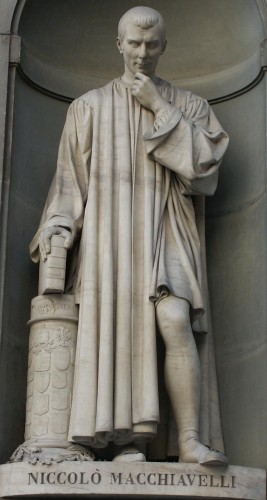
Machiavelli's Stellingen over Staat en Politiek
Machiavelli was een Middeleeuws politiek denker (15e eeuw) die ook bepaalde functies bekleed heeft in de republiek van Florence. Maar over zijn leven en carrière ga ik het niet hebben, wel over zijn boek ‘Discorsi’. Machiavelli schreef ook het bekendere (maar kleinere) boek “De Vorst” waarin hij uitlegt hoe een vorst zich moet gedragen in specifieke situaties.
Voor ons is dit echter vrij irrelevant en ik ga mij dan ook beperken tot het meer omvangrijke en inhoudelijk sterker ‘Discorsi’. Hierin brengt Machiavelli ideeën naar voor over staat en politiek. Hij beschrijft hierin de ideale staat, de schepping ervan, de hervorming ernaar, de organisatie ervan, enz. Maar ook hoe vorsten moeten reageren in bepaalde situaties, hoe samenzweringen organiseren en (Middeleeuwse) militaire strategieën komen aan bod. Ik zal me bij dit artikel beperken tot de relevante aspecten.
Uit de geschiedenis valt veel te leren
Machiavelli ziet de geschiedenis als een steeds wederkerende cirkel (1) wat wil zeggen dat elk huidig probleem zich in de geschiedenis al eens heeft voorgedaan en er dus ook al eens een oplossing voor is gevonden. Uit de geschiedenis kan dus geleerd worden, men moet het wiel immers geen tweede keer uitvinden! Om zijn ideale staat te vinden gaat Machiavelli dan ook in de geschiedenis op zoek en hij vindt deze in de Romeinse Republiek (Niet te verwarren met het Romeinse Keizerrijk!). Hij baseert zich daarvoor op het werk van Titus Livius, een Romein die de hele geschiedenis van de Romeinse Republiek beschreven heeft.
6 staatsvormen
Welke staatsvorm moet er nu gekozen worden volgens Machiavelli? Er bestaan volgens hem zes: drie goede en drie slechte. De drie goede zijn monarchie, aristocratie en democratie. De drie slechte zijn de tegenpolen van de drie goede: tirannie, oligarchie en anarchie. Als een volk geregeerd wordt door een vorst, dan kan deze makkelijk door zijn onbeperkte macht een tiran worden. Door zijn schandalig gedrag kan de adel schrik krijgen voor de vorst en zal deze uiteindelijk afzetten. De aristocratie zal echter snel op hun beurt het volk gaan uitbuiten en een oligarchie worden. De bevolking zal in opstand komen en een democratie stichten. Deze zal door besluiteloosheid rap afglijden naar een anarchie. Er zal weer nood zijn aan een krachtig figuur en zo zitten we weer bij de monarchie. Deze cyclus wordt volgens Machiavelli door elk volk doorlopen, al kunnen er natuurlijk wel eens wat stappen overgeslagen worden. Deze cyclus kan echter maar een paar keer doorlopen worden door een volk voor het ten prooi valt aan de inval van een sterker volk of gewoon ten onder gaat aan zichzelf.
Alle bestuursvormen zijn dus slecht volgens Machiavelli daar de drie goede te vlug afglijden naar hun slechte tegenpolen. Het ideaal bevindt zich dus in de combinatie van de drie goede staatsvormen die elkaar onderling controleren. Voorbeelden hiervan zijn de Romeinse Republiek, maar ook Sparta, welke het langst durende rijk ooit was. Dit in tegenstelling tot de nu zo bejubelde Atheense democratie die nooit langer dan 100 jaar heeft bestaan!
Organisatie van de Romeinse Republiek
Uit de adel werd een senaat gekozen die wetsvoorstellen kon maken en deze bekrachtigen. Uit het volk werden tribunen gekozen. Deze hadden vetorechten om het volk tegen de adel te beschermen. Ze hadden dus een negatieve macht en waren soms zelfs even machtig als de consuls. Er werden twee consuls verkozen die de republiek feitelijk bestuurden als een soort presidentsduo met veel macht. Een ervan werd verkozen uit de tribunen en een uit de senaat. Deze twee werden voor één jaar benoemd. Legercommandanten werden op een gelijkaardige manier verkozen.
Beperkt mandaat (2)
Dat deze functies beperkt werden in de tijd was volgens Machiavelli zeer belangrijk aangezien verlenging van mandaten nefast is voor de vrijheid van een volk. Vrijheid is immers het belangrijkste voor een volk, maar daar later meer over. Door de verlenging van zijn mandaat als legercommandant kon Julius Caesar immers het complete vertrouwen van zijn legioenen winnen en de macht grijpen in Rome. Dit betekende het einde van de Romeinse Republiek en het begin van het Keizerrijk. Dit moment wordt dus door Machiavelli als het begin van het einde gezien. Caesar is dus geen held zoals hij tegenwoordig word voorgesteld maar een machtswellusteling die niet geïnteresseerd was in het welzijn van het volk. Het Romeinse volk verloor toen immers zijn vrijheid en kreeg het nooit meer terug! Sindsdien is het Romeinse Rijk ook nog maar marginaal gegroeid afhankelijk van de capaciteiten van de Keizers. Dat de president van de VSA maar een maal herkozen kan worden heeft dus zijn nut. In Venezuela probeert de communist Hugo Chavez de absolute macht te grijpen door deze wijze maatregel uit de grondwet te laten halen.
Een ander voordeel van beperkte mandaten is ook dat meer mensen ervaring opdoen op het hoogste niveau, wat altijd nuttig is in tijden van crisis. Ook bemoeilijkt het weer dat er één persoon de absolute macht kan grijpen.
Leeftijd speelt geen rol (3)
Termijnen mochten dan wel beperkt zijn in de tijd, voor de benoeming tot de hoogste functies werd geen rekening gehouden met de leeftijd of afkomst (stand) van de kandidaat. Zo is er ooit een consul verkozen die slechts 23 jaar was! Capaciteiten gaven dus de doorslag, wat volgens Machiavelli een teken van de grootsheid van een natie is. Dit begint ook bij ons eigenlijk nu pas ingang te vinden, 20 jaar geleden moest je immers nog bijna bijaard zijn om kans te maken minister te worden. Men vond dit vroeger dan ook meestal enkel terug bij totalitaire systemen, die wel capaciteiten boven leeftijd verkozen.
Geen pensioen (4)
Een ander teken van grootsheid volgens Machiavelli is dat politici (of militaire commandanten) die topfuncties bekleed hebben na het aflopen van hun mandaat niet op pensioen gaan maar willen verder werken onder het commando van iemand die daarvoor misschien hun ondergeschikte was. Ook hiervan is er in ons land geen sprake. Alle ex-premiers gaan op pensioen of vluchten naar het Europese toneel. Dit in tegenstelling tot bijvoorbeeld Israël. Ehud Barak, zelf ex-premier, diende tot vorige verkiezingen als defensieminister. Trouwens vinden we nog veel aanwijzingen dat de Joodse staat veel gezonder is dan de onze (bekijk het zeer harde vreemdelingenbeleid van Israël maar eens!). Poetin is een ander voorbeeld hiervan. Eerst president en nu premier.
Dictatorschap (5)
Een andere opmerkelijke instelling die Machiavelli prijst is deze van het dictatorschap. De Romeinse Republiek zag in dat de democratie in noodgevallen (als oorlog) te traag was en voerde hiervoor de instelling van het dictatorschap in. Een dictator werd benoemd met een bepaald doel en beperkt in de tijd. Een staat die deze mogelijkheid niet voorziet is volgens Machiavelli gedoemd ten onder te gaan. Uit dit standpunt wordt vaak onterecht gesteld dat Machiavelli een voorloper van het fascisme zou zijn geweest. Dit is natuurlijk totaal fout omdat de vrijheid van het volk voor hem het belangrijkste was.
Vrijheid uit gelijkheid (6)
Vrijheid is van kapitaal belang voor een volk. Volkeren vol van vrijheid zijn immers quasi onveroverbaar volgens Machiavelli. De vrijheid van een volk zal automatisch zorgen voor de vergroting van bezit en gebied. Maar voor vrijheid moet er eerst gelijkheid zijn. Als er in een republiek veel gelijkheid heerst zullen er immers het minste onrusten zijn. In deze zin prijst Machiavelli de Duitse en Zwitserse streken uit zijn tijd. (de Zwitserse streken kenden in die tijd gelijkaardige opstanden als die van ons in 1302) Deze streken kenden dan ook een grote mate van onafhankelijkheid en vrijheid. Deze gebieden zijn dan ook uiterst geschikt om een republiek te stichten. In gebieden zonder gelijkheid is het volgens Machiavelli aangewezen om een monarchie te stichten. Machiavelli verklaart dit aan de hand van nog een andere opmerking: volkeren die altijd onderworpen zijn geweest aan een ander volk zullen na het herwinnen van hun vrijheid hiermee slechts moeilijk kunnen omgaan. In deze zin worden we als Vlamingen gewaarschuwd!
De te volgen strategie voor een nieuwe republiek (7)
Maar stel, Vlaanderen wordt toch onafhankelijk! Welke strategie moeten we dan kiezen?
Uit het voorgaande en op basis van de gelijkheid die heerst in onze streken is de republiek natuurlijk het meest aangewezen boven enig ander totalitair systeem. Vervolgens moeten we bepalen wat de nieuwe republiek zich als doelstelling oplegt. Wil ze zich toeleggen op expansie of op behoud en interne rust? In het geval dat voor expansie gekozen wordt moet volgens Machiavelli het voorbeeld van de Romeinse Republiek gevolgd worden. Voor expansie is er nood aan een groot en sterk volk. Dit kan alleen verkregen worden door vreemdelingen dezelfde rechten te geven als de eigen burgers. Geen halfslachtige regeling zoals in ons land maar een totale gelijkschakeling is nodig!
Hierbij toch ook een opmerking van mij. De Romeinse Republiek deed dit enkel voor de overwonnen volken op het Italiaanse schiereiland en dus met volkeren die cultureel zeer verwant waren aan de Romeinen. Eens buiten Italië paste men een soort kolonisatiepolitiek toe waar van gelijkschakeling geen sprake meer was. Op het einde van het Keizerrijk deed men dit wel en dat was dan ook één van de redenen voor de val van het Rijk.
Wil men als Republiek de nadruk leggen op behoud en rust, dan dient men het voorbeeld van Sparta, de langst durende republiek ooit, te volgen. Hier geldt precies het tegenovergestelde, namelijk vreemdelingen totaal weren. In Sparta mochten de vreemdelingen zich niet vestigen, tenzij als handelaar, mochten zeker niet trouwen met Spartanen en mochten zelfs niet proberen zich te integreren in de Spartaanse samenleving! Hier blijkt het onzinnige van onze vreemdelingenpolitiek in België. Bij mijn weten is de doelstelling van België niet expansie en toch geeft men vreemdelingen veel rechten waaronder zelfs stemrecht, om nog maar te zwijgen over de vele regularisaties! Hieruit blijkt toch dat men vaak de basisregels van politiek vergeet. Toch heeft ook het Spartaanse systeem zijn nadelen. Als klein volk zul je nooit een groter volk kunnen bezetten. Overwinnen wel maar bezetten niet! Dit was ook de reden voor de ondergang van Sparta. Door haar superieure leger veroverde ze heel Griekenland, maar ging ten onder aan de opstanden waarvoor ze te weinig mensen had om te onderdrukken. Ook het voorbeeld van de Romeinse Republiek heeft zijn nadelen, de interne onrust is er namelijk veel groter als in de veel stabielere Spartaanse samenleving.
Armoede (8)
Een ander punt als men voor de expansiepolitiek kiest is het arm houden van de bevolking. In Rome heerste armoede onder de bevolking en dit werd zelfs bewust en openlijk in stand gehouden! Zo zijn er voorbeelden waarbij een simpele arme boer tot consul of dictator werd verkozen en die na afloop van zijn mandaat gewoon terugkeerde naar zijn armzalig bestaan. Armoede maakt de bevolking namelijk onbevreesd en ze tonen nog slechts weinig ontzag voor andere vorsten. Een krijgszuchtige bevolking is ideaal voor een expansiepolitiek! Zo stond in Rome militaire roem hoger aangeschreven als rijkdom! Denk hierbij ook aan het Bijbelverhaal van koning Salomo, de meest wijze koning ooit volgens de Bijbel. Ook hij perste zijn bevolking uit met veel te hoge belastingen. Voor Vlaanderen is dit echter niet van toepassing daar wij kiezen voor een consoliderende in plaats van een expansiepolitiek. Daar handel onze politiek bepaalt zullen we wel een grote welvaart onder onze bevolking kunnen en mogen creëren zonder dat dit voor ons volk nadelig zou zijn.
Regeneratie (9)
Men kan dan de ideale staatsvorm, wetten en samenleving hebben, na een tijd zal er onvermijdelijk verval optreden. Enkel door regeneratie kan men volgens Machiavelli dit verval beperken. Dit kan ten gevolge van interne of externe factoren gebeuren. Extern kan door een inval van een ander volk, dit kan zeer nuttig zijn omdat het onmiddellijk alles wat fout is blootlegt, maar het is uiteraard zeer riskant. Intern kan het gebeuren door een wijze heerser, maar deze zijn natuurlijk dun gezaaid en komen niet in elke generatie voor.
Bedoeling is dat er in de beide gevallen het eerbied voor godsdienst en recht hersteld worden. Godsdienst is volgens Machiavelli trouwens van kapitaal belang voor een volk. Zonder een actieve godsdienstbeoefening is een volk gedoemd ten onder te gaan. Welke godsdienst op zich speelt geen rol, zolang hij maar actief publiek beoefend wordt. Niet dus zoals in ons land waar de godsdienst naar de privésfeer verschoven is! Een ander belangrijk punt is een rechtvaardig rechtssysteem waar de bevolking vertrouwen in heeft. Dat vertrouwen is zelfs het belangrijkste, al volgt dat natuurlijk uit de rechtvaardigheid. Om de eerbied voor godsdienst en recht te bekomen en te behouden, zijn volgens Machiavelli censuur en soms harde voorbeelden nodig. Twee dingen waar de moraalridders van onze regering niet van willen horen, al kunnen wij als NSV! over censuur wel wat mee spreken!
Ook voor een godsdienst is regeneratie nodig. Om de 3.000 à 4.000 jaar ontstaat er immers een nieuwe grote godsdienst, veelal door het verval van de vorige.
Radicaal hervormen (10)
De staat is zo in verval geraakt dat hij nodig hervormd moet worden. Volgens Machiavelli zijn logica kan dit alleen gebeuren door één persoon die alle macht neemt en daarbij enkel aan het heil van het volk vooropstelt. Een raad van wijzen om een staat te hervormen zal nooit werken! Enkel één persoon kan de nodige daadkracht aan de dag leggen. In deze zin heeft hij dan ook de uitspraak gedaan: “Het doel heiligt de middelen”. De hervormer mag bijvoorbeeld politieke moorden doen als dit nodig zou zijn om het volk of de staat terug gezond te krijgen. En natuurlijk moet de ambtstermijn beperkt in de tijd zijn.
Besluit
Bij deze een inleiding in het werk van Machiavelli, men vindt er toch wel heel wat nationalistische grondgedachten in terug en als het aan mij ligt is het verplichte lectuur voor iedereen met politieke ambities.
Crusader
[Dit artikel is een adaptatie van de toespraak gegeven op de referatenavond van NSV!-Hasselt. Crusader is Commilito en medewerker aan de Nationalistische Vormingscel. De meningen geuit in dit opiniestuk weerspiegelen echter niet noodzakelijk deze van de NSV!]
Alle pagina’s verwijzen naar de overeenkomstige pagina’s in de Nederlandstalige vertaling van de “Discorsi” van Niccolo Machiavelli (uitgeverij Ambo)
1) Machiavelli was echter geen heiden, hij ontkent immers dat de geschiedenis geen begin zou hebben.
2) p473
3) p252
4) p186
5) p181
6) p235, p266
7) p109, p272
 p475
p4759) p383, p130
10) p123
00:15 Publié dans Théorie politique | Lien permanent | Commentaires (0) | Tags : sciences politiques, politologie, politique, théorie politique, philosophie, 16ème siècle, renaissance, italie | | del.icio.us | | Digg | Facebook
Vladimir B. Avdeyev: écrivain et philosophe païen
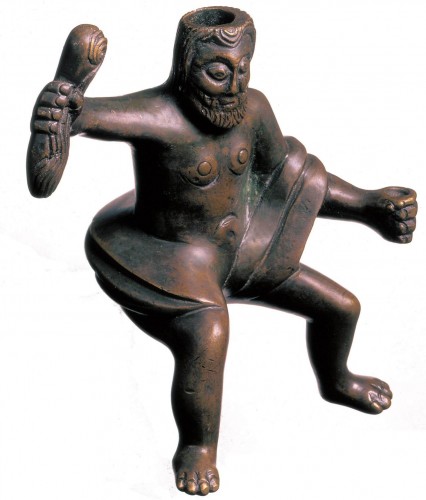
Archives de SYNERGIES EUROPEENNES - 1995
Vladimir B. Avdeyev: écrivain et philosophe païen
Vladimir Borissovitch Avdeyev, né en 1962, est un écrivain russe contemporain. Il a commencé sa carrière littéraire par la publication d'une série d'essais de “style romain” (notamment dans la rubrique “Prose d'élite” de la revue littéraire moscovite Literatournaïa Gazeta en 1989) et par deux romans remarqués, La Passion selon Gabriel (1990) et Le facteur de membres artificiels (1992). Ces romans s'inscrivent dans une tradition littéraire plus philosophique et européenne que classique et russe.
Le dépassement du christianisme (1994), troisième grande œuvre de cet auteur, est un traité d'histoire et de philosophie, axé principalement sur les problèmes des religions non conventionnelles. Ce livre contient notamment une analyse des différences structurelles existant entre les religions monothéistes et polythéistes. Il ouvre de nouvelles perspectives sur le développement des conceptions religieuses de notre monde contemporain.
Les déductions tirées par l'auteur sont dépourvues de toute ambigüité: nous sommes à la veille d'une nouvelle ère cosmique, l'ère du Verseau, qui apportera un changement complet dans les paradigmes religieux dominants, annonciateur d'un épanouissement nouveau des religions panthéistes et polythéistes. Vladimir Avdeyev est païen par conviction: ses œuvres sont polémiques contre le christianisme, hostiles aux monothéismes. Il exprime clairement ses convictions, ce qui le rapproche d'une certaine “nouvelle droite”. Avdeyev critique le christianisme non dans le cadre d'une nouvelle école historique ou mythologique, mais le définit comme un phénomène à la fois “occulte” et politique.
Vladimir Avdeyev théorise également la “contre-révolution païenne”, ce que ne font pas les autres idéologues contemporains de la “révolution conservatrice” en Russie, dont, en particulier, Alexandre Douguine, plus connu dans les médias occidentaux, qui propage un mélange théorique peu conventionnel, où confluent les constructions nées dans les salons européens et les archétypes de l'orthodoxie russe.
Vladimir Avdeyev est aujourd'hui membre du Conseil de Coordination de l'Union des Communautés Païennes Russes, dirigé par le célèbre écrivain ruraliste Alexandre Belov. Un congrès de ces “communautés païennes russes” a eu lieu à Moscou en mars 1995. Les congressistes ont décidé de former en Russie une caste de “kshatryas”, c'est-à-dire de militaires et de combattants, vivant en confromité avec les fondements de la conception païenne du monde.
Anatoli Mikhaïlovitch IVANOV.
(pour tous renseignements: V.B. Avdeyev,113.162 Mytnaya, 23-1-47a, Moscou, Russie).
00:05 Publié dans Traditions | Lien permanent | Commentaires (0) | Tags : paganisme, russie, slavistique, mythologie, littérature, littérature russe, lettres russes, lettres, mythes | | del.icio.us | | Digg | Facebook