Ok

En poursuivant votre navigation sur ce site, vous acceptez l'utilisation de cookies. Ces derniers assurent le bon fonctionnement de nos services. En savoir plus.

mercredi, 06 novembre 2013

Europa opta por South Stream

Ex: http://www.elespiadigital.com/

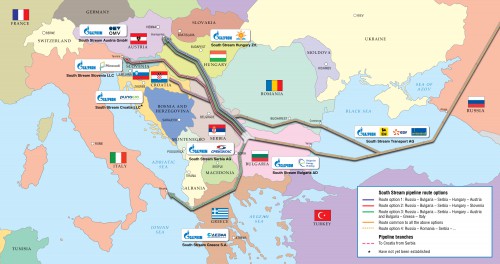
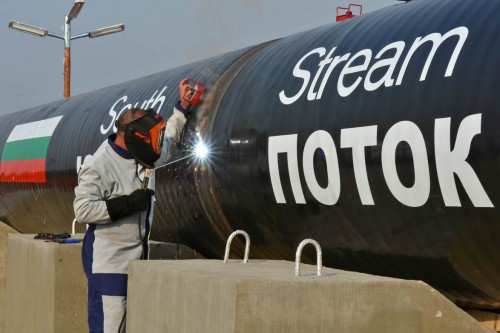
Continúa el tendido del gasoducto South Stream (Flujo Sur) en Europa. Bulgaria ha empezado a constuir el tramo que suministrará el gas ruso a Europa Central y del Sur. En lo que resta de año, se dará inicio a la construcción de la correspondiente infraestructura en Serbia, luego de lo cual le tocará el turno a Hungría. Además, los contratos sobre el tendido ya están suscritos con Grecia, Eslovenia, Croacia y Austria.

La extensión del tramo búlgaro supera 500 kilómetros. Las obras de construcción se iniciaron en la más económicamente deprimida parte noroccidental de Bulgaria, donde la tasa de desempleo supera el 20 %. Se pronostica que la ejecución del proyecto impulsará el crecimiento económico del país. Gracias a South Stream, Bulgaria recibirá inversiones por importe de tres mil quinientos millones de euro, casi tres mil millones de euro engrosarán sus arcas públicas, exenciones sobre el precio del gas y trabajo para los contratistas locales.

Además, al Holding energético de Bulgaria, socio del gigante gasístico ruso Gazprom, se le otrogará un crédito por el monto de seiscientos veinte millones de euro.

South Stream es un proyecto costoso, los gastos en su tendido ascienden a 16 mil millones de euro. Pero, desde la óptica de la seguridad energética, sus ventajas son evidentes, según ha expresado en Bulgaria el presidente de Gazprom, Alexéi Míller:

–Se trata de un importantísimo componente de la seguridad energética para todo el continente europeo, pues el gas se suministrará directamente desde Rusia a Bulgaria y a la Unión Europea, sin atravesar los países de tránsito.

Bajo el término "los países de tránsito" se sobrentiende a Ucrania que sistemáticamente genera problemas, icnumpliendo los compromisos de pago, bombeando ilíctamente este hidrocarburo en sus depósitos subterráneos. En un pasado, este país eslavo causó irregularidades en el suministro de gas a Europa. Al alcanzar South Stream la capacidad proyectada, estos problemas pasarán a la historia, se muestra seguro el director del departamento analítico en la entidad Alpari, Alexánder Razuváev:

–Después de que Gazprom adquiriera Beltransgaz (operadora del sistema de gasoductos de Bielorrusia) y se pusiera en marcha la tubería North Stream, estos riesgos disminuyeron considerablemente. Cuando comience a funcionar South Stream, los riesgos prácticamente dejarán de existir. Por lo que se refiere a Europa, tendrá los suministros garantizados. Se barajaba una variante optativa, el gasoducto Nabucco, que no resultó ser viable. Correspondientem ente, Europa optó por South Stream.

South Stream empezará a suministrar gas a la población de Europa ya a finales de 2015. La capacidad de su primera ramificación superará los quince mil millones de metros cúbicos anuales. En toral, a esta arteria gasera le corresponderá un 10 % del consumo continental de este hidrocarburo.

south-stream-bulgaria-first-welding.jpg


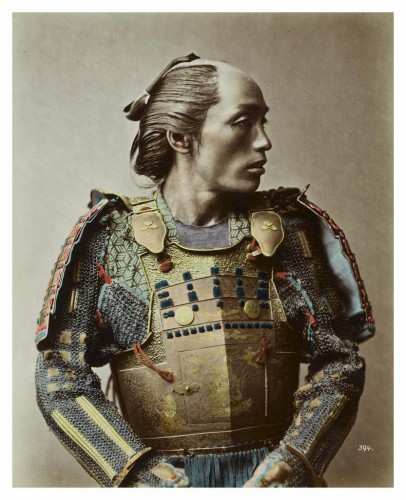
Un texte du 19ème siècle sur la formation du Samouraï déchiffré

jmkgcmgx.jpg

Un texte du 19ème siècle sur la formation du Samouraï déchiffré

Auteur : Les Découvertes Archéologiques 

Ex: http://www.zejournal.mobi

Un texte d'entraînement, utilisé par une école d'arts martiaux pour enseigner aux membres de la classe bushi (samurai ou samouraï), a été déchiffré. Il révèle les règles que les samouraïs étaient censés suivre et ce qu'il fallait faire pour devenir un véritable maître épéiste.

Le texte est appelé Bugei no jo, ce qui signifie "Introduction aux arts martiaux" et est daté de la 15e année de Tenpo (1844).

Écrit pour les étudiants samouraïs sur le point d'apprendre le Takenouchi-Ryu, un système d'arts martiaux , il devait les préparer pour les défis qui les attendaient.

Une partie du texte traduit donne ceci: "Ces techniques de l'épée, nées à l'âge des dieux, ont été prononcées par la transmission divine. Elles forment une tradition vénérée de par le monde, mais sa magnificence se manifeste seulement quand on a pris connaissance (...). Quand [la connaissance] est arrivée à maturité, l'esprit oublie la main, la main oublie l'épée," un niveau de compétence que peu obtiennent et qui requiert un esprit calme.

Le texte comprend des citations écrites par les anciens maîtres militaires chinois et est écrit dans un style Kanbun formel: un système qui combine des éléments de l'écriture japonaise et chinoise.

Le texte a été publié à l'origine par des chercheurs en 1982, dans sa langue originale, dans un volume de l'ouvrage "Nihon Budo Taikei." Récemment, il a été partiellement traduit en anglais et analysé par Balázs Szabó, du département d'études japonaises de l'Université Eötvös Loránd à Budapest, en Hongrie.

La traduction et l'analyse sont décrites dans la dernière édition de la revue Acta Orientalia Academiae Scientiarum Hungaricae.

Parmi ses nombreux enseignements, le texte dit aux élèves de montrer une grande discipline et de ne pas craindre le nombre d'ennemis. "(...) c'est comme franchir la porte d'où nous voyons l'ennemi, même nombreux, nous les voyons comme quelques uns, donc aucune crainte ne s'éveille, et nous triomphons alors que le combat vient à peine de commencer", citation d'un enseignement Sur les Sept Classiques Militaires de la Chine ancienne.

Le dernier siècle des samouraïs

En 1844, seuls les membres de la classe Samouraï étaient autorisés à recevoir une formation d'arts martiaux. Szabó explique que cette classe était strictement héréditaire et qu'il y avait peu de possibilités pour les non-samurai d'y adhérer.

Les étudiants Samurai, dans la plupart des cas, auraient participé à plusieurs écoles d'arts martiaux et, en outre, auraient appris "l'écriture chinoise, les classiques confucéens et la poésie dans les écoles du domaine ou des écoles privées", a expliqué Szabó.
Les étudiants qui commencent leur formation de Takenouchi-ryu en 1844 ne réalisaient pas qu'ils vivaient à une époque où le Japon était sur ??le point de subir d'énormes changements.

Pendant deux siècles, il y a eu des restrictions sévères sur les Occidentaux entrant au Japon. Cela a pris fin en 1853 quand le commodore américain Matthew Perry est entré dans la baie de Tokyo avec une flotte et a exigé que le Japon signe un traité avec les États-Unis.
Dans les deux décennies qui ont suivi, une série d'événements et de guerres ont éclaté qui on vu la chute du Japon Shogun, la montée d'un nouveau Japon moderne et, finalement, la fin de la classe des Samouraïs.

Les règles Samurai.

Le texte qui vient d'être traduit énonce 12 règles que les membres de l'école de Takenouchi-ryu étaient censés suivre.
Certaines d'entre elles, dont "Ne quittez pas le chemin de l'honneur !" et "Ne commettez pas de turpitude !" étaient des règles éthiques que les samouraïs étaient censés suivre.


tradition,traditions,traditionalisme,japon,samourai,asie,castes guerrières

Une règle notable, "Ne laissez pas les enseignements de l'école s'échapper !" a été créé pour protéger les techniques secrètes d'arts martiaux de l'école et à aider les élèves s'ils devaient se trouver au milieu d'un combat.

"Pour une école d'arts martiaux ... afin d'être attrayante, il était nécessaire de disposer de techniques spéciales permettant au combattant d'être efficace même contre un adversaire beaucoup plus fort. Ces techniques sophistiquées faisaient la fierté de l'école et étaient gardées secrètes, car leur fuite aurait causé une perte aussi bien économique que de prestige", écrit Szabó.

Deux autres règles, peut-être plus surprenantes, précisent que les étudiants "ne se concurrencent pas !" et "Ne racontent pas de mauvaises choses sur d'autres écoles !".

Les occidentaux modernes ont une vision populaire des samouraïs s'affrontant régulièrement, mais en 1844, ils n'étaient pas autorisés à se battre entre eux.
Le shogun Tokugawa Tsunayoshi (1646-1709) avait placé une interdiction sur les duels d'arts martiaux et a même réécrit le code que le samouraï devait suivre, en l'adaptant pour une période de paix relative. "L'apprentissage et la compétence militaire, la loyauté et la piété filiale, doit être promue, et les règles de la bienséance doivent être exécutées correctement", expliquait le shogun (traduction du livre "Études sur l'histoire intellectuelle du Japon des Tokugawa," par Masao Maruyama, Princeton University Press, 1974).

Les compétences secrètes.

Le texte propose seulement un faible aperçu des techniques secrètes que les élèves auraient appris à cette école, en séparant les descriptions en deux parties appelées "secrets les plus profonds du combat" et "secrets les plus profonds de l'escrime."

Une partie des techniques secrètes de combat à mains nues est appelé Shinsei no daiji, ce qui se traduit par "techniques divines", indiquant que ces techniques étaient considérées comme les plus puissantes.

Curieusement, une section de techniques secrètes d'escrime est répertoriée comme ?ry?ken, également connu sous le nom IJU ichinin, ce qui signifie "ceux considérés être accordés à une personne" - dans ce cas, l'héritier du directeur.

Le manque de détails décrivant ces techniques dans des cas pratiques n'est pas surprenant pour Szabó. Les directeurs avaient des raisons pour utiliser un langage crypté et l'art du secret.


Non seulement ils protégeaient le prestige de l'école, et les chances des élèves dans un combat, mais ils contribuaient à "maintenir une atmosphère mystique autour de l'école," quelque chose d'important pour un peuple qui tenait l'étude des arts martiaux en haute estime.

 - Source : Les Découvertes Archéologique

La chute de Sfeira près d'Alep

arsyr.jpg

La chute de Sfeira près d'Alep, un changement stratégique majeur

Auteur : Ghaleb Gandy 
 
Ex: http://www.zejournal.mobi

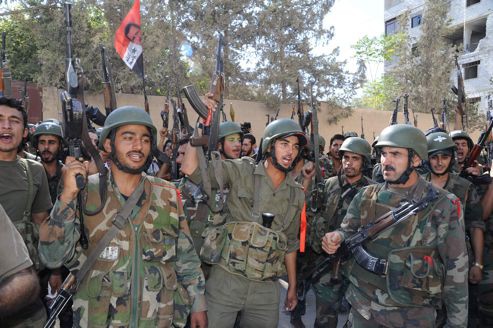
Les échanges d'accusations de trahison et de lâcheté sur les médias des groupes armés en Syrie suffisent à eux seuls à comprendre l'importance stratégique de la libération de la ville de Sfeira, au sud-est d'Alep, par l'Armée arabe syrienne et les unités de la défense nationale.

Ces derniers mois, les groupes armés avaient massé dans cette localité d'importantes troupes, les unités les mieux équipées et celles disposant des plus gros moyens financiers. On y trouvait le Front al-Nosra et l'Etat islamique d'Irak et du Levant, affiliés à Al-Qaïda, Liwaa al-Islam, dirigé par Zahran Allouche, l'homme de Bandar Ben Sultan en Syrie, Ahrar al-Cham, et un conseil militaire local rattaché à l'Armée syrienne libre. Ces groupes jouissaient de lignes de ravitaillement ouvertes vers la frontière avec la Turquie, d'où étaient acheminés armes, munitions, argents et renforts en combattants venus de l'étranger. Le soutien le plus importants provenait d'Arabie saoudite, selon les correspondants de la presse étrangère.

Ces groupes ont jeté toutes leurs forces dans la bataille pour tenter de garder Sfeira en raison de sa position stratégique. Il s'agit en effet d'un nœud important commandant l'accès à la campagne sud-est d'Alep ; elle est située non loin de l'aéroport international d'Alep et de l'aéroport militaire de Koueirès ; elle est proche de la région d'Al-Bab, qui commande l'accès à Alep.

Elle constitue un point d'équilibre décisif à l'intérieur d'Alep et de sa province, car elle est située non loin des industries de la défense et de la route d'approvisionnement, qui relie les provinces de Hama et d'Alep. De plus, elle se trouve sur l'axe de communication routier entre la province d'Alep et des régions de l'est, à Raqqa.

Pour toutes ces raisons, la libération de Sfeira aura des répercussions décisives sur les équilibres militaires dans le pays.

L'Armée arabe syrienne et les unités de la défense civile ont réussi à libérer Sfeira après la reprise de Khanasser et de ses environs, il y a quelques semaines, ce qui lui avait permis de rouvrir la voie approvisionnement Hama-Alep, appelée la "route du désert".

L'avancée rapide de l'armée syrienne est une preuve de ses hautes capacités et de sa solidité, qui surprennent les observateurs. Mais elle confirme, aussi, le changement de l'humeur populaire des Syriens, qui rejettent les exactions des groupes extrémistes, déchirés par des luttes intestines autour des butins. L'effondrement du camp hostile à la Syrie avec l'apparition de profondes divergences entre l'Arabie saoudite d'un côté, le Qatar et la Turquie de l'autre, est un signe supplémentaire de l'échec de la guerre universelle contre la Syrie.

Les groupes armés qui combattent l'Etat syrien, ne sont que des façades pour des puissances étrangères. Ils ont sombré dans une profonde dépression après que les Etats-Unis aient été contraints d'abandonner leur projet d'agression contre la Syrie. Leurs défaites sur le terrain s'accélèrent et la reprise de Sfeira sera suivie d'autres victoires dans les différentes régions du pays.

 - Source : Ghaleb Gandy

Du P.S.

1970.jpg

Du P.S.

par Georges FELTIN-TRACOL


Le thème principal du n° 44 (été 2013) de la revue quadrimestrielle Réfléchir et Agir porte sur le socialisme identitaire. À côté de diverses contributions, on peut lire un bref débat sur le mot même de socialisme entre l’ami Eugène Krampon et l’auteur de ces lignes. Eugène soutient la nécessité d’en conserver le terme parce qu’il demeure compréhensible, en dépit de tous les dévoiements imaginables, alors que le solidarisme et le justicialisme restent obscurs pour les populations européennes.


La question sémantique garde toute son importance dans la guerre des idées. Si le socialisme devient identitaire ou « européen » comme l’écrivait régulièrement Jean Mabire, il importe néanmoins d’en redéfinir le concept et de lui redonner un sens révolutionnaire, novateur et rebelle, quitte éventuellement à le reformuler à l’aune de la quatrième théorie politique conceptualisée par Alexandre Douguine. Ce travail lexical exige en priorité une claire distinction du Parti socialiste (P.S.) de Flamby, de Jean-Marc (Z)Ayrault et d’Harlem Désir ainsi que de leurs pitoyables homologues sociaux-démocrates.


La tâche semble impossible. En réalité, elle est fort simple grâce du fait des reniements successifs des dirigeants du P.S. Lui-même ancien responsable de la formation de Léon Blum, de Guy Mollet et de François Mitterrand, le co-président du Parti de Gauche, Jean-Luc Mélenchon, assène de rudes coups à ses anciens camarades. Favorable à l’« éco-socialisme » dans une perspective développementaliste et industrialiste, Mélenchon s’estime seul véritable héritier de Jean Jaurès et des ténors du socialisme institutionnalisé. Avec la virulence qu’on lui connaît, il ose dénier au P.S. – aujourd’hui au pouvoir – de se qualifier de « socialiste » et préfère le nommer avec un mépris superbe de « solférinien », de la célèbre adresse parisienne de son siège national du P.S., rue de Solférino.


Pour une fois, le camarade Mélenchon a raison de contester à son ancien parti l’emploi du mot « socialiste ». Depuis le tournant de la rigueur en 1983, le P.S. s’est plié au Diktat des marchés mondiaux, de la finance planétaire et de l’Oligarchie transnationale. Sa soumission au mondialisme après avoir célébré pendant des décennies un internationalisme éthéré a été récompensée par la nomination à la direction générale de l’O.M.C. et du F.M.I. de Pascal Lamy et de Dominique Strauss-Kahn. Les « solfériniens » ont tué leur socialisme au nom du financiarisme le plus débridé.


Cette trahison, en germe dès la naissance de la S.F.I.O. en 1905 avec les possibilistes et les partisans de l’action parlementaire, s’accompagne d’un changement profond de l’électorat « socialiste ». Si les ouvriers, les employés et le gros des catégories populaires et moyennes l’ont délaissé, une compensation s’effectue avec de nouveaux électeurs issus des couches intermédiaires aisées, des catégories sociales à haut revenu et des effets d’une immigration de peuplement massive. Dompté et désormais laquais du fric sans frontières (pléonasme !), le P.S. détourne son désir de révolution en s’attaquant aux normes culturelles traditionnelles européennes.


Hantant les coulisses d’un pouvoir légal mais illégitime, les « solfériniens » propagent par différents canaux des thèmes homosexualistes (le mariage inverti), relativistes (réformes judiciaires qui livrent l’Hexagone à la délinquance), libertaires (dépénalisation du cannabis, voire de toutes les drogues) et extrême-féministes (pénalisation des clients de prostituées, interdiction de la fessée et de la gifle adressées aux enfants par leurs parents) qui ne répondent pas aux attentes de la population. Qu’il est loin le temps où les députés socialistes comptaient parmi eux Alfred Gérault-Richard (1860 – 1911) ! D’abord élu du XIIIe arrondissement de Paris entre 1895 et 1898, il sera ensuite le représentant de la Guadeloupe de 1902 jusqu’à sa mort. Cet ami de Jaurès et d’Aristide Briand conviendrait certainement à la fort prude Najat Vallaud-Belkacem, Pasionaria à la petite semaine du néo-puritanisme gauchard. Auteur d’une courte biographie, Bruno Fuligni le qualifie d’« ouvrier tapissier, maquereau, poète, spadassin, maître chanteur, industriel, séparatiste montmartrois… (1) ». Outre qu’on a l’impression qu’il décrit une formation politique particulière, Bruno Fuligni ne cache pas que Alfred Gérault-Richard vécut un temps grâce aux charmes de sa petite amie… On a enfin dénicher la figure tutélaire d’Osez le féminisme et des FemHaine ! Au moins, cet homme-là n’escroquait pas ses électeurs… La volonté effrénée des nouveaux « gardes roses » de sanctionner des comportements ataviques accompagne la mutation anthropologique hyper-individualiste à l’œuvre.


En acceptant le « bougisme », le P.S. a récusé le socialisme pour devenir un Parti sociétaliste. Qu’est-ce que le sociétalisme ? C’est une idéologie post-moderniste qui privilégie le sociétal. Expression venue d’outre-Atlantique, « sociétal » se distingue du « social ». Son « emploi correspond à un déplacement des idées au sein de la gauche », indique Chantal Delsol (2). Selon la philosophe libérale-conservatrice, « le social relève de l’organisation et de la distribution de la production. Il est clairement lié à l’économie, aux biens quantifiables et monnayables, et à leur répartition. Tandis que le terme sociétal est employé pour désigner ce qui a trait aux comportements de l’individu et à l’évolution des mœurs – il s’agit des normes et non plus de la redistribution des biens; cela concerne la famille, le couple, la liberté individuelle, la vie privée, le sens de la vie, et non plus le niveau de vie, le confort, la sécurité (3) ». Elle ne saisit toutefois pas que la perception sociétale convient parfaitement à l’essence liquide de l’ultra-modernité libérale.


Bénéficiaires de la mondialisation globale, les sociétalistes ont entamé la démolition des dernières résistances à l’indifférenciation mortifère de la vie et du monde. Après avoir rejeté le spirituel, occulté le politique, hypertrophié l’économique et perverti le culturel, les voilà en train de s’affranchir du social afin de privilégier un sociétal compris comme d’une morale universaliste dissolvante. La félonie est donc totale.


Face à cette tendance inquiétante, il est temps de redécouvrir le social, cette dimension réelle, concrète, tangible du politique. Contre les métastases du sociétalisme présentes tant chez les « solfériniens » qu’au sein de la fumeuse U.M.P., la nécessité impose de relever un socialisme véritable, de relancer le solidarisme et d’encourager le justicialisme. Les peuples ne vivent pas en société, mais constituent des ensembles complexes de communautés qui perdurent malgré tout sous les gravats individualistes et médiatiques du sociétal délétère.


Georges Feltin-Tracol


Notes


1 : Bruno Fuligni, La Chambre ardente. Aventuriers, utopistes, excentriques du Palais-Bourbon, les Éditions de Paris – Max Chaleil, 2001, p. 213.


2 : Chantal Delsol, « La gauche préfère le “ sociétal ” au “ social ” », Le Figaro, 12 août 2013.


3 : art. cit.


Article printed from Europe Maxima: http://www.europemaxima.com


URL to article: http://www.europemaxima.com/?p=3421


Al Qaeda in China, Islamic Insurgency in Uighur-Xinjiang, China and the US-Saudi-Israeli Plan for the Middle East

xinjiang-500x615.gif

Al Qaeda in China, Islamic Insurgency in Uighur-Xinjiang, China and the US-Saudi-Israeli Plan for the Middle East

 
Global Research, October 30, 2013

THE YINON PLAN LIVES ON

Named after Israel’s minister of foreign affairs at the time of the 1982 invasion of Lebanon and occupation of Beirut, with about 25 000 dead, this divide-and-rule geostrategy plan for the MENA (Middle East and North Africa) lives on.

Already victims of this strategy since 2011 – operated by Israel, the US and Saudi Arabia – we have the divided and weakened states of Iraq, Libya, Yemen and Syria. Egypt and even Tunisia can also possibly be added to the list. Others can be identified as likely short-term target victim countries.

In February 1982 the foreign minister Oded Yinon wrote and published ‘A Strategy for Israel in the Nineteen Eighties‘, which outlined strategies for Israel to become the major regional power in the Middle East. High up the list of his recommendations was to decapitate and dissolve surrounding Arab states into sub-nations, warring between themselves. Called the peace-in-the-feud or simply divide and rule, this was part of Yinon’s strategy for achieving the long-term Zionist goal of extending the borders of Israel, not saying where but potentially a vast region. His strategy was warmly and publicly supported by leading US policy makers with close ties to Israel, like Richard Perle, by the 1990s.

This regional balkanization plan is centred on the exploitation of ethnic, religious, tribal and national divisions within the Arab world. Yinon noted the regional landscape of the MENA was “carved up” mainly by the US, Britain and France after the defeat and collapse of the Ottoman empire in 1917. The hastily traced and arbitrary borders are not faithful to ethnic, religious, and tribal differences between the different peoples in the region – a problem exactly reproduced in Africa, when decolonization started in the 1950s and 1960s. Yinon went on to argue this makes the Arab world a house of cards ready to be pushed over and broken apart into tiny warring states or “chefferies” based on sectarian, ethnic, national, tribal or other divisions.

Central governments would be decapitated and disappear. Power would be held by the warlord chiefs in the new sub-nations or ‘mini-states’. To be sure, this would certainly remove any real opposition to Israel’s coming regional dominance. Yinon said little or nothing about economic “collateral damage”.

To be sure, US and Saudi strategy in the MENA region is claimed to be entirely different, or in the Saudi case similar concerning the means – decapitating central governments – but different concerning the Saudi goal of creating a huge new Caliphate similar to the Ottoman empire. Under the Ottomans nations did not exist, nor their national frontiers, and local governments were weak or very weak.

ISLAMIC INSURGENCY IS WELL KNOWN IN CHINA

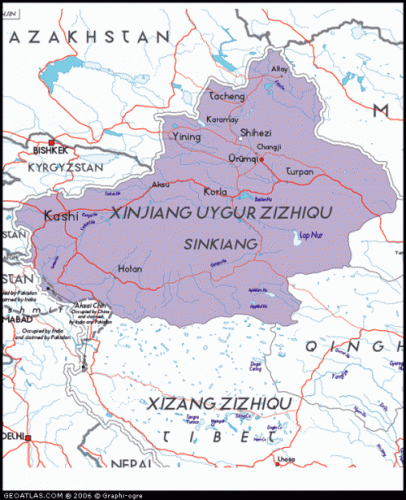
China knows plenty about Islamic insurgency and its potential to destroy the nation state. Even in the 1980s and 1990s, some 25 years ago, China had an “Islamic insurgency” threat concentrated in its eastern resource-rich and low population Xinjiang region. Before that, since the early days of the Peoples’ Republic in the 1950s, China has addressed Islamic insurgency with mostly failed policies and strategies but more recently a double strategy of domestic or local repression, but aid and support to Islamic powers thought able to work against djihadi insurgents – outside China – has produced results.

The Chinese strategy runs completely against the drift of Western policy and favours Iran.

A report in ‘Asia Times’, 27 February 2007, said this: “Despite al-Qaeda’s efforts to support Muslim insurgents in China, Beijing has succeeded in limiting (its) popular support….. The latest evidence came when China raided a terrorist facility in the country’s Xinjiang region, near the borders with Pakistan, Afghanistan, Tajikistan and Kirgizstan. According to reports, 18 terrorists were killed and 17 were captured”.

Chinese reporting, even official white papers on defence against terror are notoriously imprecise or simply fabricated. The official line is there is no remaining Islamic insurgency and – if there are isolated incidents – China’s ability to kill or capture militants without social blowback demonstrates the State’s “hearts and minds” policy in Xinjiang, the hearth area for Chinese Muslims, is working.

Chinese official attitudes to Islamic insurgency are mired with veils of propaganda stretching back to the liberation war against anti-communist forces. These featured the Kuomintang which had a large Muslim contingent in its Kuomintang National Revolutionary Army. The Muslim contingent operated against Mao Zedong’s central government forces – and fought the USSR. Its military insurgency against the central government was focused on the provinces of Gansu, Qinghai, Ningxia and Xinjiang and continued for as long as 9 years after Mao took power in Beijing, in 1949.

Adding complexity however, the Muslim armed forces had been especially active against the Soviet Union in the north and west – and by 1959 the Sino-Soviet split was sealed. Armed hostilities by Mao’s PLA against the Red Army of the USSR broke out in several border regions, with PLA forces aided by former Muslim insurgents in some theatres. Outside China, and especially for Arab opinion, Mao was confirmed as a revolutionary nationalist similar to non-aligned Arab leaders of the period, like Colonel Husni al-Zaim of Syria and Colonel Nasser of Egypt.

CHINA’S THREAT TO WESTERN STRATEGY IN THE MENA

Especially today, some Western observers feign “surprise” at China’s total hostility towards UN Security Council approval for “surgical war” strikes against Syria. The reasons for this overlap with Russia’s adamant refusal to go along with US, Saudi Arabian, Turkish and French demands for a UNSC rubber stamp to trigger “regime change” in Syria but are not the same. For China the concept of “regime change” with no clear idea – officially – of what comes next is anathema.

As we know, when or if al Assad falls, only chaos can ensue as the country breaks apart, but this nightmare scenario for China is brushed aside by Western politicians as a subject for “later decision”.

China’s successful efforts to keep the global jihad from spreading into its territory is surely and certainly taken as a real challenge by Saudi-backed insurgents in western China. Various reports indicate the al-Qaeda organization trains about 1 000 mostly Xinjiang-origin Uighurs and other Chinese Muslims every year. Located in camps in Afghanistan, Pakistan, Kirgizstan and elsewhere, this terror training has continued since at least the mid-1990s, for a total of more than 15 years.

The focus on Xinjiang, formerly called Turkestan is no accident. The region’s Russian influence is still strong, reinforced by Muslim migration from Russia in the 19th century, accelerated by the Russian Civil War and 1917 revolution. During China’s warlord era preceding Mao’s rule, the USSR armed and supported the Muslim separatist East Turkestan Republic which only accepted Mao’s rule when the PRC under the Chinese communists was fully established in 1949. The longstanding East Turkestan jihadi movement (ETIM) is highly active today after being relaunched in the early 2000′s, especially since the Iraq war of 2003. It however mainly acts in “external theatres” such as Pakistan’s Baluchistan province. The Baluchi of Pakistan have long-term rebellious relations with the central government in Islamabad, and are allied with Kurd nationalists in Iraq, Syria, Lebanon and Turkey.

The US Council on Foreign Relations in a 29 May 2012 briefing on Xinjiang noted that since the Chinese Qing dynasty collapse of 1912, the region has experienced various types of semi-autonomy and on several occasions declared full independence from China. The Council for example notes that in 1944, factions within Xinjiang declared independence with full support from the USSR, but then cites US State Dept. documents claiming that Uighur-related terrorism has “declined considerably” since the end of the 1990s and China “overreacts to and exaggerates” Islamic insurgency in Xinjiang.

Notably, the US has declassified the ETIM Islamic movement – despite its terror attacks – as a terrorist organization. The ETIM was defined as such during the Bush administration years, but is no longer listed as a Foreign Terrorist Organization (FTO) in the State Dept. FTO list as from January 2012.

China has fully recognized the Islamic insurgency threat, with its potential for drawing in hostile foreign powers seeking to destroy national unity and break the national government. Its concern, shared by Indian strategists and policy makers is to “stop the rot” in the MENA.


THE CHINESE STRATEGY

Unofficially, China regards the US and Saudi strategy in the MENA and Central Asia as “devil’s work” sowing the seeds of long-term insurgency, the collapse of the nation state and with it the economy. The US link with and support to Israel is in no way ignored, notably Israel’s Yinon plan for weakening central governments and dissolving the nation state right across the MENA.

China’s main concern is that Central Asian states will be affected, or infected by radical Islamic jihadi fighters and insurgents drifting in from the West, from the Middle East and North Africa. These will back the existing Islamic insurgent and separatist movement in resource-rich Xinjiang. To keep Central Asian states from fomenting trouble in Xinjiang, China has cultivated close diplomatic ties with its neighbors, notably through the Shanghai Cooperation Organization which has a secretariat concerned with counter-insurgency issues.

US analysts however conclude, very hastily, that China “instinctively supports the status quo” and therefore does not have an active international strategy to combat djihadi violence and anarchy outside China. US analysts say, without any logic, that China will respond to and obediently follow initiatives from Washington and other Western powers – as it has starkly not done in the UN Security Council when it concerns the Western powers’ long drawn out attempt to repeat, for Syria, their success in 2011 for getting UNSC approval to the NATO war in Libya!

China was enraged, and regarded it as betrayal when its support for limited action by NATO in Libya – a rare instance of China compromising on nonintervention – turned into an all-out “turkey shoot” to destroy the Gaddafi clan. Libya was handed over to djihadi militants, who subsequently declared war against central government, an accelerating process resulting in Libya, today, having no central government with any real authority. That experience certainly hardened Beijing’s responses on Syria.

Post-Mao China has restored the concept of Chinese cultural continuity, with a blend of Confucian, Taoist and Buddhist strands which had been been weakened but not completely destroyed in the years of ideologically-driven Communism. For the Communists of Mao’s era “history was bunk”, not even a mixed bag but an unqualified evil that must be smashed. The Chinese attitude to radical Islam as embodied in the ideologies of Wahabism and Salafism is the same – they are treated as a denial of world history and its varied cultures, with immediate and real dangers for China. Its counter-insurgency strategy against Islamic radicals is the logical result.

This strategy ensures closer Tehran-Beijing relations, usually described by Western analysts as a “balancing act” between ties to Washington and growing relations with Iran. China and Iran have developed a broad and deep partnership centered on China’s oil needs, to be sure, but also including significant non-energy economic ties, arms sales, defense cooperation, and Asian and MENA geostrategic balancing as a counterweight to the policies and strategies of the United States and its local allies, Saudi Arabia and Israel. Chinese attention now focuses the Washington-Riyadh axis and its confused and dangerous MENA region geostrategy, resulting in a de facto proliferation of Islamic djihadi insurgents and the attack on the basic concept of the nation state across the region. The Chinese view is that Iran’s version of “Peoples’ Islam” is less violent and anarchic, than the Saudi version.

OPPOSING THE WASHINGTON-RIYADH AXIS

Both Chinese and Indian strategists’ perceptions of the US-Saudi strategy in the MENA, and other Muslim-majority regions and countries is that it is dangerous and irresponsible. Why the Western democracies led by the US would support or even tolerate the Saudi geostrategy and ignore Israel’s Yinon Plan – as presently shown in Syria – is treated by them as almost incomprehensible.

China is Tehran’s largest trading partner and customer for oil exports, taking about 20% of Iran’s total oil exports, but China’s co-operation is seen as critical to the Western, Israeli and Arab Gulf State plan to force Iran to stop uranium enrichment and disable the capacity of its nuclear program to produce nuclear weapons. Repeated high-level attempts to “persuade Beijing” to go along with this plan, such as then-US Treasury Secretary Timothy Geithner’s 2012 visit to Beijing, however result each time in Chinese hosts politely but firmly saying no. This is not only motivated by oil supply issues.

Flashpoints revealing the Chinese-US divide on Iran crop up in world news, for example the US unilateral decision in January 2012 to impose sanction on Chinese refiner Zhuhai Zenrong for refining Iranian oil and supplying refined products back to Iran. This US action was described by China’s Foreign Ministry spokesman as “totally unreasonable”. He went on to say that “China (has) expressed its strong dissatisfaction and adamant opposition”.

At the same time, China’s Xinhua Agency gave prominence to the statement made by Iran’s OPEC delegate Mohamed Ali Khatibi: “If the oil producing nations of the (Arab) Gulf decide to substitute Iran’s oil, then they will be held responsible for what happens”. Chinese analysts explained that China like India was irritated that Iranian oil sanctions opened the way for further de facto dominance of Saudi Arabia in world export supplies of oil, as well as higher prices.

Iran is however only the third-largest supplier of oil to China, after Angola and Saudi Arabia, with Russia its fourth-largest supplier, using EIA data. This makes it necessary for China to run sustainable relations with the Wahabite Kingdom, which are made sustainable by actions like China’s Sinopec in 2012 part-funding the $8.5 billion 400 000 barrels-per-day refinery under construction in the Saudi Red Sea port city of Yanbu.

The Saudi news and propaganda outlet Al Arabiya repeatedly criticises China and India for their purchase of Iranian oil and refusal to fully apply US-inspired sanctions. A typical broadside of February 2013 was titled “Why is China still dealing with Iran?”, and notably cited US analysts operating in Saudi-funded or aided policy institutes, such as Washington’s Institute for Near East Policy as saying: “It’s time we wised up to this dangerous game. From Beijing’s perspective, Iran serves as an important strategic partner and point of leverage against the United States”. US analysts favourable to the Saudi strategy in the MENA – described with approval by President Eisenhower in the 1950s as able to establish a Hollywood style Saudi royal “Islamic Pope” for Muslim lands from Spain to Indonesia – say that Iran is also seen by China as a geopolitical partner able to help China countering US-Saudi and Israeli strategic action in the Middle East.

A 2012 study by US think tank RAND put it bluntly: “Isolated Iran locked in conflict with the United States provides China with a unique opportunity to expand its influence in the Middle East and could pull down the US military in the Gulf.” The RAND study noted that in the past two decades, Chinese engineers have built housing, bridges, dams, tunnels, railroads, pipelines, steelworks and power plants throughout Iran. The Tehran metro system completed between 2000 and 2006 was a major Chinese engineering project.

THE BIG PICTURE

China’s Iran policy and strategy can be called “big picture”. Iranian aid and support to mostly but not exclusively Shia political movements, and insurgents stretches from SE Asia and South Asia, to West and Central Asia, Afghanistan, the Caspian region, and SE Europe to the MENA. It is however focused on the Arabian peninsula and is inevitably opposed to Saudi geostrategy. This is a known flashpoint and is able to literally trigger a third world war. Avoiding this is the big picture – for China.

Li Weijian, the director of the Research Center of Asian and African Studies at the Shanghai Institute for International Studies puts it so: “China’s stance on the Iranian nuclear issue is not subject to Beijing’s demand for Iranian oil imports, but based on judgment of the whole picture.” China is guided in foreign relations by two basic principles, both of them reflecting domestic priorities. First, China wants a stable international environment so it can pursue domestic economic development without external shocks. Second, China is very sensitive to international policies that ‘interfere in or hamper sovereign decisions”, ultimately tracing to its experience in the 19th and 20th centuries at the hands of Western powers, and the USSR, before and after the emergence of the PRC. It adamantly opposes foreign interference in Taiwan, Tibet, and Xinjiang.

This includes radical Islamist or djihadi interference, backed by any foreign power. While China has on occasions suspected Tehran of stirring Islamic insurgency inside its borders it sees the US-Saudi geostrategy of employing djihadists to do their dirty work as a critical danger, and as wanton interference. Indian attitudes although not yet so firm, are evolving in the same general direction. Both are nuclear weapons powers with massive land armies and more than able to defend themselves.

Claims by Western, mostly US analysts that China views Iran as exhibiting “unpredictable behaviour” in response to US-led sanctions and that Iran is “challenging China’s relations with its regional partners” can be dismissed. In particular and concerning oil, China is well aware that Iran will need many years of oil-sector development to return to anything like pre-Islamic revolution output of more than 5 million barrels a day. Unless oil sanctions are lifted, Iran’s oil output will go on declining, further increasing the power of the Gulf States led by Saudi Arabia, and Shia-governed but insurgency threatened Iraq to dictate export prices.

China dismisses the claim that its policies have hampered US and other Western political effort to dissuade Iran from developing nuclear weapons capability.

China’s distaste for toppling almost any central government, even those run by dictatorial strongmen springs from a deep sense of history – marked by insecurity about the uncertain political legitimacy of governments arising from civil war and revolution – like the PRC. At its extreme, this Chinese nightmare extends to fears that if the US-Saudi geostrategy can topple governments in the Middle East almost overnight, what will stop them from working to bring down China’s government one day? Unlike almost all MENA countries minus the oil exporters, China has scored impressive victories in the fight against poverty. Its economy although slowing creates abundant jobs and opportunity.

For China, this is the only way to progress.

HARDENING POLICIES AND POSITIONS

The emerging Chinese anti-Islamist strategy also underlines a menacing reality for the US and other Western powers. China rejects the belief there is still only one superpower in today’s world—the USA. The USA’s weakened economy and uncontrollable national debt, its confused and cowardly drone war, its slavish support to Israeli and Saudi whims do not impress China – or India.

To be sure China’s classic-conventional weapons development programs lag far behind the US. The Chinese military strategy for pushing back US dominance focuses global reach ballistic missiles, tactical nuclear weapons, drones, submarines, and military space and cyberwarfare capabilities.

With the PLA it possesses the biggest land army in the world. No US warmonger, at least saner versions would “take on China”.

China has invested heavily in Iraq, Saudi Arabia and other Gulf states, as well as Iran. It does not want to see its investment effort destroyed by deliberately promoted Islamic anarchy. Also, its Middle Eastern presence will continue due to the fact that while US dependence on oil imports is declining, China overtook the US as the world’s largest oil importer on a daily basis, this year, several years ahead of analysts’ consensus forecasts.

The likely result is that China is now poised and almost certain to strengthen relations with Iran. The intensifying Syrian crisis as well as the dangerously out of control US-Saudi-Israeli djihadi strategy, of fomenting sectarian conflict and destroying the nation state in the MENA, will likely prompt China to soon take major initiatives.
House of Saud May Throw Oily Spanner into US-Iran Talks Gambit

House of Saud May Throw Oily Spanner into US-Iran Talks Gambit

by Finian Cunningham

Ex: http://www.strategic-culture.org/

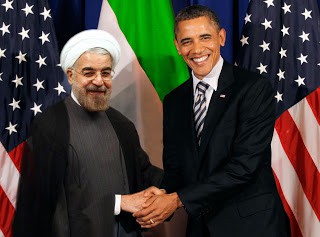
Obama-and-Hassan-Rohani.jpgThe Saudi spat with its historic Washington ally has several ways of playing out. Jilted over American «double standards» in the Middle East (how ironic is that?), senior members of the House of Saud, including intelligence chief Prince Bandar bin Sultan, have hinted that the oil-rich kingdom may shop elsewhere for its billion-dollar weapons toys that it traditionally sources from Washington. Given the parlous state of the US industrial economy, such a loss of exports in a key revenue sector, would be a nasty blow... 

Another line for a Saudi sting against the «feckless Americans» might be to throw an oily spanner into US-Iran talks over the long-running nuclear dispute. Specifically, Saudi Arabia – the main productive force in the OPEC oil cartel – could make sanctions relief for Iran a problematic order.

Not that Washington cares too much about affording sanctions relief per se, but the Saudi recalcitrance could damage what appears to be a cynical gambit by the US to engage with Iran diplomatically for geo-strategic reasons. 

For the Saudis, this opportunity for vandalism would be sweet revenge for their exasperation with perceived American flip-flopping on Syria and Iran. The Wahhabi Saudi kingdom is obsessed with the defeat of Shia Islam represented by Iran and its allies in Syria and the Hezbollah militia in Lebanon. That obsession is borne out of arcane sectarian religious animosity and also out of more mundane political rivalry. The prestige of the Iranian revolution across the Middle East and its trenchant anti-imperialism are dangerous inspirations to the Arab Street, from the House of Saud’s point of view. 

So, the apparent about-turn in US policy, first in baulking at the launch of an all-out military strike on Syria last month, and then secondly, the surprise US-led rapprochement towards Tehran over the decade-old nuclear dispute, has provoked Saudi ire to its very theocratic foundations. 

That explains the extraordinary huff expressed recently by Prince Bandar, the Saudi spymaster. Given his close contacts with the Washington establishment owing to his role as ambassador for 22 years (1983-2005), we can be sure that Bandar’s reported griping and threat-making to Western diplomats was designed to send a stern message from the House of Saud to senior US government figures. The Saudis are not merely disgruntled with their American patron; they are aggrieved by what they perceive as betrayal.

From the House of Saud’s precarious position as unelected rulers of the world’s biggest oil-exporting country – where elite wealth sits incongruously alongside massive poverty among the 20 million indigenous population – there stems an intense zero-sum mentality. Any perceived setback to the rulers or concession to rivals is intolerable to the despotic regime’s sense of its own insecure authority, both at home and regionally. That is why its reactions are so vehement, such as the furious rejection earlier this month of a non-permanent member seat on the UN Security Council – again, another action aimed at showing displeasure with Washington. 

Saudi animosity towards Iran, Syria and Hezbollah – the Shia Crescent – is of course nothing new. Such geopolitical envy can be traced back to the Islamic Revolution of 1979. For its own hegemonic reasons, Washington has cultivated the Saudi rivalry with Iran, viewing the Saudi-led Sunni monarchies of the Persian Gulf as a bulwark against Iranian-inspired popular uprisings. Bahrain is perhaps the best example, where the US and Saudi Arabia have colluded in crushing the pro-democracy movement in Bahrain that arose during the Arab Spring of 2011. The counter-insurgency propaganda of the Bahraini and Saudi regimes, with tacit approval from Washington, blames the uprising on the subversive agency of Iran and Hezbollah. Iran denies any such political interference in the internal affairs of the Sunni monarchies. Tehran maintains, with sound reasoning, that the unrest in Bahrain, Saudi Arabia and the other oil sheikhdoms is simply a reflection of the gross democratic deficit in these fascistic states. 

The Arab Spring also gave the House of Saud a golden opportunity to hit back against the Shia Crescent by joining in the Western-led covert war for regime change in Syria. By unseating the government of President Bashar al-Assad that would, so the logic went, deliver a powerful blow to Iran’s regional influence. 

But the military option against Syria and Iran has proven to be a blunt instrument that has yielded little result, as far as Western strategic objectives are concerned. Both Syrian and Iranian governments remain unbowed despite years of brutal aggression in the form of proxy mercenary armies against the former and a barrage of economic sanctions on the latter.   

This would explain why Washington and its Western allies, Britain and France, now seem prepared to exercise the political option through diplomatic negotiations. It’s not that Washington has given up on its strategic objectives of thwarting both Syria and Iran. It is just that the tactics are shifting, from military aggression to political wrestling. As Prussian military theorist Carl Von Clausewitz (1780-1831) aptly put it, war is but a continuation of politics by other means, and vice versa. 

From Washington’s point of view, this shift would kill two strategic birds with one stone. By engaging Iran and Syria into a political process, concessions might be traded one against another, with the all-important result of undermining both governments. A potential point of attack would be Iran’s urgent need for economic sanctions to be lifted.

The alacrity of Iran’s new diplomatic push over the nuclear deadlock shows that the Islamic Republic has an acute need to remove the Western embargo on its economy. It is reckoned that the combination of US and European Union sanctions imposed on Iran in mid-2012 alone has hit oil exports by more than half, resulting in a loss of revenues of $35 billion over the past year. That can only be described as devastating, to say nothing of criminal aggression.

The Iranian election of President Hassan Rouhani in mid-June and the appointment of Western-educated Mohammed Javad Zarif as foreign minister have brought a sea-change in Iran’s relations with Washington, the P5+1 group of UN Security Council members plus Germany, the EU and the UN’s atomic watchdog, the International Atomic Energy Agency. Talks with the IAEA this week in Vienna were described as «serious and earnest». All such talks have been reported as «constructive» and «progressive». This dramatic change can largely be seen as a manifestation of Iran’s pressing need to alleviate Western strictures on its economy.

But this diplomatic development can also be viewed as Washington and its Western allies wanting to engage Iran politically for their own pressing tactical reasons, with regards to realizing strategic objectives towards both Iran and Syria. 

Following the first round of negotiations between Iran and the P5+1 group in Geneva last month, there was dizzying high praise from Washington and European powers. But ahead of the second round of talks scheduled in Geneva next week, there have been assorted signals that Washington and the Europeans are reverting to playing hardball. 

The Obama administration is saying that there will no sanctions relief any time soon and that Iran will have to present concrete evidence that it is not pursuing nuclear weapons. The US Congress is also preparing to pass a bill that will ratchet up the sanctions regime even more, while the EU is reportedly stepping up enforcement of its embargoes on Iranian shipping and finance. 

The effect of this hardball will make Iran amenable to acceding to political concessions, especially as it gains the tantalizing whiff of sanctions relief. Here Iran has to tread carefully because of its own domestic population who are deeply suspicious of Western intentions. So far, the Rouhani presidency insists that the country’s right to enrich uranium at the 20 per cent level for civilian purposes is non-negotiable. It is inconceivable that the government in Tehran would survive politically if it were to give way on such a redline issue. That raises the question of what other concessions the West might demand from Iran for the latter’s much-needed sanctions relief?

Perhaps the Iranians might be asked to act as an interlocutor to enable the West to extract concessions from the government in Damascus regarding the imposition of a transitional government there.  

In pursuing its political machinations, the West has to proceed smartly and delicately too. For one thing, it has to appear to be giving the Iranians something, otherwise Iran will not engage, or the Iranian masses will demand complete withdrawal from a futile process. 

In that regard, it is significant that the White House is saying that it is considering the unfreezing of Iranian assets worth up to $50 billion. That amount would more than compensate for the loss in oil revenues for Iran over the past year. 

And it seems that Iran is anticipating a return to international oil markets because of the warmer diplomatic climate. The Reuters news agency reported last week: «Iran is reaching out to its old oil buyers and is ready to cut prices if Western sanctions against it are eased.»

The report added: «New Iranian President Hassan Rouhani's ‘charm offensive’ at the United Nations last month, coupled with a historic phone call with US President Barack Obama, revived market hopes that Iranian barrels could return with a vengeance if the diplomatic mood music translates into a breakthrough in the standoff over Tehran's disputed nuclear program.»

Reuters quoted a senior oil trader as saying: «The Iranians are calling around already saying ‘let's talk’ ... You have to be careful, of course, but there is no law against talking.»

Now, here is where the Saudis smarting over US «betrayal» could play havoc with Washington’s tactical engagement with Iran and Syria. 

Iran’s forced withdrawal from oil markets due to Western sanctions has been replaced by a spike in Saudi oil production, which has helped to maintain market prices at around $100 a barrel over the past year. Saudi oil output is said to be at an all-time high, towards its full capacity of 12 million barrels a day. 

For Washington to engage Iran in a political process, even for entirely cynical reasons, it will need to show a certain degree of flexibility in allowing Iran to resume at least a portion of vital oil exports. However, that overture is, as it turns out, the prerogative of Saudi Arabia, whose extra oil output has covered the global shortfall from sanctioned Iranian supplies. The Saudis are unlikely to facilitate any resumption of Iranian oil business. 

In that way, the Saudis have the power to throw a very oily spanner in the diplomatic wheels that Washington is trying to turn with Iran.


Republishing is welcomed with reference to Strategic Culture Foundation on-line journal www.strategic-culture.org.